
Five Scenarios for the Global Order by 2040
By 2040, the world will likely transition from a unipolar American-led system to a decentered "multiplex" order where multiple state and non-state actors share overlapping authority. Rather than a clean division of power, this future will feature intense technological competition, fluid regional blocs, and complex economic interdependence. The severity of shared global challenges - such as climate change and artificial intelligence - will ultimately determine whether this multipolar reality leads to cooperative problem-solving, a renaissance of democratic alliances, or deeply protectionist global fragmentation.
The End of the Unipolar Moment and the Fading Rules-Based Order
For decades, the post-1945 "rules-based international order" provided a foundational framework for global governance, ostensibly built on universal liberal values, free trade, and cooperative multilateralism 1. However, as the world looks toward 2040, this unipolar, Western-led system is being challenged and dismantled as never before 12. The structural forces driving this shift are numerous: the rapid economic and military rise of China, demographic transitions tilting power toward Asia and Africa, and profound disillusionment from the Global South regarding the deep hypocrisies and asymmetrical enforcement of the current order 124.
To understand how the world currently functions, analysts have invoked Václav Havel's "greengrocer's myth," an analogy recently popularized by economist Mark Carney 5. Havel described a communist-era shopkeeper who places a political sign in his window not out of genuine belief, but to signal compliance, avoid trouble, and get along. The system's power relied not on objective truth, but on everyone's willingness to perform the ritual. Carney suggests the rules-based international order has sustained itself through a similar polite fiction 5. Countries placed the sign in their window, participating in the rituals of universal values, even while knowing that the strongest nations routinely exempted themselves from international law and trade rules when it suited them 5. Today, as geopolitical tensions accelerate and major powers prioritize nationalist policies, the shopkeepers are beginning to take their signs down 15.
Welcome to the Multiplex Theater
Instead of a traditional multipolar world - often envisioned as a nineteenth-century chessboard where a few great powers carve the globe into rigid, exclusive spheres of influence - the reality of 2040 will more closely resemble a "multiplex theater" 23.
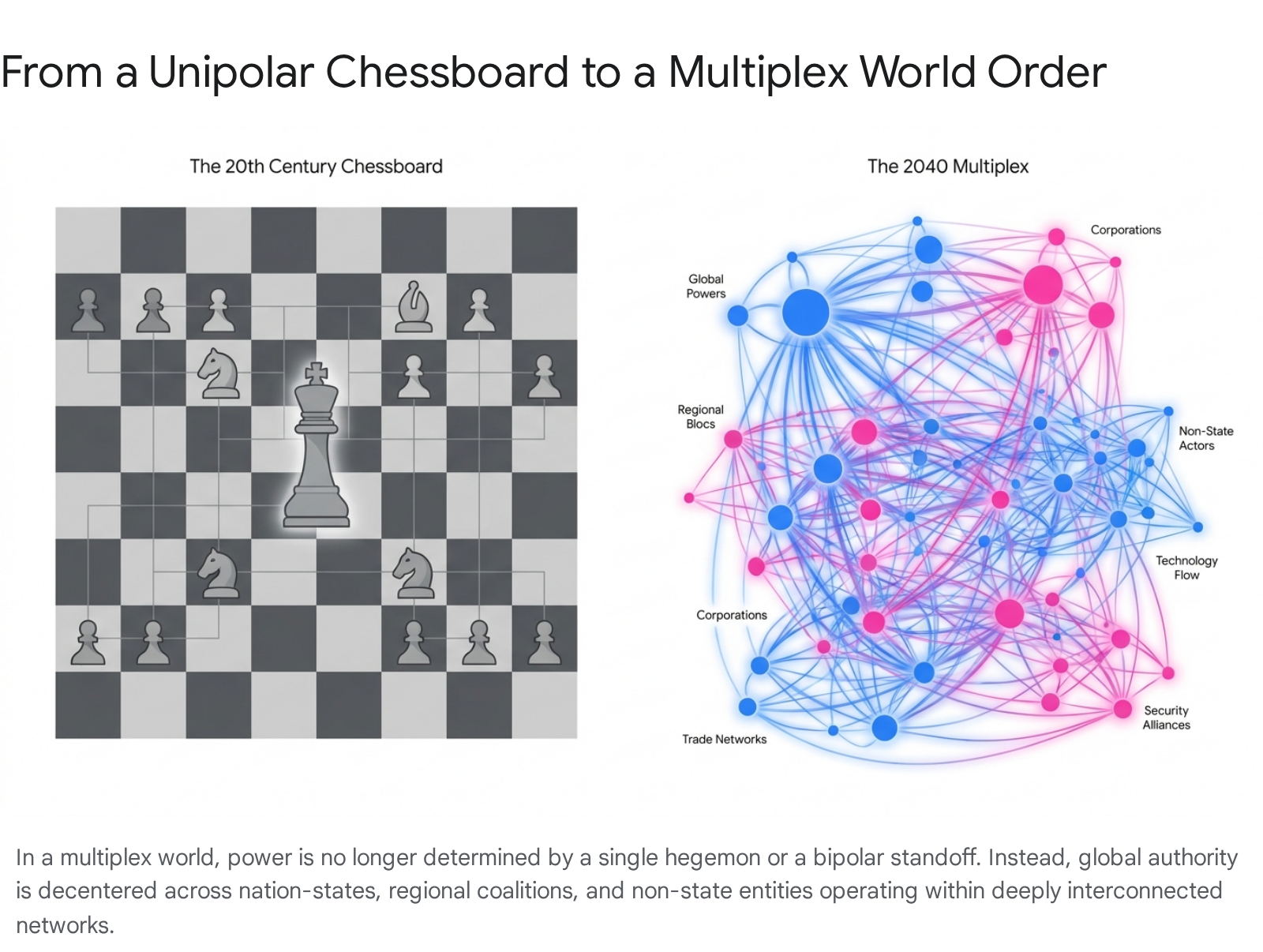
Coined by international relations scholar Amitav Acharya, a multiplex world order features multiple layers of authority 48. It is defined not just by the maneuvering of great powers, but by the proliferation of consequential actors, including regional bodies, corporations, social movements, and technology giants 3.
In this environment, complex interdependence prevents neat geographic divisions 2. Economic, environmental, and digital linkages force actors into messy, overlapping, and crosscutting globalisms 25. This is not a world defined by the hegemony of a single nation or a single idea. While elements of the old liberal order will survive, they will be forced to accommodate new actors and approaches that do not automatically yield to Western preferences 5. The resulting G-Plus world will require a fluid, dynamic governance architecture where cultural, ideological, and political diversity provides alternative pathways to stability 3.
5 Scenarios for the World in 2040
To systematically forecast the geopolitical landscape of 2040, the United States National Intelligence Council (NIC) published a comprehensive foresight report outlining five distinct scenarios 6. These scenarios serve as analytical frameworks built around three core uncertainties: the severity of looming global challenges (such as climate change and economic fragmentation), how state and non-state actors choose to engage with the world, and what governments ultimately prioritize 7. The scenarios reveal a spectrum of futures ranging from technological optimism to catastrophic systemic breakdown.
The first three scenarios assume that international challenges grow incrementally more severe and are largely defined by the trajectory of the rivalry between the United States and China 7. The final two scenarios assume radical, discontinuous shocks to the global system that force a complete reorganization of human priorities, rendering traditional great-power rivalries secondary or obsolete 7.
Scenario 1: Renaissance of Democracies
In this scenario, the world experiences a resurgence of open, democratic societies led by the United States and its allies 78. This future is predicated on rapid technological advancements - driven by robust public-private partnerships in democratic nations - that successfully transform the global economy 8. Rising incomes, improved quality of life, and technological supremacy enable these nations to effectively tackle global challenges 8. The economic and innovative tide lifts public trust in democratic institutions, easing the societal divisions and polarization that plagued the early 2020s 8. In this world, authoritarian regimes, unable to match the innovation and economic dynamism of the democratic bloc, see their global influence wane as populations demand greater representation and economic freedom.
Scenario 2: A World Adrift
"A World Adrift" describes a directionless, chaotic, and volatile international system where the rules of behavior are increasingly ignored by major powers 9. OECD countries find themselves paralyzed by sluggish economic growth, domestic political turbulence, and widening societal divisions - drawing comparisons to Japan's "lost decade" 914. China capitalizes on the West's troubles to become the leading global state, establishing unassailable dominance in Asia and coercing neighboring nations into compliance 9. However, Beijing lacks the will, the multilateral trust, and the military reach to take on full global leadership 89. Consequently, the world suffers a severe leadership vacuum. Existential challenges like climate change and global health crises are met with a patchwork of mismatched, inadequate responses, leaving developing nations vulnerable to state failure and driving massive waves of global migration 9.
Scenario 3: Competitive Coexistence
Under a scenario of competitive coexistence, the United States and China both prosper and compete for leadership within a bifurcated, yet highly interdependent, global system 67. The two superpowers prioritize economic growth and manage to restore a robust, if heavily guarded, trading relationship 6. However, this economic interdependence exists alongside fierce strategic competition over political influence, governance models, and technological dominance 6. The risk of a major kinetic war remains remarkably low, as both powers recognize the catastrophic economic costs of open conflict. Advanced economies manage short-term global problems through cooperative technological innovation, though long-term threats like environmental degradation continue to present severe underlying risks 6.
Scenario 4: Separate Silos
Driven by escalating threats and a total breakdown of globalization, the world fragments into heavily fortified economic and security blocs 614. These blocs are centered around the United States, China, the European Union, Russia, and a few rising regional powers 614. The defining characteristic of this scenario is an obsession with self-sufficiency, resilience, and defense 6. International trade is severely disrupted as nations onshore critical industries, sever supply chains, and enforce strict border controls to guard against health, economic, and terrorist threats 14. The digital world fractures into cyber-sovereign enclaves, restricting the free flow of information 6. Developing nations are forced to choose sides, offering up scarce resources in exchange for the protection of a major bloc, while low-level conflicts simmer endlessly along the fault lines of these fortified silos 14.
Scenario 5: Tragedy and Mobilization
This final scenario imagines a world where geopolitical rivalries are rendered obsolete by devastating, cascading environmental catastrophes 7. Extreme climate change causes a global food crisis of such magnitude that it triggers a bottom-up, revolutionary shift in human consciousness and governance 714. Recognizing that current state structures are entirely unmatched to the severity of the threat, populations force a radical realignment of priorities. Rich and poor countries alike are compelled to cooperate, mobilizing resources on a planetary scale to manage the crisis 714. In this future, the U.S.-China rivalry fades into the background as survival and ecological restoration become the sole organizing principles of the global order 7.
Comparing the 5 Global Scenarios
| Scenario | Core Geopolitical Dynamic | U.S.-China Relationship | Status of Globalization & Trade | Response to Global Challenges |
|---|---|---|---|---|
| Renaissance of Democracies | U.S. and allies regain global leadership via technological and economic dominance. | U.S. regains definitive edge; authoritarian models lose appeal. | High integration among democracies; robust economic growth. | Proactive and effective, driven by advanced technology and renewed trust. |
| A World Adrift | Directionless system; OECD stagnates while regional powers assert dominance. | China leads regionally but avoids global burdens; U.S. is internally focused. | Stagnant; rules-based order is ignored, leading to economic malaise. | Uncoordinated and inadequate; crises fester and state failures increase. |
| Competitive Coexistence | Bifurcated global order with two distinct spheres of influence. | High strategic competition alongside managed, robust economic interdependence. | Restructured but functional; technological races define trade. | Manageable in the near-term via innovation, but long-term risks remain. |
| Separate Silos | Breakdown of globalization; emergence of protectionist economic/security blocs. | Rivalry is superseded by mutual isolation and inward-looking defense. | Severely disrupted; supply chains severed in favor of self-sufficiency. | Fragmented; international cooperation fails, leading to risky, localized adaptations. |
| Tragedy and Mobilization | Radical, bottom-up revolution forced by catastrophic planetary crises. | Rivalry becomes irrelevant in the face of shared existential threats. | Reoriented entirely toward resource management and survival. | Unprecedented, forced global cooperation to mitigate civilizational collapse. |
How Will Geopolitical Power Shift?
The assumption that the future will exclusively revolve around decisions made in Washington and Beijing fundamentally misunderstands the demographics and economics of the mid-twenty-first century. By 2040, the center of global economic gravity will have shifted irreversibly from the industrialized North to the emerging South 4.
It is projected that more than half of global GDP will be generated by countries currently classified as "emerging markets," with Asia alone accounting for over 40% of the total 4. This economic realignment grants immense leverage to a group of influential middle powers - often referred to as the "E7" (China, India, Brazil, Indonesia, Turkey, Mexico, and Saudi Arabia) - who are actively reshaping the diplomatic landscape 15.
Case Studies in Strategic Autonomy
Rather than aligning strictly with the United States or China, these middle powers are pursuing strategies of deep non-alignment and strategic autonomy 1. They view the emerging order not as a binary choice, but as an opportunity to practice transactional, multi-vector diplomacy to secure national interests.
Indonesia provides a prime example of this strategy. The nation leans heavily on its founding philosophy of bebas aktif (free and active) foreign policy, colloquially described by its first vice president, Mohammad Hatta, as "rowing between two reefs" 16. By refusing to take sides, Indonesia maintains robust defense ties with the West while simultaneously expanding trade and infrastructure partnerships with China, and even upgrading relations with Russia to a strategic partnership 16. As the largest archipelagic country in the world, Indonesia controls vital sea lines of communication that connect East Asia with the Middle East and Europe 17. Recognizing this leverage, Jakarta is utilizing its massive demographic dividend to pursue its "Golden Indonesia 2045" vision, positioning itself as a central balancing power capable of bridging major powers' interests 17.
Africa is similarly transitioning from a passive observer of global events to an influential actor capable of collective bargaining 10. The continent is leveraging its growing demographic weight and critical mineral reserves to demand a seat at the table in global governance 1112. The precursors to this shift are already visible: the African Union recently gained a permanent seat at the G20, and coordinated diplomatic blocs (such as the "A3" in the UN Security Council) are increasingly assertive 11.
Regionalism: Will Blocs Replace the UN?
In a fractured multiplex world, regional blocs may supersede global institutions like the United Nations in terms of daily relevance and legitimacy. As global supply chains falter and international consensus becomes impossible to achieve, regional bodies are stepping in to govern their own backyards 1314.
The African Union demonstrated this during the COVID-19 pandemic by establishing the African Medical Supplies Platform (AMSP) 13. Frustrated by a global health governance failure where wealthy nations hoarded critical supplies, the AU created a mechanism to pool purchasing power and negotiate directly with global corporations, proving that regionalization can successfully bypass Western-dominated institutions 13. Additionally, regional economic integration initiatives like the African Continental Free Trade Area (AfCFTA) are projected to boost intra-African trade by over 45% by 2045, drastically reducing the continent's vulnerability to external economic shocks 4.
In Europe, the European Union is undergoing its own form of defensive regionalism through the application of economic statecraft 15. Shifting away from pure neoliberal openness, the EU is implementing policies like the Carbon Border Adjustment Mechanism (CBAM) and advanced technology "de-risking" strategies 1524. This signals an era where regional blocs use regulatory power to protect their internal markets while projecting normative influence abroad, further decentralizing global authority.
Will the US Dollar Lose Its Dominance?
A defining question of the 2040 global order is the trajectory of the United States dollar. The dollar currently serves as the backbone of global finance, accounting for approximately 56 to 57 percent of disclosed global foreign exchange reserves and playing a role in an overwhelming 88 to 89 percent of all foreign exchange market trades 1626. However, the increasing weaponization of the dollar through sanctions has triggered a concerted push for "de-dollarization" among nations wary of American financial leverage 1617.
The BRICS Expansion and Alternative Financial Architecture
The BRICS alliance - which expanded significantly in 2024 to include Egypt, Ethiopia, Iran, and the United Arab Emirates - now represents roughly 45 percent of the world's population and 35 percent of global GDP based on purchasing power parity 18. This coalition is actively developing parallel financial architectures to circumvent the Western-dominated SWIFT network, which handles the vast majority of international bank transfers 1819.
Initiatives include the "BRICS Pay" decentralized blockchain system and proposals for a new "Unit" currency 1830. To hedge against fiat currency volatility and dollar dependence, the proposed BRICS Unit is theoretically structured to be backed 40 percent by physical gold and 60 percent by a basket of BRICS national currencies 30. Global central banks are already accumulating gold at historic levels to diversify their reserves 17. Furthermore, bilateral trade is increasingly being settled in local currencies, such as India and Bangladesh purchasing Russian resources and infrastructure in rupees or yuan 20.
The Persistence of Dollar Supremacy
Despite these aggressive moves, a total collapse of dollar dominance by 2040 remains highly unlikely. The consensus among macroeconomic analysts is that the transition will be evolutionary, resulting in a more diverse, multipolar currency landscape rather than an abrupt dethroning of the greenback 1732.
The primary barrier to rapid de-dollarization is the lack of a viable, friction-free alternative with equivalent network effects 26. For a currency to act as a true global reserve, users must have absolute confidence that they can move their capital in and out of the system without political interference - a standard the U.S. financial markets, despite their vulnerabilities, still meet better than any competitor 1626.
Comparing the Global Currency Landscape
| Currency System | Current Strengths | Structural Weaknesses for 2040 Adoption |
|---|---|---|
| United States Dollar | Unrivaled liquidity, deep capital markets, legal transparency, institutional trust. | Weaponized via sanctions; threatened by rising U.S. debt and domestic political polarization. |
| The Euro | Second most utilized currency; backed by stable European democracies. | Lacks a unified fiscal treasury; crisis response authority remains politically fragmented. |
| Chinese Renminbi (Yuan) | Backed by massive manufacturing base and growing intra-Asian trade settlements. | Strict capital controls prevent free convertibility; severe transparency and legal protection concerns. |
| BRICS Unit (Proposed) | 40% gold backing offers inflation hedge; circumvents Western sanctions (SWIFT). | Unites highly disparate economies with conflicting goals; requires immense technical and political alignment. |
What Are the Emerging Megathreats?
The global order of 2040 will not be shaped solely by the decisions of diplomats and central bankers; it will be fundamentally rewired by rapid technological advancement and planetary ecological shifts.
AI Nationalism and the Fourth Industrial Revolution
Just as the First, Second, and Third Industrial Revolutions dictated the rise and fall of great powers, the AI-driven Fourth Industrial Revolution will trigger systemic alterations to the global power hierarchy 2122. As artificial intelligence becomes the primary engine of economic productivity and military capability, nations are adopting policies of "AI nationalism" 23. Viewing AI as a matter of absolute sovereign security, governments are increasingly hoarding the key components of the AI supply chain: massive datasets, highly specialized human capital, and advanced computing hardware 23.
This zero-sum approach restricts the free flow of technology across borders, threatening to divide the world into AI "haves" and "have-nots" 23. The geopolitical implications are deeply paradoxical. On one hand, AI centralizes immense power within authoritarian states (enabling unprecedented surveillance architectures) and a handful of Western Big Tech monopolies 36. On the other hand, AI drastically decentralizes power by placing highly capable, generative, and autonomous tools into the hands of non-state actors, insurgencies, and private citizens, severely eroding the traditional monopoly on force and truth previously held by the nation-state 36.
According to "Adoption Capacity Theory," the victor in the 2040 geopolitical landscape will not necessarily be the nation that invents the best algorithms, but rather the nation whose domestic institutions are most capable of adapting to and integrating these massive socio-technical disruptions without suffering internal collapse 21.
Climate Change as a Geopolitical Threat Multiplier
Simultaneously, climate change will act as a relentless threat multiplier, exposing the fragility of global interdependence 24. The physical impacts of climate change - extreme weather events, prolonged droughts, and rising sea levels - will directly threaten global food security and critical maritime choke points 24.
In regions highly vulnerable to ecological shifts, such as Southeast Asia, transitioning to renewable energy requires immense cross-border infrastructure. The Association of Southeast Asian Nations (ASEAN) is pushing forward with multilateral power grids, such as the Lao PDR-Thailand-Malaysia-Singapore Power Integration Project (LTMS-PIP), to share renewable resources 14. If the international community fails to coordinate such technology transfers and climate finance, developing nations will be forced to apply mismatched, desperate solutions, leading to localized conflicts over arable land and water, and triggering massive waves of climate-induced migration 925.
How Will Multipolarity Affect Everyday Life?
While geopolitical strategy can feel abstract, the fragmentation of the global order will have profound, tangible impacts on the everyday lives of citizens, workers, and consumers by 2040.
Supply Chains, Demographics, and Structurally Higher Inflation
For decades, consumers in the West enjoyed low prices fueled by hyper-globalization and frictionless, just-in-time supply chains extending into Asia. In a multipolar, contested world, those efficiencies vanish. The COVID-19 pandemic offered a preview of this reality: research analyzing the New York Fed's Global Supply Chain Pressure Index (GSCPI) indicates that global supply chain bottlenecks and localized labor shortages contributed significantly more to the surge in global inflation than domestic demand alone 2627.
As nations embrace the logic of the "Separate Silos" scenario - onshoring manufacturing, hoarding critical minerals, and erecting tariff walls for economic security - production costs will inevitably rise 1441. Businesses will prioritize resilience and redundancy over maximum efficiency, resulting in structurally higher inflation and more expensive consumer goods as a permanent feature of the 2040 economy 4142. This inflation will be compounded by demographic shifts, as aging populations in advanced economies shrink the labor pool, further driving up wages and costs 43.
Digital Balkanization and Data Privacy
By 2040, the "Internet of Things" will encompass trillions of hyper-connected devices, monitoring daily life in real-time 68. However, in a politically fragmented world, the digital realm will mirror physical borders. Different regional blocs will enforce vastly different data privacy and surveillance regimes 25. Citizens traveling or doing business internationally will have to navigate competing "splinternets," where the applications, financial services, and communication tools standard in one hemisphere are banned or heavily restricted in another.
The "Gated Communities" Paradigm vs. The "Neighborhood Watch"
To understand the psychological impact of this era, cultural critics offer the analogy of "gated communities" . In domestic life, the proliferation of gated neighborhoods is often driven less by a statistical increase in actual danger, and more by an omnipresent fear of a perceived threat, leading to an obsession with security that isolates communities from one another .
In 2040, nations will increasingly behave like these gated communities. Driven by the fear of supply chain contagion, foreign disinformation, and migration, states will build higher legislative, economic, and physical walls 14. Conversely, addressing global challenges requires a system akin to a "global neighborhood watch" - a form of collective security where nations pledge to collaboratively monitor and address systemic risks (like pandemics or climate change) regardless of where they originate 45. However, a neighborhood watch requires immense mutual trust 45. In a deeply polarized, multipolar world suffering from a severe deficit of institutional credibility, achieving that trust will be the defining challenge of the era.
Bottom line
By 2040, the global order will transition from a U.S.-led hegemony into a complex, "multiplex" system characterized by shifting alliances, empowered middle powers, and an increasingly fragmented economic landscape. While the United States and China will remain the dominant poles of influence, they will be forced to navigate a world where regional blocs - from the BRICS financial ecosystem to African trade unions - assert fierce strategic autonomy. Ultimately, the defining feature of this era will be the tension between the urgent need for global cooperation on existential threats like climate change and AI, and the overwhelming political momentum toward nationalistic, siloed protectionism.