
5 Scenarios Shaping the Future of Cities
The global urban landscape is fracturing into distinct models, driven simultaneously by remote work dispersing Western populations into sprawling exurbs, and explosive demographic growth creating massive new megacities across the Global South. To survive the infrastructure and climate crises of this century, municipal leaders are experimenting with vastly different strategies - from retrofitting legacy grids into compact "15-minute cities" to building heavily surveilled, trillion-dollar tech utopias from scratch.
Scenario 1: The Exurban Exodus and the "Donut Effect"
For over a century, the dominant economic gravity of the industrialized world pulled people and capital toward the dense centers of superstar cities. However, the rise of digital technology and remote work has abruptly unbundled where people live from where they earn their livelihoods 1. The result is a profound spatial reorganization of metropolitan life that threatens the traditional urban core while pushing the boundaries of suburban sprawl further outward.
The Hollowing Out of the Urban Core
The normalization of remote and hybrid work has fundamentally altered the geography of economic activity. Researchers analyzing multiple high-frequency datasets at Stanford and MIT have coined this phenomenon the "Donut Effect" - a persistent hollowing out of central business districts as economic activity disperses to the suburban ring 23.
The commercial real estate impacts of this shift have been staggering and persistent. By late 2023, Moody's Analytics found that 19.6% of office space in major U.S. markets was entirely vacant 1. Kastle Systems' tracking of office key card swipes revealed that peak occupancy in top cities has stagnated at roughly 50% of pre-pandemic levels 1. This permanent drop in daily commuters has exerted massive downward pressure on real estate values, with estimates suggesting a $600 billion loss in office and neighboring retail real estate value 1.
Simultaneously, the loss of daily commuters has devastated public transportation revenues, forcing municipal governments to rethink transit services and infrastructure projects entirely 4. While some analysts argue this presents an opportunity to convert vacant offices into residential units and revitalize downtowns to be "welcoming, legible, and needed by a broad diversity of people," the immediate reality is one of severe municipal financial strain 14.
The Housing Squeeze and the Flight to Space
The exodus from city centers has not primarily fueled a rural renaissance, but rather a massive expansion of the suburbs and exurbs. Analyzing household microdata, researchers found that 58% of households that left the centers of big cities simply moved further out within the same broader metropolitan area, moving to suburbs of the exact same city 23. This localized dispersion is largely explained by the enduring popularity of hybrid work; employees who only commute a few days a week are willing to tolerate much longer commute distances in exchange for more residential space 23.
This outward migration is also a visceral reaction to a historic housing affordability crisis. According to the Joint Center for Housing Studies at Harvard University, the median existing single-family home price in the U.S. hit a record $412,000 in 2024 - five times the median household income 5. In 2023, a record 50% of renters spent more than half their income on rent 5. Urban containment policies, greenbelts, and strict zoning - while intended to promote density and environmental sustainability - have severely limited land supply, inflating prices and forcing middle-income households to "vote with their feet" by moving to more affordable fringes 6.
| Affordability Category | Example City | Median Price-to-Income Ratio | Housing Market Assessment |
|---|---|---|---|
| Most Affordable | Pittsburgh, USA | 3.2x | Moderately Unaffordable |
| Severely Unaffordable | London, UK | 9.1x | Impossibly Unaffordable |
| Severely Unaffordable | San Francisco, USA | 10.0x | Impossibly Unaffordable |
| Severely Unaffordable | Sydney, Australia | 13.8x | Impossibly Unaffordable |
| Least Affordable | Hong Kong | 14.4x | Impossibly Unaffordable |
Data sourced from the Demographia International Housing Affordability 2025 Edition, covering the third quarter of 2024. The ratio demonstrates the extreme financial pressure pushing residents away from dense urban centers 6.
The Rise of the "One-Minute City"
Consequently, housing inventory in exurbs has grown by an average of 15% over the past decade, outpacing both suburbs (14%) and principal cities (10%) 7. Population growth in these exurbs has also surpassed other areas, growing at 16% 7.
Prominent urbanists have described this demographic shift as a preference for the "one-minute city" over the traditional dense urban core 8. Rather than living in a neighborhood where all amenities - groceries, parks, restaurants, and schools - are within a 15-minute walk, buyers in exurban master-planned communities are loading up on amenities at home 8. They are opting for significantly larger square footage, home gyms, home theaters, dual offices, and large backyards with pools 8.
However, this rapid exurban boom is already recreating the problems of the city it sought to escape. Traffic, infrastructure deficits, and rising median home prices are following residents into the sprawl 8. For instance, Celina, Texas, a booming exurb north of Dallas, saw massive population influxes but now features a median home sales price of roughly $488,000 - more than five times the Dallas-Fort Worth metro area median income 8. Furthermore, despite the rise of remote work, American Community Survey data from late 2024 shows that the automobile's share of commuting (including driving alone and carpooling) actually grew by 0.4 percentage points as work-from-home rates dipped slightly to 13.3%, indicating that sprawl continues to lock residents into car dependency 9.
Scenario 2: The Unstoppable African Megacity
While Western cities hollow out and grapple with remote work, the demographic center of the global urban future has moved decisively south. The African continent is urbanizing faster than any other region on Earth, transitioning from roughly 400 million urban residents in 2010 to an estimated 1.3 billion by 2050 .
A Demographic and Economic Revolution
The World Bank identifies this rapid urbanization as the single most important transformation the African continent will undergo this century 11. Roughly 40,000 people migrate into African urban areas every single day, a cumulative movement that will concentrate populations at a scale few planning systems are prepared to absorb 11. By the end of the century, Africa is projected to host 13 of the world's 20 largest cities, fundamentally rewriting where global innovation, risk, and cultural production sit 11.
This is not merely a story of population density, but an economic revolution in motion. Cities in Africa already account for over 50% of the continent's GDP . The Abidjan-to-Lagos corridor - a 1,000-kilometer stretch along West Africa's coast - currently hosts over 40 million people and is on track to rival global urban powerhouses like India's Mumbai-Pune belt or China's Pearl River Delta in economic clout and dynamism within two decades 12. Furthermore, Africa's urban population is strikingly young, with half the continent under the age of 19 12.
The sheer scale of projected population growth in these regional powerhouses requires a total reimagining of infrastructure.
| African Megacity | Current Population (Approx.) | Projected Population by 2050 | Projected Century-End Status |
|---|---|---|---|
| Dar es Salaam, Tanzania | 7.5 million | 16.4 million (+118%) | Quiet Giant emerging globally |
| Nairobi, Kenya | 5.2 million | 10.4 million (+100%) | East African Tech Hub |
| Cairo, Egypt | 22+ million | 32.6 million | Historic anchor, stabilizing |
| Lagos, Nigeria | 20+ million | 28.2 million | Anchor of West African corridor |
| Kinshasa, DR Congo | 12+ million | 29.0 million | Projected world's largest by 2100 |
Data synthesizing demographic forecasts from the Institute for Economics & Peace and UN models, reflecting mid-century targets 1112514.
The Lived Reality: Costs, Commutes, and Informality
The immense economic potential of these growing workforces is threatened by profound infrastructure deficits. Currently, roughly 36% of the global urban population lives in slums or informal settlements due to a lack of coordinated economic development 6. The UN-Habitat 2024 Annual Report notes that 2.8 billion people globally lack access to adequate housing, and an estimated 96,000 new housing units must be built every day to meet adequate housing needs by 2030 78. The world is effectively producing new slum dwellers faster than it can address existing slums 9.
In megacities like Lagos, Nigeria - which grew from a modest coastal city of 1.5 million in the 1970s to a sprawling metropolis of over 20 million today - the cost of living presents a daily strain on residents 1219. Housing is the single largest expense; a mid-range 2-to-3-bedroom flat on the Lagos Mainland costs between ₦2.5 million and ₦6 million per year, while luxury apartments on the Island (like Ikoyi or Victoria Island) run from ₦8 million to ₦15 million annually 19. Because landlords in Lagos typically require one to two years of rent paid upfront, affordability is a massive barrier, consuming 40% to 60% of a family's income 19.
Transportation compounds this financial pressure. Due to severe congestion and sprawling distances, Lagos commuters face an average one-way commute time of 1.26 hours 10. Research analyzing the private cost of commuting in Metropolitan Lagos found that for many residents, the financial value of their commuting time actually exceeds their hourly wage rate, implying that workers are effectively losing money just to travel to their jobs 10. With petrol prices fluctuating heavily due to subsidy removals, car owners can spend over ₦100,000 monthly just on fuel 1921.
Innovation Amidst Infrastructure Deficits
Yet, these cities are also powerful engines of grassroots innovation and resilience. Where formal infrastructure fails, informal transport options - such as shared minibus taxis (Danfo) and motorcycle taxis (Okada) - have evolved to provide affordable and flexible mobility solutions for residents in underserved areas 919.
Urban planners and global organizations are increasingly recognizing that these informal networks cannot simply be erased; they must be integrated into municipal strategies 9. The UN-Habitat 2024 report highlighted that community-led service provision models empower residents to shape their own infrastructure 9. Planners are also retrofitting "blue-green infrastructure" - networks of natural and nature-based elements - into established informal settlements to protect the most vulnerable from climate shocks like extreme heat and flooding 9. If managed correctly, African megacities could drive digital leapfrogging, green transitions, and homegrown entrepreneurship on an unprecedented global scale 12.
Scenario 3: The 15-Minute City and the Compact Revolution
As an antidote to both endless suburban sprawl in the West and gridlocked, unmanageable megacities in the developing world, progressive urban planners have rallied around the concept of the "15-minute city." First conceptualized by academic Carlos Moreno in 2016 and endorsed heavily by UN-Habitat, this model envisions decentralized, polycentric neighborhoods where residents can access all essential daily needs - work, education, healthcare, shopping, and leisure - within a 15-minute walk or bike ride from their homes 221112.
Successes and Transformations in Paris
The 15-minute city framework has found its most high-profile success in Paris under the leadership of Mayor Anne Hidalgo, who made the concept a central pillar of her re-election campaign and municipal strategy 22122526. Capitalizing on the momentum of the 2024 Olympic and Paralympic Games, Paris aggressively transformed its urban landscape 27.
The city dramatically reduced the number of vehicles allowed in the city center, converted numerous multi-lane roads into one-way traffic, and reclaimed vast amounts of street space for pedestrians and cyclists 1329. Recognizing that active transport is unappealing in extreme weather or polluted air, Paris accompanied its cycling infrastructure with an ambitious plan to plant 200,000 trees to clean the air and mitigate the urban heat island effect 2713.
The health and environmental benefits of eliminating car dependency are well-documented. Studies have shown that restricting private car use reduces atmospheric emissions, lowers noise pollution, and significantly decreases traffic fatalities 2613. Health data from cities that severely restrict car commuting (such as Beijing's license plate lottery) show that individuals forced to walk, cycle, or take transit maintain significantly healthier body weights compared to daily drivers 26. By bringing daily activities out of small apartments and into safe, welcoming streets, Paris is attempting to restructure the very nature of urban consumption 13.
The Affordability and Gentrification Dilemma
Economically, compact city models show incredible promise. Research indicates that mixed-use, walkable neighborhoods can increase local property values by 1.1% to 3.4% as land use diversity improves 14. By reducing the need for private vehicles, residents save significantly on transportation costs (insurance, fuel, parking, and maintenance), freeing up disposable income 3115. Furthermore, local spending bolsters small businesses and creates localized employment 15.
However, this success is heavily caveated by the threat of displacement. In major Western cities, the high demand for highly walkable, 15-minute neighborhoods has led to severe speculative pricing and gentrification 14. A 2021 study ranking the 15-minute city potential of U.S. municipalities found that top-ranking cities like Miami and San Francisco suffered from dismal housing affordability 33. Overall, six of the top ten 15-minute ready cities in the U.S. had severe affordability crises 33.
Critics argue that without aggressive, targeted affordable housing policies, rent controls, and mixed-income developments, 15-minute cities risk becoming exclusionary luxury enclaves where only the wealthy can afford the "premium" of walkability, pushing low-income workers further into unwalkable sprawl 333435. Researchers point out that while a high-crime, walkable neighborhood is generally better for economic mobility than a high-crime, unwalkable suburb, the persistent spatial inequality within cities requires planners to view the 15-minute city as an engine for social inclusion, not just a real estate amenity 2535.
Japan's Strategy for Shrinking Cities
While Western planners use compact city models to manage emissions and lifestyle quality, Japan is utilizing the exact same urban principles to manage demographic collapse. Japan is undergoing a severe population decline; a staggering 28.9% of its populace is 65 or older, and 74.6% of its 1,747 municipalities are officially categorized as "shrinking" 1637.
To adapt to a smaller future population, Japan has aggressively pursued national "Compact City" and regional revitalization programs 16. By encouraging residents to relocate from the sprawling periphery into designated central zones near public transit hubs (like Light Rail Transit lines), municipalities aim to reduce the unsustainable cost of maintaining sprawling roads, water pipes, and power lines for a dwindling tax base 3839.
In places like Toyama City, empirical studies from 2001 to 2025 demonstrate that these policies successfully increased official land prices in residence-encouraged zones 39. This appreciation expanded the local property and city planning tax bases, ensuring the fiscal sustainability of the local government - a mechanism conceptualized as "urban management" 39. However, the success of these policies is highly dependent on the city's baseline size. Machine learning models (using XGBoost on 270 socio-economic indicators) reveal that while medium-sized cities can manipulate economic and natural population indicators through childcare and planning initiatives, smaller rural municipalities struggle to attract residents back to the center regardless of the economic incentives provided, forcing them to officially designate "underpopulated areas" for managed decline 37.
The Global South: Environmental Urbanism vs. Inequality
Exporting the 15-minute city framework to the Global South presents severe, often insurmountable structural challenges. A systematic review of recent literature shows that cities in developing nations suffer from inherited modernist, car-oriented planning paradigms (wide roads and single-use zoning), massive gaps in infrastructure, and widespread urban informality that make "15-minute" accessibility nearly impossible for marginalized groups 1718.
In Bogotá, Colombia, for example, while proximity to amenities appears high on paper, deep digital divides and poor local service quality force low-income residents to commute long distances for work, while wealthier residents enjoy the benefits of localized living and telework 19. Similarly, a comprehensive study operationalizing the 15-minute model across seven major Iranian cities found that while essential amenities were technically within a 15-minute reach, deep socio-cultural barriers completely hindered the model's implementation 2021. Factors such as legally imposed restrictions on women cycling, hostile pedestrian environments, and the persistent cultural non-recognition of walking as a legitimate mode of transportation meant that residents' deprivation levels correlated strongly with a failure to access everyday services 2021.
Instead of the strict European walking model, successful Global South cities lean toward what planners call "Environmental Urbanism" - adapting infrastructure to both social inequality and extreme geography. Curitiba, Brazil, pioneered this approach decades ago with its famous Bus Rapid Transit (BRT) system, adopting a radial linear-branching pattern that diverted traffic from the city center and protected green spaces 22. This integration of land use and transit resulted in fuel usage 3% lower than other major Brazilian cities, drastically lower congestion costs, and a remarkable 70% active recycling rate 2223.
Medellín, Colombia, has similarly adopted a 2024 - 2027 urban plan centered on nature-based solutions 24. Based on the recognition of environmental pre-existences like mountains, streams, and hills, the city is creating 30 million square meters of new public space 24. By building Social and Environmental Care Centers (CASA Deporte) and integrating pedestrian routes within the steep urban fabric, Medellín is using environmental urbanism as a direct tool to tackle historic inequality, improve air quality, and foster community cohesion 24.
Scenario 4: Purpose-Built Smart Cities and Capital Relocations
Rather than attempting the painful, politically fraught process of retrofitting legacy cities with bike lanes, transit lines, and affordable housing, some nations are attempting to leapfrog legacy infrastructure entirely. They are building heavily surveilled, AI-driven "smart cities" from the ground up.
Technology-Driven Urbanism in Southeast Asia
Southeast Asia has become the premier testing ground for technologically driven urban management. The ASEAN Smart Cities Network (ASCN) is currently overseeing 108 distinct smart city projects across the region, focusing heavily on civic safety, traffic optimization, and resource management 25.
These projects view urban management primarily as a data and engineering challenge. For instance, South Korea's land ministry is currently funding and testing AI-based smart city technologies across the region to validate their effectiveness for global export 26. In Brunei, an AI-based platform is being tested to improve water management and disaster response; in Vietnam, AI smart intersection controls are deployed in Can Tho to optimize traffic flow; and in Thailand, safety management solutions are monitoring aging building infrastructure 26.
Central to this movement is the use of "Digital Twins" - virtual, real-time replicas of urban systems. Cities like Singapore and Barcelona are using these digital twins to simulate scenarios, optimize waste collection routes, and manage smart grids that distribute renewable energy precisely where it is needed 3450. However, urbanists and critical scholars warn that hyper-reliance on "GovTech" and automation without addressing underlying housing, poverty, and social crises risks creating environments that are technically efficient but deeply unequal and socially sterile 5127.
Nusantara: Leaving Sinking Jakarta Behind
The most extreme manifestation of purpose-built urbanism currently underway is Indonesia's unprecedented, multibillion-dollar decision to abandon its capital, Jakarta, and build a new one: Nusantara.
Jakarta, home to over 10 million people (and closer to 30 million in the greater metropolitan area), represents the absolute limit of urban strain 54. The city is notorious for paralyzing, multi-hour traffic congestion that costs trillions of rupiah annually in lost productivity, severe air pollution that frequently fails international standards, and a critical lack of green space (currently less than 10% of the city area) 54. Worse, due to excessive groundwater extraction and climate change, Jakarta is physically sinking. Land subsidence in some areas is occurring at a catastrophic rate of 10 to 20 centimeters per year, making future submergence of the northern sectors a grim probability 5428.
To save the administrative functions of the state and ease pressure on the island of Java, Indonesia is building Nusantara from scratch in the jungles of East Kalimantan (Borneo) 2829. The city will span approximately 256,000 hectares and is designed to accommodate 1.5 million residents initially, including civil servants and their families 29. Envisioned as a green, technologically advanced utopia under the "Nagara Rimba Nusa" (forest city) vision, Nusantara will rely entirely on renewable energy, prioritize pedestrian zones, and utilize an advanced transportation system featuring electric buses and autonomous vehicles 2829.
However, the reality of relocating a national capital is fraught with logistical and financial risk. The estimated cost of Nusantara exceeds $30 billion 29. The Indonesian government is employing a mixed funding approach, covering only 20% from the state budget for initial infrastructure and government facilities, and relying on private sector investment to fund the remaining 80% for housing and commercial development 29. Whether global capital will fully fund the construction of a city carved out of Borneo's jungles - and whether abandoning Jakarta simply leaves its poorest residents to manage a sinking city alone - remains one of the most hotly debated questions in modern urban planning 2829.
Scenario 5: The Reality Check for Trillion-Dollar Megaprojects
As governments and sovereign wealth funds dream up increasingly fantastical urban futures to diversify their economies and project global power, they are colliding violently with the unyielding realities of economics, engineering, and logistics. No project exemplifies this collision better than NEOM in Saudi Arabia.
The Ambition and Struggles of NEOM's "The Line"
Conceived as the crown jewel of Saudi Crown Prince Mohammed bin Salman's Vision 2030, NEOM was billed as a transformative, $500 billion, 26,500-square-kilometer futuristic megacity on the Red Sea coast 3031. Its centerpiece, known as "The Line," was pitched to the world as a 170-kilometer-long linear city enclosed in a towering mirrored facade, entirely devoid of cars and streets 31. Promising a 100% sustainable transport system with an end-to-end transit time of just 20 minutes via high-speed rail, The Line was projected to house 1.5 million residents by 2030 and eventually scale to accommodate 9 million people 313160.
The reality of executing this unprecedented vision has proven drastically different from the renderings. Building infrastructure suited for harsh desert conditions, managing water sustainably, and overcoming severe topographical and logistical challenges pushed engineering boundaries past their breaking point 6132. By mid-2024, reports indicated that the Public Investment Fund (PIF) was officially scaling back the 2030 ambitions for The Line: instead of 1.5 million people, it is now expected to house fewer than 300,000 3160. Furthermore, only 2.4 kilometers of the intended 170-kilometer structure is expected to be completed by the end of the decade 3160.
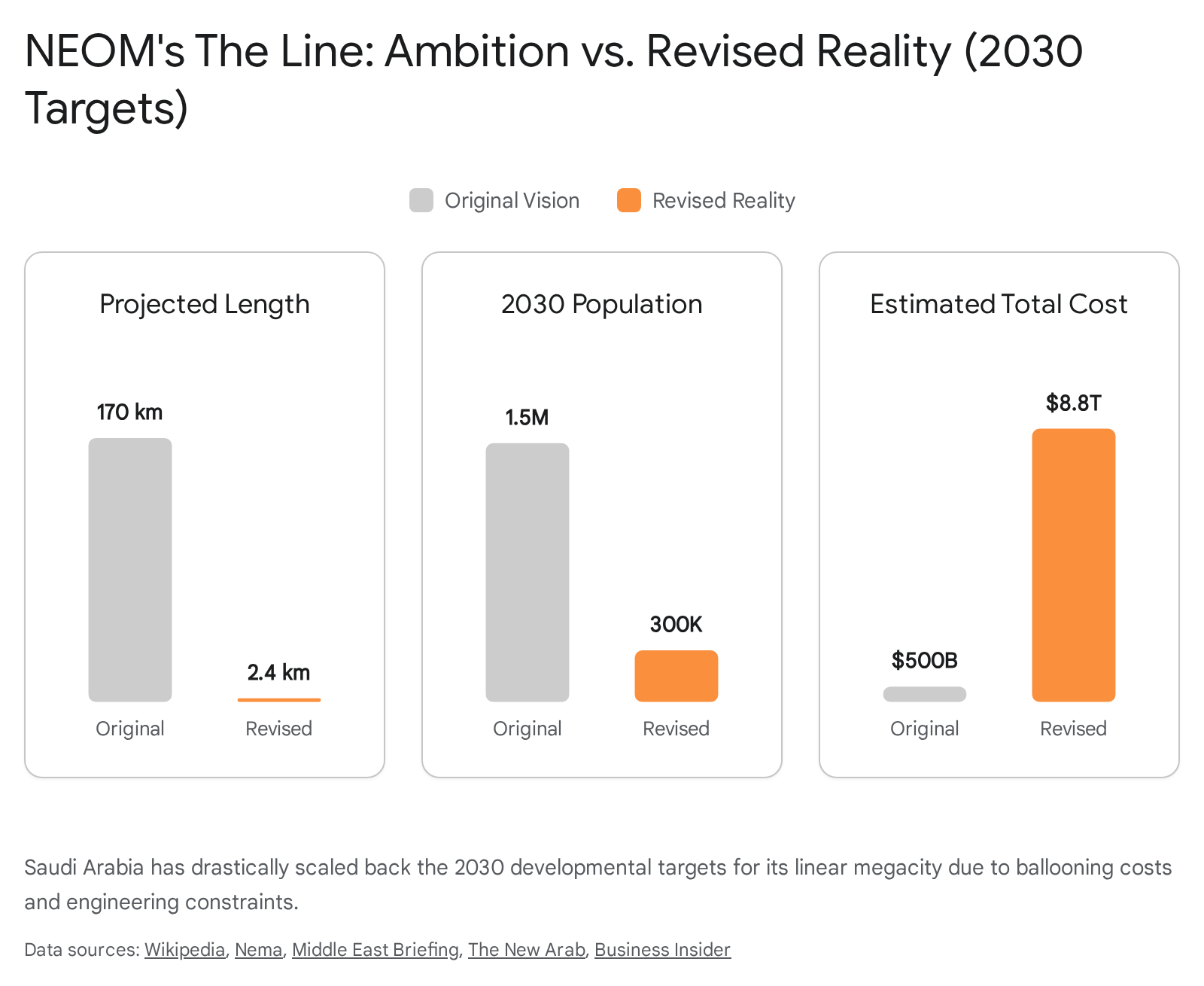
The financial toll has been catastrophic, revealing the limits of domestic financing. Internal audits and feasibility studies suggest that the true end-state cost of the project could balloon to an unfathomable $8.8 trillion - more than 25 times the entire annual Saudi budget 3033. Moody's has described the progress of Saudi Arabia's megaprojects as "uneven," and the PIF reportedly projected an $8 billion loss by the end of 2024 alone 61. By 2025, new contracts for NEOM had dried up, and the project was notably absent from Saudi Arabia's pre-budget statement for 2026 30.
Furthermore, deep internal fragilities have hampered the project. Human rights controversies, including the forced displacement of roughly 20,000 members of the local Howeitat tribe to clear the construction site, have deeply tarnished the project's global reputation and deterred international stakeholders from investing 3065. By late 2024, NEOM's long-time CEO Nadhmi al-Nasr departed amid allegations of a toxic work culture, ethical violations, and missed milestones, leaving the project at a critical crossroads 65. Some officials involved in the project now suggest that reaching the "end-state" of NEOM could take until 2080, or even up to 100 years 33. NEOM serves as a stark, expensive warning for the future of urbanism: throwing limitless capital and futuristic technology at a barren landscape cannot effortlessly override the fundamental laws of economics, geography, and human rights.
Bottom line
The future of cities is no longer a single trajectory toward ever-denser global hubs, but a highly fractured landscape of competing survival strategies. In the West, remote work has catalyzed an exodus to sprawling, amenity-heavy exurbs, forcing legacy cities to pivot toward 15-minute, hyper-local livability to retain residents and combat climate change. Meanwhile, the true crucible of 21st-century urbanism lies in the Global South, where governments must balance the unmatched economic potential of rapidly growing megacities against the severe limits of informal infrastructure, sinking coastlines, and the hubris of trillion-dollar tech utopias that fail to account for human realities.