
5 Scenarios for the Future of Food and Agriculture
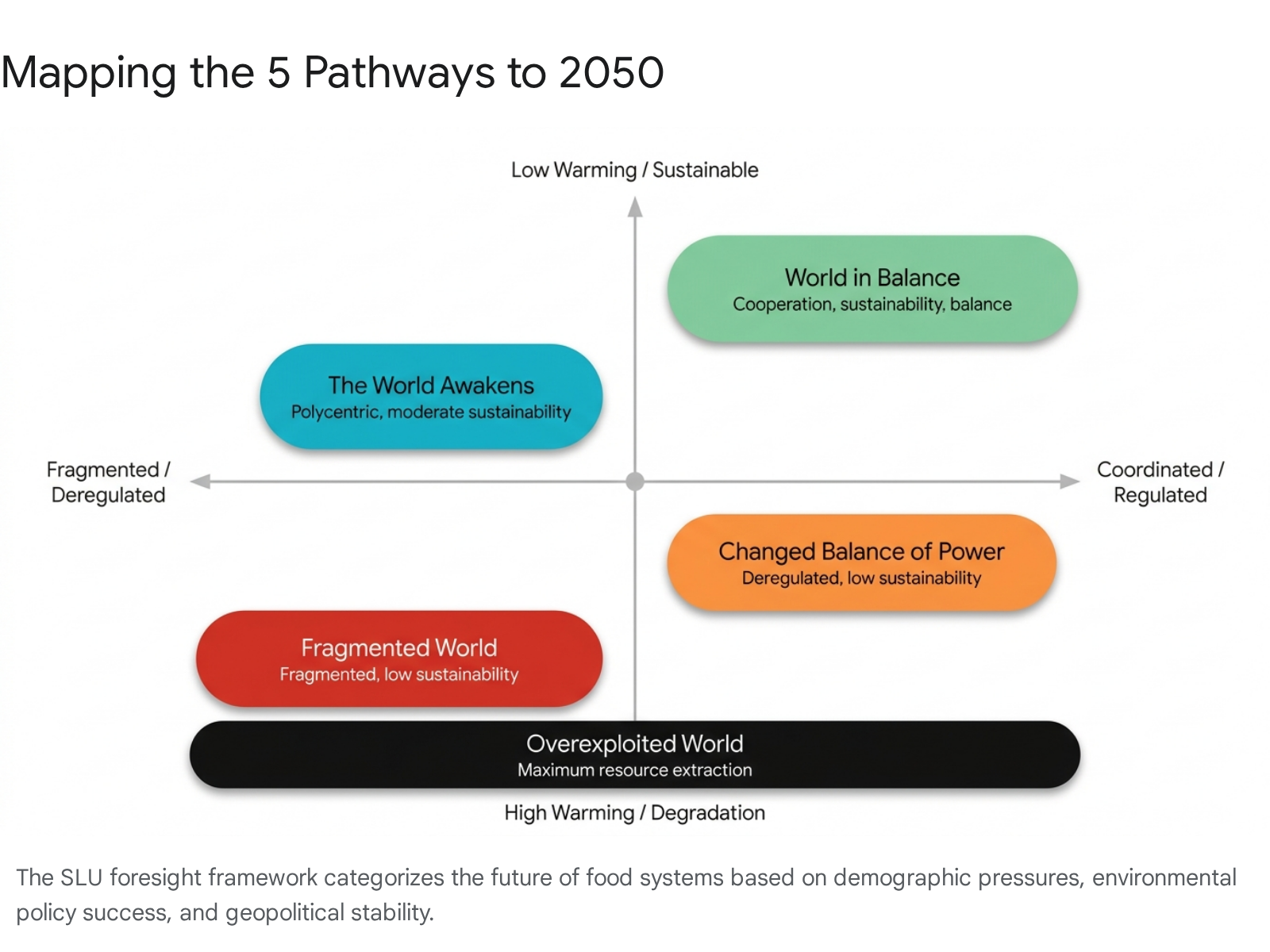
Foresight researchers model the future of global food systems using five distinct pathways for the year 2050: an overexploited world, a world in balance, a changed balance of power, an awakened world, and a fragmented world. These models demonstrate that humanity's ability to achieve sustainable food security depends entirely on near-term investments in environmental management, equitable technology distribution, and coordinated international trade.
The Global Imperative to Model Agrifood Systems
By the year 2050, the global population is projected to reach between 9.1 and 9.8 billion people, with approximately seventy percent of those individuals residing in urban environments 11. To feed this larger, wealthier, and highly urbanized demographic, global food production must increase by roughly seventy percent compared to early twenty-first-century baselines 1. However, the global agricultural sector is currently operating under unprecedented, compounding stress. As of 2024, an estimated 295.3 million people across 53 countries experienced acute levels of food insecurity, representing a staggering tripling of acute hunger since just 2016 23.
This escalating crisis is not a temporary anomaly but a structural vulnerability embedded within modern supply chains. Global agrifood systems are caught in a complex web of interconnected pressures. Extreme weather events driven by climate change are destroying harvests, arable topsoil is rapidly degrading, and escalating water scarcity is rendering traditional farming regions inhospitable 465. Furthermore, geopolitical conflicts continue to disrupt logistics, driving up the cost of vital inputs like synthetic fertilizers and diesel fuel 67. At the same time, the agricultural sector is responsible for roughly a quarter of all global greenhouse gas emissions, creating a destructive feedback loop where the act of producing food actively worsens the climate conditions required to sustain future yields 1011.
To navigate these immense challenges, major international bodies, including the Food and Agriculture Organization of the United Nations (FAO), the World Economic Forum (WEF), and leading academic institutions, rely on the discipline of strategic foresight. Foresight analysis is not an exercise in making definitive predictions about the future. Rather, it uses morphological analysis and back-casting methodologies to build plausible future scenarios by adjusting the trajectories of critical drivers, such as economic growth, population dynamics, technological progress, and climate policy 8910. By visualizing these alternative futures, policymakers, agricultural economists, and industry leaders can stress-test their strategies, identifying which global interventions are robust enough to withstand deep uncertainty and which pathways inevitably lead to systemic collapse.
The Five SLU Scenarios for 2050
One of the most comprehensive and widely utilized models for understanding the long-term trajectory of global agriculture was developed by a multidisciplinary panel led by the Swedish University of Agricultural Sciences (SLU), in collaboration with the Swedish Defence Research Agency (FOI) and other academic institutions 91112. This major research initiative utilized a highly structured morphological analysis method to map out five distinct scenarios for 2050 regarding the overarching conditions for agriculture, food security, and land use 9101314. These five scenarios are defined by how humanity ultimately chooses to manage greenhouse gas emissions, demographic shifts, technological distribution, and geopolitical cooperation.
Scenario 1: An Overexploited World
In the "Overexploited World" scenario, humanity continues along a path of aggressive resource extraction without establishing adequate environmental safeguards. Population growth radically exceeds baseline United Nations forecasts, pushing the global population to a precarious eleven billion people by the mid-century mark 915. Economic development remains highly unequal and fractured. The Western world achieves strong economic growth and high consumption, while severe, entrenched poverty persists throughout much of the Global South 9.
Because strong climate policies are never implemented at a global level, the global average temperature is projected to increase by a catastrophic four to five degrees Celsius between 1990 and 2090 910. Energy consumption remains extremely high and heavily reliant on fossil fuels. This dynamic prompts a desperate, parallel surge in the production of biofuels as nations attempt to secure domestic energy independence, creating intense, direct competition for arable land between fuel production and food production 9.
The agricultural and food security outcomes in this scenario are dire. The demand for land reaches unprecedented levels, causing agricultural production and livestock grazing to expand rapidly into previously unfarmed areas, leading to severe global deforestation 916. Consequently, soil fertility, vital water resources, and core ecosystem services decline precipitously due to absolute overexploitation 9. Global food security remains low and highly volatile. While wealthy nations can afford to import goods and secure their domestic food supplies, regions like Sub-Saharan Africa experience widespread, chronic famine. In these vulnerable regions, plant-based foods are projected to account for roughly ninety-four percent of all caloric intake, as animal protein becomes entirely economically unviable for the impoverished majority 912.
Scenario 2: A World in Balance
"A World in Balance" represents the most optimistic and sustainable pathway envisioned by foresight researchers. In this model, global population growth slows much faster than anticipated, stabilizing at roughly eight billion people by 2050 915. This demographic stabilization is paired with robust, globally coordinated, and strictly enforced political action on environmental protection. Efficient policies successfully limit the increase in average global temperatures to below two degrees Celsius 915.
Economic development remains strong but is successfully decoupled from environmental destruction. Land is utilized efficiently, allowing for vast tracts to be preserved or used for purposes beyond mere calorie production. Diversified agricultural production methods actively preserve soil health, restore biodiversity, and manage watersheds effectively 16.
The agricultural outcomes under a balanced world are highly favorable. The agricultural sector successfully transitions to sustainable practices, meaning that ecosystem services and inherent soil fertility actually improve over time. This is supported by active conservation policies and a deliberate cultural shift away from resource-intensive animal products 912. Global food security is remarkably high, as both income and food resources are distributed more fairly within and between countries. The overall pressure on global land is limited, and rural areas flourish economically alongside urban centers, effectively reducing the strain of hyper-urbanization 9.
Scenario 3: Changed Balance of Power
This scenario envisions a future where the geopolitical and economic center of gravity has decidedly shifted to the East, with nations like China and India driving massive global economic development 914. The global economy becomes highly deregulated, characterized by aggressive free trade and a relentless focus on market expansion. The rapid economic development and rising middle class in Asia successfully drive down birth rates, slowing population growth and resulting in a global population of eight billion by 2050 914.
However, this economic boom comes at an immense expense to the environment. Climate mitigation and environmental protections are entirely sidelined in the pursuit of uninterrupted GDP growth. Consequently, global temperatures are projected to increase by four to five degrees Celsius 914.
To maintain yields in this rapidly warming world, the agricultural sector relies almost entirely on intense technological interventions and artificial inputs. While these technologies initially stave off disaster and free trade keeps food moving to where it is demanded, the complete lack of environmental policies eventually catches up to the system. The natural fertility of the soil collapses, and water aquifers run dry 916. Initially, wealth generation keeps food security relatively stable, but the long-term degradation of foundational ecosystems creates creeping, systemic vulnerabilities. The availability of external agricultural inputs, such as synthetic fertilizers and chemical pesticides, eventually drops as raw materials deplete, causing their prices to spike and threatening future global stability 9.
Scenario 4: The World Awakens
In "The World Awakens," humanity narrowly avoids the worst climate outcomes through a delayed but forceful reaction. After years of sluggish responses and weak international commitments, a series of severe, undeniable environmental and humanitarian crises serve as a brutal wake-up call to the global public 19. The global community finally unites to implement efficient, sweeping climate policies and strict resource regulations. The population reaches the baseline United Nations forecast of nine billion people by 2050, and global temperature increases are successfully held between two and three degrees Celsius 9.
Geopolitically, power becomes polycentric, distributed relatively evenly among several major blocs including North America, Europe, China, India, Brazil, and Russia. Non-state actors, particularly human rights organizations and environmental advocacy groups, wield significant, institutionalized global influence 9.
Because the world awakened late, some severe environmental damage is already locked in from previous decades of inaction. However, massive, coordinated policy shifts prioritize sustainable agriculture and climate adaptation. Immense capital investments in mitigation strategies limit further agricultural collapse. Global food security remains relatively high and stable. While urbanization continues, strong investments in both digital and physical infrastructure allow rural areas to thrive as highly respected, vital hubs of sustainable food production 914.
Scenario 5: A Fragmented World
"A Fragmented World" is a scenario defined by institutional failure, extreme vulnerability, and balkanization. Population growth is exceptionally high, pushing the global headcount to eleven billion 914. Intergovernmental organizations have entirely lost their authority, and no single nation or allied bloc is strong enough to enforce global norms. International negotiations on trade, climate, and security routinely fail, leading to a highly volatile, divided global system. Without coordination, the world continues its heavy reliance on the cheapest available fossil fuels, particularly coal, driving catastrophic temperature increases of four to five degrees Celsius 914.
Without strong government oversight, multinational private companies dominate the market, aggressively prioritizing short-term shareholder profits over long-term ecological resilience 910.
In this fragmented reality, technological development stalls significantly. More importantly, the distribution of existing agricultural technologies is highly uneven and strictly guarded by intellectual property laws. Wealthy, corporate-controlled enclaves have access to advanced, climate-resilient farming tools, while the rest of the world relies on outdated, failing methods 910. Global food security is chronically low and deeply fractured along socioeconomic lines. The massive population creates immense demand for agricultural land, but severe water scarcity and collapsing soil fertility strictly limit yields. The world sees the proliferation of localized hunger hotspots and resource wars, as the comparative advantages of globalized free trade are entirely lost 917.
Alternative Foresight Frameworks from the FAO and WEF
While the SLU model provides a foundational understanding of agricultural futures, other major institutions have published parallel foresight exercises to guide macroeconomic policy. Comparing these models reveals a strong, undeniable consensus among global experts regarding the most critical variables dictating human survival: trade connectivity, technological equity, and immediate climate mitigation.
The Food and Agriculture Organization published a flagship report in 2023 titled The future of food and agriculture - Drivers and triggers for transformation, which outlines four specific pathways. The FAO model heavily emphasizes that avoiding systemic collapse requires a deliberate, politically difficult decision to trade short-term economic gains for long-term ecological resilience 5818. Similarly, the World Economic Forum released a comprehensive report in 2017 that framed its four scenarios around the pairing of demand shifts, contrasting resource-intensive diets against efficient consumption, alongside market connectivity, which measures globalized free trade against nationalist isolationism 17.
The following table synthesizes these institutional models, demonstrating how the core themes of cooperation, consumption, and climate interact to produce vastly different outcomes for global food security.
| Institutional Framework | Scenario Designation | Core Narrative and Agrifood System Outcome |
|---|---|---|
| FAO (2023) | More of the Same (MOS) | Current structural inequalities and emission trends continue uninterrupted. This pathway results in persistent food insecurity, the total degradation of natural resources, and highly unsustainable economic growth 818. |
| FAO (2023) | Adjusted Future (AFU) | Governments implement minor policy tweaks and incremental changes. These fail to outpace compounding climate and demographic pressures, leading to moderate but persistent systemic vulnerability 18. |
| FAO (2023) | Race to the Bottom (RAB) | A catastrophic unraveling of social and environmental systems where vested interests and deregulation maximize short-term extraction, ending in environmental and social collapse 818. |
| FAO (2023) | Trading Off for Sustainability (TOS) | A radical paradigm shift driven by consumer awareness and strong governance. Short-term GDP growth is actively sacrificed in favor of inclusiveness, climate resilience, and long-term sustainability 5818. |
| WEF (2017) | Survival of the Richest | A future of disconnected markets and high, resource-intensive consumption. Wealthy enclaves produce and innovate to secure their own food, while import-dependent nations face intensifying hunger, poverty, and isolationist policies 17. |
| WEF (2017) | Unchecked Consumption | Highly connected global markets but dangerously resource-intensive diets. Trade booms and GDP grows, but water and land are severely depleted, and diet-related health costs soar due to low-nutrient foods 17. |
| WEF (2017) | Open-source Sustainability | Highly connected markets paired with resource-efficient consumption. Increased international cooperation, transparency, and technology-sharing dramatically improve global food system resilience 17. |
| WEF (2017) | Local Is the New Global | Fragmented, localized markets but highly efficient, plant-based consumption. Nations rely entirely on self-sufficiency; regions without high-quality arable land struggle immensely to feed their populations without global trade 17. |
The Structural Drivers Dictating Our Path
To deeply understand how the global community might arrive at any of these 2050 scenarios, it is essential to examine the structural drivers actively reshaping the agricultural landscape today. The future of food will not manifest by accident; rather, it will be the compounding, mathematical result of current climate volatility, geopolitical maneuvering, and the integration of novel technologies.
Extreme Weather and the Reality of Heatflation
In almost all pessimistic foresight models, such as the Fragmented World or the Race to the Bottom, unmitigated climate change acts as an aggressive threat multiplier. The mechanisms for this are no longer theoretical or relegated to future modeling. Extreme weather events, encompassing compound droughts, monsoon floods, and prolonged heat stress, are already causing immediate and severe disruptions to the four foundational pillars of food security: availability, access, utilization, and stability 1924.
When a vulnerable agricultural region experiences an extreme weather shock, the physical destruction of crops immediately restricts total market availability. Because the global demand for staple foods is relatively inelastic, meaning people must consume calories regardless of the market cost, this sudden drop in supply causes a rapid and violent spike in consumer prices. This price volatility directly restricts access for lower-income populations, forcing them into food insecurity 2520.
This phenomenon, increasingly referred to by economists as climate-driven food inflation or "heatflation," was starkly visible between 2022 and 2025. A rigorous 2024 study published in the journal Nature, which examined 27,000 monthly consumer price records from 121 countries, found that high temperatures persistently increase food inflation for up to twelve months following an extreme weather event. Crucially, this inflationary pressure affects both high-income and low-income nations, proving that wealth does not entirely insulate an economy from agricultural shocks 41121.
Recent global case studies demonstrate the sheer scale and speed of these climate-induced price shocks.
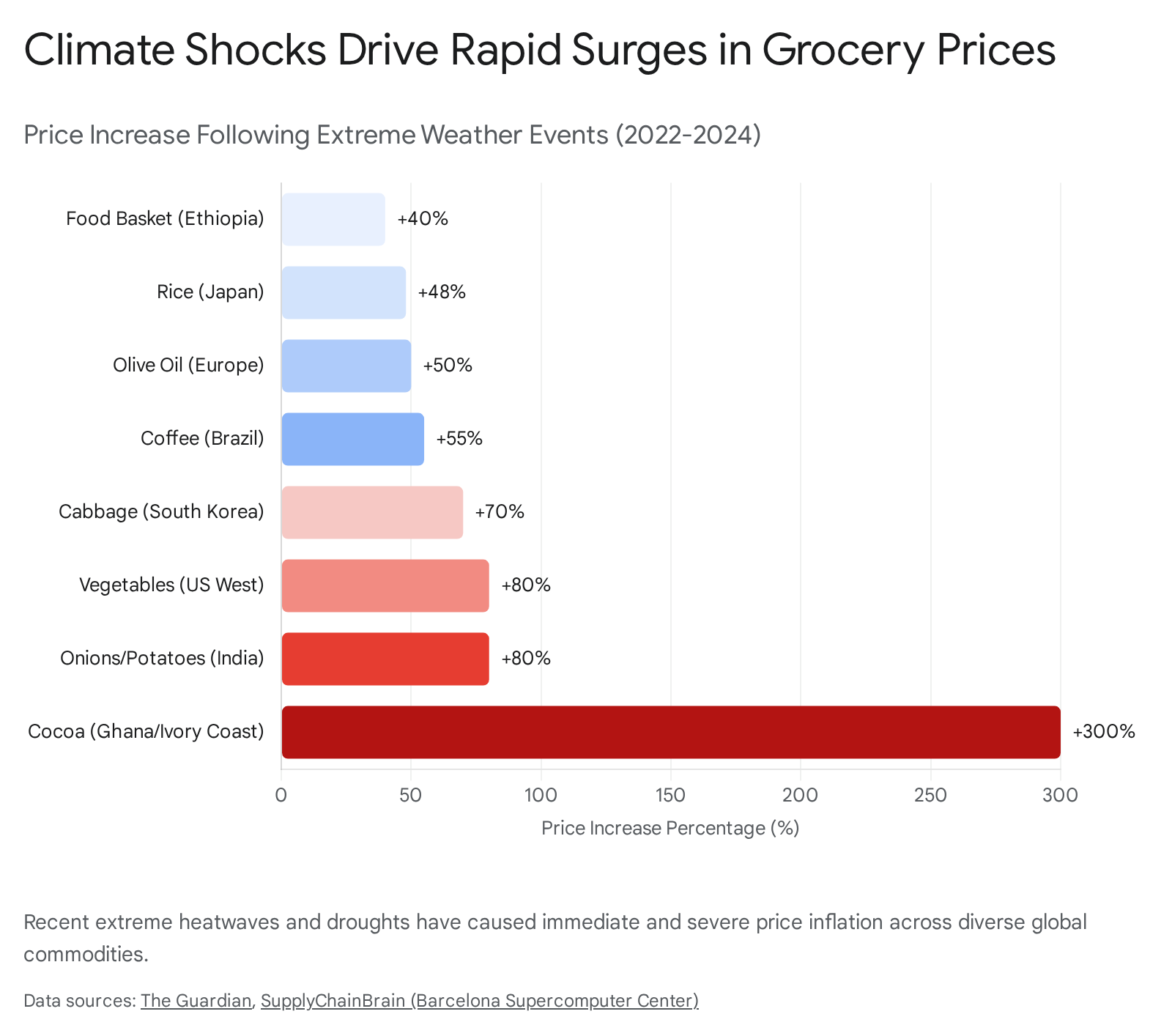
In early 2024, unprecedented heat and drought devastated cocoa crops across Ghana and the Ivory Coast, a region responsible for sixty percent of the world's supply. This extreme weather anomaly caused global prices for cocoa to spike by an astonishing three hundred percent 2229. Similarly, an extreme heatwave across East and South Asia in 2024 caused widespread agricultural damage to everyday staples. In India, onion and potato prices surged by eighty percent, while in South Korea, cabbage prices jumped seventy percent. In Japan, domestic rice prices increased by forty-eight percent 212229.
Western markets are not immune to these shocks. Following a prolonged, multi-year drought across Spain and Italy between 2022 and 2023, European olive oil prices rose by fifty percent in early 2024 222923. In the United States, an unprecedented drought affecting California and Arizona throughout 2022 contributed to an eighty percent year-over-year increase in vegetable prices 112129. The impacts are even more devastating in developing nations; in Ethiopia, following the worst drought the Horn of Africa had seen in four decades, the price of a basic food basket jumped by forty percent in 2023 2229.
If global greenhouse gas emissions are not aggressively curtailed, macroeconomic models project that global warming will cause underlying food price inflation to increase by between 0.9 and 3.2 percentage points per year globally by 2035 1124. In lower-income households, these unrelenting price surges force families to abandon diverse, nutrient-dense diets. Instead, they must rely on cheaper, calorie-dense, and highly processed alternatives, a shift that directly accelerates rates of malnutrition, diabetes, heart disease, and childhood stunting 2022.
The Geopolitics of Food and Trade Fragmentation
The pathways to 2050 will also be heavily dictated by international trade dynamics and geopolitical stability. In the SLU's Fragmented World and the WEF's Local Is the New Global scenarios, nations respond to climate uncertainty and economic anxiety by hoarding vital resources, erecting steep tariff walls, and utilizing food exports as geopolitical leverage 917.
The architecture of global food trade is currently showing severe signs of this fragmentation. Rising geopolitical tensions, highlighted by ongoing conflicts in Eastern Europe and the Middle East, have disrupted critical agricultural logistics. For example, severe disruptions in the Strait of Hormuz directly impact the movement of oil, liquefied natural gas, and sulfur. This logistical bottleneck drives up the cost of synthetic fertilizers globally. Because modern seeds and high crop yields are intrinsically dependent on these fertilizers, an energy logistics shock translates almost immediately into an agrifood shock 6.
Furthermore, as the world fractures into distinct economic and political blocs, global supply chains are being radically realigned. We are witnessing a historical pivot where nations in the Global South are increasingly trading directly with one another and powers like China, attempting to bypass traditional Western-led institutions and mitigate exposure to Western tariffs 32. The International Monetary Fund warns that this type of commodity market fragmentation poses a massive risk to global stability. In a highly fragmented scenario, if a major agricultural producer experiences a severe crop failure due to extreme weather, the lack of interconnected buffer stocks and the absence of free trade agreements mean that localized shortages will swiftly escalate into regional famines 725.
The Limits of Technological Silver Bullets
Advanced technology is frequently presented by venture capital and industry optimists as the ultimate solution to the impending 2050 food crisis. However, foresight analysts strongly caution against treating technology as a guaranteed panacea. The profound benefits of agricultural innovation are rarely distributed equitably across the globe, and rapid advancements often introduce new, unforeseen systemic risks.
Precision Agriculture and the Expanding Digital Divide
Precision agriculture represents a massive paradigm shift from traditional, broad-spectrum farming to highly targeted, data-driven crop management. Utilizing a network of GPS systems, satellite imagery, Internet of Things sensors, and deep learning algorithms, precision agriculture allows farmers to monitor micro-variations in crop health, pest activity, and soil moisture in absolute real-time 2425.
The core advantage of precision agriculture is its ability to apply expensive inputs, namely water, chemical fertilizers, and pesticides, only exactly where and when they are strictly needed. In practice, it acts as a surgical scalpel rather than a blunt sledgehammer 2425. This targeted approach drastically reduces toxic chemical runoff, protects surrounding fragile ecosystems, and lowers overall production costs while stabilizing yields against increasingly volatile weather patterns 2526.
However, implementing precision agriculture requires significant upfront capital expenditure, reliable rural broadband connectivity, and high technical literacy to interpret the massive datasets generated. Consequently, modern precision management systems are almost exclusively deployed on large, highly mechanized commercial farms in the developed world. Conversely, smallholder farmers in Sub-Saharan Africa and South Asia, who actually produce much of the world's food supply and are concurrently the most vulnerable to climate shocks, rarely have financial or infrastructural access to these advanced tools 24. Without targeted, heavily subsidized international policies to bridge this expanding digital divide, precision agriculture will inadvertently accelerate the inequalities envisioned in the Fragmented World scenario, where corporate mega-farms thrive in climate-controlled isolation while smallholders face total economic obsolescence.
Gene Editing and the Promise of CRISPR
To forcibly adapt fragile crops to a hotter, drier, and more volatile world, agricultural scientists are increasingly turning to advanced genome-editing technologies, most notably CRISPR-Cas9. First discovered as a functional tool in 2012, CRISPR operates as a pair of hyper-precise genetic scissors. It allows researchers to cut specific parts of a plant's native DNA sequence and alter targeted traits without introducing foreign genetic material from entirely different species, a distinction that separates it scientifically from traditional transgenic organisms or GMOs 2736.
The potential applications of CRISPR for securing the 2050 food supply are immense. To combat climate vulnerability, scientists have successfully utilized CRISPR to silence natural susceptibility genes, creating novel crop variants that can withstand prolonged, severe droughts and resist emerging bacterial and viral pathogens that are spreading to new latitudes 372829. Furthermore, researchers have identified specific nucleotide deletions in rice cultivars that can significantly increase the total number of grains grown per individual plant, theoretically doubling total yields on existing plots of arable land 27. To combat hidden hunger, a condition where populations suffer from severe micronutrient deficiencies despite consuming adequate baseline calories, CRISPR is being actively deployed to increase antioxidant levels in tomatoes, alter starch compositions for better digestion, and induce staple crops like bananas to produce significantly higher levels of beta-carotene 2737.
Despite these remarkable scientific breakthroughs, the widespread commercial adoption of CRISPR-edited crops faces significant, non-technical hurdles. Public perception remains highly mixed, with lingering consumer skepticism regarding the naturalness and long-term health safety of laboratory-edited foods 2736. Furthermore, international regulatory frameworks lag far behind the pace of the technology. While some jurisdictions, like the European Union, are slowly easing rules on specific gene-edited plants, others maintain incredibly strict, slow-moving approval processes that effectively stall the deployment of these resilient crops to the farmers who desperately need them 363728.
The Stalled Revolution of Cultivated Meat
Just a few years ago, lab-grown or cultivated meat was universally heralded as a revolutionary biotechnology capable of entirely eliminating the vast land requirements, water usage, and greenhouse gas footprint associated with traditional livestock agriculture. Aggressive industry projections suggested that industrial cultivated meat would rapidly reach price parity with slaughtered meat and dominate grocery shelves by the late 2020s 3041.
However, as we approach the end of the decade, this lofty promise has largely stalled, transitioning the product from a presumed future dietary staple to an incredibly expensive, highly regulated novelty. While some optimistic market analyses still project the global market to reach significant valuations by 2050, the industry is currently mired in what manufacturing analysts refer to as engineering hell 4142.
The challenges facing cultivated meat are multifaceted and structural. Growing animal cells at high industrial densities without catastrophic bacterial contamination requires incredibly sophisticated, pharmaceutical-grade sterile bioreactors. Furthermore, the specialized growth media required to feed and multiply the cells remains prohibitively expensive to produce at a commodity scale. The fundamental issue is that biological processes do not adhere to the exponential cost-reduction curves historically seen in software development or semiconductor manufacturing; living cells require fixed, irreducible minimums of nutrients, energy, and time to grow 104142.
Beyond raw cellular growth, there is the persistent texture problem. While growing a formless, soft mass of animal protein for use in nuggets is scientifically achievable, engineering those cells to accurately mimic the complex, three-dimensional fibrous architecture of a whole-cut steak, complete with integrated muscle fibers, fat marbling, and connective tissue, has proven extraordinarily difficult 304142. Finally, the industry faces severe regulatory and political backlash. Rather than welcoming the technology as a climate solution, several jurisdictions have adopted actively hostile postures. Outright production and marketing bans on cultivated meat have been aggressively enacted in nations like Italy, as well as in United States jurisdictions including Florida, Alabama, and Texas, severely restricting the addressable commercial market for these highly capitalized startups 10.
Consequently, alternative proteins are highly unlikely to single-handedly solve the agricultural emissions crisis by 2050. Achieving true sustainability will require much broader, systemic behavioral shifts, such as drastically reducing post-harvest food waste and voluntarily transitioning populations toward plant-heavy diets that utilize traditional legumes and pulses, which require only a fraction of the resources of beef to produce 43.
Bottom line
The trajectory of the global food system toward 2050 will not be determined by a single miraculous technological breakthrough or an inevitable, apocalyptic climate collapse. Instead, our reality will be shaped by the aggregate political and economic policy choices made over the next critical decade. If the global community prioritizes short-term resource extraction and retreats into fragmented, isolationist trade blocs, the world will almost certainly face chronic, climate-driven food inflation, the collapse of arable land, and the proliferation of regional hunger hotspots. Conversely, avoiding this overexploited fate is entirely within human capability. It requires the difficult, deliberate decision to trade unchecked consumption for long-term ecological resilience, heavily investing in the equitable, subsidized distribution of climate-smart agricultural technologies, and maintaining interconnected, cooperative trade networks capable of absorbing and mitigating localized environmental shocks.