
Fear appeals in advertising and consumer behavioral compliance
Introduction to Threat-Based Persuasion
Fear appeals are persuasive messaging strategies designed to arouse anxiety or fear in an audience by emphasizing the potential danger, harm, or negative consequences that will befall individuals if they fail to adopt a recommended course of action, product, or service 12. Rooted in the evolutionary primacy of threat detection, these emotional appeals attempt to bypass purely rational cognitive processing, leveraging the physiological and psychological arousal of fear to jump-start behavioral modification 32. Historically utilized across public health campaigns, political marketing, and commercial advertising, the underlying premise of the fear appeal is that an individual will be more motivated to pay attention to a message and alter their behavior if their survival instincts or personal anxieties are activated 2.
Despite their ubiquitous presence in marketing, the efficacy and predictability of fear appeals remain subjects of intense academic and industry debate. While some practitioners view fear as an unparalleled catalyst for action, empirical research reveals a highly complex phenomenon where fear can operate as a double-edged sword 34. When properly calibrated, fear appeals can successfully drive adaptive behaviors, such as increasing cancer screenings, reducing drink-driving, or prompting the purchase of necessary insurance products 27. However, when mismanaged, excessive or poorly constructed fear appeals can backfire, triggering maladaptive defensive mechanisms such as message denial, psychological reactance, and active brand avoidance 56. Understanding the precise mechanisms through which fear translates into persuasion requires an exhaustive analysis of cognitive appraisal theories, the moderating role of efficacy, and the distinct contextual environments in which these messages are deployed.
Theoretical Frameworks of Fear Processing
The academic literature surrounding fear appeals is dominated by theories that attempt to explain the cognitive routing an individual undertakes when exposed to a threatening stimulus. These frameworks are essential for predicting whether a consumer will change their attitude favorably toward the advertisement or reject it entirely.
Historical Models and the Inverted-U Hypothesis
Early fear appeal research, heavily influenced by Hovland's Drive Theory and Janis's subsequent work, posited an inverted-U relationship between the intensity of a fear appeal and its persuasive effectiveness 789. Under this hypothesis, moderate levels of fear were deemed optimal for persuasion; low fear was insufficient to capture attention or drive arousal, while overwhelmingly high fear triggered paralyzing defensiveness and immediate message rejection 710.
However, decades of subsequent empirical testing have complicated the inverted-U hypothesis, particularly in between-subjects experimental designs. Comprehensive meta-analyses, notably by Witte and Allen, and more recently by Tannenbaum et al., have consistently established a positive, linear relationship between fear intensity and persuasion 1311. The Tannenbaum meta-analysis - comprising 127 articles and 27,372 participants - concluded that fear appeals generally have a positive effect on attitudes, intentions, and behaviors (composite index d = 0.29), with no identified threshold where fear intrinsically backfires across a population, provided that the message includes strong efficacy statements 1310.
Despite the dominance of the linear model in modern inter-individual literature, recent nuanced studies suggest the inverted-U effect may still manifest in within-subjects analyses, where an individual's fear is measured dynamically at multiple time points during message processing rather than aggregated after exposure 5811. This indicates that intra-individual fear processing is highly dynamic, and initial spikes in fear must be managed carefully over the duration of the advertising exposure.
Protection Motivation Theory
Developed by Rogers, the Protection Motivation Theory (PMT) shifted the focus from purely emotional arousal to cognitive evaluation 7. PMT posits that consumers respond to a threatening message by seeking to reduce the fear induced by the advertisement through adaptive or maladaptive coping strategies 7. This theory introduces the concept that fear appeals function through two primary appraisal processes: threat appraisal and coping appraisal 712. PMT laid the groundwork for understanding that physical threats and social threats can both lead to protection motivation, engaging the consumer at both cognitive and emotional levels 7.
The Extended Parallel Process Model
The most comprehensive and widely utilized framework for understanding fear appeals today is the Extended Parallel Process Model (EPPM), developed by Kim Witte in the 1990s as an amalgamation and refinement of previous threat-processing theories, specifically Leventhal's Parallel Response Model and Rogers's PMT 121314. The EPPM posits that when a consumer is exposed to a fear-inducing advertisement, they engage in a rapid, two-stage cognitive evaluation consisting of a threat appraisal and an efficacy appraisal 1213.
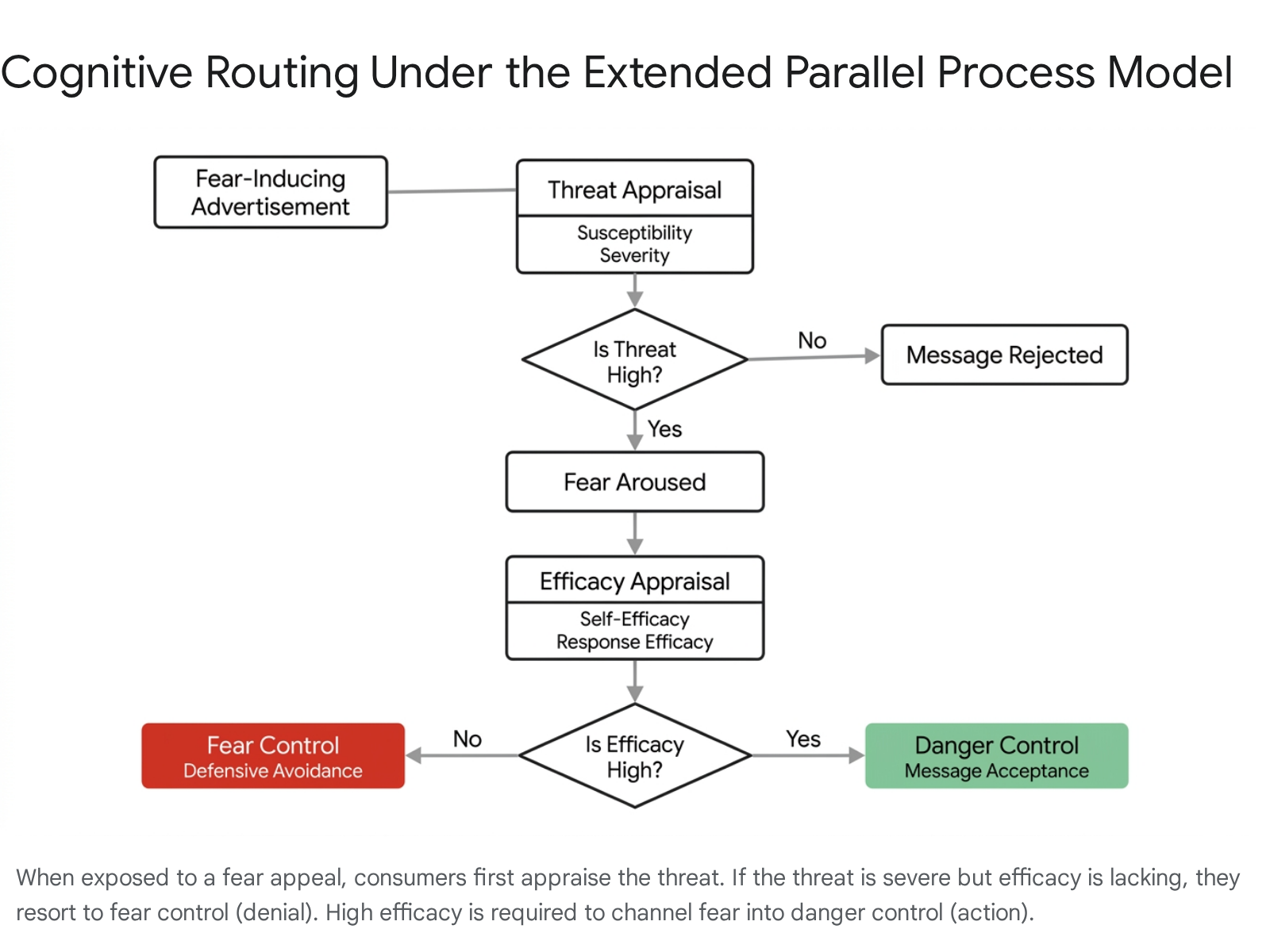
During the initial threat appraisal, the individual evaluates the message for perceived severity (the magnitude of the danger) and perceived susceptibility (the personal likelihood of experiencing the danger) 1215. If the perceived threat is deemed low or irrelevant, the cognitive process terminates immediately, and the advertisement is ignored 412. Conversely, if the threat is perceived as severe and personally relevant, the emotion of fear is elicited, propelling the consumer into the second stage: efficacy appraisal 1213.
Efficacy appraisal involves evaluating the recommended solution presented in the advertisement. This requires two distinct components: response efficacy (the belief that the advertised product, service, or action will actually mitigate the threat) and self-efficacy (the individual's belief in their own capability to successfully execute the recommended action) 1316.
The critical threshold of the EPPM lies in the mathematical-psychological comparison between the perceived threat and the perceived efficacy. This comparison dictates which of two parallel pathways the consumer will take: danger control or fear control 1317.
If perceived efficacy is greater than or equal to the perceived threat, the consumer engages in danger control. They accept the message, experience positive attitude change, and take the recommended action to mitigate the external risk 413. Conversely, if the perceived threat overwhelms the perceived efficacy - meaning the consumer feels highly threatened but powerless to stop it - they engage in fear control. Instead of managing the external danger, the consumer attempts to manage their internal emotional distress through denial, defensive avoidance, message derogation, or psychological reactance 41317. In this state, consumers may even exhibit fatalism or discriminatory behaviors to regain a compensatory sense of psychological security 418.
| Perceived Threat Level | Perceived Efficacy Level | Dominant Processing Pathway | Psychological Mechanism | Advertising Outcome |
|---|---|---|---|---|
| Low | High or Low | None | Lack of arousal; threat dismissed as irrelevant. | Advertisement ignored; no behavioral change. |
| High | High | Danger Control | Focus is directed outward toward mitigating the external threat. | Message acceptance; favorable attitude change; behavioral compliance. |
| High | Low | Fear Control | Focus is directed inward toward mitigating emotional distress. | Message derogation; defensive avoidance; psychological reactance; brand avoidance. |
Efficacy and Message Construction Mechanics
The prevailing consensus across contemporary marketing psychology is that fear alone is insufficient, and potentially detrimental, without the presence of robust efficacy cues. Meta-analytical data confirms that the effectiveness of fear appeals increases significantly when the message includes clear, actionable efficacy statements 116. Conversely, fear appeals lacking efficacy statements produce substantially weaker, or even null, persuasive effects 1.
Distinguishing Response and Self-Efficacy
The distinction between response efficacy and self-efficacy is vital for copywriters and marketers. An advertisement may convince a consumer that a product works perfectly to stop a threat (high response efficacy), but if the product is prohibitively expensive or too complex for the consumer to implement (low self-efficacy), the consumer will default to fear control processing to manage their anxiety 1319. The strength of a consumer's conviction in their own effectiveness affects whether they will even attempt to cope with a given situation 19.
Furthermore, research highlights a distinction in the type of behavior being recommended. Fear appeals have proven significantly more effective when promoting one-time, discrete actions (e.g., getting a vaccine, buying a specific software license, installing a smoke alarm) rather than sustained, repeated behavioral changes (e.g., maintaining a daily diet, perpetual environmental conservation) 1710. A single, concrete action boosts perceived self-efficacy because it feels immediately achievable, rapidly resolving the induced emotional tension 10.
Message Sequencing and Emotional Dynamics
The structural order of elements within a fear appeal significantly influences cognitive processing. Presenting the severity of a threat before susceptibility has been shown to result in more positive attitudes toward the message recommendation, particularly in contexts like climate pollution messaging 20.
Moreover, the temporal dynamics of fear within the duration of an advertisement play a pivotal role. A "dynamic fear reduction process" - where fear is successfully aroused and then actively resolved by the advertisement's efficacy statements - is a strong positive predictor of engagement in protective behaviors 20. Decreasing fear throughout the message increases message acceptance and danger control, demonstrating that an advertisement must provide a viable psychological exit for the consumer 20.
Additionally, fear is rarely isolated. Advertisements often induce adjacent emotions such as disgust, anxiety, or guilt. Incorporating disgust into a fear appeal has been found to significantly boost message persuasion and compliance, surpassing appeals that evoke fear alone, largely due to disgust's potent and immediate avoidance response 21. However, advertisers must separate fear (driven by severity) from anxiety (driven by susceptibility) when crafting messages, as both contribute differently to response efficacy and information-seeking motivation 10.
Contextual Variations in Fear Appeal Effectiveness
The effectiveness, ethical boundaries, and consumer tolerance for fear appeals vary significantly depending on the industry and the nature of the threat being advertised.
Public Health and Crisis Communication
Fear appeals are deeply entrenched in public health and government crisis communication. In these contexts, messages are explicitly designed to disrupt complacency regarding severe threats such as tobacco use, infectious diseases, and road safety 59.
During the COVID-19 pandemic, government health messaging utilizing fear appeals proved highly dynamic. Analysis of social media engagement with state-owned media revealed that messages conveying high threats elicited significantly more comments - reflecting high emotional arousal - but required clear efficacy subdimensions to be positive predictors of constructive engagement (likes and shares) 22. Messages containing threat alone often exerted negative effects on overall engagement, reinforcing the EPPM's requirements 22.
Studies assessing the Transport Accident Commission (TAC) campaigns in Victoria, Australia, further validate this approach. TAC advertisements are explicitly briefed to "upset, outrage, and appall" the audience regarding drink-driving 2. Yet, their historical success in behavioral modification relies entirely on combining high visceral fear with clear, sensible action plans 2. However, public health fear appeals can suffer from audience habituation. In anti-tobacco initiatives, such as "The Real Cost" campaign, researchers found that while visceral, fear-inducing advertisements successfully increased risk perceptions and negative smoking attitudes, prolonged reliance on singular emotional tones necessitated the introduction of alternative appeals, such as humor, to prevent message fatigue and consistently recapture target audience attention 59.
Environmental and Sustainable Marketing
The application of fear appeals in green advertising yields highly conditional results. Research indicates that consumer involvement with environmental issues strictly moderates ad effectiveness 23. When consumers possess high environmental involvement, they are already acutely aware of the threat. Subjecting them to high-intensity fear appeals regarding climate change can trigger defensive avoidance or annoyance 723.
Studies show that consumers strongly connected to eco-friendly causes actually hold more positive attitudes toward advertisements employing moderate fear rather than high fear 21. Furthermore, if a green advertisement relies exclusively on physical fear appeals without emphasizing actionable social benefits, it can decrease purchase intent 21. Sustainable marketers achieve greater behavioral compliance when shifting from physical threat frames to social threat frames (e.g., "Neglecting sustainable products puts our social benefits at risk"), highlighting the nuanced requirements of cause-related marketing 21. Temporal framing also moderates effectiveness; advertisements utilizing future-focused temporal framing often help consumers make sense of how a brand can build a better post-crisis future, enhancing electronic word-of-mouth (eWOM) intentions more effectively than present-focused concrete framing 24.
The Cybersecurity Industry and Market Fatigue
In the B2B and commercial technology sectors, particularly cybersecurity, fear appeals are colloquially known as "FUD" (Fear, Uncertainty, and Doubt). For decades, cybersecurity vendors have relied on catastrophic headlines, breach statistics, and regulatory panic to pressure organizations into purchasing software 2825.
Recent industry analyses indicate a severe decline in the effectiveness of this strategy.
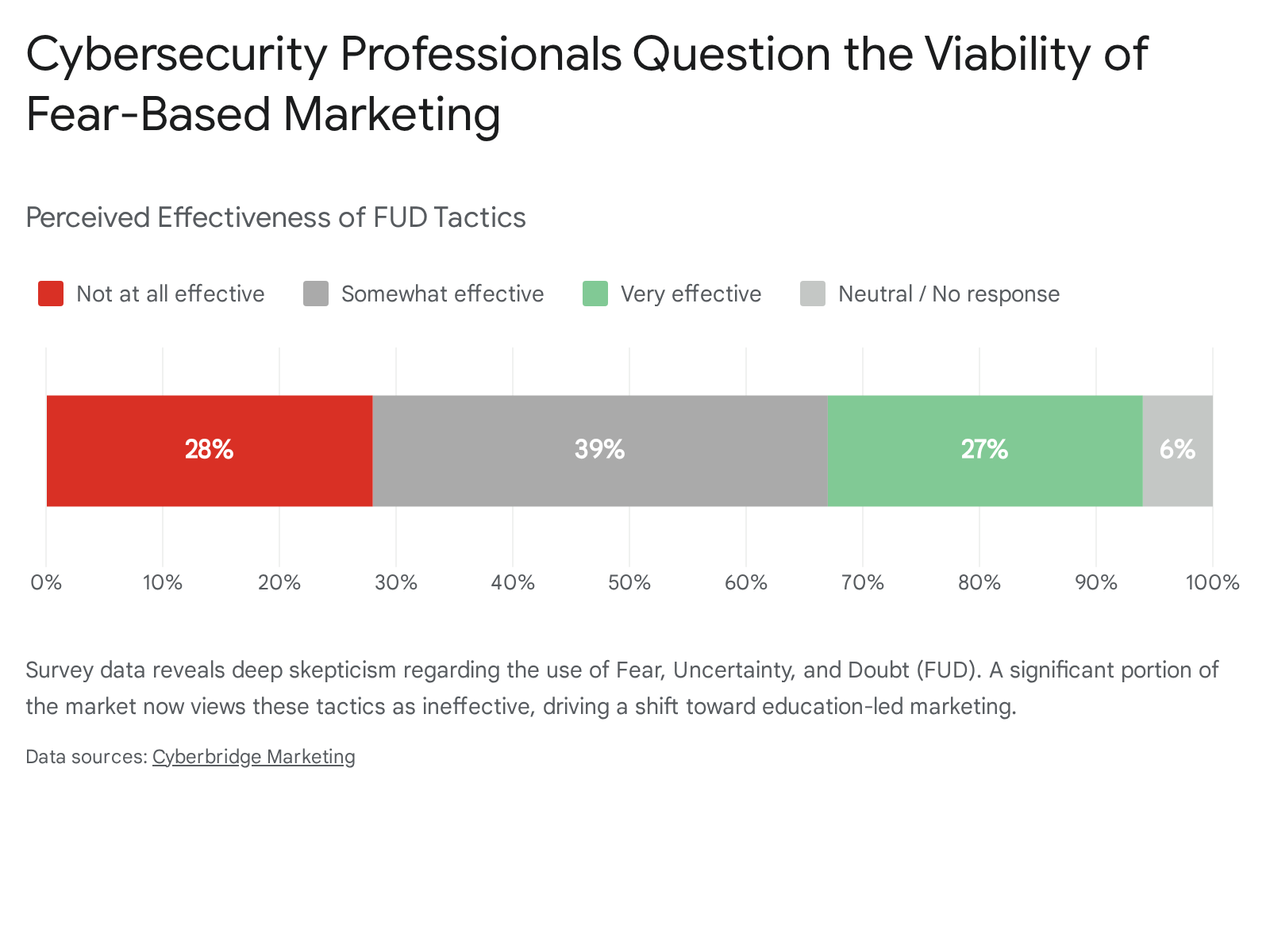
With an estimated 6,500 vendors utilizing similar threat-centric marketing tactics, buyers have become desensitized to the messaging 28.
Experts note that continuous FUD marketing has created a "technology vs. user" cycle that actually leaves consumers feeling less secure 25. By repeatedly emphasizing that hackers are unstoppable and users are inherently vulnerable without advanced software, marketers actively undermine the user's self-efficacy. According to the EPPM, low self-efficacy coupled with high threat results in fear control. In the cybersecurity market, this manifests as apathy and resentment, where buyers disengage, believing that no matter what software they buy, they will always be at risk 25. Overwhelming people with fear leads to paralysis and inaction, directly counterproductive to improving safe behavior 18. Consequently, modern cybersecurity buyers are actively ignoring panic-driven urgency in favor of trust-based marketing that focuses on education, business continuity, and tangible outcomes 1828.
Insurance Advertising Dynamics
The insurance sector inherently deals with risk mitigation, making it a natural environment for fear appeals regarding death, accidents, and financial ruin. A neuromarketing study analyzing Life Insurance Corporation of India (LIC) campaigns demonstrated that fear appeals generated moderate-to-high emotional arousal and negative valence among consumers 26. Crucially, the intensity of the fear appeal was strongly correlated with emotional arousal and purchase intention, explaining 24% of the variance in the likelihood to purchase insurance 26. The study noted specific demographic effectiveness patterns, with consumers aged 31 - 40 exhibiting the highest purchase intentions when exposed to fear appeals 26.
However, the international insurance market is witnessing a distinct pivot. Recognizing that frightening advertisements can trigger dysfunctional anxiety among high-risk recipients and hamper rational evaluation of complex insurance products, many global carriers are replacing raw fear appeals with humor and trust-building narratives 2732. The underlying logic is that rising insurance costs and tightening underwriting standards are already driving consumer anxiety and mistrust; layering additional fear in advertisements exacerbates negative brand relationships 32. By using humor - such as ironically portraying insurance stereotypes - or focusing on human empathy and community protection, brands attempt to foster trust in highly uncertain economic climates, avoiding the ethical pitfalls of exploiting consumer misfortune 2732.
Digital Media, Habituation, and Advertising Fatigue
The transition of advertising from traditional broadcast channels to algorithmic social media feeds has fundamentally altered how fear appeals are received. The sheer volume and velocity of digital ad delivery have accelerated the rate at which consumers experience emotional exhaustion.
Overexposure and Marketing Fatigue
Digital marketing fatigue occurs when consumers feel overwhelmed by the volume or repetition of brand messages, leading to diminished engagement, negative perceptions, and active ad avoidance 2829. As brands increasingly leverage digital channels, the ubiquity of emotionally charged messaging in email inboxes and social feeds forces brands to compete in an arms race of arousal 29.
Consumer surveys project that approximately 67% of consumers anticipate experiencing marketing fatigue prior to major purchasing seasons, causing them to tune out generic or highly intense messaging 2829. Data from ad-tracking studies reveals that excessive repetition of the same advertisement directly harms purchasing decisions; roughly 49% of consumers report deciding against purchasing a product specifically because they were exposed to repetitive ads too frequently 30. In the post-COVID-19 digital landscape, where the pandemic profoundly modified baseline societal anxiety and psychological well-being, overemphasizing negative emotions like fear and guilt is increasingly viewed by consumers as blatant manipulation, inducing offense and annoyance 3132.
Brand Avoidance and Perceived Hypocrisy
When digital fear appeals cross the threshold from persuasive to exploitative, they trigger behavioral ad avoidance, where viewers proactively use ad-blockers, skip videos, or unfollow brands 33. Under the Protection Motivation Theory framework, consumers exposed to exaggerated digital advertising develop self-protective tendencies against the brand itself 634.
If a consumer detects a disparity between the severe threat depicted in an advertisement and the reality of the product's value, it breeds Perceived Brand Hypocrisy (PBH) 634. PBH reflects an inconsistency between a firm's claims and its actions. When consumers perceive this hypocrisy, they determine that the business is unfriendly and manipulative. This cognitive evaluation stimulates retaliatory behaviors, notably brand avoidance, negative electronic word-of-mouth (eWOM), complaints, and a profound decrease in long-term brand loyalty 634.
FOMO as a Digital-Specific Fear Appeal
The "Fear of Missing Out" (FOMO) has emerged as a dominant, highly specific manifestation of the fear appeal in digital and influencer marketing, particularly targeting Generation Z and Alpha consumers 35. While traditional fear appeals threaten physical or financial safety, FOMO threatens social inclusion, peer status, and experiential participation 3536.
Research demonstrates that while social media advertising exerts a relatively weak direct influence on impulsive buying, FOMO acts as a powerful mediating variable linking social media engagement to impulsive consumption 36. In a digital context, particularly in societies with collectivist undertones, FOMO manifests as a social conformity mechanism, driving users to execute immediate, unplanned purchases to maintain group belonging and avoid the anxiety of social exclusion 36.
While highly effective at driving short-term transactional metrics, the psychological toll is severe. Studies indicate an inverse relationship between screen time and psychological health, with FOMO-induced stress contributing to anxiety, peer pressure, and an erosion of long-term brand trust when users realize they are being emotionally manipulated by influencers and targeted algorithms 3537. The American Psychological Association has linked excessive use of short-form, highly stimulating video content to negative mental health outcomes, including stress and social isolation, driven by a dopamine reinforcement loop that functions similarly to a continuous fear/relief cycle 38.
Platform Dynamics: TikTok vs. Instagram
The specific social media platform carrying the fear appeal drastically alters its reception. Recent benchmarking data highlights a massive divergence in brand growth and organic reach between major platforms, influencing how advertisers construct emotional appeals.
| Platform Metric (2024-2025 Data) | TikTok | Implication for Advertisers | |
|---|---|---|---|
| Median Brand Follower Growth | +200% YoY | Stagnant | TikTok offers massive audience acquisition potential for emerging narratives. |
| Organic Reach Decline | Minimal | -30% to -40% | Instagram requires higher paid investment to reach the same audience size. |
| Peak Median Engagement Rate | ~35.9% | ~9.7% | High TikTok engagement suggests users are highly responsive to varied content mixes. |
| Primary Traffic Source | "For You" Feed (>70%) | Follower Feed / Explore | TikTok content must capture attention immediately from non-followers, often favoring high-arousal appeals. |
Data derived from the Emplifi 2026 Social Media Benchmarks Report tracking 200,000 branded profiles 39.
While TikTok's distinct advertising strategy generally succeeds in alleviating users' typical negative perceptions toward social media advertising, users maintain high demands for authenticity 45. Audiences are wary of brands that only appear when selling a product; they favor brands demonstrating consistent understanding and shared growth, punishing inauthentic or overly aggressive fear appeals with swift algorithmic rejection 4540.
Furthermore, platform governance models add a layer of complexity. Content moderation and algorithmic appeals on platforms like TikTok and Instagram disproportionately impact marginalized users - such as LGBTQIA+ creators - who find the moderation systems dysfunctional and discriminatory 41. When platforms arbitrarily de-platform users based on skewed threat models, it breeds deep systemic distrust among highly active demographic segments 41.
Cross-Cultural Variances in Fear Processing
The effectiveness of a fear appeal is not universal; it is heavily mediated by the cultural programming of the target audience. The dichotomy between Individualistic cultures (e.g., the United States, Western Europe) and Collectivistic cultures (e.g., East Asia, Latin America) dictates both the type of threat that will resonate and the behavioral response it will elicit 484243.
Individualism vs. Collectivism
Individualistic cultures conceptualize the self as independent. Consequently, consumers in these cultures prioritize personal goals, individual rights, and personal autonomy 484344. In individualistic markets, fear appeals that emphasize personal physical harm, individual financial ruin, or loss of personal independence are highly effective 4345. Members of individualistic cultures also stick closer to their culture's emotion norms and express their emotions more openly in everyday interactions, creating a distinct baseline for evaluating advertising intensity 46.
Conversely, collectivistic cultures define the self interdependently, prioritizing group harmony, loyalty, and social conformity 484344. In these cultures, fear appeals are vastly more effective when they emphasize threats to the family unit or the in-group rather than the individual 747. Collectivist cultures generally display higher social anxiety due to stringent social norms designed to ensure group harmony; the fear of negative consequences from violating these norms acts as a powerful lever for persuasion 42. Consequently, social threat appeals (the fear of being ostracized or harming the community) resonate more deeply than purely physical threats 2142.
Interestingly, recent meta-analyses regarding cross-cultural persuasion reveal that affective (emotional) appeals are broadly more effective than cognitive (rational) appeals in collectivistic societies, whereas both perform similarly in individualistic societies 48. However, advertisers attempting to localize campaigns must be cautious: while adapting fear appeals to collective values (e.g., "protect your family") works globally, European audiences tend to show negligible differences in persuasion between culturally adapted and unadapted value appeals, suggesting that standard individualistic messaging remains resilient across Western markets despite localized nuances 45.
Ethical Constraints and Regulatory Perspectives
The deliberate induction of fear for commercial gain raises profound ethical dilemmas. At the core of the ethical debate is the tension between informing consumers of legitimate risks and exploiting their psychological vulnerabilities through manipulation or coercion 213749.
From an ethical framework prioritizing consumer autonomy, persuasive advertising must allow individuals to make independent, rational choices based on transparent information. Manipulative fear appeals intentionally bypass rational thought, relying on emotional distress, anxiety, or feelings of inadequacy to force compliance 3749. This is particularly contentious in industries like beauty and lifestyle marketing, where advertisements frequently prey on personal insecurities, fostering body image issues and a distorted sense of self-worth to drive the consumption of products that claim to "fix" the consumer 3749.
Furthermore, "shock advertising" - the use of graphic, gruesome, or highly disturbing imagery for the sake of brand visibility - risks trivializing serious societal issues and traumatizing unintended audiences, including children 2737. A campaign that successfully motivates a target demographic to buy a product might simultaneously cause dysfunctional anxiety and psychological distress in broader audiences who are unwillingly exposed to the imagery 27. Unethical advertising, whether manipulative or coercive, ultimately damages long-term corporate reputation and erodes systemic consumer trust in the marketplace 49.
Regulatory Enforcement
Due to these risks, regulatory bodies actively monitor and restrict the use of fear in advertising. In the United States, the Federal Trade Commission (FTC) regulates unfair or deceptive advertising, ensuring that the threats depicted are not factually false and that advertisers have a reasonable basis for their claims 505152.
In the United Kingdom, the Advertising Standards Authority (ASA) enforces stricter, emotion-based codes. The ASA explicitly rules that marketing communications "must not cause fear or distress without justifiable reason; if it can be justified, the fear or distress should not be excessive" 53. The ASA has routinely banned advertisements that cross this line into exploitation. For example, advertisements for health supplements that exaggerated the urgency of Alzheimer's disease to force rapid purchases were banned for causing unjustified distress to the elderly 53. Similarly, a life insurance advertisement referencing a real-world serial killer to highlight mortality risks was banned for causing profound, unjustified distress to the public 53. These regulatory actions underscore the legal and moral obligation of advertisers to calibrate their use of fear, ensuring that the psychological toll extracted from the audience is strictly proportional to the legitimate prudent behavior being encouraged.
Conclusion
Fear appeals remain one of the most potent instruments in the advertising repertoire, capable of cutting through immense digital clutter to initiate immediate attitude change and behavioral compliance. However, the contemporary landscape demands a highly sophisticated application of this psychological tool. As illuminated by the Extended Parallel Process Model (EPPM), fear is not a standalone solution; it is merely an arousal mechanism that must be immediately paired with robust, credible, and achievable efficacy cues. Without clear pathways for response efficacy and self-efficacy, fear appeals reliably degenerate into fear control, triggering defensive avoidance, apathy, and brand rejection.
Furthermore, the digital era has fundamentally altered consumer tolerance for threat-based messaging. The pervasive nature of algorithmic advertising has led to accelerated marketing fatigue, particularly regarding manipulative tactics like FOMO and Cybersecurity FUD. Consumers are increasingly adept at identifying Perceived Brand Hypocrisy, actively punishing brands that rely on exaggerated, distress-inducing campaigns by migrating toward platforms and creators that foster authentic engagement.
To ethically and effectively deploy fear appeals, advertisers must transition from campaigns of paralyzing terror to campaigns of empowered caution. This requires aligning the intensity of the threat with the audience's baseline involvement, tailoring the nature of the threat to the target's cultural orientation, and ensuring that the ultimate message prioritizes actionable solutions over raw emotional exploitation.