
Behavioral science principles for marketing copy conversion
Executive Summary
The discipline of behavioral marketing is undergoing a structural paradigm shift. Historically anchored in the foundational heuristics articulated by Kahneman, Tversky, and Cialdini, the modern practice of copywriting and conversion rate optimization must now navigate a landscape complicated by algorithmic intermediation, artificial intelligence, and globalized cross-cultural dynamics. The traditional application of cognitive biases - such as loss aversion, social proof, and scarcity - is increasingly demonstrating diminishing returns when executed without contextual nuance. In contemporary digital environments, the over-deployment of these triggers frequently leads to psychological reactance and consumer fatigue 1223. Furthermore, the introduction of generative artificial intelligence into the copywriting workflow has introduced systemic risks. Academic research identifies phenomena such as the "average trap" and "model collapse," which threaten to homogenize brand messaging, erode consumer trust, and trigger severe authenticity penalties 457.
Simultaneously, the bedrock of empirical marketing - A/B testing - is facing intense academic scrutiny. Recent investigations reveal that algorithmic advertising platforms systematically confound experimental results through a mechanism known as "divergent delivery," rendering many conventional performance metrics statistically unreliable 67811. This exhaustive report synthesizes empirical data published between 2023 and 2026 across consumer psychology, neuromarketing, and computational advertising to redefine how modern copywriting and behavioral design interact with human cognition. The analysis rigorously delineates where academic psychological theory diverges from live marketing practice, establishing a modernized framework for ethical, culturally intelligent, and algorithmically sound behavioral marketing.
Advanced Cognitive Biases in Copywriting: Moving Beyond Foundational Heuristics
While the baseline principles of persuasion remain relevant, sophisticated conversion copywriting requires a deeper neurological and behavioral understanding of how the human brain processes digital information. The strategic deployment of cognitive biases requires balancing mental load, visual hierarchy, and precise value framing.
Cognitive Fluency and the Ease of Processing
Cognitive fluency refers to the subjective ease with which the human brain processes information 910. Seminal research consolidated by Reber and Schwarz (1999) established a fundamental principle of human psychology: stimuli processed with high perceptual and conceptual fluency are subconsciously judged to be more truthful, beautiful, and trustworthy 910. From an evolutionary perspective, familiarity and ease of processing signal safety; if a stimulus has been encountered repeatedly without adverse consequences, the brain categorizes it as non-threatening, thereby reducing the activation of the amygdala and lowering cognitive friction 911.
In digital marketing, cognitive fluency manifests across both visual design and textual composition. Neuromarketing studies utilizing functional magnetic resonance imaging (fMRI) and eye-tracking technology within decentralized finance (DeFi) interfaces demonstrate that highly structured visual hierarchies produce more centralized fixation clusters and shorter scan paths, reflecting greater attentional efficiency 12. Furthermore, trust cues - such as audit badges or secure call-to-action (CTA) buttons - consistently draw user attention and function as stabilizing signals in high-uncertainty environments 12. When a checkout process or a landing page is streamlined to minimize distractions, clarify options, and reduce choice paralysis, it leverages cognitive fluency to seamlessly guide users toward transaction finalization 1617. For example, HubSpot data reveals that establishing clear visual contrast in CTA buttons and core messaging can elevate click-through rates by up to 21% 16.
However, fluency effects are conditional. Research indicates that the persuasive advantages of cognitive fluency disappear entirely when individuals consciously attribute their processing ease to irrelevant external sources, such as poor print quality or interface glitches, rather than the intrinsic value of the stimulus content 9. Additionally, the construction of mental models during narrative processing relies heavily on fluency; when consumers effortlessly comprehend a narrative, they enter a state of flow that commands full cognitive engagement, thereby reducing the mental resources available to critically analyze or resist the marketing message 13.
The Von Restorff Effect and Visual Hierarchy
The Von Restorff effect, frequently referred to as the isolation effect, dictates that an item that perceptually differs from its surroundings is significantly more likely to be retained in working memory 191415. For early human ancestors, scanning the horizon for anomalies was a critical survival mechanism; today, this hardwired cognitive default compels consumers to fixate on the single element that breaks a visual pattern 14. In a controlled experiment measuring brand recall, researchers presented participants with a list containing eleven car brand logos and one fast-food brand logo; participants were four times more likely to recall the isolated fast-food brand 14.
In the context of copywriting and email marketing, the Von Restorff effect is deployed to intercept the user's attention within milliseconds. Standard applications include the strategic use of emojis, special characters (e.g., >>>> or ////), brackets, or selective capitalization in email subject lines 1415. Within email body copy or landing pages, utilizing a starkly contrasting color for a CTA button - such as placing a white button on a black background - forces immediate visual prioritization 16.
Nevertheless, the efficacy of the isolation effect is highly sensitive to the signal-to-noise ratio. Utilizing multiple high-contrast elements simultaneously triggers cognitive overload and choice paralysis, directly violating Hick's Law, which states that decision time increases logarithmically with the number of available choices 1716. To maintain optimal cognitive fluency, marketers must enforce strict visual hierarchies. The "Rule of 3" is frequently cited as a cognitive optimum: presenting three distinct choices is easily processable and memorable, whereas presenting four or more introduces decision fatigue and cannibalizes the isolation effect 16.
Anchoring Effects and Value Framing
The anchoring effect fundamentally alters how consumers perceive value by establishing an initial cognitive reference point - the "anchor" - that skews all subsequent judgments 171819. Neurologically, anchoring functions through the selective activation of memory networks consistent with the initial stimulus 17. When a consumer is exposed to a high price point first, the brain activates neural associations with premium quality and high value, effectively reducing the cognitive friction associated with subsequent, lower prices 1726.
In A/B testing environments, manipulating the anchor has yielded profound behavioral shifts. A documented case study involving a B2B Software-as-a-Service (SaaS) company revealed that restructuring their pricing page to present the most expensive premium plan first - reading from left to right - established a high anchor that made the middle-tier options appear highly economical 1927. This strategic positioning, combined with social proof indicating the "Most Popular" plan, reduced the paradox of choice and generated a 65% improvement in click-through rates 27. Displaying the original price of a product alongside its discounted rate instantly magnifies the perception of savings, converting the objective cost into a subjective psychological gain 18.
However, price anchoring must be aligned with consistent brand messaging to avoid cognitive dissonance. If a brand positions a product as a premium offering but sets the anchor price too low, or conversely, sets an absurdly inflated original price to feign a discount, it severely damages brand credibility 1826. The first feature highlighted, the first statistic presented, and the first price viewed dictate the indelible reference points for all subsequent consumer evaluations 1719.
Deconstructing Copywriting Misconceptions
As behavioral marketing has matured, several widely accepted industry axioms have been proven false through rigorous empirical testing. Marketers relying on outdated assumptions risk alienating sophisticated consumer bases.
The Fallacy of "Shorter is Always Better"
A pervasive misconception in digital marketing dictates that modern consumers lack attention spans, necessitating that all copy be reduced to its shortest possible form 20. Contemporary research thoroughly debunks this oversimplification. The optimal length of copy is strictly contingent upon the user's cognitive load, the complexity of the product, and the consumer's position within the conversion funnel 20.
For highly sophisticated users purchasing a low-risk, low-commitment product, brevity indeed enhances cognitive fluency 20. Conversely, when targeting users evaluating high-risk or complex B2B products, excessively short copy creates cognitive friction 20. It fails to adequately address subconscious objections, establish trust, or build the necessary mental models required for a purchasing decision. In these scenarios, robust, well-structured long-form copy actually increases cognitive fluency by providing narrative clarity 1320. Furthermore, the syntactic structure of the copy matters profoundly. A study published by Oxford University Press demonstrated that consumer testimonials and reviews written in the present tense are rated as significantly more helpful and persuasive than those written in the past tense, as present-tense framing implies ongoing efficacy rather than obsolete utility 20.
Conversely, in initial engagement mechanisms like cold email outreach, extreme brevity remains empirically superior. An analysis of 5.5 million cold emails sent between January and December 2024 revealed that subject lines framed as questions and restricted to exactly 2-4 words achieved the highest open rates (46%) 29.
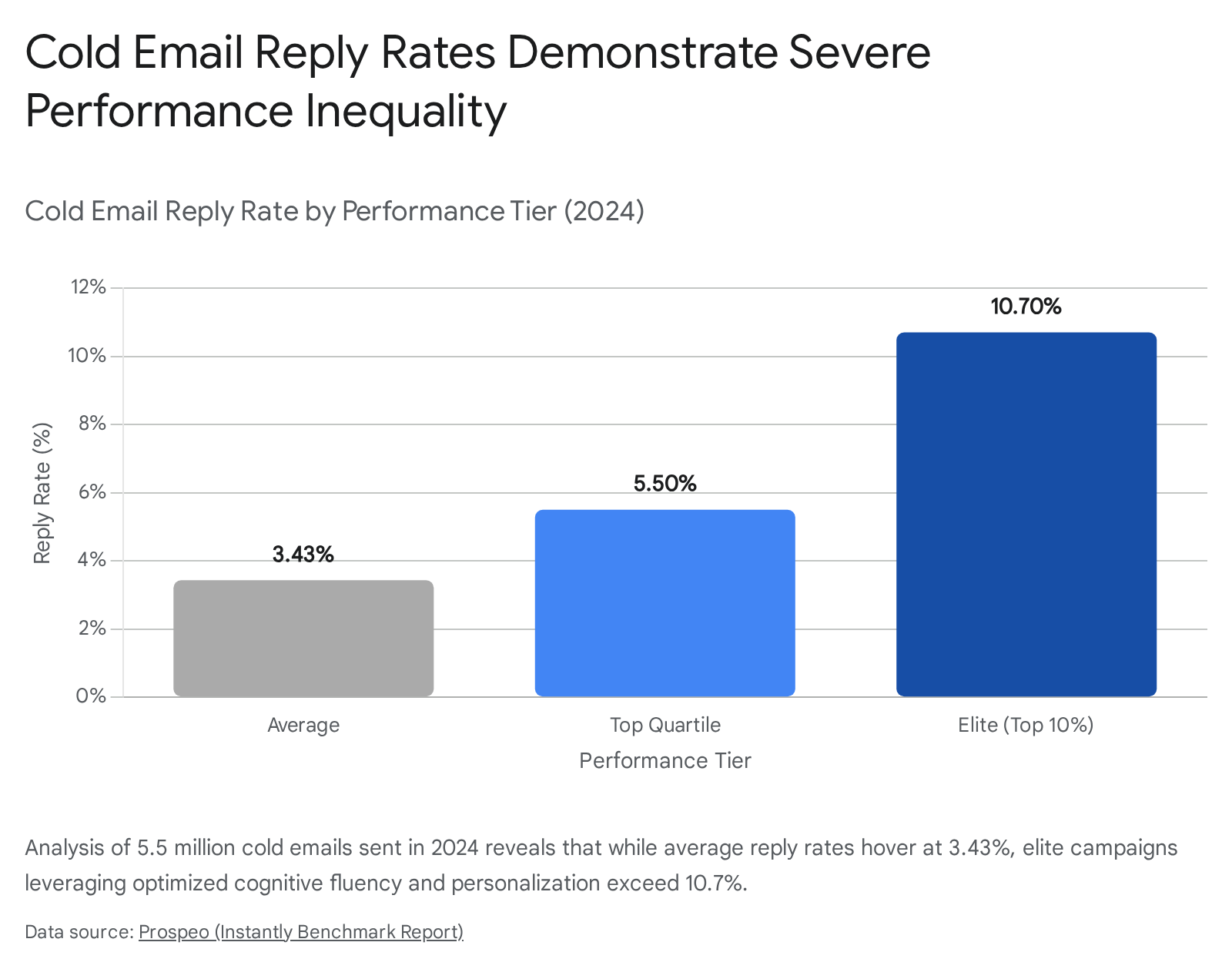
Performance degraded rapidly as word count increased, dropping to 34% for subject lines containing nine or more words 29. The data dictates a bifurcated approach: brevity must be deployed aggressively to capture initial attention, while comprehensive, long-form narrative must be deployed to secure complex commitments.
Loss Aversion and the Limitations of Negative Framing
Prospect Theory, pioneered by Kahneman and Tversky (1979), posits that the psychological pain of losing an asset is approximately twice as intense as the pleasure of gaining an equivalent asset 2131. In copywriting, framing an offer in terms of what the consumer stands to lose ("Stop losing $500 a month on inefficient ads") frequently outperforms gain-framed equivalents ("Save $500 a month") by triggering anticipated regret 2132.
However, recent behavioral literature emphasizes that the effectiveness of loss aversion is not absolute. Loss aversion is heavily dependent upon the believability of the threat 1121. Neuroscience research indicates that individuals with amygdala damage do not experience loss aversion, reinforcing the theory that genuine emotional fear is a biological prerequisite for this bias to function 11. If the threat of loss is perceived as inauthentic or manufactured, the amygdala fails to register a genuine emotional response, neutralizing the bias entirely and triggering profound cognitive skepticism 11. Furthermore, empirical studies have struggled to replicate robust loss aversion effects for very small monetary amounts, suggesting a threshold of magnitude is required to activate the heuristic 11. Marketers relying exclusively on loss-framed messaging, particularly in top-of-funnel interactions where trust has not been established, risk alienating prospects who perceive the tactic as aggressive spam 21.
Scarcity Fatigue and Psychological Reactance
For decades, commodity theory has been treated as an infallible tool for driving conversion. The logic dictates that restricting supply (quantity scarcity) or restricting time (time scarcity) induces a Fear of Missing Out (FOMO), overrides rational deliberation, and forces immediate purchasing action 232223. Scarcity triggers impulse buying through two concurrent emotional pathways: anticipated surprise (the hedonic excitement of securing a rare item) and anticipated regret (the fear of permanent unavailability) 2224.
However, the modern digital environment has been flooded with highly visible, often fabricated scarcity cues - such as perpetual countdown timers and artificial stock warnings. This ubiquitous oversaturation has birthed the phenomenon of "scarcity fatigue" 223. When consumers are chronically exposed to urgency-based marketing, the novelty erodes rapidly, and the psychological trigger loses its neurochemical potency 2. Modern consumers, particularly Millennials and Gen Z, possess high digital literacy and express severe skepticism toward limited-edition claims 2.
When scarcity cues are perceived as manipulative, they cease to function as behavioral nudges and instead trigger psychological reactance 1236. Reactance is an acute motivational state aroused when an individual feels their freedom of choice is being threatened, coerced, or artificially constrained 125. In response, the consumer will actively rebel against the persuasion attempt, leading to cognitive dissonance, negative brand associations, and the ultimate severing of the business-to-consumer relationship 13626. Medical and public health studies demonstrate that campaigns heavily designed to persuade or correct behavior can violently backfire, causing up to a 39% drop in a subject's intent to comply with the messaging 1.
Furthermore, the foundational assumption that scarcity uniformly increases sales is empirically flawed. A massive e-commerce study analyzing sales data from 34,748 information goods found that quantity-based scarcity actually decreased overall unit sales, directly contradicting classical commodity theory 27. Digital products inherently lack the physical constraints that make traditional scarcity believable. When marketers attempt to artificially scarcify digital assets without providing legitimate symbolic, social, or structural value, consumers reject the premise entirely 2327.
The Empirical Reality: Where A/B Testing Contradicts Psychological Theory
A critical maturation in behavioral marketing is the acknowledgment that academic psychological theory does not translate perfectly into live, noisy digital environments. Blindly applying hypothetical "best practices" derived from cognitive theory often results in catastrophic conversion failures due to unintended semantic priming or algorithmic interference.
Deconstructing the Failure of Behavioral "Best Practices"
Live A/B testing frequently upends established cognitive heuristics. For instance, the addition of "Trust Seals" or security badges on checkout pages is universally lauded as a mandatory method to reduce friction and build credibility 28. Yet, rigorous A/B tests have documented instances where adding trust seals actively decreased conversions by 1.6% to 3.5% 28. The underlying psychological mechanism responsible for this failure is contextual priming. In website environments where users already feel intrinsically safe, abruptly displaying a prominent security badge subconsciously introduces the concept of risk and fraud, triggering anxiety that was previously absent 28.
Similarly, explicit privacy policies can trigger negative semantic associations that destroy conversion rates. In a highly documented experiment conducted on a landing page, adding the copy "100% privacy - I will never spam you!" beneath an email capture form resulted in a massive 24% drop in conversions compared to the control 29. The inclusion of the word "spam," despite being framed negatively, activated the consumer's cognitive schema for junk mail, significantly increasing perceived risk and reducing processing fluency 29.
Another prevailing theory involves the endowment effect and the use of possessive pronouns. Theoretical marketing dictates that using the pronoun "Your" (e.g., "Get Your Free Trial") implies psychological ownership and should outperform alternatives 29. However, large-scale A/B testing has demonstrated that changing CTA copy from "Your" to "My" (e.g., "Get My Free Trial") can increase click-through rates by up to 90% 29. The pronoun "My" aligns seamlessly with the user's internal narrative perspective at the precise moment of action, proving that theoretical psychological ownership is subordinate to immediate cognitive alignment 29.
The Illusion of Causality: The "Divergent Delivery" Phenomenon
Perhaps the most disruptive recent discovery in marketing science is the exposure of fundamental flaws in how major digital advertising platforms (such as Meta and Google) conduct A/B testing. Groundbreaking research published in the Journal of Marketing by Braun and Schwartz (2024/2025) demonstrates that native platform A/B tests suffer from an inescapable confounding variable known as "divergent delivery" 6781130.
In a true randomized controlled trial, subjects are randomly assigned to a control or treatment group, ensuring both cohorts are statistically identical at baseline. Any resulting difference in outcome is thereby caused strictly by the treatment - in this case, the ad copy. However, modern advertising algorithms do not respect true randomization during ad delivery. Instead, they dynamically and independently optimize the delivery of Ad A and Ad B to entirely different subsets of users based on complex predictive models of who is most likely to click each specific ad variant 6711.
For example, if Ad A emphasizes "sustainability" and Ad B emphasizes "aesthetics," the platform's machine learning model will autonomously deliver Ad A predominantly to environmentally conscious users and Ad B predominantly to design-conscious users 7. Consequently, the resulting performance data does not measure which copy is objectively superior across a uniform population; rather, it measures the combined, convoluted effect of the copy and the algorithmic selection bias 630. This divergent delivery phenomenon mathematically explains why marketers frequently observe wildly contradictory A/B test results that completely fail to replicate when scaled 831. The magnitude, and even the directionality, of the A/B test result can be entirely confounded by Simpson's Paradox, rendering basic causal inferences regarding copywriting effectiveness highly suspect in any algorithmically mediated environment 630.
Table 1: Theoretical Psychology vs. Empirical A/B Testing Reality
| Marketing Element | Theoretical Principle | Academic Expectation | Empirical Reality in Live A/B Testing |
|---|---|---|---|
| Trust Seals / Badges | Risk Aversion & Credibility | Adding security badges reduces consumer anxiety and systematically increases checkout conversions. | Often Fails: Can decrease conversions (e.g., -3.5%) by subconsciously priming users to think about risk, hackers, and fraud in an otherwise safe environment 28. |
| Privacy Guarantees | Cognitive Reassurance | Explicitly stating "We will not spam you" builds trust and lowers the psychological threshold for opting in. | Often Fails: Reduced conversions by 24% in tests; the word "spam" acts as a negative semantic prime, activating fear schemas 29. |
| Copy Length | Cognitive Fluency | Shorter copy reduces cognitive load and universally performs better across all digital media formats. | Context Dependent: While ultra-short copy wins for cold email subjects 29, complex SaaS products suffer; longer copy is required to establish necessary mental models for high-risk purchases 20. |
| Pronoun Usage | Endowment Effect | Using "Your" (e.g., "Start Your Trial") implies psychological ownership and should universally outperform other phrasing. | Often Fails: Changing CTA copy from "Your" to "My" (e.g., "Start My Trial") has been shown to increase CTR by up to 90%, aligning better with the user's internal narrative perspective 29. |
| A/B Ad Testing | Randomized Controlled Trials | Splitting traffic 50/50 between two ads provides clear, objective causal data on which copywriting is superior. | Confounded: "Divergent Delivery" by AI algorithms ensures completely different user demographics see different ads, making causal attribution to the copy alone mathematically impossible 6711. |
The Generative AI Era: From Democratization to Model Collapse
The integration of generative artificial intelligence into behavioral marketing has radically altered the speed, scale, and nature of copywriting 443233. By leveraging natural language processing and advanced large language models, marketers can execute real-time hyper-personalization, instantaneously matching specific linguistic triggers to granular audience segments 3347. Market researchers anticipate that within three years, over 50% of market research and data collection may be conducted utilizing AI-created synthetic personas rather than human subjects 34. However, as AI transitions from a novel experimental tool to foundational marketing infrastructure, academic researchers warn of severe long-term consequences for consumer behavior and brand differentiation.
The "Average Trap" and Autoregressive Homogenization
In a seminal 2025 paper published in the Journal of Consumer Research, Huang and Rust comprehensively outline the evolutionary trajectory of generative AI in marketing through a three-stage framework: Democratization, The Average Trap, and Model Collapse 45735.
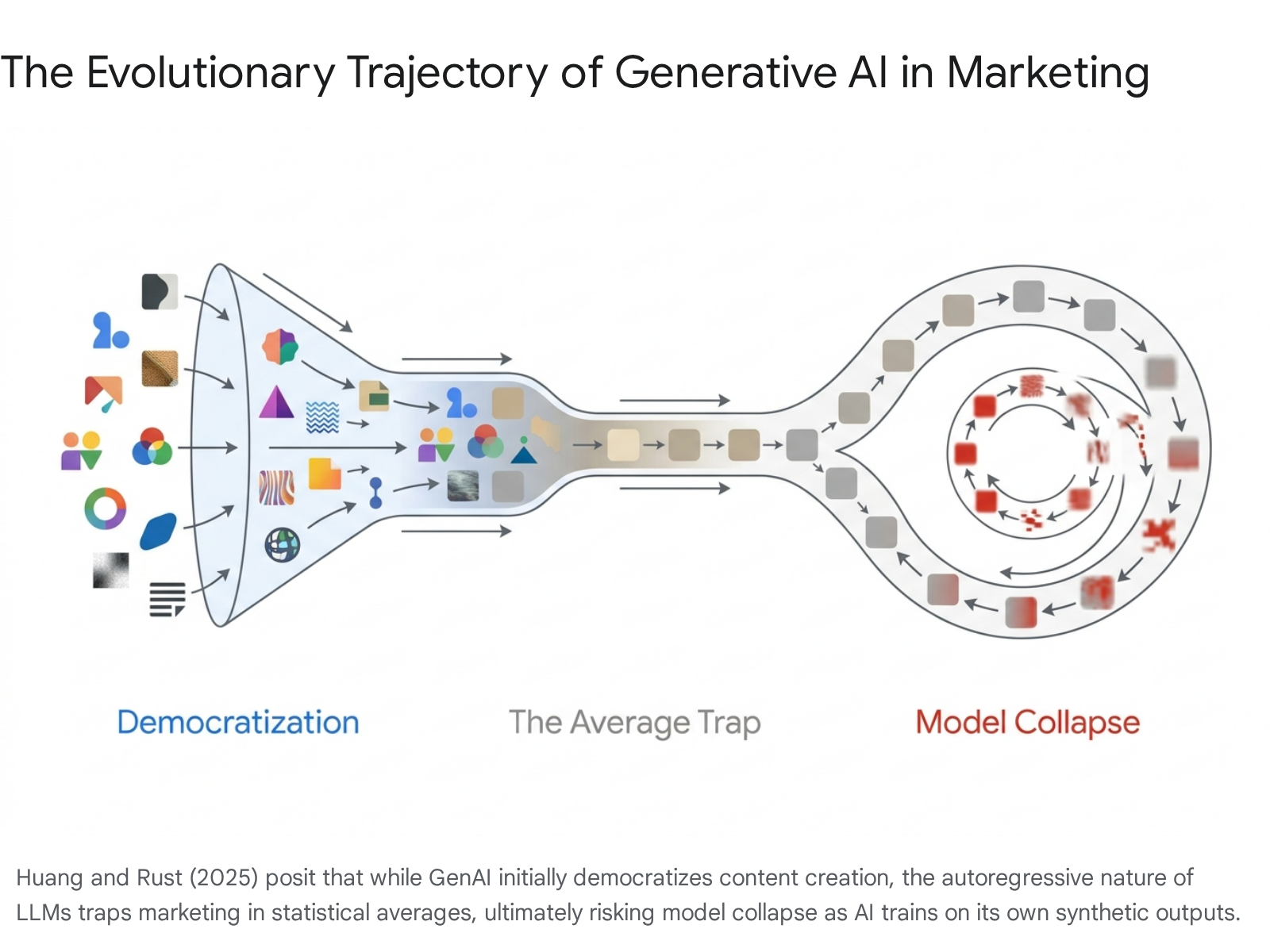
In the initial stage, GenAI democratizes high-level content creation, allowing average marketers to produce competent, structurally sound copy at an unprecedented scale, effectively lowering the barrier to entry for persuasive communication 4. However, this rapid proliferation inevitably devolves into the second stage: the "Average Trap" 47. Large language models operate via autoregressive, next-token prediction algorithms; they are mathematically constrained to generate the most statistically probable sequence of words based on their vast training datasets 47. Because the statistical average inherently represents the most common value, AI-generated copy naturally and inevitably gravitates toward profound mediocrity 47. It systematically strips away the nuance, emotional edge, and idiosyncratic brand voice that define elite conversion copywriting 750. The resulting output is grammatically flawless but psychologically inert, failing to trigger the necessary emotional heuristics required to drive consumer action 450.
AI Fatigue, Model Collapse, and the Authenticity Penalty
As the sheer volume of AI-generated content saturates the digital ecosystem, consumers are experiencing acute cognitive and emotional "AI fatigue" 5136. A comprehensive 2026 consumer report indicates that while 73% of consumers regularly interact with AI tools, 71% worry deeply about their reliability and propensity for misinformation 36. More critically, 62% of consumers experience severe frustration and dehumanization when authentic human nuance is removed from brand interactions 5136. Consumers have rapidly developed highly sensitive heuristic filters for identifying AI-generated syntax, actively penalizing brands that deploy generic, machine-generated copy - a phenomenon increasingly referred to as the "Authenticity Penalty" 4750.
Psychological studies published in late 2025 further document the emergence of "AI Ghostwriting Remorse." This phenomenon describes the acute feelings of guilt and perceived dishonesty experienced by individuals who utilize generative AI to author personalized or emotionally laden messages, severely disrupting the authenticity of interpersonal and business relationships 37.
If left unchecked, the over-reliance on synthetic content leads inexorably to the final stage of Huang and Rust's trajectory: "Model Collapse" 45. As future iterations of AI models are inevitably trained on the ubiquitous, homogenized outputs of previous AI models - rather than on genuine human behavioral data - they lose contact with the diverse "long tail" of authentic human emotion and preference 735. The models begin to reflect pure machine behavior, entering a catastrophic recursive loop of degraded accuracy and amplified bias, ultimately generating marketing stimuli that hold absolutely no persuasive power over actual human neurology 5735.
Cross-Cultural Behavioral Marketing: The Globalization of Nudges
As digital commerce transcends geographic borders, relying on a monolithic, Western-centric understanding of human psychology represents a critical point of failure in behavioral marketing. Behavioral triggers do not operate in a cultural vacuum; they are heavily modulated by societal values, historical context, symbolism, and prevailing socio-cognitive frameworks 54553839.
The Perils of Direct Translation and Ethnocentrism
The history of global marketing is littered with catastrophic blunders caused by a severe deficit in cultural intelligence. These failures frequently stem from literal linguistic translations that ignore vital phonetic or cultural associations 5458. Coca-Cola's initial phonetic translation upon entering the Chinese market in 1927 inadvertently utilized characters that translated to "Bite the Wax Tadpole" 5859. Similarly, Mercedes-Benz entered the Chinese market under the localized name "Bensi," which sounded phonetically akin to the phrase "rush to die" - an imagery completely antithetical to the persuasive behavioral triggers required for luxury automobile sales 5859.
Cultural insensitivity extends beyond translation into the realm of unintended symbolism and social exclusion. The Australian oral-care brand White Glo launched a campaign urging consumers to "Make the White Choice"; while intended as a harmless tooth-whitening pun, the messaging carried severe racially exclusionary undertones in a diverse, globalized context, necessitating immediate withdrawal and public apologies 54. Furthermore, behavioral imagery must align rigidly with local norms regarding appropriateness and privacy. Procter & Gamble infamously aired a highly successful European advertisement in Japan featuring a husband casually entering the bathroom while his wife bathed. In Japan, this depiction was perceived as a severe invasion of privacy and highly inappropriate, completely neutralizing the intended persuasive message 5859.
Individualism vs. Collectivism in Cognitive Processing
At a deeper neurological and behavioral level, cultural dimensions - such as the spectrum of individualism versus collectivism, and the cultural adherence to tightness versus looseness - dictate precisely how cognitive resources are allocated when processing marketing messages 3940.
Rigorous academic research indicates that consumers allocate cognitive resources differently based on whether advertising utilizes self-benefit appeals (targeting individualistic desires for status, uniqueness, and autonomy) or other-benefit appeals (targeting collectivistic desires for harmony, family security, and social integration) 40. In highly individualistic cultures, predominantly located in Western Europe and North America, behavioral triggers emphasizing exclusivity, personal achievement, and supply-based scarcity perform exceptionally well 5540. Conversely, in collectivist cultures, triggers grounded in social proof, authority, and demand-based scarcity - which emphasize group consensus, popularity, and social harmony - are vastly superior 265540.
Furthermore, the structure of the message itself must adapt to cultural cognition. Applying two-sided messaging (presenting both the pros and cons of a product to build trust) combined with other-benefit appeals in collectivist cultures can inadvertently induce severe cognitive overload and processing disfluency 40. This cognitive friction causes the consumer to suspect manipulative intent, degrading trust 40. To operate effectively on a global scale, behavioral marketing must pivot from raw language translation to profound cultural intelligence, integrating diverse cultural perspectives in creative decisions and rigorously testing behavioral hypotheses within specific, localized parameters 5455.
Ethical Boundaries: Legitimate Nudges vs. Manipulative Dark Patterns
The weaponization of behavioral science in digital design has catalyzed a regulatory and ethical crisis. As the line between persuasive marketing and psychological coercion blurs, the distinction between legitimate "nudges" and manipulative "dark patterns" has become a central focus for global consumer protection agencies, including the Federal Trade Commission in the United States and the Australian Competition and Consumer Commission 256162.
Defining the Ethical Demarcation
Both ethical nudges and manipulative dark patterns leverage the exact same foundational psychological mechanisms - capitalizing on cognitive biases, decision fatigue, heuristic shortcuts, and the human propensity for loss aversion 616263. The ethical demarcation between the two practices rests entirely upon intent, transparency, and the preservation of consumer autonomy 63.
An ethical behavioral nudge operates under the philosophical framework of paternal libertarianism. It seeks to influence the user toward a choice that objectively aligns with their best interests, executed with benevolent intent, while fully preserving their autonomy to easily choose an alternative path 63. For example, defaulting a user into a higher-privacy setting, or utilizing high-contrast cognitive fluency to highlight a secure checkout button, streamlines a beneficial action without coercion.
Conversely, a dark pattern is characterized by cynical manipulation driven by ill intent, actively subverting user autonomy to generate financial benefit for the corporation at the direct expense of the consumer 616341.
The Mechanics of Digital Coercion
Dark patterns manifest structurally within both the visible user interface and the underlying software architecture 41. A comprehensive 2024 report released by NSW Fair Trading, supported by rigorous academic surveys, exposed the rampant deployment of specific tactics designed to exploit cognitive vulnerabilities: * Forced Continuity & Hidden Costs: This tactic exploits status quo bias and decision fatigue by making cancellation processes intentionally labyrinthine (often referred to as the "roach motel" pattern), trapping consumers in unwanted, recurring subscriptions 6162. * Confirm Shaming: This leverages social pressure and psychological guilt by forcing users to click emotionally manipulative decline buttons (e.g., forcing a user to click "No, I prefer to stay uneducated" to decline a newsletter subscription) 61. * Misleading Consent Interfaces: Exploiting cognitive accessibility and default biases by highlighting privacy-invasive options while hiding opt-out mechanisms behind vague, ambiguous language such as "I am OK" 25. This deliberate obfuscation restricts meaningful choice and constitutes a severe threat to user autonomy, whereas clear phrasing like "I Agree" or "I Decline" enhances perceived control 25.
When consumers recognize these covert persuasion tactics, it immediately activates their Persuasion Knowledge, generating intense psychological reactance and feelings of dehumanization 255161. Academic literature categorizes dark patterns not merely as superficial UI flaws, but as profound relational violations that violently disrupt consumer-brand identification 41. While manipulative tactics may artificially inflate short-term engagement metrics, the empirical data is unequivocal: they result in devastating long-term commercial risk, eroding trust, triggering severe legal penalties, and permanently destroying customer lifetime value 616241.
Operationalizing Behavioral Copywriting
To effectively navigate this complex, algorithmically mediated landscape, modern marketers must systematically map specific behavioral science principles to precise structural components of their campaigns. This ensures that psychological triggers are deployed ethically, seamlessly, and without inducing cognitive overload or reactance.
Table 2: Structural Mapping of Copy Components to Behavioral Principles
| Copy Component | Primary Behavioral Principle | Implementation Strategy & Ethical Boundary |
|---|---|---|
| Email Subject Lines | Curiosity Gap & Von Restorff Effect | Use concise phrasing (optimally 2-4 words) or unique visual characters to break inbox uniformity and create isolation. Ethical Rule: The subsequent email body must immediately fulfill the curiosity gap to prevent clickbait resentment and trust erosion 191429. |
| Value Proposition | Anchoring Effect & Loss Aversion | Position the highest-tier or highest-value outcome first to anchor expectations. Frame the primary benefit around mitigating a specific, believable pain point. Ethical Rule: Never use inflated or fictitious original pricing to create a false anchor, as this violates pricing regulations and destroys credibility 19262721. |
| Call-to-Action (CTA) | Cognitive Fluency | Utilize clear, action-oriented verbs with high-contrast button design. Eliminate surrounding visual noise to reduce cognitive friction and choice paralysis. Ethical Rule: Avoid "confirm shaming" language in decline options, preserving absolute user autonomy 9171661. |
| Testimonials / Reviews | Social Proof (Culturally Contingent) | Deploy quantitative data and authentic customer stories to mitigate perceived risk. Modify based on culture (highlight individual success and uniqueness in Western markets; emphasize community impact and consensus in Eastern markets). Ethical Rule: Utilize only genuine, verifiable testimonials with clear attribution 194065. |
| Checkout / Cart | The Endowment Effect & Scarcity | Offer generous return policies or trial periods to accelerate psychological ownership. Use scarcity cues only for genuinely limited inventory. Ethical Rule: Never deploy fabricated countdown timers or artificial stock limitations, which constitute deceptive dark patterns 231561. |
Conclusion
The intersection of behavioral science, data analytics, and digital marketing has evolved far beyond the simplistic, theoretical application of psychological "hacks." As the ubiquitous integration of generative artificial intelligence threatens to trap brands in a cycle of algorithmic mediocrity and model collapse, the true differentiator for modern marketing will be profound human empathy, cultural intelligence, and unyielding ethical restraint.
Marketers must recognize that cognitive biases are highly volatile instruments. The exact same heuristic that drives a successful conversion can, if overused, fabricated, or misapplied across cultural boundaries, trigger severe psychological reactance, scarcity fatigue, and irreversible brand erosion. Furthermore, the reliance on algorithmic A/B testing platforms must be tempered with a structural understanding of "divergent delivery," ensuring that performance data is interpreted with severe analytical rigor rather than blind algorithmic faith. Ultimately, the future of conversion copywriting lies not in coercive digital manipulation or synthetic language generation, but in the transparent, ethical deployment of cognitive fluency to reduce friction, build authentic trust, and deliver genuine value to the consumer.