
Efficacy of reappraisal and suppression for public speaking anxiety
Introduction to Performance Anxiety and Emotion Regulation
State anxiety in performance contexts, particularly public speaking, represents a high-arousal, negative-valence emotional state characterized by feelings of apprehension, uncertainty, and a perceived lack of control 12. When individuals experience acute anxiety prior to or during a performance task, the autonomic nervous system initiates a sympathetic fight-or-flight cascade. This response results in elevated heart rate, increased blood pressure, rapid respiration, and a surge in the production of stress hormones such as cortisol and adrenaline 345. Cognitively, state anxiety drains working memory capacity, reduces self-confidence, limits information processing fluency, and diverts attentional resources toward threat-monitoring and rumination rather than task execution 156.
Given the pervasive nature of public speaking anxiety in academic and professional environments, psychological research has heavily focused on emotion regulation strategies to mitigate these debilitating effects. Emotion regulation encompasses the processes by which individuals influence the occurrence, duration, intensity, and expression of their emotional experiences 789. According to the seminal process model of emotion regulation proposed by Gross (1998), strategies are broadly categorized by when they occur in the emotion-generative process 191011. Two of the most rigorously studied strategies within this framework are cognitive reappraisal, an antecedent-focused strategy, and expressive suppression, a response-focused strategy 11011.
The comparative effectiveness of these two strategies for managing public speaking anxiety reveals stark contrasts in physiological, cognitive, and performance outcomes. While conventional wisdom frequently dictates that individuals should suppress their anxiety or attempt to force a state of calmness, empirical evidence heavily favors cognitive reappraisal frameworks, specifically the reappraisal of anxiety as excitement 1212.
Theoretical Mechanisms of Expressive Suppression
Expressive suppression is a response-focused strategy implemented late in the emotion-generative process 81113. It involves the deliberate inhibition of ongoing, observable emotion-expressive behavior 91014. In a public speaking context, this manifests as an individual attempting to mask facial expressions of panic, consciously steady a trembling voice, or suppress physical tremors 11015.
Cognitive and Subjective Costs
Because expressive suppression is deployed after the emotional response has already been generated, the individual must exert continuous cognitive effort to conceal the autonomic reactions from observers 17. Research consistently demonstrates that expressive suppression is maladaptive for managing acute performance anxiety 916. This strategy requires substantial cognitive resources, effectively placing a secondary cognitive load on the individual. This secondary load further depletes the working memory required for the complex cognitive processes involved in public speaking 1617.
Furthermore, while suppression may temporarily hide external cues of anxiety, it frequently leads to a paradoxical increase in the subjective experience of the concealed emotion 17. Long-term conscious efforts to reduce emotional experiences via emotional suppression are generally ineffective and are associated with reduced positive affect, lower life satisfaction, and greater negative emotion in response to affective stimuli 915. Individuals utilizing expressive suppression exhibit impaired memory recall, reduced verbal fluency, increased intrusive thoughts, and compromised interpersonal communication during speech delivery 1718.
Theoretical Mechanisms of Cognitive Reappraisal
Cognitive reappraisal is an antecedent-focused strategy that occurs early in the emotion-generative process 891013. It involves cognitively construing a potentially emotion-eliciting situation in a manner that alters its affective impact before the full emotional response cascades 891014. Rather than attempting to suppress the physiological markers of anxiety, the individual changes the cognitive meaning attached to those markers, altering their emotional significance 182019.
Preservation of Cognitive Resources
In the context of public speaking, cognitive reappraisal is widely considered the most effective emotion regulation strategy 10202122. By reinterpreting the physiological arousal (e.g., elevated heart rate) as a beneficial, performance-enhancing resource rather than a debilitating threat, individuals successfully mitigate the subjective experience of distress 1023. Because the re-evaluation happens before the emotional response is fully entrenched, reappraisal entails significantly lower physiological, cognitive, and interpersonal costs compared to suppression, thereby preserving working memory capacity for the performance task 1717.
The Expanded reAppraisal Framework
To further clarify the cognitive mechanisms underlying reappraisal, Uusberg et al. (2023) developed the expanded "reAppraisal" framework. This model suggests that reappraisal consists of appraisal shifts arising from changes to either the mental construal of a situation or the goals used to evaluate that construal 242526.
The framework provides a detailed taxonomy based on three intersecting dimensions: 1. Reconstrual vs. Repurposing: Reconstrual alters the mental representation of the situation itself (e.g., viewing an evaluative audience not as hostile critics, but as a neutral or supportive group). Repurposing alters the goals used to evaluate the situation (e.g., shifting the goal from "delivering a flawless presentation" to "sharing a baseline concept effectively") 192425. 2. Object-Level vs. Meta-Level: Reappraisal can target object-level representations (states in the external environment) or meta-level representations (states in the mind, such as the feeling of anxiety itself) 242526. 3. Decommitment vs. Commitment: Reappraisal operates by facilitating decommitment from a dominant, maladaptive construal or goal, or by facilitating commitment to alternative, adaptive construals or goals 242526.
| Mechanism | Target Concept | Operational Application in Public Speaking |
|---|---|---|
| Reconstrual (Object-Level) | External Environment | Re-interpreting an unresponsive audience as "focused and listening attentively" rather than "bored and critical" 1925. |
| Reconstrual (Meta-Level) | Internal Emotional State | Re-interpreting a racing heart as "my body preparing for peak performance" rather than "a sign of impending panic" 1925. |
| Repurposing (Commitment) | Goal Adoption | Committing to a new goal of "learning from the presentation experience" rather than "achieving a perfect score" 1925. |
| Repurposing (Decommitment) | Goal Abandonment | Actively dropping the goal of "ensuring every audience member agrees with me" to reduce interpersonal pressure 1925. |
Neurobiological and Physiological Divergences
The differential effectiveness of reappraisal and suppression is deeply rooted in physiological and neurobiological pathways. Public speaking anxiety triggers complex responses across the autonomic nervous system (ANS) and the hypothalamic-pituitary-adrenal (HPA) axis, which are modulated differently depending on the regulation strategy employed.
Autonomic Nervous System and Cardiovascular Responses
During public speaking and social-evaluative tasks, individuals suppressing their anxiety exhibit significantly greater cardiovascular strain. Studies demonstrate that suppression results in a greater increase in heart rate from baseline compared to those utilizing reappraisal or acceptance strategies 715. Furthermore, suppression is linked to lower heart rate variability (HRV) and decreased stroke volume 1627. Low HRV is an indicator of poor autonomic flexibility, suggesting the sympathetic nervous system remains locked in a state of physiological distress, which is associated with poor cardiovascular health over time 2728.
Conversely, cognitive reappraisal facilitates more adaptive cardiovascular functioning. Reappraisal interventions lead to increased cardiovascular efficiency, decreased vascular resistance, and improved HRV profiles during psychologically stressful tasks 2729. Research involving test-anxious individuals indicates that reappraisal training reduces the low-frequency to high-frequency HRV ratio, indicating a healthier balance between sympathetic activation and parasympathetic recovery 28.
Endocrine System and Cortisol Reactivity
The HPA axis governs the release of cortisol, a primary stress hormone, in response to psychosocial stressors. The relationship between emotion regulation strategies and cortisol reactivity is complex and highly interactive.
Chronic reliance on expressive suppression is predictive of exaggerated cortisol reactivity to acute stress. Individuals who frequently use suppression experience larger, sustained spikes in cortisol during evaluative tasks, and exhibit delayed cortisol recovery phases 30313233. This exaggerated HPA axis response is generally viewed as detrimental, contributing to long-term systemic inflammation and increased vulnerability to stress-related psychopathologies 303132.
The relationship between cognitive reappraisal and cortisol is more nuanced. While some studies indicate that reappraisal can also be associated with initial cortisol reactivity (likely due to the active cognitive effort required to reframe an event), it generally acts as a protective moderator against the harmful effects of suppression 30313233. Linear regressions and simple slope analyses reveal a significant interaction effect: when an individual possesses high reappraisal abilities, the deleterious spikes in cortisol reactivity and recovery associated with expressive suppression are significantly buffered or neutralized 303435.
Neural Circuitry and Brain Connectivity
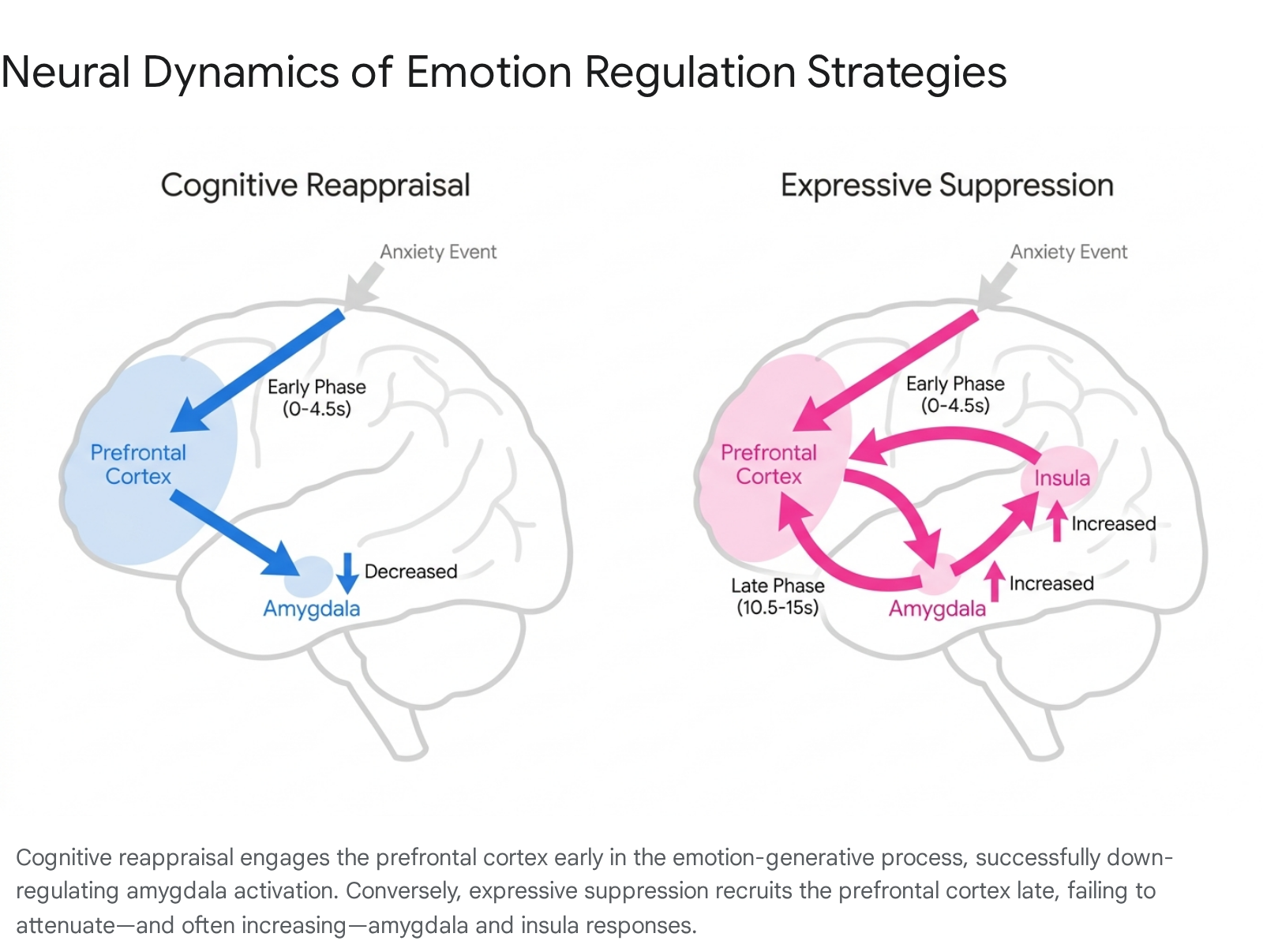
Functional magnetic resonance imaging (fMRI) studies reveal that reappraisal and suppression operate through distinct neural networks and temporal dynamics. Cognitive reappraisal results in early prefrontal cortical (PFC) responses - specifically within the medial and lateral PFC - occurring within the first 0 to 4.5 seconds of exposure to an emotional stimulus 1114. This early cognitive control successfully down-regulates activation in the amygdala and insula, the subcortical regions responsible for threat detection and emotional arousal 11363738.
In contrast, expressive suppression produces late PFC responses, typically observed 10.5 to 15 seconds post-stimulus 11. Because the emotional response is already underway, suppression fails to diminish amygdala and insula activation. In many cases, it actively increases neural activity in these threat-processing centers, explaining the paradoxical increase in subjective distress 1139.
Neuroanatomically, individuals who habitually rely on suppression show larger gray matter volumes in the medial PFC and dorsal anterior cingulate cortex, reflecting the sustained, intensive effort required to constantly inhibit emotion-expressive behavior 1437. Reappraisers, conversely, show brain connectivity patterns that facilitate more efficient down-regulation of anxiety. Interpersonal hyperscanning research further demonstrates that reappraisal evokes broader and more effective intrapersonal and interpersonal neural couplings between the cognitive control, social cognition, and mirror neuron systems compared to suppression 4041.
Arousal Congruency and the Anxiety as Excitement Framework
While the superiority of cognitive reappraisal over suppression is well-documented, performance psychology research has identified critical nuances in how reappraisal should be targeted. Historically, the default advice given to anxious speakers has been to "try to calm down" 1221. However, empirical evidence demonstrates that this specific reappraisal target is physiologically flawed.
The Limitation of Calming Strategies
Anxiety is an emotion characterized by high physiological arousal and negative valence. Calmness, by contrast, is characterized by low arousal and positive valence 124245. Reappraising anxiety as calmness requires the individual to execute a massive physiological shift (forcing the body from high to low arousal) while simultaneously attempting a cognitive shift (from negative to positive valence). Because high arousal is automatic and biologically driven by the sympathetic nervous system, willing the body to abruptly shut down its fight-or-flight response on command is exceedingly difficult 22143. Consequently, the attempt to "calm down" frequently fails, leading to frustration, experiential avoidance, and further performance deterioration 214347.
Reappraising Anxiety as Excitement
A foundational shift in performance psychology, pioneered by researcher Alison Wood Brooks at Harvard Business School, proposes a far more effective strategy: reappraising anxiety as excitement 1212.
Anxiety and excitement are "arousal congruent." Both emotional states share nearly identical physiological signatures - elevated heart rate, heightened alertness, increased respiration, and elevated cortisol 2543. A laboratory test measuring pure physiological symptoms cannot reliably distinguish between an individual experiencing severe pre-performance anxiety and one experiencing intense excitement 45. The primary difference lies solely in the cognitive appraisal: anxiety frames the high arousal as a threat, whereas excitement frames it as an opportunity 543.
Because the physiological states are identical, reappraising anxiety as excitement requires no change in the body's autonomic arousal level; it requires only a cognitive shift in valence from negative to positive 22142. This represents a much shorter cognitive distance to travel and allows the individual to align with their body's physiology rather than resisting it 4543.
Empirical Performance Outcomes of Arousal Congruency
The efficacy of arousal-congruent reappraisal has been rigorously tested across multiple domains involving public performance, vocal execution, and timed cognitive tasks. Individuals employing minimal interventions - such as simply stating "I am excited" out loud prior to the task - demonstrate profound performance improvements:
- Public Speaking Performance: Speakers who reframed anxiety as excitement were independently rated by observers as more persuasive, competent, confident, and persistent. They spoke for longer durations and engaged the audience more effectively than those who stated they were anxious or those who explicitly attempted to calm down 1424449.
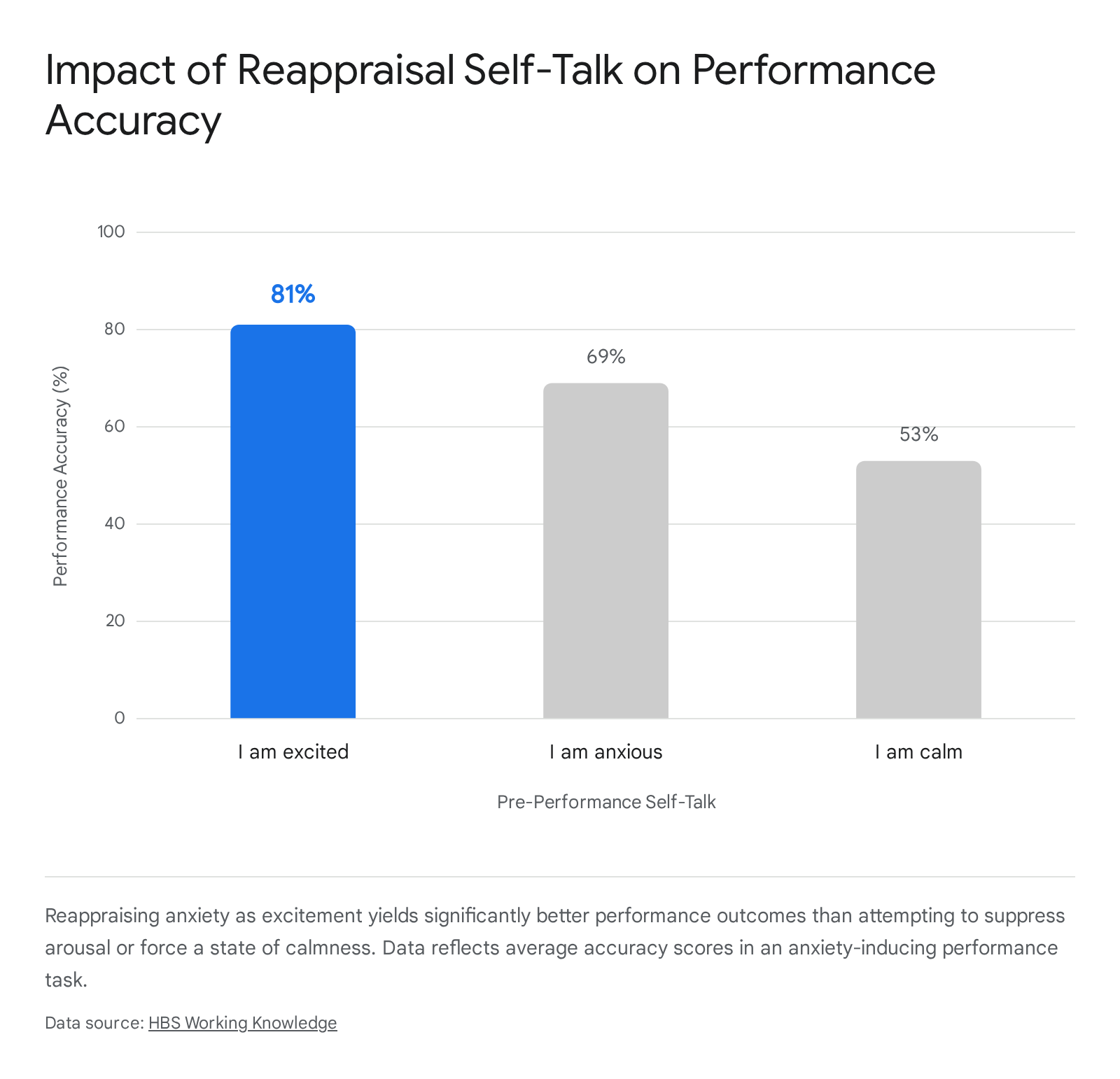
- Vocal Accuracy: In laboratory karaoke protocols designed to induce acute performance anxiety, participants utilizing excitement self-talk achieved an objective pitch and rhythm accuracy score of 81%, compared to 69% for those who stated "I am anxious" and a mere 53% for those who stated "I am calm" 42.
- Mathematical and Cognitive Tasks: Under intense time pressure, students instructed to reframe physiological arousal as a beneficial resource scored significantly higher (up to 8 percent improvement) on math problems than control groups 549. Interventions delivering minimal reappraisal messaging to students prior to exams significantly improved academic outcomes and reduced long-term worry 5045.
This intervention functions by altering the individual's psychological orientation. Anxiety-induced threat mindsets cause individuals to fixate on potential negative outcomes and failure, draining working memory 1521. Excitement-induced opportunity mindsets broaden cognitive focus, allowing individuals to leverage their physiological arousal as energetic enthusiasm and passion 1214243.
Challenge versus Threat Appraisals in Competitive Contexts
The application of arousal reappraisal extends deeply into high-stakes competitive environments, expanding the traditional anxiety framework into the Theory of Challenge and Threat States. This theory posits that physiological arousal in high-pressure scenarios is mediated entirely by appraisal states.
Research in professional esports provides a rigorous testing ground for these mechanisms. Sharpe et al. (2024) investigated the impact of unmitigated psychological pressure on Counter-Strike competitors. Under pressure, competitors reliably exhibited "threat appraisals," which correlated with elevated cognitive anxiety, suboptimal visual gaze behavior, and inferior action performance, despite the competitors mobilizing increased cognitive effort 235246.
However, when competitors received a single-session arousal reappraisal intervention - educating them that physiological stress responses are a facilitative evolutionary tool designed to aid performance - their psychological state shifted from a threat appraisal to a "challenge appraisal" 234748. This mindset shift yielded specific benefits: 1. Reduced somatic and cognitive anxiety 4748. 2. Increased quiet eye duration (a biometric marker of expert visual focus and attentional control) 4748. 3. Accelerated task completion times and heightened overall accuracy 474950.
The data reinforces that performance breakdown under pressure is not inevitable; rather, it is mediated by how the individual cognitively appraises their physiological activation 4946. Challenge states boost performance through more efficient physiology, including increased blood flow to the brain, higher cardiac output, and faster stress recovery compared to threat states 49.
Cross-Cultural Variances in Emotion Regulation Efficacy
While the cognitive superiority of reappraisal over suppression is treated as a universal axiom in foundational Western literature, recent cross-cultural research demands a calibrated, nuanced view. The psychological costs and benefits of specific emotion regulation strategies are heavily dependent on an individual's cultural context, specifically regarding the spectrum of individualism versus collectivism 51525354.
Individualistic versus Collectivistic Norms
In individualistic cultures (e.g., the United States, Western Europe, Australia), emotions are viewed as reflections of the authentic self. Emotional expression is culturally valued, and the restriction of emotional displays is viewed negatively 8515556. Consequently, when individuals from Western cultures utilize expressive suppression, they experience severe psychological dissonance. This dissonance manifests as the high physiological costs, decreased well-being, and social disconnection documented extensively in Western clinical psychology 8956.
Conversely, in collectivistic cultures (e.g., East Asia, the Middle East, Pakistan, Vietnam), cultural norms prioritize interdependence, collective welfare, and interpersonal harmony over individual emotional expression 8515255. In these contexts, expressing negative emotions like anxiety in an ingroup setting may be viewed as jeopardizing group cohesion 555758. Therefore, expressive suppression is frequently deployed as an adaptive tool to avoid disrupting social harmony.
Differential Mental Health and Performance Outcomes
The efficacy of suppression is highly context-dependent. Studies comparing Western and East Asian demographics reveal that the negative psychological and physiological consequences of suppression are significantly less pronounced - and sometimes absent entirely - in collectivistic populations 5158. For instance, a study comparing Pakistani and American students found that while suppression positively predicted psychological distress among American students, the effect was significantly moderated by the collectivistic cultural background of the Pakistani sample 5559. Similarly, East Asian individuals tend to engage in suppression more frequently, but evaluate the self less negatively when doing so, compared to Western counterparts 5158.
| Cultural Context | Cognitive Reappraisal Efficacy | Expressive Suppression Efficacy | Underlying Cultural Value |
|---|---|---|---|
| Western / Individualistic | Highly adaptive. Improves performance, reduces distress 515556. | Highly maladaptive. Increases physiological stress, impairs cognition 85156. | Prioritizes authentic self-expression and individual agency 5657. |
| East Asian / Collectivistic | Highly adaptive. Universally associated with positive well-being 515258. | Contextually adaptive. Preserves social harmony; negative psychological costs are buffered 8515258. | Prioritizes interpersonal harmony, group cohesion, and duty 85254. |
Despite the variance in suppression outcomes based on cultural frameworks, cognitive reappraisal remains consistently associated with positive psychological states and mental health across all cultural boundaries. For example, a large-scale study conducted across 87 countries demonstrated that instructing individuals to use cognitive reappraisal effectively decreased unpleasant emotions uniformly across distinct cultural backgrounds 5156. Therefore, while suppression may not be as inherently destructive for a collectivistic public speaker, reappraisal remains the universally optimal recommendation for mitigating performance anxiety 5156.
Boundary Conditions and Limitations of Reappraisal
While cognitive reappraisal is highly effective, it is not a panacea. Performance researchers emphasize that reappraisal possesses distinct boundary conditions, primarily tied to the individual's cognitive load and the intensity of the physiological arousal.
Extreme Physiological Arousal and High Cognitive Load
Cognitive reappraisal is an executive function that relies heavily on the prefrontal cortex and draws directly upon limited working memory resources 61829. Under conditions of moderate stress, individuals generally possess sufficient cognitive bandwidth to reinterpret their anxiety 16. However, as task demands escalate and physiological strain reaches near-maximal levels, the efficacy of cognitive reappraisal diminishes severely 1629.
When an individual enters an extreme panic state or an acute stress response (characterized by overwhelming HPA axis activation and severe sympathetic overdrive), their working memory is effectively hijacked by threat-detection mechanisms 5660. At this biological threshold, the prefrontal cortex goes "offline," rendering the individual incapable of the complex cognitive restructuring required for reappraisal 529. Research examining the interaction between anxiety and cognitive load demonstrates that high-load tasks (such as complex problem solving or high-stakes public speaking) are highly susceptible to anxiety-related disruption. Asking a panicked individual to execute a complex reappraisal under these conditions may result in complete cognitive overload and performance breakdown 61661.
Alternative Strategies Under High Cognitive Load
When an individual breaches the threshold where active cognitive reappraisal is no longer viable, performance researchers recommend alternative, lower-load emotion regulation techniques.
- Distraction: Shifting attention entirely away from the emotion-eliciting stimuli requires significantly less executive functioning than actively reappraising it. Under high-intensity stress or pain (such as maximum-effort exercise or severe panic), distraction has been shown to be effective where reappraisal fails due to ceiling effects 2962.
- Mindful Acceptance: Mindful acceptance involves acknowledging the presence of anxiety without attempting to change, evaluate, or suppress it 7063. Empirical evidence demonstrates that acceptance consumes fewer mental resources than both expressive suppression and cognitive reappraisal 17.
- Mindfulness-Based Stress Reduction (MBSR): The Dual-mode Model of Mindful Emotion Regulation (D-MER) suggests that mindfulness positively correlates with reappraisal success but requires less active cognitive force. Brief mindfulness inductions can effectively mitigate state anxiety by detaching the individual's identity from the physiological response. This makes acceptance a highly viable fallback strategy when the cognitive load is too high for active cognitive reframing 13706465.
| Emotion Regulation Strategy | Cognitive Load Requirement | Efficacy under Extreme Stress/Panic | Primary Mechanism |
|---|---|---|---|
| Cognitive Reappraisal | Moderate to High 618 | Low. Fails due to prefrontal cortex hijacking 529. | Active reframing of stimulus meaning 1018. |
| Expressive Suppression | Very High 1617 | Harmful. Induces cognitive overload and systemic stress 16. | Active inhibition of behavioral expression 910. |
| Mindful Acceptance | Very Low 1765 | High. Functions well when working memory is depleted 17. | Non-judgmental observation of physiological state 7065. |
| Distraction | Low 29 | High. Shifts attention away from threat entirely 2962. | Disengagement of attention 29. |
Synthesis of Recommended Cognitive Techniques for Performance
Based on the exhaustive synthesis of emotion regulation literature, performance psychology, and neurobiological data, researchers recommend a hierarchy of specific, evidence-based cognitive techniques for managing public speaking anxiety.
First, individuals must actively abandon attempts to suppress physiological arousal or force a state of calmness. "Calming down" is an arousal-incongruent strategy that tasks the nervous system with an impossible physiological deceleration, frequently resulting in performance impairment, experiential avoidance, and heightened physiological stress 254347.
Instead, speakers should utilize Arousal Reappraisal Protocols. When the physiological markers of anxiety manifest - such as elevated heart rate, sweaty palms, or shallow breathing - the individual should immediately deploy specific, positive self-talk, such as stating "I am excited" aloud 1543. This simple cognitive shift aligns with the body's natural physiological state, re-labeling the sympathetic nervous system activation as a performance-enhancing resource rather than a threat 34574.
For deeper preparation, speakers should leverage the reAppraisal Framework by consciously engaging in reconstrual (viewing the audience as peers seeking information rather than hostile judges) and repurposing (shifting the goal from achieving a perfect evaluation to delivering value and connection) 192425.
If pre-performance anxiety levels escalate to the point of cognitive overload or panic, speakers should temporarily default to Mindful Acceptance. By utilizing slow exhale-focused breathing to engage the parasympathetic nervous system, and allowing the physiological wave of anxiety to pass without resistance or judgment, the individual can preserve working memory 5176574.
By aligning cognitive strategies with human neurobiology rather than fighting against it, individuals can transform public speaking anxiety from a debilitating barrier into a powerful catalyst for optimal performance.