
Does Consensus or a Single Owner Make Better Decisions
Consensus decision-making generally yields higher-quality outcomes, reduces critical errors, and ensures deep team alignment, but it sacrifices speed and can occasionally mask individual accountability. Conversely, single-owner decisions are executed much faster and thrive in rapidly changing markets, but they risk catastrophic failure if the leader lacks complete information or fails to secure the team buy-in required for implementation. Ultimately, the most effective organizations do not strictly favor one over the other; they adopt hybrid frameworks that match the decision-making model to the complexity of the problem, the cultural expectations of their workforce, and the specific urgency of their industry.
Decoding Decision Quality in Organizations
Before evaluating whether a group or an individual is better equipped to make a choice, it is necessary to define what actually constitutes a "good" decision. In organizational behavior research, there is a vital and often misunderstood distinction between decision quality and outcome quality 1. A decision can be made using a flawless, data-driven process and still result in a negative outcome due to unforeseeable market shifts or black swan events. Conversely, a terrible, biased process can occasionally yield a lucky outcome 12.
Because outcomes are heavily influenced by external variance, researchers measure decision quality by examining the process itself: how well the decision-maker utilizes available information, mitigates cognitive biases, aligns with organizational goals, and secures the commitment necessary for long-term implementation 23. In highly complex fields such as investment finance, engineering design, or medical diagnostics, decision quality is often undermined by predictable cognitive failures like overconfidence, herd behavior, and outcome bias 12. When incentives reward immediate, visible returns over rigorous process discipline, managers face intense pressure to prioritize speed and outcome over careful judgment 1.
The primary tension in designing any decision-making framework is the speed-accuracy tradeoff. Acquiring more information - or consulting more people - generally increases the accuracy of a judgment, but it incurs a heavy opportunity cost in time, resources, and cognitive load 3. Interestingly, the relationship between time spent and decision quality is not always linear. In cognitively demanding strategic environments, researchers have found a negative association between decision time and quality. For example, in a comprehensive study analyzing professional chess players, researchers noted that faster decisions were often of higher quality 4. This does not mean that rushing produces better results; rather, it indicates that incredibly fast decisions typically occur when a decision-maker has a highly accurate intuition early in the process, rendering further deliberation unnecessary. When situations are highly complex or ambiguous - measured by a smaller gap between the best and next-best options - decision-makers naturally take longer, yet they are still more prone to error due to the inherent difficulty of the problem 45.
The Mechanics and Psychology of Group Consensus
Consensus decision-making is a collaborative process wherein a group discusses an issue until it finds a solution that all members can actively support and commit to executing. It is widely recognized in academic literature for producing superior accuracy, fostering inclusivity, and generating comprehensive solutions 67.
However, true consensus does not necessarily mean unanimous, enthusiastic agreement from every single participant. According to organizational negotiation research, such as models developed at MIT Sloan, consensus exists on a spectrum of acceptance. A team has reached consensus if all individuals fall within a tolerable threshold of agreement. This ranges from a participant giving an unqualified "yes" to the decision, to a participant acknowledging the choice is acceptable, to a participant simply stating they can "live with the decision" despite not being entirely enthusiastic. The boundary of consensus is broken only when a participant actively refuses to support the decision, feeling the need to stand in the way of its execution due to a fundamental disagreement 8. If the entire group can commit to not blocking the decision and actively supporting its implementation, consensus is achieved 6.
Cognitive Synergy and Error Reduction
Decades of behavioral economics and social psychology research demonstrate that groups generally outperform individuals on intellective and strategic tasks. A meta-analysis of project teams solving contextually relevant organizational problems found that groups outperformed their most proficient individual member 97% of the time, achieving significant process gains that could not be explained merely by averaging individual scores 11.
This phenomenon is known as "cognitive synergy." Researchers distinguish between two specific types of synergy in group dynamics. Weak cognitive synergy occurs when the group's collective performance exceeds the average performance of its individual members 9. Moving from an autocratic style to a consultative style improves quality, but moving to a full group decision-making style maximizes this weak synergy. A large-scale 2023 experimental study involving nearly 600 teams found that shifting from an autocratic decision-making style to a group consensus style improved overall decision quality by nearly 24%, drastically reducing error rates compared to individual averages 9.
Strong cognitive synergy occurs when the group's performance actually exceeds that of its absolute best individual member. While highly desired by organizations, strong synergy is rare. In many cases, a single highly competent expert can still outline a better theoretical solution than a group, with studies showing that over half of teams produce consensus decisions of slightly lower pure academic quality than their best member's isolated proposal 9. However, the group process acts as a vital safeguard. Group consensus acts as a natural filter for extreme risk. Groups are significantly less likely to make highly misguided, catastrophic decisions because diverse perspectives balance out individual blind spots 9. Furthermore, groups tend to behave closer to game-theoretical assumptions of rationality than individuals do, demonstrating less susceptibility to myopic loss aversion and an improved ability to update beliefs based on new evidence 10.
This predictive power of consensus is highly visible in financial risk modeling. When comparing consensus-driven credit ratings - aggregated from over 40 leading global banks - against single-agency ratings like S&P, the consensus model demonstrates remarkably strong discriminatory power in predicting corporate defaults. Over a ten-year study period, consensus ratings offered equivalent or superior predictive accuracy across one, three, and five-year horizons, proving that collective, aggregated intelligence often outperforms single-entity analysis in complex risk environments 14. The Nordic private equity market provides another compelling example of the financial value of consensus. Nordic buyout managers, operating in cultures that heavily favor transparent, consensus-based governance and high employee participation, have consistently generated returns that outperform buyouts in the rest of Europe and North America, particularly in small-to-mid-market investments where local network buy-in is paramount 11.
The Risks of Consensus: Speed, Fatigue, and Groupthink
The collective benefits of consensus come at a steep operational cost. The most obvious drawback is the time required to deliberate, which can lead to missed market windows, decision paralysis, and severe organizational fatigue 1116.
Furthermore, a consensus model is highly fragile if it lacks psychological safety. According to Patrick Lencioni's organizational models, if a team lacks "vulnerability-based trust," consensus-seeking devolves into dysfunction. Without trust, team members fear constructive conflict. Instead of engaging in rigorous debate over the facts, the team settles for "artificial harmony." Real risks, dissenting opinions, and critical trade-offs remain undiscussed to avoid offending peers 1718.
This dynamic severely dilutes accountability. When a decision is collectively owned by everyone, no single person feels the burden of responsibility if it fails. When debate is suppressed in the name of reaching a quick, polite consensus, people may comply in the meeting room but fail to truly commit to the execution. This leads to the infamous "meeting after the meeting," where passive-aggressive resistance undermines the implementation of the superficially agreed-upon plan 617. In medical diagnostic teams, for example, systematic group biases and the perceived pressure to align with senior staff can result in suboptimal group decisions, highlighting that consensus is only valuable when communication remains genuinely open and critical 12.
Single-Owner Decisions and the Need for Speed
At the opposite end of the spectrum is the single-owner model, which prioritizes speed, clear accountability, and rapid execution. This model encompasses both purely autocratic and consultative leadership styles.
Autocratic vs. Consultative Frameworks
In an autocratic, or directive, decision-making process, a single individual makes choices completely on their own without seeking input or feedback from the broader group 202113. This style is highly efficient and establishes an unambiguous chain of accountability. It is particularly useful in time-sensitive crisis scenarios, when managing strictly operational, reversible choices, or when clear, non-negotiable instructions are required immediately 723.
However, pure autocracy often breeds intense resentment and can be detrimental in highly competitive or creative environments. It severely limits creative input, can drastically reduce overall team motivation, and relies on the dangerous assumption that the single decision-maker possesses all necessary data 913. In competitive team sports, for example, autocratic leadership is frequently cited as the least-preferred style among athletes, as it limits creative play and relies too heavily on negative reinforcement, whereas athletes prefer democratic or servant-leadership styles that foster community and ownership 13.
The consultative approach serves as a highly effective functional middle ground. Here, a designated decision owner actively seeks input, data, and diverse perspectives from key stakeholders but ultimately retains sole authority to make the final call 720. Consultative decisions yield significantly higher quality outcomes than pure autocratic decisions because they integrate a wider array of information, yet they remain faster than consensus models because they do not require the exhausting process of securing unanimous agreement 914.
Environmental Constraints: Dynamism and Munificence
Whether an organization should prioritize the speed of a single owner or the quality of a consensus group depends heavily on external environmental constraints. Organizational research reveals that the impact of strategic decision speed on overall decision quality is not universally positive; it is heavily moderated by the specific market environment 15. Two factors are critical in this equation: environmental dynamism (the rate and unpredictability of change in the industry) and environmental munificence (the abundance of resources and growth opportunities available) 15.
When a firm operates in an environment that is highly dynamic and highly munificent, fast, single-owner decision-making drastically improves decision quality and firm performance. In these markets, companies must move rapidly to seize fleeting first-mover advantages, and because capital and resources are abundant, they have the safety net required to quickly rectify any mistakes that arise from moving too fast 15.
However, when an environment is highly dynamic but suffers from low munificence - a hostile, resource-scarce market - prioritizing speed can be actively harmful. In hostile environments, a single ill-conceived, autocratic decision can threaten the very survival of the firm. Rivals will quickly imitate successful moves, erasing first-mover advantages, and the firm lacks the financial resources to recover from hasty errors. In these unforgiving contexts, slower, more analytical, and consensus-driven approaches are mandatory for ensuring strategic survival 15.
The Perils of the Single-Owner Execution Gap
The critical vulnerability of any single-owner decision is execution failure. If a leader makes a swift, highly accurate decision but fails to secure the buy-in of the people required to execute it, the resulting friction will inevitably cost more time than a consensus process would have taken initially 1626. As business leaders often discover, an organization may have the objectively correct answer, but if implementation is stalled by internal resistance, lack of understanding, or apathy, it is the functional equivalent of finishing last in a competitive race 16. Indecisive or excessively autocratic leaders breed indecisive followers, replacing a culture of innovation with a culture of compliance and complexity 16.
Cultural Nuances in Decision-Making Frameworks
Decision-making styles are deeply rooted in regional cultural norms, creating significant, often invisible friction in multinational organizations. Erin Meyer's "Culture Map" framework highlights the stark contrasts between how different societies view authority and how they actually execute decisions, noting that an egalitarian culture does not automatically equate to a consensual decision-making culture 162817.
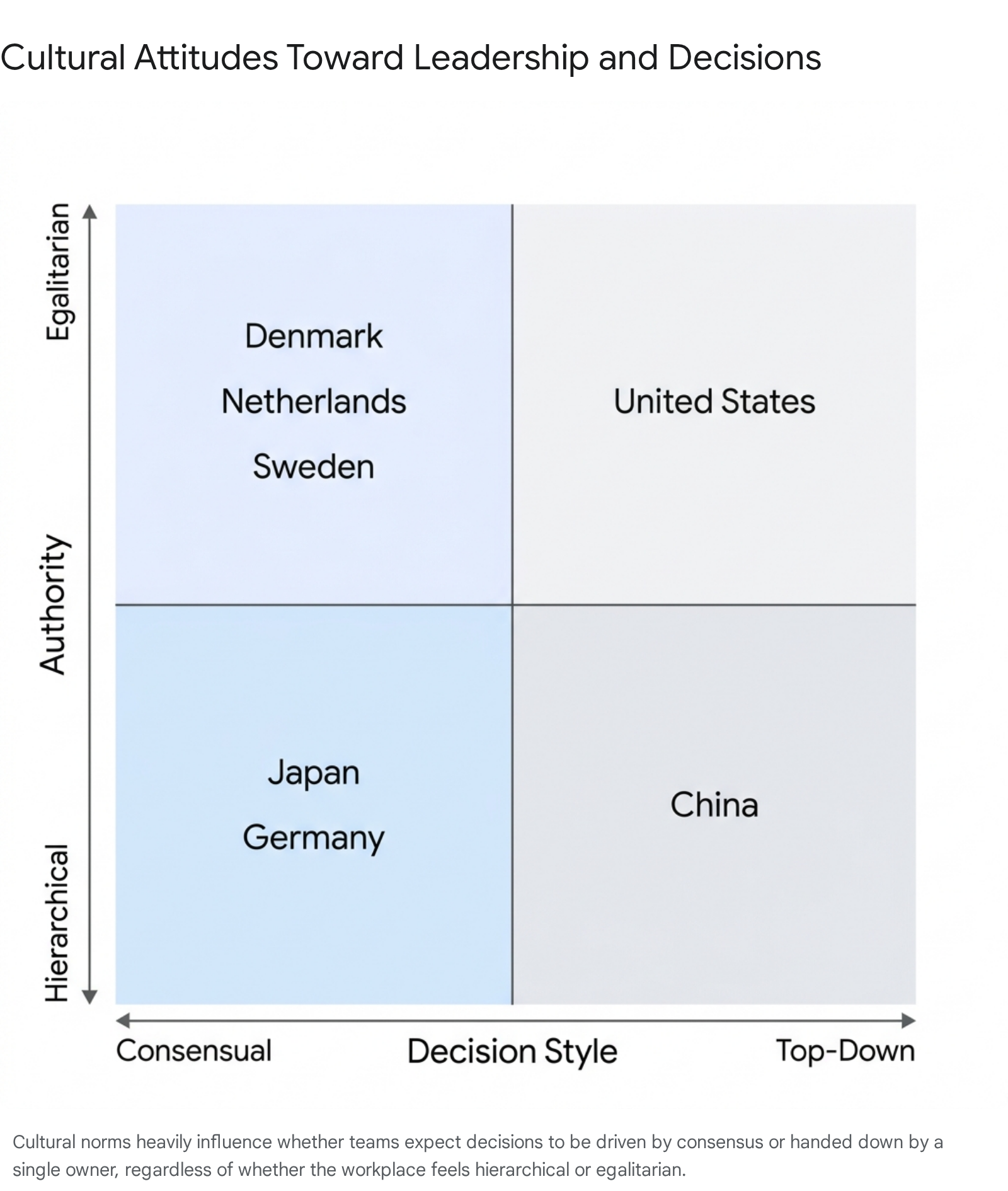
In strongly consensual cultures, such as Japan, Sweden, and the Netherlands, decision-making is an intentionally long, inclusive process. Japan famously utilizes the ringi system, systematically pushing a proposal through every single management level to gather input and build unanimous agreement before any action is taken 2818. Swedish corporate culture relies heavily on consensus to ensure that all potential obstacles are addressed early, trusting that broad input prevents future failures 26. These are categorized as "Big D" decisions. They require a massive upfront investment of time and effort to finalize, but once the decision is made, implementation is lightning-fast because all stakeholders are already deeply aligned, and the decision is considered final and unalterable 2616.
Conversely, in top-down decision-making cultures, such as the United States and China, decisions are primarily made quickly by individuals in charge. These are known as "little d" decisions. American corporate culture, despite being highly egalitarian in how people speak to one another (using first names, encouraging open debate), remains incredibly individualistic and top-down when it comes to finalized actions. Decisions are made rapidly to maintain momentum and are viewed merely as flexible agreements to move forward, with the explicit understanding that the decision can and will be altered later if new data emerges 162817.
When these distinct cultures mix within global teams, structural misunderstandings are inevitable. Team members from consensus-driven cultures often view top-down American or Chinese leaders as abrupt, dictatorial, and reckless for moving forward without full alignment. Meanwhile, workers from top-down cultures view the agonizingly slow consensus-building of their Nordic or Japanese counterparts as a highly inefficient waste of time that stalls progress 2818. Resolving this requires explicit cross-cultural training and the adoption of hybrid approaches, where teams actively designate specific strategic decisions for consensual processes and specific urgent matters for top-down execution 31.
Bridging the Gap: Frameworks for Hybrid Decision Making
Given the inherent tradeoffs between the speed of the individual and the safety of the group, modern organizations increasingly rely on structured frameworks that attempt to capture the best elements of both models.
The "Disagree and Commit" Principle
Popularized heavily by technology giants like Amazon and Intel, the "disagree and commit" philosophy acts as a potent organizational remedy for both the endless paralysis of consensus culture and the silent resentment of autocratic culture 183233.
In this operational model, leaders and team members are actively obligated to respectfully challenge decisions and express their concerns during the deliberation phase. Constructive conflict is not avoided; it is treated as a vital mechanism for stress-testing ideas, ensuring diverse perspectives are heard, and improving overall decision quality 171832. However, the critical pivot occurs once a designated decision owner makes the final call. At that moment, all debate ceases. The team does not need to reach a unanimous psychological consensus, but every single member is expected to fully commit to executing the decision exactly as if it were their own idea 1832.
This framework effectively converts abstract debate into concrete clarity. It prevents decisions from being endlessly re-litigated by dissenting factions and stops the passive-aggressive behavior that ruins implementation 1723. To function effectively, organizations must enforce mechanisms like formal decision logs - documenting exactly who made the decision, what was decided, why, and what specific metrics would trigger a reversal of the decision - and publish these rationales within 48 hours 1723.
Decentralization and Agile Frameworks
The software and product development industries have spent two decades aggressively pursuing models that balance speed and quality through Agile methodologies. Historically, organizations adopted Agile primarily to "accelerate time to market" and boost delivery speed. However, recent data indicates a profound maturation in how companies view these frameworks. In the 17th Annual "State of Agile" report, for the first time in nearly two decades, the number one reason companies cited for adopting Agile shifted away from raw speed and toward the desire to "prioritize, deliver, and measure incremental customer and business value" 19. Quality and value have officially superseded raw velocity 19.
Enterprise frameworks like SAFe (Scaled Agile Framework) achieve this balance by strictly enforcing decentralized decision-making. Tactical and operational choices - such as how to implement a specific feature or resolve a day-to-day workflow issue - are pushed down to the specific teams closest to the work, completely eliminating the wait times and bottlenecks associated with traditional top-down executive approvals 35. Higher-level strategy and significant business risks remain centralized, but frontline teams operate within established "decision guardrails." This empowers them with the autonomy to course-correct instantly based on real-time feedback, fostering a sense of ownership that naturally accelerates delivery because teams feel responsible for the outcomes, not just the output 3520.
The Decision Matrix: Objectifying the Process
Whether an organization utilizes a group consensus model or a consultative single-owner approach, the mechanics of the decision can be vastly improved using quantitative tools like a Decision Matrix (also known as a Pugh matrix, grid analysis, or Multi-Criteria Decision Analysis) 213822.
A weighted decision matrix removes raw emotion, fatigue, and cognitive bias by breaking highly complex problems down into quantifiable criteria 3823. The team begins by identifying all available options. They then determine the crucial factors for success (e.g., implementation cost, time to market, return on investment, ease of maintenance), assign a numerical weight to each factor based on its strategic importance, and score every option against those criteria 2124.
This tool is invaluable for driving consensus without falling into the trap of endless, circular debate. By focusing the group's arguments on the weight of the underlying criteria rather than fighting over the final outcome, it depersonalizes the conflict. It transforms subjective, qualitative impressions into a clear, quantifiable ranking, significantly improving the objectivity, transparency, and quality of the final choice 21224243.
| Feature | Autocratic | Consultative | Group Consensus | Agile / Decentralized |
|---|---|---|---|---|
| Decision Speed | Very High | Medium to Fast | Low | High (within guardrails) |
| Quality of Decision | Highly dependent on leader's isolated expertise | High (integrates diverse data while maintaining speed) | Very High (strongest safeguard against severe errors) | High (relies on rapid, iterative feedback loops) |
| Team Buy-In | Low to Moderate | Moderate to High | Very High | High (driven by local team ownership) |
| Accountability | Singular and clear | Singular and clear | Diffused among the group | Distributed to specific operational teams |
| Best Used For | Crises, simple/reversible operational choices | Complex decisions requiring speed, data, and clear ownership | High-stakes, irreversible strategic shifts and cultural changes | Fast-paced product development and continuous delivery |
Decision Velocity in the Era of Remote Work
The global shift toward hybrid and remote work models has fundamentally altered how corporate decisions are formulated and executed. In 2025, approximately 79% of remote professionals reported lower stress levels, and broad studies indicate that remote work increases individual productivity by 35% to 40% due to fewer office distractions and highly focused work hours 4445. However, this individual productivity boom poses unique, systemic challenges for collaborative decision-making and group synergy.
Organizations increasingly track "Decision Velocity" - the total time elapsed from the initial identification of a problem to the full implementation of the decision. Benchmarks for this metric vary wildly depending on the specific context and risk profile of the choice. For example, a standard marketing decision in B2C e-commerce may confidently be executed in 1 to 3 days, whereas a strategic pricing decision in an enterprise sales environment might require 10 to 21 days of deliberation 46.
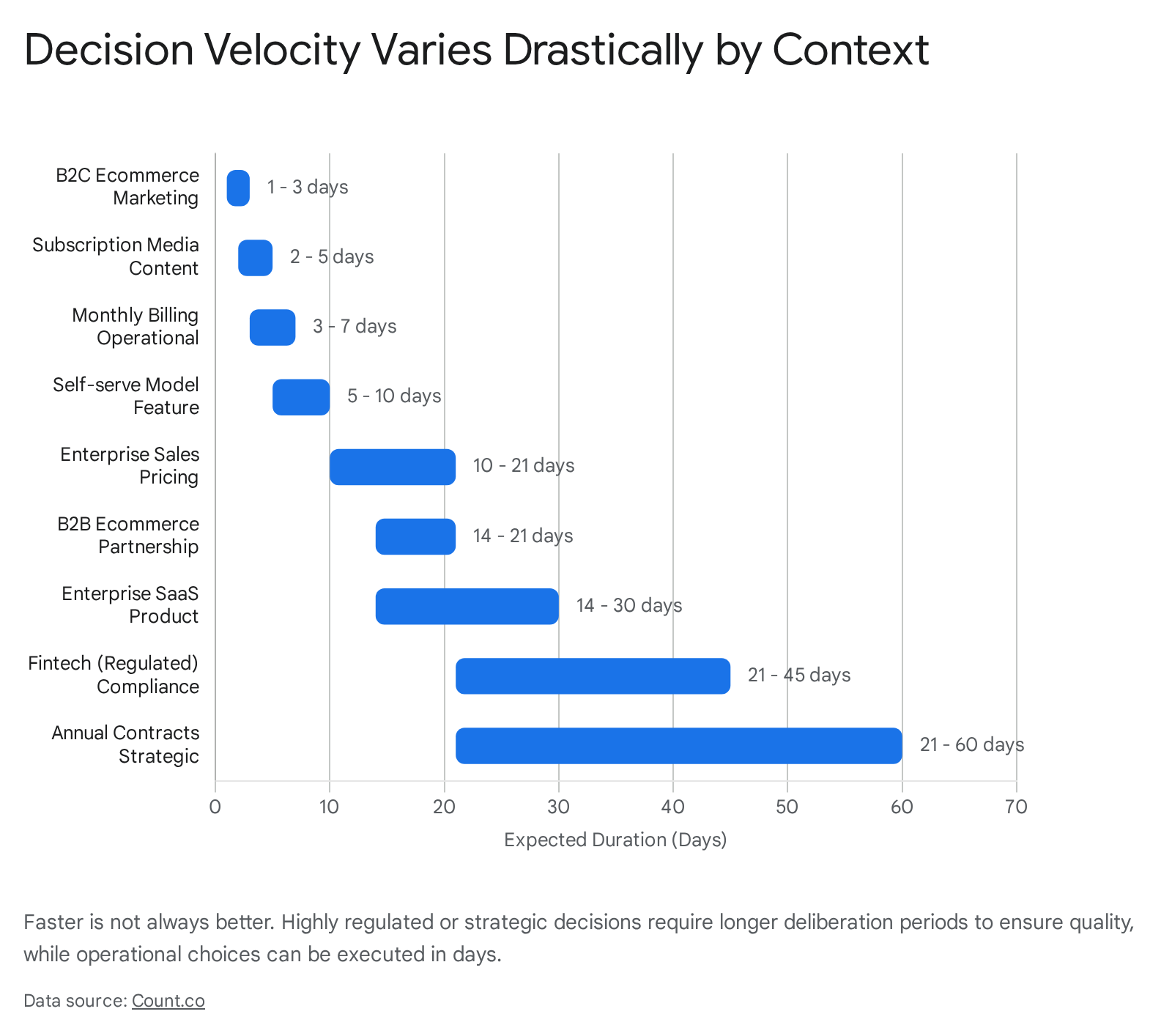
In a highly distributed workforce, the insistence on synchronous consensus - waiting weeks to schedule a video meeting to get every single stakeholder to agree - severely bottlenecks this decision velocity. Consequently, successful remote and hybrid teams are rapidly transitioning to asynchronous-first decision-making models 2325. This involves documenting decision rationales in shared digital spaces, setting strict, clear deadlines for input, and relying heavily on the single-owner consultative model to keep projects moving forward without requiring everyone to be in the same digital room 2325.
However, research indicates that while remote tools are excellent for routine, structured decisions, physical in-person interaction still holds a distinct, measurable advantage for highly complex, high-stakes consensus building. A comprehensive study published in PNAS analyzing scientific conferences found that while formal, structured interactions function perfectly well in virtual settings, informal interactions and the crucial building of community ties thrive almost exclusively at in-person events 26. These informal, non-verbal cues present in physical meetings foster the vulnerability-based trust necessary to navigate difficult tradeoffs without fracturing the team 2627. Similarly, research on medical practice guideline panels found that while virtual meetings were vastly superior for resource efficiency and created no noticeable drop in the quality of the final recommendations, participants still heavily favored in-person formats for their ability to foster deep engagement, nuanced discussion, and professional networking 28. The consensus points toward a hybrid sweet spot: leveraging asynchronous, remote tools for speed and data gathering, while reserving in-person gatherings for the friction-heavy task of building true strategic alignment.
The AI Variable: Augmenting Human Judgment
Artificial intelligence is rapidly becoming the third, highly disruptive pillar in the decision-making dynamic, acting as a hyper-efficient participant that can process vast data streams, automate analytical tasks, and significantly reduce human cognitive bias 515253. According to recent industry surveys, nearly 95% of professionals affirm agile's critical relevance, and almost half report leveraging generative AI infused tools to refine project planning, forecast data, and automate routine tasks 5329.
However, the integration of AI does not replace the fundamental need for decision ownership; it merely shifts the nature of the task from data generation to data curation. Studies show that AI decision quality is highly vulnerable to phenomenon known as "context collapse." When high-velocity data streams are collected under varying conditions or for different original purposes, AI systems can easily generate misleading, distorted, or inaccurate outcomes if they lack the contextual nuances that a human expert would instinctively recognize and adjust for 5152.
Furthermore, AI cannot currently substitute for baseline human judgment. A striking study conducted by academics at Harvard Business School and the University of California at Berkeley involving Kenyan entrepreneurs revealed a counterintuitive reality: providing AI assistance to users who lacked fundamental business acumen actually widened the performance gap between them and their high-performing peers 30. The technology alone could not reliably distinguish a mediocre idea from a brilliant one, nor could it guide long-term strategy without the steady, guiding hand of an experienced human decision-owner 30. AI is an unmatched tool for accelerating the gathering and synthesizing of information, but the final evaluation of that information still strictly requires structured human oversight, ethical governance, and deep, context-aware business judgment 5253.
Bottom line
The debate between group consensus and single-owner decision-making is not about crowning a universally superior method, but rather about deploying the correct structural tool for the specific environmental context. Single-owner decisions excel in highly dynamic, resource-rich environments where speed, operational agility, and clear accountability are paramount. Consensus models remain essential for high-stakes, complex problems where minimizing severe errors and ensuring deep execution buy-in far outweigh the cost of lost time. Ultimately, organizations that thrive combine the best of both worlds by establishing high-trust cultures that embrace the "disagree and commit" philosophy, leveraging data-driven matrices to maintain objectivity, and integrating AI carefully to augment - not replace - human judgment.