
What Happens to Decision Quality in Larger Meetings
As meeting attendance grows beyond five to seven participants, the quality and speed of group decision-making reliably decline due to psychological friction, social loafing, and communication bottlenecks. To maintain effectiveness, research suggests organizations should cap decision-focused meetings at single digits, utilizing separate formats and asynchronous channels for broader brainstorming or information sharing.
The Core Paradox of Group Collaboration
Organizations rely on meetings as the primary mechanism for collaboration, problem-solving, and strategic alignment. In the modern corporate landscape, it is estimated that between 36 and 56 million meetings occur daily in the United States alone, consuming vast amounts of human capital 1. However, structural decisions regarding who is invited and how many individuals sit at the table profoundly dictate the ultimate success of these gatherings. An extensive body of research spanning organizational psychology and corporate management science consistently points to a clear, inverse relationship between the size of a decision-making group and the quality of its output 234.
When humans gather to solve a problem, the prevailing assumption is that more minds generate better ideas. This concept, often referred to as synergy, assumes that the collective intelligence of a group will produce something greater than the sum of individual contributions 5. However, organizational psychologists note that synergy is the exception rather than the default 5. Instead, groups consistently fall victim to what is known as "process loss" 5678.
First defined by psychologist Ivan Steiner, process loss represents the gap between a group's theoretical potential productivity and its actual realized productivity 578. Steiner observed that actual output is always equal to potential productivity minus process loss, plus any process gain 7. As the size of a meeting increases, the variables contributing to process loss - such as coordination difficulties, communication breakdowns, and declining motivation - rapidly overtake any marginal gains provided by adding another perspective to the room 68.
The Mathematics of Meeting Size: Thresholds and Limits
The corporate sector has long sought to quantify the exact point at which a meeting transitions from a productive working session into an inefficient gathering. Through decades of observation and data analysis, researchers have identified specific numerical thresholds that dictate meeting success.
The "Rule of Seven" and Decision Decay
In the context of decision-making, the threshold for effectiveness is remarkably low. Extensive research conducted by management experts Marcia W. Blenko, Michael C. Mankins, and Paul Rogers at Bain & Company established what is commonly referred to as the "Rule of Seven" 348. Their empirical analysis revealed that a decision-making group reaches its peak efficiency at exactly seven members 38.
Data indicates a notable 10% decline in decision-making effectiveness for every additional attendee added beyond the seventh person 4810. Consequently, a meeting containing 17 or more participants reaches a theoretical effectiveness of zero when tasked with making a concrete, strategic choice 4811. In groups of this size, the volume of communication channels and potential interpersonal conflicts becomes too immense to navigate efficiently, leading to circular discussions, stalled consensus, and the inevitable scheduling of follow-up meetings without any documented outcome 1012.
The Two-Pizza Team and Academic Consensus
This mathematical limitation has been famously operationalized in the technology sector through Amazon's "Two-Pizza Rule." Instituted by founder Jeff Bezos, the principle mandates that no team or meeting should be larger than what two pizzas can comfortably feed, which typically translates to five to eight people 13141516. The underlying logic is that smaller teams naturally minimize communication lines, reduce coordination overhead, and foster a heightened sense of individual ownership over the final product 1315.
Academic studies corroborate this corporate heuristic. Foundational research by organizational behavior experts J. Richard Hackman and Neil Vidmar analyzed member satisfaction against the ability to efficiently execute tasks, ultimately pinpointing an optimum group size of 4.6 members 315. Hackman noted that coordination friction explodes when team sizes reach double digits, leading to wasted time and diminished returns 15. Furthermore, anthropological research by Robin Dunbar suggests that the human brain can only comfortably maintain stable, highly cohesive working relationships with roughly five people simultaneously, further supporting the single-digit limit for high-stakes intellectual collaboration 15.
Defining Size by Objective: The 8-18-1800 Framework
While a team of five to seven is mathematically ideal for decision-making, it is critical to calibrate the size to the meeting's specific objective. Meeting science suggests that organizations should classify their gatherings and invite participants accordingly. The "8-18-1800 Rule" offers a practical framework for this calibration 17.
According to this rule, leaders should invite no more than eight people when the explicit goal is to make a decision or solve a critical problem 17. If the goal shifts to divergent thinking or brainstorming, the group can be expanded to 18 participants to capture a wider array of creative inputs 17. Finally, if the objective is purely informational - such as rallying the troops, announcing a strategic pivot, or sharing quarterly results - the size can scale to 1,800 or more, as these events do not require multi-directional conversational turn-taking 17.
Cognitive Friction: The Mechanisms of Process Loss
To understand why larger groups consistently make poorer decisions, it is necessary to examine the socio-psychological mechanics of human collaboration. When a meeting expands from six to twelve people, the environment undergoes a fundamental shift that degrades cognitive performance and alters individual behavior.
The Ringelmann Effect and Social Loafing
The foundational theory explaining individual performance degradation in groups is the Ringelmann Effect. Formulated in the early 1900s by Maximilien Ringelmann through rope-pulling experiments, the concept demonstrates that as more people engage in a collective task, the average physical and cognitive effort exerted per person decreases 61518. You do not receive double the intellectual output by doubling the meeting size; instead, the per-person contribution falls predictably 18.
A primary driver of the Ringelmann Effect is "social loafing." Social loafing occurs when individuals consciously or unconsciously work below their maximum capacity because their specific contributions are pooled and cannot be easily identified by leadership 561819. In a meeting of three people, every participant's silence is obvious, compelling them to engage and contribute to the decision. In a meeting of twelve to fifteen, participants can easily hide in the psychological safety of the crowd, assuming that colleagues will pick up the intellectual slack 1819. As the size of the meeting scales, evaluation apprehension decreases, and members feel a significantly diminished sense of personal accountability for the final outcome 18.
Production Blocking and Information Asymmetry
Even if every member of a large meeting remains highly motivated, they inevitably run into mechanical constraints regarding communication. Chief among these is "production blocking," a phenomenon inherent to verbal human interaction. In standard discussions, only one person can speak at a time 589. In a one-hour meeting with 15 participants, each person theoretically has only four minutes of speaking time. This creates a severe cognitive bottleneck where members either forget their ideas while waiting for a turn to speak, or self-censor because they feel the window of relevance has passed by the time the floor is open 58.
Furthermore, large groups suffer from critical cognitive process losses regarding information sharing. Group discussion generally improves decision quality only if the group successfully unearths unique, unshared information from diverse experts 21. However, human groups possess a well-documented bias toward discussing information that everyone in the room already knows, while systematically ignoring critical data held by only one or two members 21. The larger the group, the more likely the conversation will center on lowest-common-denominator topics to maintain conversational flow, thereby stripping the final decision of the very nuance that the diverse group was originally assembled to provide 21.
Groupthink and Conformity Pressures
As groups expand, the desire for interpersonal harmony and the path of least resistance often overpower the desire for the correct decision. "Groupthink" is a psychological phenomenon where the pressure to conform to group norms leads to poor, irrational, or highly polarized decisions 671921.
Larger groups are highly susceptible to conformity pressures, especially when a dominant leader is present or when the group seeks to avoid the agonizingly slow process of building consensus among a dozen competing voices 610. When individuals feel anonymous in a larger group - a state known as deindividuation - they become less likely to monitor their own behavior against personal standards and more likely to simply follow the momentum of the loudest voices in the room 5. Historical catastrophes, from the Bay of Pigs invasion to the lack of preparedness at Pearl Harbor, have been heavily analyzed by organizational psychologists as primary examples of large, cohesive advisory groups succumbing to groupthink and failing to challenge flawed operational assumptions 6721.
Table: Core Mechanisms of Process Loss in Meetings
| Psychological Mechanism | Definition | Impact as Meeting Size Increases |
|---|---|---|
| Social Loafing | The tendency for individuals to exert less effort when working collectively than when working individually. | Highly magnified. Individual contributions become anonymous, leading to rapid disengagement. |
| Production Blocking | The cognitive and physical bottleneck caused by the fact that only one person can speak at a time. | Highly magnified. Causes participants to forget ideas, lose focus, and reduces total idea generation. |
| Groupthink | A drive for consensus and harmony that overrides realistic appraisal of alternative courses of action. | Increased risk. Groups default to the most vocal leader's opinion to bypass the friction of coordinating a large debate. |
| Information Asymmetry | The tendency for groups to discuss commonly shared knowledge rather than unique, individual expertise. | Increased risk. Specialized knowledge is drowned out by generalized, universally understood topics. |
Modality Matters: Virtual and Hybrid Dynamics
The global shift toward remote and hybrid work models over recent years has fundamentally altered the geometry of the workplace meeting. By 2024, over 70% of corporate meetings were being conducted remotely or in a hybrid format, with virtual meeting platforms becoming the default ecosystem for organizational decision-making 23. While digital platforms erase geographic barriers and significantly reduce travel costs, they also magnify the negative impacts of large group sizes, creating new hurdles for decision quality.
Virtual Environments and Cognitive Load
Virtual meetings demand a fundamentally different cognitive load than face-to-face interactions. In traditional in-person environments, humans rely heavily on unconscious non-verbal cues - body language, eye contact, subtle shifts in posture, and micro-expressions - to regulate conversation, signal agreement, and manage conversational turn-taking 1112.
Research utilizing functional near-infrared spectroscopy (fNIRS) to measure brain activity during live interactions found that virtual meetings produce substantially less activity in the neural regions associated with facial processing and social interaction 11. The eye-tracking data in these studies showed that real-life pairs exhibit significantly "increased cross-brain synchrony" and higher neural signal strength compared to those interacting via screens 11. Because participants are starved of these natural regulatory cues in virtual settings, large online meetings often feature awkward pauses, frequent interruptions, and ultimately, fewer speaking turns taken by participants 13. A study conducted at Stanford University pairing 72 participants in collaboration tasks found that those meeting virtually took fewer turns swapping the speaking role and reported a lower sense of cooperation compared to their in-person counterparts 13.
Furthermore, the technological environment actively invites exhaustion. "Zoom fatigue" - a recognized state of physical and mental depletion caused by prolonged direct eye gaze, restricted physical mobility, and screen glare - reduces the cognitive stamina required for high-quality, complex decision-making 232714. When participants are tired, they are more likely to default to the easiest decision rather than the best one.
The Threat of Multitasking in Large Virtual Meetings
When meetings exceed the optimal threshold of five to seven people in a virtual environment, the phenomenon of social loafing rapidly morphs into active multitasking. Because attendees are reduced to small, often muted tiles on a screen, the social pressure to maintain the appearance of active engagement vanishes entirely.
Data indicates that during virtual meetings with multiple participants, 52% of workers report actively multitasking, with significant portions of attendees dealing with email, sending instant messages, or even performing household chores 2729. Alarmingly, nearly 40% of meeting attendees admit to dozing off in the middle of a session 27. When critical decision-makers divide their attention, the group loses its collective intelligence. Research into workplace interruptions indicates that knowledge workers take an average of 23 minutes to fully return to a complex task after a disruption 1230. If a 12-person virtual team is constantly context-switching between the meeting discussion and their inbox, decision quality suffers tremendously, often resulting in "meeting amnesia" where outcomes are forgotten or misunderstood immediately after the call concludes 1215.
The Dominance of Major Platforms
The infrastructure enabling these remote interactions is massive and highly consolidated. As of early 2024, Zoom held approximately 55% of the global video conferencing software market, boasting over 300 million daily users and generating over $4 billion in revenue 291617. Microsoft Teams closely follows, deeply integrated into enterprise ecosystems with 320 million daily users and driving billions in corporate productivity revenue 1617.
Both platforms have attempted to engineer solutions to large-meeting process loss by introducing features like breakout rooms, digital whiteboards, real-time polling, and AI-generated meeting summaries 18. However, while these tools facilitate information sharing, they cannot overwrite human psychology. A meeting of 20 people on Microsoft Teams will still suffer from production blocking and reduced individual accountability, regardless of the software's bandwidth quality.
The Hybrid Trap: Asymmetry in Decision-Making
Hybrid meetings - where a core group gathers physically in a conference room while others dial in remotely - present the most severe threat to group decision quality of any modality 192021.
These environments create an inherent communication asymmetry 2021. The co-located participants benefit from full social cues, seamless turn-taking, and the crucial pre- and post-meeting informal chatter where informal alignments are often forged. The remote participants, meanwhile, are relegated to observing through a fixed camera lens, frequently struggling to hear side conversations and finding it nearly impossible to gracefully interject into fast-paced physical dialogue 1020.
In hybrid environments, larger meeting sizes virtually guarantee that remote participants will be disenfranchised 2021. Medical studies analyzing multidisciplinary team (MDT) meetings in oncology have warned that hybrid settings may negatively impact decision quality because remote attendees exhibit a reduced willingness to speak up, leading to hierarchical rather than inclusive team collaboration 10. The resulting corporate decisions often suffer from an "in-room bias," heavily reflecting the opinions of the physical attendees while inadvertently ignoring the expertise of remote contributors 1021.
Table: Meeting Modality and Size Constraints
| Meeting Modality | Ideal Size for Decisions | Primary Friction Points in Large Groups | Structural Recommendations |
|---|---|---|---|
| In-Person | 5 to 8 | Turn-taking dominance; highly vocal participants overpowering introverts; risk of groupthink. | Utilize circular seating; leverage structured, silent ideation before opening verbal debate. |
| Fully Virtual | 3 to 6 | Extreme social loafing; off-camera multitasking; lack of non-verbal regulatory cues causing awkward silences. | Enforce "cameras on" for core decision-makers; utilize digital polling; keep durations under 45 minutes. |
| Hybrid | 4 to 6 | Severe communication asymmetry; "in-room" bias; remote participant alienation and disengagement. | Require in-room participants to log into the platform individually; assign a dedicated advocate for remote voices. |
Cultural Nuances: When Larger Meetings Are Required
While Western management science overwhelmingly advocates for the hyper-efficient, single-digit two-pizza team, the definition of an "optimal" meeting size is heavily influenced by regional and organizational culture. Frameworks like Erin Meyer's Culture Map illustrate that global business environments operate on a broad spectrum between rapid, top-down execution and deliberate, consensus-based decision-making 3822.
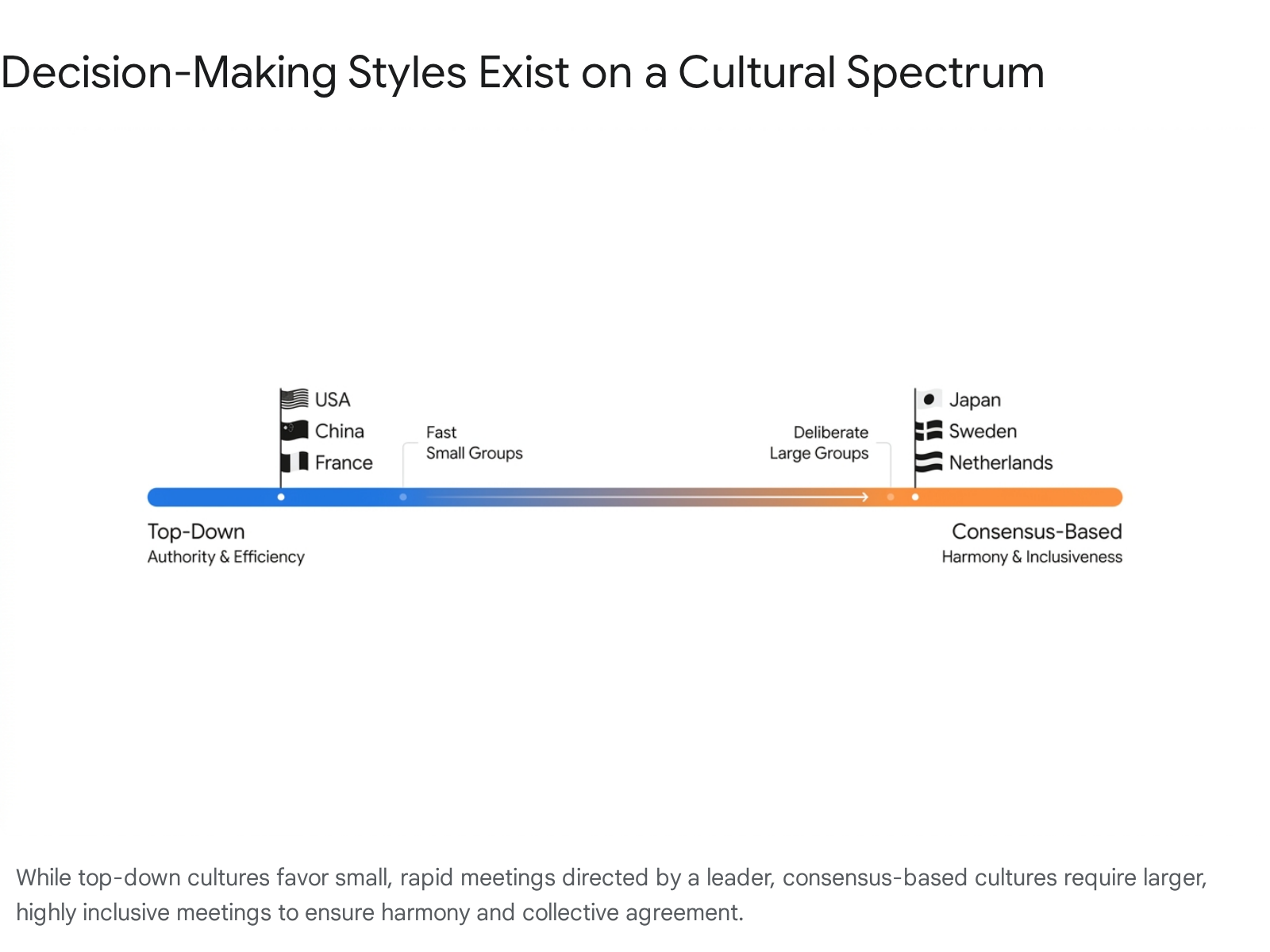
Failing to account for these cultural norms when sizing a meeting can lead to severe organizational friction.
Top-Down Execution Cultures
In top-down cultures - such as those prevalent in the United States, China, and France - decisions are tightly concentrated 38222341. The leader gathers information from subordinates but ultimately retains the unilateral authority to make the final call 2223. In these environments, small meetings of five to seven individuals are highly effective because the goal of the meeting is rapid alignment and data gathering, not universal democratic agreement 4124.
Team members in top-down cultures expect clear directives and swift action. They are accustomed to decisions being made efficiently, even if their personal input was overruled or if the decision is finalized outside of the formal meeting structure 3823. For these organizations, limiting meeting size strictly adheres to their cultural demand for speed and operational efficiency.
Consensus-Driven Cultures
Conversely, consensual cultures - such as Japan, Sweden, and the Netherlands - value harmony, inclusivity, and widespread agreement before moving a project forward 384143. In these regions, pushing a decision through a small, five-person meeting would be viewed as improperly exclusive, aggressively hierarchical, or dangerously rogue 3822.
The Japanese ringi system serves as a prime example, systematically pushing proposals through various management layers to build widespread consensus before a final organizational decision is formalized 38. Similarly, in Swedish corporate culture, compromising is strongly favored, and decisions are made with immense consideration to avoid risking team alignment 43.
If the organizational objective is deep, lasting buy-in, mathematical models of consensus networks suggest that the optimal group size can actually range from 5 up to 30 individuals, provided the communication network is structured properly to allow all voices to be heard 25. While these large meetings take significantly longer to reach a conclusion - often frustrating individuals accustomed to top-down speed - they frequently result in faster downstream implementation, as all potential objections and friction points were handled during the extensive deliberation phase 22412443.
The Financial and Organizational Toll of Over-Inviting
When organizations fail to manage meeting size, the consequences extend far beyond subjective employee frustration; it actively drains corporate finances. Unproductive meetings cost businesses in the United States an estimated $375 billion to $399 billion annually 2745.
The math is unforgiving. If a routine recurring meeting is bloated with eight attendees who each make an average of $70,000 per year, and they meet twice a week for one hour, that single recurring meeting costs the organization a staggering $28,000 annually in pure labor costs 27. According to studies, unnecessary or ineffective meetings waste approximately $25,000 annually per employee, which translates to a $101 million annual bleed for organizations with 5,000 or more employees 27.
Furthermore, the sheer volume of meetings is accelerating. Research indicates that the total time spent in meetings has more than doubled since the 1960s 1246. Today, the average employee spends 57% of their time communicating across meetings, email, and chat, leaving less than half their week for deep, focused execution 1. Managers and directors are hit hardest, spending an average of 13 hours per week in meetings, while executives report spending up to 23 hours a week trapped in conference rooms or on video calls 122746. As meeting loads increase, so does employee burnout, meeting fatigue, and organizational paralysis 2747.
Evidence-Based Strategies to Preserve Decision Quality
Knowing that meeting size degrades decision quality and drains corporate resources, organizations must adopt active, structural countermeasures. Rather than arbitrarily slashing invite lists and alienating staff, expert meeting facilitators utilize specific frameworks to capture the benefits of wide input without the friction of a massive debate.
The Nominal Group Technique (NGT)
To circumvent production blocking, evaluation apprehension, and social loafing, organizational psychologists frequently deploy the Nominal Group Technique (NGT) 59262728. Originally developed as an alternative to chaotic free-flowing brainstorming, NGT is designed for small groups of roughly four to seven people and forces participants to operate as individuals before they operate as a collective 927.
The process functions in distinct, structured stages: 1. Silent Ideation: Participants are presented with the problem and required to generate ideas independently and in writing, in total silence. This completely eliminates production blocking and ensures introverted members have equal footing 52627. 2. Round-Robin Sharing: Each idea is recorded on a board one by one, without any immediate debate, criticism, or praise. This separates idea generation from idea evaluation 52729. 3. Clarification: The group discusses the ideas solely to ensure everyone understands the concepts, merging duplicates where necessary 527. 4. Anonymous Voting: Participants privately rank or vote on the best ideas, mathematically producing a final group decision without the pressure of groupthink or dominant personalities 5927.
Research proves that NGT groups produce more unique ideas, experience more balanced participation, and report higher satisfaction with decision quality and group efficiency compared to traditional interacting groups 5928.
Tiered Meeting Structures
For complex operations requiring vast organizational alignment, packing forty people into a single room is disastrous. Instead, highly efficient companies utilize "tiered" meeting structures to build a pyramid of communication 46.
For example, a manufacturing firm may implement a multi-tier system starting with Tier 1: short, 15-minute daily stand-ups consisting of small frontline teams focused entirely on immediate daily blockers 46. The supervisors of those small groups then convene in a Tier 2 weekly meeting to review progress and escalate issues 46. This cascades up to Tier 3 managerial meetings and Tier 4 executive strategy sessions 46. This "circles" structure - which is also a foundational element of organizational frameworks like Sociocracy - preserves the cognitive benefits of the 5-to-9 person threshold at every single level 52. It breaks down silos and ensures information flows upward without resorting to massive, unmanageable town halls 4652.
Managing FOMO and the "Optional" Attendee
A significant driver of meeting bloat is FOMO (Fear Of Missing Out). Meeting organizers frequently over-invite participants out of a desire to be inclusive, to signal respect, or to avoid offending colleagues who might feel left out 1545. However, using meeting attendance as a proxy for employee engagement or commitment is a deeply flawed metric that destroys productivity 15.
Best practices dictate that meeting organizers must ruthlessly separate decision-makers from information-consumers 4553. * Primary Attendees: These are the individuals critically required to actually make the decision or provide essential subject matter expertise. This list should be strictly capped at 5 to 7 individuals 4553. * Secondary/Optional Attendees: These are individuals who might benefit from the context but do not possess veto power or essential input for the core decision 455354.
To manage optional attendees effectively, organizations must embrace asynchronous communication. By explicitly marking invitations as "optional," recording virtual meetings, utilizing AI-generated transcripts, and distributing highly specific agendas with documented outcomes, stakeholders can stay perfectly informed without sacrificing their focus time 155430. Furthermore, if a subject matter expert is only needed for one specific agenda item, they should be invited strictly for that 10-minute window and encouraged to drop off the call immediately after providing their counsel, thereby protecting their time and keeping the core decision-making group small 45.
Bottom line
As meeting sizes expand beyond single digits, the psychological friction of social loafing, groupthink, and production blocking reliably destroys the quality and speed of collective decisions. While virtual and hybrid platforms have made it technologically effortless to invite vast audiences, these environments actually amplify negative dynamics by reducing interpersonal accountability and encouraging active multitasking. Ultimately, protecting an organization's strategic agility requires ruthlessly limiting decision-making forums to five to eight core participants, while leveraging structured facilitation techniques and asynchronous communication to keep the wider company informed.