
Influencer and Creator Marketing Performance in 2026
The global creator economy has transitioned from an experimental digital sector into a highly structured, multibillion-dollar media ecosystem. By 2026, the sector has surpassed $100 billion in global value, with projections indicating it will exceed $200 billion by the end of the year and approach $376.6 billion by 2030 11. In the United States alone, brand spending on digital personalities exceeded the $10 billion threshold a year earlier than historically forecast, reaching an estimated $10.52 billion in 2025, and continues to outpace traditional social ad spending growth 234.
However, this rapid financial expansion has been accompanied by intense structural scrutiny. Brands, marketing agencies, and digital platforms no longer treat the digital talent pool as a monolith. A critical operational distinction has emerged between the "influencer" and the "content creator." While these terms were used interchangeably throughout the early 2020s, industry data from 2025 and 2026 demonstrates that they represent different business models, require distinct compensation structures, and deliver fundamentally different marketing returns 56. As algorithms pivot to reward retention over superficial engagement, and as consumers develop sophisticated mechanisms for detecting performative brand endorsements, the mechanics of digital influence have undergone a profound transformation 79.
Industry Definitions and Classifications
The semantic division between an influencer and a content creator represents a divergence in intent, execution, and audience relationship. Understanding this distinction is a prerequisite for accurate budget allocation, platform selection, and campaign measurement in 2026.
The Influencer Model
An influencer is fundamentally defined by their ability to leverage personal branding, visibility, and persuasive communication to shape opinions and drive audience behaviors 58. Influencers focus meticulously on image curation, often selling an aspirational lifestyle or persona 6. Their primary capital is their reach and the parasocial relationship they maintain with their followers. In the marketing funnel, influencers - especially macro-influencers and celebrities - are highly effective at the bottom of the funnel for luxury and aspirational brands where the product is intimately tied to aesthetic presentation and social status 6.
The commercial relationship between brands and influencers has traditionally been transactional. Brands effectively rent access to the influencer's audience for brief periods, paying for sponsored posts, product placements, and short-term endorsements 69. The primary value proposition of an influencer is distribution, attention, and the rapid generation of top-level brand awareness 10.
The Content Creator Model
Conversely, a content creator is defined by their production skills, storytelling ability, and domain expertise 511. Creators are motivated by a passion for content generation - whether educational, comedic, analytical, or artistic - and their audiences gather around the inherent value of the content itself rather than the creator's lifestyle 14. Their outputs are often long-form, evergreen, or highly produced, spanning formats such as deep-dive YouTube videos, expert newsletters, technical tutorials, or specialized podcasts 1114.
For brands, content creators function more as external production studios and strategic partners than mere distribution channels. Creators provide high-quality creative assets that brands can license, repurpose across paid media, or use to build sustained brand equity 815. Because their audiences are built on shared interests and expertise, creator-led content generally drives higher authenticity metrics and is increasingly integrated into top-of-funnel brand storytelling, product education, and even co-creation initiatives 612.
Strategic Convergence and Operational Overlap
While the conceptual distinction is critical, the roles in practice are not mutually exclusive. A successful creator often wields significant influence, and many influencers produce high-quality content. However, 86% of marketers engaging in this space now actively categorize and manage these partnerships differently based on whether the primary goal is rapid audience acquisition (the influencer model) or asset generation and community building (the creator model) 513.
| Feature | Influencer | Content Creator |
|---|---|---|
| Primary Focus | Personal branding, lifestyle curation, persuasion, high visibility 58. | Storytelling, high-quality production, education, entertainment 58. |
| Audience Relationship | Broad, aspirational, personality-driven, trend-focused 5. | Niche, interest-driven, deeply engaged, community-oriented 511. |
| Brand Value Proposition | Audience scale, rapid awareness, aspirational association 68. | Creative assets, long-term trust, product education, evergreen content 811. |
| Monetization Strategy | Sponsored posts, brand endorsements, affiliate links 8. | Ad revenue, licensing, subscriptions, digital products, co-creation 8. |
| Engagement Profile | High volume, surface-level interaction (likes, broad reach) 11. | Deep engagement (saves, shares, watch time, active comments) 11. |
Marketing Effectiveness and Financial Returns
As annual marketing budgets expand - with average annual influencer marketing investment increasing 171% between 2025 and 2026, and some major enterprises allocating up to 50% of their advertising spend to the creator economy - scrutiny over return on investment (ROI) has intensified 12. The data heading into 2026 reveals a pronounced shift in what types of digital partnerships actually drive measurable financial returns.
Follower Count and Engagement Dynamics
The historical assumption that audience size correlates linearly with campaign success has been debunked by comprehensive 2026 performance data. Follower counts are increasingly viewed as vanity metrics, with platforms frequently suppressing content from high-follower accounts if the initial behavioral engagement signals are weak 1819.
The industry has documented a strict inverse relationship between follower count and engagement rate. Mega-influencers (those with over 1 million followers) typically average engagement rates between 0.5% and 1.0% 14. In stark contrast, micro-influencers (10,000 to 100,000 followers) achieve average engagement rates of 2.0% to 4.0%, and nano-influencers (1,000 to 10,000 followers) routinely reach 5.0% to 8.0%, with some TikTok nano-creators pushing past 10.3% 1314. Marketers partnering with micro-influencers report 60% higher engagement rates compared to those working with mega-influencers, delivering these results at approximately one-tenth of the cost per post 15.
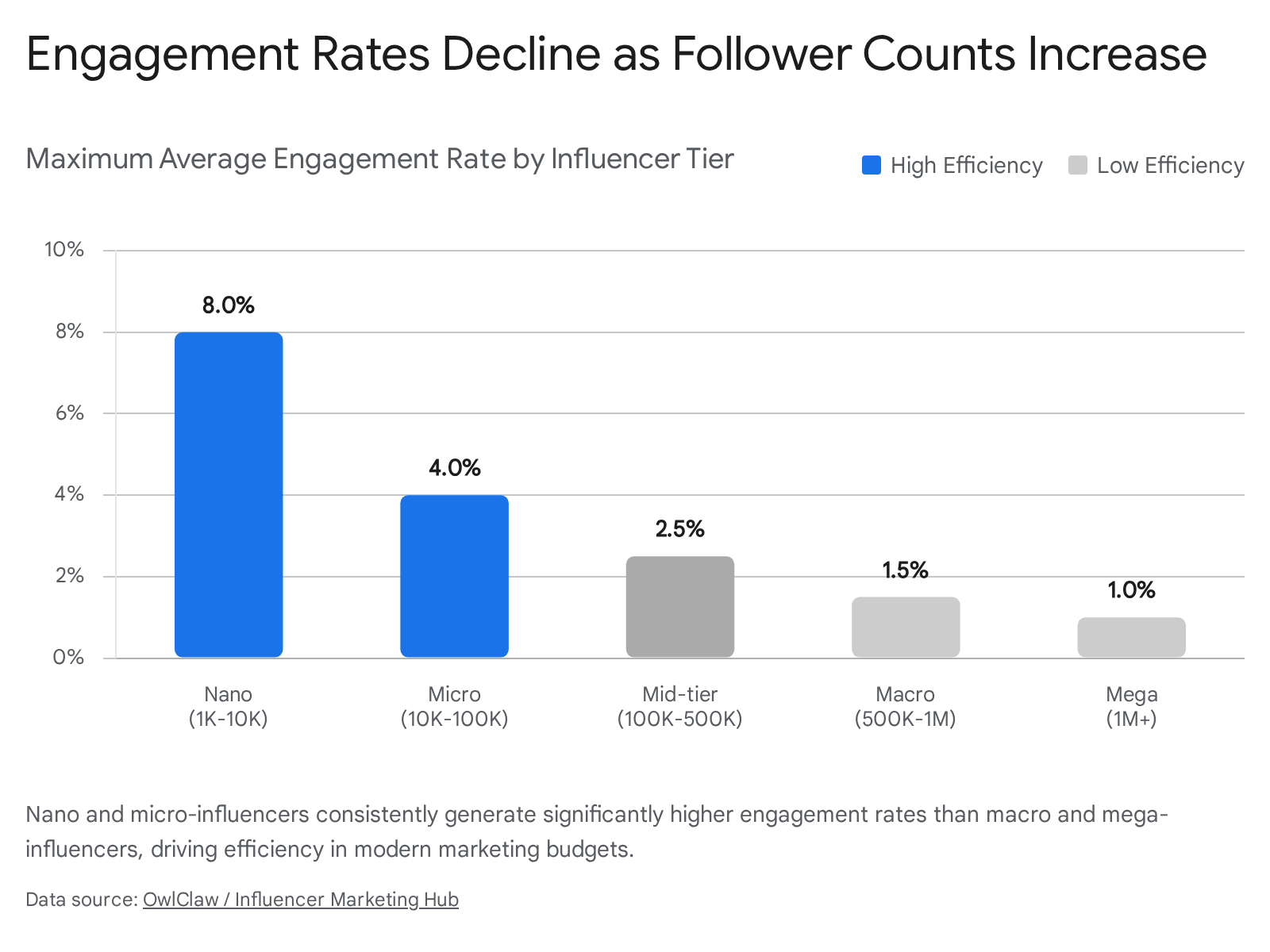
Beyond mere engagement, conversion metrics follow a similar pattern. Campaigns utilizing micro- and nano-influencers see conversion rates two to three times higher than those relying on macro-influencers 15. This performance discrepancy is rooted in consumer trust paradigms. Smaller creators foster tight-knit communities where recommendations are processed similarly to word-of-mouth advice from peers (with 82% of consumers stating they are more likely to follow a micro-influencer's recommendation), whereas celebrity endorsements are processed with the skepticism reserved for traditional paid advertising 1315.
The Creator Gamble and Financial Inefficiencies
Despite the proven efficacy of highly targeted creator partnerships, systemic inefficiencies threaten budget allocations. The 2026 WARC Marketer's Toolkit outlines a phenomenon termed the "Creator Gamble." While 61% of marketers plan to aggressively increase their creator marketing investments, a vast portion of this spend fails to generate ROI due to weak measurement frameworks and poor creative execution 16.
Research aggregated by WARC indicates that 45% of creator ad spend on Meta platforms is wasted entirely due to suboptimal creative practices, such as failing to present brand messaging early in the content 1718. Furthermore, Kantar data reveals that only 27% of creator content effectively links back to the sponsoring brand in the consumer's mind 1618. This highlights a tension between creator reach, brand control, and narrative authenticity that often results in highly engaging content that yields zero commercial benefit for the sponsor 1618.
| Influencer Tier | Follower Range | Avg. Engagement Rate | Cost Per Engagement (CPE) | Primary Utility |
|---|---|---|---|---|
| Nano | 1,000 - 10,000 | 5.0% - 8.0% | $0.01 - $0.05 | High trust, peer-to-peer conversion 1415. |
| Micro | 10,000 - 100,000 | 2.0% - 4.0% | $0.05 - $0.15 | Niche authority, engagement efficiency 1415. |
| Mid-Tier | 100,000 - 500,000 | 1.2% - 2.5% | $0.15 - $0.50 | Balanced scale and community 14. |
| Macro | 500,000 - 1,000,000 | 0.8% - 1.5% | $0.50 - $2.00 | Broad category awareness 14. |
| Mega/Celebrity | 1,000,000+ | 0.5% - 1.0% | $2.00 - $10.00+ | Prestige, mass market visibility 14. |
Sector-Specific Returns and Attribution
When correctly executed and tracked, the industry average ROI sits at $5.20 to $5.78 for every dollar spent on influencer marketing 2519. However, returns vary heavily by sector and tracking methodology.
In the Business-to-Business (B2B) sector, influencer marketing has matured significantly. According to the 2026 B2B Influencer Marketing Report, brands with robust, always-on influencer programs experience outsized results: 61% report increased sales revenue, 58% see improved brand reputation, and 47% report improved brand advocacy 27. B2B engagements frequently move beyond monetary compensation to include co-creation opportunities, exclusive executive access, and inclusion in high-profile industry research 27.
In the Direct-to-Consumer (DTC) e-commerce space, 68% of marketers now view influencer campaigns as vital to their bottom line 28. DTC brands utilizing rigorous multi-touch attribution models report influencer Return on Ad Spend (ROAS) frequently ranging between 5x and 8x 1425. The divergence in these outcomes highlights that success in 2026 relies less on the sheer talent selected and more on the measurement infrastructure - shifting away from surface metrics like impressions toward Cost Per Acquisition (CPA) and Lifetime Value (LTV) tracking 28.
Platform Algorithm Updates
The functional distinction between creators and influencers is further exacerbated by profound changes to social media algorithms. In late 2024 and throughout 2025, major platforms re-architected their content distribution models to prioritize deep engagement, retention, and topic clarity over superficial viral metrics.
Instagram Distribution Mechanics
Instagram executed a fundamental algorithmic overhaul in 2025, effectively completing its transformation from a follower-based social graph into a behavior-based discovery engine 729. The platform now relies on separate, distinct AI ranking systems for the Feed, Reels, Stories, and the Explore page 7.
Crucially, the hierarchy of engagement signals has been inverted. While "likes" were historically the primary currency of influence, the 2026 algorithms weigh "saves," "shares" (content forwarded via direct message), and "watch time" as significantly heavier signals 720. According to Meta's public guidance, the algorithm interprets a high completion rate - particularly an average view rate holding above 10.53% for Reels - as a proxy for high-quality, original content worthy of broader unconnected reach 7. The critical threshold for audience retention has shrunk; viewers decide whether to continue watching a video within the first 1.7 seconds, placing immense pressure on the creator's structural hooking mechanics 7.
Furthermore, the mechanics of discovery have been permanently altered. In December 2024, Instagram removed the ability for users to follow specific hashtags, heavily reducing their algorithmic weight 31. Discovery is now driven by semantic Search Engine Optimization (SEO) - meaning captions, alt text, and bio keywords dictate visibility across the app and even on external search engines like Google 2031. The algorithm actively rewards "topic clarity," punishing accounts that pivot haphazardly between unrelated subjects and rewarding niche creators who maintain strict topical authority across their content history 31. This environment inherently favors the specialized content creator over the broad-appeal lifestyle influencer.
TikTok Behavioral Shifts
TikTok's platform dynamics have similarly evolved to favor authenticity over curation. According to TikTok's "Next 2026" trend report, derived from AI-powered analytics tools and user data, consumer behavior has shifted away from the highly polished, romanticized content that characterized previous years 2122.
The platform identifies a primary macro-trend termed "Reali-TEA," where audiences demand unfiltered, reality-based content 21. Users are embracing a mindset characterized by "loud cracking" - setting boundaries, protecting peace, and navigating daily chaos without the veneer of perfection 2122. The 2026 TikTok algorithm prioritizes what it calls "Curiosity Detours" and "Emotional ROI," rewarding content that elicits genuine, unscripted reactions 34.
Consequently, brands are advised to abandon hyper-curated aesthetics. The comment section has evolved into an interactive focus group, and the platform has increasingly become a primary search engine for product reviews, with nearly 60% of users conducting research on TikTok before making a purchase 2324. This search-first mentality places a premium on creators who can provide detailed, utilitarian product breakdowns, turning mundane product comparisons into highly engaging formats 22.
The Re-emergence of Long-Form Value
While short-form video dominates impulse discovery, there is a concurrent flight to quality in long-form content. Market projections indicate that over half of U.S. marketers will use YouTube for influencer marketing in 2026 23. As geopolitical uncertainty surrounding TikTok's regulatory status prompts brands to diversify ad spending, YouTube is capturing significant budget reallocation 23. The platform benefits from a creator ecosystem prioritizing predictable content, longer-term relationships, and narrative storytelling over fleeting trends and ad-hoc sponsorships, making it highly attractive for brand equity-building initiatives 325.
Asian Market Creator Ecosystems
To fully understand the 2026 trajectory of Western creator marketing, analysts heavily monitor the highly mature Asian digital ecosystems (particularly in China, South Korea, and Southeast Asia), which operate years ahead in terms of social commerce integration. In these markets, the ambiguity between "influencer" and "creator" was resolved years ago through a rigid, tripartite taxonomy: Key Opinion Leaders (KOL), Key Opinion Consumers (KOC), and Key Opinion Sellers (KOS).
Key Opinion Leaders (KOL)
In the Asian market context, a KOL is not merely an influencer; they are recognized, verifiable authorities within a specific industry (e.g., dermatology, automotive engineering, finance, or luxury fashion) 102627. Their influence is derived from professional credentials and deep expertise rather than social popularity 1027.
KOLs are deployed at the top of the marketing funnel to establish brand credibility, validate claims, and shape industry perception 1026. Because Chinese consumers are highly sophisticated and deeply skeptical of traditional advertising, they rely heavily on KOL endorsements to legitimize a product's efficacy before engaging further 1028. The top-tier KOLs frequently operate as sophisticated media entities backed by Multi-Channel Networks (MCNs) that manage their legal, production, and distribution strategies 28.
Key Opinion Consumers (KOC)
While KOLs provide top-down authority, Key Opinion Consumers (KOCs) provide bottom-up relatable validation 23. KOCs are everyday shoppers, students, and grassroots product testers who share unfiltered, authentic experiences without the polish of professional studio lighting 2829. Analogous to Western nano-influencers, KOCs operate within highly engaged niche communities, generally holding between a few hundred and 50,000 followers 2842.
The KOC model is demonstrably highly efficient for driving actual conversions. Data tracking 150 Web3 and cryptocurrency projects demonstrated that users acquired through KOC campaigns had an average 30-day retention rate of 22%, compared to just 6% for users acquired through broad KOL campaigns 43. The synergistic "KOL + KOC" model is the dominant strategy across Asia in 2026: KOLs ignite visibility and transfer authority, while KOCs drive the peer-to-peer persuasion necessary to validate the purchase 42.
Key Opinion Sellers (KOS)
The most aggressive evolution in social commerce is the rise of the Key Opinion Seller (KOS). Driven by the explosion of livestreaming and video commerce (which accounts for up to 20% of all e-commerce GMV in Southeast Asia), KOS are hyper-focused on direct sales rather than brand building 30.
Unlike traditional influencers who monetize views and attention, KOS monetize trust through immediate transactions 30. They perform rigorous, live demonstrations of products, answering consumer questions in real-time to remove purchasing friction 30. With influencer marketing projected to generate up to $46 billion in Net Merchandise Value (NMV) in Southeast Asia by 2025, an estimated $21 billion of that is direct, trackable revenue generated primarily by affiliate-driven KOS networks 30.
Regional Nuances: South Korean Consumer Trends
South Korea offers a distinct look into the behavioral psychology shaping digital commerce in 2026. The "Trend Korea 2026" report, leveraging big data analysis, highlights a consumer base reacting to the saturation of artificial intelligence 3132. Consumers are engaging in what is termed the "Feelconomy," where consumption is used as a tool for emotional self-management; purchases are made not for practical utility, but to regulate mood in an increasingly "Pixelated" (fragmented and fast-paced) daily life 3233.
Simultaneously, Korean consumers are demanding analog, slow-paced experiential consumption to counter digital fatigue, illustrating a paradox where hyper-connected audiences actively seek out tactile, un-curated experiences 3133. This psychological environment directly supports the KOC model, as consumers prioritize deep, authentic devotion to niche interests over mass-market celebrity endorsements 33.
Consumer Trust and the Authenticity Paradox
The overarching narrative driving the shift toward creators, KOCs, and micro-influencers globally is the consumer demand for authenticity. However, by 2026, the strategic corporate pursuit of authenticity has generated a severe crisis of credibility known in marketing literature as the "Authenticity Paradox."
Defining the Authenticity Paradox
The Authenticity Paradox occurs when the calculated, organizational effort to appear "real," "raw," or "vulnerable" is detected by the consumer, resulting in severe backlash and an active reduction in trust 948. While surveys indicate 91% of consumers state that authenticity is a primary factor in their purchasing decisions, only 51% believe brands successfully deliver it 9. The modern consumer is highly digitally literate; they can easily distinguish between a genuine identity evolution and a strategic, performative positioning masking a commercial motive 4849.
When consumers suspect that vulnerability is being weaponized as a marketing tactic, they do not merely ignore the content; studies show that over 50% actively disengage from or avoid the brand entirely 9. A notable industry example occurred in December 2025, when a major global fast-food campaign attempting to depict the messy, stressful reality of the holidays was widely rejected by the public as depressing and "performative," proving that manufactured emotional realism without underlying structural truth damages brand equity 9. In the creator economy, this paradox manifests when large influencers accept sponsorships for products they clearly do not use, instantly eroding the trust required for the channel to function and triggering audience skepticism 2950.
Artificial Intelligence and the Synthetic Influencer
The Authenticity Paradox is deeply compounded by the proliferation of Artificial Intelligence. AI tools are now embedded in every layer of the creator economy, from agency workflows automating contract negotiation and fraud detection, to generative models assisting creators in scriptwriting 1251.
The emergence of entirely virtual, AI-generated influencers presents a complex dichotomy for marketers. Virtual influencers offer brands absolute control, eliminating the risks of human scandal, fatigue, or misaligned messaging 51. Studies show virtual influencers averaging 8.7% engagement compared to 3.1% for human influencers, driven largely by novelty and flawless, optimized aesthetics 51. Furthermore, peer-reviewed research indicates that virtual influencers experience significantly higher "engagement elasticity" (34.7% versus 8.3% for humans) when executing "de-influencing" strategies - content featuring product criticism. This occurs because the synthetic persona lacks "existential authenticity" to begin with, insulating it from accusations of hypocrisy that a human would face when critiquing a product 52.
However, the "AI-authorship effect" dictates that when consumers realize emotional or highly relatable content is machine-generated, they experience a form of moral disgust 9. This psychological reaction leads to immediate, measurable drops in brand trust, positive word of mouth, and loyalty intentions 9. Therefore, while AI operates excellently as an operational infrastructure - predicting campaign ROI, vetting followers, and parsing analytics - its use as a front-facing replacement for human emotional connection remains highly volatile and subject to fierce consumer rejection 912.
Compliance, Disclosure, and Market Research Challenges
As the line between genuine recommendation and paid promotion blurs, regulatory compliance has become a central operational challenge. Organizations like the Federal Trade Commission (FTC) strictly require clear, unambiguous disclosure of material connections between brands and creators 2753. Failure to adequately tag affiliate links or sponsored posts not only invites legal penalty but acts as a massive trust-killer for audiences. Surveys indicate that 64% of consumers view the failure to disclose brand relationships as a primary destroyer of trust, rendering the underlying marketing spend entirely counterproductive 5354.
The challenge of quantifying this authenticity extends into market research itself. In 2025, the Global Data Quality Initiative reported that 40% of all market research records were potentially problematic, with 4-5% directly linked to fraud via AI bots and synthetic respondents mimicking real participants 55. This contamination of research panels makes it increasingly difficult for brands to accurately measure consumer sentiment regarding authenticity, forcing a reliance on multi-layered behavioral analysis to extract genuine insights 5556.
Integrated Partnership Strategies
To navigate algorithmic volatility, the Authenticity Paradox, and the corporate mandate for measurable ROI, brand strategies in 2026 have shifted away from transactional influencer purchasing toward integrated, system-wide creator partnerships.
Transitioning from Transactional to Collaborative
The era of issuing rigid creative briefs to digital talent is ending. In 2026, 65% of creators state they prefer to be involved in the conceptual and product development phases rather than simply executing a predetermined corporate script 19. Leading brands are treating creators as creative partners, granting them equity stakes, revenue-sharing agreements, and roles as strategic brand consultants 57.
By bringing creators in-house or integrating them deeply into the marketing architecture, brands bypass the friction of forced endorsements 12. Creators are given the autonomy to craft messages in their native tone, preventing the content from triggering the audience's internal skepticism. This collaborative approach is vital because an influencer's audience data and distribution capability are only valuable if the content genuinely resonates with that specific community without feeling extractive 69.
Always-On Ambassador Programs and Advocacy Engineering
The standard operating procedure has moved from episodic, one-off campaigns to "always-on" ambassador programs. Continuous, long-term partnerships provide repeated exposure, proving to the audience that the creator genuinely utilizes and values the product over time 58.
The compounding benefits of this approach are substantial. Marketers report that long-term influencer partnerships deliver 35% higher engagement rates compared to single-post campaigns 27. According to B2B Influencer Marketing research, 99% of marketers using an always-on approach rate their programs as effective 27.
Simultaneously, a discipline known as "advocacy engineering" is emerging to address the scale mismatch in traditional influencer management. Rather than spending massive budgets on 50 managed influencers, brands are using AI systems to identify, segment, and mobilize tens of thousands of existing real customers and superfans 59. This grassroots, community-generated content consistently outperforms traditional influencer campaigns because it reflects genuine product affection rather than paid promotion 59.
Advanced Multi-Touch Attribution Methodologies
Ultimately, the commercial viability of creator marketing is verified by advanced measurement frameworks. The industry has evolved past vanity metrics (likes, gross impressions) and rudimentary single-touch attribution (last-click promo codes).
Sophisticated marketers now utilize multi-touch attribution models to track the entire customer journey 60. This involves pairing direct tracking links (measuring immediate Cost Per Acquisition, or CPA) with brand lift studies (measuring changes in awareness) and longitudinal customer data (tracking Lifetime Value, or LTV) 2857. By tracking metrics like Return on Ad Spend (ROAS) and CPA at the individual creator level, brands can dynamically reallocate budgets away from underperforming macro-influencers and toward the highly efficient network of micro-creators, nano-influencers, and KOCs 28.
By abandoning outdated performance metrics and aligning their strategies with the nuanced realities of creator ecosystems, brands in 2026 are successfully converting digital attention into sustainable, trackable revenue.