
Founder-led marketing in B2B environments for 2026
Baseline Market Conditions and the Trust Deficit
Institutional Trust Contraction
The strategic migration toward founder-led marketing in 2026 is structurally tied to unprecedented shifts in global consumer and corporate trust. Data aggregated from the 2026 Edelman Trust Barometer, which surveyed nearly 34,000 respondents across 28 countries in late 2025, identified a severe contraction in institutional confidence 1. The report characterizes the current socioeconomic climate as a crisis of insularity, wherein 70% of respondents globally report an unwillingness or deep hesitation to trust individuals, organizations, or information sources operating outside their immediate circles or possessing differing values 12. In specific regional markets such as Canada, this insularity metric rises to 73% 1.
This deficit has tangible impacts on business operations and marketing efficacy. The data reveals that 61% of global respondents hold a moderate to high grievance index, believing that massive institutional entities - including government, large corporate brands, and traditional media - do not operate in the public interest 3. While generic "business" remains the most trusted institution overall at 62%, this trust is highly conditional and increasingly localized to familiar entities 23. Consequently, corporate communications strategies have been forced to adapt. Analysis of corporate earnings calls spanning 2025 indicated a sharp decline in the utilization of macro-level terminology such as "volatility," dropping from 247 mentions in the second quarter to 124 in the third quarter, as executives attempted to project hyper-local stability and competence 2.
Artificial Intelligence and Content Saturation
Compounding the institutional trust deficit is the rapid deployment of generative artificial intelligence across business-to-business (B2B) marketing channels. By 2026, AI-driven automation has saturated distribution networks with synthetic, highly polished, but undifferentiated corporate messaging 14. Buyers have developed advanced detection mechanisms for this content; surveys indicate that 82% of consumers can successfully identify AI-generated marketing copy, and their engagement drops significantly upon detection 1. In high-consideration B2B environments, flawless corporate polish is no longer interpreted as a signal of authority, but rather as a mechanism of automated obfuscation 4.
The market response has been a definitive shift away from volume-based marketing toward credibility-based verification. A comprehensive 2025 B2B benchmark study conducted by LinkedIn and Ipsos surveying 1,500 senior-level marketers demonstrated that 94% of professionals now view trust as the singular most critical driver of commercial performance 35. Buyers are actively seeking transparency, verified peer proof, and direct human connection, prioritizing these elements over standard product feature lists and automated email sequences 34.
Business Entities as Trust Brokers
In this environment, buyers seek proxies for institutional credibility, frequently turning to specific individuals - peers, technical specialists, and company founders - to validate purchasing decisions. The Edelman data suggests that employers are uniquely positioned to act as trust brokers because the expectation-performance gap regarding trust is smallest within the employer-employee dynamic 56. Employees and buyers alike prefer companies to maintain neutrality on divisive macro-issues (48%) rather than taking polarized stances (41%), focusing instead on operational competence and direct problem-solving 2.
Founder-led marketing directly leverages this dynamic. When a founder publicly stakes their reputation on a methodology or product, it introduces a symmetry of risk that buyers respect. If a product fails to deliver, a faceless corporate entity can easily rebrand or shift its messaging; the visible founder, however, risks their personal market equity and professional reputation 89. This accountability accelerates the velocity of trust, allowing founders to establish credibility far more rapidly than multimillion-dollar brand awareness campaigns 8.
Mechanics of Founder-Led Marketing
Conceptual Framework
Founder-led marketing operates as a strategic go-to-market protocol where the founder of a company acts as the primary conduit for brand visibility, audience education, and market engagement 910. Rather than delegating all communications to a decentralized marketing department or an external public relations agency, the founder utilizes their personal identity, domain expertise, and operational transparency to build a commercial audience 11.
The operational execution of this framework involves the public documentation of the business lifecycle, transparent discussions regarding industry pain points, and the dissemination of actionable expertise 713. The content mix is deliberately engineered to avoid relentless promotion. Optimal performance is typically achieved through a ratio where 80% of the output is value-driven educational material, 15% is personal narrative detailing operational failures and successes, and only 5% contains direct promotional solicitations 11. By exposing the reality of building a business - including the anxieties, financial constraints, and strategic pivots - founders forge emotional connections that are impossible to replicate through sanitized corporate channels 8.
Traditional Corporate Marketing Limitations
The efficacy of conventional B2B marketing has degraded severely under the weight of market saturation and buyer fatigue. In the current landscape, traditional outbound advertising is losing its competitive edge, with 90% of B2B decision-makers reporting that they actively ignore cold outreach and unsolicited corporate communications 10. This systemic failure of high-volume outbound sales tactics has driven up customer acquisition costs and forced organizations to reevaluate their lead generation models.
Traditional corporate marketing relies on a linear funnel constructed around product-centric messaging, gated whitepapers, and automated lead-nurturing sequences 15. This approach is fundamentally transactional, designed to capture contact information and immediately deploy sales representatives. In contrast, the founder-led approach prioritizes upfront value creation and community building, shortening the psychological distance between the vendor and the buyer long before a commercial transaction is proposed 99. When founders operate authentically in public, they create familiarity before the buyer is even in-market for a solution, ensuring that when timing aligns, the interaction begins as a warm conversation rather than a cold pitch 9.
Psychological Distance and Buyer Engagement
The success of the founder-led model is rooted in basic behavioral psychology: human beings prefer to transact with other human beings who demonstrate shared vulnerabilities and specific domain understanding 11. Out of all personnel within an organization, founders are uniquely positioned to articulate the foundational problem the company solves, primarily because their proximity to that problem was the catalyst for the company's creation 11.
This psychological alignment translates directly into executive engagement. Research indicates that 84% of C-suite executives utilize social media platforms to inform their strategic purchasing decisions, and 82% of buyers explicitly trust companies more when the leadership team maintains an active, visible online presence 10. Furthermore, 78% of B2B buyers conduct independent research into a company's leadership team before finalizing a procurement decision 10. By making themselves accessible and transparent, founders intercept these buyers during the critical early phases of their independent research cycles.
Table 1: Structural Comparison of B2B Marketing Paradigms
| Dimension | Traditional Corporate Marketing | Founder-Led Marketing |
|---|---|---|
| Primary Voice | Faceless corporate brand, formal and sanitized tone. | Individual founder, conversational, vulnerable, and authoritative tone. |
| Content Focus | Product features, corporate milestones, polished success metrics. | Operational realities, industry analysis, lessons learned, and systemic failures. |
| Platform Efficacy | Low organic reach; high reliance on paid advertising amplification. | High organic reach; algorithmically favored by major social networks. |
| Buyer Engagement | Transactional; focused on immediate lead-capture and gating. | Relational; oriented toward community building and continuous trust generation. |
| Differentiation | Relies on feature comparisons and pricing parity. | Relies on a unique personal worldview, narrative, and individual reputation. |
| Risk Symmetry | Low personal risk for corporate marketers if messaging fails. | High personal reputational risk for the founder, signaling accountability to the buyer. |
Quantitative Performance Benchmarks
Engagement and Conversion Differentials
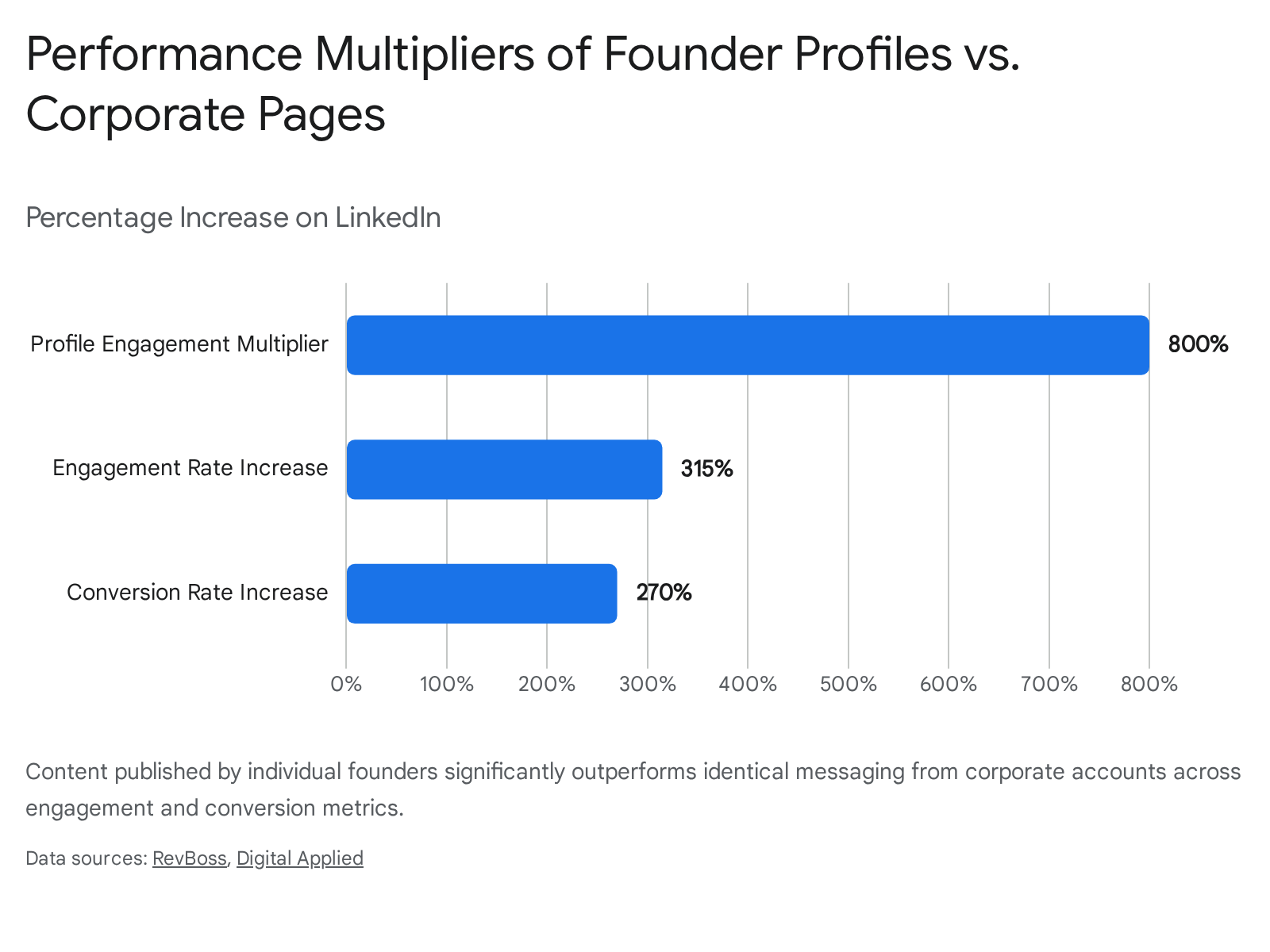
The migration of B2B marketing budgets toward founder-led strategies is fundamentally driven by unit economics, pipeline velocity, and measurable platform advantages. Algorithmic prioritization on major distribution platforms, particularly LinkedIn, heavily favors individual creator profiles over corporate entities. Data indicates that content published by individual personal profiles generates up to eight times the engagement of identical content distributed through standard company pages 10.
This visibility differential directly impacts the bottom line. Founder profiles contribute to a 315% higher engagement rate and a 270% higher conversion rate compared to corporate accounts within top B2B SaaS organizations 10.
Companies that commit to an active founder-led strategy frequently experience significant spikes in inbound velocity. Documented case studies reveal that SaaS founders who executed a disciplined 90-day thought leadership sprint achieved a 340% increase in inbound demo requests, accompanied by a 2.3x increase in average contract value (ACV) for those specific leads 10.
Customer Acquisition Cost and Pipeline Velocity
The financial implications of these conversion differentials are profound. When comparing paid acquisition channels, LinkedIn's targeting precision combined with the trust generated by a strong founder brand produces a 28% lower cost-per-qualified-lead (CPL) than equivalent B2B campaigns run on Google Ads 10. This efficiency is critical for financial forecasting, given that the global average cost per qualified B2B opportunity across all formats on LinkedIn stands at approximately $642 10.
Furthermore, founder-led leads progress through the sales pipeline differently. The average B2B sales cycle involves 6.1 touchpoints before a purchase decision is reached, and the timeline from initial impression to closed revenue averages 281 days 1011. However, the lead-to-opportunity conversion rate for digitally nurtured organic leads sits at 14.6%, drastically outperforming the 1.7% average observed in pure outbound cold-calling environments 10. The average timeline for a marketing-qualified lead to become a sales-qualified lead in an optimized system is approximately 38 days; organizations experiencing longer delays are typically suffering from nurturing bottlenecks rather than sales execution failures 510.
Vanity Metrics Versus Leading Indicators
As the founder-led model gains widespread adoption, a critical operational vulnerability emerges: the frequent conflation of vanity metrics with leading revenue indicators. The immediate feedback loop of social media algorithms often misdirects executives into pursuing broad, viral consumer engagement rather than targeted B2B pipeline generation 122021.
Vanity metrics, including raw follower counts, aggregate impressions, superficial comments, and basic page views, signal general attention but completely fail to confirm commercial intent 122223. An executive who accumulates thousands of likes by posting generic motivational quotes without ever discussing a product application is generating vanity PR, not business value 22. In contrast, leading indicators provide actionable forecasting data for future revenue growth. In a founder-led system, these forward-looking indicators include the visitor-to-lead conversion rate, customer acquisition cost reduction, MQL to SQL progression, and the volume of direct, inbound technical inquiries from ideal customer profiles 1224.
Founders who successfully monetize their digital presence treat content creation as only one fraction of the strategy. The other portion relies heavily on active, unscalable engagement in comment sections, direct messaging, and relationship building 20. When executives optimize solely for algorithmic vanity metrics, their content inevitably drifts toward generalized platitudes, destroying the specialized technical credibility required to convert high-value enterprise accounts 22.
Table 2: B2B Funnel Conversion Benchmarks (2026)
| Funnel Stage | Average Benchmark | High-Performer Benchmark | Notes / Dependencies |
|---|---|---|---|
| Visitor to Lead | 1.5% - 2.5% | 8% - 15% | Heavily dependent on website UX and content relevance 24. |
| Lead to MQL | 30% - 40% | 50%+ | Requires clear gating mechanisms and precise audience targeting 2425. |
| MQL to SQL | 13% | 25% - 35% | Average timeline is 38 to 107 days depending on deal complexity 51025. |
| SQL to Opportunity | 14.6% | 20%+ | Outperforms cold outbound averages of 1.7% significantly 10. |
| LinkedIn Lead Gen Form | 6% - 10% | 13%+ | Reduces friction by keeping the user on the platform 112627. |
Platform Infrastructure and Distribution Strategies
LinkedIn Dominance in B2B Discovery
In 2026, LinkedIn remains the undisputed infrastructural backbone for B2B founder-led marketing. The platform reports a registered user base exceeding 1.3 billion members globally, representing the largest professional network in existence 1128. However, marketers must contextualize this figure; only approximately 424 million of those members operate as monthly active users 10. This active base is heavily concentrated among organizational decision-makers, senior-level influencers, and procurement specialists, making it exceptionally valuable for targeted communications despite the smaller absolute number 1029.
The corporate reliance on this network is massive, with Microsoft reporting LinkedIn annual revenues of $16.4 billion for fiscal year 2025, representing an 18% year-over-year increase in ad revenue driven largely by B2B marketers 10. Currently, 41% of all B2B advertising budgets are allocated specifically to LinkedIn 11. The platform offers an average Return on Ad Spend (ROAS) of 121%, outperforming alternative channels such as Google Search (67%) and Meta (51%) in targeted B2B datasets 11.
For organic founder-led marketing, consistency and frequency form the algorithmic foundation of success. Companies and individuals that publish content weekly experience a baseline 2x lift in engagement, and organizations that maintain this cadence grow their followings seven times faster than those posting monthly 29. For individual founders, data suggests the optimal posting rhythm is between three and five times per week, utilizing strategic content pillar batching to prevent burnout and ensure thematic consistency 103031.
Emerging Video and Interactive Content Preferences
The format of content distributed on these platforms is evolving rapidly. By 2026, video content has transitioned from a supplementary marketing priority to an absolute prerequisite for B2B engagement 5. Recent benchmarking reveals a 12% year-over-year increase in B2B advertisers deploying video, accompanied by a 34% increase in video completions 5.
Furthermore, video content that is emotionally resonant or features authentic, unpolished founder narratives generates a 44% higher view-through rate and double the completion rate of standard, static corporate video assets 5. While video ad click-through rates may occasionally appear lower on paper if the call-to-action is not explicitly forced, the deeper engagement and brand recall generated by the format fundamentally alter down-funnel conversion behavior 26. Social media posts containing native video universally command a 20% higher conversion rate than text-only counterparts 32.
Platform Diversification and the X Network
While LinkedIn dominates general B2B commerce, platform diversification remains critical for specific industries. The X platform (formerly Twitter) continues to hold substantial relevance for founder-led marketing within deep-tech, venture capital, and developer-focused ecosystems 8. Despite systemic changes to the platform, X maintains approximately 103.9 million users in the United States as of 2025, with dense concentrations of industry influencers and technical operators 8.
The real-time, high-velocity nature of X makes it optimal for founders sharing immediate operational observations, engaging in rapid-fire industry debates, and building thought leadership through extended, analytical threads 8. The platform disproportionately rewards technical founders who can distill highly complex engineering or market concepts into digestible, sequential arguments.
The Owned Media Transition and Audience Flywheels
Platform Risk and Newsletter Migration
Relying entirely on rented social media infrastructure presents significant, existential business risks. Algorithms undergo unannounced alterations, platform policies shift, and organic reach is ultimately controlled by the host network's commercial priorities 33. Consequently, sophisticated B2B founders do not view social media platforms as the final destination for their audience; rather, they view them as top-of-funnel discovery engines designed to capture attention before migrating that audience to owned media assets 2833.
The primary vehicle for this owned media transition is the email newsletter. Newsletters have experienced a massive structural resurgence, becoming the fastest-growing content format on professional networks 10. On LinkedIn alone, newsletter subscriptions grew 150% year-over-year in 2025, reaching over 450 million total subscribers, with the top 1% of publications exceeding 100,000 readers 10.
However, utilizing native social media newsletters presents a fundamental limitation: the host platform retains total ownership of the subscriber data. Founders operating native LinkedIn newsletters cannot download their subscriber lists or access direct contact information, creating a single point of failure 3334. Therefore, optimized GTM strategies use native tools strictly for initial exposure, aggressively funneling high-intent readers to external, independent email platforms where the business owns the intellectual property and the distribution list outright 33.
The Flywheel Marketing Concept
This transition from rented social media to owned email lists fundamentally disrupts the traditional, linear B2B marketing funnel. Linear funnels are inherently designed for acquisition; they operate on the premise of capturing broad attention at the top, filtering it, and terminating the process at the point of conversion 15. This model ignores post-conversion engagement and retention.
In 2026, leading organizations have replaced the funnel with a "marketing flywheel" model. The flywheel focuses on continuous, cyclical engagement structured across three interconnected phases: Attract, Engage, and Delight 15. * Attract: Founders utilize high-visibility platforms (LinkedIn, X, YouTube) to distribute educational content and capture initial attention. * Engage: Interested prospects are moved to an owned newsletter environment, where they receive consistent, deep-dive technical analysis and operational narratives. * Delight: The ongoing value provided via owned media builds profound trust. Satisfied readers transition into product users and eventually become advocates who refer new prospects back into the "Attract" phase, creating compounding momentum that reduces overall acquisition costs over time 15.
Infrastructure Selection and Creator Economics
The technological infrastructure chosen to host this owned media heavily dictates an organization's ability to scale. The market is primarily segmented among platforms like Substack, Beehiiv, and MailerLite, each catering to different operational maturity levels.
Substack gained early prominence by prioritizing extreme simplicity, an elegant reading interface, and a built-in algorithmic recommendation network that aids organic discovery 3334. It is optimized for independent journalists, solo analysts, and creators whose primary business model relies on charging readers directly for content. However, this simplicity creates a hard ceiling for scaling B2B SaaS companies. Substack lacks advanced pixel tracking capabilities, robust API integrations, and sophisticated marketing automations 35. Furthermore, its revenue model extracts a perpetual 10% fee on all paid subscriptions, stripping significant capital from operations operating at high scale 3435.
Beehiiv was explicitly engineered to serve growth teams and founders building integrated media operations. In 2025, the platform processed over 20 billion emails and supported 75,000 newsletters, generating over $30 million in annualized publisher revenue 35. Beehiiv provides "3D analytics" that track not just open rates, but link clicks, referral activity, and subscriber cohort retention 1535. Crucially for B2B marketers, Beehiiv permits the placement of tracking pixels directly on newsletter pages, enabling sophisticated paid retargeting campaigns 36. It operates on a flat-fee subscription tier rather than a revenue percentage, preserving margins for scaling businesses 3435.
MailerLite and similar platforms offer a middle ground, providing flexible enterprise marketing automations (workflows, behavioral triggers) suitable for small brands that require deep CRM integration but do not necessarily function as standalone media publications 34.
Table 3: Newsletter Infrastructure Comparison for B2B Founders (2026)
| Capability / Feature | Substack | Beehiiv | MailerLite / Traditional ESP | LinkedIn Native Newsletters |
|---|---|---|---|---|
| Primary Target Audience | Independent writers, journalists, paid subscription models. | Media operators, B2B growth teams, scaling audience funnels. | Small brands, traditional eCommerce, established businesses. | Executives seeking rapid, frictionless audience building. |
| Data Ownership | High (Exportable lists). | High (Exportable lists, deep CRM integration via API). | High (Full ownership). | Low (Data restricted entirely to the host platform). |
| Cost Structure | Free to publish; strict 10% fee on all subscription revenue. | Flat monthly tiered pricing; 0% fee on generated revenue. | Tiered pricing based on total subscriber volume. | Free (Requires active professional profile). |
| Analytics Depth | Basic (Subscriber counts, general open rates). | Advanced (Cohort analysis, 3D tracking, pixel placement). | Advanced (A/B testing, comprehensive tracking). | Basic (Platform-native impressions and clicks). |
| Marketing Automations | Minimal (Scheduled sends only). | Robust (Workflows, sequences, referral engines). | Highly Robust (Complex behavioral triggers). | None. |
Enterprise Procurement and Institutional Risk Assessment
Buying Committee Expansion
While founder-led marketing excels at generating immediate top-of-funnel awareness and single-threaded trust with specific champions, it inevitably collides with the procedural friction of modern enterprise procurement. Over the past decade, the average size of a B2B buying committee has expanded dramatically. In 2015, the average committee consisted of 5.4 stakeholders; by the close of 2025, data confirms that standard enterprise software deals require alignment among 8 to 13 separate individuals 37. Complex enterprise implementations frequently involve even larger groups.
These expanded committees now encompass highly defensive roles, including IT architecture review, financial operations, legal counsel, AI governance specialists, and data privacy officers 37. Each stakeholder evaluates the vendor through a distinct lens: the CFO demands verifiable return on investment (ROI), the CTO scrutinizes data security protocols, and compliance officers assess regulatory risk 38. The modern B2B sales cycle for complex solutions stretches between 6 to 9 months, characterized by "looping" behavior where buyers continually revisit prior stages of research rather than moving in a predictable, linear path 13. Consequently, while a founder's dynamic social media presence may capture the enthusiastic attention of an internal business sponsor, that champion alone lacks the unilateral authority to finalize a high-value contract.
Startup Fragility and Vendor Risk
Procurement departments are fundamentally engineered to mitigate institutional risk, not to foster untested innovation 14. Startups selling to established enterprises often appear inherently fragile to procurement officers. As noted by industry experts, enterprise procurement teams are searching for the operational threshold where a minor vendor failure or an internal corporate mistake will not cause the startup to collapse, thereby breaking the enterprise's supply chain or compromising sensitive data 41.
When assessing founder-led startups, procurement teams evaluate both hard quantitative metrics - such as guaranteed large-scale production capacity, SOC2 compliance, insurance coverage, and long-term financial stability - and qualitative risk signals 1442. Here, the founder's visible expertise serves as a vital qualitative risk mitigator. If a founder demonstrates profound, public industry knowledge and has built an executive brand rooted in competence, it provides procurement teams with a positive signal regarding the management team's capability to deliver on their operational promises 14.
Transitioning from Single-Threaded Sales to Buyer Enablement
To convert founder-generated leads into closed-won enterprise deals, the marketing strategy must adapt dynamically. Continuing to rely on single-persona messaging - where the founder speaks solely to a peer executive - will alienate the broader buying committee and result in deal collapse 37.
Organizations must transition from pure founder storytelling to comprehensive "buyer enablement." This involves providing the internal champion with the exact collateral required to persuade the rest of the committee. Founder-led awareness must be backed by rigorous case studies, transparent Total Cost of Ownership (TCO) models for finance, deep-dive API documentation for engineering, and verified peer references from comparable enterprise clients 373843. The founder's job shifts from merely generating attention to actively brokering consensus among disparate enterprise stakeholders.
Scaling Operations Beyond the Founder Bottleneck
Inflection Points and Capacity Limitations
A critical and often perilous inflection point arrives when a B2B organization scales its Annual Recurring Revenue (ARR) between the £1 million and £5 million marks. At this stage, the founder-led sales and marketing motion transitions from an "unfair competitive advantage" into a systemic organizational bottleneck 44.
In the early stages of Problem-Market Fit, trust and distribution grow concurrently based almost entirely on the founder's sheer energy and domain expertise. The founder understands the product intimately, can read the nuances of a discovery call, adapts the pitch in real-time, and closes deals based on instinct 94445. This works brilliantly until the mathematical limits of time are reached. A business generating £1m ARR with a £50k ACV requires 20 customers a year; at a 50% close rate, the founder must take 40 meetings, which is highly manageable. However, scaling to £5m ARR requires 100 customers and 200 meetings. The founder's calendar shatters under the volume, and growth flattens because trust remains entirely concentrated around one individual 44.
Knowledge Extraction and Playbook Documentation
Scaling past this bottleneck requires systematic knowledge extraction and the deliberate transfer of trust from the individual founder to the broader institutional brand. This transition generally unfolds across a disciplined timeline:
- Months 1-6 (Founder-Led Reliance): The founder executes basic content generation and handles all customer interviews, utilizing simple CRM tracking.
- Months 6-12 (Systematization): The intuitive actions of the founder are documented. A formal messaging matrix is developed, mapping exactly how the founder addresses pain points, handles objections, and positions the product 46. A basic sales funnel is codified with clear progression criteria. Content generation is delegated to a specialized team or assistant who repurposes the founder's organic thoughts into scalable assets.
- Months 12-18 (Delegation): The sales process is fully documented into a playbook. By this phase, 70% or more of sales calls must be handled by trained representatives, freeing the founder to intervene only during critical mid-funnel stalls or high-value enterprise demos 46.
Founders frequently make the critical error of hiring a Vice President of Sales at the £2m ARR mark, expecting the new executive to simultaneously build a team and invent a sales process from scratch. Data indicates this usually fails; new sales hires require an existing, documented playbook derived from the founder's initial success to effectively scale operations 44.
Building Brand Memory and Distributed Team Advocacy
To completely eliminate single-point-of-failure risk, organizations must activate other internal subject matter experts. Founder-led marketing should evolve into a distributed team advocacy model. Analytics confirm that B2B teams where five or more leadership voices post consistently on platforms like LinkedIn generate 3 to 5 times more organic reach per post than organizations relying exclusively on a single founder's voice 47.
Simultaneously, the organization must invest in brand-led amplification. Trust is expanded via structured Go-To-Market (GTM) infrastructure and targeted paid advertising. Utilizing thought leadership ads and conversational formats extends the founder's validated messaging to audiences outside their immediate organic network. The strategic objective evolves from building a transient "personal brand" for the CEO to establishing durable institutional "brand memory" that will sustain the company long after the founder steps back from daily marketing activities 9.
Global Implementations and Regional Case Studies
European Market Penetration
The European B2B SaaS ecosystem provides compelling examples of founders utilizing localized, product-aligned marketing to navigate complex, fragmented markets. A prominent case is Surfe, a Paris-based CRM integration startup. Co-founder and CEO David Chevalier heavily leveraged LinkedIn as both a primary marketing channel and a live demonstration of his product's utility. By publishing highly specific content regarding data-driven outreach, waterfall data enrichment, and the transition from founder-led sales to scalable teams, Chevalier built a dedicated community exceeding 20,000 users. Bootstrapped initially to €1 million in ARR, Surfe utilized this transparent founder presence to acquire major enterprise clients like Google, Uber, and Spendesk before successfully raising €4 million in seed funding to expand operations 484950.
Similarly, rapidly scaling European entities like Factorial (Spain) and Celonis (Germany) have utilized executive thought leadership to demystify complex, heavily regulated operational software. Factorial, operating in the human resources and payroll sector, expanded rapidly across 9 European countries by utilizing leadership voices to simplify the complexities of multi-country compliance 51. Celonis, valued well over the $1 billion threshold, pioneered the entire category of process mining. Their leadership team utilized deep, data-driven content to educate the market on how analyzing IT systems could identify operational bottlenecks, thereby securing $540 million in total funding and dominating the sector 52.
Asia-Pacific Market Navigation
In the Asia-Pacific (APAC) region, tech entrepreneurs leverage founder-led strategies to build trust across highly fragmented cross-border markets with diverse regulatory environments. Airwallex, founded by Jack Zhang in Melbourne, utilized the founders' personal, relatable experiences running a small local café to validate the narrative surrounding cross-border payment friction. This authentic origin story grounded their massive fintech expansion, building credibility with small business owners before scaling into enterprise logistics 53.
In the logistics sector, Shippit, co-founded by William On, utilized consistent founder-led communication to bridge the trust gap between small independent ecommerce merchants and massive international logistics couriers across Australia and Southeast Asia 53. In Singapore, highly visible founders like Quek Siu Rui of the consumer-to-consumer marketplace Carousell and Anthony Tan of Grab maintain prominent public profiles. They utilize regional media appearances and direct digital communication to signal market dominance, foster local consumer trust, and continually narrate their companies' rapid technological transitions in highly competitive markets 1516.
United States Market Benchmarks
In the highly saturated United States software market, founder-led marketing is often the primary mechanism for category creation. Drift, a major US-based B2B platform, utilized the relentless public presence of its leadership to define and popularize the entire concept of "conversational marketing." Their philosophy of "doing things that don't scale" fundamentally reshaped how B2B companies interact with buyers, allowing them to capture massive market share during the explosive growth of the chatbot industry 10.
More recently, SaaS founders like Adam Holmgren of Fibbler utilized transparent, build-in-public methodologies to drive early traction and credibility, carefully navigating the transition from a founder-dependent network to a scalable brand engine 9. Additionally, specialized marketing agencies orchestrating campaigns for massive US tech providers, such as the SAP "Inspire the Future" initiative, utilize emotionally resonant, future-facing narratives that mimic the authenticity of founder-led content. This specific SAP campaign, focusing on concrete business challenges rather than generic corporate boasts, generated 48% higher engagement than standard campaigns and produced over €924 million in pipeline generation 56.
In all global contexts, whether navigating the General Data Protection Regulation (GDPR) in Europe, the cross-border complexities of Southeast Asia, or the extreme noise of the US tech sector, the visible, accountable founder's voice provides a human anchor that accelerates the velocity of trust far more effectively than traditional, centralized corporate marketing.