
Cognitive load theory principles for training material design
Human Cognitive Architecture
Cognitive Load Theory is predicated upon a specific model of human cognitive architecture that describes how the brain acquires, processes, and stores information. Developed primarily by John Sweller in the late 1980s, the theory integrates principles from cognitive psychology to explain why certain instructional designs facilitate learning while others hinder it 123. To understand how cognitive load theory informs the design of training materials, instructional designers must first examine the biological constraints of human memory systems, as the fundamental purpose of any educational intervention is to seamlessly transfer information from a highly restricted temporary processing center into an infinite permanent storage repository 34.
Sensory Memory and Stimulus Filtering
The learning process begins when an individual is exposed to environmental stimuli, which are initially registered by sensory memory. Sensory memory acts as a filter for the continuous stream of visual, auditory, and tactile information bombarding the learner 35. This system possesses a large capacity but holds information for mere fractions of a second. The cognitive architecture dictates that human beings can select and process only a small fraction of the information present in their environment at any given time 6. Through the mechanism of attention, a learner selects specific, relevant sensory inputs to pass into the conscious processing center. Consequently, instructional environments that present excessive, irrelevant visual or auditory stimuli force the sensory memory and attentional mechanisms to work overtime, often filtering out the essential learning materials in favor of salient but distracting information 257.
Working Memory Constraints
The central bottleneck in human cognition - and the core focus of cognitive load theory - is working memory. Working memory is the mental system responsible for processing information in the present moment, integrating novel inputs from sensory memory with established knowledge retrieved from long-term memory 38. Decades of cognitive psychology research have established that working memory is severely limited in both its storage capacity and the duration for which it can hold information 78.
When information is entirely novel, working memory can generally hold only a small number of discrete items simultaneously. While early historical models, such as Miller's law, posited a capacity of seven plus or minus two items, contemporary educational neuroscience suggests that when processing complex information that requires active manipulation, working memory can effectively manage only three to five meaningful chunks 89. Furthermore, without active rehearsal or processing, information held in working memory decays rapidly, typically vanishing within fifteen to thirty seconds 1014. Because working memory capacity is severely limited, training materials that present too much new information simultaneously inevitably overload the system, causing executive functioning to triage data, which results in learning failure and the loss of critical information 8711.
Long-Term Memory and Schema Construction
In stark contrast to the fragility of working memory, long-term memory possesses a virtually limitless storage capacity. Long-term memory is the repository of cumulative stored knowledge acquired over an individual's lifetime 47. Information within long-term memory is not stored as isolated facts but is organized into complex structural networks known as schemas 312.
Schemas act as cognitive frameworks that categorize information based on how it is used, dictating problem-solving behaviors and enabling individuals to process complex environments rapidly 3. The ultimate objective of any training workshop or instructional material is to facilitate the construction of new schemas or the refinement of existing ones 1314. Once a schema is constructed and repeatedly practiced, it becomes automated. Automated schemas can be processed unconsciously, which dramatically reduces the load on working memory 5.
Crucially, working memory treats a fully developed schema as a single element, regardless of how much nested information the schema contains 315. This phenomenon, known as chunking, is the primary mechanism by which human cognitive architecture bypasses the inherent limitations of working memory, allowing experts to handle highly complex material that would instantly overwhelm a novice 58.
Element Interactivity as a Determinant of Complexity
The extent to which information imposes a load on working memory depends heavily on the concept of element interactivity 20. Element interactivity defines the inherent difficulty of instructional material based on how many constituent parts must be processed simultaneously for the concept to be understood 1622.
Material characterized by low element interactivity consists of isolated facts or concepts that can be learned independently. For instance, learning the names of twelve different function keys in a software application involves low element interactivity because the function of one key can be understood without reference to the others . In adult training, memorizing basic compliance terminology operates on a similarly low level of interactivity. Because the elements do not interact, they can be processed one at a time, imposing a minimal burden on working memory 12.
Conversely, material with high element interactivity requires the learner to mentally manipulate multiple interacting variables simultaneously. Understanding how to balance a complex chemical equation or how a change in one macroeconomic variable affects a global supply chain requires the learner to hold numerous interacting elements in working memory concurrently 1217. Instructional designers cannot fundamentally alter the element interactivity of a specific concept without changing the learning objective; instead, they must manage the sequence in which these interacting elements are introduced to prevent cognitive overload 520.
| Memory System | Primary Function | Capacity | Duration | Design Implication 358 |
|---|---|---|---|---|
| Sensory Memory | Filters environmental stimuli for attention. | Extremely Large | Fractions of a second | Materials must use clear cues to direct attention to essential information. |
| Working Memory | Conscious processing and manipulation of novel information. | Highly Limited (3-5 interacting elements) | Short (15-30 seconds without rehearsal) | Instruction must be carefully paced and free of distractions to prevent overload. |
| Long-Term Memory | Permanent storage of automated schemas. | Virtually Limitless | Permanent | Training must connect new concepts to prior knowledge to facilitate schema formation. |
Evolution of the Cognitive Load Classifications
Cognitive load theory historically conceptualized the total load placed on working memory as an additive amalgamation of three distinct categories: intrinsic load, extraneous load, and germane load 135. Over the past decade, however, empirical research and theoretical debate have fundamentally shifted how these loads - particularly germane load - are understood and measured in instructional design 142218.
Intrinsic Cognitive Load
Intrinsic cognitive load is the mental effort dictated by the inherent complexity of the subject matter 3725. It is determined entirely by the intersection of two factors: the element interactivity of the learning material and the prior knowledge of the learner 71214.
Because prior knowledge is stored as automated schemas in long-term memory, an expert possesses schemas that encapsulate numerous interacting elements into a single chunk. Therefore, a task that imposes a high intrinsic load on a novice will impose a very low intrinsic load on an expert 15. For instructional designers, intrinsic load is considered an essential and productive load. It cannot be reduced without compromising the integrity of the learning objective or fundamentally omitting essential interacting elements 26. Instead of attempting to eliminate intrinsic load, designers must manage it through appropriate sequencing, such as breaking a complex task into isolated sub-components and introducing them progressively until the learner develops rudimentary schemas 51227.
Extraneous Cognitive Load
Extraneous cognitive load represents the unnecessary and unproductive mental effort imposed by suboptimal instructional design 141225. This load is entirely under the control of the workshop facilitator or instructional designer and does not contribute to schema construction 131419. Extraneous load arises when learners are forced to engage in cognitive activities that are irrelevant to the primary learning goal, such as deciphering confusing instructions, searching for related information across multiple pages, or processing decorative multimedia elements that lack instructional value 141720.
Because working memory resources are strictly limited, any cognitive capacity consumed by extraneous load is capacity stolen from the processing of intrinsic material 721. If the intrinsic load of a task is high, the addition of extraneous load will almost certainly result in cognitive overload and learning failure 521. Consequently, the foundational mandate of cognitive load theory is the absolute minimization of extraneous cognitive load across all training formats 31227.
The Reconceptualization of Germane Load
For many years, germane cognitive load was defined as a distinct, third category of load representing the working memory resources explicitly dedicated to the productive processes of schema construction and automation 122522. The traditional optimization formula advised instructional designers to minimize extraneous load, manage intrinsic load, and maximize germane load 1527.
However, between 2010 and 2024, significant theoretical shifts occurred regarding the validity of germane load as an independent construct 142223. Leading researchers, including Sweller and Kalyuga, acknowledged that distinguishing between intrinsic load (the complexity of the material) and germane load (the effort used to process that complexity) during empirical studies was highly problematic 222333. The contemporary academic consensus now argues that germane load is not an independent additive source of load; rather, it is more accurately conceptualized as the specific working memory resources allocated to dealing with intrinsic load 71834.
In this updated perspective, cognitive load is fundamentally a two-factor model consisting of intrinsic and extraneous load 1433. Germane processing refers to the active investment of cognitive resources driven by the learner's engagement, representing how effectively the learner is handling the intrinsic demands of the task 2224. Reflecting this theoretical evolution, modern psychometric validations of cognitive load measurement instruments have frequently excluded germane load items entirely, relying solely on intrinsic and extraneous load subscales to predict academic performance 14. The instructional goal remains to eliminate extraneous load, thereby ensuring that maximum working memory capacity is available for the productive, germane processing of intrinsic material 223424.
| Load Type | Source | Designer's Goal | 2024 Theoretical Consensus Status 7142224 |
|---|---|---|---|
| Intrinsic | The inherent complexity of the task and element interactivity. | Manage (via sequencing, scaffolding, and chunking). | Remains a foundational, independent metric driven by task difficulty and learner prior knowledge. |
| Extraneous | Poor instructional design, distractions, and formatting. | Minimize (via integrated materials, clear UI, and noise reduction). | Remains the primary target for reduction to prevent working memory overload. |
| Germane | The active cognitive resources devoted to schema construction. | Facilitate (by freeing up capacity). | Reconceptualized. No longer viewed as an independent load type, but rather as the working memory resources applied to processing intrinsic load. |
Evidence-Based Principles for Extraneous Load Reduction
Translating the theoretical constraints of human cognitive architecture into actionable workshop design requires the application of several well-documented cognitive load effects. These principles serve as specific, evidence-based guidelines for eliminating the extraneous processing that causes training failures 836.
Mitigation of the Split-Attention Effect
The split-attention effect occurs when learners are required to mentally integrate multiple, spatially or temporally separated sources of information that are mutually referring and dependent upon one another to be understood 112036. A classic manifestation of this effect in corporate training involves a workshop where an instructor displays a complex diagram on a presentation screen while providing a printed manual that contains a numbered legend explaining the diagram's various components 8.
To comprehend the material, the learner must continuously shift their visual focus between the screen and the manual. This process of visual search and continuous cross-referencing acts as an extraneous cognitive task. The learner is forced to hold the visual representation of the diagram in their limited working memory while simultaneously searching for the corresponding explanatory text, severely depleting the cognitive resources available for actual learning 812. Research indicates that spatially distributed materials consistently result in slower processing times and lower overall learning outcomes compared to integrated designs 11.
To resolve the split-attention effect, instructional designers must ensure spatial and temporal integration. Text labels should be placed directly adjacent to the parts of the diagram they describe, eliminating the need for a separate legend 8.
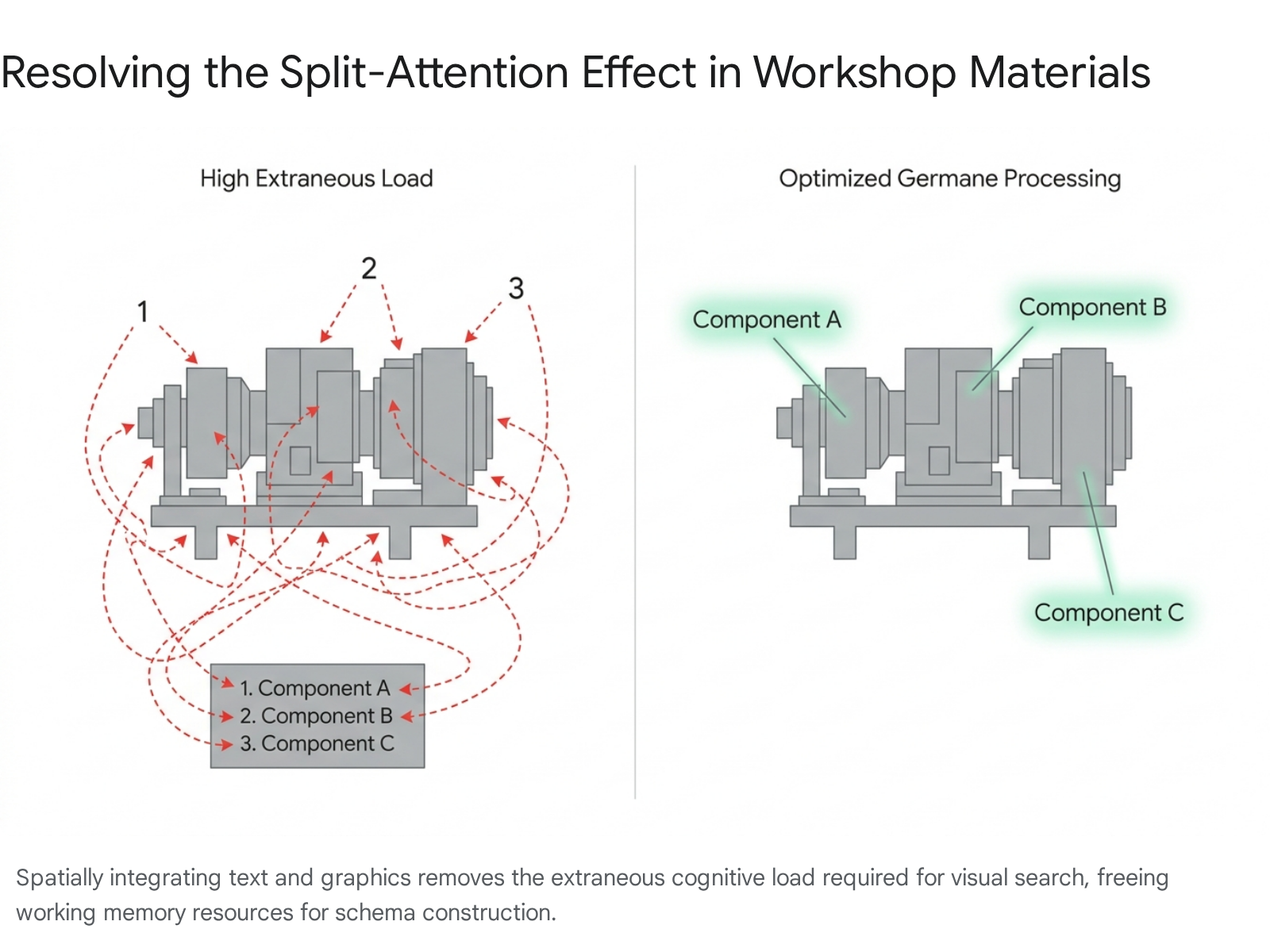
In digital training environments, designers can utilize hover-states or embedded tooltips that reveal definitions in situ, rather than forcing users to consult separate glossary pages 3625. When demonstrating software or processes, spoken explanations must be synchronized perfectly with the visual demonstrations on the screen, creating temporal contiguity that prevents working memory decay 8.
Management of the Redundancy Effect
While the split-attention effect deals with mutually dependent information, the redundancy effect occurs when learners are presented with multiple sources of information that are identical in content, or when non-essential, distracting information is added to essential material 173626.
A frequent violation of this principle occurs when a workshop presenter displays a text-heavy slide and proceeds to read the text verbatim to the audience. This introduces codal redundancy, as the exact same linguistic code is processed simultaneously through both visual and auditory channels 226. Because both the spoken words and the written text compete for limited processing capacity in the phonological loop of working memory, cognitive load artificially inflates while learning efficiency decreases 1239.
Instructional designers must ruthlessly eliminate redundant information. Instead of relying on text-heavy slides accompanied by narration, designers should employ the modality effect by presenting complex information as a visual diagram supported by auditory narration 1736. This dual-channel approach distributes the cognitive load across the separate visual and auditory working memory processors, effectively expanding the total working memory capacity available to the learner 36. Furthermore, designers must avoid the seductive details effect, which involves the inclusion of interesting but irrelevant pictures, anecdotes, or background music. While intended to increase engagement, these elements invariably act as distractors that tax processing capabilities and decrease perceptual processing of the core textual information 1727.
The Transient Information Effect in Multimedia
The transient information effect represents an increasingly critical challenge in modern adult training, given the heavy reliance on video, animations, and dynamic visual presentations 627. The effect occurs when continuous, fleeting information - such as a spoken sentence or a rapidly moving animation sequence - disappears from the screen before the learner has fully processed and understood it 82728. Because the information is impermanent, the learner is forced to actively hold preceding steps in working memory while simultaneously attempting to attend to new incoming frames, a demand that rapidly leads to severe cognitive overload 610.
Recent theoretical frameworks, including Predictive Processing and Active Inference theory, offer a refined perspective on why transient input is so detrimental. According to these models, learning occurs when the brain updates its internal models by resolving prediction errors generated by sensory input. When information is fleeting, the sensory evidence disappears before the brain has fully utilized the prediction error to update its model 29. Unlike studying a static diagram or a piece of text that remains visible and allows for repeated re-sampling, transient input denies the learner the opportunity to check and refine their predictions, stalling schema development 29.
To counteract the transient information effect, instructional videos and animations must be strategically segmented. Breaking a continuous instructional presentation into logical, bite-sized chunks allows learners sufficient time to consolidate information into schemas before progressing to the next segment 6836. Additionally, providing learners with explicit control mechanisms - such as pause buttons, rewind features, and timeline scrollbars - coupled with clear guidance on how to use them, significantly improves immediate comprehension and delayed recall compared to continuous, system-paced presentations 130.
The Worked Example Effect and Means-Ends Analysis
For novices attempting to learn tasks with high element interactivity, unguided problem-solving is a highly inefficient and counterproductive instructional strategy. When a novice is presented with a novel problem and asked to solve it without guidance, they typically default to a cognitive strategy known as means-ends analysis 3436. This involves continuously holding the desired goal state in working memory, comparing it to the current state, and searching for operations that might reduce the gap between the two 34. This exhaustive mental search process imposes a massive extraneous cognitive load, leaving virtually no working memory capacity available to internalize the actual rules, procedures, and patterns required to build a permanent solution schema 1234.
The worked example effect bypasses the bottleneck of means-ends analysis by providing learners with a fully mapped-out, step-by-step solution to the problem. By studying a worked example rather than attempting to generate a solution from scratch, the learner avoids unproductive task confusion and can allocate all available cognitive resources toward understanding the underlying principles and analogical mapping of the solution structure 1214.
The Fading Technique in Practice
Implementing the worked example effect in workshops requires careful sequencing, often referred to as the fading technique.
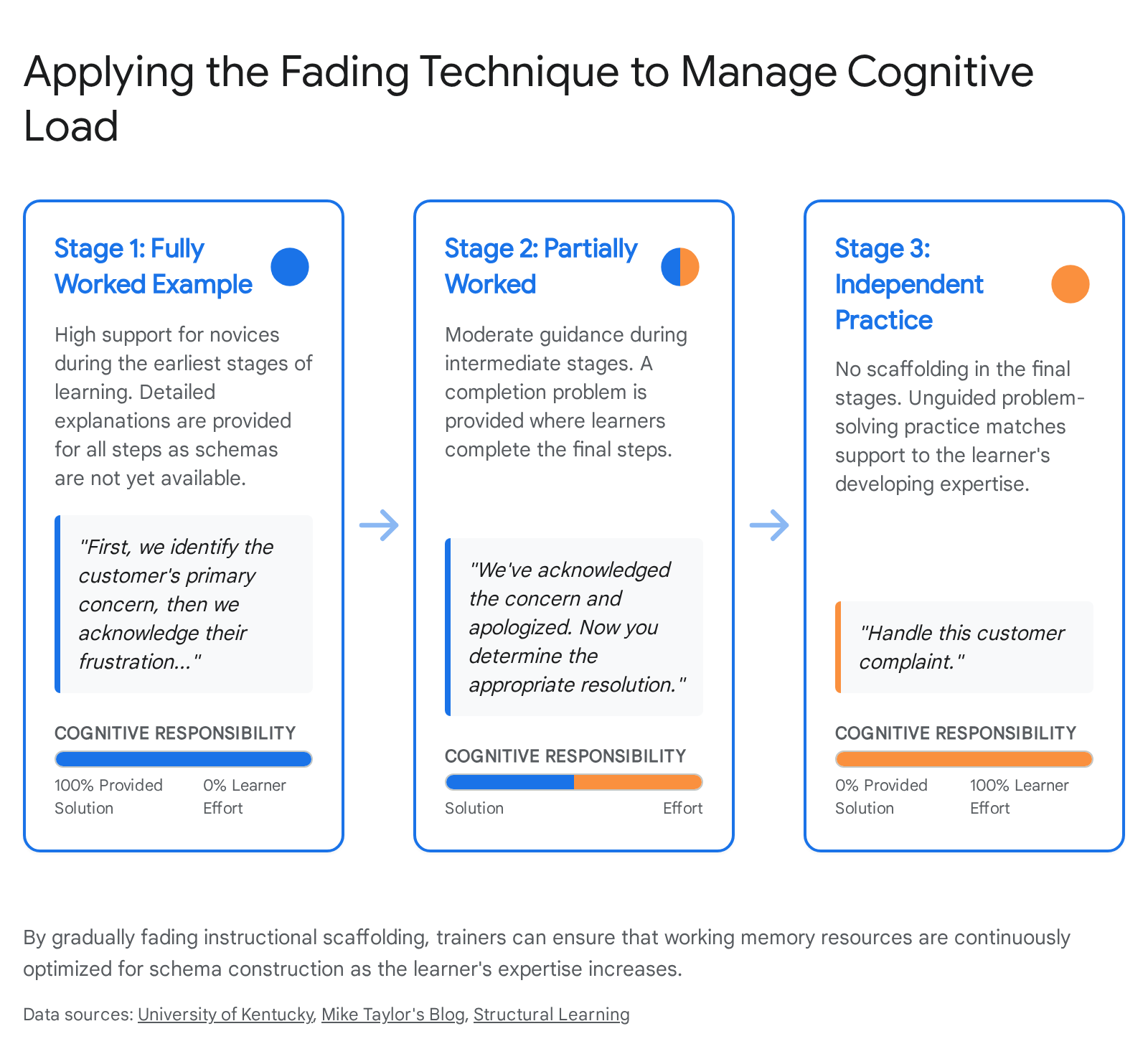
Training should follow a gradual release of responsibility that matches the learner's developing expertise 8.
- Stage 1: In the initial phase, when intrinsic load is highest due to an absence of prior schemas, learners are provided with fully worked examples featuring detailed explanations for every procedural step 8.
- Stage 2: As schema formation begins to free up working memory capacity, the instruction transitions to completion problems. These are partially worked examples where the instructor provides the initial steps, and the learner is required to complete the final operations, increasing germane processing 834.
- Stage 3: Only in the final stage, when sufficient working memory capacity has been liberated through automation, are learners presented with unguided, independent problem-solving tasks 8.
An alternative strategy to mitigate means-ends analysis is the use of goal-free problems. Rather than instructing learners to find a specific numerical answer - which inevitably triggers backward problem-solving and goal-holding in working memory - instructors provide a scenario and ask learners to calculate or determine as many variables as possible. This approach promotes forward-working solutions and reduces extraneous load, as learners focus on applying known operations to the current state rather than fixating on the end goal 3436.
The Expertise Reversal Effect
A critical caveat that governs the application of all extraneous load reduction principles is the expertise reversal effect. The experience of cognitive load is highly contextualized by the specific learner's level of prior knowledge 515. Instructional techniques that are highly effective for supporting novices - such as highly detailed worked examples, explicit step-by-step scaffolding, and integrated explanatory text - can paradoxically become a significant source of extraneous cognitive load for advanced learners 515.
When an expert with highly automated schemas is forced to process basic, fully worked steps or redundant explanations, the instructional format conflicts with their pre-existing mental models. Processing this redundant information consumes working memory capacity that the expert could otherwise use for complex problem-solving 1529. Consequently, training materials cannot utilize a static, one-size-fits-all approach. As a learner's expertise increases, instructional guidance must be dynamically faded, transitioning from direct instruction and worked examples to exploratory, problem-based learning environments 5.
Application to Adult Learning and Corporate Workshops
The transition from traditional academic pedagogy to professional adult learning (andragogy) introduces unique variables that must be accommodated within a cognitive load framework. Adult learners operate within high-stakes, time-constrained environments and require context, immediate real-world relevance, and problem-centered instructional architectures 3132.
When corporate training organizations prioritize the sheer volume of content distribution over cognitive enablement, the result is often a superficial, compliance-driven learning experience that fails to generate meaningful behavioral change or transfer to on-the-job performance 832. A striking example of this phenomenon occurs when training modules are overloaded with gamified elements, interactive badges, and tangential leadership videos. While these features are intended to increase engagement, they drastically inflate extraneous load. Employees often remember the mechanics of the gamified dashboard perfectly but fail to recall the actual compliance procedures, demonstrating that working memory was consumed entirely by the interface rather than the core material 8.
Content Moderation in Workshop Environments
Recent empirical studies highlight the vital importance of content moderation in professional and specialized workshop settings. A 2025 study evaluating instructional intensity in STEM workshops for novices assigned learners to typical, moderately reduced, or highly reduced content groups 16. The findings revealed that the moderately reduced content group achieved significantly better knowledge recall and conceptual understanding in post-tests compared to the typical content-heavy group 16.
This demonstrates the concept of desirable difficulty within cognitive load management; by moderately reducing the total volume of content, workshop designers balanced element interactivity and intrinsic load, preventing working memory saturation while still providing enough challenge to engage learners 16. Interestingly, the study also found that the moderately reduced group required the fewest interactions with educators to understand the material, indicating high instructional efficiency 16. Furthermore, a specialized cognitive load workshop designed for clinical workplace educators demonstrated that adult professionals could effectively rapidly acquire and apply CLT principles to their own unpredictable teaching environments, with participants scoring an average of 85% on retention tests months after a targeted, load-optimized two-hour session 33.
Digital Learning Environments and Multimedia
The rapid proliferation of digital, asynchronous learning environments introduces substantial risks of multimedia-induced cognitive overload. While digital tools offer unparalleled flexibility and accessibility, poorly integrated e-learning modules frequently violate cognitive load principles through cluttered navigation structures, split-attention effects caused by poorly placed visuals, and the simultaneous presentation of text and audio 7.
However, when digital materials are rigorously optimized using cognitive load theory, the performance gains are dramatic. A large-scale implementation of digital mathematics textbooks utilized CLT frameworks to reduce intrinsic load by using animations to build schemas, minimized extraneous load through Gestalt-principled user interface redesigns to ensure spatial consistency, and enhanced germane processing via adaptive analytics. This optimized digital implementation resulted in a 34% increase in knowledge retention and a 28% reduction in perceived cognitive load compared to traditional static materials 47.
Similarly, the Mentu learning platform in Latin America, designed to address severe regional learning poverty, underwent rapid iterative improvements based on learning sciences and load management. By refining instructional sequencing and removing confusing gamification elements, the platform's standardized effect size regarding learning gains increased substantially from 0.17 in its initial version to 0.70 in its optimized iteration 34. Research comparing online and traditional formats consistently emphasizes that the success of digital training relies not on the technology itself, but on personalized support, clear instructional design that minimizes split attention, and the ability to tailor content to the learner's capacity 3550.
Emerging Paradigms and Technological Integrations
As instructional formats evolve, cognitive load theory is increasingly intersecting with advanced technological capabilities and interdisciplinary research, offering novel methods for optimizing adult training.
Artificial Intelligence and Neuroadaptive Systems
One of the most profound advancements in managing cognitive load is the integration of Artificial Intelligence (AI) and Machine Learning (ML) to create neuroadaptive learning systems 1. Traditional workshops and e-learning modules typically rely on a standardized pacing strategy, which inevitably overwhelms novices while simultaneously frustrating experts due to the expertise reversal effect 132.
Modern AI-driven adaptive systems utilize real-time data to monitor a learner's cognitive state and dynamically adjust instructional delivery 136. By employing deep learning algorithms - such as Support Vector Machines (SVMs), Recurrent Neural Networks (RNNs), and Convolutional Neural Networks (CNNs) - these systems analyze multimodal inputs ranging from behavioral response times to physiological markers of stress 123. If an AI tutor detects impending cognitive overload, it can automatically intervene by scaffolding complex concepts, providing immediate hierarchical feedback, or segmenting the material into smaller, manageable chunks 12736. Conversely, when utilizing curriculum learning strategies, AI systems that sequence tasks from simple to complex demonstrate significantly faster convergence and better generalization than traditional randomized training approaches 37. Research has also shown that pedagogical AI agents excel at decomposing complex information, effectively shifting static instructional scaffolds into responsive, generative support that reduces extraneous load 27.
Embodied Cognition and Physical Activity
Recent interdisciplinary intersections between cognitive load theory and Embodied Cognition Theory reveal that cognitive processes are fundamentally grounded in physical bodily actions and sensorimotor experiences 5338. A comprehensive 2024 meta-analysis encompassing 46 empirical studies across 66 effect sizes demonstrated that embodied learning interventions significantly enhance academic and learning performance, yielding a moderately positive overall effect size (Hedges' g = 0.406) 53.
Physical actions incorporated into learning - such as pointing, utilizing tracing gestures, or physically manipulating objects during a workshop - serve a highly effective dual purpose in cognitive load management. Firstly, they reduce intrinsic cognitive load by allowing learners to offload complex abstract reasoning into the physical environment 38. Secondly, physical interactions minimize extraneous cognitive load by firmly anchoring the learner's visual attention, preventing wandering focus and task-irrelevant processing 38. For corporate training designers, incorporating physical, tactile interactions or deliberate spatial movement into conceptual training can free up significant working memory resources that would otherwise be strained by attempting to hold purely abstract mental visualizations 533839.
Measurement of Cognitive Load
The practical application of these theoretical principles relies entirely on the ability of researchers and designers to accurately measure the cognitive load that learners experience. Because working memory capacity is an internal cognitive state, it cannot be directly observed, presenting persistent methodological challenges 253.
Subjective Assessment Instruments
Historically, the dominant methodology for assessing cognitive load has relied on subjective, self-reporting questionnaires administered immediately following a learning task. The most widely utilized tools include the NASA Task Load Index (NASA-TLX) and the specialized, multi-dimensional questionnaire developed by Leppink et al. (2013) 142547.
While originally designed to capture intrinsic, extraneous, and germane load as distinct subscales, modern psychometric validations of these instruments have adapted to the theoretical shifts in the field. Contemporary researchers frequently deploy these questionnaires as two-factor models, entirely excluding the germane subscale due to its conceptual ambiguity 14. In these validated models, Likert-scale items are used to capture perceived task complexity and conceptual difficulty (measuring intrinsic load) and the clarity and effectiveness of the instructional presentation (measuring extraneous load) 1424.
Psychophysiological and Continuous Assessment
Subjective questionnaires are inherently limited by retrospective bias and provide only a single, aggregate score reflecting the entirety of a learning session 724. To achieve a granular, continuous assessment of cognitive load in real-time, modern educational neuroscience relies on psychophysiological measurement modalities.
| Physiological Metric | Modality Type | Target Insight | System Application 162327 |
|---|---|---|---|
| EEG (Electroencephalography) | Neurological | Detects real-time cortical activity and electrical frequency variations. | Utilized in AI-adaptive systems to detect sudden spikes in intrinsic processing demands. |
| fNIRS (Functional Near-Infrared Spectroscopy) | Neurological | Measures blood oxygenation changes in the prefrontal cortex. | Highly reliable for detecting sustained cognitive overload during complex problem-solving. |
| Eye-Tracking | Behavioral | Analyzes fixation duration, saccadic movements, and pupil dilation. | Crucial for identifying split-attention effects and visual search patterns caused by extraneous load. |
| GSR (Galvanic Skin Response) | Autonomic | Measures sweat gland activity indicating physiological arousal. | Correlates stress, anxiety, or frustration with periods of cognitive overload. |
By fusing these multimodal data streams - such as combining EEG data with eye-tracking metrics - researchers and advanced AI systems can determine not only when a learner is experiencing cognitive overload, but why. This multimodal approach allows instructional systems to distinguish between the productive, intense focus characteristic of heavy intrinsic processing and the frustrated, erratic visual search indicative of extraneous overload 12327.
Limitations and Theoretical Critiques
Despite its robust empirical foundation and widespread adoption, cognitive load theory is not without its limitations and academic critiques. Understanding these boundaries is essential for instructional designers attempting to deploy the framework in complex, real-world adult training scenarios.
The Risk of Content Simplification
A primary critique of the broad application of cognitive load theory is the risk that an overzealous drive to reduce load may result in the inadvertent "dumbing down" of essential academic or professional content 265640. Some researchers argue that while reducing extraneous load is universally beneficial, attempting to aggressively lower intrinsic load by excessively fragmenting material can deprive learners of the necessary cognitive struggle required to develop robust, interconnected schemas 156.
Effective instruction relies on optimizing the processing of complex information, not simply removing the complexity. For instance, in language acquisition training, rather than simplifying the vocabulary and grammar rules to an extreme degree, effective instruction utilizes "chunking" by teaching formulaic sequences and lexical chunks 26. This approach bypasses working memory bottlenecks by providing pre-assembled linguistic frameworks, allowing learners to achieve fluency without sacrificing the complexity of the target language 26.
Emotional and Metacognitive Omissions
A secondary critique highlights that cognitive load theory, in its strict focus on information processing efficiency and working memory mechanics, often overlooks the profound impact of emotional, social, and metacognitive variables on learning 41. Human learning in a workshop environment is not solely a computational process; it is heavily influenced by anxiety, motivation, and environmental stressors.
Affective factors, such as performance anxiety, imposter syndrome, or stereotype threat, can impose a massive, invisible extraneous load on working memory, depleting the resources available for processing training material even if the presentation slides are perfectly designed 742. Furthermore, frameworks like Self-Determination Theory (SDT) demonstrate that when learners feel a sense of autonomy and competence, they are more likely to engage in productive self-regulation, which buffers against cognitive overload 1343. Consequently, neurodevelopmentally informed holistic learning frameworks advocate for environments that manage cognitive load while simultaneously fostering emotional engagement, social interaction, and metacognitive awareness to fully support adult learners facing real-world challenges 3241.
Conclusion
Cognitive load theory provides an indispensable, biologically grounded blueprint for understanding the mechanics of human learning and the optimization of instructional design. By recognizing working memory as an acute and severe cognitive bottleneck - capable of processing only a handful of interacting elements simultaneously - instructional designers can strategically architect training materials to facilitate the seamless transfer of knowledge into permanent, automated schemas within long-term memory.
The primary mandate for any workshop facilitator or digital training designer remains the systematic eradication of extraneous cognitive load. By spatially integrating separated information to eliminate the split-attention effect, removing redundant audiovisual inputs, segmenting transient multimedia materials, and utilizing the fading techniques of worked examples, designers preserve vital working memory capacity. As the theoretical landscape continues to evolve - moving away from germane load as an independent metric and expanding toward neuroadaptive AI environments and embodied learning interventions - the core principle remains unchanged: to drive meaningful behavioral change and skill acquisition, training must align flawlessly with the established parameters of human cognitive architecture.