
Social learning theory in peer-to-peer training design
Albert Bandura's Social Learning Theory established that human beings acquire new behaviors, cognitive frameworks, and attitudes primarily through the observation and imitation of others within a social context 12. Diverging from strict behaviorist models that required direct reinforcement or punishment through trial and error, Bandura's framework positioned individuals as active information processors capable of internalizing complex activities by watching a model 13. Within modern organizational and educational psychology, these observational learning principles form the structural foundation for peer-to-peer learning formats, including synchronous workshops and digital cohort-based courses. The transition from instructor-led didactic models to collaborative, peer-driven training ecosystems relies directly on facilitating the precise cognitive and environmental conditions that Bandura identified as necessary for behavioral modeling.
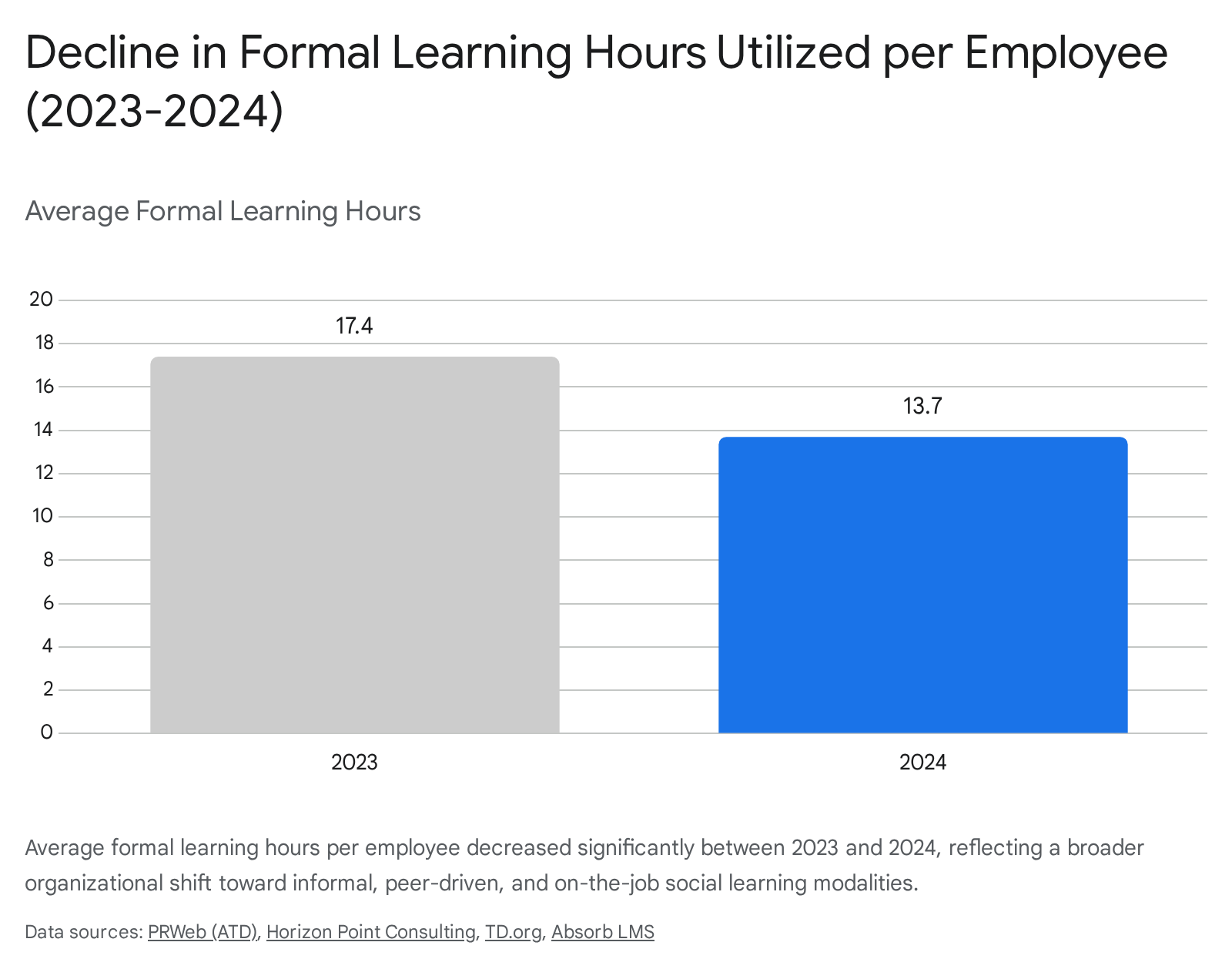
The successful implementation of peer-to-peer structures requires a meticulous alignment of instructional design with cognitive constraints and cultural variables. Organizational talent development metrics reflect a structural shift toward these observational models, driven by the need for continuous skill acquisition that outpaces the production capabilities of formal training manuals. Data from the Association for Talent Development (ATD) indicates that average formal learning hours utilized per employee steadily declined to 13.7 hours in 2024 from a recent high of 17.4 hours in 2023, while expenditures shifted toward social collaborative tools, mentoring, and on-the-job peer learning 455.
As organizations depend more heavily on peer networks to disseminate localized expertise, understanding the psychological mechanisms governing observational learning, cognitive load distribution, and cultural communication contexts becomes critical for effective training design.
Theoretical Foundations of Observational Learning
To apply social learning theory to modern training interventions, it is necessary to examine the distinct psychological mechanisms that govern how humans absorb information from peers. Bandura's theories bridged the gap between traditional behaviorism and cognitive psychology 1. Prior to his work, behaviorists like B.F. Skinner argued that learning occurred strictly through direct experience: a behavior was emitted, and subsequent environmental reinforcement or punishment shaped future occurrences 6. Bandura criticized this model as incomplete, noting that humans frequently emit entirely novel, complex behaviors flawlessly on their first attempt, without any prior reinforcement 6. Furthermore, he observed that imitation of a behavior is often delayed long after the initial observation, proving that the learner cognitively stored the information rather than merely reacting to immediate stimuli 6.
Reciprocal Determinism and the Bobo Doll Experiment
The foundational evidence for observational learning emerged from the 1961 Bobo doll experiments, wherein children observed adults behaving aggressively toward an inflatable doll 28. When later placed in a room with the doll, the children who had observed the aggressive models consistently replicated the violence, utilizing the exact actions and phrases they had witnessed, whereas control groups exhibited virtually no aggression 2. Crucially, the children learned and reproduced these behaviors without receiving any direct reward or punishment 2. This demonstrated that modeling alone, independent of operant conditioning, functions as a primary driver of skill acquisition.
This insight culminated in Bandura's concept of reciprocal determinism, which asserts that learning is shaped by the continuous, bidirectional interaction of three factors: the individual's internal cognition, their behavior, and the surrounding environment 6. In a peer-learning context, reciprocal determinism dictates that while the training environment (e.g., a workshop setting) influences a learner's behavior, the learner's behavior simultaneously alters the environment 6. When a participant models a new skill, they alter the psychological situation for their peers, providing a dynamic social stimulus that cannot be replicated by a static training manual.
The Four Stages of the Modeling Process
Observational learning occurs through symbolic processes during exposure to modeled activities, long before any overt responses are performed 7. For this cognitive transfer to succeed within a training cohort, four sequential mediational processes must be systematically engaged 168. If any of these four stages are neglected in instructional design, the behavioral transfer fails.
- Attention: Learning cannot commence unless the observer accurately perceives and focuses on the significant features of the modeled behavior 19. Attention is highly variable and depends on the distinctiveness of the behavior, the observer's cognitive state, and the characteristics of the model 10. Models who exhibit high competence, perceived status, and similarity to the observer command the highest levels of attention 1013.
- Retention: The observer must convert the transitory social interaction into enduring internal guides for memory representation 11. Bandura argued that learners utilize visual imagery and verbal coding to store facts 2. If a peer's demonstration is not cognitively coded - through debriefing, note-taking, or mental rehearsal - it will not influence future behavior 9.
- Reproduction: The individual must possess the physical and cognitive capability to convert their stored memory codes into overt action 111. In professional settings, this involves translating the abstract understanding of a peer's strategy into personal execution. Deficits in prior knowledge or physical ability will cause failure at this stage, regardless of how well the behavior was observed 1.
- Motivation: Even if a learner attends to, remembers, and is capable of reproducing a behavior, they will not enact it without sufficient incentive 10. Motivation is largely governed by anticipated consequences 7. Observers evaluate whether the model was rewarded (vicarious reinforcement) or punished (vicarious punishment) to decide if the effort of reproduction is worthwhile 1015.
Abstract Modeling and Self-Efficacy
While basic imitation involves copying specific actions, adult peer-to-peer learning relies heavily on abstract modeling. In abstract modeling, observers extract underlying principles and general rules from the specific behaviors they witness, allowing them to apply those rules to novel situations 3. For example, a junior employee observing a senior peer defuse a tense client escalation does not merely memorize the exact words spoken; they abstract the underlying principles of active listening and emotional regulation to use in future, differing conflicts 3.
The likelihood of a learner attempting to apply these abstracted rules is intrinsically linked to self-efficacy - a person's belief in their capability to execute a specific task 912. Bandura identified four primary sources of self-efficacy: mastery experiences (direct success), vicarious experiences (observing peers succeed), verbal persuasion, and physiological states 9. Within collaborative cohorts, vicarious experiences are paramount. Observing a relatable peer successfully perform a daunting task significantly boosts the observer's self-efficacy, generating a cognitive shift from "this is impossible" to "if they can do it, I can do it" 1. Thus, peer models frequently serve a more powerful motivational function than expert instructors, precisely because their perceived similarity renders their success more attainable to the observer 1.
Application in Workshop Design and Peer Structures
The transition from theoretical mechanisms to practical instructional architecture requires specific protocols that deliberately trigger Bandura's four stages. Traditional training programs frequently underperform because they over-index on the presentation of information (attention) while neglecting structured cognitive encoding (retention) and physical enactment (reproduction) 13. Advanced peer-to-peer designs leverage specific exercises to systematically guide cohorts through the entire observational learning lifecycle.
Fishbowl Observation Exercises
A prominent instructional strategy for structured peer modeling is the fishbowl exercise. A fishbowl isolates a small, core group of participants (typically three to six individuals) in the center of the room to discuss a topic or demonstrate a skill, while the remainder of the cohort sits in an outer ring, observing the interaction in silence 14. This architectural setup artificially constrains the learning environment to maximize the attentional process. Because the outer ring is prohibited from interrupting, their cognitive resources are entirely dedicated to coding the behavior of the inner circle 14.
To ensure the retention stage occurs, facilitators frequently require observers to map the interaction using specific criteria 15. For instance, observers may utilize an empathy map to document what the peer models said, did, thought, and felt during the simulation 16. This prevents passive viewing and forces the observers to actively translate the modeled behavior into semantic and visual codes 11. The fishbowl technique illustrates that observation in social learning is not a passive absorption of stimuli, but a highly active cognitive process requiring structured facilitation.
Role-Play and Behavioral Enactments
Role-play activities primarily serve the reproduction and motivation stages of the social learning cycle 813. After observing a peer or instructor model a skill, learners are divided into dyads or triads to enact the scenario themselves. According to Bandura's theory, the act of role-playing forces the learner to reconcile their internal symbolic image of the behavior with their actual physical and verbal output 121.
The subsequent peer critique acts as the motivational mechanism. Meta-analytic research confirms that behavior modeling training (BMT) - a structured sequence where trainees observe a skill, verbally describe it, and then physically rehearse it - yields significant gains in both declarative knowledge and applied job performance 113. The efficacy of role-play is contingent on the feedback loops established during the exercise. Learners who observe both positive executions and negative failures of work behaviors develop stronger, more resilient skills, as they benefit simultaneously from vicarious reinforcement and vicarious punishment 113.
| Bandura's Modeling Stage | Primary Cognitive Function | Corresponding Peer-to-Peer Training Exercise | Instructional Mechanism |
|---|---|---|---|
| Attention | Sensory registration of the modeled action. | Fishbowl Observation | The observer is positioned in an outer circle, restricted from participating, forcing exclusive focus on the peer model's actions 914. |
| Retention | Translating observed actions into enduring symbolic memory codes. | Empathy Mapping / Peer Rubrics | Observers are required to document specific behaviors, categorizing what the peer model said or did, encoding the action into memory 1116. |
| Reproduction | Converting memory representations into overt physical or verbal action. | Role-Play Enactments | Learners physically or verbally rehearse the modeled behavior in a simulated, low-stakes environment, refining their approximation of the skill 81321. |
| Motivation | Evaluating the consequences of the behavior to determine future enactment. | Peer Critique & Debriefing | The acting learner receives direct reinforcement, while observing peers receive vicarious reinforcement or punishment based on the feedback provided 915. |
Peer Mentoring and Communities of Practice
Beyond isolated workshops, organizations sustain observational learning through ongoing peer mentoring and communities of practice. Formal mentorship programs construct highly structured environments for longitudinal observational learning, granting junior employees persistent exposure to the behavioral models of seasoned professionals 22. Research within higher education and corporate contexts indicates that peer mentors act as a vital form of "social capital," providing both academic and emotional support 17. In studies involving underrepresented demographics, such as Latino college students at Hispanic-Serving Institutions, peer mentoring significantly increased university integration and connection, demonstrating that relatable role models enhance belongingness and self-efficacy simultaneously 17.
In collaborative work environments, informal communities of practice enable the continuous flow of knowledge. Studies by cognitive scientists have demonstrated that individuals solve complex problems much more effectively by observing the exploratory strategies of peers in networked groups rather than attempting to derive solutions in isolation 24. By exploring the payoffs of their peers' solutions, employees engage in trial-and-error by proxy, significantly accelerating the acquisition of effective behaviors 24.
Cognitive Load Constraints in Collaborative Environments
While social learning theory emphasizes the myriad benefits of observational learning, its application in intensive cohort environments is strictly governed by Cognitive Load Theory (CLT). Developed by John Sweller in the late 1980s, CLT focuses on the architectural constraints of human information processing 2518. When training programs rely heavily on peer interactions, instructional designers must carefully balance the social advantages against the persistent risk of cognitive overload.
Human Information Processing and Memory Systems
CLT operates on the premise that human memory is divided into sensory memory, working memory, and long-term memory 2519. Sensory memory filters the continuous stream of environmental stimuli, passing select information into working memory 19. Working memory is a rapid, flexible, but highly unstable system capable of processing only 5 to 9 discrete "chunks" of information at any given moment 1920. If working memory is successful, it organizes information into "schemas" - knowledge structures stored in the infinite capacity of long-term memory 2519.
Cognitive load refers to the amount of mental effort required in working memory to process an instructional task, divided into three categories: * Intrinsic Load: The inherent, unavoidable complexity of the material itself 2521. * Extraneous Load: The unnecessary mental strain imposed by poor instructional design, confusing interfaces, or irrelevant environmental distractions 2521. * Germane Load: The beneficial cognitive effort required to actually organize the new information into long-term schemas 2519.
Cognitive overload occurs when the combined intrinsic, extraneous, and germane loads exceed the learner's finite working memory capacity 2519. When overwhelmed, learners fail to process the modeled behaviors of their peers, resulting in rapid forgetting and an inability to transfer skills to the job 1922.
The Collective Working Memory Effect
In peer-to-peer learning, collaboration can serve as a mechanism to distribute and manage intrinsic load. When a cohort tackles a complex problem collectively, no single individual is required to hold all variables in their working memory. The group shares the cognitive burden, a phenomenon referred to as the collective working memory effect 23. This shared processing capability is one of the primary pedagogical advantages of group workshops.
However, peer settings can also induce cognitive overload if tasks lack sufficient scaffolding. Novice learners placed in minimally guided, highly interactive group tasks may focus entirely on the social dynamics and procedural mechanics of the activity rather than the underlying concepts 20. If the "problem space" - the gap between the learner's current knowledge and the desired goal - is too large, peer collaboration devolves into shared confusion 19. Effective design mitigates this by providing structured rubrics and breaking complex social modeling tasks into sequenced components 1920.
Limitations of Strict Cognitive Load Frameworks
While CLT provides vital guidelines for reducing extraneous distraction, recent critiques from neuroscientists and educational psychologists highlight that strict adherence to load-reduction can inadvertently sterilize the learning environment 24. An overemphasis on cognitive efficiency and content-focused instruction often overlooks the complex, interpersonal dimensions of human learning 24.
Stripping a workshop of all dynamic peer interaction in an attempt to minimize extraneous load may succeed in transferring discrete facts, but it fails to cultivate metacognitive strategies, social-emotional resilience, and adaptive problem-solving skills 24. Furthermore, highly sterile environments reduce the emotional and social engagement necessary for building the very motivation and vicarious reinforcement that Bandura identified as crucial for sustained behavioral change 1024. Therefore, optimal cohort design requires a calibrated approach: providing structured scaffolding to manage intrinsic load while permitting enough social complexity to foster deep observational learning, psychological safety, and peer empathy.
Cohort-Based Courses and Digital Peer Interaction
As corporate training and higher education increasingly shift toward digital ecosystems, instructional designers face the challenge of translating observational learning into remote environments. Cohort-Based Courses (CBCs) have emerged as the primary vehicle for online social learning. CBCs differ significantly from the earlier paradigm of Massive Open Online Courses (MOOCs) by synchronizing a group of learners to a shared schedule and deadlines 33. This structure inherently preserves the social context required for peer observation, mutual motivation, and accountability, mitigating the high dropout rates that plague solitary, self-paced e-learning 33.
Digital Breakout Rooms and Peer Dialogue
Within synchronous virtual environments, digital breakout rooms serve as the primary proxy for small-group peer modeling. Research demonstrates that breakout rooms can successfully facilitate peer-to-peer discourse, collaborative problem-solving, and cross-functional knowledge sharing 3425. By isolating smaller groups from the main plenary session, instructors enable learners to engage in the reproduction phase of learning in a lower-stakes digital space.
However, the efficacy of breakout rooms is highly variable. Without strict architectural guidance, virtual breakout rooms often devolve into apathy, characterized by muted microphones, disabled cameras, and a lack of social presence 36. To combat this, digital peer interactions require highly structured tasks, pre-assigned roles (e.g., a designated leader or note-taker), and distinct collaborative deliverables (such as completing a shared digital whiteboard or Padlet) to ensure that students are actively engaged in mutual observation and modeling 3426. When utilized properly, students report that breakout rooms increase their confidence in applying learning and facilitate necessary social bonding that virtual lectures lack 26.
The Split-Attention Effect and Remote Modeling Challenges
The modalities used to facilitate virtual peer learning frequently introduce severe extraneous cognitive load. Digital training environments are plagued by the "split-attention effect," a phenomenon where a learner's cognitive resources are fragmented by attempting to mentally integrate multiple, physically separated sources of information 27.
In a typical webinar platform, a participant must simultaneously process a live presentation, track an active, fast-scrolling chat stream, and monitor a grid of peer video feeds.
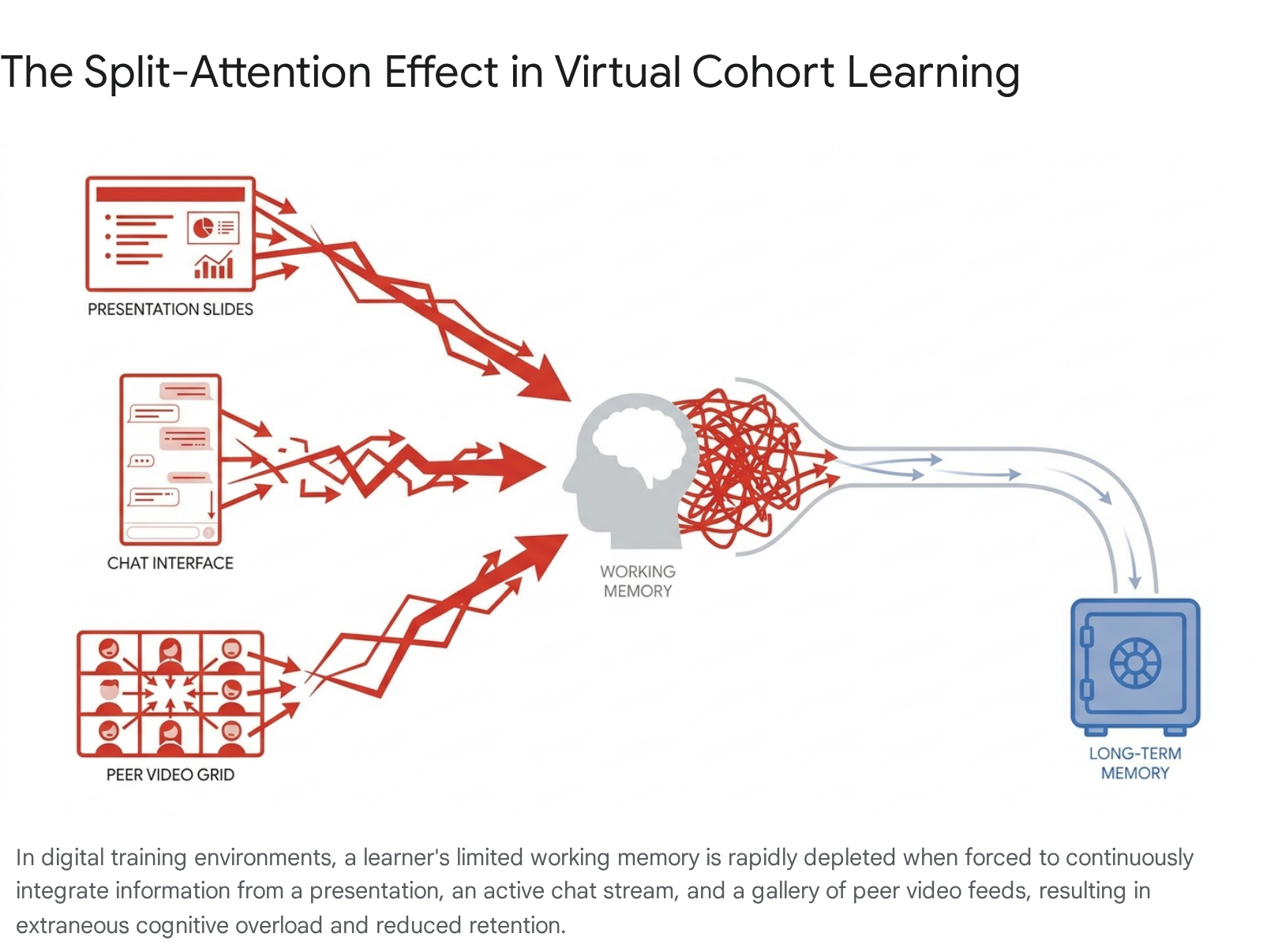
Research indicates that this division of attention is neurologically taxing; fast-scrolling chat windows cause participants to miss 40% to 60% of messages, draining working memory resources that should be allocated to germane learning 27.
Furthermore, remote peer modeling introduces specific psychosocial stressors that do not exist in physical workshops. Participants frequently experience "hyper-gaze" (the unnatural perceptual experience of constantly having multiple people's gaze in one's direct field of view) and mirror anxiety induced by the self-view camera 28. Because the digital interface suppresses subtle physical cues, users experience cognitive overload from the intentional, effortful production and interpretation of non-verbal behaviors that occur naturally and subconsciously in real-life interactions 28. These factors inhibit biobehavioral synchrony, a central mechanism underpinning human social communication 28.
Asynchronous Video Observation and Feedback
To bypass the cognitive constraints of synchronous virtual environments, many cohort-based programs utilize asynchronous video observation. Video-based feedback has emerged as a highly effective mechanism for observational learning, allowing peers to record performances, role-plays, or presentations for subsequent analysis by the cohort 2930.
The primary advantage of asynchronous video is its ability to facilitate repetitive, targeted attention. Learners can pause, rewind, and review specific details of a peer's performance, which enhances memory retention and cultivates observational expertise 30. This is particularly critical in motor learning and complex communication training, where precise, context-specific feedback drives skill refinement 30.
Studies examining asynchronous video feedback reveal nuanced outcomes based on the type of peer model observed. In a randomized controlled study of an online statistics course, students were exposed to different types of video-based peer modeling 29. Students exposed to "mastery models" - videos of a peer demonstrating the flawless, efficient process of arriving at a correct answer - reported significantly higher self-efficacy and achieved higher subsequent quiz scores than those in the control group 29. Interestingly, exposure to "coping models" - videos of peers who made errors but narratively self-corrected on screen - did not yield statistically significant improvements over the control group 29. This data suggests that for initial skill acquisition in asynchronous digital environments, observing direct mastery provides the clearest, uncorrupted symbolic code for retention, preventing the cognitive load required to parse a peer's mistakes.
| Learning Modality | Primary Benefit for Social Learning | Primary Challenge / Cognitive Risk | Optimal Instructional Application |
|---|---|---|---|
| Synchronous Breakout Rooms | High social presence; enables real-time peer discourse and collective problem-solving 3425. | Vulnerable to student apathy, silent participation, and the split-attention effect 3627. | Task-based activities with pre-assigned roles and explicit, time-bound deliverables 3426. |
| Asynchronous Video Review | Allows repetitive viewing, reducing intrinsic load and enabling precise observation of complex skills 30. | Lacks real-time conversational flow; may feel isolating compared to live interactions 42. | Evaluating mastery models, providing structured descriptive feedback, and reflecting on technical procedures 2930. |
Motivation and Social Reinforcement Mechanisms
The final stage of Bandura's modeling process - motivation - requires careful integration into cohort design. Motivation dictates the persistence with which a learner will apply their retained knowledge 10. While traditional pedagogical models emphasize instructor praise or grades, peer-to-peer structures leverage the nuanced mechanisms of social reinforcement.
Vicarious Reinforcement and Goal Alignment
Vicarious reinforcement occurs when an observer witnesses a peer receiving a favorable outcome for a specific behavior, thereby increasing the observer's incentive to replicate it 1015. In a workshop setting, public peer recognition is a powerful tool. When a facilitator or group commends a participant during a fishbowl exercise, the entire observing cohort is vicariously reinforced. Expectancy-Value Theory (EVT) suggests that these external rewards are most effective when they reinforce students' beliefs in their own ability to succeed and align closely with their personal or professional goals 31.
However, motivation regulation is highly dynamic. Recent studies utilizing video analysis of collaborative learning groups demonstrate that motivation fluctuates within single lessons and across students, with peers primarily influencing each other through indirect strategies, such as maintaining equal participation and signaling growth-mindset beliefs 32. Therefore, instructional designers must aim to balance intrinsic value beliefs (making the instruction inherently interesting or enjoyable) with extrinsic motivators, ensuring that the peer feedback loop emphasizes progress, effort, and mastery rather than destructive peer comparison 3334.
Cultural Variables in Peer Modeling
The efficacy of peer-to-peer modeling is heavily moderated by the socio-cultural dynamics of the cohort. Observational learning and peer feedback require an environment where individuals are willing to display vulnerability, make mistakes during the reproduction phase, and offer candid critiques. This willingness is fundamentally dependent on psychological variables that vary drastically across different demographics and organizational cultures.
Psychological Safety and Interpersonal Risk-Taking
Central to effective peer learning is team psychological safety - the shared belief that a group is safe for interpersonal risk-taking without fear of embarrassment, marginalization, or retribution 3536. When teams possess high psychological safety, members focus less on self-protection and more on knowledge sharing, collaboration, and collective problem-solving 3637. Research by Google's Project Aristotle demonstrated that teams with high psychological safety are 76% more likely to engage in strong collaboration practices and are significantly more innovative 36.
In contexts historically characterized by rigid hierarchies and high burnout, such as academic medicine, structured peer mentoring interventions have been shown to significantly increase psychological safety. In these programs, the deliberate use of storytelling, active listening, and skilled facilitation repairs damaged trust, fosters a sense of belonging, and encourages the vulnerability required for profound professional growth 35. Multicultural teams also require explicit inclusive leadership practices - such as participative decision-making and language inclusivity - to establish the mutual respect necessary for cross-cultural peer learning 38.
Power Distance and the Fear of Authority
Psychological safety is significantly inhibited by macro-cultural variables, most notably power distance - the degree to which a society or organization accepts and expects an unequal distribution of power 3940. In cultural or corporate contexts characterized by high power distance (common in many Asian and Latin American environments), subordinates view leaders as possessing absolute authority, and deviations from hierarchical norms are heavily discouraged 394142.
Research involving high power distance environments reveals that an inherent "fear of authority" severely restricts workplace communication 40. In peer training cohorts operating within these cultures, learners exhibit significantly lower rates of feedback-seeking behavior if a superior is present, or if the peer group itself is stratified by seniority 3940. Without psychological safety, the fear of retribution suppresses the motivation to engage in the reproduction phase of Bandura's model 3941.
To overcome these barriers, the intervention of ethical, inclusive leadership is required. In high power distance contexts, ethical leadership acts as a critical moderator. When leaders deliberately establish clear ethical standards, demonstrate empathy, and model vulnerability, they significantly increase the psychological safety of the team 3839. Because employees in high power distance cultures are highly sensitive to the cues of their superiors, a leader explicitly endorsing peer critique and flattening the temporary hierarchy of a workshop can effectively override the default cultural hesitation 39.
High-Context Versus Low-Context Communication
The cultural communication style of a cohort further dictates how observational learning cues are processed. Anthropologist Edward T. Hall distinguished between high-context and low-context cultures 43444546. In low-context cultures (e.g., the United States, Germany, Scandinavia), communication is direct, explicit, and heavily reliant on the literal meaning of spoken or written words 434647. Conversely, in high-context cultures (e.g., Japan, China, Brazil, Mexico), meaning is heavily embedded in implicit cues, non-verbal signals, silence, and the surrounding social context 43484950.
Bandura's stages of attention and retention operate differently across these paradigms. When a learner from a high-context culture observes a peer model in a workshop, they allocate attentional resources not just to the explicit procedural steps being executed, but to the model's posture, tone, hesitation, and situational deference 4449. If instructional designers utilize low-context assessment rubrics that only ask observers to evaluate explicit verbal statements, they force high-context learners to ignore a vast portion of the behavioral data they naturally encode 44.
This dichotomy becomes highly problematic in virtual environments and multicultural cohorts. Digital interfaces inherently filter out the subtle non-verbal cues upon which high-context communicators rely 2850. Furthermore, a low-context learner's direct, explicit critique of a peer's role-play may be perceived as aggressive or relationship-damaging by a high-context peer, instantly eroding psychological safety 474863. Facilitators must accommodate these differences by utilizing dual-style feedback mechanisms - blending direct written rubrics for low-context learners with nuanced, open-ended group reflection for high-context communicators - ensuring that all participants can safely engage in the motivational feedback loops required for learning 4451.
Macro Trends in Corporate Talent Development
The theoretical alignment of social learning theory with modern instructional design is increasingly reflected in macro-level industry behavior. As the pace of technological and organizational change accelerates, centralized, top-down training modules struggle to remain relevant. Consequently, learning and development (L&D) strategies are pivoting heavily toward decentralized peer networks to facilitate rapid, contextually relevant knowledge transfer 65.
The Shift Toward Social and Collaborative Modalities
Recent empirical data underscores the growing prioritization of collaborative learning structures over isolated, formal instruction. The CIPD's Learning at Work research highlights a measurable upward trajectory in the utilization of peer collaboration for organizational learning, increasing from 30% to 36% between 2021 and 2023, surpassing traditional instructor-led formats in strategic preference 52. This shift is fundamentally an application of Bandura's modeling principles at scale; organizations recognize that the most efficient method for an employee to acquire an evolving skill is by observing a competent peer executing it in the flow of work 1365.
Furthermore, as organizations increasingly focus on closing acute skills gaps - cited as the top priority by 29% of L&D professionals 67 - peer learning ecosystems are viewed as the most agile solution. Cohort-based learning provides the necessary scaffolding to integrate these peer interactions formally. By grouping learners with shared schedules and deadlines, CBCs foster the social density and interconnectedness required for vicarious reinforcement and continuous observational learning 33. This represents a significant evolution from the limitations of the early e-learning era, blending the scalability of digital platforms with the psychological imperatives of human social interaction.
Ultimately, the successful deployment of workshop and cohort-based training relies on a sophisticated synthesis of psychological frameworks. Bandura's social learning theory provides the blueprint for observational skill acquisition, demanding structured attention, retention, reproduction, and motivation. Cognitive load theory serves as the necessary governor, ensuring that the collaborative formats designed to facilitate modeling do not overwhelm the learner's working memory, particularly in distraction-heavy digital environments. Finally, cultural intelligence regarding psychological safety, power distance, and communication context dictates whether the interpersonal environment will support the vulnerability necessary for true peer critique. By harmonizing these dimensions, instructional designers can construct peer-to-peer learning structures that effectively harness the collective intelligence and adaptive capacity of the modern workforce.