
Facilitator and instructor roles and competencies in adult learning
Foundational Definitions and Pedagogical Shifts
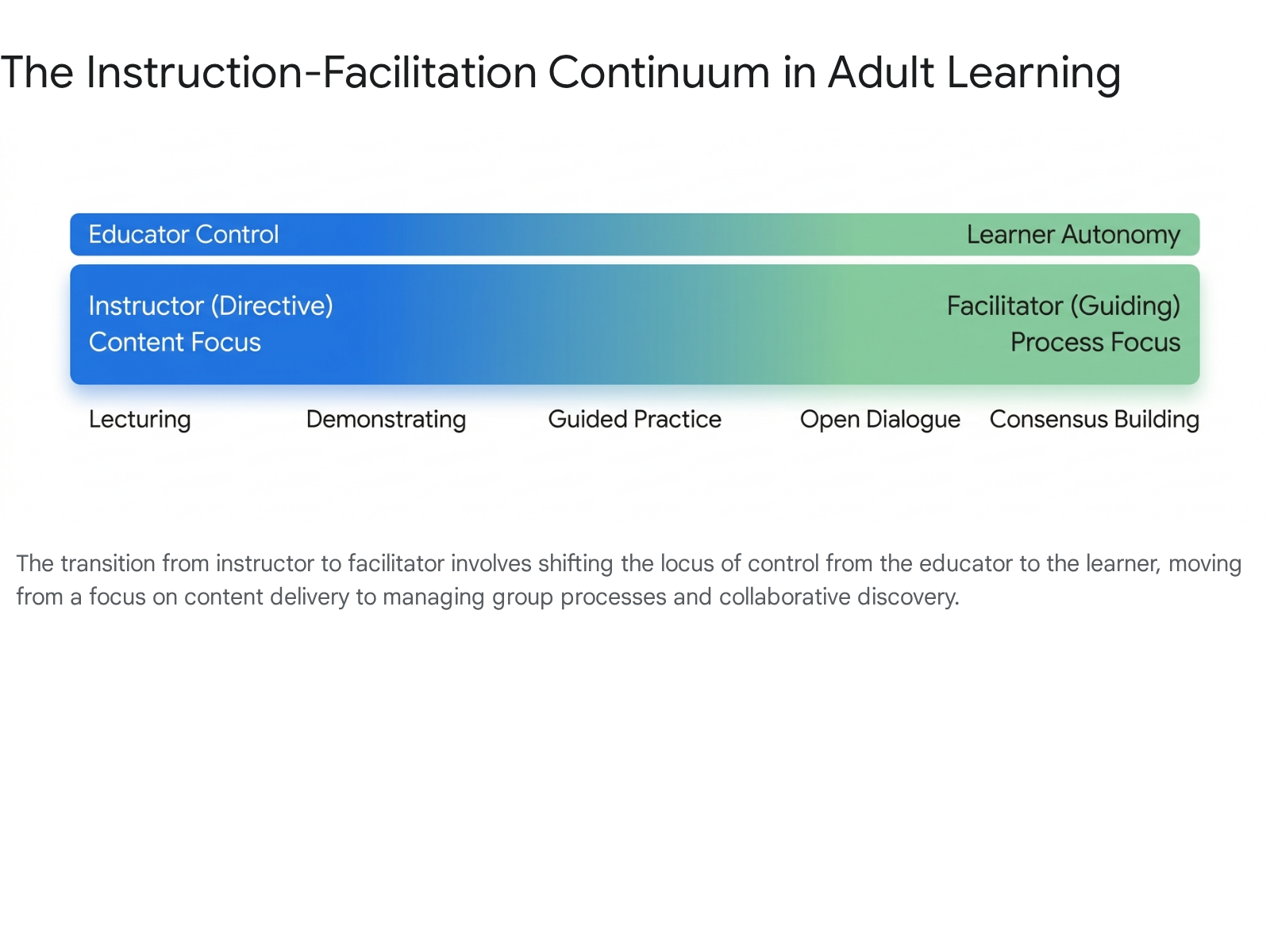
The landscape of adult education, corporate training, and professional development operates on principles that are fundamentally distinct from traditional pedagogical models designed for younger students. Adult learners enter educational environments with established self-concepts, extensive prior experiences, and an orientation toward the immediate, problem-centered application of knowledge 123. Within this complex educational matrix, the roles assumed by educators critically dictate the efficacy and depth of the learning experience. Historically, the dominant model has been that of the instructor, a subject-matter expert who directs the flow of information. However, contemporary adult learning theories increasingly emphasize the necessity of the facilitator, a process expert who guides learners in constructing their own knowledge architectures. While the terms "instructor" and "facilitator" are frequently used interchangeably in institutional discourse, they represent divergent pedagogical philosophies, power dynamics, and instructional methodologies 45.
The Instructor Paradigm
The traditional instructor role is deeply rooted in a teacher-centered educational paradigm. Instructors serve primarily as content resources, maintaining strict control over the curriculum, the pacing of the lesson, and the overall direction of the learning process 34. In this model, the educator is positioned as the primary source of knowledge, tasked with imparting factual information, demonstrating specific skills, and explaining complex concepts through direct instruction 4. This approach is highly structured and often normative, relying on planned lessons, lectures, and standardized exercises to ensure participants gain particular, predefined competencies 56.
The instructional model is particularly advantageous in scenarios where precise, factual information must be delivered efficiently and uniformly across a cohort. It is the preferred methodology for technical skills training, regulatory compliance education, or introductory foundational courses where learners possess minimal prior knowledge of the subject matter 6. In these contexts, the efficiency of direct instruction guarantees consistency. However, a heavy reliance on didactic instruction in adult contexts carries significant risks regarding engagement. Pure instruction positions the adult learner in a passive role, expected to receive and replicate information rather than actively integrating it into their existing experiential frameworks. This lack of agency and autonomy can quickly lead to participant disinterest and disengagement, as it runs counter to the natural psychological drivers of the mature learner 47.
The Facilitator Paradigm
Conversely, the facilitator adopts a strictly learner-centered approach, acting fundamentally as a process manager rather than a mere content resource 35. Facilitation focuses on guiding groups toward achieving self-defined goals by fostering collaboration, extracting collective intelligence, and creating environments where learners can independently explore topics and discover solutions 68. Facilitators operate on the epistemological premise that adult learners already possess valuable knowledge and lived experiences. Rather than dictating what is learned, a facilitator employs techniques such as active inquiry, reflective listening, and structured experiential activities to empower students to take complete ownership of their educational journey 4910.
The facilitator controls the structural process of the session, ensuring psychological safety, managing time allocations, and balancing participation, but deliberately cedes control of the actual content and specific outputs to the group 811. This methodology encourages critical thinking, peer-to-peer knowledge transfer, and the immediate application of theoretical concepts to real-world challenges 4610. By stepping away from the "sage on the stage" dynamic, facilitators act as a "guide by the side," neutralizing the traditional power imbalance between the educator and the educated 312.
The Emergence of Facilitative Instruction
While the theoretical distinction between instructors and facilitators provides a useful analytical framework, modern adult education frequently demands a fluid synthesis of both roles, a concept often termed "facilitative instruction" 13. Master educators recognize that treating motivation and instruction as isolated pedagogical constructs is flawed; adult learners sometimes require a baseline of foundational instruction before they can meaningfully participate in facilitated, high-level dialogue 613.
Empirical studies in higher education and vocational training indicate that combining motivational, student-centered support with structured instructional strategies leads to significantly higher levels of sustained engagement and deeper cognitive involvement 1314. In a hybrid approach, the educator may begin with direct instruction to establish a common vocabulary and factual baseline, and subsequently transition seamlessly into a facilitator role to allow learners to explore, debate, and synthesize that knowledge 614. This shifting of pedagogical stances prioritizes dialogic interactions that honor student voices while maintaining academic rigor, ensuring that both the emotional and procedural needs of the adult learner are met simultaneously 1315.
Operational Contrasts in the Learning Environment
To effectively operationalize the differences between the instructional and facilitative stances, it is necessary to map their divergent characteristics across multiple dimensions of the learning environment.
| Pedagogical Dimension | The Instructor Role | The Facilitator Role |
|---|---|---|
| Primary Objective | Efficient delivery of factual content and transfer of technical skills 56. | Group process management, critical thinking, and collaborative problem-solving 56. |
| Locus of Control | The educator dictates the content, pace, agenda, and direction of learning 34. | The educator controls the process; learners control the direction and conceptual outcomes 411. |
| Instructional Methodology | Teacher-centered; relies heavily on lectures, demonstrations, and structured presentations 46. | Learner-centered; utilizes open-ended questioning, peer discussion, and experiential activities 46. |
| Perception of the Learner | A receiver of information expected to absorb, retain, and replicate established models 410. | An active participant and co-creator of knowledge expected to draw upon prior life experience 410. |
| Metrics for Success | Mastery of predefined objectives, consistency of knowledge acquisition, and normative testing 616. | Generation of novel insights, achievement of group consensus, and autonomous application of concepts 1115. |
Theoretical Underpinnings of Adult Learning
The efficacy of facilitative approaches in adult contexts is not merely an intuitive preference; it is deeply rooted in robust theoretical frameworks regarding human cognitive development, educational psychology, and instructional design.
Andragogical Principles
Malcolm Knowles' theory of andragogy provides the definitive psychological foundation for why facilitation is vastly more effective than traditional pedagogical instruction for mature audiences. Andragogy posits that as individuals mature, their psychological self-concept shifts away from being dependent personalities toward becoming self-directed, autonomous human beings 210. This fundamental shift alters how adults process information and engage with authority figures.
Four core conditions of andragogy dictate the necessity of a facilitative approach. First, adult learners demand self-direction. They learn optimally when they are granted agency to take charge of their learning process, make decisions regarding curriculum relevance, and maintain a degree of independence 31017. Facilitators honor this psychological need by acting as collaborative guides rather than authoritative dictators 410. Second, adults enter educational environments possessing a vast reservoir of prior knowledge and occupational experience. This experience acts as the richest available resource for their own learning and the learning of their peers 310. Facilitators actively draw out and validate this knowledge, whereas strict instructors may inadvertently ignore it by positioning themselves as the sole arbiters of truth. Third, adult learners exhibit a problem-centered orientation. They are motivated by an immediate, pragmatic need to cope with real-life situations and solve specific workplace problems 23. Facilitators leverage this orientation by utilizing applied case studies and collaborative troubleshooting rather than delivering abstract, decontextualized theoretical lectures 1. Finally, adults are driven predominantly by internal motivation, such as the desire for increased self-esteem, career satisfaction, or personal growth, rather than external rewards 210. Engaging participants in the planning phases of a program inherently taps into this internal drive.
Humanistic Psychology and Learner-Centered Environments
Parallel to andragogy, humanistic psychology has profoundly influenced the design of adult education, primarily through the work of Carl Rogers. Humanistic psychology advocates for an educational paradigm that fundamentally respects and acknowledges each learner's unique background, emotional state, and perspective 18. Within this paradigm, educators are encouraged to transition from traditional instructors into "facilitators of learning," prioritizing the creation of a compassionate, supportive, and emotionally safe learning environment 18.
Rogers maintained that meaningful learning is a collaborative process requiring active student engagement. This approach explicitly contrasts with teacher-centered methods that prioritize rote knowledge transfer over addressing the holistic needs of the learner 18. Humanistic facilitation relies heavily on experiential learning strategies, such as role-playing, immersive group discussions, and open-space meeting formats, allowing learners to draw organically on their own perspectives 118. By building deep rapport and trust, the facilitative instructor minimizes the defensive barriers that adult learners often erect when faced with the vulnerability of acquiring new skills 18.
The Spectrum of Teaching Styles
A more granular, structural understanding of how an educator shifts between instructing and facilitating is provided by Muska Mosston and Sara Ashworth's Spectrum of Teaching Styles. Developed to map the entirety of the teaching-learning process, the spectrum identifies eleven landmark instructional styles based on a single, defining metric: decision-making 1920. The spectrum analyzes who makes the decisions prior to the lesson (pre-impact), during the lesson (impact), and following the lesson (post-impact) 1921.
The spectrum is divided into two primary conceptual clusters that directly mirror the instructor-facilitator divide. The Reproduction cluster, encompassing styles such as Command, Practice, Reciprocal, Self-Check, and Inclusion, is characterized by the teacher making the vast majority of instructional decisions 1922. The educational objective here is the precise reproduction of known knowledge and the accurate replication of established skills 21. This closely aligns with the traditional instructor role, where precision is paramount 22. Conversely, the Production cluster, which includes Guided Discovery, Convergent Discovery, Divergent Discovery, Individual Program, and Learner Initiated styles, represents a deliberate, systematic shift of responsibility and decision-making power from the educator to the learner 1922. These styles are characterized by the creation of new knowledge and the exploration of the unknown 21. These production-oriented styles embody the essence of high-level facilitation, requiring the educator to design sophisticated environments where learners uncover concepts and solve problems independently 22.
Master educators recognize that no single style on the spectrum is inherently superior. Instead, they employ a non-versus approach, analyzing the intended learning outcomes, the contextual environment, and the learners' developmental stage to select the precise teaching style that best serves the immediate objective 2022.
Cultural Contexts and Power Distance Dynamics
The effectiveness of shifting from instruction to facilitation is not universally guaranteed across all demographics. Pedagogical success is heavily mediated by cultural dimensions, most notably the concept of Power Distance, originally developed by Geert Hofstede 23. Power distance refers to the extent to which the less powerful members of institutions and organizations expect and accept that power is distributed unequally 23. This cultural metric profoundly shapes behavioral expectations within the classroom.
High Power Distance Environments
In high power distance cultures, which are frequently observed in East Asian and Central Asian societies heavily influenced by Confucian philosophy, there is a deep-seated adherence to hierarchical structures and strict social roles 242425. In these educational settings, the instructor is viewed unequivocally as the ultimate authority figure, the enforcer of discipline, and the unquestioned source of knowledge 2424. Students are culturally conditioned to show profound deference, and they rarely challenge the teacher's views or interrupt with questions 2425.
Within high power distance contexts, students expect highly structured, didactic instruction. When exposed to Western facilitative methodologies, such as unstructured group investigations, peer-led activities, or open-ended dialogue, these students often experience significant epistemological tension 2324. Research indicates that such student-led activities frequently fail to improve academic achievement in these regions, as the blurring of boundaries between the leader (educator) and the follower (student) violates established cultural norms regarding how information should be received 24. A facilitator's refusal to provide direct, authoritative answers may be interpreted not as an empowering pedagogical choice, but as a lack of professional competence or an abdication of instructional duty 2424.
Low Power Distance Environments
Conversely, low power distance cultures, typical of Scandinavian nations and many Western countries, inherently embrace egalitarianism in educational settings 2426. Authority is viewed as something to be shared or negotiated rather than blindly obeyed. Teachers are expected to act as facilitators, treating students as intellectual equals and actively encouraging open dialogue, debate, and critical questioning 2426. Learning gains in these environments are attributed to the effective, bidirectional interaction between the student and the teacher, with both parties sharing responsibility for the educational outcome 26. Students from low power distance cultures generally exhibit significantly higher levels of classroom engagement, self-expression, and self-directed learning when placed in facilitative environments 24.
Strategic Cultural Calibration
The globalization of the workforce and the rise of international education have created culturally diverse classrooms where conflicting power distance values frequently clash 24. International students from high power distance backgrounds often struggle to adapt to egalitarian, facilitative classrooms, feeling immense uncertainty about when and how it is appropriate to participate 24.
Therefore, master facilitators operating in multicultural settings must exhibit profound cultural agility. They cannot rigidly impose Western, low power distance facilitation models on all groups. Instead, they must understand how to strategically calibrate their approach, perhaps initially adopting a more formal, authoritative instructional stance to build trust and meet cultural expectations, before incrementally introducing facilitative, student-centered practices to bridge differing epistemological paradigms 2324.
Structural Frameworks for Facilitator Competency
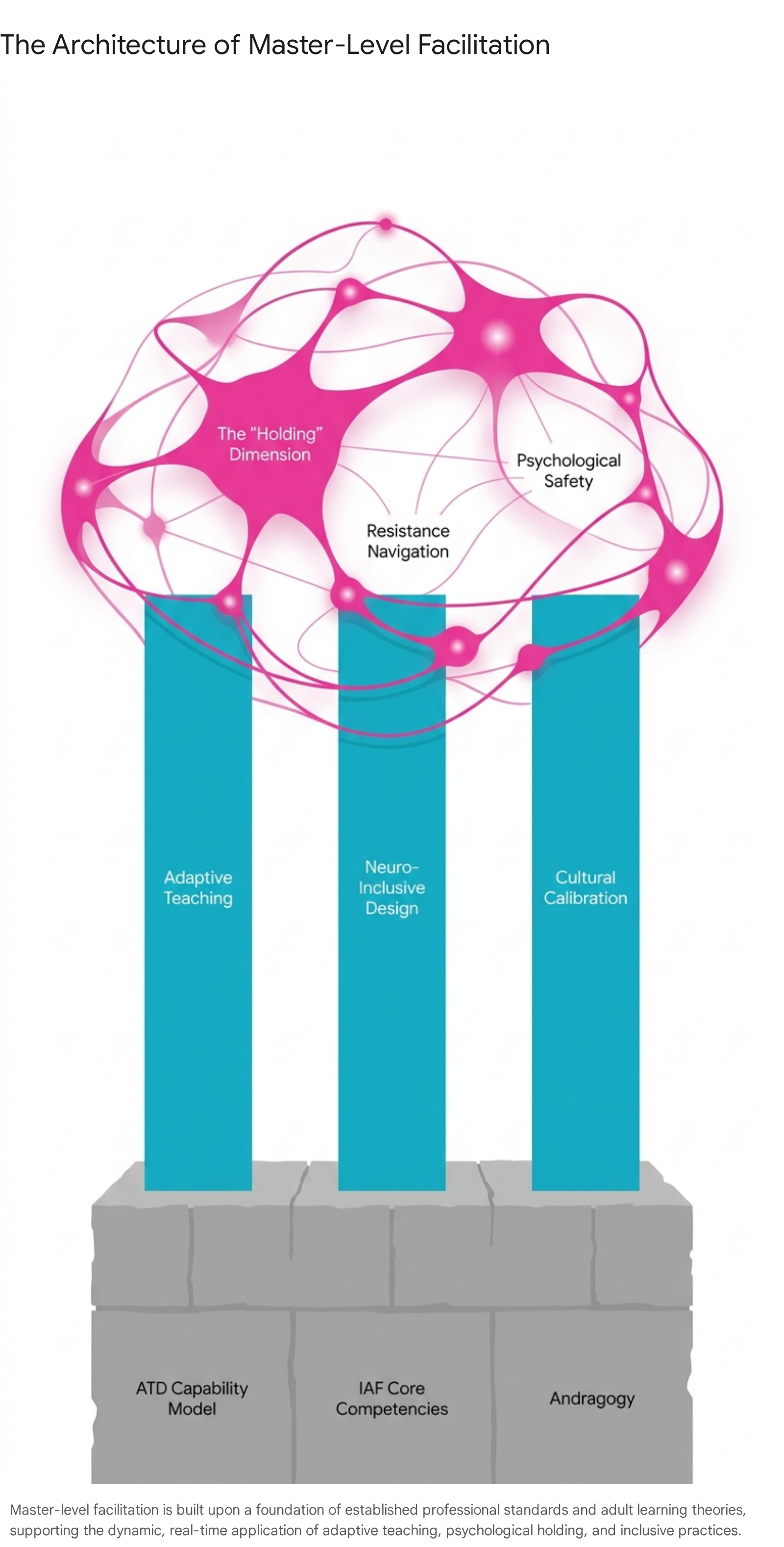
Achieving true mastery in adult learning facilitation transcends a basic, intuitive understanding of how to lead a group discussion. It requires adherence to formalized professional standards, high-level emotional intelligence, and rigorous methodological discipline. Two premier global organizations define the structural competencies required for professional adult educators and facilitators: the Association for Talent Development (ATD) and the International Association of Facilitators (IAF).
The ATD Talent Development Capability Model
The Association for Talent Development has transitioned its professional standards from a static competency model to a dynamic capability model, reflecting the need for educators to adapt to rapid technological and organizational changes 2728. The ATD Talent Development Capability Model outlines the precise knowledge, skills, and behaviors required for success across three interconnected domains: Building Personal Capability, Developing Professional Capability, and Impacting Organizational Capability 2930.
Within this framework, "Training Delivery and Facilitation" is situated as a core capability under the Developing Professional Capability domain 293031. According to ATD standards, an educator achieves master-level facilitation by serving as a catalyst for learning 3032. This involves creating an optimal environment for knowledge transfer, building deep rapport with participants, and demonstrating a profound understanding of the learning sciences, cognitive load theory, and andragogical principles 3033. Furthermore, the ATD model heavily emphasizes the integration of soft skills, noting that emotional intelligence, active listening, and cultural awareness are foundational to elevating facilitation from mere delivery to transformational learning 2934. The model also codifies the necessity of technological fluency, requiring facilitators to adeptly leverage collaborative software, virtual reality simulations, and hybrid platforms to support knowledge sharing 2833.
The IAF Core Competencies
While the ATD addresses the broader spectrum of talent development, the International Association of Facilitators focuses exclusively on the specialized art of process facilitation 3536. The IAF distinguishes sharply between training (which involves content delivery) and facilitation (which is strictly content-neutral process management) 11. To achieve the advanced IAF Certified Professional Facilitator Master (CPF Master) designation, practitioners must demonstrate sustained, real-world excellence across six defined core competencies 35363738.
The first competency involves creating collaborative client relationships, which requires diagnosing underlying organizational needs, establishing clear roles, and designing highly customized processes that guarantee predefined quality outcomes 3638. The second competency centers on planning appropriate group processes by selecting clear methodologies that foster open participation, respect cultural norms, and accommodate varied cognitive processing styles 3638.
The third and fourth competencies address live execution. Master facilitators must create and sustain a participatory environment by demonstrating advanced interpersonal communication, managing disruptive group conflict, and evoking group creativity 3638. They must then guide the group to useful outcomes by maintaining a strict orientation toward the process, facilitating the group's self-awareness of its own dynamics, and navigating the complex path to consensus 3637. Finally, the IAF requires facilitators to maintain a continuous base of professional knowledge and model a positive professional attitude, which involves rigorous self-assessment, maintaining absolute neutrality regarding the content, and acting with unwavering ethical integrity 3637.
Comparative Alignment of Frameworks
While the ATD and IAF frameworks serve slightly different primary audiences, analyzing them side-by-side reveals the unified core of master-level facilitation skills.
| Competency Area | ATD Capability Model Emphasis | IAF Core Competencies Emphasis |
|---|---|---|
| Preparation and Design | Focuses on instructional design models, learning sciences, and cognitive processing theories 3033. | Focuses on diagnosing client needs, organizational analysis, and designing customized group processes 3638. |
| Live Execution | Emphasizes creating a positive learning climate, building rapport, and utilizing diverse delivery methods 330. | Emphasizes fostering open participation, managing group conflict, and evoking creativity without injecting content 3638. |
| Interpersonal Dynamics | Categorized as "Personal Capabilities" (Emotional intelligence, communication, cultural awareness) 2934. | Integrated into live execution (Demonstrating interpersonal skills, modeling positive professional attitude, ensuring inclusiveness) 3637. |
| Technological Fluency | Highly emphasized; requires proficiency in digital platforms, virtual facilitation, and LMS integration 2833. | Less explicitly platform-focused; emphasizes preparing whatever spatial and temporal environments support the process 36. |
| Outcomes Measurement | Focuses on evaluating learning impact, performance improvement, and organizational data analytics 3039. | Focuses on reaching group consensus, delivering agreed-upon outputs, and evaluating client satisfaction 3638. |
Dynamic Competencies of Master-Level Facilitation
While structural frameworks provide the necessary scaffolding for professional development, the true measure of a master facilitator is observed during live execution. Advanced facilitation requires the ability to navigate complex group energy, manage overt and covert resistance, and establish an environment where transformational vulnerability can safely occur.
Psychological Holding and Group Resistance
In transformational corporate and educational interventions, facilitators must foster deep psychological safety, allowing participants to challenge their existing beliefs and collaborate authentically. This capability is often conceptualized as the dimension of "holding" 40. Holding refers to the facilitator's capacity to maintain the integrity and effectiveness of the learning environment by managing the energetic and emotional landscape of the group in real time 40. It requires a precarious balance of high sensitivity, empathetic observation, and firm assertiveness. Facilitators who master holding ensure that participants have the psychological support necessary to process emotionally charged situations constructively, rather than retreating into defensiveness 40.
A direct consequence of transformational work is group resistance. Overt resistance to change or learning is universally recognized as one of the most formidable challenges a facilitator confronts 42. Novice instructors often interpret resistance as a disruption to be minimized, bypassed, or forcefully shut down. Conversely, master-level coaches and facilitators recognize emotional resistance as vital diagnostic data; it is an indicator that the group is approaching a significant conceptual breakthrough or structural transformation 43.
The Architecture of Psychological Safety
To navigate this resistance effectively, facilitators must construct an architecture of psychological safety. The first step involves suspending personal judgment and shifting from a defensive posture to one of radical curiosity 43. Resistance frequently stems from a fundamental lack of safety, poorly defined interpersonal boundaries, or a pervasive organizational feeling that the learners' opinions are routinely disregarded by management 4243.
To dismantle these barriers, master facilitators employ specific tactical strategies. Paradoxically, one highly effective method is to allocate significantly more speaking time to the most resistant stakeholders 42. Providing a structured, highly visible platform for dissent allows resistant individuals to express their concerns and aspirations fully. This bidirectional communication mitigates the frustration of isolation, provides the facilitator with insights into the root causes of the resistance, and ultimately integrates the dissenting voices into the collaborative change process 42. Furthermore, facilitators must aggressively manage group dynamics by intervening tactfully to limit dominant voices - often implementing structural time constraints or speaking limits - while utilizing mechanisms like "think-pair-share" to create lower-risk environments that encourage silent participants to contribute without fear of immediate group critique 944.
Real-Time Curriculum Adaptation and Hybrid Environments
The capacity to read a room is rendered ineffective if the educator cannot alter their instructional plan accordingly. Unlike static, pre-recorded lectures or rigid computer-based assessments, masterful facilitation requires real-time curriculum adaptation. This involves dynamically adjusting the trajectory, depth, and pacing of the learning path based on the immediate responses, struggles, and breakthroughs of the participants 4541.
Adaptive Teaching Methodologies
Adaptive teaching is the indispensable operational engine of effective facilitation, relying entirely on continuous, embedded formative assessment 45. Master facilitators do not rigidly adhere to a predefined agenda if empirical observation indicates it is failing to serve the group's current cognitive state 840. Instead, they utilize data gathered through dynamic listening and strategic questioning to modify the curriculum on the fly 4445.
This adaptation manifests in several distinct ways. First, facilitators engage in input and output adaptation, which entails altering the modality of instruction delivery (e.g., shifting from a complex verbal explanation to a tactile, hands-on activity) or permitting learners alternative methods to demonstrate their comprehension 47. Second, facilitators continuously adjust scaffolding and task difficulty. They provide temporary cognitive supports, such as writing frames or worked examples, and progressively remove them as competence develops, or reintroduce them if widespread misconceptions become apparent 4547. Finally, master facilitators exercise precise pacing and time adaptation. They recognize when a cohort requires extended time to process complex, emotionally charged concepts, deliberately slowing the pace, or conversely, accelerating the curriculum when mastery is achieved faster than anticipated 4547.
Facilitation in Hybrid and Asynchronous Settings
The rapid digitalization of education and the lingering impacts of global disruptions have permanently shifted much of adult learning into hybrid and fully online environments 424344. Transitioning facilitation skills from physical rooms to digital platforms requires significant methodological adjustments. In online settings, the absence of physical proximity and immediate non-verbal feedback amplifies the risk of learner isolation and disengagement 45.
In asynchronous online discussions (AOD), research demonstrates that adult learners are highly sensitive to the nature of the instructor's presence 46. If the educator acts as an authoritative "sage on the stage," dominating the discussion boards, it quickly stifles peer-to-peer interaction and creative dialogue 1245. Instead, effective online facilitators adopt a peer-like, consistent presence. They anchor discussions around shared artifacts and utilize specific questioning techniques to foster the co-construction of knowledge, acting as community builders rather than mere content validators 4547. In synchronous hybrid settings - where face-to-face and remote learners interact simultaneously - facilitators must master the complex logistics of cross-functional teaming, ensuring technological parity so that remote participants are not marginalized 4448.
The Integration of Artificial Intelligence
The frontier of real-time curriculum adaptation is currently being redefined by the integration of artificial intelligence and generative language models. Advanced Adaptive Learning Systems (ALS) leverage AI and complex data analytics to customize learning experiences to the granular, unique needs of individual students 49.
Emerging research highlights the use of graph attention mechanisms that dynamically assign weights to learning nodes, enabling fine-grained cognitive profiling and instantaneous, real-time curriculum adaptation 49. These systems can generate personalized microlearning pathways, optimizing content sequences based on a learner's current knowledge state and interaction history 4957. As these technologies mature, they handle the heavy computational lifting of individualized assessment and content generation. Consequently, the role of the human educator is fundamentally transformed. Freed from the mechanics of basic instruction and grading, faculty must transition entirely into high-level learning facilitators and mentors, orchestrating human-AI collaboration and managing the complex socio-emotional elements of education that algorithms cannot replicate 5051.
Neurodiversity-Affirming Facilitation Practices
As clinical understanding of cognitive diversity expands, a critical, non-negotiable competency for master-level facilitators is the implementation of neurodiversity-affirming practices. Current research indicates that between 10% and 30% of the global population is neurodivergent, encompassing variations such as Autism, ADHD, Dyslexia, and Dyspraxia 525354. Traditional, neurotypical-centric learning environments frequently create unintentional, yet profound, structural barriers and friction points for these learners 52.
The Shift from Behavioral to Affirming Models
Master-level facilitation has evolved definitively past historical medical models that viewed neurodivergence as a deficit requiring behavioral correction. In adult education, practices derived from Applied Behavior Analysis (ABA) or those focused on forced "normalization" (such as demanding sustained eye contact or suppressing stimming behaviors) are recognized as incompatible with affirming therapy and education, often leading to severe anxiety, masking fatigue, and poor mental health outcomes 5556.
Instead, masterful facilitation validates autistic diversity and diverse forms of social intelligence 55. Central to this affirming approach is the understanding of the Double Empathy Problem. This concept posits that communication breakdowns between neurotypical and neurodivergent individuals are a bidirectional failure of mutual understanding, not a unilateral deficit inherent to the neurodivergent person 55. The master facilitator takes responsibility for bridging this communication gap, providing neutral information for navigating social dynamics without demanding that the neurodivergent learner mask their natural behaviors or conform to neurotypical communication standards 5556.
Universal Design for Learning Application
To foster a genuinely inclusive environment, facilitators must embed specific, neuro-affirming accommodations directly into the structural design of the workshop, guided by the principles of Universal Design for Learning (UDL). UDL ensures that educational experiences are accessible to all students from the outset, rather than retrofitting accommodations only after a student struggles 56.
A primary focus within UDL is establishing absolute clarity in communication. Neurodivergent learners frequently rely on high degrees of predictability and structure to navigate environments comfortably 5253. Facilitators achieve this by utilizing frameworks such as TILT (Transparency in Learning and Teaching), which dictates the development of highly explicit, unambiguous assignments and expectations 53. This transparency dramatically reduces the heavy executive function load required to decode vague instructions 53. Furthermore, facilitators must optimize cognitive accessibility by employing plain, direct language - avoiding complex idioms or unnecessary metaphorical language - and ensuring all visual materials utilize readable typography, optimal color contrast, and closed-captioning 525357.
Finally, facilitators must actively manage the sensory and participatory environment. Sensory overload is a common, debilitating challenge; therefore, facilitators provide alternative attention supports (such as permission to knit, pace, or use fidget tools) and adjust lighting and noise levels wherever possible 5258. Recognizing that prolonged, unstructured social interaction can be exhausting, facilitators offer flexible participation options. By defining clear roles within group work, participants can choose a method of engagement that aligns with their neurotype - whether that involves written feedback, independent research, or verbal reporting - thereby ensuring that assessment measures true cognitive mastery rather than social conformity 445253.
Conclusion
The evolution of adult education and professional development has necessitated a profound pedagogical shift from the instructor-as-expert to the facilitator-as-guide. While the directive instructor role remains a necessary utility for the precise delivery of factual content and technical compliance, the inherent complexities of adult cognitive development, internal motivation, and experiential learning demand the nuanced process management that only facilitation provides.
Master-level facilitation is not an intuitive soft skill; it is a rigorous, multidisciplinary competency that requires the educator to navigate the entire spectrum of teaching styles, calibrating their methodology to the specific cultural and power-distance expectations of their audience. True mastery is evidenced dynamically in the room: through the psychological holding of group resistance, the agility to execute real-time curriculum adaptation based on formative feedback, and the intentional, structural design of neurodiversity-affirming environments.
As the demands of the modern workforce continue to shift toward continuous, lifelong learning and complex, collaborative problem-solving, the ability to facilitate generative, psychologically safe, and highly adaptable learning spaces will remain the paramount capability of the advanced adult educator.