
Emotion and affective states in adult learning and workshop design
Introduction to Affective-Cognitive Integration
Historically, the fields of instructional design, cognitive psychology, and adult education operated under a predominantly cognitive paradigm. This framework treated the acquisition of knowledge as an information-processing task largely devoid of emotional variables, drawing a firm philosophical and functional distinction between the "emotional brain" and the "cognitive brain" 1. Educational models prioritized logic, behavioral objectives, and repetitive exposure, operating on the assumption that emotions were chaotic variables that interfered with executive function and rational thought 123.
Contemporary cognitive neuroscience and psychological research have fundamentally dismantled this binary perspective. Emotion and cognition are now understood to be deeply interwoven within the fabric of the brain, utilizing a shared and highly complex neural architecture 13. Emotional states profoundly influence key elements of cognition, including selective attention, working memory capacity, and executive control 14. Rather than acting as impediments, emotions serve as fundamental components of the human experience that dictate whether incoming information is processed, consolidated, and retained 25.
For adult learners, this affective-cognitive integration is particularly significant. Adults bring rich reserves of prior experiences, established professional identities, and culturally conditioned emotional models to any learning environment 678. Their engagement is heavily dependent on motivation, perceived relevance, and the psychological safety of the instructional setting 69. Emotional responses such as curiosity, eustress, and productive confusion act as potent catalysts for neuroplasticity and long-term memory encoding 41011. Conversely, acute distress, chronic anxiety, and boredom can trigger biological stress responses that induce cognitive overload and severely impair learning aptitude 4710.
The role of the adult learning facilitator has consequently evolved. Facilitators are no longer merely transmitters of content; they are architects of the emotional learning environment. By intentionally designing the emotional arc of a workshop, curriculum, or digital learning experience, educators can optimize both learner engagement and structural memory encoding.
This report provides a comprehensive examination of the neurobiological mechanisms of emotion in memory, the psychological paradigms of stress and cognitive load, the cross-cultural dimensions of emotional expression, and the evidence-based instructional design frameworks utilized to navigate the affective domain of adult education.
Neurobiology of Memory Encoding
The biological mechanisms by which emotion enhances or impairs adult learning are localized primarily within the limbic system, its connections to the prefrontal cortex, and the autonomic nervous system. The capacity of adult learners to encode, consolidate, and retrieve new declarative and episodic memories is heavily modulated by these neurobiological structures.
Amygdalohippocampal Circuit Interactions
The amygdala is a temporal lobe structure central to the perception, processing, and expression of emotion, particularly in tracking the emotional intensity and significance of an event 121314. While the amygdala does not independently store complex episodic or declarative memories, it acts synergistically with the hippocampus - the brain region primarily responsible for the initial encoding, spatial mapping, and consolidation of new memories 121315.
Cognitive neuroscience demonstrates that memories of emotionally arousing events tend to endure significantly longer than neutral memories due to reciprocal interactions within the amygdalohippocampal circuit 1516. During an emotionally significant learning event, the basolateral complex of the amygdala (BLA) becomes highly active. The BLA sends direct and indirect projections to the hippocampus and the entorhinal cortex, effectively modulating hippocampal-dependent memory consolidation 1215.
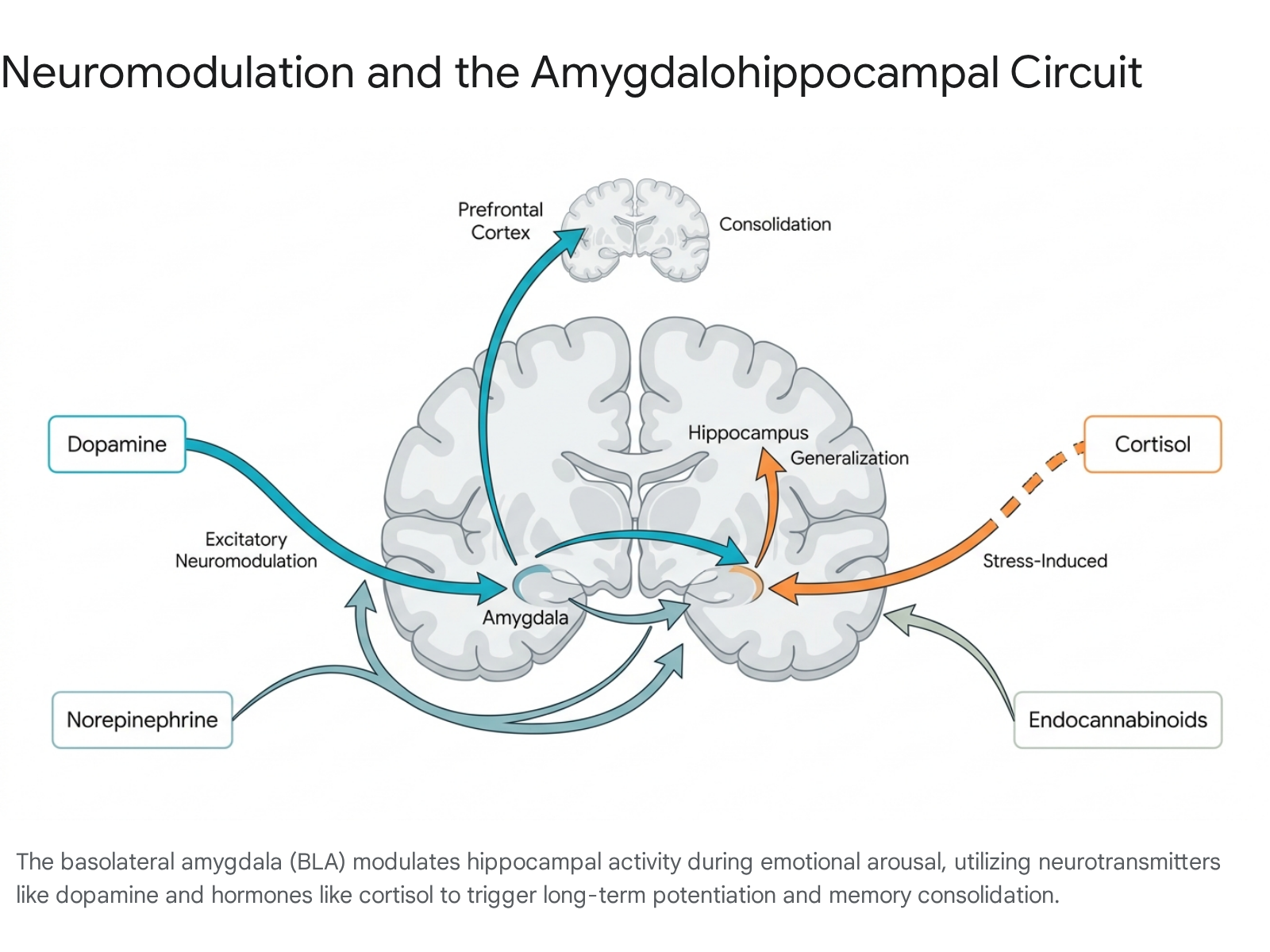
Functional magnetic resonance imaging (fMRI) and intracranial electroencephalography (iEEG) studies show that the joint activation of the amygdala and the hippocampus rapidly increases during the encoding of both positive and negative emotional stimuli 1516. This heightened connectivity predicts the strength of subsequent memory retention 1516. The BLA influences synaptic plasticity, histone modifications, and the translation of synaptic plasticity-associated proteins in the hippocampus, essentially instigating long-term potentiation (LTP) and spike-timing-dependent plasticity (STDP) 1315. This process primes the hippocampus to prioritize and deeply encode the emotional information over surrounding neutral data 13.
Dopaminergic and Cholinergic Systems
The efficacy of learning is further dictated by specific neurotransmitters. Dopamine, a chemical messenger heavily involved in the brain's reward system, positive value prediction, and motivation, plays a pivotal role in reinforcement learning 1718. The mesolimbic pathway, a critical dopaminergic circuit, releases dopamine in anticipation of rewards, which reinforces the storage of new information 1920. Dopamine neurons also innervate regions responsible for working memory and executive control, highlighting their systemic importance 20.
Historically, neuroscientists believed that external, tangible rewards were strictly necessary to trigger the dopamine release required for learning, typically by causing a simultaneous spike in dopamine and a decline in acetylcholine 19. Acetylcholine is a neurotransmitter essential for memory formation, attention, and cognitive processing 1921. However, recent studies measuring the interaction of these chemicals reveal that dopamine and acetylcholine constantly ebb and flow independently of external incentives 19. The brain autonomously generates cycles where elevated dopamine coincides with reduced acetylcholine, creating frequent, natural windows of neuroplasticity 19. This indicates that adult brains are structurally prepared for continual learning, and facilitators can capitalize on these endogenous cycles through effective instructional pacing rather than relying solely on extrinsic rewards 19.
The Endocannabinoid System and Memory Generalization
While moderate emotional arousal enhances the encoding of specific events, severe or traumatic stress can fundamentally alter how aversive memories are formed and retrieved 2223. The endocannabinoid system enhances memory formation and links lived experiences with behavioral outcomes 22. In the amygdala, specific "gatekeeper" interneurons possess receptors for endocannabinoids. These interneurons help constrain the size of a memory engram, ensuring that a memory remains highly specific to the context in which it was formed 22.
However, during experiences of acute, overwhelming stress, the brain releases an excessive volume of endocannabinoids 22. This over-release disrupts the function of the gatekeeping interneurons, causing the memory engram to expand and the memory to lose its specificity 22. This phenomenon, known as stress-induced aversive memory generalization, results in adult learners associating broad, non-threatening environments with a specific negative event 2223. In the context of adult education, if a learner experiences acute humiliation or distress during a workshop, the resulting generalized memory may cause them to experience anxiety in all subsequent educational settings, severely hampering their ability to participate and learn 722.
The PACE Framework for Curiosity
Curiosity is one of the most potent affective states for adult learning, often described psychologically as a "hunger for knowledge" 24. The neurobiological mechanisms of curiosity have been recently structured into the Prediction, Appraisal, Curiosity, and Exploration (PACE) framework 1125.
The PACE framework posits that curiosity is triggered when a learner encounters a significant prediction error - a gap between what they know and what they observe - that they appraise as resolvable 1125. This cognitive appraisal stimulates activity within the dopaminergic reward circuit, specifically the ventral striatum and the caudate 1124. Crucially, intrinsic curiosity recruits the exact same neural reward areas that are activated by tangible, extrinsic motivation 17.
When an adult learner is placed in a curious state, increased dopaminergic neuromodulation of the hippocampus ensues 1117. This interaction puts the brain into a highly receptive state, functioning much like a "vortex" that enhances the encoding and consolidation of information 17. Notably, this enhanced encoding applies not only to the specific target of the curiosity but also to entirely incidental or unrelated information encountered while in that curious state 1117. The memory benefits of curiosity are robust, evident in both immediate and delayed memory tests, and remain independent of prior knowledge or general emotional arousal 1117. Furthermore, research indicates that states of curiosity offer a protective effect against false recognition and false memory formation, particularly in older adult populations 26.
Summary of Neurochemical Modulators
The following table summarizes the primary neurochemicals involved in adult learning and their impact on cognitive processing:
| Neurochemical | Primary Source / System | Mechanism in Learning & Memory | Cognitive & Affective Impact |
|---|---|---|---|
| Dopamine | Mesolimbic pathway, Ventral Striatum | Facilitates long-term potentiation via reward anticipation and curiosity 1120. | Enhances motivation, working memory, and incidental learning 1720. |
| Acetylcholine | Central and peripheral nervous systems | Modulates attention and encoding; cyclic fluctuations with dopamine create neuroplasticity 1921. | Essential for sustained focus and schema formation 1921. |
| Norepinephrine | Locus coeruleus | Released during arousal; strengthens amygdalohippocampal connectivity 1621. | Increases alertness; dysregulation causes anxiety or fatigue 1821. |
| Cortisol | Hypothalamic-pituitary-adrenal (HPA) axis | Alters dynamic brain networks to specialize in emotional content 14. | Acute spikes aid memory; chronic exposure is neurotoxic 214. |
| Endocannabinoids | Amygdala interneurons | Regulates the size and specificity of memory engrams 22. | Over-release during acute stress causes aversive memory generalization 2223. |
Cognitive Load and Stress States
To optimize adult learning, facilitators must carefully calibrate the psychological and cognitive pressure applied within a curriculum. The physiological response to challenges heavily dictates whether learning is assimilated or rejected.
Eustress Versus Distress
Modern psychophysiological research categorizes stress into two distinct responses based on the individual's appraisal of the stressor and their available coping resources 2728.
Eustress, or constructive stress, occurs when an adult learner perceives a challenge as manageable and views it as an opportunity for growth 2728. Physiologically, eustress triggers a transient elevation in cortisol to marshal energy, followed by a rapid parasympathetic rebound that restores homeostasis once the challenge is addressed 27. Psychologically, eustress is processed not as a threat, but as a stimulating challenge. It promotes cognitive agility, emotional flexibility, sustained motivation, and enhanced engagement 2728.
Distress, conversely, is a maladaptive response that occurs when a learner feels overwhelmed, lacking the resources, support, or prior knowledge to navigate a difficult situation 2728. Distress leads to prolonged activation of the HPA axis, chronic sympathetic arousal, and lowered heart rate variability (HRV) 27. In adult learners, this physiological dysregulation manifests as "brain fog," shrinking of the memory-forming capacities of the hippocampus, emotional exhaustion, and a complete withdrawal from the learning environment 2729. Furthermore, distress diverts metabolic energy from higher-order cognitive processing to survival mechanisms, severely impairing executive decision-making 29.
Cognitive Load Theory
The concepts of eustress and distress map directly onto Cognitive Load Theory (CLT). Formulated to understand the limitations of human working memory, CLT asserts that the brain has a finite capacity for processing concurrent stimuli 103031. Cognitive load is subdivided into three categories:
- Intrinsic Load: The inherent difficulty and complexity of the subject matter being learned 331.
- Extraneous Load: The unnecessary cognitive effort imposed by poorly designed instruction, confusing interfaces, chaotic environments, or the emotional burden of anxiety and fear 31031.
- Germane Load: The productive mental effort dedicated to processing information, creating associations, and building long-term memory schemas 1030.
When intrinsic and extraneous loads combined exceed the total capacity of working memory, the learner experiences cognitive overload 331. In this state, processing new information becomes impossible; the learner is overwhelmed by competing cognitive signals and struggles to filter relevant data 3033. Cognitive overload is particularly detrimental for neurodivergent adult learners, whose brains may process sensory and social inputs differently, leading to rapid overstimulation, meltdowns, or complete cognitive shutdowns 30. Factors contributing to overload include intense emotional regulation requirements, sensory distractions, and complex social interactions 3033.
Productive Confusion and Cognitive Reappraisal
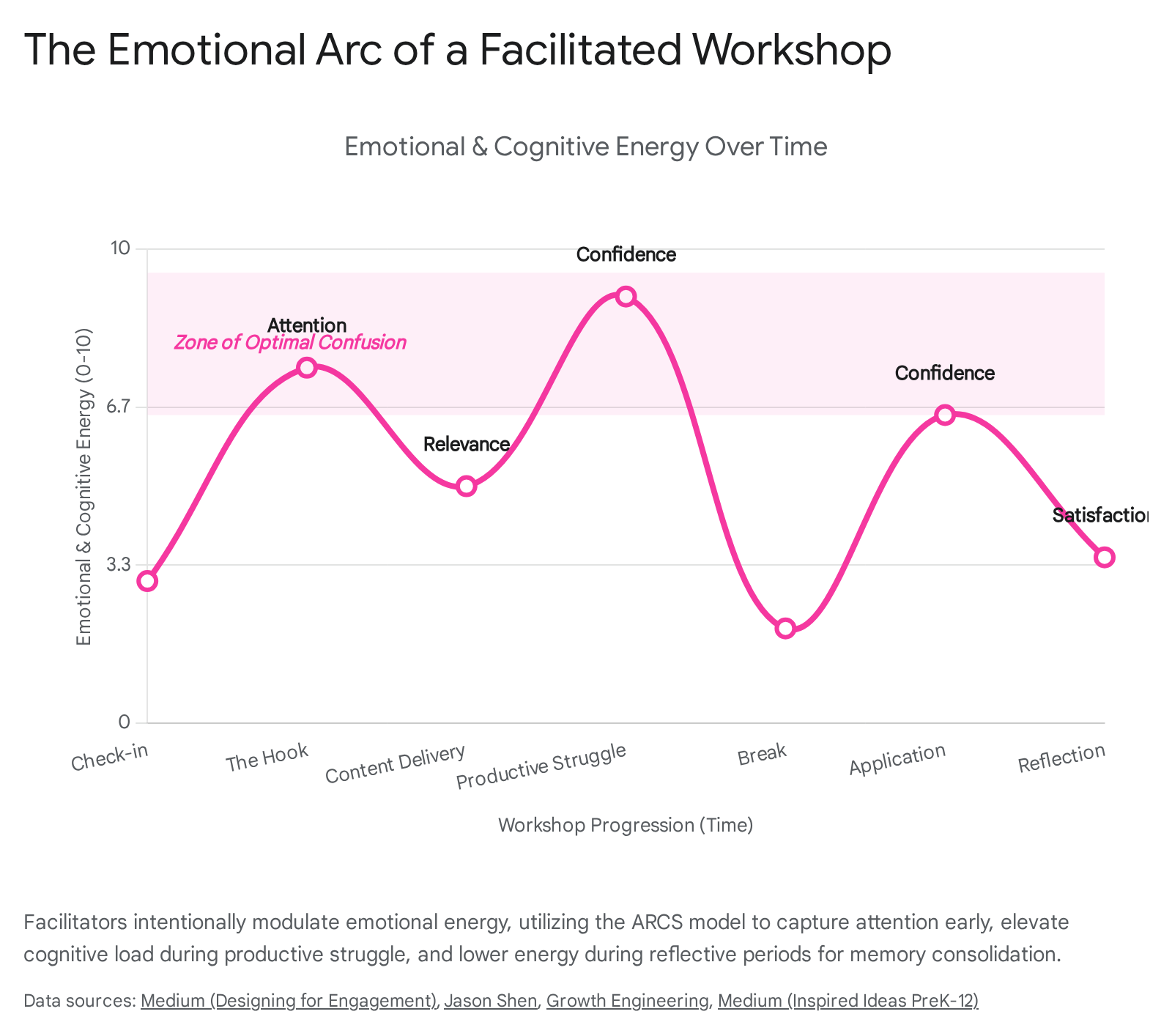
While minimizing extraneous load is crucial, reducing intrinsic load too far results in boredom and disengagement 210. Effective instructional design seeks the "Zone of Optimal Confusion" 32. Related to the pedagogical concepts of "desirable difficulties" and "productive failure," productive confusion occurs when a learner encounters cognitive disequilibrium - a temporary conceptual impasse 3233.
If the learning environment provides adequate psychological safety, this confusion functions as eustress. It prompts the learner to invest greater germane mental effort, heightening concentration to resolve the impasse and leading to highly durable structural learning 332.
To sustain learners in this zone, facilitators encourage the use of adaptive emotion regulation strategies, notably cognitive reappraisal 3. Cognitive reappraisal involves reassessing the underlying beliefs about an emotional response. When a learner is taught to view frustration not as a sign of intellectual inadequacy but as the necessary friction of neuroplasticity, they reappraise the emotion 3. This strategy actively mitigates the extraneous cognitive load imposed by maladaptive emotional responses, keeping the learner engaged in productive struggle 3.
Measurement Methodologies for Affective States
A significant challenge in educational research is accurately measuring the emotional states of adult learners to validate instructional interventions. A debate persists regarding the reliability and convergence of subjective self-reporting versus objective biometric indicators 343536.
Subjective Self-Reporting Instruments
Historically, the predominant method for assessing affective states in adult education has been subjective instruments such as the Positive and Negative Affect Schedule (PANAS) and Ecological Momentary Assessments (EMAs) 3537. In EMA frameworks, learners are prompted to provide self-reports randomly throughout the day or during specific learning intervals, capturing their conscious emotional appraisal in real-time 37.
Self-reports are highly effective at capturing explicit emotions and are often the best predictors of political attitudes, perceived clinical competence, and overall psychological well-being 343538. Extensive studies involving thousands of video stimuli demonstrate that self-reported emotional states occupy a complex, high-dimensional semantic space consisting of at least 27 distinct varieties of emotional experience 39. Categorical labels (e.g., "amusement," "awe") often better capture the nuance of the subjective experience than broad affective dimensions like valence and arousal 39.
However, subjective methodologies possess significant limitations. They are highly susceptible to social desirability bias; adult learners may rationalize their answers or suppress reports of boredom, frustration, or fear if they believe such admissions are socially or professionally undesirable 34. Furthermore, self-reports rely on the respondent's conscious awareness and cannot capture rapid, implicit, or subconscious emotional fluctuations 3435.
Biometric and Physiological Indicators
To circumvent the biases of self-reporting, researchers increasingly utilize biometric monitoring to measure physiological responses linked to the autonomic nervous system (ANS) 344041. Common modalities include:
- Facial Expression Recognition (FER): Utilizing artificial neural networks (e.g., FaceReader) to analyze webcam recordings, FER matches facial muscle movements to discrete emotions. Because it operates at very short time intervals, FER provides an unobtrusive, continuous view of rapid, subconscious emotional transitions during a learning session 3536.
- Electrodermal Activity (Skin Conductance) and Temperature: Measures the electrical conductance of the skin, driven by sweat gland activity. This serves as a proxy for sympathetic arousal, frequently used to assess test anxiety and stress 4041.
- Pupillometry and Eye Tracking: Pupil dilation is tightly correlated with cognitive load, mental effort, and the specific affective state of curiosity 2441. Tracking saccades and fixations also aids in differentiating between negative and positive emotional valence 4041.
The Convergence Debate and Multimodal Approaches
Despite their apparent objectivity, biometric indicators are not absolute proxies for emotion. A major meta-analysis of over 200 studies tested the "classical view" of emotion, which hypothesizes that specific emotion categories possess a distinct ANS "fingerprint" 42. The analysis found substantial variation within emotion categories, indicating that ANS responses are highly variable and context-dependent rather than distinct physiological fingerprints 42.
Furthermore, studies testing the convergence of subjective and biometric data in educational settings yield mixed results. In an analysis of nursing students using virtual reality (VR) simulations, FER successfully captured rapid fluctuations in engagement across different phases, while PANAS self-reports detected broader explicit emotional trends; both channels provided additive value 35. Conversely, a study investigating students reading digital factual texts found no relationship between the automated FaceReader data and self-reported epistemic emotions like interest or boredom 36. Because basic FER software is trained on extreme emotional expressions, it may fail to accurately detect the subtle, nuanced affective states associated with cognitive tasks 36.
Consequently, leading researchers advocate for multimodal data collection, integrating both continuous biometric monitoring and subjective macro-level self-reports to generate a holistic understanding of learner engagement 3540.
Cross-Cultural Dimensions of Emotional Expression
The integration of emotion into instructional design cannot be treated as a universally uniform process. Cross-cultural psychology establishes that the expression, regulation, and perception of emotions are deeply embedded within cultural contexts 54344. Adult educators must recognize that learners from different geographical and cultural backgrounds adhere to distinct emotional display rules and regulatory scripts 74445.
Individualism vs. Collectivism in Emotion Regulation
One of the most prominent frameworks for analyzing cross-cultural emotional variance is the individualism-collectivism dimension 543.
In highly individualistic cultures - such as those in the United States and Western Europe - cultural models prioritize personal autonomy, self-assertion, and the authentic expression of personal feelings 543. Emotions are viewed as personal experiences to be openly expressed 545. Consequently, adult learners from Western contexts frequently employ cognitive reappraisal as their primary emotional regulation strategy 545. In these societies, emotional suppression is generally maladaptive; significant empirical research demonstrates that suppressing emotions in North American contexts is strongly associated with higher levels of depression, lower life satisfaction, and psychological distress 4446.
In contrast, collectivist cultures - prevalent in East Asia - emphasize interdependence, interpersonal harmony, and group cohesion 54344. Emotions are viewed as relational 45. Overt displays of intense emotion, particularly negative emotions like anger or frustration, are discouraged as they threaten group harmony and may be perceived as a lack of self-control 5. Therefore, learners from Eastern cultures frequently and successfully utilize emotional suppression as a primary, culturally appropriate regulation strategy 54445. Crucially, the negative psychological consequences of suppression observed in Western populations do not consistently hold true in collectivist populations, highlighting that the effectiveness of an emotional regulation strategy is moderated by cultural background 4546.
Sub-Saharan Africa and Self-Promotive Interdependence
Recent research extends beyond the East-West binary, revealing unique emotional paradigms in other regions. In Sub-Saharan Africa (SSA), the cultural ethos is characterized by a system termed "self-promotive interdependence" 49.
In many Western and East Asian frameworks, there is a clear distinction between individual and collective achievement: personal success typically elicits pride, while the success of an ingroup member evokes a feeling of connection 49. However, in SSA, both personal success and the success of a close other elicit a simultaneous co-expression of pride and connection 49. This cultural system integrates intense personal ambition with a profound commitment to the ingroup, viewing individual achievement as an essential component of collective wellbeing 49. In adult learning environments in SSA, even experiences of failure elicit complex emotional blends encompassing self-blame, camaraderie, and pride in the collective effort 49. Facilitators operating within or designing for these populations must therefore account for a learning dynamic where personal and collective outcomes are emotionally inseparable 49.
Psychological Safety in High Power-Distance Contexts
Psychological safety - the shared belief that a learning environment is safe for interpersonal risk-taking without fear of negative consequences - is critical for ensuring that productive confusion does not devolve into distress 947. However, the barriers to establishing psychological safety vary globally.
In high power-distance, non-Western learning environments (such as specific regions in the Middle East, Latin America, and Asia), strict hierarchical structures represent a primary barrier to psychological safety 3848. For example, a cross-sectional study of medical residents in a Lebanese academic medical center found that perceptions of psychological safety were heavily constrained by rigid hierarchy and psychological distance from leadership 3848. While higher psychological safety was directly correlated with proactive feedback-seeking and self-perceived competence, the cultural norms surrounding authority made direct inquiry difficult 3848. Facilitators working with diverse adult populations must recognize that expecting overt vulnerability or direct confrontation of authority in the name of "psychological safety" may induce distress rather than eustress; culturally sensitive interventions that respect hierarchical boundaries are required 3845.
Debunking Neuromyths in Adult Learning
The enthusiasm for integrating neuroscience into adult education has unfortunately led to the proliferation of "neuromyths" - oversimplified or entirely pseudoscientific beliefs about brain function that misguide instructional design and compromise learning outcomes 495051.
The Persistence of the Learning Styles Myth
Perhaps the most pervasive and resilient myth in global education is the concept of rigid "learning styles" 495052. The most common iteration is the VAK model, which posits that individuals are inherently visual, auditory, or kinesthetic learners 505253. Surveys indicate that between 80% and 90% of educators worldwide believe that tailoring instruction to match a student's predominant learning style improves academic outcomes 51545556. Furthermore, psychological essentialism leads many to believe these styles are inherited and neurologically fixed at birth 56.
Extensive cognitive science research, including massive meta-analyses, has thoroughly debunked this concept 4950525354. While individuals certainly have subjective preferences regarding how they interact with media, there is no credible scientific evidence that teaching to these preferences enhances memory encoding, comprehension, or skill acquisition 49505355. The misconception partially stems from the valid fact that different brain regions process visual, auditory, and kinesthetic information 54. However, the brain is highly interconnected; these sensory areas work collaboratively during learning, not in isolation 54.
Catering to the learning styles myth is actively harmful. It oversimplifies human cognition, pigeonholes adult learners, and discourages them from developing the flexible, adaptable cognitive strategies necessary to conquer complex material across different domains 495053. Similar myths, such as the belief that people are fundamentally "left-brained" (logical) or "right-brained" (creative), lack any neurological basis and artificially limit learner identity 49505152.
The Illusion of Mastery and the "Happy Learner" Fallacy
Another significant misconception is the belief that adult learning should always be intuitive, frictionless, and emotionally "happy" 57. In this paradigm, successful facilitation is equated with high learner comfort and low cognitive strain. However, cognitive psychology reveals that many low-friction study activities - such as rereading texts or highlighting - create an "illusion of mastery" 33. These activities rely on short-term maintenance rehearsal, providing the learner with a false sense of fluency without actually integrating the knowledge into long-term schemas 33.
Genuine learning and conceptual change require cognitive effort 33. Educators who strive to eliminate all struggle to maintain a "happy" affective state inadvertently design out the desirable difficulties required for deep reasoning 3357. As detailed in the discussion on productive confusion, effective instructional design requires pushing learners into cognitive disequilibrium 32. The goal is not continuous comfort, but the strategic management of eustress to build resilient intellectual architectures 2733.
Summary of Common Neuromyths
| Myth | Scientific Reality | Impact on Instructional Design |
|---|---|---|
| VAK Learning Styles | Learners have preferences, but tailoring instruction to styles does not improve outcomes 505556. | Wastes instructional resources; limits learner adaptability 4956. |
| Left/Right Brain Dominance | Hemispheres collaborate on complex tasks; personality is not localized to one side 495051. | Creates false dichotomies (e.g., "I'm not a math person") 51. |
| Digital Natives Can Multitask | The human brain cannot multitask; it rapidly task-switches, which impairs encoding 49. | Designing for simultaneous inputs causes cognitive overload 49. |
| Frictionless Learning is Best | Rereading and highlighting create the illusion of mastery without deep encoding 33. | Overlooks the necessity of "productive struggle" and desirable difficulties 3357. |
Instructional Design Frameworks: The ARCS Model
To translate these neurobiological and psychological insights into practice, adult learning facilitators utilize structured instructional design frameworks. These frameworks systematically plot the emotional trajectory of a curriculum, ensuring that cognitive load is managed and motivation is sustained 5859.
The preeminent framework for motivational design is the ARCS Model, developed in 1979 by educational psychologist John Keller 606162. Created in response to the limitations of strict behaviorist models, the ARCS framework borrows from expectancy theory, assuming that adults are motivated to engage if the activity satisfies personal needs and offers a positive expectancy for success 6162. The model consists of four sequential pillars designed to capture and maintain adult motivation 606663:
- Attention: The prerequisite for learning. Facilitators must capture the learner's interest through "perceptual arousal" (introducing surprise, novelty, or uncertainty) and "inquiry arousal" (posing complex, thought-provoking questions) 60616264. Neurologically, these techniques trigger the prediction errors necessary to stimulate the dopaminergic pathways of curiosity, priming the hippocampus for encoding 1124.
- Relevance: Adult learners are highly pragmatic and goal-oriented; they must perceive the immediate utility of the content 66570. Facilitators establish relevance by bridging the gap between theoretical content and the learner's real-world professional environment 66163. This process taps into the learner's existing cognitive schemas and leverages their rich life experiences as foundational context 666.
- Confidence: To prevent the onset of distress and cognitive overload, facilitators must strategically build the learner's self-efficacy 616665. This involves providing clear learning objectives, scaffolding the instruction to present incremental challenges, and creating low-risk environments where learners can practice decision-making without fear of severe consequences 61666365. Fostering psychological safety is paramount at this stage 947.
- Satisfaction: To cement the learning and maintain long-term motivation, learners must feel a sense of accomplishment 6061. Facilitators achieve this by providing intrinsic and extrinsic rewards, meaningful positive reinforcement, and immediate opportunities to apply the newly acquired skills to authentic problems 60616365.
Facilitation Methodologies and Trauma-Informed Practice
Executing an effective instructional design model requires dynamic, real-time facilitation. Because adult learners require modal shifts every 10 to 20 minutes to sustain attention, expert facilitators leverage a variety of active techniques to modulate the emotional flow of the group 5967.
Active Facilitation Techniques
- Image-Based Check-Ins: To establish psychological safety early, facilitators may bypass traditional, anxiety-inducing verbal icebreakers in favor of visual check-ins. Participants select an abstract image or photo that reflects their current emotional state, followed by a minute of silence 68. This allows the brain to connect with affective states non-verbally, dropping defensive barriers and grounding the learner 68.
- Embodiment and Participatory Practices: To prevent cognitive fatigue and physical lethargy, facilitators integrate movement 6869. Methods such as walkable reflection pathways or guided somatic exercises break down communication barriers, reduce stress, and foster group empathy 6869. Participatory methods like Fishbowl discussions - where an inner circle debates while an outer circle actively observes - balance active contribution with reflective listening, ensuring all voices are integrated without forcing exposure 69.
- Graphic Facilitation: Utilizing live sketch notes or large-scale diagrams during discussions caters to the adult brain's capacity for spatial and structural mapping, reducing extraneous cognitive load by making complex relationships visually explicit in real-time 69.
- Appreciative Inquiry: When addressing organizational challenges, facilitators may use Appreciative Inquiry to deliberately shift the emotional valence of the room. Rather than dissecting past failures (which can trigger defensiveness and distress), this method focuses entirely on what is working well and how to replicate it, utilizing positive affect to broaden cognitive scope and motivate cooperative action 69.
- Conflict Resolution: Affective facilitation does not mean suppressing negative emotions; it means processing them constructively 3. When interpersonal friction arises, skilled facilitators utilize frameworks like the Technology of Participation (ToP) Focused Conversation or Non-Violent Communication. These methods systematically probe the emotional triggers behind an outburst, allowing for emotional release and transforming disruption into a pathway for deeper group cohesion 370.
Healing-Centered and Trauma-Informed Frameworks
Perhaps the most critical evolution in modern facilitation is the integration of trauma-informed practices. Statistical data indicates that over 70% of adults worldwide have experienced some form of trauma 7. Traumatic stress fundamentally alters neurobiology, hyper-sensitizing the amygdala and making the learner highly susceptible to stress-induced memory generalization and cognitive overload 7222371.
To support adult learners carrying trauma, organizations utilize the ARC Framework (Attachment, Regulation, and Competency), originally developed for clinical settings but highly applicable to adult learning systems 7172.
- Attachment (Connection and Safety): Facilitators prioritize building a safe container. This involves modeling unconditional high regard, validating all participant experiences, and establishing clear community agreements that govern respectful interactions 7273. Creating a sense of belonging mitigates the immediate threat-response of the amygdala 774.
- Regulation: Trauma compromises the nervous system's ability to self-regulate. Facilitators must speak in a calming manner, normalize the presence of strong emotions, and provide learners with tools to manage physiological dysregulation 717273. This includes offering flexible participation options and the explicit permission for learners to step away if they feel cognitively or emotionally overwhelmed 3073.
- Competency: Rather than focusing solely on symptom reduction or content delivery, the framework emphasizes building resilience and executive function 7172. Facilitators empower learners to integrate new concepts safely. Sessions often close with moments of silence, allowing participants to lead their own meaning-making process - choosing a single word or gesture to capture what the learning meant to them, thereby cementing the experience without forced vulnerability 68.
Conclusion
The assertion that adult education is a strictly cognitive endeavor is an obsolete artifact of early pedagogical theory. As evidenced by comprehensive neurobiological mapping, the amygdala, the hippocampus, and the complex dopaminergic and cholinergic networks operate as a unified matrix, rendering emotion the ultimate gatekeeper of memory encoding, attention, and knowledge acquisition.
By understanding the physiological distinctions between constructive eustress and neurotoxic distress, facilitators can manage cognitive load to keep learners engaged in productive struggle. Furthermore, by dispelling persistent neuromyths regarding learning styles and respecting the diverse, cross-cultural parameters of emotional expression - such as the self-promotive interdependence seen in Sub-Saharan Africa or the hierarchical dynamics of high power-distance cultures - educators can design environments that maximize psychological safety.
Ultimately, utilizing robust frameworks like the ARCS model and trauma-informed ARC methodologies allows facilitators to move beyond the mere transmission of data. They actively sequence the emotional arc of an experience: leveraging curiosity to hook attention, guiding learners through the cognitive disequilibrium of complex problem-solving, and facilitating reflective integration. In doing so, they forge resilient, transformative learning outcomes that endure far beyond the confines of the educational setting.