
Dark patterns in UX design and consumer psychology
Evolution of Interface Terminology
The conceptual framework surrounding manipulated user interfaces has undergone a significant lexical and theoretical evolution over the past decade. The phenomenon was initially categorized under the neologism "dark patterns," coined in 2010 by user experience researcher Harry Brignull. The original definition described interfaces that were carefully crafted to trick users into performing actions they did not intend, such as purchasing overpriced insurance or inadvertently signing up for recurring billing cycles 123. The terminology gained widespread traction across the fields of Human-Computer Interaction (HCI) and digital ethics. However, as the research matured and intersected with international regulatory frameworks, academic and legal consensus gradually transitioned toward the terms "deceptive design" or "deceptive patterns." This shift, which prompted the renaming of Brignull's foundational repository to deceptive.design in 2023, reflects a preference for clearer, more neutral language suitable for legal codification and public policy debates 24.
A critical theoretical boundary in HCI research exists between deceptive design and the concept of "behavioral nudges." Rooted in behavioral economics and popularized by researchers Richard Thaler and Cass Sunstein, nudges involve the deliberate structuring of choice architecture to influence outcomes while simultaneously preserving the user's freedom of choice, a concept known as "libertarian paternalism" 53. A nudge is theoretically deployed to encourage positive, societally beneficial behaviors, such as enrolling in a retirement savings plan or participating in an organ donation registry 154.
The distinction between a legitimate persuasive nudge and a deceptive pattern relies fundamentally on intent, transparency, and the ultimate beneficiary of the interaction. Both mechanisms harness human psychology, leveraging cognitive biases and mental heuristics to influence decision-making 56. Behavioral nudges, however, operate with benevolent intent, prioritizing the user's needs or broader societal benefits without obscuring alternative choices. Conversely, deceptive patterns are motivated entirely by the extraction of resources - such as attention, personal data, or capital - through cynical manipulation that prioritizes corporate metrics over user autonomy 35.
Recent literature has also introduced the concept of "sludge," which functions as the friction-heavy opposite of a nudge. Sludge involves designs that intentionally erect hurdles to prevent a user from taking an action that serves their best interests, such as canceling a subscription or claiming a refund 1. While some industry practitioners argue that influencing consumer behavior is the inherent objective of all marketing communications and that performance-driven design is justifiable 7, the prevailing consensus in HCI research defines deceptive design as a structural subversion of rational deliberation.
| Interface Strategy | Primary Intent | Mechanism of Influence | Impact on User Autonomy | Common Examples |
|---|---|---|---|---|
| Behavioral Nudge | Benevolent; aligns with user or societal best interests. | Simplification, transparency, framing positive outcomes. | Preserved; alternative choices remain accessible. | Defaulting to double-sided printing; automatic pension enrollment. |
| Deceptive Pattern | Exploitative; prioritizes business metrics and revenue extraction. | Deception, asymmetry, covert influence, emotional pressure. | Subverted; choice architecture manipulates rationality. | Fake countdown timers; sneaking items into a shopping cart. |
| Sludge | Obstructive; prevents users from acting in their own interest. | High interaction cost, circular navigation, obfuscation. | Constrained; user fatigue forces surrender. | Requiring a phone call during business hours to cancel an online service. |
Taxonomy of Deceptive Interfaces
HCI scholars and regulatory bodies have identified and cataloged numerous distinct manifestations of deceptive design. Empirical prevalence is high; a 2024 review by the International Consumer Protection and Enforcement Network (ICPEN) evaluated 642 websites and applications globally, concluding that a vast majority employ at least one such pattern 89. European Commission studies corroborate this, noting that up to 97% of the most popular websites and applications deploy these tactics 101115.
The most heavily documented deceptive patterns function by exploiting visual hierarchy, asymmetric effort, and information asymmetry. A primary example is the "Roach Motel" or hard opt-out pattern. This represents an asymmetric design architecture where entering a situation, such as signing up for a subscription or accepting a free trial, requires minimal effort. However, the exit path is actively obscured by a complex maze of repetitive prompts, hidden links, or requirements to contact customer service, designed to maximize user retention through attrition 51217.
Confirmshaming represents another pervasive tactic, relying on the use of emotionally manipulative copywriting to guilt or shame a user into compliance. This often appears in opt-out buttons framed negatively, such as "No thanks, I prefer to pay full price" or "I don't care about my digital security," leveraging social pressure to steer behavior 151218.
Sneaking and hidden costs involve the practice of secretly adding items to a user's shopping basket or delaying the disclosure of mandatory fees, taxes, or delivery charges until the final step of a checkout process 51813. False urgency and scarcity utilize artificial countdown timers or low-stock warnings that have no basis in actual inventory or time constraints. These are designed to induce anxiety and force hasty purchasing decisions 51814.
Recent research has also documented the emergence of "linguistic dead-ends." This pattern occurs when crucial functionality, such as opting out of tracking, is presented using unfamiliar words, confusing double negatives, or language of a foreign origin to intentionally stall user comprehension and force reliance on pre-selected defaults 18.
Temporal Analysis of Deceptive Patterns
While early HCI research focused on identifying static instances of deceptive design on isolated interface screens, current scholarship has shifted toward analyzing the cumulative effect of these patterns over time. A prominent advancement in this area is the Temporal Analysis of Dark Patterns (TADP) methodology, formalized in research presented at the ACM CHI 2025 conference 1522.
The TADP methodology posits that deceptive design rarely operates through a single visual trick. Instead, it relies on the multiplicative effects of multiple pattern types strung together across a multi-step user journey 23.
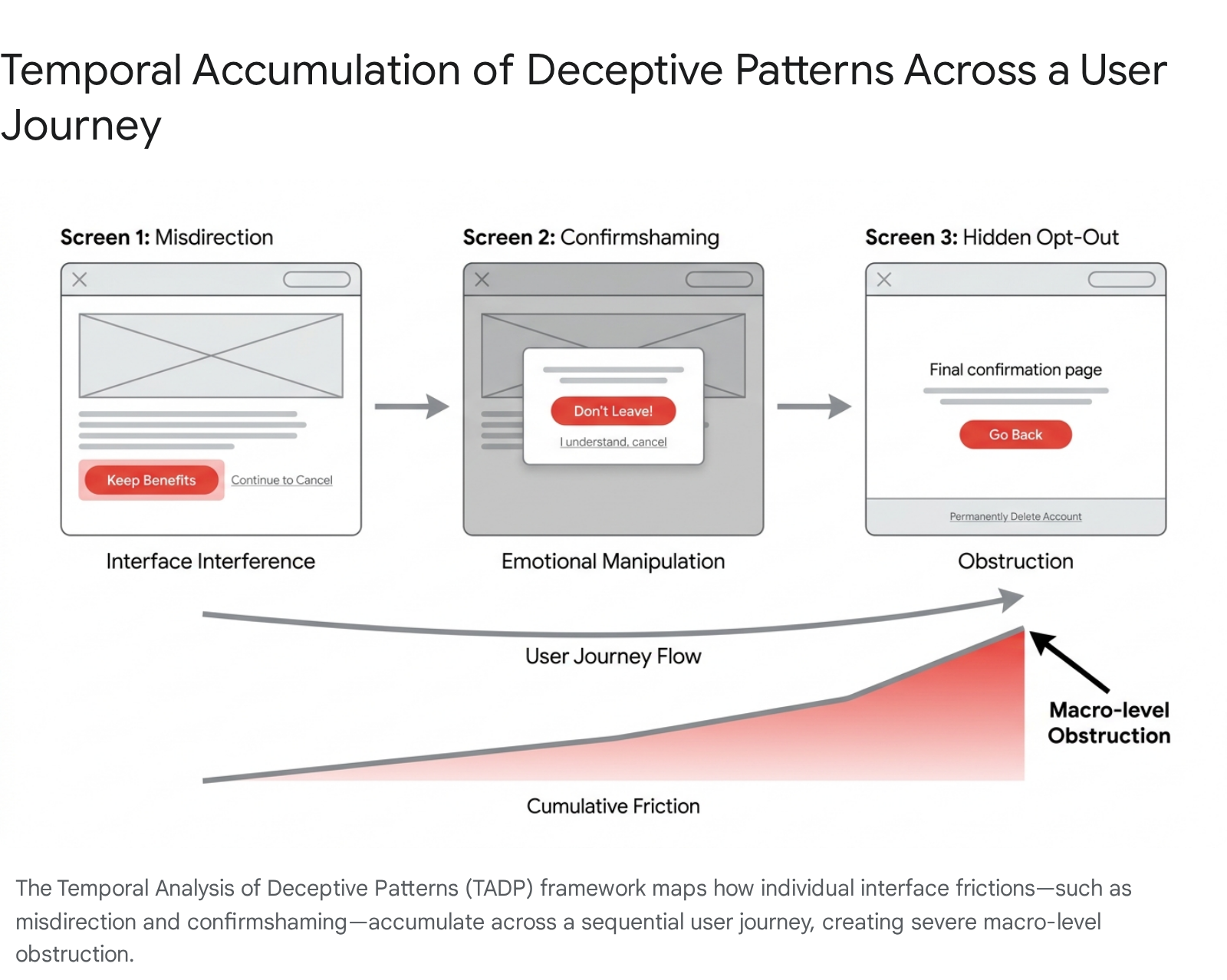
Researchers utilized the Federal Trade Commission's complaint against Amazon Prime's "Iliad Flow" as a foundational case study for developing TADP. The Iliad Flow required users to navigate multiple screens, bypass repeated interface interference, and parse confirmshaming tactics merely to cancel a subscription 15.
By characterizing deceptive patterns at both high-level scales - representing the overall obstructive journey - and meso-level scales - representing the specific button colors and text on a single screen - TADP provides a rigorous framework for auditors, legal scholars, and regulators to document the sustained psychological attrition orchestrated by a platform over time 152223.
Psychological Mechanisms and Cognitive Biases
The efficacy of deceptive design is rooted in its exploitation of established behavioral economics principles and inherent human cognitive limitations. By manipulating choice architecture, designers force users into relying on mental shortcuts rather than rational, evaluative deliberation 354.
Recent HCI and sociological research explicitly maps specific deceptive patterns to corresponding cognitive biases. The sunk cost fallacy, for example, describes the human tendency to continue investing in an endeavor due to previously invested resources, such as time, money, or effort, even when the current costs outweigh the benefits 16. Deceptive interfaces leverage this bias by introducing hidden costs or data extraction requests only at the terminal stage of a lengthy, multi-page checkout or registration process. Users, having already spent significant time configuring a purchase or inputting personal details, become psychologically resistant to abandoning the transaction, effectively throwing good money after bad to avoid the perception of wasted effort 317.
Loss aversion - the psychological principle that losing an item or status feels significantly more painful than gaining the equivalent item - is frequently utilized to sustain recurring revenue. Subscription platforms deploy interface prompts warning users that canceling will result in the immediate and permanent loss of personalized data, curated content histories, or grandfathered legacy pricing schemes, utilizing the fear of loss to override the desire to cancel 617. Furthermore, default bias and inertia play a massive role in data extraction. Because humans naturally gravitate toward the path of least resistance, companies pre-select options that benefit the business, such as opting into extensive tracking cookies or recurring billing. This relies on user inertia to secure conversions that require active effort to decline 46.
Cognitive Load and Psychological Harm
Deceptive design exerts a measurable psychological toll on consumers. Researchers examining the impact of "hard to cancel" and "hidden subscription" patterns have utilized integrated methodologies including electroencephalograms (EEG), eye-tracking technology, and natural language processing (NLP) sentiment analysis to record physiological responses. When confronted with manipulative interfaces, users exhibit significant spikes in cognitive load, indicating the increased mental effort required to parse deliberately confusing information, double negatives, and asymmetrical visual hierarchies 1819. Concurrently, eye-tracking data reveals visual disorientation as users struggle to locate obscured exit paths or opt-out mechanisms.
The emotional fallout from these encounters is substantial and well-documented. In qualitative sociological studies and quantitative consumer surveys, users frequently report acute feelings of frustration, anger, contempt, and helplessness following interactions with deceptive interfaces 202122. A study conducted by the Australian Consumer Policy Research Center found that 40% of surveyed users felt annoyed, and 28% felt explicitly manipulated after encountering deceptive patterns on a website or application 22.
Over time, repeated exposure to these manipulative architectures leads to a psychological state termed "privacy resignation." In this state, users internalize the belief that maintaining digital autonomy or protecting personal data is functionally impossible within modern digital environments, causing them to passively accept exploitative terms and conditions 23. Beyond emotional distress, these patterns inflict quantifiable material harms, including significant financial loss from unwanted subscriptions, systemic time depletion due to obstructive cancellation flows, and severe privacy loss from coerced data sharing 22.
Vulnerability Across Demographic Groups
While deceptive design impacts the broad spectrum of internet users, its effects are not distributed equally. A central focus of recent HCI research involves identifying how these interfaces disproportionately harm vulnerable demographics, turning digital platforms into environments of structural inequality 2124. Sociological research highlights that variables such as age, neurodivergence, digital literacy, and socioeconomic status severely compound the risks associated with deceptive UX 2425.
Impacts on Children and Adolescents
Children and adolescents represent a uniquely vulnerable demographic due to their ongoing cognitive development and high, unmediated exposure to digital environments. An ACM Interaction Design and Children (IDC) 2025 study explored how youths assess deceptive designs by asking 45 children (ages 10 - 12) and 37 adolescents (ages 16 - 18) to redraw fair interfaces into deceptive ones. The findings revealed notable developmental differences in how manipulation is perceived. Children associated manipulation with extreme measures, utilizing overt threats and immediate rewards in their designs, whereas adolescents utilized subtler manipulations that closely mirror reality, such as false visual hierarchies and social proof 2627.
The study highlighted a prevailing sense of resignation among youth, summarized by the prevailing sentiment that if a platform offers no clear alternative, they will simply accept the invasive terms 27. Because children often struggle to differentiate between authentic content and disguised advertising, and lack the financial literacy to understand the long-term consequences of "freemium" models, they are highly susceptible to monetization mechanics that exploit impulsivity and fear of missing out 2528.
Neurodivergent and Elderly Users
Populations with cognitive variations or decline are heavily targeted by attention-draining interface designs. A study presented at the CHI 2025 conference investigated how individuals with Attention Deficit Hyperactivity Disorder (ADHD) interact with deceptive patterns on social media platforms. The researchers initially hypothesized that people with ADHD might react more strongly to, and be more susceptible to, attention-grabbing artifacts and false urgency cues. However, the study of 135 participants found that explicit recognition of dark patterns was uniformly low across both neurotypical and ADHD groups. Interestingly, individuals with ADHD demonstrated a significantly higher propensity to actively avoid specific dark patterns when navigating interfaces, suggesting the development of unique, functional coping mechanisms despite a lack of formal recognition of the underlying manipulation 15.
Elderly users face different, yet equally severe, challenges. Sociological research indicates that older adults experience high levels of fear regarding privacy breaches, financial scams, and phishing. Despite this heightened caution, they often lack the digital literacy required to navigate deliberately complex cancellation flows or linguistic dead-ends 2125. Consequently, elderly users are heavily represented in statistics concerning financial loss due to unintended subscriptions, roach motels, or investment fraud 2125. Similarly, users with lower educational attainment or those operating in a second language are significantly more susceptible to mild deceptive patterns. They struggle to parse convoluted legal jargon and are forced to place undue trust in the platform's default choices, accelerating their rate of financial and privacy loss 125.
Artificial Intelligence and Algorithmic Manipulation
The widespread integration of Artificial Intelligence (AI) and machine learning algorithms marks a transition from static UI tricks to a regime of invisible, dynamic, and hyper-personalized manipulation, frequently referred to in recent literature as "Dark Patterns 2.0" 3729.
Traditional deceptive design relies on a uniform interface presented equally to all users. AI, however, enables the deployment of personalized nudges optimized for individual vulnerabilities. By leveraging vast datasets of past behavior, social media activity, location tracking, and purchasing habits, algorithms determine the precise moment, context, and method to present an interface that maximizes the likelihood of conversion for that specific user 1037.
This algorithmic exploitation frequently manifests as dynamic pricing or "big data price gouging." In these scenarios, AI systems analyze a consumer's willingness and ability to pay, subsequently presenting different prices for the exact same product or service to different users without their knowledge. An AI-driven chatbot or recommendation engine might exploit conversational context to cross-sell products aggressively. This crosses the line from helpful recommendation to coercion by utilizing intimate knowledge of a user's recent life events, financial status, or psychological state to trigger impulse purchases 1030.
The rise of Large Language Models (LLMs) and generative design tools introduces a secondary risk: the unintentional automation of deception at scale. Because generative AI systems are trained on massive datasets scraped from the existing internet - an environment where an overwhelming majority of sites contain deceptive patterns - the models internalize these manipulative tactics as standard operating procedure 1011. Research assessing the output of models like ChatGPT in generating web elements found that even when prompted with strictly neutral language, the AI-generated code consistently contained deceptive design patterns, averaging five such patterns per page . When these models are integrated into professional design workflows, they threaten to scale the proliferation of deceptive design exponentially, embedding manipulative architectures into products automatically, even without deliberate malicious intent from the human operator 29.
Deceptive Design in Immersive Environments
As computing paradigms transition into spatial and immersive environments - encompassing Virtual Reality (VR), Augmented Reality (AR), and Extended Reality (XR) - researchers are documenting novel vectors for manipulation that bypass traditional cognitive defenses entirely 2331.
A 2026 study in the ACM Designing Interactive Systems (DIS) conference surveyed 481 users regarding their exposure to privacy deceptive patterns in commercial VR scenarios. The research introduced the critical concept of "Ergonomic Susceptibility." In virtual reality, users must endure physical burdens, including the weight of the head-mounted display, neck strain, and varying degrees of motion sickness. Deceptive designs in these environments weaponize this physiological discomfort 23.
When faced with a lengthy privacy policy or a complex configuration menu blocking entry to a VR experience, the bodily strain rapidly accelerates decision fatigue. Users hastily accept invasive data collection simply to escape the uncomfortable menu interface and alleviate physical discomfort. Furthermore, the sensory-rich nature of VR fosters "immersion normalization." Here, invasive data requests - such as mapping physical room dimensions, tracking gaze, or biometric monitoring - are framed as strictly necessary for maintaining the fidelity of the simulation. This coerces users into surrendering vastly more data than they would tolerate on a standard 2D web platform 23.
Immersive technologies possess unique hardware capabilities, such as haptic feedback controllers and eye-tracking sensors, which are increasingly co-opted for deceptive purposes. Researchers note that malicious actors can use eye-gaze data to determine precisely where a user is looking and dynamically move critical privacy disclosures into their peripheral blind spots 3132. Alternatively, systems might utilize well-timed haptic feedback, such as controller rumbling, to intentionally distract a user's attention away from unchecking a default subscription box 31. These biometric manipulations represent a severe escalation in deceptive design, as they subvert involuntary physiological responses rather than merely exploiting higher-order cognitive logic.
Global Regulatory Frameworks and Enforcement
In response to the escalating sophistication and ubiquity of deceptive interfaces, global regulatory bodies have initiated stringent legislative and enforcement frameworks between 2024 and 2026. This regulatory momentum aims to establish clear boundaries for digital fairness, harmonize international standards, and penalize exploitative architectural choices.
| Jurisdiction | Key Legislation / Framework | Target Enforcement Areas | Effective Date |
|---|---|---|---|
| European Union | Digital Services Act (DSA); Digital Fairness Act (DFA) | Systemic risk assessments, manipulative interfaces, addictive design, B2C gaps. | DSA Active; DFA Proposal late 2026 3334. |
| United States | FTC Negative Option Rule ("Click-to-Cancel") | Subscription traps, hidden auto-renewals, forced continuity. | Enforced 2025/2026 3735. |
| China | Anti-Unfair Competition Law (AUCL) Revision | Algorithmic manipulation, "Big Data Price Gouging," false hierarchies. | Effective October 2025 303637. |
| South Korea | E-Commerce Act Amendment | False hierarchies, obstruction of cancellation, repeated interference pop-ups. | Effective February 2025 4849. |
| Brazil | Digital Statute for Children and Adolescents | Platform-level design restrictions, limits on compulsive/addictive features for minors. | Effective March 2026 38. |
European Union Legislation
The European Union has positioned itself at the vanguard of digital consumer protection. The Digital Services Act (DSA), specifically Article 25, explicitly prohibits Very Large Online Platforms (VLOPs) from designing, organizing, or operating their online interfaces in a way that deceives or manipulates recipients, or materially distorts their ability to make free and informed decisions 5152. Enforcement is actively occurring; in a landmark action in December 2025, the European Commission levied a €120 million fine against the social media platform X for deceptive design related to its verification checkmarks, which misled users regarding account authenticity and advertising transparency 33.
Recognizing that the DSA primarily targets VLOPs, the EU is advancing the Digital Fairness Act (DFA), scheduled for formal legislative proposal in late 2026 following extensive public consultations. The DFA intends to close remaining regulatory gaps in the broader business-to-consumer (B2C) market. It aims to explicitly ban dark patterns across all platforms regardless of size, ensure transparent pricing by outlawing drip pricing, and strictly regulate addictive design and influencer marketing practices 14345354.
United States Federal Trade Commission
In the United States, the Federal Trade Commission (FTC) relies on its authority under the FTC Act Section 5 to prosecute unfair and deceptive practices. A cornerstone of its recent regulatory efforts is the updated Negative Option Rule, widely referred to as the "Click-to-Cancel" rule, which began enforcement across 2025 and 2026. This mandate requires that the process for terminating a subscription must be as straightforward, and utilize the same medium, as the process for initiating it, directly outlawing the "Roach Motel" pattern and forced continuity traps 3735.
The FTC has aggressively pursued enforcement actions, securing a $245 million settlement from Epic Games for using confusing button configurations to trick minors into unwanted in-game purchases, and suing Intuit and Amazon for bait-and-switch tactics and subscription traps, respectively 23755. However, geopolitical friction has emerged regarding international digital sovereignty. In August 2025, FTC Chair Andrew Ferguson warned major US technology firms that complying with the EU's DSA - specifically regarding content moderation mandates and encryption removal - could paradoxically violate US consumer protection and free speech laws, highlighting a fracturing global compliance landscape 3940. At the state level, laws such as the California Privacy Rights Act (CPRA) explicitly state that consent obtained through dark patterns does not constitute valid legal consent 18.
Regulatory Developments in Asia and South America
Asian jurisdictions have enacted specific, technologically targeted legislation. In China, the sweeping 2025 revision to the Anti-Unfair Competition Law (AUCL) directly addresses the complexities of the digital economy. The AUCL explicitly prohibits platforms from abusing data and algorithms to enforce "involution-style" destructive price wars or to engage in "Big Data Price Gouging" based on hidden consumer profiling 303637. Furthermore, China's Cyberspace Administration implemented mandatory labeling rules in September 2025, requiring explicit visible watermarks or implicit metadata on all AI-generated content to prevent public deception and ensure content traceability 4159. Crucially, the AUCL includes extraterritorial provisions, meaning foreign entities are subject to enforcement if their deceptive practices harm Chinese consumers 37.
South Korea's National Assembly amended its E-Commerce Act, effective February 2025, specifically codifying and prohibiting five high-risk dark patterns. These prohibitions target false visual hierarchies, the obstruction of cancellation, and repeated interference through nagging pop-ups 4849. India's Department of Consumer Affairs has similarly issued guidelines defining and banning 13 specific dark pattern practices 60.
In South America, Brazil enacted the Digital Statute for Children and Adolescents, which came into force in March 2026. Moving beyond traditional reactive content moderation, the statute imposes strict platform-level architectural requirements. It bans design practices that encourage compulsive use, restrict manipulation via gamification, and limit monetization practices that exploit the cognitive vulnerabilities of minors. These structural mandates are backed by heavy financial penalties and overseen by the national data protection authority (ANPD) 2838. Furthermore, Brazil's Consumer Defense Code is increasingly utilized to prosecute deceptive advertising and choice architectures that exploit a consumer's lack of experience 42.
Countermeasures and Future Research Directions
The current state of research highlights a critical inflection point in human-computer interaction. The pervasive deployment of deceptive design has fundamentally altered the digital economy, achieving short-term conversion metrics at the severe cost of long-term consumer trust, psychological well-being, and market fairness 1329. As the tactical deployment of these patterns evolves from crude visual misdirection into invisible, AI-driven algorithmic manipulation and biometric exploitation in immersive reality, the challenge for both academic researchers and legal regulators intensifies 3162.
Emerging research focuses on developing robust, automated countermeasures. Institutions are proposing hierarchical analysis approaches that evaluate web pages across visual, behavioral, and semantic layers to systematically detect complex patterns like the Roach Motel, which previously evaded simple text-based auditing 43. Other initiatives are exploring the use of specially tuned LLMs to act as real-time browser extensions, automatically identifying and neutralizing deceptive patterns in situ, effectively overriding the platform's manipulative architecture before it reaches the user 4445.
To sustainably mitigate these harms, the HCI community, legal scholars, and regulatory agencies are converging on the principle of "Fairness by Design." This paradigm demands that transparency, user autonomy, and frictionless consent be hardcoded into the architectural bedrock of digital systems 2946. Ultimately, combating deceptive design requires a transdisciplinary approach - merging the empirical methodologies of cognitive psychology, the systemic auditing capabilities of computer science, and the enforceable frameworks of global law - to ensure that digital environments serve to empower, rather than exploit, the consumer 244748.