
Default options and status quo bias in consumer markets
Cognitive Foundations of the Status Quo Bias
The efficacy of default options in consumer markets is fundamentally rooted in the psychological architecture of human decision-making. Individuals consistently demonstrate a disproportionate preference for maintaining their current state of affairs, a behavioral phenomenon defined by William Samuelson and Richard Zeckhauser in 1988 as the status quo bias 12343. In consumer environments, a default option - a pre-selected state that takes effect if the decision-maker takes no proactive action - functions as the established baseline. Rather than evaluating all available choices objectively, consumers perceive the default as the reference point, evaluating any deviation as a potential risk.
This bias is not a singular cognitive error but a composite heuristic driven by several intersecting psychological mechanisms.
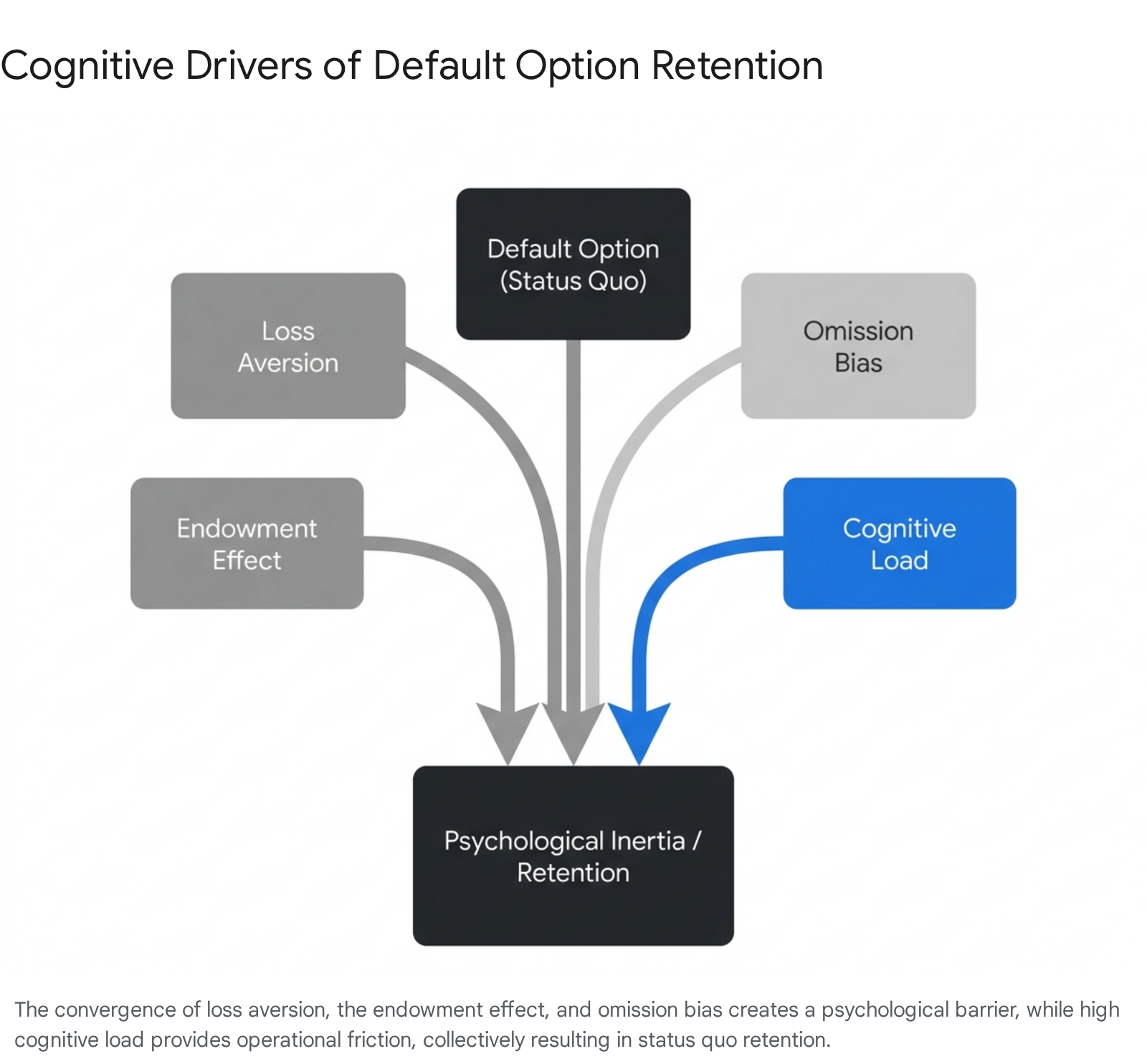
Foremost among these is loss aversion, formulated by behavioral economists Daniel Kahneman and Amos Tversky. Loss aversion posits that the psychological disutility of giving up an object, service, or state is substantially greater than the utility associated with acquiring an equivalent gain 24567. When a consumer is presented with a default option, opting out requires relinquishing the attributes of the default choice. Because losses are weighted more heavily than gains, consumers exhibit significant inertia, frequently retaining the default even when alternative options present higher objective utility 13.
The Endowment Effect and Valuation Asymmetry
The status quo bias is heavily reinforced by the endowment effect, a cognitive bias wherein individuals assign a higher subjective value to goods or services simply because they possess them. Kahneman, Knetsch, and Thaler demonstrated this asymmetry through classic market experiments utilizing university coffee mugs. In these trials, individuals endowed with a mug demanded a median selling price of $7.12, while buyers were only willing to pay $2.87, and neutral "choosers" valued the mug at $3.12 27. This indicated that the suppression of trade volume was caused not by a reluctance to spend, but by an owner's aversion to parting with their endowment 27.
In the context of digital consumer markets, the endowment effect materializes the moment a consumer is automatically enrolled in a service, such as a subscription free trial. By defaulting the consumer into the service, the corporation artificially grants psychological ownership. When the trial period expires, the act of cancellation is no longer evaluated as declining an initial purchase; rather, it is processed cognitively as a tangible loss of a possessed asset. This framing effectively paralyzes consumer action, ensuring high retention rates through passive compliance 789.
Omission Bias and Regret Avoidance
Status quo bias operates in tandem with omission bias, though the two distinct constructs govern different aspects of inaction. Omission bias dictates that individuals judge harmful actions (commissions) as substantially worse than equally harmful inactions (omissions) 157. In decision-making scenarios characterized by uncertainty, consumers frequently anticipate experiencing greater regret if an active choice leads to a negative outcome compared to allowing a negative outcome to occur passively 37.
Default options provide a safe harbor from anticipated regret. By accepting the pre-selected option, the consumer avoids the responsibility of taking an active step that might yield a suboptimal result. Even when inaction results in financial detriment - such as continuing to pay for an unused service - the psychological burden of the loss is mitigated because it is attributed to the default architecture rather than a proactive personal failure 13.
Cognitive Load and Psychological Inertia
The translation of theoretical biases into actual market behavior is largely mediated by cognitive load. The Consumer Contextual Decision-Making Model (CCDMM) illustrates that modern consumers operate in highly complex, information-dense commercial environments where they cannot possibly assess every available variable. To process commercial stimuli efficiently, the brain minimizes the expenditure of cognitive energy according to the principle of Occam's Razor, favoring the simplest available solutions 10.
Opting out of a default mechanism requires active cognitive engagement: reading disclosures, evaluating alternatives, and physically navigating interfaces. When cognitive load is high, working memory is taxed, and consumers routinely fall back on the path of least resistance 10111213. A 2026 study by Ingendahl and Vogel utilizing a process dissociation procedure across 1,598 participants sought to disentangle these elements. Their findings suggested that default effects are driven by both passive processes (inaction due to convenience) and active processes (deliberate inferences that a default implies an expert recommendation). While exploratory analyses indicated that passive components were stronger during faster decisions, the researchers found no definitive evidence that these processes varied systematically with manipulated cognitive load alone, suggesting that default exploitation relies on a complex matrix of user laziness, perceived endorsement, and interface friction 14.
| Cognitive Concept | Definition | Role in Default Exploitation |
|---|---|---|
| Status Quo Bias | Preference for maintaining the current state of affairs. | Ensures the default option is retained simply because it is established as the baseline 14. |
| Loss Aversion | The tendency to weigh potential losses more heavily than equivalent gains. | Frames the act of opting out as a "loss" of functionality, benefit, or access 26. |
| Endowment Effect | Assigning greater value to an asset simply because one possesses it. | Causes consumers to overvalue automatically enrolled subscriptions, increasing retention 27. |
| Omission Bias | Judging harmful actions as worse than equally harmful inactions. | Reduces the likelihood of active cancellation out of fear that the active choice will cause regret 1. |
| Cognitive Load | The mental effort required to process information and execute a decision. | High friction in opt-out mechanisms exhausts working memory, driving consumers to abandon the opt-out attempt 101112. |
Behavioral Market Interventions
The application of behavioral economics to market design was popularized by the concept of "nudges" - subtle alterations to choice architecture intended to alter behavior predictably without forbidding options or significantly changing economic incentives 151617. A strategically designed default option is widely considered the most effective behavioral nudge available 1518. In public policy, default mechanisms have been utilized to achieve beneficial societal outcomes, such as automatically enrolling employees in retirement savings plans, which drastically increases participation compared to regimes requiring active opt-in 315.
Limits of Beneficial Defaults
Despite their efficacy in specific contexts, relying solely on default architecture to achieve broad behavioral shifts presents inherent limitations. This is particularly evident in complex decisions heavily influenced by deeply held personal or structural factors. A rigorous 2024 longitudinal study analyzing deceased organ donation rates across five countries (Argentina, Chile, Sweden, Uruguay, and Wales) that transitioned from explicit consent (opt-in) to presumed consent (opt-out) revealed that changing the legal default did not lead to an increase in donation rates 19. The findings indicated that the long-term trend remained unchanged following the legal switch, underscoring that without accompanying systemic measures - such as healthcare investments and public awareness campaigns - a shift to an opt-out default is insufficient to overcome broader structural challenges 19.
The Evolution of Sludge
When corporations deploy choice architecture mechanisms to maximize profit at the expense of consumer autonomy, the intervention transitions from a beneficial nudge to a malicious "sludge." Behavioral economist Richard Thaler defines sludges by the presence of deliberate friction combined with bad intentions 1516. While a nudge minimizes friction to facilitate an action aligned with the user's best interest, a sludge weaponizes friction to inhibit beneficial actions, such as canceling a costly subscription or denying intrusive data tracking 151820.
Sludge operates by manipulating cognitive biases to increase subjective transaction costs. It traps consumers in a state of continuous exploitation where the transactional cost of opting out - measured in time, required cognitive effort, and frustration - intentionally exceeds the immediate perceived benefit of cancellation 151720. By weaponizing institutional complexity, businesses ensure that psychological inertia overrides rational economic choice.
Deceptive Interfaces in Digital Commerce
In digital consumer markets, sludges are operationalized through "dark patterns." These are manipulative user interface (UI) and user experience (UX) designs meticulously engineered to coerce, steer, or deceive users into making choices that serve corporate interests 82321222327. Dark patterns specifically prey upon status quo bias, decision fatigue, and systemic information asymmetry 824. Recent empirical studies suggest these deceptive design elements are pervasive, with estimates indicating that up to 97% of popular websites and applications in Europe employ practices perceived by users as dark patterns 25.
Typology of Deceptive Design Patterns
Digital platforms employ distinct categories of dark patterns to exploit default behaviors and subvert consumer agency. The deployment of pre-checked boxes is the most direct exploitation of the status quo bias. During checkout or account creation, options for ancillary purchases, newsletter subscriptions, or extensive data sharing are checked by default. Consumers operating under high cognitive load frequently proceed without unchecking these boxes, resulting in inadvertent consent through omission 9233026.
Forced continuity, often referred to as subscription traps, leverages the endowment effect. Services offer free trials that require initial credit card information. Upon the trial's expiration, the service silently converts to a recurring paid subscription by default. The consumer, now endowed with the service, is subjected to a laborious process to terminate the billing 9233027. This is typically paired with the "Roach Motel" pattern, wherein digital interfaces are designed to make entry entirely frictionless but exit highly complex. Users attempting to opt out face multiple redundant confirmation screens, obscured cancellation links, and requirements to interact with human customer service agents to finalize termination 8232127.
To further dissuade cancellation, platforms deploy "Confirmshaming." This involves the use of emotive, guilt-inducing language to penalize a user psychologically for opting out of the default state. For instance, an opt-out button dismissing a discount subscription may read, "No thanks, I prefer to pay full price and lose money" 8232127. Additionally, while not defaults inherently, practices like drip pricing (hidden fees revealed at the final stage of checkout) and scarcity tactics (fake countdown timers) induce artificial urgency and decision fatigue. This exhaustion increases the likelihood that the consumer accepts the default checkout terms without further scrutiny 893028.
Corporate Implementation Strategies
The operationalization of these patterns is highly sophisticated. One of the most documented examples of dark pattern exploitation involving defaults is the case of Amazon Prime. In a lawsuit initiated by the Federal Trade Commission (FTC), regulators alleged that Amazon engaged in "non-consensual enrollment" by duping customers into automatic subscription renewals without informed consent 213429. The checkout process systematically prioritized the Prime subscription through interface interference, utilizing an asymmetric presentation that made enrollment seamless while actively obscuring the decline option 2129.
Once enrolled, users attempting to opt out encountered an internal cancellation process named the "Iliad Flow" - a corporate term reflecting the lengthy, multi-step labyrinth reminiscent of Homer's epic 29. This mechanism was entirely reliant on creating sludge; it deliberately exhausted the consumer's cognitive load, banking on psychological inertia to force the retention of the default subscription 29. Following extensive litigation regarding these deceptive practices, Amazon agreed to pay $2.5 billion to settle the FTC lawsuit in late 2025 29.
Similar strategies have been identified globally. In Singapore, the Competition and Consumer Commission (CCCS) intervened against the booking platform Agoda. The platform utilized interface elements including "Cheapest" labels and countdown timers that created a false sense of urgency, misleading consumers and impairing rational decision-making 2324. Agoda subsequently modified its interface, demonstrating the global prevalence of these tactical manipulations 24.
Conversion Dynamics and Consumer Impact
The implementation of default options and dark patterns creates severe asymmetries in market outcomes. The disparity in consumer behavior when confronted with opt-in versus opt-out regimes provides stark quantitative evidence of the power of the status quo bias.
Performance Metrics of Consent Models
Opt-in models require the user to take an affirmative action to participate; the default state is exclusion 3637. Conversely, opt-out models assume consent or participation by default, placing the burden of action entirely on the consumer to withdraw 363738.
Industry benchmarking indicates that the average organic conversion rate for an active opt-in mechanism, such as an email signup landing page, typically hovers around 1.95% to 6.6%, contingent upon the industry and the friction involved 3031. However, when an opt-out framework is applied, passive decision-makers uniformly remain within the default state 37. Under opt-out models, default acceptance and retention rates frequently exceed 80% 41. Studies show that the deployment of aggressive pressure nudges and dark patterns can artificially inflate short-term conversion rates by 5% to 30% 28.
This massive disparity exists because informed decision-makers will execute their preferences regardless of the regime, navigating the necessary friction to achieve their goal. However, passive decision-makers - who constitute a vast portion of the consumer base and are driven to exert the least cognitive effort - will invariably mirror the default setting 37.
Market Harm and Trust Erosion
Despite the short-term financial advantages secured through exploitative choice architecture, the long-term impact on consumer welfare is overwhelmingly negative. The exploitation of defaults provokes severe consumer backlash and trust erosion. Surveys reveal that 81% of consumers encounter unexpected hidden charges during checkout, and 78% face forced auto-renewed subscriptions 928.
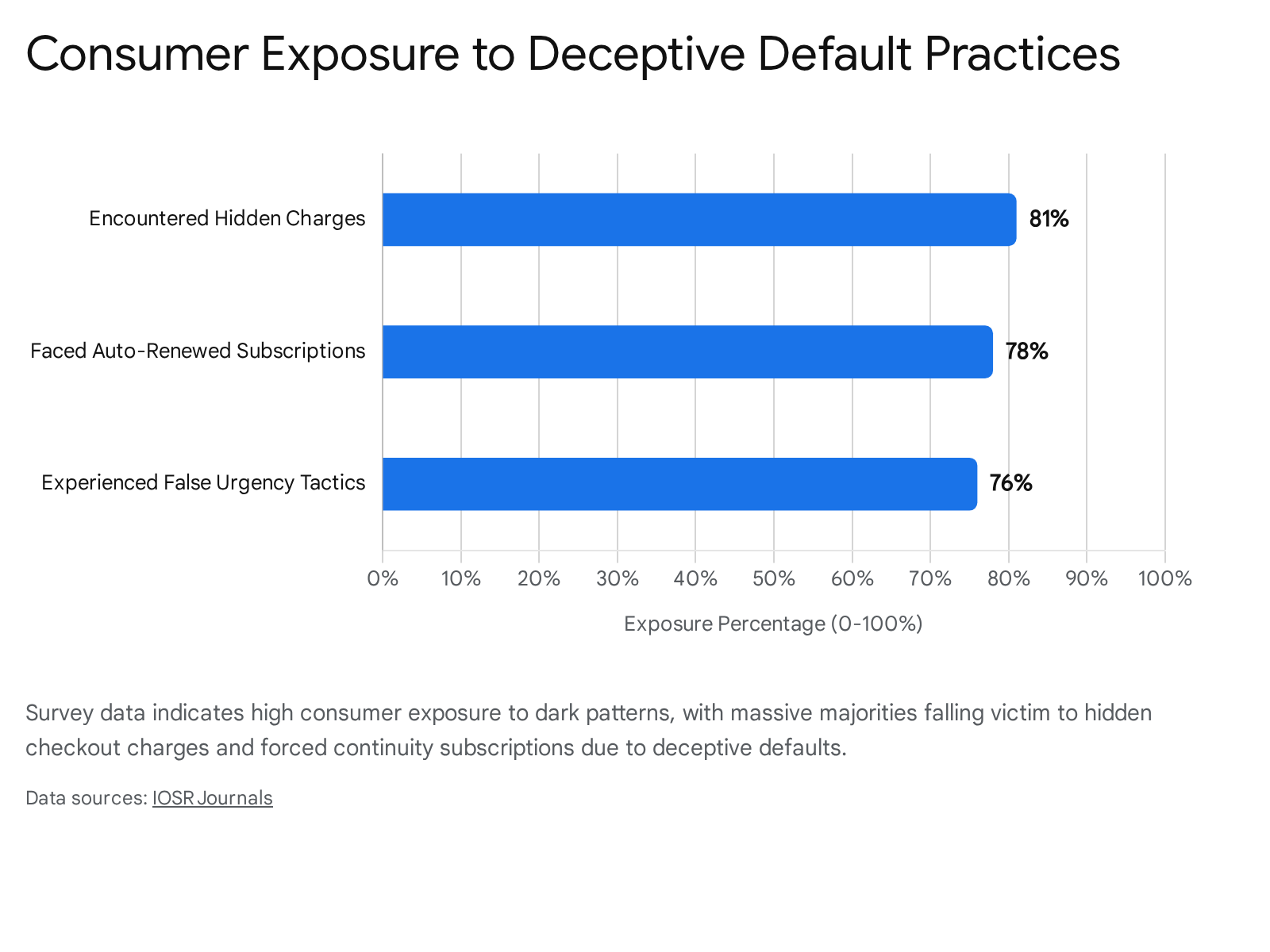
Consequently, 88% of surveyed consumers report feeling overwhelmed by deceptive UI tactics, leading to intense decision fatigue and post-purchase regret 9.
Research indicates that brands utilizing multiple dark patterns concurrently generate vastly more regulatory complaints than competitors employing transparent checkout designs 28. While dark patterns generate immediate conversion gains, the resulting benefits are frequently offset by substantial long-term costs, including severe reputation damage, deterioration of consumer relationships, and the triggering of aggressive regulatory penalties 928.
Global Regulatory Frameworks
Recognizing that dark patterns systematically subvert market efficiency and undermine consumer autonomy, regulatory bodies globally have initiated sweeping legislative overhauls. These frameworks aim to neutralize manipulative choice architecture by mandating affirmative consent and strictly limiting the use of default options.
United States Federal and State Enforcement
In the United States, federal enforcement against deceptive defaults has traditionally relied on Section 5 of the FTC Act, which prohibits unfair or deceptive business practices 2730. Seeking to modernize the 1973 Negative Option Rule, the FTC introduced the "Click-to-Cancel" rule to formally target subscription traps, auto-renewals, and free-to-pay conversions 233233343536. Finalized in October 2024 after reviewing 16,000 public comments, the rule established a strict legal framework mandating that sellers make the cancellation mechanism at least as easy to navigate as the mechanism the consumer used to initially sign up 32333436. The rule expressly required clear disclosures prior to collecting billing information and demanded informed consent separate from any other transaction portion, effectively banning pre-checked consent boxes for subscriptions 32333436.
However, the regulatory landscape remains highly volatile. The FTC faced immense industry pushback, resulting in the removal of initial proposals that would have required annual reminders and restricted "save" offers (attempts to convince consumers not to cancel during the exit flow) 3233. Furthermore, in July 2025, the U.S. Court of Appeals for the Eighth Circuit vacated the rule entirely, citing procedural deficiencies regarding the FTC's preliminary regulatory analysis 23. Despite this vacatur, the FTC and state regulators continue to pursue private lawsuits and enforcement actions against companies utilizing roach motels and forced continuity 23.
At the state level, the U.S. operates primarily on an opt-out paradigm regarding data collection, contrasting sharply with international norms. Laws such as the California Consumer Privacy Act (CCPA) and its amendment, the CPRA, assume consumer consent for data collection and sharing by default, requiring consumers to navigate to a "Do Not Sell or Share My Personal Information" link to proactively opt out 3638413738. Nonetheless, state legislation is increasingly targeting dark patterns that frustrate these specific opt-out rights. CCPA regulations explicitly prohibit interfaces that burden the user's ability to exercise privacy choices, leading to enforcement actions against entities like Sephora and Zoom that obscured opt-out paths 2739. Additionally, states have accelerated the passage of age assurance laws, with 25 states enacting legislation by early 2026 targeting minors' access to harmful content, upheld by the Supreme Court in Free Speech Coalition, Inc. v. Paxton (2025) 40.
European Union Digital Regulations
The European Union represents the most stringent regulatory environment countering status quo exploitation, heavily favoring affirmative opt-in consent mechanisms over passive opt-out defaults. The General Data Protection Regulation (GDPR) establishes the global benchmark, dictating that consent must be freely given, specific, informed, and an unambiguous indication of the user's wishes 414152. Consequently, pre-checked boxes and implicit opt-out models are legally invalid in the EU 26415354. Companies must provide interfaces where the user executes an active choice, and refusing consent must be as frictionless as providing it, effectively outlawing asymmetric cookie banners 4155.
To address the dominance of massive digital platforms, the EU implemented the Digital Markets Act (DMA) and Digital Services Act (DSA), representing a paradigm shift in ex-ante regulation. The DMA specifically regulates designated "gatekeepers" (such as Alphabet, Amazon, Apple, and Meta), addressing platform-level defaults 42434445. A core requirement of the DMA is configuration choice: gatekeepers must allow users to easily change default settings in operating systems, web browsers, and virtual assistants that route them to the gatekeeper's proprietary services 43. Gatekeepers are strictly prohibited from bundling services to prevent alternatives and must secure explicit consent to combine personal data across different platform services 4345.
Concurrently, the DSA focuses on digital fairness and user protection, imposing tailored obligations based on platform size 4246. The DSA strictly prohibits targeted advertising based on sensitive data and completely bans profiling-based advertising directed at minors 4246. Furthermore, it mandates that large online platforms (exceeding 45 million monthly EU users) offer users the ability to opt out of algorithmically personalized recommendation feeds, effectively forcing platforms to provide non-personalized chronological defaults as an accessible choice 4246. Furthermore, the EU's Unfair Commercial Practices Directive (UCPD) classifies manipulative designs as unfair practices, heavily scrutinizing hidden subscriptions and forced registration flows 2647.
Latin American Consumer Protection
The global push to neutralize exploitative choice architecture has catalyzed regulatory overhauls across Latin America. Brazil's General Data Protection Law (LGPD) shares extensive architectural similarities with the GDPR, operating on a strict opt-in model that prohibits implied consent and the use of pre-checked boxes 4148495051. In recognition of this robust framework, the European Commission and Brazil adopted mutual adequacy decisions in January 2026, creating the largest geographic area of free and safe data flows globally 665268. Further enhancing protections, Brazil enacted the Digital ECA Framework in September 2025, mandating privacy and safety-by-default for minors, establishing robust age verification mechanisms, and completely banning behavioral profiling for children, with violations incurring sanctions of up to 10% of gross revenue 40.
Mexico overhauled its data privacy landscape in March 2025 by adopting the new LFPDPPP (Federal Law on the Protection of Personal Data Held by Private Parties) 69. The 2025 reform explicitly limits data processing to the specific purposes stated in privacy notices and requires explicit, lawful opt-in consent without deceptive or fraudulent means 69. The legislation designates the Secretariat of Anti-Corruption and Good Governance as the new enforcement authority, signaling a hardline approach against corporate non-compliance and manipulative data harvesting 69.
Asia-Pacific Compliance Mechanisms
In the APAC region, regulators are increasingly pursuing statutory and enforcement actions targeting dark patterns directly. India has modernized its approach, combining the Digital Personal Data Protection Act (DPDP Act) of 2023 with specific Department of Consumer Affairs (DoCA) guidelines targeting dark patterns 84153. The guidelines formally define and prohibit practices such as "False Urgency," "Confirm Shaming," "Basket Sneaking," and "Subscription Traps," recognizing them as exploitations of cognitive biases 827.
The Competition and Consumer Commission of Singapore (CCCS) has identified dark patterns as a primary enforcement priority 2370. Between 2023 and 2025, the CCCS significantly escalated interventions against retailers violating the Consumer Protection (Fair Trading) Act 70. In addition to the Agoda false urgency case, the CCCS obtained landmark court orders against immigration consultancy businesses utilizing unfair trade practices, signaling robust enforcement capabilities 2470.
Regionally, the ASEAN Committee on Consumer Protection launched the ASEAN Strategic Action Plan on Consumer Protection (ASAPCP) 2025, emphasizing the monitoring of cross-border digital markets and educating populations against manipulative digital designs, highlighting a growing consensus that unchecked default exploitation threatens regional economic inclusivity 245354.
| Regulatory Jurisdiction | Primary Frameworks | Default and Consent Paradigm | Specific Enforcement and Status |
|---|---|---|---|
| European Union | GDPR, DMA, DSA, UCPD | Strict Opt-In. Banned pre-checked boxes and implicit consent 2641. | Gatekeepers must allow easy default changes; DSA bans specific manipulative interfaces 4346. |
| United States | FTC Act, CCPA/CPRA | Predominantly Opt-Out, except for minors and sensitive data 4137. | FTC actively litigates subscription traps; Negative Option rules vacated in 2025 232934. |
| Brazil | LGPD, Digital ECA | Strict Opt-In. Aligns heavily with GDPR requirements 4951. | Achieved EU adequacy in 2026; Digital ECA (2025) strictly protects minors 405052. |
| Mexico | LFPDPPP (2025 Reform) | Opt-In. Requires lawful, unambiguous consent 69. | Empowered Secretariat of Anti-Corruption to oversee consumer transparency 69. |
| India | DPDP Act, DoCA Guidelines | Opt-In. Heavy focus on informed, granular consent 841. | Specific statutory bans on "Confirm Shaming" and "Subscription Traps" 827. |
| Singapore | CPFTA, TR 76 Guidelines | Context-dependent, increasingly strict on digital fairness 2370. | CCCS actively enforcing against false urgency and deceptive ranking 2470. |
Conclusion
The intersection of behavioral economics, interface design, and commercial strategy has positioned default options as one of the most powerful determinants of consumer behavior. Rooted in deep-seated cognitive vulnerabilities - chiefly status quo bias, loss aversion, omission bias, and cognitive load - default mechanisms capitalize on the human tendency to avoid the mental friction of proactive decision-making.
While defaults can function as beneficial public policy nudges, the digital economy has seen the widespread weaponization of these psychological traits. Sludges and dark patterns, including forced continuity, roach motels, and pre-checked boxes, artificially inflate corporate conversion rates by trapping passive consumers in a state of continuous enrollment or unintended data surrender. The empirical evidence demonstrates a clear asymmetry: an opt-out architecture guarantees high retention of passive consumers, directly exploiting their cognitive limits at the cost of severe long-term trust erosion.
Recognizing the threat to consumer autonomy, global regulatory bodies are shifting from reactive policies to proactive choice architecture mandates. From the EU's Digital Markets Act forcing structural interoperability, to the strict opt-in consent models of Brazil's LGPD and India's explicit bans on specific dark patterns, the legal consensus is moving toward requiring digital interfaces to reflect genuine, frictionless consumer intent. However, as demonstrated by the volatile legal battles surrounding the FTC's Click-to-Cancel rule in the United States, dismantling established commercial reliance on the status quo bias remains a highly contested frontier in modern consumer protection.