
Personalized pricing ethics and consumer psychological backlash
Evolution and Typology of Algorithmic Pricing
For over a century, the retail economy was governed by the principle of the uniform posted price. Popularized in the mid-19th century by Quaker merchants and retail pioneers like John Wanamaker, the fixed price tag was designed to eliminate the inefficiencies, opacity, and perceived unfairness of individualized haggling 12. However, the advent of the digital economy, characterized by massive data collection, sophisticated artificial intelligence, and real-time computational processing, has facilitated a structural reversion to individualized pricing. Modern firms increasingly delegate their pricing decisions to algorithms capable of generating distinct prices based on highly granular data inputs 334.
Academic and regulatory literature strictly demarcates algorithm-driven pricing into two distinct, albeit sometimes overlapping, categories: dynamic pricing and personalized pricing 1465. Dynamic pricing refers to automated adjustments made in response to shifting macroeconomic variables, aggregate supply and demand ratios, inventory fluctuations, and competitor pricing 166. While the price changes frequently, it remains universal; at any given moment, all consumers observe the identical price 67. Examples include ride-hailing surge pricing during inclement weather or airline ticket prices increasing as departure dates approach 57.
Conversely, personalized pricing - frequently termed "surveillance pricing" in consumer advocacy and regulatory contexts - relies on processing individual-level data to predict a specific consumer's maximum willingness to pay 378. Instead of relying on aggregate market conditions, personalized pricing algorithms utilize inputs such as individual browsing history, historical purchase behavior, demographic proxies, geolocation, device type, and even real-time hardware metrics like battery life 3578. Consequently, two individuals browsing the identical product simultaneously may be presented with entirely divergent prices 7912.
| Characteristic | Dynamic Pricing Models | Personalized Pricing Models |
|---|---|---|
| Primary Algorithmic Inputs | Aggregate market demand, inventory levels, competitor pricing, time of day, weather, seasonality 166. | Individual browsing history, demographic proxies, geolocation, hardware/device type, cart abandonment history 7810. |
| Targeting Scope and Visibility | Universal and uniform at any specific temporal milestone. All active consumers observe identical fluctuating prices 16. | Highly individualized. Simultaneous consumers observe different prices for the exact same product or service 67. |
| Economic Objective | Temporal demand smoothing, inventory clearing, and dynamic response to broad market shocks 611. | Implementation of first-degree or third-degree price discrimination to maximize the extraction of individual consumer surplus 101213. |
| Common Algorithmic Techniques | Time-series forecasting, deep neural networks for aggregate demand prediction, rule-based heuristics 411. | Contextual bandits, Q-learning, clustering algorithms, Bayesian predictive willingness-to-pay modeling 141516. |
To operationalize these personalized models, firms increasingly rely on sophisticated machine learning frameworks, particularly reinforcement learning and contextual bandit algorithms 1114. Contextual bandit algorithms analyze high-dimensional user data (the "context") to select a pricing strategy (the "arm") that maximizes immediate and future financial returns 1415. Because these models continuously update their predictive accuracy based on real-time consumer feedback - such as transaction completion or cart abandonment - they optimize the extraction of consumer surplus far more aggressively and efficiently than traditional static pricing teams 101520.
Economic Welfare and Market Efficiency Analysis
The economic implications of personalized pricing remain highly contested within academic literature, with empirical findings presenting a nuanced relationship between algorithmic price discrimination and total consumer welfare. Classical economic theory posits that perfect, or first-degree, price discrimination - where a firm accurately charges every consumer exactly their maximum willingness to pay - unambiguously increases total economic welfare 101213. By offering lower prices to individuals whose valuation sits below the standard monopoly price but above the marginal cost of production, the firm expands output and eliminates deadweight loss 1017. However, under perfect price discrimination, the firm extracts the entirety of the consumer surplus, theoretically leaving consumers no better off than if they had not participated in the market 10.
The Market Expansion and Subsidization Effect
Recent empirical evaluations complicate the theoretical assumption of uniform consumer harm, suggesting that algorithmic personalization can function as an implicit cross-subsidy that expands market access for lower-income or highly price-sensitive consumers 21718. In competitive market environments characterized by high product coverage - where most consumers inherently need or intend to buy the product - personalized pricing intensifies competition among firms to capture price-sensitive users 218. Competing algorithms identify price-sensitive consumers and aggressively offer poaching discounts, effectively driving down the average price paid by these vulnerable demographic segments 217.
A randomized controlled trial evaluating personalized pricing deployed via machine learning on a digital platform demonstrated significant, albeit uneven, economic benefits 192021. The study revealed that while the deployment of the pricing algorithm increased the firm's expected profits by 86% relative to non-optimized pricing, over 60% of individual consumers within the trial actually benefited from lower personalized prices 1920. The algorithm achieved these dual benefits by offering discounted rates to individuals who would have been priced out under a uniform fixed-price model, effectively relying on a smaller segment of highly inelastic consumers to subsidize the broader consumer base 1920. Similar empirical analyses of algorithmic pricing in the airline, utility, and ride-hailing sectors consistently indicate that lower-income households, which traditionally exhibit higher price sensitivity, realize the most significant percentage savings when algorithms optimize for maximum market participation 17.
Information Asymmetry and Algorithmic Exploitation
Conversely, the net benefits of personalized pricing dissipate rapidly under conditions of low market coverage, monopoly power, or extreme information asymmetry 218. For niche products with high production costs, or in markets where consumers exhibit strong brand loyalty, algorithms leverage behavioral profiles to charge substantial premiums 218. For example, in competitive online retail settings, consumers lacking strong brand preferences benefit from targeted discounts designed to win their business, whereas consumers exhibiting rigid purchasing habits or brand loyalty are identified by the algorithm as highly inelastic and subjected to consistently higher prices 222. Research from the Rotman School of Management further indicates that when firms successfully conceal personalized prices from the broader public, they systematically extract more wealth from loyal consumers, though this opacity risks driving down overall sales volume if consumers suspect manipulation 23.
A significant secondary threat to market efficiency is the emergence of tacit algorithmic collusion. Economic simulations utilizing Q-learning agents demonstrate that independent pricing algorithms, designed purely to maximize their respective firms' profits, can learn to sustain supra-competitive prices without any explicit programming, human communication, or traditional price-fixing agreements 1624. By analyzing competitor responses over millions of automated iterations, reinforcement learning agents independently calculate that aggressive price-cutting ultimately harms long-term profitability 24. Consequently, competing algorithms gravitate toward stabilized, artificially high price equilibriums. This phenomenon challenges traditional antitrust frameworks, as it produces the economic damage of a cartel without the legally actionable element of an explicit human conspiracy 162425.
| Market Condition | Algorithmic Pricing Strategy | Consumer Welfare Impact | Firm Profitability Impact |
|---|---|---|---|
| High Competition, High Market Coverage | Algorithms target price-sensitive consumers with aggressive "poaching" discounts 21718. | Positive for majority. Reallocates surplus toward lower-income/price-sensitive buyers 17. | Moderate increase. Margins compress but volume increases 2. |
| High Brand Loyalty, Low Market Coverage | Algorithms identify rigid preferences and increase prices to match maximum willingness to pay 21822. | Negative. Extracts surplus from loyal consumers without offsetting market expansion 222. | High increase. Maximizes margin per transaction 1920. |
| Oligopoly with Q-Learning Agents | Algorithms learn to avoid price wars, stabilizing at supra-competitive equilibrium 1624. | Highly Negative. Functions as tacit collusion, artificially inflating prices universally 1624. | High increase. Replicates monopoly profit dynamics without explicit cartel agreements 24. |
Ethical Frameworks and Market Imbalances
The translation of behavioral data into pricing architectures introduces profound ethical complications that challenge the foundational principles of free-market commerce. Business ethics literature increasingly scrutinizes personalized pricing through the lens of extreme information asymmetry, the erosion of transactional equality, and the commodification of consumer privacy 132627. Under historical uniform pricing models, consumers and firms operate within a paradigm of relative equality; the consumer retains the autonomy to evaluate a fixed price against personal budget constraints and compare it transparently across competitors 13. The integration of big data and personalized algorithmic pricing dismantles this equilibrium, shifting the locus of control entirely to the firm 1327.
Ethicists and legal scholars conceptualize this imbalance as a modern, digitized iteration of laesio enormis - a historical legal doctrine designed to invalidate contracts involving massive, exploitative disparities in value or bargaining power. In the context of data-driven markets, researchers have proposed the concept of laesio algorithmica to describe the structural inability of consumers to detect, comprehend, or challenge the basis of their individualized pricing 28. The ethical harm of laesio algorithmica lies not merely in the financial penalty imposed on the consumer, but in the opacity of the algorithmic mechanism itself 28.
This opacity undermines market legitimacy and treats consumer data as a weapon for surplus extraction rather than a tool for mutual value creation 2728. Furthermore, the ethical analysis of algorithmic pricing highlights the involuntary nature of the data surrender. Because data collection relies on ubiquitous tracking techniques - such as device fingerprinting, mouse-movement tracking, and cross-site cookies - consumers routinely divulge the information used against them in ways that are implicit, passive, and largely unavoidable in the modern digital ecosystem 8913. This dynamic raises severe ethical questions regarding consent, as consumers are rarely aware that their navigational behaviors are actively calibrating the financial terms of their subsequent transactions 927.
Psychological Mechanisms of Consumer Backlash
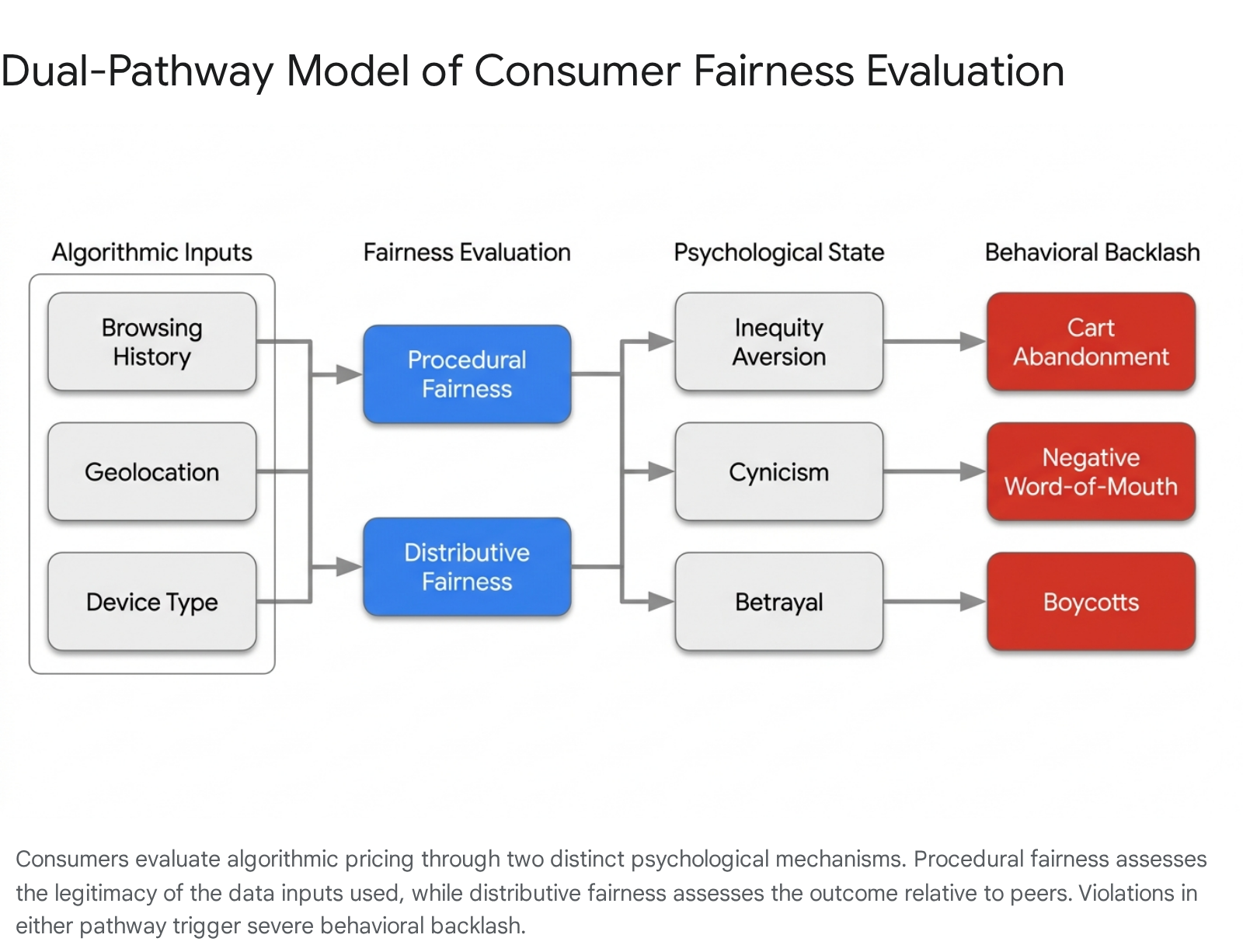
Despite its potential to optimize inventory, streamline revenue generation, and theoretically expand market access for lower-income groups, personalized pricing frequently triggers severe, highly emotional consumer backlash 29. Behavioral economics, psychology, and marketing science attribute this backlash to profound violations of consumer fairness norms. The psychological evaluation of price fairness does not rely on a simple calculation of financial loss; rather, it operates through two distinct, parallel cognitive mechanisms: distributive fairness and procedural fairness 293031.
Distributive Fairness and Inequity Aversion
Distributive fairness refers to the consumer's evaluation of the ultimate outcome - the specific price they pay compared to a perceived internal reference price, or critically, compared to the price paid by a peer 2930. Consumers harbor strong "self-interested inequity aversion," an evolutionary and social psychological trait that dictates extreme sensitivity to unequal treatment 3132. When consumers discover they have been subjected to a higher price than another buyer for an identical product at the exact same time, it violates deeply ingrained implicit social contracts regarding equal treatment in the marketplace 3132.
However, experimental data reveals a highly complex manifestation of this aversion within the context of algorithmic pricing: consumer backlash occurs even when the price difference explicitly favors the consumer 2933. While standard rational choice economic utility models assume that consumers exclusively prioritize their own financial gain, empirical psychological studies indicate otherwise. The mere discovery that a firm engages in covert personalized pricing triggers feelings of guilt, suspicion regarding future transactions, and a generalized aversion to the firm's manipulative capabilities. Consequently, researchers observe negative attitudinal and behavioral reactions from both price-disadvantaged and price-favored individuals 2933.
Procedural Fairness and Acceptable Segmentation Bases
Procedural fairness evaluates the legitimacy, transparency, and ethical validity of the mechanism used to determine the price 2930. In the realm of algorithmic pricing, procedural fairness is heavily dependent on the "segmentation base" - the specific categories of personal data the algorithm utilizes to profile the consumer 2934.
Consumers exhibit highly calibrated judgments regarding which data inputs are ethically permissible for price setting. Research mapping consumer perceptions reveals that pricing variations based on geographic location or explicit purchase history, while generally disliked, are viewed as somewhat tolerable because consumers intuitively understand the relationship between shipping logistics, local economies, and loyalty rewards 34. Conversely, pricing based on inferred intelligence, device type, or battery life is universally perceived as highly unfair, exploitative, and manipulative 834.
When consumers perceive the procedural mechanism as an extraction of sensitive, non-relevant data - such as a ride-hailing algorithm leveraging an expiring smartphone battery to increase surge prices, recognizing the consumer's temporal desperation - it irrevocably destroys trust 81135. These practices are viewed not as market-driven pricing, but as predatory behavioral exploitation.
Attitudinal and Behavioral Consequences
The culmination of distributive and procedural unfairness manifests in severe behavioral backlash. The discovery of algorithmic price discrimination frequently induces high-arousal negative emotions, specifically anger, feelings of isolation, vulnerability, and betrayal 35. These emotional states bypass standard rational choice frameworks, leading directly to retaliatory and self-protective consumer behaviors.
Consumers subjected to pricing algorithms they perceive as unfair exhibit significantly higher rates of cart abandonment, marked decreases in future purchase intent, and an increased propensity to engage in brand-damaging behaviors, such as spreading negative word-of-mouth or filing formal complaints 3536. E-commerce data from 2022 to 2025 across major product categories demonstrates that while aggressive dynamic pricing can temporarily raise revenue by an average of 12.3%, it simultaneously increases cart abandonment rates by 8.7%, revealing an inverted-U relationship where excessive pricing intensity ultimately cannibalizes net gains 36.
Furthermore, psychological studies reveal a profound paradox regarding regulatory transparency mandates: mandatory disclosure of algorithmic pricing - intended to empower consumers - frequently exacerbates the psychological backlash. When firms are forced to explicitly notify consumers that an artificial intelligence model is dictating their price based on their personal data, it dramatically increases the salience of the procedural mechanism. This heightened awareness of manipulation frequently results in decreased conversion rates, eroded brand loyalty, and active attempts by the consumer to subvert tracking mechanisms via browser privacy settings or data-shielding tools 273637.
Global Regulatory Frameworks and Legal Interventions
In response to the economic risks of algorithmic collusion and the profound psychological damage associated with surveillance pricing, global regulatory bodies are rapidly developing divergent legal frameworks to govern the use of consumer data in automated decision-making. The legal landscape is broadly characterized by the European Union's proactive, rights-based omnibus approach and the United States' fragmented, reactive, sector-and-state-driven model 383940.
The European Union Comprehensive Regulatory Model
The European Union regulates algorithmic pricing through a horizontal, human-rights-centric framework anchored by the General Data Protection Regulation (GDPR) and the newly enforceable Artificial Intelligence Act (AI Act) 3839. The EU paradigm fundamentally treats data privacy as a non-negotiable human right, mandating explicit legal bases for data processing and severely restricting purely automated decision-making (ADM) that produces legal or similarly significant effects on consumers under Article 22 of the GDPR 38.
The EU AI Act, representing the world's first comprehensive algorithmic governance regime, implements a tiered, risk-based taxonomy with obligations phasing in between 2025 and 2027 3940. AI systems deployed for personalized pricing, biometric categorization, and behavioral profiling are subjected to strict transparency obligations, rigorous data governance mandates, and mandatory algorithmic auditing to prevent discrimination 3941. This regime is further supplemented by the Digital Services Act (DSA) and Digital Markets Act (DMA), which impose proactive governance requirements on digital gatekeepers to prevent self-preferencing and exploitative market segmentation 38. Crucially, the EU framework exercises broad extraterritorial jurisdiction, compelling multinational corporations to adopt EU standards globally to maintain operational consistency and avoid massive financial penalties 394046.
The United States Federal and Antitrust Approach
The United States currently lacks a unified federal data privacy or algorithmic governance statute. Instead, it relies on existing consumer protection laws, antitrust statutes, and an increasingly aggressive patchwork of state-level legislation tailored to specific industries 383940. At the federal level, the Federal Trade Commission (FTC) utilizes Section 5 of the FTC Act to police "unfair and deceptive" algorithmic practices 3847.
In 2024 and 2025, the FTC launched extensive 6(b) market studies targeting algorithmic pricing intermediaries, issuing administrative subpoenas to investigate how companies utilize precise location, browsing history, and demographic data to set individualized prices across the grocery, travel, and retail sectors 94742. FTC Chair Lina Khan has publicly criticized "surveillance pricing," asserting that Americans deserve transparency regarding how their private data dictates their economic reality 9.
Concurrently, the Department of Justice (DOJ) and the FTC have pioneered novel antitrust enforcement strategies targeting algorithmic pricing vendors under horizontal price-fixing theories. In landmark actions against real estate pricing algorithms, federal enforcers argue that the shared use of a common pricing algorithm by competing firms constitutes a per se antitrust violation - a "hub-and-spoke" conspiracy - regardless of whether the competing firms explicitly communicated with one another 25435051.
State-Level Legislative Interventions in the United States
In the absence of comprehensive federal preemption, individual U.S. states have advanced highly novel legislative mechanisms to regulate personalized pricing throughout 2025 and 2026. These interventions represent the frontline of algorithmic regulation in the US and primarily fall into two distinct categories: mandatory disclosure frameworks and outright prohibitions on surveillance pricing 52444546.
| Jurisdiction | Legislative Action & Status | Regulatory Approach | Core Mechanism and Scope |
|---|---|---|---|
| New York | Algorithmic Pricing Disclosure Act (Enacted, Effective Nov 2025) 124746 | Mandatory Transparency | Requires businesses using personal data for pricing to display a conspicuous point-of-sale disclosure stating: "THIS PRICE WAS SET BY AN ALGORITHM USING YOUR PERSONAL DATA." Carries penalties up to $1,000 per violation 4647. |
| Maryland | Protection From Predatory Pricing Act (Enacted April 2026, Effective Oct 2026) 484950 | Outright Prohibition | The first law of its kind. Bans the use of dynamic/surveillance pricing based on personal data specifically for food retailers (grocery stores >15,000 sq ft) and third-party delivery services 4850. |
| California | Assembly Bill 325 (Enacted, Effective Jan 2026) & AG Enforcement Sweeps 475161 | Antitrust & Privacy Enforcement | Prohibits the use of "common pricing algorithms" that ingest competitor data to stabilize prices. Concurrently, the AG is investigating if personalized pricing violates consumer expectations under the CCPA 4761. |
| Colorado | CO HB 1210 (Advancing via legislative chambers as of May 2026) 5048 | Consumer Protection | Classifies surveillance-based individualized price setting as a deceptive trade practice under the Colorado Consumer Protection Act 5048. |
| Tennessee | TN SB 1807 (Enacted, Effective July 2026) 61 | Consumer Protection | Classifies the use of personalized algorithmic pricing as an unfair or deceptive act violating the Tennessee Consumer Protection Act 61. |
These state-level developments introduce severe compliance complexities for domestic and multinational retailers. Disparate state definitions of what constitutes "personal data" versus aggregate market data, coupled with nuanced, highly specific exemptions for traditional loyalty programs and geographic price variations, force firms into a difficult position. Retailers must either balkanize their digital pricing infrastructures to comply with a fragmented map of state laws or abandon highly profitable personalized pricing models entirely to avoid localized litigation and reputational damage 5253.
Future Research Directions
The rapid deployment of algorithmic pricing architectures continuously outpaces both empirical academic research and regulatory intervention. Current literature identifies a critical need to investigate the long-term psychological and economic impacts of mandatory transparent pricing disclosures on consumer behavior. As dictated by laws like the New York Algorithmic Pricing Disclosure Act, researchers must determine whether forced transparency mitigates procedural unfairness perceptions by empowering consumer choice, or conversely, exacerbates distributive unfairness perceptions by explicitly highlighting discriminatory practices to the consumer 3637.
Furthermore, deep computational research is required to develop pricing algorithms embedded with mathematical fairness constraints, often referred to as Explainable AI (XAI) in pricing 11. Designing objective functions for contextual bandits or Q-learning agents that optimize for revenue while simultaneously maintaining price differentials within socially and legally acceptable boundaries represents a vital frontier for bridging the gap between economic efficiency and consumer trust 41129. Finally, empirical macroeconomic studies must continue to rigorously evaluate the redistributive effects of algorithmic pricing across diverse sectors, separating the theoretical potential for progressive market cross-subsidization from the practical reality of surplus extraction in highly concentrated digital markets 21920.