
What the Marshmallow Test Actually Says About Self-Control
The scientific consensus now recognizes that the ability to delay gratification in early childhood is not an innate, immutable trait of willpower that independently predicts adult success. Instead, recent large-scale and cross-cultural replications demonstrate that a child's performance on tests of delayed gratification is heavily dictated by socioeconomic background, learned trust in environmental reliability, and culturally specific behavioral norms. Consequently, while executive function remains a critical developmental capacity, isolated behavioral tests like the marshmallow experiment do not reliably forecast long-term educational, economic, or health outcomes once confounding environmental and cognitive variables are controlled.
For decades, a pervasive and highly specific anxiety has haunted modern parenting and early childhood education: the paralyzing fear that a four-year-old's inability to sit alone in a room and wait fifteen minutes for a second treat invariably dooms their future Scholastic Aptitude Test (SAT) scores, career prospects, and overall life trajectory 12. This everyday anxiety stems directly from a pop-culture distortion of early psychological research. In the public consciousness, the classic marshmallow test became a deterministic crystal ball. If a toddler hastily ate the marshmallow, they were supposedly destined for a life of underachievement, obesity, and poor emotional regulation; if they waited, they were virtually guaranteed a spot in an elite university 23. This compelling but deeply flawed narrative popularized the misconception that willpower is an innate, unchangeable personality trait that acts as the ultimate arbiter of human potential and life success 13. However, the landscape of developmental and behavioral psychology has dramatically shifted. Over the past decade, rigorous conceptual replications, expanded longitudinal tracking into mid-adulthood, and cross-cultural analyses have systematically dismantled this deterministic view, revealing a far more nuanced reality about self-control, executive function, and the profound impact of socioeconomic and cultural environments on human behavior 123.
How Did the Original Marshmallow Test Create the Willpower Myth?
To understand the unraveling of the marshmallow myth, it is essential to first examine the foundational methodology and the subsequent sweeping claims of the original experiments. Conducted initially in the late 1960s and early 1970s by psychologist Walter Mischel and his colleague Ebbe B. Ebbesen at Stanford University, the original delay-of-gratification studies were initially designed with a much narrower scope: to understand the cognitive strategies children use to regulate their impulses 21.
The experimental setup was elegantly simple but highly artificial. A child, typically between the ages of three years and six months to five years and eight months (with a median age of four years and six months), was brought into a stark laboratory room at the Bing Nursery School, devoid of toys or distractions 1. A researcher placed a highly desired treat - such as a marshmallow, pretzel stick, or animal cookie, depending on the child's stated preference - on a table in front of them 31. The child was offered a choice: they could eat the single treat immediately by ringing a bell to summon the researcher, or, if they could wait alone in the room for a predetermined period (usually 15 minutes) until the researcher returned organically, they would be rewarded with two treats 14.
Mischel's primary early interest was in the cognitive mechanisms of attention deployment. The researchers secretly observed the children through a one-way mirror, noting that children who successfully delayed gratification employed various distraction techniques. They covered their eyes with their hands, rested their heads on their arms, sang songs, kicked the desk, or actively tried to imagine the marshmallow as a non-edible object, like a fluffy cloud 318. Mischel and Ebbesen discovered that when the treats were physically obscured from view, or when children were instructed to think about "fun things," they were able to wait significantly longer 189. This suggested that delay ability was highly dependent on cognitive avoidance and the suppression of the reward object, rather than a monolithic exertion of sheer willpower 18.
The experiment escalated from a localized study of cognitive strategies to a global cultural phenomenon during the subsequent follow-up phases. In 1988 and 1990, Shoda, Mischel, and Peake tracked down the original participants, who had since become adolescents. The researchers reported astonishing bivariate correlations between the number of seconds a child waited at age four and their subsequent adolescent life outcomes 345. The data suggested that those who waited longer were described by their parents ten years later as significantly more academically and socially competent, exhibited better stress management, and, most famously, scored significantly higher on their college entrance exams 31.
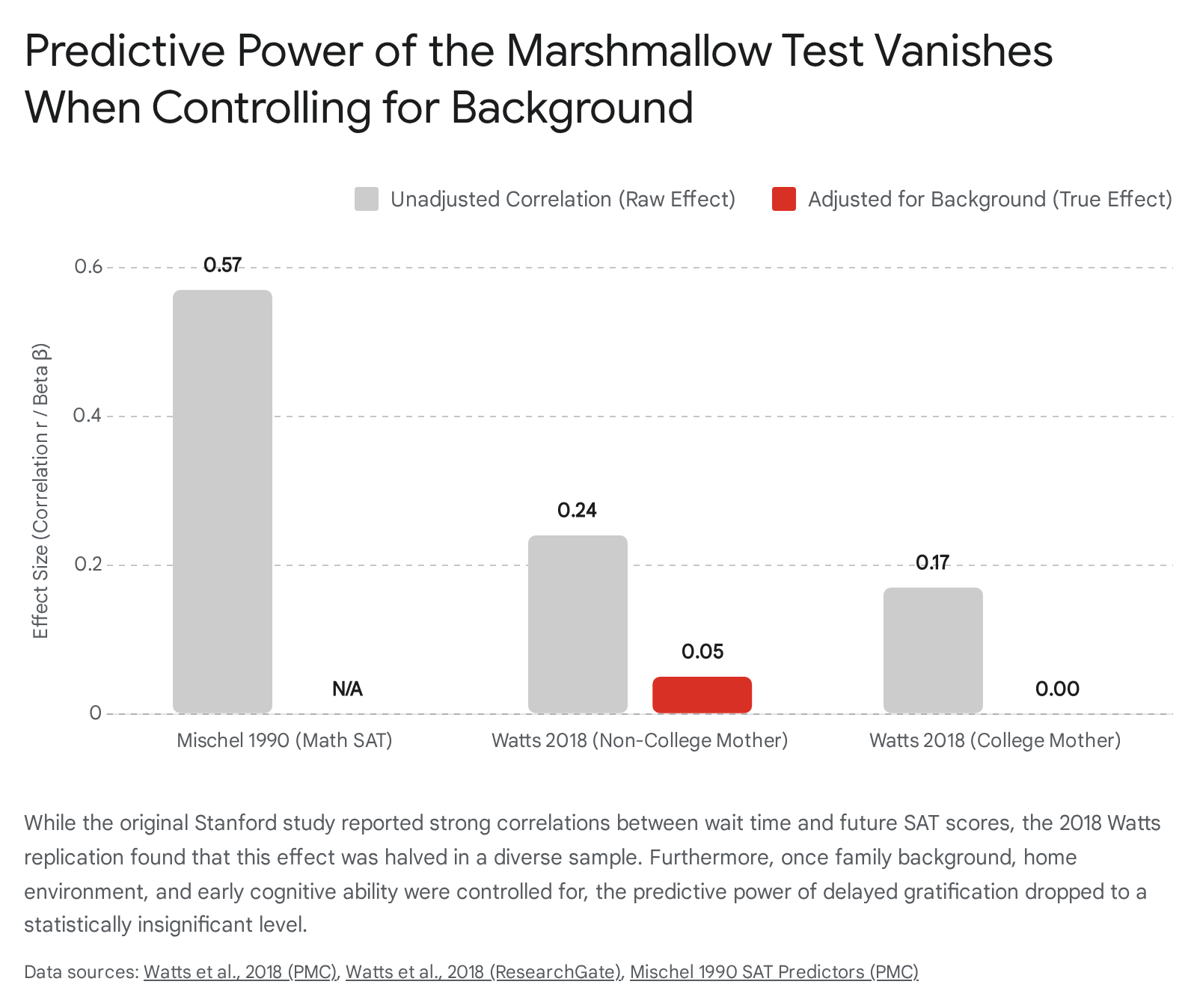
The statistical claims made during this era were striking. The 1990 study reported a correlation coefficient (r) of .57 for Math SAT scores and .42 for Verbal SAT scores 45. In the realm of psychology, where a correlation of .30 is often considered a medium effect and .50 a large effect, these numbers appeared to be monumental discoveries 67. Further longitudinal follow-ups into the participants' 30s and 40s linked early delay ability to a lower body mass index (BMI), decreased substance abuse, and even structural differences in the brain 218. For example, a 2011 brain imaging study of the original cohort in mid-life showed that individuals categorized as "high delayers" exhibited more activity in the prefrontal cortex during a go/no-go task, whereas "low delayers" showed more activity in the ventral striatum, a region associated with processing immediate, alluring temptations 21.
The resulting narrative was intoxicatingly simple and deeply aligned with Western cultural values of rugged individualism, discipline, and meritocracy. It suggested that a single, easily observable behavior in preschool could serve as a proxy for a lifelong trajectory of success. Educational policies, parenting books, and corporate training programs seized upon the marshmallow test, reducing complex socioeconomic, systemic, and psychological development into a binary test of moral and cognitive character 214.
Why Did the Watts (2018) Replication Shatter the Predictive Power of the Test?
The predictive power of the marshmallow test remained largely unquestioned in popular culture until the advent of the replication crisis in psychology. This paradigm shift prompted researchers across the globe to rigorously re-evaluate classic, textbook studies using modern standards: larger, more diverse sample sizes, preregistered methodologies, and highly sophisticated statistical controls designed to isolate true causation from mere correlation. The most devastating empirical blow to the deterministic marshmallow narrative arrived in 2018, when researchers Tyler W. Watts, Greg J. Duncan, and Haonan Quan published a landmark conceptual replication in the journal Psychological Science 19.
The original Stanford studies were profoundly limited by their sample characteristics. Mischel's follow-up studies relied on incredibly small, highly selective, and non-representative cohorts. For example, for their investigation of SAT and behavioral outcomes, Shoda and colleagues were able to contact only a fraction of the children who passed through the Bing Nursery School 4. The sample for the vaunted SAT correlations included fewer than 90 children 14. Furthermore, the Bing Nursery School was attended almost exclusively by the children of Stanford University faculty, graduate students, and alumni. These children were predominantly white, highly privileged, and represented a remarkably narrow slice of the socioeconomic and intellectual spectrum 489.
Watts and his colleagues addressed this critical methodological flaw by analyzing a massive dataset from the National Institute of Child Health and Human Development (NICHD) Study of Early Child Care and Youth Development (SECCYD). Their sample included 918 children and was specifically designed to be significantly more representative of the racial, geographic, and economic makeup of the broader United States population 499. To rigorously test the willpower hypothesis across the socioeconomic spectrum, the researchers created a specific subsample focusing heavily on children whose mothers had not completed college by the time the child was born 99.
When Watts et al. analyzed the raw, unadjusted data (the bivariate correlations), they did find a relationship between waiting time at age four and academic achievement at age 15. For children of mothers without a college degree, an additional minute of waiting predicted a gain of approximately one-tenth of a standard deviation in adolescent achievement 4916. This unadjusted correlation (β = 0.24) was roughly half the size of what Mischel originally reported 49. However, the true revelation emerged when the researchers applied multiple regression analysis to control for confounding variables that the original Stanford researchers had largely ignored.
When Watts introduced controls for the child's family background, early cognitive ability (such as baseline memory and verbal skills), and the quality of the home environment (using the standardized HOME Inventory by Caldwell & Bradley), the predictive power of the marshmallow test essentially vanished 489. For the sample of children whose mothers had not completed college, the association was reduced by two-thirds, falling to a statistically nonsignificant β = 0.05 49. Similarly, for children of college-educated mothers, the relationship became statistically indistinguishable from zero once the controls were added 4.
Furthermore, associations between delay time and measures of behavioral outcomes at age 15 were much smaller and rarely statistically significant 49.
The data firmly supported the conclusion that the children who waited longer and subsequently performed better in high school did not do so because of an innate, mystical reserve of willpower 29. Rather, they possessed broader cognitive, financial, and behavioral advantages derived from their socioeconomic environment. As the researchers explicitly concluded, interventions focused solely on teaching young children to delay gratification without addressing broader cognitive and environmental deficits are likely to be entirely ineffective 910.
To fully understand the magnitude of this paradigm shift, it is instructive to compare the methodologies and findings of the two landmark studies directly.
The Original Stanford Mischel Study vs. The Watts (2018) Replication
| Parameter | Original Mischel Follow-ups (1988, 1990) | Watts, Duncan, & Quan Replication (2018) |
|---|---|---|
| Sample Size | Small (e.g., n < 90 for SAT correlation; ~185 for broader behavioral outcomes) 14 | Large and highly powered (n = 918) 19 |
| Demographic Diversity | Highly homogeneous; primarily the white children of Stanford faculty and alumni 489 | Highly diverse; deliberately oversampled children of mothers without a college degree to match population demographics 499 |
| Effect Size (Bivariate / Unadjusted) | Large (r = .42 for Verbal SAT to .57 for Math SAT scores) 45 | Moderate to Small (β = .24 for adolescent achievement) 49 |
| Effect Size (Controlled / Adjusted) | Not rigorously controlled for family SES, maternal education, or early baseline IQ 110 | Statistically insignificant (effect reduced by two-thirds to β = .05 when covariates were applied) 49 |
| Primary Scientific Conclusion | The isolated ability to delay gratification is a critical success factor that directly drives future academic and social competence. 114 | Delay ability is largely a secondary byproduct of socioeconomic status, family background, and early baseline cognitive ability. 2918 |
Does Childhood Delayed Gratification Predict Adult Functioning in 2024 Research?
The re-evaluation of the marshmallow paradigm did not cease at adolescence. In recent years, researchers recognized that true human capital formation and well-being are measured in adulthood. They sought to track delay-of-gratification cohorts into their late twenties to test whether early self-control ultimately dictates adult functioning, as had been previously claimed by Mischel's later follow-ups of the Stanford cohort 38.
A definitive 2024 study by Jessica F. Sperber, Deborah Lowe Vandell, Greg J. Duncan, and Tyler W. Watts addressed this by tracking 702 participants from the SECCYD sample to age 26 311. The researchers preregistered their analytic plan - a hallmark of modern, rigorous open science that prevents researchers from fishing for positive results - and measured a comprehensive suite of adult outcomes 320. These outcomes included educational attainment, body mass index (BMI), annual earnings, depressive symptoms, substance use, impulsive behavior, risk-taking, and debt 2021.
The findings delivered another profound, empirically sound blow to the willpower myth. The preregistered analysis revealed that performance on the marshmallow test at 54 months of age was not strongly predictive of adult achievement, health, or behavioral metrics 31122. While the researchers did detect modest bivariate correlations with educational attainment (r = .17) and body mass index (r = -.17), virtually all regression-adjusted coefficients became nonsignificant once basic demographic and early home-life variables were introduced into the statistical models 32223.
Furthermore, the researchers found no clear pattern of moderation by either socioeconomic status or sex, meaning the test failed to predict outcomes universally across different groups 31122. Surprisingly, the test failed to predict the very behaviors one might expect to be most highly related to early gratification delay, such as adult impulse control, substance use, and risk-taking 21. The researchers firmly concluded that the marshmallow test does not reliably predict adult functioning 31122. This lack of long-term predictive power raises serious skepticism over the construct validity of the test itself. It appears the task acts primarily as a crude, noisy screener for broader developmental and environmental advantages in early childhood, rather than an isolated, pure measure of a lifelong psychological trait 2123.
However, the scientific community emphasizes that while the marshmallow test is deeply flawed as a predictive instrument, severe behavioral dysregulation in childhood is not benign. If the marshmallow test is dead as a metric, what actually predicts adult success and failure? Contemporary research points to broader, comprehensive measures of behavioral problems. A 2023 conceptual replication by Koepp et al. analyzed massive longitudinal cohorts from the United States (n = 1,168) and the United Kingdom (n = 16,506) to examine the long-term impacts of early attention and behavior problems 2425. Unlike the marshmallow test, which measures behavior in a single 15-minute artificial window, these studies utilized multi-informant composites of impulsive-aggressive, hyperactive, and inattentive behaviors observed over years 25.
Koepp and colleagues found that severe attention and behavior problems across distinct periods of childhood strongly and reliably predicted a range of adult outcomes. Higher levels of childhood dysregulation were associated with lower educational attainment, poorer financial well-being, increased physical health problems, and a higher likelihood of spending time in the penal system 251227. Importantly, these associations remained robust even when controlling for child IQ and family characteristics 812. The pathways through which these dysregulations operate are complex and compounding. For instance, adverse childhood experiences (ACEs) contribute significantly to later delinquency, operating indirectly via sleep problems in early adolescence and disrupted self-control 13. Thus, while the isolated marshmallow test fails as a destiny-defining predictor, the broader ecosystem of a child's environment, their psychological trauma, and their sustained ability to regulate emotions remain deeply consequential for their life trajectory 1227.
How Does Environmental Reliability and Trust Dictate a Child's Choice?
If the marshmallow test does not purely measure a biological or characterological capacity for self-control, what exactly is it measuring during those 15 minutes in the laboratory? Modern psychological and economic analysis suggests that a child's decision to eat the marshmallow immediately is rarely a failure of willpower, but rather a highly rational, calculated response to environmental instability and scarcity 114.
Historically, the traditional interpretation of the marshmallow test judged children evaluatively; those who did not delay gratification were viewed as possessing poor reasoning skills, an innate tendency toward gluttonous indulgence, and a culpably low amount of self-discipline 14. This interpretation deeply stigmatizes the highly adaptive behaviors of children raised in poverty or unpredictable environments. The academic discussion surrounding the test points to issues in the rationality involved in the economic behavior of poor versus non-poor households 14. When an individual is socialized in scarcity, delaying the receipt of resources is frequently a dangerous, counterproductive strategy. In an unpredictable world where adults routinely break promises, bills unexpectedly arise, and the safety net is nonexistent, waiting for a hypothetical "second marshmallow" that may never materialize is inherently irrational. Securing the caloric or monetary resource immediately is the optimal survival tactic 114.
This hypothesis was elegantly and empirically demonstrated in a landmark 2012 study by researchers Celeste Kidd, Holly Palmeri, and Richard Aslin at the University of Rochester. They hypothesized that the marshmallow test measures a child's trust in the experimenter rather than innate self-control. Before administering the standard marshmallow test, the researchers randomly assigned 28 four-year-olds to either a "reliable" or an "unreliable" environment 815. In the unreliable condition, children were promised a set of exciting new art supplies if they waited, but the researcher soon returned empty-handed, claiming they could not find them. In the reliable condition, the researcher faithfully fulfilled the promise and brought the supplies.
When subsequently given the actual marshmallow test, the results were staggering and immediate. Children who had been primed in the reliable environment waited an average of four times longer (approximately 12 minutes) than children in the unreliable environment, who succumbed in an average of just 3 minutes 815.
This paradigm shift reframes delayed gratification from a question of internal character to a question of external trust and reputation management 131. The test fundamentally measures whether a child has accumulated enough statistical evidence in their short life to believe that adults keep their promises, that their immediate environment is secure, and that the future can generally be counted on 1. A child from a stable, affluent, predictable home who waits 15 minutes is not necessarily demonstrating superior moral virtue or innate cognitive strength; they simply possess more empirical evidence that waiting pays off 13. Conversely, a child from a chaotic, resource-deprived environment who eats the marshmallow immediately is making an entirely rational assessment of the odds based on their lived experience. As one analysis noted, when you are four years old and you have learned that when adults say "I'll be right back" they sometimes never return, taking the marshmallow now is not a failure of self-control; it is an intelligent response to uncertainty 1.
How Does the Concept of Ego Depletion Relate to the Self-Regulation Crisis?
The dismantling of the marshmallow myth parallels a broader crisis in the psychological study of self-control, particularly regarding the theory of "ego depletion." For decades, the dominant framework for understanding self-regulation was the "strength model," proposed heavily by Roy Baumeister and colleagues 1617. This model posited that all acts of self-control - whether resisting a marshmallow, persisting on a difficult puzzle, or regulating emotional outbursts - draw from a single, limited metabolic resource (often theorized as willpower or even physical blood glucose) 1617. According to this theory, initial acts of self-control deplete this resource, leaving the individual in a state of "ego depletion," resulting in impaired performance on subsequent self-regulatory tasks 1618.
Initially, the strength model seemed unassailable. A 2010 meta-analysis reported a moderate and robust effect size (Cohen's d = 0.62) for the ego depletion phenomenon across hundreds of studies 18. However, as the replication crisis swept through psychology, the ego depletion effect came under intense, critical scrutiny. Skeptics argued that the reported results primarily reflected severe publication bias and a lack of clear operational definitions regarding what actually constitutes a "self-control task" 18.
To settle the debate, a high-profile, preregistered multilab replication study was organized by Hagger and colleagues in 2016 involving 23 independent laboratories. The results were devastating to the strength model: the researchers found essentially zero effect 18. More recent, highly rigorous preregistered multilab replications have attempted to salvage the theory using optimized tasks (e.g., using the Stroop task as the depleting mechanism and the antisaccade task as the outcome metric). Data from 12 global labs involving 1,775 participants did find a statistically significant ego depletion effect, but the effect size was shockingly small (Cohen's d = 0.10) 16. Even after excluding participants who responded randomly, the effect size only increased to d = 0.16 16. In psychological research, an effect size this small indicates that while the phenomenon may technically exist under highly specific laboratory conditions, it has negligible practical significance in real-world human behavior 616.
The crisis in ego depletion literature perfectly mirrors the collapse of the marshmallow test. Both relied on overly simplistic, mechanistic views of human behavior. Just as the marshmallow test failed to account for trust, socioeconomic background, and rational choice, the strength model of ego depletion failed to account for motivation, personal beliefs about willpower, and the complex, dynamic nature of executive function. Modern researchers increasingly reject the idea of willpower as a depletable "muscle" or a fixed genetic trait, viewing self-regulation instead as a complex interplay of motivation, attention deployment, environmental context, and habit 161718.
In What Ways Do Cultural Norms and Geography Override Innate Self-Control?
The dismantling of the marshmallow myth has been further accelerated by a growing recognition of the WEIRD (Western, Educated, Industrialized, Rich, and Democratic) bias pervasive in psychological research. For over forty years, foundational assumptions about self-control, executive function, and optimal child development were based almost entirely on the observed behavior of American and European children. However, recent cross-cultural replications have vividly demonstrated that a child's willingness to delay gratification is profoundly shaped by the specific cultural norms, social conventions, and parenting styles of their native society 23435.
The Cameroon vs. Germany Replication (Lamm et al., 2018)
In 2018, psychologist Bettina Lamm and her team conducted the first marshmallow test on non-Western children, aiming to compare 125 middle-class German four-year-olds with 76 four-year-olds from the rural Nso farming community in Cameroon 361920. Recognizing that marshmallows hold no cultural relevance in rural Central Africa, the researchers thoughtfully adapted the temptation parameters: German children were offered a choice between a lollipop and a chocolate bar, while the Nso children were offered a "puff-puff," a highly popular local fried pastry 341920.
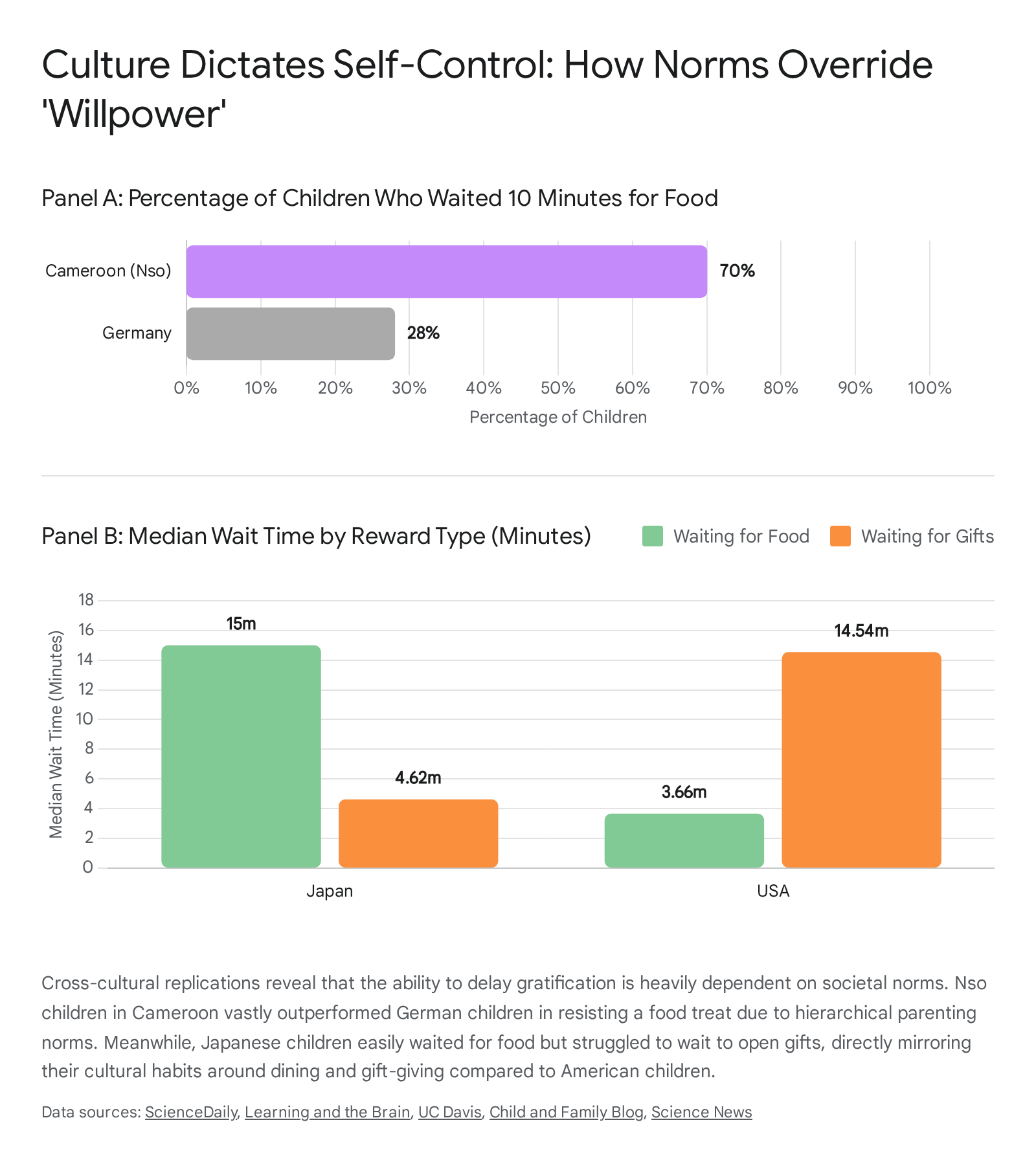
The results were a paradigm-shifting revelation for developmental psychologists. While only 28% of the middle-class German children successfully waited the full 10 minutes for a second treat, a staggering 70% of the Cameroonian children succeeded in waiting without eating the puff-puff placed on the table in front of them 3620. Almost 50% of the German children succumbed and ate the single sweet, compared to only 29% of the Nso children 3619. The average delay time was 4.56 minutes for the German children and 7.73 minutes for the Nso children 36.
Furthermore, the behavioral strategies employed during the waiting period diverged drastically along cultural lines. The German children exhibited the classic signs of a frantic internal battle of wills widely documented in Western literature: they paced the room, sang, talked to themselves, fidgeted with the treat, showed frustration, and nearly a quarter (22.4%) of them simply terminated the experiment by walking out of the room 361920. In stark contrast, the Nso children exhibited almost no motor activity. They sat silently, showing little emotion or frustration, and eight of the Nso children actually fell asleep in their chairs while waiting 361920.
Researchers attribute this immense behavioral disparity to the profound effects of enculturation and distinct, culturally dictated parenting styles. Four years prior to the marshmallow test, the researchers had monitored the mothers interacting with these same children as nine-month-old infants 3619. They found that the Nso mothers utilized a more authoritarian, hierarchical parenting style that prioritized social harmony, modesty, and strict compliance with adult instructions. In this collectivist culture, emotional regulation, respect for hierarchy, and the suppression of personal desires in favor of community obligation are instilled from infancy 353619. Conversely, the middle-class German mothers exhibited an autonomous, observant parenting style, actively encouraging children to express their desires, pursue personal interests, and challenge constraints 1920. What Western psychologists had historically labeled as a universal, objective measure of "self-control" and future academic potential was, in fact, heavily capturing a culturally specific assessment of compliance, obedience, and hierarchical respect 3520.
The Japan vs. United States Replication (Yanaoka et al., 2022)
Cultural relativity was further established in an elegant 2022 study published in Psychological Science by Kaichi Yanaoka, Yuko Munakata, and colleagues, which compared preschool children in Kyoto, Japan, with children in Boulder, Colorado 239. The researchers hypothesized that the specific object of the temptation matters deeply, as different cultures prioritize waiting for different categories of rewards.
In Japan, social conventions dictate a powerful habit of waiting for food; individuals typically wait until everyone is served and formally say "Itadakimasu" before eating, establishing a year-round behavioral norm 3921. However, Japanese culture does not heavily emphasize waiting to open gifts. Parents frequently leave gifts for their children without the cultural expectation that the child should hold back and wait for a specific occasion to open them 3921. In the United States, the inverse cultural pattern is true: snacking on demand is highly common, but children are rigorously trained from a young age to wait to open wrapped gifts on specific occasions like birthdays and Christmas 3921.
To test this hypothesis, the researchers subjected both groups of children to two distinct conditions: waiting to eat a marshmallow (food) and waiting to open a wrapped present (gift) 3921. The results perfectly mirrored the specific cultural habits of each nation. Japanese children waited overwhelmingly longer for the delayed food reward, achieving a median wait time of 15 minutes. However, in the gift condition, their wait time plummeted to a median of just 4.62 minutes 3921. The American children showed the exact reverse pattern, demonstrating high levels of self-control when waiting to open the gift (a median wait time of 14.54 minutes), but rapidly succumbing to the marshmallow in a median of 3.66 minutes 3921.
As lead researcher Yuko Munakata noted, if developmental scientists had only looked at the marshmallow data - as had been standard practice for half a century - they would falsely conclude that Japanese children possess vastly superior innate self-control 2. Instead, the study proves that the marshmallow test primarily measures a child's sensitivity to social conventions and the strength of their culturally ingrained habits regarding the specific object placed in front of them 3521.
A Summary of Cross-Cultural Delay Variances
| Cultural Cohort Comparison | Key Cultural Variable Tested | Dominant Behavioral Norm | Resulting Wait Behavior on Delay Tasks |
|---|---|---|---|
| Cameroon (Nso) vs. Germany 3620 | Collectivist / Hierarchical vs. Autonomous Parenting | Nso emphasize compliance and social harmony; Germans emphasize individual expression. | 70% of Nso children waited 10 mins (sitting still/sleeping) vs. 28% of German children (pacing/fidgeting). |
| Japan vs. United States (Food) 3921 | Cultural habits around dining and eating | Japan heavily emphasizes waiting for meals; US emphasizes on-demand snacking. | Japanese median wait: 15 minutes. US median wait: 3.66 minutes. |
| Japan vs. United States (Gifts) 3921 | Cultural habits around gift-opening | Japan opens gifts immediately year-round; US enforces waiting for specific holidays. | US median wait: 14.54 minutes. Japanese median wait: 4.62 minutes. |
Can We Teach Executive Function, and What Does the 2025 - 2026 Evidence Reveal?
Having empirically established that delayed gratification is not an innate, genetic destiny, but rather a highly complex interplay of socioeconomic trust, environmental stability, and cultural habit, a critical question remains: can the underlying cognitive architectures of self-control be intentionally taught and improved?
The contemporary scientific literature approaches this question through the lens of Executive Function (EF). Executive functions are top-down, deliberate cognitive control processes that comprise three interrelated core skills: inhibitory control (resisting impulsive actions or thoughts), working memory (holding and manipulating information in the mind), and cognitive flexibility (adapting to new demands or changed rules) 2223. While the predictive power of a single delay-of-gratification test has been thoroughly debunked, the consensus remains that robust, generalized EF skills are critical for school readiness, emotional self-regulation, and long-term social competence 222425.
Crucially, modern neurological and psychological research confirms that executive functions are highly malleable in children, owing to the profound neuroplasticity of the developing frontal lobe during early childhood 222345. However, the pedagogical field has evolved significantly past the simplistic, punitive idea of forcing a child to stare at a marshmallow to build "willpower muscle."
Recent systematic reviews and meta-analyses published between 2024 and 2026 reveal that intentional, structured interventions can indeed enhance executive function, though the effects are often domain-specific and modest in size, requiring sustained environmental support. A massive 2026 meta-analysis published in Child Neuropsychology comprehensively evaluated 35 experimental studies involving over 4,200 preschool children (2,367 in intervention groups and 1,928 in controls) 462648. The researchers assessed various cognitive-based, multimodal, and physical activity interventions.
The meta-analysis showed statistically significant, albeit small, positive effects on verbal working memory (Cohen's d = 0.13) and inhibitory control (d = 0.10) 2648. Interestingly, they found an almost null effect on nonverbal working memory (d = 0.02) 2648. While these effect sizes are modest - likely due to the brief duration of most interventions, methodological heterogeneity, and the use of non-clinical, typically developing samples - they confirm that targeted cognitive scaffolding does yield reliable developmental gains in early childhood 2648.
How are these gains optimally achieved in practice? The latest empirical evidence points strongly toward the integration of executive function training into naturalistic, ecologically valid activities, particularly social playfulness and structured movement, rather than sterile laboratory drills. 1. Social Playfulness and Dramatization: A 2025 study published in Scientific Reports demonstrated that short, highly engaging playful social interactions significantly improved primary school children's attentional performance and inhibitory control on complex cognitive tasks (such as the Flanker task) compared to standard physical exercise control groups 22. Playful interactions are multidimensional; they simultaneously engage cognitive, emotional, and social functions, forcing children to regulate their impulses in real-time to maintain the rules and joy of the game 22. Similarly, researchers have found that integrating dramatization and pretend-play into kindergarten curricula powerfully enhances both self-regulation and literacy. In these scenarios, children must hold complex narrative rules and character perspectives in their working memory while actively inhibiting out-of-character, impulsive behavior 2224. 2. Exergaming and Motor Activity: Research published in 2026 indicates that motor-activity-based interventions and "exergaming" (interactive video games that require vigorous physical exertion and real-time decision making) positively impact cognitive flexibility (SMD = 0.34) and inhibitory control (SMD = 0.57) 4648. The combination of physical arousal, increased neural efficiency, and the strict requirement to allocate top-down attentional resources to complex digital rules provides a highly potent training ground for the developing prefrontal cortex 2248. 3. Teacher-Student Interactions (TSI): A comprehensive systematic review highlighted that the quality of daily interactions between educators and students is a profound environmental factor in EF development 25. Interventions that manipulated the classroom environment to explicitly increase emotional support, clear communication, and structured behavior management resulted in significant gains in children's self-regulation 1225. Notably, these classroom-level interventions consistently showed the largest effects on vulnerable or economically disadvantaged children, suggesting that high-quality, supportive environments can effectively buffer against cognitive deficits associated with early adversity 25.
What Are the Practical Takeaways for Cultivating Authentic Self-Regulation?
The evolution of the science of delayed gratification requires a fundamental shift in how parents, educators, and policymakers approach child development. Society must move away from the anxiety-inducing paradigm of testing a child's moral character through forced temptation, and instead focus on cultivating the specific environmental conditions that make self-regulation a rational, achievable, and accessible choice.
When discussing the practical application of these scientific findings, it is absolutely vital to apply calibrated uncertainty. The science has proven that executive functions are malleable, and we definitively know that chaotic, high-stress environments hinder their development 2225. However, we must remain rigorously cautious about over-promising the long-term impacts of short-term, isolated interventions. As the massive Watts (2018) replication and the Sperber (2024) adult follow-up clearly demonstrated, brief behavioral tweaks and willpower exercises do not override the massive, compounding, lifelong effects of socioeconomic status, systemic inequality, and baseline cognitive resources 39. As Watts explicitly warned, an intervention that narrowly trains a child to delay gratification for a few minutes - but fails to address broader cognitive capacities or environmental stability - will almost certainly have negligible effects on their later life outcomes 920.
With this calibrated scientific uncertainty firmly in mind, there are several evidence-based, practical takeaways for fostering healthy, authentic self-regulation in children:
1. Build a Foundation of Connection and Environmental Trust Self-regulation is intrinsically built upon the foundation of co-regulation. Children cannot independently regulate their nervous systems or delay gratification if they do not feel safe and trust their environment. Before expecting a child to exhibit self-control, adults must ensure they are providing a reliable, predictable reality 149. As the Rochester reliability studies explicitly showed, broken promises destroy the rational incentive to wait for the future 15. Parents and educators must follow through on their commitments. Furthermore, forming a deep, trusting connection allows an adult to "lend" their regulated nervous system to a child during moments of high emotional stress. This co-regulation moves the child out of a primitive fight-or-flight state, allowing their prefrontal cortex to eventually engage and practice good choices 49.
2. Teach Cognitive Reappraisal Rather Than Brute Willpower Instead of demanding that children rely on sheer, exhausting willpower to resist temptation, adults must explicitly teach them the actual cognitive mechanisms of control. Help preschoolers understand that they can mentally process demands by intentionally shifting their attention 45. Teach them to physically look away from a temptation, engage in a distracting physical task, or reframe the object in their mind. By the time a child reaches ten years of age, if they have been equipped with these cognitive techniques, they will begin using them autonomously to reappraise situations that evoke negative emotions, transitioning from external management to internal executive function 845.
3. Establish Predictable, Structured Routines Children thrive on absolute consistency. Following a predictable daily routine actively helps manage a child's cognitive load. By setting clear, unwavering boundaries around different daily activities - learning, quiet time, outdoor play, and eating - parents and educators drastically reduce the amount of active, exhausting decision-making a child must engage in 50. This structured environment preserves their limited executive function for when it is truly needed to navigate novel challenges or social conflicts 2350.
4. Maintain Developmentally Appropriate Expectations It is critical to maintain scientifically sound, developmentally appropriate expectations. The frontal lobe, which facilitates self-monitoring and behavioral inhibition, is highly immature in infants and toddlers 45. A parent or caregiver demanding strict emotional suppression from a screaming infant or a very young toddler is demanding the biological impossible. Expecting immediate compliance or flawless self-control without providing heavy scaffolding will not only fail to achieve the desired result, but it actively undermines the child's future ability to self-regulate by inducing chronic stress 45.
5. Connect Daily Choices to Natural Consequences In older children, true self-control requires the ability to engage in "mental time travel" - projecting oneself into the future to weigh outcomes. Educators and parents should regularly and calmly guide children through discussions about cause and effect. By raising conscious awareness of how daily actions impact future outcomes, and by explicitly identifying both the positive and negative natural consequences of their choices, adults give children the requisite cognitive tools to pause and think before acting instinctively 51. When children realize what their choices do to themselves and their community, it provides the necessary pause required for successful self-control 51.
Bottom Line
The famous Stanford marshmallow test does not measure an innate, genetic destiny of willpower; rather, it primarily reflects a child's socioeconomic background, their learned trust in the reliability of adults, and their culturally ingrained habits regarding reward. While severe, sustained behavioral dysregulation remains a valid risk factor for poor adult outcomes, executive function and self-control are highly malleable skills that can be nurtured through play, predictable routines, and trusting relationships. Ultimately, setting children up for lifelong success is not achieved by artificially testing their endurance against temptation, but by providing a secure, supportive, and predictable environment that makes patience a rational and highly rewarding choice.