
Criticisms of disruptive innovation theory
Fundamentals of Disruptive Innovation
Disruptive innovation theory stands as one of the most influential frameworks in contemporary strategic management and business history. Originally articulated by Clayton M. Christensen and Joseph L. Bower in a 1995 article and subsequently popularized in Christensen's 1997 seminal book, The Innovator's Dilemma, the theory sought to explain a persistent paradox in corporate strategy 123. The central question was why well-managed, dominant companies frequently lose their market leadership precisely because they engage in traditionally sound management practices 14. According to the framework, incumbent organizations listen astutely to their most profitable customers and invest aggressively in what the theory terms "sustaining innovations." These sustaining innovations consist of incremental or breakthrough improvements that enhance the performance of established products along dimensions that mainstream customers historically value 456.
However, this relentless focus on the high end of the market creates a structural vulnerability. Disruptive innovations typically emerge at the bottom of the market or in entirely new segments, initially appearing as inferior, cheaper, and less profitable alternatives to the mainstream offering 578. Because these nascent innovations do not meet the strict performance requirements of an incumbent's best customers, rational management principles dictate that incumbents should ignore them, avoiding the cannibalization of their own high-margin products 3910. Over time, however, the disruptive technology improves at a trajectory that outpaces the ability of consumers to utilize those improvements. Eventually, the performance of the disruptive product intersects with mainstream market demands, allowing the entrant to displace established industry leaders 111213.
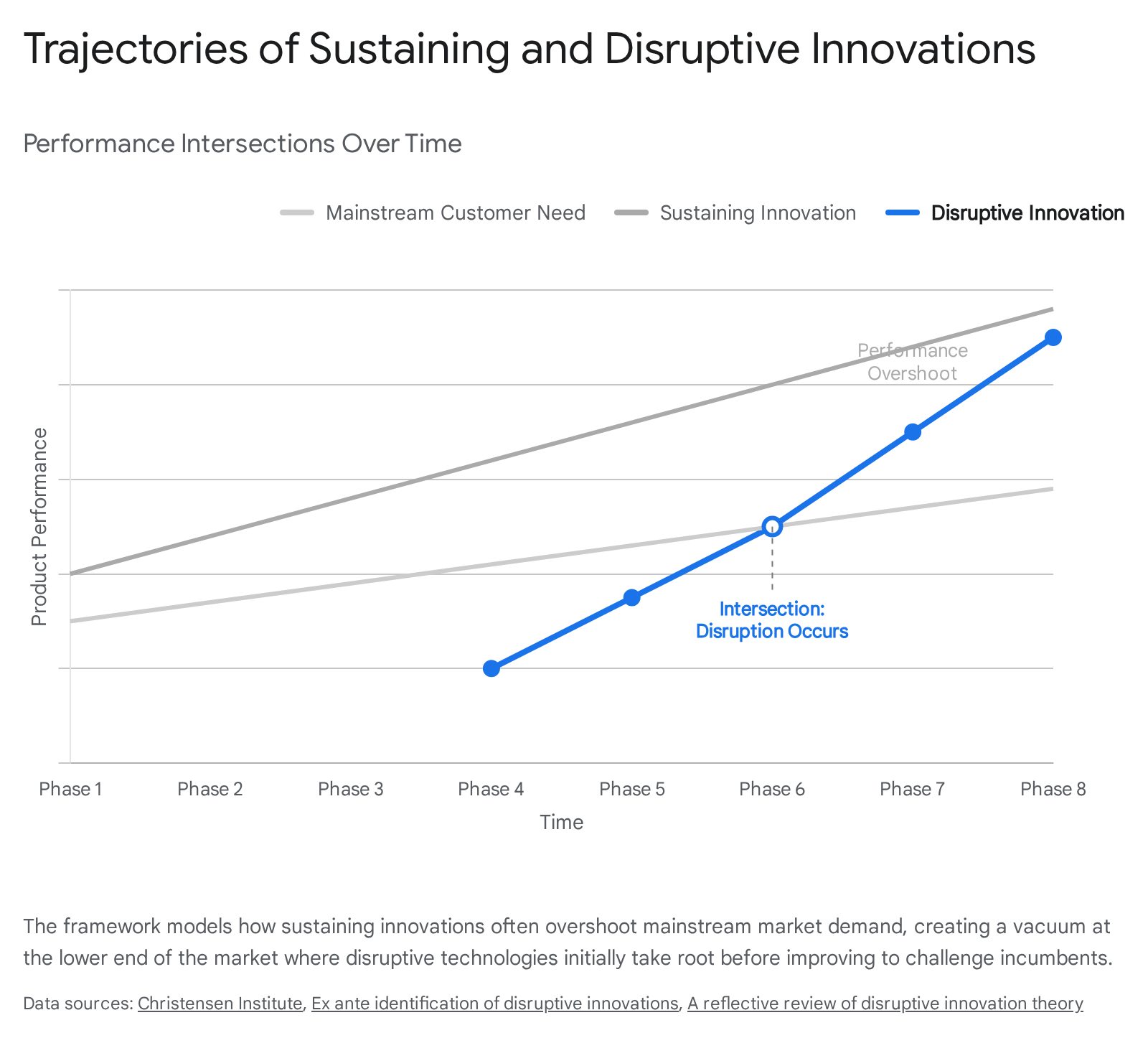
The theory broadly classifies disruptions into two primary types: low-end market disruptions and new-market disruptions. Low-end disruptions occur when a low-cost business model enters the bottom of an existing market, claiming a segment that incumbents are happy to abandon due to exceptionally low profit margins 57. New-market disruptions, conversely, create an entirely new segment by targeting non-consumption, appealing to an audience that previously lacked the financial resources or technical skill to participate in the market 567.
While the theory achieved ubiquitous acceptance among corporate executives, consultants, and venture capitalists, it has faced sustained and rigorous criticism from academic researchers across the disciplines of management, economics, and history. Scholars have challenged its empirical validity, its methodological rigor, and its predictive capacity. Decades of subsequent research have exposed definitional ambiguities, survivorship biases, and a reliance on historical case studies that are increasingly viewed as incomplete or flawed.
Methodological Weaknesses and Conceptual Ambiguity
A primary thread of criticism directed at disruptive innovation theory concerns its methodological foundations. Critics argue that the theory suffers from fundamental flaws in how evidence was collected, selected, and analyzed to form its core tenets. This academic scrutiny suggests that the theory functions better as a descriptive narrative than as a rigorous scientific model.
The Ex Ante Identification Problem
A consistent critique from strategy and management scholars focuses on the theory's inability to identify disruptive innovations ex ante, meaning prior to the actual disruption occurring in the marketplace. Scholars such as Erwin Danneels and Gerard Tellis have argued that the theory is heavily reliant on ex post rationale, where disruptiveness is only definitively diagnosed once a new technology has successfully toppled an incumbent 111214. Danneels noted that without explicit, predictive criteria that can be measured before a disruption occurs, the theory loses much of its practical utility for managers 11.
Forecasting what performance levels emerging technologies will achieve, and predicting the exact trajectory of market performance demands across various dimensions, remains a highly speculative endeavor 12. If disruptiveness can only be verified retroactively, the theory risks becoming tautological: successful market entrants are labeled disruptors, and their success is attributed to their disruptiveness, while failed low-end entrants are simply ignored or categorized as non-disruptive. Christensen refuted this assertion, maintaining that disruption is a process rather than an event, yet the lack of a standardized predictive measure continues to trouble researchers 12.
Sampling on the Dependent Variable
Closely related to the ex post identification problem is the accusation that Christensen's foundational research suffered from severe selection bias. Danneels and Costas Markides both critiqued the methodology of selecting predominantly successful cases of disruption to build the theory, a practice known in academic research design as "sampling on the dependent variable" 211.
By failing to systematically examine unsuccessful or aborted technologies that possessed all the theoretical hallmarks of a disruptive innovation but failed to materialize into market success, the theory ignores the high base rate of failure among low-end entrants 2. This selective inclusion undermines the framework's generalizability and credibility, as it presents an incomplete spectrum of innovation outcomes. It creates an illusion of inevitability, suggesting that any entrant meeting the criteria of disruption will triumph over an incumbent, despite historical realities showing that many promising low-end technologies simply collapse 15.
The Challenge of Defining a Unit of Measure
Although defining a clear unit of measure is instrumental to building robust management theory, disruptive innovation theory has historically struggled with this foundational requirement. Critics have pointed out that foundational work on the topic appears to shift fluidly between different units of analysis depending on the context of the argument 216.
In some iterations, the unit of analysis is the broader market or the technological ecosystem. In others, the focus narrows to the specific organization, the managerial agency of executives, or the business model itself 2. This semantic ambiguity makes it exceedingly difficult for subsequent researchers to test the theory quantitatively or to establish clear boundaries separating disruptive innovations from other forms of market turbulence.
Taxonomy of Innovation Types
A further theoretical limitation highlighted by scholars is the simplistic binary classification of innovations as either "sustaining" or "disruptive." Critics argue that this dichotomy forces highly complex market dynamics into an overly restrictive framework that fails to account for the multidimensional nature of technological progress 2.
Costas Markides (2006) became a prominent voice in this debate, asserting that while Christensen bundled various forms of innovation under the single umbrella of "disruptive innovation," these phenomena behave fundamentally differently and require disparate managerial responses 1718. Markides proposed that innovations should be separated into distinct categories to avoid confusing the mechanisms of market change. By treating business-model innovations and technological innovations identically, the original theory risks prescribing the wrong strategic remedies to incumbent firms facing challenges.
| Innovation Classification | Primary Mechanism of Change | Strategic Impact | Example Application |
|---|---|---|---|
| Sustaining Innovation | Improves existing product performance along traditional, historically valued metrics. | Maintains the competitive status quo; favors established incumbents. | A faster microprocessor; a higher-resolution camera. |
| Technological Disruption | Introduces a new technological paradigm that initially underperforms but ultimately displaces the old. | Destroys incumbent technical competencies; requires acquiring new engineering capabilities. | Solid-state drives replacing mechanical hard disk drives. |
| Business-Model Disruption | Discovers a fundamentally different model to capture and deliver value within an existing industry. | Enlarges the economic pie and attracts new customers; requires organizational restructuring rather than just R&D. | Subscription-based streaming replacing retail video rentals. |
| New-to-the-World Radical | Creates an entirely new product category that cannot be measured against existing alternatives. | Establishes brand new markets and infrastructures without necessarily destroying legacy industries. | The initial invention of the airplane or the internet. |
As outlined in the comparison above, responding to a new business model necessitates entirely different capabilities and corporate structures than responding to a purely technological disruption 131718. A technological disruption might require a firm to invest heavily in new laboratory research, while a business-model disruption might require a complete overhaul of a company's pricing strategy, distribution channels, and sales incentives.
The Quantitative Rebuttal
The narrative that incumbents inevitably falter when faced with disruptive innovation has been subjected to rigorous empirical testing over the past decade, with results that heavily challenge the theory's universality. The most prominent empirical reassessment of the framework was conducted by Andrew A. King and Baljir Baatartogtokh in 2015 192021.
King and Baatartogtokh noted that Christensen and his co-authors had never conducted a quantitative, statistical study to test the predictive power of their own theory 20. To rectify this, the researchers evaluated the 77 specific historical case studies listed in Christensen's first two books. They surveyed approximately 80 academic experts with deep knowledge of these specific industries to determine if the historical record actually matched the theoretical framework 220.
The researchers tested the cases against four strict criteria dictated by disruptive innovation theory itself: 1. Incumbents in the market were actively improving along a trajectory of sustaining innovation. 2. The pace of this sustaining innovation was demonstrably outstripping mainstream customer needs (performance overshoot). 3. Incumbent firms possessed the capability to respond to the entrant but failed to exploit it due to existing profit incentives. 4. Incumbent firms ultimately faltered specifically because of the disruptive entry.
The findings severely undermined the empirical foundation of the theory. King and Baatartogtokh discovered that only seven of the 77 cases - a mere 9 percent - exhibited all four elements required by the theory 192223. The vast majority of the cases featured divergent outcomes or were driven by entirely different causal mechanisms 19. In many instances, the incumbents did not fail at all, or they failed for macroeconomic and internal management reasons entirely unrelated to overshooting customer needs or ignoring low-end entrants. This stark lack of confirmatory evidence led the authors to conclude that the complete theory of disruptive innovation is applicable only under highly specific conditions, and its sweeping predictions regarding incumbent failure are statistically unsupported 2324.
Historiographical Challenges: The Lepore Critique
The most prominent public intellectual challenge to disruptive innovation theory emerged in 2014, when Harvard historian Jill Lepore published a comprehensive and highly critical essay in The New Yorker titled "The Disruption Machine" 192525. Lepore attacked the theory on historiographic grounds, arguing that its core case studies relied on dubious sources, questionable logic, and severe confirmation bias 192526. Her dissection of the historical record struck at the very heart of the theory, demonstrating that the foundational narratives used to teach the innovator's dilemma were largely inaccurate.
The Disk Drive Industry Narrative
Christensen's original theory relied heavily on the hard disk drive industry, which he referred to as the "fruit flies of genetics" for business disruption due to the industry's rapid generations, observable mutations, and clear outcomes 2227. Christensen argued that as drive sizes shrank from 14-inch mainframe drives to 8-inch minicomputer drives, and subsequently to 5.25-inch desktop and 3.5-inch laptop formats, each generational shift was led by a new entrant firm. Meanwhile, the incumbents, purportedly tied to the high-margin demands of their existing customers, perished at each transition 828.
Lepore's historiographic analysis dismantled this narrative. She demonstrated that companies like Seagate Technology, which Christensen explicitly cited as a victim of disruption during the transition to 3.5-inch drives, actually remained dominant, thriving market leaders long after the publication of The Innovator's Dilemma 226. Seagate had not been destroyed by entrants; rather, it had successfully navigated the transition. Furthermore, firms like Western Digital successfully adapted to new architectures and regained market dominance after initially ceding ground, completely contradicting the assertion that disruptive newcomers invariably terminate incumbents 2.
The Steel Minimill Narrative
Similarly, Lepore scrutinized the case of the steel minimills, which Christensen frequently utilized in lectures and literature to illustrate low-end disruption. According to the theory, massive integrated steelmakers produced all grades of steel and averaged out their margins 9. Minimills emerged using cheap scrap metal in electric ovens to produce low-quality rebar, a low-margin product that the integrated mills were happy to cede 929. Gradually, the minimills improved their technical capabilities to produce higher-margin structural steel and eventually sheet steel, ultimately driving the integrated mills out of business in a classic disruption cycle marked by price collapses in 1979 and 1996 83032.
Lepore argued that this analysis was structurally flawed because it entirely omitted the immense impact of labor strife. She asserted that Christensen's analysis of the steel industry failed to take into account the effects of union dynamics, massive labor strikes, and macroeconomic shifts in global trade that critically wounded the integrated steel companies during the same era 2531. By isolating a single technological variable - the electric arc furnace of the minimill - the theory ignored the broader historical context and complex socio-economic realities of the industry's collapse.
The Mechanical Excavator Narrative
Another foundational case in the disruption canon is the mechanical excavator industry, where hydraulic excavators supposedly disrupted cable-operated steam shovels. According to the theoretical narrative, established cable-shovel manufacturers listened carefully to their mining and general contracting customers, who required massive bucket capacities. Consequently, they ignored early hydraulic technology because it was weak and limited to small buckets 3432. Hydraulic entrants found a new market among residential sewer contractors who needed small, maneuverable machines to dig narrow trenches. Between 1955 and 1974, hydraulic bucket capacities expanded from 3/8 of a cubic yard to 10 cubic yards, allowing the technology to scale up and destroy the cable shovel incumbents 3432.
Lepore and subsequent researchers pointed out fatal empirical inconsistencies in this narrative as well. The leading incumbent in the steam/cable shovel era, Bucyrus, did not blindly ignore the transition. They attempted hybrid models and remained a massive, successful corporate entity, not a victim of total disruption 232. More broadly, established firms like Caterpillar and John Deere, which Christensen categorized as agile entrants in the hydraulic space, were actually well-established, massively resourced incumbents in adjacent agricultural and heavy machinery markets. Their success was not that of a scrappy startup utilizing a low-end foothold, but rather an adjacent incumbent leveraging massive corporate scale and existing manufacturing expertise to enter a new product category 34.
Predictive Failures and Strategic Responses
The ultimate test of any strategic or economic theory is its predictive power, an area where disruptive innovation theory has suffered highly publicized failures. The most heavily cited predictive failure was Christensen's assessment of the Apple iPhone.
The iPhone Anomaly
In 2007, operating strictly within the parameters of his established theory, Christensen predicted the iPhone would fail 2233. According to the theoretical model, the iPhone was not a low-end disruption; it was an expensive, premium product launching into an established mobile phone market against entrenched, highly capitalized incumbents like Nokia and Motorola 1622. Because Apple was executing a sustaining innovation - building a better, higher-priced phone with superior features - the theory predicted that the incumbents, highly motivated to defend their profitable market, would easily defeat the newcomer 3133.
Instead, the iPhone became arguably the most successful and profitable consumer product in history, completely dismantling the incumbent mobile phone industry and destroying the market dominance of firms like Nokia and BlackBerry 1622. Christensen later spent years attempting to resolve this anomaly post hoc, eventually adjusting his analysis to claim that the iPhone was actually disruptive not to mobile phones, but to the personal computer market, acting as a low-end laptop alternative 2031. Critics point to this retroactive reclassification as evidence of the theory's structural malleability. If a framework can be adjusted after the fact to explain any market outcome, its value as a forward-looking predictive tool for executives is severely compromised 2025.
Incumbent Resilience and Dynamic Capabilities
A crucial flaw identified in the empirical record is the theory's severe underestimation of incumbent resilience. The framework assumes a fatalistic trajectory where established companies are inexorably trapped by their value networks, rendering them paralyzed and systematically destined to ignore challengers until it is too late 101432.
However, management literature on "dynamic capabilities" demonstrates that incumbents frequently engage in complex strategic responses that allow them to survive, adapt, and co-opt disruptive threats 2. Research indicates that incumbent firms are significantly less likely to exit the market when faced with disruptive competition than the theory predicts 2. They often utilize their vast financial resources, complementary assets, brand equity, and regulatory influence to neutralize challengers 216. Furthermore, incumbents routinely acquire disruptive startups, integrating the new technology into their existing portfolios. The theory has been critiqued for oversimplifying these strategic contingencies, presenting a deterministic view of market evolution that ignores the agency, strategic foresight, and adaptive capacity of established organizations 2.
Misapplication Beyond Corporate Spheres
Beyond factual historical disputes, scholars have offered a profound cultural critique regarding the indiscriminate application of the "gospel of innovation." Critics argue that the framework, forged in the context of industrial manufacturing, disk drives, and mechanical excavators, has been dangerously misapplied to public institutions, higher education, healthcare, and journalism 2538.
Institutions such as universities, hospitals, and newsrooms are not driven solely by the profit-maximizing value networks and fiduciary duties described in Christensen's framework 3834. Their operational goals involve civic duty, the pursuit of knowledge, public service, and the maintenance of societal health. Lepore argued that attempting to map a theory of corporate failure onto the administration of public goods results in destructive public policy that treats complex social services as stale technologies waiting to be displaced 3840. She diagnosed the cultural obsession with disruption as an artifact of history - a comforting fable that provides an atavistic explanation for financial collapse and rapid economic anxiety, rather than a universal law of nature 202538.
This misapplication is particularly evident in global development discourse. Lant Pritchett, a scholar of international development, noted that the term is frequently thrown around in policy discussions regarding education system reform in developing nations 35. Often, policymakers use "disruptive innovation" as a buzzword to justify providing second-class, technology-heavy but pedagogically inferior educational solutions to marginalized populations, fundamentally misunderstanding that true educational improvement requires deep institutional capacity building rather than mere technological displacement 35.
Contemporary Theoretical Controversies
In response to decades of critique, the academic discourse surrounding disruptive innovation has entered a phase of intensive recalibration. A 2024 analysis published by Cambridge Judge Business School scholar Shahzad Ansari and colleagues synthesized the ongoing debates into six core controversies that continue to challenge the theory's validity 16.
The Cambridge research suggests that while previous critiques sought to polish and perfect the theory, these six controversies pose fundamental challenges to its core tenets and could potentially invalidate its traditional application 2.
| Controversy | Academic Critique | Impact on Theory |
|---|---|---|
| Definitions | Lack of scholarly consensus on the precise meaning of disruption. Christensen himself questioned the prefix "disruptive." | Creates semantic confusion; enables practitioners to mislabel any generic market threat as a "disruption." |
| Case Studies | Over-reliance on a narrow set of historical case studies that obscure the frequency of incumbent recovery and survival. | Severely limits the ability to develop generalizable, universal theories of market behavior. |
| Generalizability | The theory breaks down when applied outside highly specific manufacturing contexts (e.g., the iPhone anomaly). | Proves that not all disruptions involve cheaper, inferior technology finding footholds in underserved markets. |
| Unit of Measure | Foundational work shifts erratically between the market, the firm, and the business model as the unit of analysis. | Prevents rigorous quantitative testing and standardization across academic disciplines. |
| Outcome Bias | "Incumbent survivor bias" focuses only on fallen giants. "Pro-innovation bias" assumes all disruption is inherently positive. | Distorts broader societal issues, ignoring the negative externalities of disruption (e.g., job losses, misinformation). |
| Nature of Theory | Debate over whether the theory has true predictive power, or if it is merely a "performative" blueprint used to generate hype. | Suggests the theory functions as a rhetorical tool for startups to attract venture capital rather than a scientific law. |
To address these controversies, contemporary scholars advocate moving away from the fatalistic, incumbent-centric focus of the original theory. Ansari's research proposes a "challenger-incumbent perspective" that acknowledges the agency of both actors within a broader ecosystem, recognizing that incumbents can successfully adapt and that challengers do not operate in a vacuum 1636.
Alternative Frameworks and Global Perspectives
As the limitations of disruptive innovation theory have become apparent, particularly outside the highly specific context of Silicon Valley technology startups and Western manufacturing, scholars have developed alternative frameworks. These models address the theory's Western-centric bias and its rigid assumption that innovation must inherently destroy and displace incumbent organizations.
Frugal and Reverse Innovation in the Global South
Much of the foundational literature on disruptive innovation relies on industrialized, Western market dynamics where there is intense competition for high-end consumers 37. Scholars focusing on the Global South, Africa, India, and Latin America have introduced the concept of "frugal innovation" as a parallel, and often more relevant, framework for understanding technological change in developing economies 383940.
Frugal innovation refers to the practice of developing products that strip out unnecessary features to create extreme cost advantages, specifically designed for resource-constrained environments and the "bottom of the pyramid" (BOP) demographic 74142. These innovations prioritize extreme affordability, durability in harsh conditions, and simplicity over aesthetic design or high performance 38. Examples include India's Mitticool clay refrigerator, which uses evaporation to keep food cold without electricity, or GE's MAC 400 portable ECG machine, designed to be battery-operated and highly affordable for rural clinics 74042. Another example is the Aakash tablet, a low-cost computing device aimed at students in India 49.
While frugal innovations share the disruptive characteristic of being low-cost and targeting underserved consumers, academic comparisons reveal profound divergences from Christensen's model:
- Lack of Displacement: Disruptive innovation theory requires the destruction of an incumbent's market share. However, frugal innovations often serve populations that previously relied on complete non-consumption. Because they operate in vast institutional voids, they frequently do not challenge or displace any incumbent. They simply create new localized value without the "destructive" element of disruption 74943.
- Intentional Resource Constraint: Frugal innovation is a design philosophy born of material scarcity (often referred to as jugaad or bricolage in academic literature), whereas disruptive innovation is a deliberate market-entry strategy usually executed by well-funded startups seeking eventual upward mobility to achieve massive financial returns 4144.
- Trajectory Limitations: The mathematical core of disruptive innovation is that the technology relentlessly moves upmarket to eventually rival high-end products. Conversely, frugal innovations often remain securely in the low-income segment. If manufacturers attempt to add high-end features to a frugal product, they lose their frugal nature and critical pricing advantage, meaning they rarely topple premium incumbents 49.
Furthermore, the phenomenon of "reverse innovation" - where a frugal product developed in a developing nation (such as the MAC 400 ECG) is later exported back to a developed market to serve cost-conscious consumers - highlights complex global innovation flows that Christensen's original value-network framework did not accommodate 384142.
Blue Ocean Strategy vs. Disruptive Innovation
Another prominent alternative in the strategic management literature is the Blue Ocean Strategy, introduced by W. Chan Kim and Renée Mauborgne 4546. While often conflated with disruptive innovation in popular business discourse, the academic literature sharply distinguishes the two concepts.
Disruptive innovation relies fundamentally on creative destruction; it involves a challenger entering an established market and violently displacing an enduring market leader by altering the performance metrics of competition 4654. It is inherently a combative, displacement-oriented theory focused on stealing market share from below.
Conversely, Blue Ocean Strategy focuses on non-destructive creation. It urges firms to create entirely new, uncontested market spaces ("blue oceans") by redefining the industry problem itself, thereby rendering competition irrelevant without necessarily destroying existing legacy systems or triggering a fatal reaction from incumbents 4647. Where disruption implies an eventual zero-sum intersection of technological trajectories, blue ocean strategy emphasizes "value innovation" that explicitly breaks the value-cost trade-off, expanding total market demand and creating new economic pies rather than fighting over existing ones 4654.
To clearly delineate the differences between Christensen's theory and these prominent alternatives, the following comparison highlights their distinct mechanisms, target markets, and impacts on incumbents.
| Theoretical Framework | Primary Mechanism | Target Market | Impact on Incumbents | Origin Context |
|---|---|---|---|---|
| Disruptive Innovation | A cheaper, initially inferior technology relentlessly moves upmarket, changing performance metrics. | Low-end segments or new markets (non-consumers). | Displaces and destroys established incumbents through market encroachment. | Highly industrialized Western markets (e.g., Disk drives, US steel). |
| Frugal Innovation | Extreme simplification and resource reduction to overcome severe financial and infrastructural constraints. | "Bottom of the pyramid" (BOP) in emerging economies. | Often zero displacement; serves markets where incumbents are entirely absent. | Resource-constrained environments (India, Africa, Latin America). |
| Blue Ocean Strategy | Value innovation that simultaneously pursues differentiation and low cost by redefining the problem. | Completely new, uncontested market space. | Renders competition irrelevant; emphasizes non-destructive creation. | Broad strategic management application. |
Conclusion
Disruptive innovation theory fundamentally altered the lexicon of business strategy, providing a compelling, intuitive explanation for the vulnerability of massive industry giants. However, three decades of rigorous academic scrutiny have revealed substantial empirical, methodological, and conceptual limitations within the framework. Scholars like Jill Lepore have successfully deconstructed the historical case studies upon which the theory was built, demonstrating that many "disrupted" incumbents actually survived and prospered, while highlighting the danger of indiscriminately applying corporate survival frameworks to civic institutions, education, and healthcare.
Quantitative reassessments, most notably by King and Baatartogtokh, confirm that the strict mechanics of the theory apply to only a minute fraction of real-world innovations. Furthermore, theoretical challenges from scholars like Danneels and Markides expose the framework's reliance on hindsight bias, its conflation of technological and business-model changes, and its failure to provide robust predictive criteria for executives.
As global paradigms like frugal innovation and Blue Ocean Strategy demonstrate, innovation is not exclusively a process of incumbent destruction driven by low-end technological encroachment. Moving forward, the strategic management field is shifting away from the deterministic "disrupt or be disrupted" narrative. Contemporary scholarship embraces a more nuanced understanding of dynamic capabilities, incumbent resilience, the reality of non-destructive creation, and the highly varied ecosystem of technological change across different global contexts.