
Complexity theory and linear disruptive innovation models
The study of disruptive innovation has long been dominated by deterministic models that trace the displacement of established firms by agile entrants. Rooted in the foundational research of the 1990s, these traditional frameworks established a linear, highly predictable trajectory of market evolution. However, the modern business landscape - characterized by hyper-connectivity, rapid technological shifts, and globalized networks - increasingly defies these linear expectations. In response, organizational scientists and strategic management researchers have increasingly turned to complexity theory to understand the unpredictable, non-linear dynamics of modern market disruptions. Originating in the natural sciences to explain phenomena ranging from ecosystems to neural networks, complexity theory posits that markets are complex adaptive systems. This paradigm shift challenges the core assumptions of traditional disruptive innovation models, fundamentally altering the way researchers analyze causality, market entry, technological trajectories, and strategic response.
The Traditional Disruptive Innovation Framework
To understand the critique leveled by complexity theory, it is first necessary to establish the structural mechanics and assumptions of traditional disruptive innovation theory. Popularized by Clayton Christensen and his collaborators, the traditional model explains how well-managed incumbent firms fail not due to incompetence, but because of a rational adherence to customer demands and margin preservation 123. The framework has profoundly influenced corporate strategy over the past quarter-century, offering a structured lens through which to view market transitions.
Origins and Linear Mechanics
The theory of disruptive innovation posits that market leaders frequently collapse because they listen too closely to their best customers, investing heavily in sustaining innovations that improve existing products 12. These sustaining innovations move along performance dimensions that mainstream customers already value, allowing incumbents to maintain attractive profit margins 145. However, this relentless pursuit of high-margin, high-performance optimization creates a structural blind spot at the bottom of the market, leaving the incumbent vulnerable to disruption 16.
The traditional model assumes a highly linear and sequential market trajectory. An entrant establishes a foothold with a product that initially underperforms on traditional metrics but excels in alternative dimensions, such as affordability, convenience, or simplicity 178. Because incumbents are motivated to pursue higher-margin opportunities by moving upmarket, they willingly cede these less profitable segments to the entrant 149. The core assumption is that disruption is a product-centric or firm-centric phenomenon, where a single entrant systematically dismantles an incumbent's market share through asymmetric resource allocation and predictable technological refinement 3910.
Market Entry Footholds
The classical disruption framework meticulously categorizes market entry into two primary pathways: low-end footholds and new-market footholds 146. In a low-end disruption, the entrant targets "overserved" customers who do not require or cannot afford the advanced features of the incumbent's sustaining innovations 16. The entrant provides a "good enough" product at a significantly lower cost, establishing a viable business model at the bottom of the existing market 14.
Conversely, new-market disruption occurs when an entrant targets non-consumers - populations that previously lacked the money, skills, or access to utilize the product 14. By offering a simplified, accessible alternative, the entrant creates a completely new value network, essentially competing against non-consumption 1611. In both scenarios, the theory dictates that once the entrant secures its foothold, it will relentlessly improve its offerings, migrating upward to capture mainstream customers and eventually displacing the incumbent 2412.
The S-Curve Trajectory
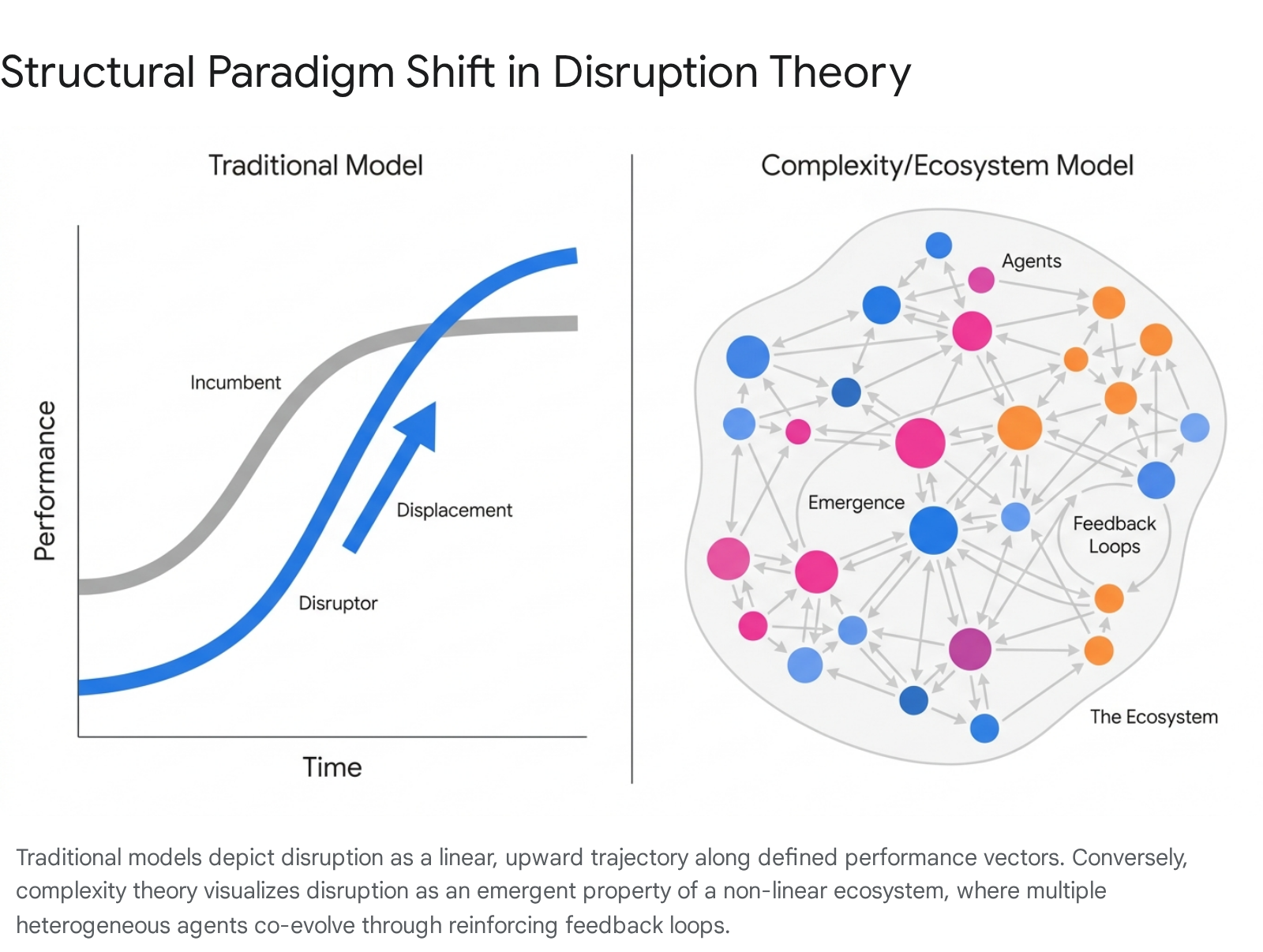
A foundational component of this traditional view is the reliance on the S-curve of technological evolution and adoption. The S-curve models innovation as a slow initial phase of development, followed by rapid, exponential growth as the technology achieves scale and market acceptance, and concluding with a plateau as the technology reaches its physical, architectural, or economic limits 131415.
Traditional frameworks utilize stacked S-curves to illustrate how industries evolve. As an incumbent technology matures and its curve flattens, a disruptive technology emerges on a nascent, overlapping curve 1415. Initially, the new S-curve operates at a lower performance level, but its steeper trajectory of improvement eventually allows it to cross the threshold of mainstream market requirements, overtaking the incumbent standard 1415. This geometric representation has historically endowed the theory with substantial explanatory power, leading many to view disruption as a predictable, clockwork mechanism governing industrial cycles 1316.
Critiques of the Traditional Model
Despite its widespread adoption, the traditional theory of disruptive innovation has faced significant academic scrutiny. As digital platforms and networked economies have grown in prominence, scholars have identified critical limitations in the theory's deterministic mechanics, arguing that it oversimplifies the messy, multi-dimensional reality of market evolution 31017.
Definitional Ambiguity and Scope Limitations
A persistent critique of traditional disruption theory is its definitional ambiguity. The term "disruptive" has frequently been co-opted in popular business discourse to describe any successful startup, radical technological breakthrough, or rapid market shift, regardless of whether it fits the strict criteria of low-end or new-market entry 146. This dilution has prompted scholars to point out that the theory's original scope was relatively narrow, focusing predominantly on technological attributes and product performance metrics 310.
By maintaining a narrow focus on product technology and market tiers, the traditional model often obscures other critical variables that play an existential role in the emergence of innovations 310. Factors such as socio-political dynamics, regulatory shifts, macro-economic conditions, and institutional environments are frequently treated as exogenous background noise rather than active drivers of disruption 31018. For example, the trajectory of blockchain technology or 3D printing cannot be understood purely through the lens of a low-end product moving upmarket; their adoption is heavily mediated by regulatory frameworks, distributed networks, and entirely novel business model paradigms 10.
The Predictive Utility Controversy
Perhaps the most fiercely debated aspect of traditional disruption theory is its predictive utility. Executives and analysts have long attempted to use the framework ex-ante to predict which startups will successfully topple incumbents 317. However, extensive empirical reviews have challenged this application. Critics argue that incumbents are frequently ill-equipped to identify disruptive threats, unable to make sense of them even when they do, and incapable of reacting in a timely manner due to institutional inertia 17.
Furthermore, empirical testing has shown that the strict low-end/upmarket trajectory fails to predict outcomes reliably across diverse industries 101719. In response to these critiques, some scholars have pivoted the discussion toward a performative perspective. They suggest that the true value of disruptive innovation theory lies not in its ability to generate accurate quantitative predictions, but in its "performativity" - serving as an actionable blueprint or cognitive framework that helps visionary leaders structure their strategic thinking and initiate innovation journeys 310.
Strategic Response Oversimplifications
The traditional model has also been critiqued for oversimplifying the strategic choices available to both incumbents and challengers 310. Early iterations of the theory broadly prescribed that incumbents facing disruption should spin out autonomous, independent business units to pursue the new technology, thereby shielding the nascent project from the parent company's margin requirements and organizational antibodies 2920.
While this linear isolation strategy proved effective in traditional manufacturing and hardware sectors (such as disk drives or mini-mills), it often fails in contemporary digital markets. Establishing an insulated internal unit ignores the complex web of external partnerships, data sharing, and network effects required to compete in modern ecosystems 2021. As researchers increasingly map the failures of these linear responses, the demand for a more holistic, systems-level understanding of innovation has grown, setting the stage for the integration of complexity theory.
Principles of Complex Adaptive Systems
The emergence of complexity theory in organizational studies directly challenges the mechanistic assumptions of the traditional disruption framework. Institutions such as the Santa Fe Institute have formalized complexity science as the study of systems comprising large numbers of non-linearly interacting components that self-organize into structures not pre-programmed into the components themselves 2223. When applied to strategic management, markets and organizations are reconceptualized as complex adaptive systems.
Defining Complexity in Organizational Science
Complexity theory draws from research in the natural sciences - such as evolutionary biology, statistical physics, and non-linear dynamics - to examine uncertainty, adaptation, and systemic change 2425. In the context of organizational science, firms are not viewed as static, isolated entities processing inputs into outputs, but as dynamic networks of interactions nested within larger socio-economic ecosystems 242627.
The application of complex adaptive systems to business suggests that organizational environments are in a state of perpetual co-evolution 2427. Firms act as heterogeneous agents that continuously adjust their behaviors based on the actions of competitors, consumers, and regulators. Because these agents are tightly interconnected, a change initiated by one agent reverberates throughout the entire system, rendering the long-term prediction of market trajectories nearly impossible using traditional linear extrapolation techniques 2228.
Complicated Systems Versus Complex Systems
To fully grasp the paradigm shift introduced by complexity theory, it is essential to delineate the difference between "complicated" and "complex" systems - a distinction that is well accepted in scientific communities but frequently misunderstood in business management 293030. Traditional disruptive innovation frameworks implicitly treat markets as complicated systems 3030.
A complicated system, such as a jet engine or an accounting procedure, features a massive number of components, but the relationships between those components are linear, fixed, and ultimately knowable 2930. Complicated systems can be decomposed; an expert can analyze the individual parts, deduce the rules governing their interaction, and accurately predict the system's output 293031. In complicated environments, problems can be permanently solved through rigorous engineering and optimization.
Conversely, complex systems - such as global financial markets, weather patterns, or innovation ecosystems - cannot be understood by analyzing their isolated parts 3031. The components in a complex system are interdependent and adaptive; they change one another through interaction 29. Consequently, complex systems are irreducible, and their outcomes are governed by probabilities and emerging patterns rather than rigid, deterministic rules 303031.
| Attribute | Complicated Systems | Complex Systems |
|---|---|---|
| Causality | Linear cause-and-effect relationships 2829. | Non-linear, configurational, and highly interdependent 2932. |
| Predictability | Outcomes are proportional to inputs and highly predictable 2931. | Small inputs can have disproportionate, unpredictable effects 2931. |
| Analysis Method | Reductionist: Can be decomposed and understood piecemeal 2930. | Holistic: Must be understood through interaction and observation 2930. |
| Nature of Change | Requires an external force or predetermined recipe for change 2930. | Self-organizing, adaptive, and continuously evolving 2930. |
| Problem Solving | Problems can be permanently solved with "best practices" 2930. | Problems require nuanced management, experimentation, and adaptation 2930. |
Core Mechanics of Complex Adaptive Systems
Complex adaptive systems operate via specific structural mechanics that differentiate them from the mechanistic environments envisioned by traditional strategic frameworks:
- Heterogeneous Agents: Systems consist of diverse actors (e.g., competing firms, diverse consumer segments, regulatory bodies, and automated algorithms) that operate based on localized rules and heuristics rather than centralized control 2233.
- Non-Linearity: Unlike complicated systems where inputs scale proportionally, complex systems exhibit sensitive dependence on initial conditions. Small, seemingly localized perturbations can produce disproportionately massive, system-wide effects 223435.
- Feedback Loops: Adaptation is driven by continuous reinforcing (positive) and balancing (negative) feedback loops. Reinforcing loops amplify deviations and accelerate adoption, while balancing loops constrain growth and maintain temporary stability 2235.
- Self-Organization: Order and structure emerge organically from the localized interactions of agents, without the need for a master blueprint or central coordinator 222435.
Emergence and the Edge of Chaos
The most fundamental property of a complex adaptive system is emergence: the appearance of novel behaviors, macro-structures, or systemic properties that are not present in, and cannot be predicted by, the individual components 22303436. In an innovation context, emergence suggests that a market disruption is not merely a cheap product climbing a performance curve; it is a systemic phase transition where the entire architecture of the market shifts 2737.
Organizational ecologists posit that complex systems are most innovative when they operate "near the edge of chaos" - a delicate transitional zone situated between rigid, stagnant order and unmanageable disorder 243336. In this zone, organizations maintain enough stability to function but possess sufficient flexibility and decentralization to foster creativity, agile adaptation, and radical innovation 243336. When traditional management attempts to impose rigid control and complicated, rule-based thinking upon a complex market operating near the edge of chaos, they frequently stifle the very adaptability required to survive disruption 3038.
Reconceptualizing Disruption Through Complexity
By applying the principles of complex adaptive systems, the foundational assumptions of traditional disruptive innovation theory undergo a radical transformation. The focus shifts from isolated products to interconnected networks, and from linear trajectories to unpredictable, emergent phenomena.
Innovation Ecosystems as the Unit of Analysis
Traditional models isolate the innovator and the incumbent, conceptualizing disruption as a bilateral conflict over a specific customer segment operating in a vacuum 310. Complexity theory challenges this firm-centric view by elevating the "innovation ecosystem" as the primary unit of analysis 26394140.
Innovation ecosystems are diverse networks of collaborative and competitive actors - including startups, academic research institutions, risk capital providers, regulatory bodies, and community stakeholders - that interact to co-create and capture value 264341. From a complexity perspective, a firm cannot disrupt an industry solely through superior product iteration; the success of an innovation depends fundamentally on the simultaneous presence and alignment of these interdependent ecological factors 4342. Innovation policies and corporate strategies that assume a linear causality - e.g., "build a technology product, and disruption will follow" - routinely fail because they ignore the requisite networking, cultural readiness, and institutional capital that sustain complex ecosystems 4342.
Network Effects and Non-Linear Adoption
In highly networked, digital markets, the dynamics of disruption diverge sharply from the gradual S-curves of hardware manufacturing. Complexity theory highlights the preeminence of network effects, where the inherent value of a platform or service increases exponentially as more nodes (users, developers, or complementary service providers) join the system 2039.
The traditional linear model fails to adequately map these dynamics. In a network-driven market, an innovation does not simply crawl upmarket by incrementally improving product specifications; it rapidly consumes the market laterally through preferential attachment and viral scaling 2042. Once a critical mass of network effects is achieved, the speed of adoption is vastly accelerated. Consumers gravitate rapidly toward the dominant network, creating winner-take-all dynamics that leave incumbents with significantly less time to formulate a strategic response 920.
| Disruption Characteristic | Traditional Linear Model | Network-Based Complexity Model |
|---|---|---|
| Core Value Driver | Standalone product performance and lower price 12. | Ecosystem connectivity, data, and network effects 2039. |
| Speed of Threat | Gradual upward migration; incumbents have time to react 46. | Rapid, non-linear tipping points; swift market capture 20. |
| Market Identification | Niche, low-end markets are often ignored because they seem small 120. | Niches become rapidly visible due to mass network adoption 20. |
| Incumbent Response | Spin out a separate, insulated business unit 220. | Acquire the disruptor to preserve existing network effects 20. |
The Innovation Butterfly and Path Dependence
In replacing the linear S-curve with the framework of complex networks, researchers point to the mechanism of the "innovation butterfly" - a concept directly derived from chaos theory's butterfly effect 43. The innovation butterfly illustrates that because innovation systems are constructed from vast numbers of elements interacting via non-linear feedback loops with embedded delays, minor perturbations can alter the fate of an entire industry 43.
A seemingly insignificant decision made by a startup, an unexpected spike in commodity prices, or a minor regulatory tweak can cascade through the system's feedback loops 43. When these interactions involve positive feedback loops, certain behaviors self-amplify rapidly, crowding out alternatives and steering the market down an irreversible trajectory 35. This dynamic inherently creates path dependence, where the future decision landscape is deeply constrained by historical events and initial conditions 3543.
Path dependence demonstrates why "quick fixes" or isolated interventions by incumbents frequently fail in complex ecosystems; self-reinforcing mechanisms lock industries into specific pathways, making switching costs prohibitive over time 43. The collapse of Nokia, for instance, provides a definitive case study of path-dependent failure, where early, heavy investments in the Symbian operating system created cognitive and institutional lock-in, rendering the firm unable to adapt to the emergent smartphone ecosystem despite possessing massive resources 43.
Configurational Causality and Equifinality
The epistemological core of complexity theory demands a fundamental reevaluation of how researchers deduce causality in innovation studies. Traditional management theories typically rely on a regular, linear model of causality: variable X (a low-cost business model) causes outcome Y (the disruption of the incumbent) 42844. Complexity science argues that causality in socio-technical systems is not isolated, but deeply contingent and configurational 283245.
In a complex market, causality is characterized by three key features: conjunction, equifinality, and asymmetry 3245. Conjunction dictates that outcomes result from the specific interplay of multiple conditions rather than a single dominant cause. Equifinality is the principle that multiple distinct paths or combinations of factors can lead to the exact same disruptive outcome 32. Asymmetry implies that variables causally linked in one configuration may be entirely unrelated, or even inversely related, in another context 32.
To capture this complexity, modern researchers are increasingly abandoning traditional linear regression models in favor of advanced analytical techniques. Methodologies such as Qualitative Comparative Analysis (QCA) are deployed to identify the various "recipes" of industry factors, structural conflicts, and technological enablers that contingently lead to digital disruption 3245. Additionally, the application of machine learning, such as Random Forest and gradient boosting algorithms, allows researchers to examine non-linear relationships and predictive validities that traditional models cannot adequately capture 4546. This shift underscores that while the mechanics of past disruptions can be understood retrospectively, formulating exact, linear predictions for future disruptions is an exercise in futility 2844.
Empirical Divergences from Linear Trajectories
The tension between linear assumptions and complex realities is not merely theoretical; it is highly visible in modern empirical case studies. Across global markets, technological and financial disruptions have increasingly circumvented the traditional rules of incumbent displacement.
Asian Platform Ecosystems and the Double Squeeze
According to the traditional disruptive framework, a new product invariably disrupts a market by starting at the bottom with a low-cost, simplified offering 1447. However, the rapid ascent of Asian super-apps fundamentally contradicts this core assumption. Ecosystems such as WeChat in China, Grab in Southeast Asia, and various platforms utilizing India's Unified Payments Interface (UPI) demonstrate non-linear disruption driven by platform bundling and hyper-connectivity 394849.
Rather than attacking a single product vertical from the low-end, these firms leverage open ecosystem architectures to execute a "Double Squeeze" on traditional financial incumbents 3949. By securing daily user engagement through a core, high-frequency service - such as messaging or ride-hailing - these platforms rapidly bundle high-margin financial, retail, and logistical services into a single, ubiquitous interface 4749.
This ecosystem strategy bypasses traditional evolutionary steps. These platforms capitalize on vast digital networks and proprietary data pools to systematically unbundle lucrative services from legacy banks, while leaving those incumbents burdened by the massive fixed costs of their physical branch infrastructure 49. This form of disruption frequently starts at the center or even the top of a market, offering premium convenience and seamless integration, and expands outward through cross-selling and application programming interface (API) partnerships 3947. It serves as a prime illustration of the co-evolution of technology and social networks predicted by complexity theory.
Technological Leapfrogging in African Markets
Similarly, the evolution of financial technology (fintech) in Africa highlights the concepts of path dependence and technological leapfrogging within complex adaptive systems 485051. Traditional linear development models assume a sequential evolution of infrastructure, suggesting that developing markets must gradually build and iterate upon the centralized banking norms of industrialized nations 5051. However, complexity theory reveals that systems with limited legacy infrastructure are highly susceptible to radical, systemic phase transitions 51.
In Africa, the lack of an entrenched, centralized banking grid provided a unique initial condition that prevented the technological "lock-in" effect seen in Western markets 5051. Innovations like Kenya's M-Pesa initiated a non-linear disruption by leveraging high mobile phone penetration to bypass traditional banking architecture entirely 485052. This initial perturbation triggered massive reinforcing feedback loops. As mobile money achieved ubiquity, a surrounding ecosystem of digital credit (e.g., Tala, Branch, Carbon), micro-insurance, and automated savings (e.g., Cowrywise) rapidly emerged to co-evolve alongside the payment rails 5056.
The result is a financial sector that did not linearly iterate on Western commercial banking models, but rather self-organized into an entirely novel, digital-first ecosystem projected to generate over $65 billion in revenue by 2030 5056. The African fintech landscape underscores how environmental context, dynamic interactions, and the absence of institutional inertia can generate sudden, emergent macro-structures that defy conventional S-curve analysis.
Top-Down Disruption and Lateral Expansion
Further challenging the traditional model is the emergence of "top-down" disruption. While Christensen's framework relies heavily on "good enough" technology entering from below, recent digital products have successfully disrupted markets by entering as premium, luxury, or high-performance options before scaling downward 47. Products such as Superhuman (in email) and early iterations of Uber (starting with premium black cars) entered at the top of the market and utilized strong network effects and bundling strategies to work their way down into mainstream dominance 547. When combined with the principles of complexity and network density, these case studies demonstrate that disruption is not strictly a low-end phenomenon, but a flexible, multi-directional process dictated by network connectivity and ecosystem leverage.
Strategic Management in Complex Environments
The application of complexity theory to innovation not only redefines how disruptions are analyzed but also demands a radical paradigm shift in how organizations strategically respond to them. The contemporary business era - often described by frameworks such as VUCA (Volatility, Uncertainty, Complexity, and Ambiguity) or BANI (Brittle, Anxious, Non-linear, Incomprehensible) - requires strategies that prioritize structural adaptability over rigid, long-term prediction 5354.
Dynamic Capabilities and Ecosystem Orchestration
Historically, the traditional linear response to disruption was defensive isolation. Incumbent firms were advised to create entirely separate, autonomous business units to pursue new technologies, supposedly protecting the innovation from the parent company's margin requirements and institutional sluggishness 2920. However, in a complex ecosystem governed by network effects, this isolation strategy is profoundly flawed. If an incumbent isolates an internal unit, that unit must build a consumer network entirely from scratch - a nearly impossible task if a disruptive entrant has already activated rapid, self-reinforcing network effects 20.
Instead, complexity-aware strategies advocate for the active orchestration of innovation ecosystems 2055. Rather than isolating internal efforts, incumbents are increasingly advised to acquire disruptive networks and integrate them, providing the entrant with vast corporate resources while carefully preserving the external network dynamics and brand associations 20. Furthermore, surviving in complex environments requires the cultivation of dynamic capabilities 5556. This involves leveraging digital technologies to enhance "digital sensing" - the continuous scanning of the market landscape to identify perturbations - and "supply chain meta-agility," which allows firms to rapidly reconfigure structural routines as the ecosystem mutates 5556.
Double-Loop Learning and Adaptive Strategy
The shift toward complexity demands that leadership move away from standard operational optimization to a deeper form of cognitive flexibility. Organizational learning theorists differentiate between single-loop learning and double-loop learning 57. Single-loop learning involves refining and optimizing existing strategies within established rules - essentially trying to make a complicated system run faster 57. While useful for sustaining innovations, single-loop learning fails in complex environments where the rules of the market are fundamentally shifting.
Double-loop learning, conversely, requires executives to utilize feedback loops to question the foundational assumptions, institutional norms, and underlying business models of the organization itself 57. Because complex systems operate near the edge of chaos, strategy must transition from rigid, multi-year planning to a process of continuous experimentation and evolutionary adaptation 212433. Management must recognize that deterministic strategic plans are inherently brittle when faced with the non-proportional impacts of an innovation butterfly 3554.
Overcoming the Linear Spin-Out Fallacy
To cope with this uncertainty, organizations must apply Ashby's Law of Requisite Variety. This cybernetic principle states that to successfully control or adapt to a complex environment, a system must possess an equal or greater amount of internal variety (or flexibility) than the environment it faces 38.
Many leaders fall into the trap of responding to environmental complexity by building highly complicated organizational structures - adding layers of bureaucracy, rigid compliance rules, and labyrinthine reporting matrices 38. This approach inevitably leads to systemic inefficiency and a failure to absorb external shocks. Instead, the correct application of Ashby's law requires organizations to increase their behavioral repertoire by decentralizing power, empowering heterogeneous agents (employees) to make localized decisions, and fostering a culture that embraces ambiguity 273338. By doing so, organizations shift from trying to control the uncontrollable to surfing the emergent waves of the ecosystem.
| Strategic Dimension | Linear Innovation Strategy | Complexity-Aware Innovation Strategy |
|---|---|---|
| Response to Disruption | Spin out an isolated, autonomous business unit 2920. | Orchestrate ecosystems, integrate, and acquire to maintain network effects 2055. |
| Organizational Learning | Single-loop: Optimize existing processes and metrics 57. | Double-loop: Question core assumptions and alter business models 57. |
| Handling Uncertainty | Attempt to reduce uncertainty through rigid, long-term planning 4354. | Embrace uncertainty through agile experimentation and digital sensing 4355. |
| Structural Approach | Respond to market shifts by creating complicated hierarchies 38. | Respond by building complex, decentralized, and highly adaptable networks 3338. |
Conclusion
The theoretical transition from traditional disruptive innovation models to complexity theory represents a profound maturation in the field of strategic management. While the linear frameworks established in the 1990s provided invaluable insight into the mechanics of asymmetric competition and incumbent inertia, they lack the topological nuance required to decode the hyper-connected, digital ecosystems of the 21st century. By embracing the principles of complex adaptive systems - heterogeneous agents, emergence, non-linear feedback loops, and configurational causality - researchers and executives can better understand how vast market shifts actualize.
The empirical realities of Asian super-apps and African fintech leapfrogging prove that disruption is rarely a sequential, predictable climb up an isolated performance curve. Instead, it is the emergent result of rapid network effects, path dependence, and the systemic unbundling of legacy architectures. Consequently, organizations must abandon the illusion of linear predictive control. Survival and competitive advantage in complex environments rely not on the isolation of internal innovative units, but on continuous double-loop learning, digital sensing, and the agile orchestration of expansive, co-evolving ecosystems.