
Contrast Effects in Consumer Pricing and Product Presentation
Introduction to Cognitive Contrast and Assimilation Mechanisms
In the evaluation of prices, product assortments, and service tiers, consumer decision-making relies on contextual information rather than absolute valuation. Humans inherently struggle to assign isolated numerical values to goods; instead, they depend on comparative heuristics to form judgments 12. This comparative processing is governed by two foundational cognitive biases: the assimilation effect and the contrast effect. The assimilation effect, or assimilation bias, occurs when an individual perceives a target stimulus as being closer to its contextual surroundings, effectively blending the stimulus into the background and minimizing discrepancies 2. Conversely, the contrast effect manifests when an individual evaluates a stimulus as being further apart from its surroundings, thereby magnifying the differences between the target and the context 2.
The cognitive architecture behind these evaluations dictates that prior expectations, alongside immediately present alternative options, establish internal reference points 3. These reference points act as mental anchors. When a new stimulus falls within a consumer's "zone of acceptance" - meaning the disparity between expectation and reality is minor and psychologically tolerable - the perception generally assimilates toward the reference point 4. However, if the disparity is significant and breaches this threshold of acceptance, the difference is cognitively exaggerated, resulting in a contrast effect 45. These mechanisms dictate how consumers react to physical product dimensions, digital subscription tiering, and real-time algorithmic pricing.
The contrast effect is heavily influenced by cognitive dissonance theory. When a discrepancy arises between a consumer's expectation and the actual performance or price of a product, the consumer seeks to resolve the tension 5. If the discrepancy is minimal, moral rationalization or cognitive decoupling allows the consumer to assimilate the information 6. If the discrepancy is large, the resulting contrast effect forces a reevaluation of the product's value, often leading to polarized purchasing behaviors 5.
Structural Formats of Contrast in Pricing Strategies
Marketers and product strategists manipulate choice architecture to deliberately invoke the contrast effect, shifting consumer reference points to favor specific purchasing outcomes. This is frequently achieved through comparative pricing, strategic tiering, and visual price framing.
To distinguish the precise operational mechanics of these psychological pricing strategies, the following table summarizes the distinct triggers and cognitive outputs of the contrast effect alongside related cognitive heuristics utilized in modern commerce.
| Cognitive Mechanism | Input Condition | Primary Cognitive Output | Commercial Application |
|---|---|---|---|
| Contrast Effect | Options are evaluated strictly relative to one another rather than in isolation. | Magnification of differences; a target seems vastly superior or inferior depending on adjacent context. | Presenting good-better-best subscription tiers; displaying luxury items next to standard items. 37 |
| Price Anchoring | Exposure to an initial numerical value or extreme price point prior to evaluation. | Subsequent prices are judged against the initial high/low benchmark, fundamentally altering perceived value. | Listing the most expensive menu item first; displaying an inflated manufacturer's suggested retail price (MSRP). 37 |
| Decoy Effect | Introduction of a third option that is asymmetrically dominated by a target option. | Simplification of choice; the target option appears undeniably logical, shifting preference away from competitors. | Subscription plans with a redundant middle option; three-tier software pricing models. 127 |
| Zero Price Effect | Highlighting a "free" benefit or service alongside a paid product. | An emotional positive response (affect heuristic) that disproportionately overvalues the "free" component. | Free shipping thresholds; "Buy One, Get One Free" promotional structures. 8 |
Price Anchoring and Strikethrough Pricing
Price anchoring establishes an initial reference point that shapes the consumer's perception of all subsequent prices. The human brain locks onto the first figure encountered; when a consumer views a premium product first, subsequent items appear significantly more affordable due to the contrast against the initial anchor 179. For example, encountering a luxury watch priced at $1,500 establishes an anchor that makes a $300 watch seem like a rational, cost-effective compromise, even if the absolute value of the $300 watch remains objectively high 3. The effectiveness of anchoring is reinforced by behavioral economics, which demonstrates that these anchors operate through interconnected mechanisms of preference formation and neuroeconomic responses, such as heightened striatum activity when a perceived "deal" is encountered 10.
The removal of established price anchors can have disastrous commercial consequences. A prominent historical case study is J.C. Penney's 2012 strategic shift from a high-low promotional pricing model to an "everyday fair pricing" model. By removing the inflated initial reference prices (the anchors) and the subsequent deep discounts, the retailer eliminated the contrast effect that consumers relied upon to gauge value. Consequently, perceived value plummeted, consumer trust eroded, and revenues dropped precipitously, demonstrating that consumers require anchors to contextualize price 11. Similar anchoring dependencies are observed in the real estate market, where sellers resist lowering prices below an initial high anchor, leading to prolonged listing periods and market inefficiency during downturns 11.
A direct, visual application of this principle in digital commerce is strikethrough pricing. A crossed-out original price placed directly adjacent to a discounted price serves as an immediate visual anchor. Strikethroughs amplify contrast on two fronts: the product appears cheaper relative to its own historical price, and it appears more attractive compared to neighboring, non-discounted items in the same category 12. However, consumer sophistication and price fairness perceptions act as boundary conditions. Modern shoppers and artificial intelligence shopping agents exhibit authenticity bias; they can differentiate between genuine historical markdowns and artificial anchors. An exaggerated or unverified strikethrough price triggers skepticism, feeling manipulative and severely damaging long-term brand equity, whereas a well-grounded anchor feels like a legitimate reward 12.
The Decoy Effect and Asymmetric Dominance
The decoy effect, formally known as asymmetric dominance, is a specialized application of the contrast principle. It occurs when a third, strategically inferior option is introduced into a choice set to alter preferences between two primary options 12. The decoy is designed to be completely dominated by the target option (inferior in all respects) but only partially dominated by the competitor option.
This inclusion simplifies the consumer's cognitive load by providing a clear, favorable comparison. The presence of the decoy enhances the perceived differences between the viable options, making the target option appear to yield significantly higher value 2. The decoy essentially serves as a localized anchor that consumers use as a reference point for judging the value of the other options, mitigating choice overload in complex markets 1.
In business-to-business (B2B) marketing, choice architecture relying on decoys has proven highly effective. Corporate procurement often involves high-stakes, rationalized decision-making, yet these decisions remain susceptible to contrast heuristics. For instance, General Electric bundled high-tech manufacturing equipment into tiered packages, anchoring prospects to a premium offer and using a strategically priced decoy to drive a reported 20% increase in sales for their highly profitable middle-tier package 13. Siemens applied a similar choice architecture for their Product Lifecycle Management (PLM) software, resulting in a 25% increase in higher-tiered product sales by leveraging the contrast effect to make premium benefits more readily apparent 13. Similar escalations in consumer choice toward expensive product bundles have been empirically validated in the foodservice and hospitality industries 14.
Consumer Goals and Cognitive Boundaries
The manifestation of the contrast effect is not uniform across all consumers or all product categories. Psychological research demonstrates that the intensity and direction of comparative evaluations are heavily moderated by the consumer's immediate objective, as well as the mathematical magnitude of the difference between the compared items.
Browsing Versus Buying Goal Orientations
Research highlights that consumer goals - specifically the intent to browse versus the intent to buy - serve as primary moderators in price image formation. This moderation dictates how a consumer allocates attention and processes surrounding price information within a retail or digital environment 15.
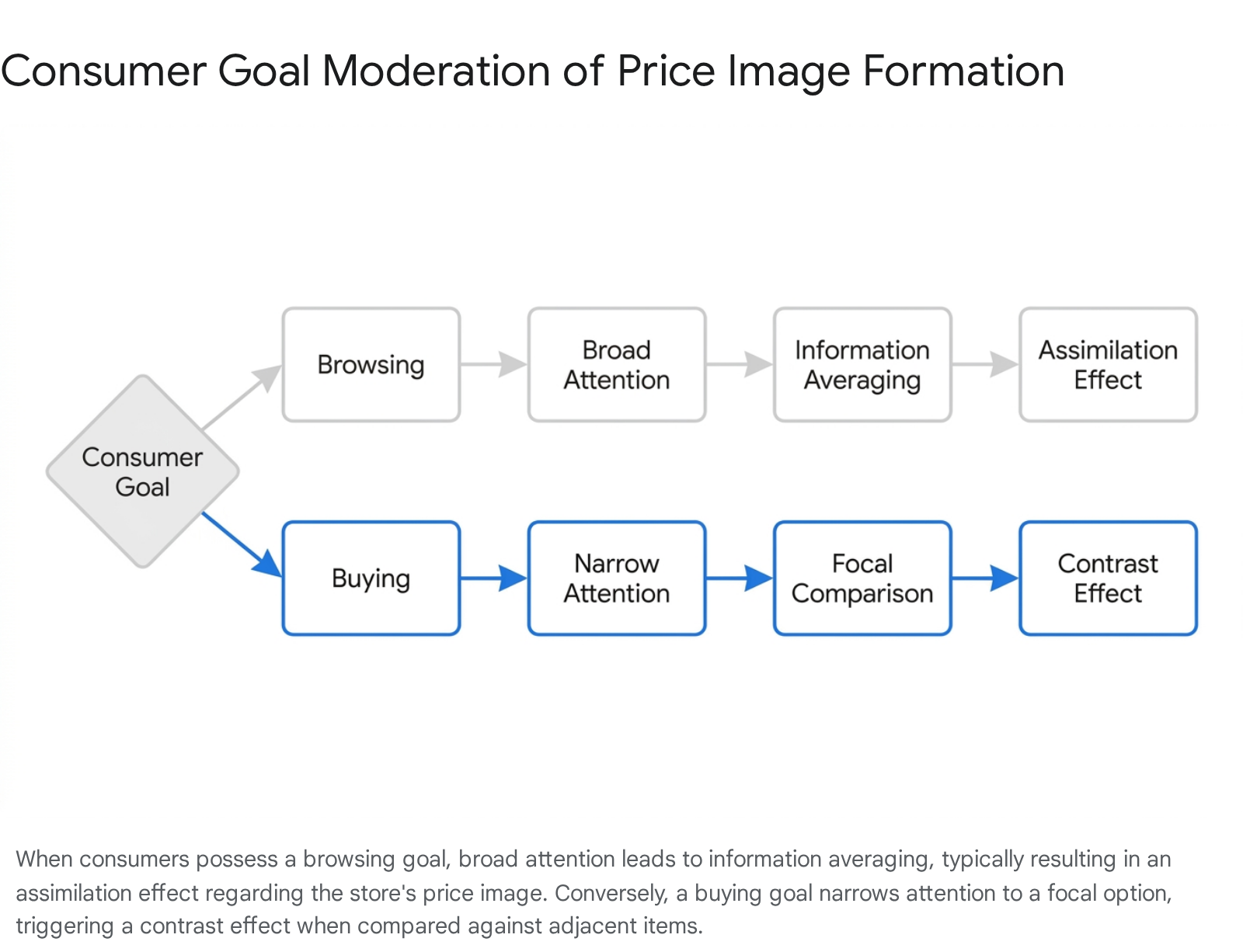
When consumers possess a browsing goal, their primary objective is gathering information for future reference rather than making an immediate selection. This objective necessitates a broad allocation of attention across an entire assortment. Consequently, browsers tend to process information using an averaging or integration model, assigning relatively equal weight to various data points 15. In this cognitive state, the addition of vertical product extensions (e.g., adding an ultra-premium item to a standard lineup) results in an assimilation effect: an upscale extension pulls the overall store price image higher, while a downscale extension pulls it lower. The consumer's generalized price image is sensitive to the mean of the observed set 15.
By contrast, a buying goal requires selecting a single alternative for an immediate transaction. This objective forces a narrow allocation of attention toward a specific "focal option" 15. Because the consumer's cognitive resources are concentrated on evaluating this focal item, they naturally evaluate it by contrasting it against the surrounding assortment. Under these conditions, the contrast effect dominates. If a consumer evaluates a moderately priced item while a highly-priced upscale extension is present, the contrast makes the focal option appear significantly less expensive 15. Because the focal option is overweighted in the consumer's memory and overall impression, the contrast effect results in a shift that is directionally opposite to the extension type: the presence of an expensive upscale item can paradoxically lower the consumer's perception of the store's overall price image 15.
Asymmetric Scope Sensitivity
Traditional economic assumptions suggest that the larger the objective difference between two products, the stronger the resulting contrast effect. However, investigations into scope sensitivity reveal a pronounced asymmetry between positive and negative contrast 16.
When evaluating products, consumers typically process information in two distinct stages: an ordinal assessment (determining if a target is better or worse than a reference point) followed by a cardinal assessment (determining precisely by how much it is better or worse) 16. Research demonstrates that positive contrast - where a superior product is evaluated against an inferior one - is relatively scope insensitive. Consumers require fewer cognitive resources to evaluate advantageous options; once they determine a product is "better," they often skip the secondary cardinal assessment entirely. Therefore, placing a product next to a slightly worse comparator yields nearly the same psychological attractiveness boost as placing it next to a significantly worse comparator 16.
Conversely, negative contrast - where an inferior product is evaluated against a superior one - is highly scope sensitive. Consumers pay strict attention to disadvantages, actively calculating the magnitude of the deficit. Therefore, a large quality gap severely penalizes the inferior product, while a minor gap results in negligible negative contrast 16.
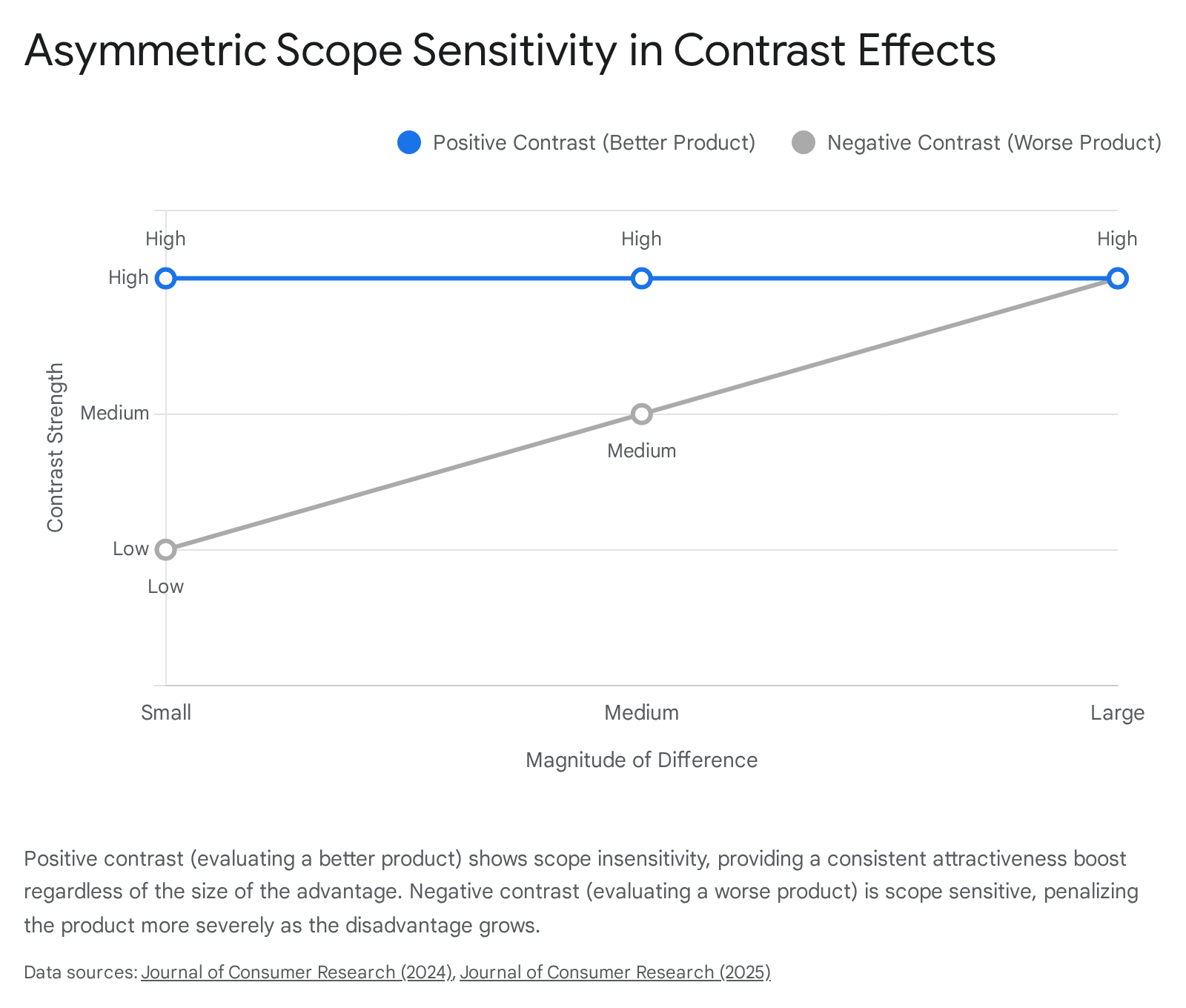
For corporate strategy, this asymmetry has profound implications for product line optimization and tradeoff management. Introducing a minor quality disadvantage to one product in a choice set can significantly boost the sales of a competing product (due to strong positive contrast for the superior item) without substantially harming the sales of the degraded product (due to weak negative contrast for the inferior item) 16. In scenarios involving feature tradeoffs - such as a device with a superior display but inferior battery life - shrinking the size of the tradeoff improves the overall evaluation. Reducing the gap mitigates the negative contrast of the weaker attribute while preserving the full positive contrast of the stronger attribute, since positive contrast remains scope insensitive 16.
Algorithmic and Dynamic Pricing Contexts
The digitization of commerce has transitioned pricing from static numbers printed on physical shelves to fluid variables determined by complex machine learning algorithms. This shift fundamentally alters how the contrast effect operates, moving it from a static comparative environment to a temporal and highly personalized one.
The Mechanics of Algorithmic Price Setting
Dynamic pricing models adjust prices in real-time based on fluctuating parameters such as inventory levels, competitive pricing arrays, macroeconomic trends, and individual user behavioral data (e.g., browsing history, device type, location) 171820. Algorithms calculate the optimal price point to maximize total revenue by continuously evaluating the intersection of price and demand. At its core, the algorithmic goal is mathematically represented as finding the price $p$ that maximizes revenue: $P^* = \text{argmax}_p (p \times d(p))$ 17. Machine learning algorithms - utilizing both supervised learning from historical sales and unsupervised learning for customer segmentation - allow systems to process the massive volumes of data generated by modern e-commerce (frequently exceeding four petabytes per hour in retail) to update prices almost instantly 1721.
Because dynamic pricing causes prices to change frequently, the consumer's temporal reference point is perpetually destabilized. If a consumer observes a high price for a flight on a Tuesday, that value becomes an internal anchor. When the algorithm lowers the price on a Wednesday, the contrast effect drives an immediate purchase decision. While this maximizes short-term revenue, high price volatility contradicts the consumer's innate desire for price stability, often leading to a reduction in trust toward the retailer 19. However, longitudinal research indicates that this reduction in trust is often temporary. As algorithmic dynamic pricing becomes the market norm, consumers acclimate to the volatility, and corporate trust can be rebuilt through transparent price-matching guarantees and clear communication that pricing is reactive to competitive market forces 19.
Furthermore, advanced sequential recommender systems (SRS) are increasingly integrating the psychological contextual contrast effect directly into their Markov decision models 20. By modeling the optimal sequence of product presentations under both linear and nonlinear contrast scenarios, these algorithms exploit the contrast effect to capitalize on consumer impulse, systematically presenting slightly inferior items before a target item to maximize the probability of conversion .
Fairness Perceptions in Personalized Dynamic Pricing
A highly controversial application of algorithmic pricing is Personalized Dynamic Pricing (PDP), where prices are tailored to individual consumers based on deep data profiling 21. PDP creates a scenario where the contrast effect occurs not merely between two sequential product prices, but between people.
According to social comparison theory, outcome differences among consumers trigger intense evaluations of fairness 21. When consumers discover they paid a higher price than another individual for an identical product, they actively seek to explain the discrepancy. If a consumer views the other buyer as fundamentally similar to themselves (similarity bias), an assimilation effect occurs: the transaction outcome difference is highlighted as inexplicable, triggering severe perceptions of unfairness and ethical breach 21.
Conversely, if the pricing algorithm relies on transparent, logical segmentation (e.g., offering a discount to a student, a senior citizen, or based on documented purchase history), a contrast effect occurs in the social comparison. The consumer recognizes the demographic or behavioral dissimilarity between themselves and the reference party. This perceived dissimilarity cognitively justifies the transaction difference and maintains the perception of fairness 2122. Consequently, consumers evaluate broad, segment-based pricing as significantly fairer than opaque, highly individualized pricing 21.
The ethical concerns surrounding algorithmic opacity have prompted significant legislative pushback. Lawmakers categorize opaque, highly individualized PDP as "surveillance pricing," arguing that it adjusts prices based on data consumers cannot see and factors they cannot control 18. In the United States, legislative momentum against these practices accelerated rapidly; by mid-2025, 51 bills across 24 states were introduced to regulate algorithmic pricing, up from just 10 bills in 2024 18. Notable legislation includes California's AB446 and Colorado's HB1264, which aim to prohibit surveillance pricing and mandate disclosures when pricing algorithms utilize personal data to set individualized rates 18. Algorithmic transparency - explaining exactly why a price differs - is therefore not only a psychological necessity for mitigating the negative fallout of social contrast but is rapidly becoming a legal requirement 14182122.
Risk-Induced Contrast in Social Commerce Networks
The contrast effect is also instrumental in shaping macro consumer behavior across competing digital platforms. Recent research into Generation Z consumer behavior within Social Commerce (S-commerce) environments - such as TikTok Shop or Instagram shopping functionality - reveals a paradoxical phenomenon termed the "risk-trust co-generation mechanism" 23.
When consumers discover products on S-commerce platforms, they frequently engage in cross-platform price comparisons. Price comparison acts as a mechanistically important mediator that converts initial product discovery into heightened risk perception 23. The S-commerce environment is often perceived as high-risk, fraught with concerns over counterfeit goods, payment insecurity, and unreliable logistics 23. Exposure to these risks does not simply deter the purchase entirely; rather, it triggers a powerful contrast effect.
The perceived risk of the social platform starkly highlights the structural assurances, reliability, and buyer protections of established e-marketplaces (such as Amazon or established direct-to-consumer sites). This contrast elevates the consumer's trust in the established marketplace 23. Therefore, the perceived risk in a novel channel paradoxically drives purchase completion, redirecting the transaction to a competing, safer platform. This "risk-redirection hypothesis" demonstrates how contrast effects govern the modern cross-platform Customer Decision Journey (CDJ), proving that institutional trust acts as a powerful trust generator when contrasted against high-uncertainty environments 23.
Physical Attributes and Sensory Contrast
Beyond numerical pricing, the contrast effect heavily influences consumer evaluation of a product's physical composition, visual presentation, and structural integrity within retail and digital environments.
Visual Contrast and Information Architecture
In retail environments and digital interfaces, presenting an abundance of information or product options often leads to visual crowding. Choice overload repels consumers by increasing cognitive strain and upsetting the user's photoreceptors, creating an incomprehensible information architecture 12425. However, strategically adjusting the visual contrast between elements can mitigate this effect.
Research on visual contrast in product displays - specifically foreground-to-foreground (F-F) contrast - demonstrates that enhancing the color, luminance, or spacing contrast between items reduces the perceived crowdedness of the display 24. By making individual options easier for the optic system to isolate, high visual contrast improves the aesthetic appraisal of the display and directly increases consumer shopping intentions and click-through rates 24. Conversely, when items bleed together due to color assimilation (a phenomenon where neighboring colors optically mix and reduce actual contrast), the lack of visual distinction frustrates the consumer's ability to evaluate options, leading to misunderstandings of progress bars, missed toggles, and ultimate choice deferral 25.
Skimpflation and Material Product Degradation
While the contrast effect applies broadly to pricing and visual displays, consumers process contrasts in physical product quality through an entirely different, highly punitive ethical framework. In response to inflation and margin compression, corporations often engage in "shrinkflation" (the reduction of product size) or "skimpflation" (the covert reduction of product quality, such as substituting premium ingredients for cheaper, artificial alternatives) 26.
Research conducted by the Marketing Science Institute reveals that consumers exhibit extreme outrage toward skimpflation compared to straightforward price increases or size reductions. In controlled studies across diverse product categories, 83.5% of participants judged a quality decrease as unfair, whereas only 42.5% viewed a size decrease as unfair, and a mere 15% viewed a transparent price increase as unfair 26.
This disproportionate outrage is driven by the contrast in the fundamental consumption experience. Consumers generally understand the macroeconomic mechanisms of inflation and accept that firms must raise prices to protect profitability. A higher price represents a numerical economic shift but leaves the intrinsic product identity intact. However, a reduction in quality alters the sensory and functional baseline of the product itself 26. The contrast between the expected sensory experience (the deeply ingrained internal anchor) and the degraded physical reality is perceived as an egregious, deceptive violation of trust 26. While size decreases restrict the volume of consumption, they do not alter the sensory baseline. Therefore, negative contrast in physical product quality generates substantially more long-term reputational damage and consumer defection than negative contrast in pricing or sizing 26.
Cross-Cultural Variances in Contrast Processing
The assumption that the contrast effect operates uniformly across global populations is challenged by cross-cultural consumer psychology. Cognitive processing styles, rooted in societal norms, shift how different demographics integrate comparative information and establish baseline economic expectations.
Analytical Versus Holistic Processing Styles
Cognitive psychology divides information processing into two broad categories: analytical thinking, which is predominant in Western, individualistic cultures, and holistic thinking, which is predominant in Eastern, collectivistic cultures 27. Analytical thinkers tend to detach target objects from their context, focusing heavily on focal attributes and strict categorizations. Holistic thinkers, conversely, view objects as inherently embedded within their environments, focusing on relationships, background context, and broad continuity 27.
Because analytical thinkers isolate the focal object, they are highly susceptible to the contrast effect when evaluating corporate brand architecture, such as product line extensions. For instance, when a prestige brand introduces a lower-tier functional product (a downward extension), analytical thinkers focus heavily on the discrepancy between the parent brand's established prestige and the extension's lower status. This cognitive separation results in a sharp negative contrast effect that actively penalizes the parent brand's overall image 27. Holistic thinkers, who are accustomed to integrating contradictory contextual information and viewing phenomena as interconnected, are more likely to assimilate the new extension without experiencing the same severe contrast penalty to the parent brand 27.
However, this divergence in brand evaluation does not imply that the contrast effect is entirely absent in collectivistic societies. Empirical experimental studies examining facial attractiveness and product design in non-Western populations confirm that prior exposure to highly attractive stimuli still reliably and significantly suppresses the evaluation of subsequent neutral stimuli 28. This proves that the contrast effect remains a universal neurological baseline, even if its application in complex, abstract brand architecture differs across cultural cognitive styles 28.
Baseline Price Sensitivities and Discount Expectations
Cultural differences also influence the initial reference points against which prices and promotional discounts are contrasted. Studies comparing consumer normative expectations of preferential pricing between the United States and China reveal distinct differences in baseline sensitivities.
Overall, Chinese consumers exhibit higher price sensitivity and a lower baseline willingness to pay compared to United States consumers 29. Furthermore, the metrics used to anchor discount expectations differ. When evaluating the fairness of a personalized discount, US consumers heavily contrast the offered price against the "merit" of the transaction, such as their loyalty tier or total purchase volume 29. Conversely, while merit plays a role, Chinese consumers place a significantly stronger emphasis on "personal relationship" (Guanxi) when establishing their expectation for a discount 29. Therefore, the contrast effect in global pricing strategies must be intricately calibrated to local reference points. A discount magnitude that triggers a strong positive contrast and high perceived fairness in the US may be perceived merely as a standard, expected baseline in a highly price-sensitive and relationship-driven market like China.