
Comparison of creative destruction and disruptive innovation
Introduction to the Theoretical Frameworks
The modern understanding of economic growth, technological change, and corporate strategy is heavily anchored in the theories of innovation developed over the past century. At the center of this academic and practical discourse are two seminal frameworks: Joseph Schumpeter's concept of creative destruction and Clayton Christensen's theory of disruptive innovation. In contemporary business vernacular, the terms "disruption" and "creative destruction" are frequently conflated, used interchangeably to describe any technology or startup that challenges established market leaders 12. However, a rigorous examination of the academic literature reveals that these are distinct theoretical constructs, operating at different units of analysis, driven by different mechanisms, and offering different predictive capabilities.
Schumpeter's creative destruction, introduced in the mid-twentieth century, provides a macroeconomic, evolutionary perspective on how capitalism inherently mutates from within, constantly destroying old economic structures to create new ones 13. It operates as a systemic theory of long-term economic development. Conversely, Christensen's disruptive innovation, articulated in the late 1990s, is a microeconomic, firm-level theory of corporate strategy 3. It explains the specific mechanisms by which well-managed incumbent firms fail when confronted by entrants offering simpler, cheaper, and initially inferior products that target overlooked market segments 44.
While Schumpeter establishes the foundational reality that innovation drives economic change, Christensen operationalizes a specific subset of this phenomenon to explain the strategic and competitive dynamics between incumbents and challengers 56. This report provides an exhaustive analysis of the relationship and differences between these two frameworks, evaluates recent scholarly critiques and methodological debates regarding their predictive validity, and examines their application in contemporary contexts such as frugal innovation in emerging markets and the rise of generative artificial intelligence.
Theoretical Foundations of Creative Destruction
Macroeconomic Scope and Evolutionary Dynamics
Joseph Schumpeter, an Austrian-born economist who later taught at Harvard University, fundamentally challenged the classical and neoclassical economic models of his era. Early twentieth-century economic thought, heavily influenced by Walrasian general equilibrium theory, posited that economic systems naturally gravitated toward a static "circular flow" of inputs and outputs 17. In this orthodox view, the economy was essentially a balancing act where prices coordinated supply and demand, and any deviation or disturbance was treated as an external shock or a temporary aberration 78.
Schumpeter rejected this static equilibrium as a complete description of reality, arguing that such models assumed away the most vital characteristic of a capitalist economy: its endogenous capacity for change. In his early foundational work, The Theory of Economic Development (1911), and later in his highly influential Capitalism, Socialism, and Democracy (1942), Schumpeter argued that capitalism is by nature an evolutionary process 19. He posited that the essential fact about capitalism is not price competition in a static market, but rather a "process of industrial mutation" that incessantly revolutionizes the economic structure from within 110. He termed this continuous cycle of renewal and obsolescence "creative destruction."
Creative destruction is inherently systemic and macroeconomic in its scope. It describes the sweeping out of old products, outdated enterprises, and obsolete organizational forms by novel ones 1. The destructive component of this innovation is often viewed as a negative externality by those invested in the status quo, representing a cost borne by third parties in the way pollution might affect a factory's neighbors 11. For example, the integration of digital cameras into mobile phones rapidly obliterated the market for stand-alone point-and-shoot cameras, severely impacting historic incumbents like Eastman Kodak 11. Furthermore, creative destruction can lead to significant localized job losses and the obsolescence of certain industries, such as the precipitous decline in newspaper publishing jobs following the rise of internet portals 11. However, Schumpeter maintained that despite the localized destruction of capital and employment, the net economic benefit and societal welfare generated by radical innovation significantly surpass the value destroyed over the long term, creating new opportunities for employment and economic activity in emerging sectors 911.
The Entrepreneurial Actor and Long Waves of Innovation
In the Schumpeterian framework, the primary agent of systemic change is the entrepreneur. Unlike traditional business managers who optimize existing processes to maintain the circular flow of an economy, the entrepreneur is the innovator who introduces "new combinations" of existing resources 312. These new combinations can take the form of new products, new methods of production, the opening of new markets, the conquest of new sources of raw materials, or the implementation of new forms of industrial organization 312. The entrepreneur initiates gales of creative destruction, actively destroying existing equilibriums to capture monopoly rents, which in turn fuels further economic expansion 613.
Schumpeter's theory is also closely tied to the concept of long economic cycles, often referred to as Kondratieff waves. Schumpeter identified that innovations do not occur at a steady, predictable rate; rather, they appear discontinuously in clusters or bunches, propelling long-term investment cycles and widespread technological revolutions 1214. These bunchings of radical innovations drive the business cycle and fundamentally alter the techno-economic paradigm of society 12.
Historical analysis typically identifies six major waves of innovation that have driven the process of creative destruction since the dawn of the Industrial Revolution. The longevity of these wave cycles appears to be shortening as technological progression accelerates 14.
| Wave | Time Period | Cycle Duration | Key Breakthrough Technologies and Industrial Drivers |
|---|---|---|---|
| First Wave | 1785 - 1845 | 60 years | Water power, full-sized dams, early textile manufacturing, and iron goods 1415. |
| Second Wave | 1845 - 1900 | 55 years | Steam power, steel production, and the massive expansion of railway networks 1415. |
| Third Wave | 1900 - 1950 | 50 years | Electrification, chemical engineering, and the internal combustion engine (e.g., automotive assembly lines) 15. |
| Fourth Wave | 1950 - 1990 | 40 years | Petrochemicals, early electronics, and the aviation industry . |
| Fifth Wave | 1990 - 2020 | 30 years | Digital networks, software development, new media, and the commercial internet 14. |
| Sixth Wave | 2020 - Present | Ongoing | Artificial intelligence (AI), the Internet of Things (IoT), robotics, automation, and digitization 1416. |
Each historical wave has created massive systemic upheaval. Entire legacy industries are rendered obsolete, leading to structural economic shifts, while simultaneously generating entirely new industries, capabilities, and avenues for economic growth 1416. The Schumpeterian perspective is ultimately one of dynamic, inevitable, and systemic transformation, providing the broad historical context in which all subsequent theories of innovation operate 3.
Mechanics of Disruptive Innovation
Microeconomic Focus and the Innovator's Dilemma
While Schumpeter observed the macroeconomic weather patterns of innovation and industrial cycles, Clayton Christensen analyzed the microeconomic mechanics of competitive strategy at the firm level. Introduced in his 1997 seminal work, The Innovator's Dilemma, the theory of disruptive innovation seeks to answer a specific, highly focused anomaly: why do exceptionally well-managed, dominant companies frequently fail when confronted with certain types of technological or market changes? 317.
Christensen found that established market leaders do not generally fail because they are poorly managed, complacent, or lacking in technological capability. Paradoxically, they fail precisely because they follow established "best practices" of corporate management. These incumbents listen closely to their most profitable customers, invest aggressively in new technologies that provide higher margins, and systematically allocate capital and human resources away from small, unproven markets with low profit margins 1819. This highly rational resource allocation process creates a structural vulnerability, laying the groundwork for disruption.
Sustaining Versus Disruptive Trajectories
To explain this dynamic, Christensen drew a sharp distinction between two types of innovations: sustaining innovations and disruptive innovations.
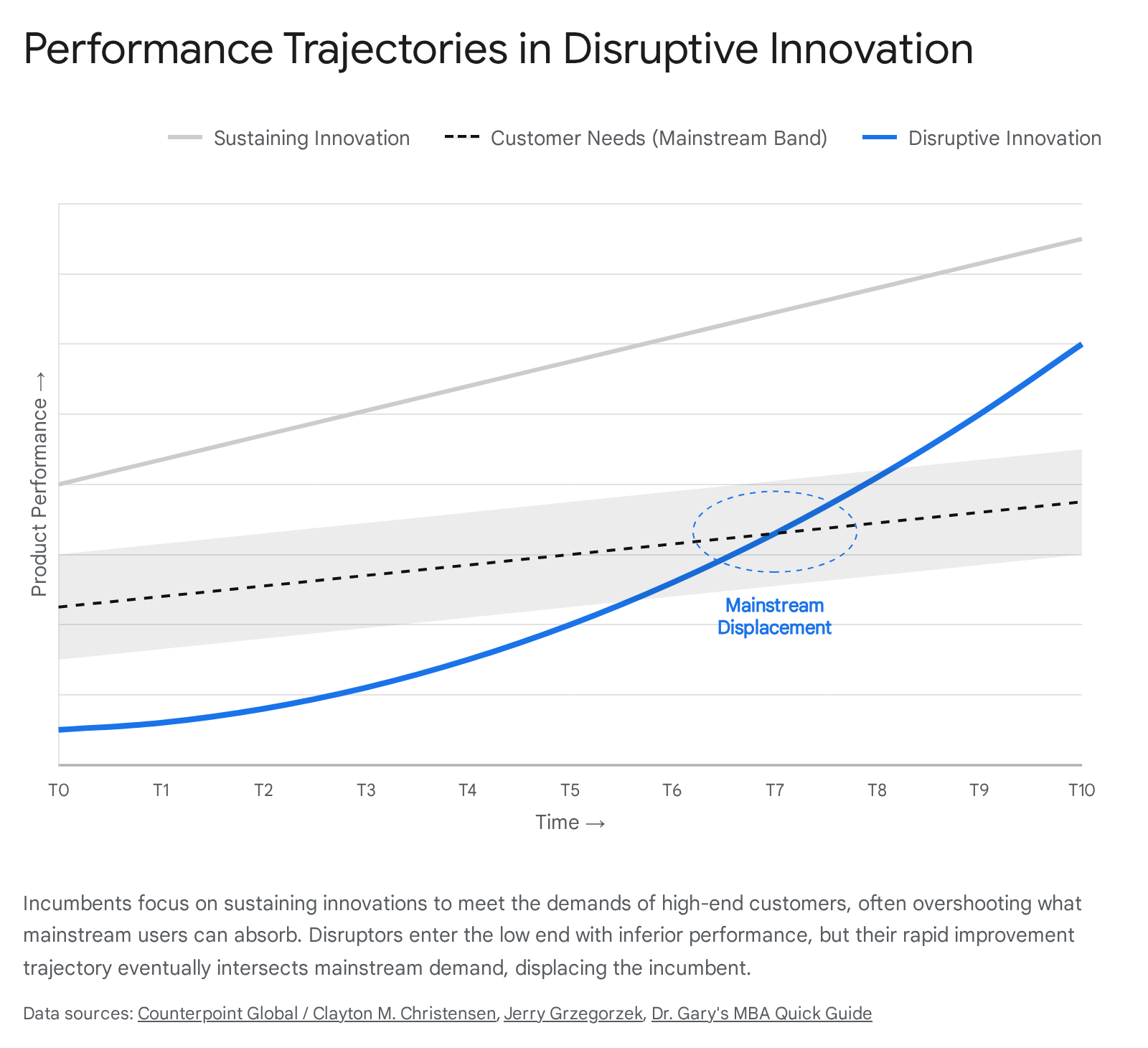
Sustaining innovations are improvements made to existing products or services along historical performance dimensions that mainstream and high-end customers already value 420. These can be incremental (such as adding a slightly faster processor to a smartphone) or radically breakthrough in nature (such as the transition from analog to digital telecommunications). Regardless of the technological difficulty involved, incumbents almost always win battles of sustaining innovation because they possess the resources, the established customer base, and the financial motivation to succeed 1923. Their existing business models are highly optimized to deliver these improvements.
Disruptive innovations, by contrast, do not initially compete on the established performance metrics valued by mainstream customers. They are typically simpler, more convenient, more accessible, and significantly cheaper 420. Initially, a disruptive product severely underperforms the incumbent's offering and appeals only to a fringe segment of the market. Because these innovations serve low-margin tiers of the market and represent a small revenue opportunity that does not meet the growth requirements of a large corporation, incumbent firms rationally choose to ignore them or even abandon the lower tiers of the market to the new entrants 218.
However, a critical element of the theory is that technological progress generally advances faster than the ability of customers to utilize it. As incumbents pursue sustaining innovations, they eventually "overshoot" the needs of mainstream consumers, producing overly complex, expensive products that offer features consumers neither want nor are willing to pay for 418. Meanwhile, the entrant relentlessly improves its disruptive product. Once the entrant's quality reaches a threshold of "good enough" for the mainstream market, consumers switch en masse to the cheaper, more convenient alternative, and the incumbent is displaced 44.
Low-End and New-Market Footholds
Christensen further clarified that disruption can originate from two distinct strategic footholds: 1. Low-End Disruption: The entrant targets "overserved" customers at the absolute bottom of the existing market who are willing to accept a "good enough" product in exchange for a lower price. Examples include discount retailers disrupting traditional department stores, or steel mini-mills slowly displacing integrated steel mills by starting with cheap rebar before moving up to sheet metal 218. 2. New-Market Disruption: The entrant targets "non-consumers" - people who previously lacked the money, technical skill, or access to consume the product at all. In this scenario, the entrant competes against non-consumption, creating an entirely new value network before eventually pulling mainstream customers away from incumbents 21823. The advent of the personal computer disrupting mainframe computers is a classic manifestation of this mechanism.
Comparative Analysis of the Two Frameworks
Systemic Transformation versus Strategic Application
The popular business press frequently uses "creative destruction" and "disruptive innovation" synonymously to describe technological change, treating them as interchangeable buzzwords 1721. However, academic literature firmly views them as distinct yet complementary theories 5.
Schumpeter's creative destruction provides the underlying philosophical and macroeconomic reality: capitalism is evolutionary, and new technologies will inevitably destroy old ones to propel societal growth. However, Schumpeter's theory is highly aggregated; it does not explicitly explain why specific incumbents fail to transition to a new technology, nor does it prescribe how a firm should navigate the transition at a strategic level 522.
Christensen's framework steps into this analytical gap. Disruptive innovation acts as the micro-level mechanism that fulfills Schumpeter's macro-level prophecy 35. Where Schumpeter posits that entrepreneurs drive economic growth by introducing new combinations, Christensen specifies the exact strategic pathway - asymmetric motivation and resource dependence - that allows a specific entrant to successfully topple a specific, well-resourced incumbent 323.
Structural Differences in Scope and Causality
To rigorously distinguish the two frameworks, it is necessary to compare them across several core dimensions of theoretical scope and application.
| Dimension of Comparison | Schumpeter's Creative Destruction | Christensen's Disruptive Innovation |
|---|---|---|
| Unit of Analysis | Macroeconomic systems, entire economies, and broad societal structures 3. | Microeconomic dynamics, specific firms, business models, and defined industries 3. |
| Primary Actor | The Entrepreneur, viewed as a heroic innovator and catalyst for change 3. | The Entrant Firm versus The Incumbent Firm, viewed through the lens of organizational constraints 3. |
| Core Mechanism | The introduction of "new combinations" (technologies, markets, methods) that render old structures obsolete 312. | Asymmetric financial motivation, where incumbents rationally ignore low-margin threats until the entrant moves upmarket 218. |
| View of the Incumbent | Often viewed as static or bureaucratic obstacles to be inevitably swept away by technological progress 13. | Viewed as rational, highly capable, and well-managed, yet structurally trapped by their own resource allocation processes 1819. |
| Nature of Innovation | Broadly encompasses any revolutionary change, including radical, breakthrough technological advancements 324. | Strictly defined. Excludes sustaining technological breakthroughs; focuses exclusively on simpler, cheaper, low-end or new-market entry 2025. |
| Societal Impact | Systemic. Focuses on the destruction of old industries and the eventual creation of higher living standards and new employment 311. | Strategic. Focuses on the shifting of market share, profit pools, and the survival or failure of individual corporate entities 1826. |
A critical distinction lies in the role of technology. While creative destruction assumes that a superior new technology simply crushes an inferior old one, disruptive innovation insists that the technology itself is rarely the primary cause of failure. Instead, it is the business model surrounding the technology 427. An incumbent can possess the most advanced technology in the world (a sustaining innovation) but still be bankrupted by a challenger utilizing inferior technology embedded in a highly efficient, low-cost business model that captures the lower tiers of the market 427.
Scholarly Critiques and Methodological Debates
Despite - or perhaps because of - the pervasive influence of disruptive innovation theory in management literature over the past three decades, it has been the subject of intense scholarly scrutiny. Post-2015 academic literature has highlighted several persistent controversies regarding its predictive validity, methodology, and scope 28.
The Lepore Critique and Historical Validity
One of the most prominent and widely discussed critiques of Christensen's framework was authored by Harvard historian Jill Lepore in a 2014 New Yorker article titled "The Disruption Machine." Lepore challenged the historical and empirical foundations of the theory, arguing that it was built on flawed methodology and dubious historical interpretations 2930.
By revisiting Christensen's original case studies - specifically the disk-drive and steel industries - Lepore argued that Christensen cherry-picked his data to fit a predetermined narrative 2930. She pointed out that in the disk-drive industry, many of the entrant companies that supposedly disrupted the market quickly failed themselves, while manufacturers skilled at incremental, sustaining innovations often survived and prospered over the long term 31. Furthermore, she argued that Christensen's analysis of the steel industry ignored critical external factors such as labor strife, falsely attributing market shifts entirely to disruptive innovation 30.
Lepore also heavily criticized the cultural elevation of disruption to a "gospel of innovation." She argued that disruption had become a theory of governance and a rationale for relentless corporate restructuring, driven by an apocalyptic fear of the future embedded in the mandate to "disrupt or be disrupted" 2931. Lepore concluded that the theory acts more as a post-hoc historical artifact than a predictive law of nature, serving to justify the actions of reckless startups while ignoring the immense social costs and the actual historical value of sustaining innovation 2931. Christensen fiercely contested these claims, stating that the theory had undergone rigorous peer review and that Lepore had fundamentally misunderstood the mechanics of his research 3032.
Empirical Validations and Predictive Failures
Lepore's qualitative historical critique was subsequently followed by rigorous quantitative assessments of the theory's predictive validity. A landmark study by King and Baatartogtokh (2015), published in the MIT Sloan Management Review, systematically surveyed 79 academic experts regarding the 77 historical case studies Christensen had cited in his foundational texts 1728.
The survey tested the validity of the four core elements of disruptive innovation theory: (1) incumbents improving along a trajectory of sustaining innovation, (2) the pace of innovation outstripping customer needs, (3) incumbents possessing the capability to respond but failing to exploit it, and (4) incumbents ultimately faltering due to the disruption 28.
The findings fundamentally challenged the broad applicability of the theory. The experts concluded that only 9% of the 77 cases matched all four elements of the theory 1733.
| Criteria of Disruptive Innovation Theory | Percentage of the 77 Cases Where Criteria Was NOT Met 17 |
|---|---|
| Incumbents were on a trajectory of sustaining innovation | 31% |
| Incumbents overshot the needs of their customers | 78% |
| Incumbents possessed the capability to respond | 39% |
| Incumbents faltered as a direct result of disruption | 38% |
The academic consensus that emerged from these empirical tests is that the theory possesses highly limited predictive power. King and Baatartogtokh concluded that the theory functions best as a useful warning against managerial myopia and an explanation for specific industry transitions, rather than a universal scientific law or a reliable predictive model for investment 1733.
Outcome Bias and Theoretical Boundaries
Recent peer-reviewed retrospectives have identified structural biases in how the theory has been constructed and applied. Research by scholars such as Lilea, Ansari, and Urmetzer (2024) points out that disruptive innovation theory suffers heavily from "outcome bias" - specifically "incumbent survivor bias" and "pro-innovation bias" 2834.
Outcome bias occurs when researchers evaluate the validity of a theory based strictly on whether the entrant won or the incumbent lost, rather than testing the ex-ante soundness of the underlying methodology 2834. Incumbent survivor bias leads to an overrepresentation of cases where established companies fell to startups, largely ignoring the vast multitude of markets where incumbents successfully co-opted the threat, partnered with challengers, or survived through superior resource allocation 34. Pro-innovation bias refers to the inherent assumption in business literature that disruption is intrinsically positive, ignoring the negative societal externalities that can accompany it - a concern that aligns closely with Schumpeter's earlier warnings about the painful realities of the "destruction" phase of economic cycles 1128.
Furthermore, the boundaries of the theory remain contested. A major theoretical controversy is the framework's inability to fully account for "high-end disruption" 26. Products like the Apple iPhone or Tesla electric vehicles did not enter at the low end of the market with cheap, inferior attributes. They entered as expensive, premium products targeting high-end customers and subsequently disrupted the market downward 1926. The strict requirement of a low-end or new-market foothold limits the framework's generalizability in modern digital and luxury markets.
In response to these predictive limitations, some scholars have argued for a "performative perspective" of the theory 3435. Under this view, disruption theory is valuable not because it accurately predicts the future, but because it provides an "actionable blueprint" and a powerful managerial discourse. By framing their actions in the language of disruption, entrepreneurs and executives actually constitute reality, securing venture capital funding and organizing resources in a way that actively creates the disruption they are supposedly predicting 2834.
Frugal Innovation in Emerging Markets
The intersection of disruptive innovation theory and macroeconomic development is particularly evident in the study of emerging markets, where extreme resource constraints have given rise to the paradigm of "frugal innovation."
Resource Constraints as Innovation Drivers
Frugal innovation is a design and business process characterized by the removal of non-essential features from a product to substantially reduce costs, maximize core functionality, and ensure durability in resource-constrained environments 3637. Often associated with the concepts of Jugaad (an improvised, ingenious fix) and "Base of the Pyramid" (BoP) economics, frugal innovation views the roughly four billion low-income consumers primarily located in Africa, Southeast Asia, and Latin America not just as a consumer market, but as active participants and sources of innovation 383940.
Unlike traditional innovation in developed Western markets, which relies on massive research and development budgets and targets the premium segment of the market, frugal innovation turns systemic constraints - such as lack of capital, unstable electricity grids, and poor distribution infrastructure - into competitive advantages 3841. For example, in Uganda, the startup Arbutus Medical developed an orthopedic surgical drill that was 30 times less expensive than standard $30,000 hospital drills by adapting the core mechanism of a standard hardware drill and surrounding it with a sterilized, medical-grade casing 37. Similarly, the M-Pesa mobile money platform in Kenya leveraged basic SMS technology on cheap feature phones to bypass the need for physical banking infrastructure entirely, granting millions of unbanked citizens immediate access to financial services 45.
Frugal Solutions as Disruptive Trajectories
Academic researchers increasingly recognize frugal innovations as textbook examples of Christensen's disruptive innovation framework in action 42. By design, frugal innovations target "non-consumers" or the absolute lowest end of the economic pyramid. They offer a product that is "good enough" for people who previously had no financial or physical access to the service at all 2043.
When multinational corporations from developed markets attempt to sell in emerging economies, they typically offer stripped-down, inferior versions of their premium products, maintaining their high overhead costs. Frugal innovators, however, build tailored solutions from the bottom up. As these frugal products gain market share, achieve localized economies of scale, and incrementally improve their performance trajectories, they begin to disrupt established domestic incumbents 4244.
Furthermore, frugal innovations possess the potential for "reverse innovation" - a process where a low-cost, disruptive product developed initially for an emerging market is subsequently exported back to developed economies 3844. As economic constraints and environmental sustainability demands increase in the West, products designed for extreme affordability and low environmental footprints become highly competitive. This allows entrants from the Global South to disrupt legacy incumbents in the Global North 3738. In this dynamic, frugal innovation acts as the micro-level strategic catalyst (Christensen) that ultimately drives global macroeconomic shifts in manufacturing, capital allocation, and market dominance (Schumpeter).
Applications in Artificial Intelligence and Digital Platforms
The technological landscape of the 2020s - dominated by the proliferation of digital platforms and the rapid advent of advanced Artificial Intelligence (AI) - provides a real-time laboratory for testing the theories of both Schumpeter and Christensen.
Artificial Intelligence as a General Purpose Technology
From a Schumpeterian macroeconomic perspective, AI represents the core technological driver of the "Sixth Wave" of creative destruction 14. Much like steam power in the nineteenth century and electricity in the twentieth century, generative AI functions as a General Purpose Technology. It promises multi-dimensional progress across all sectors of the economy: automating complex cognitive tasks, enabling advanced predictive analytics, and fundamentally accelerating the transformation of data inputs into higher-value outputs 45.
As this sixth wave progresses, the macro-level destruction of legacy workflows is inevitable. Professions relying heavily on routine knowledge work, basic coding, and standard content generation face significant labor displacement. Concurrently, AI paves the way for new industries, enhanced capabilities, and broad economic expansions 1445. This dynamic perfectly encapsulates Schumpeter's vision of an economy that is never stationary and must relentlessly destroy its own foundations to advance to a higher level of productivity.
Business Model Determinants of AI Disruption
However, classifying AI strictly through the microeconomic lens of Christensen's disruptive innovation framework requires a much more nuanced analysis. According to analysts at the Christensen Institute, generative AI, in and of itself, is not automatically a disruptive innovation. A core tenet of the theory is that a technology alone is never inherently disruptive; its disruptiveness is entirely determined by the business model in which it is deployed and the specific market it targets 27.
Currently, many powerful incumbent firms are utilizing generative AI primarily as a sustaining innovation. Established software providers, massive consulting firms, and legacy media conglomerates are aggressively embedding AI into their existing product suites to make their premium offerings even better for their most demanding, high-paying customers 2734. By leveraging their massive proprietary datasets, vast capital resources, and existing global distribution networks, incumbents are using AI to solidify their market dominance and fend off smaller rivals 34. In these specific instances, AI does not disrupt the market structure; it sustains and entrenches it.
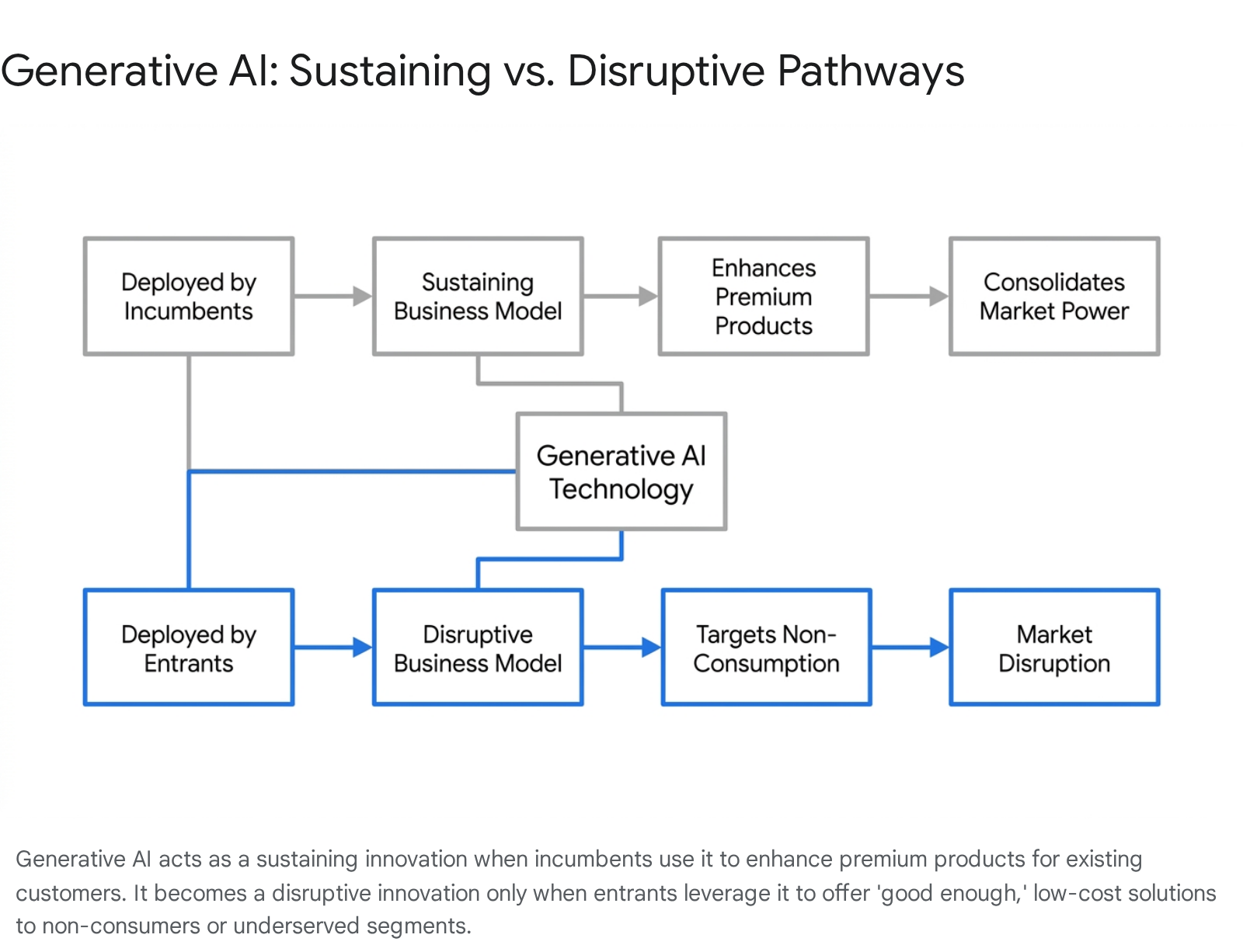
Conversely, generative AI acts as a genuine disruptive innovation when startup entrants deploy it to target "non-consumers" or the low end of the market 2746. In the knowledge economy, incumbents (such as elite corporate law firms, premium design agencies, or massive enterprise SaaS providers) optimize for perfect accuracy, deep specialized expertise, and high trust, resulting in extremely expensive services. A generative AI startup, however, can enter the market offering a product that is highly imperfect and prone to occasional hallucination, but is exceptionally fast, broadly accessible, and cheap 46.
For a small business owner who cannot afford a corporate lawyer, an AI-generated draft of a non-disclosure agreement is not competing with the perfection of a human lawyer; it is competing against nothing at all (non-consumption). To this user, the AI's output is highly valuable because it is "good enough" 46. Christensen's theory predicts that as the underlying foundational models rapidly improve along their performance trajectory, the error rates of these AI tools will drop. They will eventually cross the threshold of adequacy for mainstream corporate use cases, at which point they will aggressively move upmarket and hollow out the high-margin, human-driven business models of traditional knowledge incumbents 4546.
Conclusion
Joseph Schumpeter and Clayton Christensen provided the economic and managerial sciences with two of the most enduring lenses through which to view technological change. While popular culture and business journalism frequently collapse their theories into a single, diluted buzzword of "disruption," maintaining the rigorous analytical distinction between them is crucial for both accurate historical analysis and effective corporate strategy formulation.
Schumpeter's creative destruction serves as the macro-level engine of capitalism. It dictates that economic progress is intrinsically tied to the obsolescence of the old, propelled forward by massive long waves of technological revolution and the relentless drive of the entrepreneur. It is a systemic reality that governs the rise and fall of entire economic epochs, from the advent of the steam engine to the current explosion of artificial intelligence.
Christensen's disruptive innovation operates as the micro-level strategic playbook of this phenomenon. It reveals the counterintuitive reality that market leaders rarely fail because they are blind to the future or incompetent, but because the highly rational pursuit of high-margin customers structurally blinds them to the asymmetrical, low-cost threats growing at the bottom of the market. While modern scholarly critiques correctly note that Christensen's framework has limited empirical predictive power and suffers from outcome biases, its utility as an analytical blueprint for understanding specific industry transitions remains unparalleled.
When viewed together, these frameworks are highly complementary. Whether observing the frugal innovations emerging from the extreme resource constraints of the Global South, or mapping the strategic trajectories of generative AI platforms in Silicon Valley, understanding both the macroeconomic inevitability of Schumpeter's waves and the microeconomic vulnerabilities of Christensen's dilemma provides a comprehensive, multi-layered understanding of how the future inevitably displaces the past.