
Comparison of Blue Ocean Strategy and disruptive innovation theory
Strategic management theory provides the analytical frameworks through which organizations navigate competition, market evolution, and technological advancement. For decades, the dominant paradigm for understanding competitive advantage was rooted in the structural analysis of existing industries, most notably through Michael Porter's generic strategies, which forced firms to choose between cost leadership and differentiation. However, the rapid technological shifts of the late 20th and early 21st centuries necessitated new models to explain how upstart companies could consistently unseat well-capitalized incumbents.
Two distinct paradigms emerged to explain these phenomena and guide corporate strategy: Disruptive Innovation theory, introduced by Clayton Christensen in 1997, and Blue Ocean Strategy, conceptualized by W. Chan Kim and Renée Mauborgne in 2005 123. While contemporary business vernacular frequently conflates these concepts - treating any significant market shift or successful startup as a "disruption" or a "blue ocean" - the underlying mechanisms, predictive models, and macroeconomic impacts of these two theories diverge significantly 456. This report exhaustively analyzes the theoretical foundations, structural divergences, academic critiques, and modern applications of both frameworks, with specific attention to their utility in the era of multi-sided platforms and artificial intelligence.
Theoretical Foundations of Disruptive Innovation
Disruptive Innovation describes a specific historical process by which an under-resourced new entrant successfully challenges established incumbent businesses 78. The theory was formulated following extensive analysis of the disk-drive and steel industries, where leading, well-managed firms repeatedly failed to maintain dominance despite listening to their customers and investing heavily in research and development 9.
The Innovator's Dilemma and Incumbent Asymmetry
The core engine of Disruptive Innovation is not technological superiority, but rather the rational, profit-maximizing behavior of incumbent firms - a phenomenon termed the "Innovator's Dilemma" 9. Incumbent organizations develop resource allocation processes and internal values optimized to serve their most demanding, and consequently most profitable, customers 7810.
When a new technology emerges, established firms evaluate it through the lens of their existing profit margins and customer base. If the new technology initially underperforms against mainstream metrics, incumbents typically dismiss it, choosing instead to invest in "sustaining innovations" - incremental or breakthrough improvements that make their existing products better for their current top-tier customers 78. The data supports this incumbent bias: historical studies of the disk-drive industry indicate that incumbents won nearly all battles involving sustaining innovations, as they possessed the capital and distribution networks to absorb them 8.
However, by continuously focusing on sustaining innovations and moving upmarket, incumbents routinely "overshoot" the needs of lower-tier and mainstream customers, producing overly complex and expensive products 811. This upward migration creates a structural vacuum at the bottom of the market, leaving incumbents vulnerable to entrants operating with lower cost structures and different definitions of quality.
Low-End and New-Market Footholds
According to orthodox disruption theory, a genuinely disruptive innovation must originate in one of two specific footholds:
- Low-End Footholds: A disruptor targets the most overserved customers at the bottom of an existing market, offering a "good enough" product at a significantly lower price 7. Because these customers yield the lowest profit margins, the incumbent has no financial incentive to defend this segment and willingly cedes it to the entrant, accelerating their own retreat upmarket 710. A classic example is the steel mini-mill, which initially could only produce low-quality rebar, a segment integrated steel mills happily abandoned due to low margins, only to watch mini-mills steadily improve their quality to capture the entire sheet steel market 7.
- New-Market Footholds: A disruptor creates a market where none previously existed, targeting "non-consumers" who previously lacked the money, skill, or access to participate in the market 78. The innovation competes against "non-consumption" by offering unprecedented simplicity, convenience, or affordability, even if the absolute performance is inferior to traditional alternatives 5.
Once established in these footholds, the entrant relentlessly improves its product performance. Eventually, the disruptive technology intersects with the performance requirements of mainstream customers. When mainstream customers adopt the entrant's offering in high volume, the incumbent is displaced, and the disruption is complete 78.
Theoretical Foundations of Blue Ocean Strategy
In contrast to Disruptive Innovation's focus on the structural asymmetries between entrants and incumbents within existing markets, Blue Ocean Strategy (BOS) focuses on the total reconstruction of market boundaries 1213. Based on a study of 150 strategic moves across 30 industries over a century, Kim and Mauborgne concluded that long-term profitability is rarely achieved by battling competitors in crowded, commoditized industries - termed "red oceans" 314. Instead, firms must seek "blue oceans" of uncontested market space 15.
Value Innovation and the Value-Cost Trade-Off
The foundational principle of BOS is "value innovation," which explicitly rejects the traditional strategic dogma that a company must choose between differentiation and cost leadership 141516. In a red ocean, industry boundaries are defined and accepted, and the competitive rules of the game are known; companies try to outperform rivals by capturing a greater share of existing demand, usually by offering slight premium differentiation or engaging in price wars 1214.
Value innovation occurs only when an organization aligns innovation with utility, price, and cost positions simultaneously 1718. By driving down costs while concurrently driving up value for buyers, a company achieves a "leap in value" for both itself and its customers, thereby making the competition irrelevant rather than attempting to beat it 141517.
The Four Actions Framework and Strategy Canvas
The operational execution of value innovation is guided by the Four Actions Framework, a diagnostic tool designed to break the value-cost trade-off 320. Strategy formulation requires evaluating standard industry competitive factors and asking four questions: 1. Which of the factors that the industry takes for granted should be eliminated? 2. Which factors should be reduced well below the industry standard? 3. Which factors should be raised well above the industry standard? 4. Which factors should be created that the industry has never offered? 320
By eliminating and reducing factors that cost money but add little value to a newly defined target audience, the firm lowers its cost structure. By raising and creating new elements, the firm drives differentiation and unlocks new demand 315.
The resulting divergence is mapped on a "Strategy Canvas."
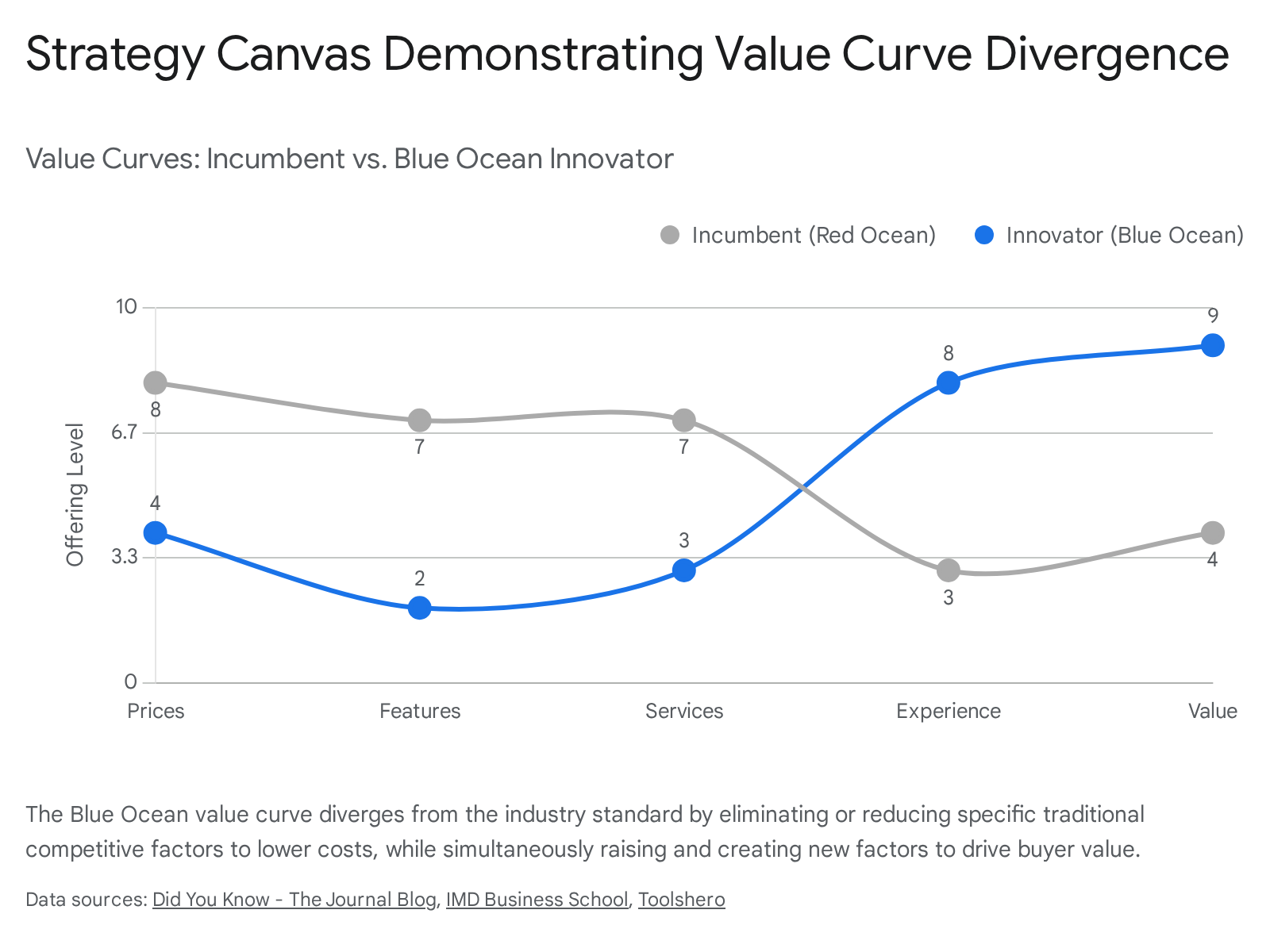
For instance, Cirque du Soleil eliminated expensive animal acts and star performers (reducing costs), while creating artistic music, intellectual themes, and multiple productions (raising differentiation), effectively bridging the circus and theater industries to appeal to a non-traditional, higher-paying adult demographic 34.
The Nondisruptive Creation Paradigm
As the academic literature matured, Kim and Mauborgne recognized that while BOS created uncontested market space, the broader business community remained hyper-fixated on the concept of disruption 519. In 2023, they introduced the concept of "Nondisruptive Creation" (NDC) to address the limitations and social externalities inherent in disruptive models 4520.
The Social Costs of Disruption
A primary critique of Disruptive Innovation is its inherent destructiveness. The process is functionally zero-sum regarding existing market share; as the disruptor ascends, the incumbent is displaced, inevitably leading to shuttered companies, capital destruction, and large-scale job losses within the disrupted sector 21920. The displacement of Blockbuster by Netflix, or traditional taxis by Uber, while delivering consumer value, exacted a severe toll on the incumbent labor forces and communities reliant on those legacy systems 719. Nondisruptive creation was conceptualized as a positive-sum alternative that aligns the goals of business and society without incurring these painful adjustment costs 519.
Positive-Sum Market Generation
Nondisruptive creation occurs when an organization identifies and solves a brand-new problem, or seizes a brand-new opportunity, entirely outside existing industry boundaries 1921. Because no established market exists for the solution, there are no incumbent players to disrupt, and therefore no resultant displacement or destruction 192122.
Historical examples underscore this mechanism. The invention of microfinance by the Grameen Bank provided capital to impoverished populations previously ignored by the commercial banking sector, creating an entirely new market without threatening traditional banking institutions 22. Similarly, the children's television program Sesame Street created a new paradigm for early childhood education at home, without disrupting preschools or existing entertainment formats 1920. The development of Viagra, initially intended for blood pressure, created a multi-billion dollar lifestyle pharmaceutical market for impotence that displaced no existing therapies 23.
Incumbent Retaliation and Survival Strategy
Nondisruptive creation also offers a strategic advantage by avoiding direct confrontation with entrenched incumbents. Disruptors often face fierce, coordinated retaliation from established industries that leverage their capital, regulatory influence, and distribution networks to crush the entrant 23. The bankruptcy of SmileDirectClub (SDC) in 2023 serves as a cautionary tale. While SDC offered a textbook disruptive solution for teeth straightening - dramatically reducing cost and time by bypassing traditional orthodontic visits - it triggered massive retaliation from dental professionals who allied with regulators to spark lawsuits and negative media campaigns. The resulting legal and advertising costs ultimately drowned the disruptor in debt 23.
Conversely, nondisruptive creation offers established companies a viable path to growth when they themselves are facing disruption. For instance, when transatlantic jet travel disrupted the ocean liner industry, the British company Cunard survived not by attempting to build faster ships (a futile technological race), but by creating the luxury cruise industry - a nondisruptive market focused on the vacation experience rather than transportation 23.
Comparative Analysis of the Theoretical Models
While Disruptive Innovation, Blue Ocean Strategy, and Nondisruptive Creation all map the pathways through which extraordinary market growth is achieved, they diverge sharply across three core dimensions: market boundaries, the nature of the value proposition, and ultimate economic impact 421.
Spatial Relationship to Market Boundaries
The most distinct conceptual difference among the theories is their spatial relationship to established industry boundaries. Disruptive Innovation operates within existing boundaries; it is an inside-out invasion where the entrant attacks from the bottom fringes of a known market and progressively moves upward to capture the core 47.
Blue Ocean Strategy generally operates across existing boundaries. It synthesizes elements from disparate industries (e.g., blending circus and theater, or combining commercial airline efficiency with private jet luxury) to create a hybrid space 4. Nondisruptive Creation operates entirely outside existing boundaries, materializing in the void where unrecognized problems reside 421.
Divergent Value Propositions and Growth Impacts
Disruptive products initially underperform against mainstream metrics. Their primary advantage is accessibility or lower cost, relying on continuous technological improvement to eventually satisfy the mainstream 79. Conversely, a Blue Ocean offering must deliver a "leap in value" from inception; it does not start as an inferior product, but rather a completely differentiated one 1415.
Regarding economic impact, Disruptive Innovation relies on the mechanism of creative destruction; its growth is fundamentally tied to the displacement of incumbents 41924. Blue Ocean Strategy generates a blend of disruptive and nondisruptive growth - expanding the total market size by attracting non-customers, while still drawing some demand away from existing industries 42125. Nondisruptive Creation is purely additive, generating growth and employment with zero industry displacement 1921.
| Strategic Framework | Relationship to Market Boundaries | Initial Value Proposition | Economic Impact and Displacement | Core Mechanism of Action |
|---|---|---|---|---|
| Disruptive Innovation | Operates within existing boundaries, invading from the low-end. | Inferior performance on traditional metrics, superior in cost/simplicity. | Zero-sum (Creative Destruction). High displacement of incumbents. | Continuous technological or business model improvement to move upmarket. |
| Blue Ocean Strategy | Operates across existing boundaries, synthesizing distinct sectors. | Immediate leap in value; unprecedented differentiation. | Partially positive-sum. Low to moderate displacement of incumbents. | Value innovation (breaking the value-cost trade-off via the Four Actions Framework). |
| Nondisruptive Creation | Operates outside existing boundaries in unaddressed spaces. | Entirely novel solution to an unrecognized or unaddressed problem. | Purely positive-sum. Zero displacement; additive growth. | Identifying new socio-economic pain points and seizing brand-new opportunities. |
Empirical Scrutiny and Academic Critiques
As both theories achieved widespread adoption among practitioners, management scholars subjected them to rigorous empirical testing, revealing methodological limitations, predictive weaknesses, and execution gaps 169.
Methodological Challenges in Disruptive Theory
The academic critique of Disruptive Innovation primarily centers on the dilution of the term and anomalies in its foundational case studies. The phrase has become pervasive, often utilized as vacuous marketing-speak to describe any successful startup or novel technology, regardless of whether it genuinely follows the low-end or new-market trajectory 2568.
Furthermore, researchers have challenged the universal validity of Christensen's model. A comprehensive 2015 study by King and Baatartogtokh surveyed 79 experts regarding the 77 historical industry transitions featured in Christensen's original research. The empirical findings directly contradicted core tenets of the theory: in 78% of the cases, incumbents did not actually overshoot customer needs; in 39% of cases, incumbents possessed the necessary capabilities to respond; and in 38% of the cases, incumbents were not ultimately disrupted or displaced 611.
These findings suggest that incumbent failure is not an inescapable law dictated by the innovator's dilemma, but often the result of broader socio-political shifts, institutional rigidities, or isolated strategic blunders 626. Contemporary research indicates that incumbents frequently survive, and even prosper, when faced with disruptive threats by forging strategic partnerships, acquiring challengers, or leveraging complementary assets vital for commercializing the new technology 27.
Survivorship Bias and Implementation Gaps in Blue Ocean Strategy
The primary academic critique leveled against Blue Ocean Strategy highlights "survivorship bias" and retrospective determinism. Critics argue that because Kim and Mauborgne developed the framework by analyzing 150 historical success stories, the model effectively maps the traits of past winners but lacks robust predictive validity 11314. While BOS can retrospectively explain why a firm succeeded, it struggles to predict whether a newly proposed value curve will successfully attract non-customers, presenting entrepreneurs with a potential false sense of security 114.
Additionally, scholars note a severe implementation gap. BOS prescribes what to do - reconstruct market boundaries and utilize the Four Actions Framework - but offers minimal guidance on how an organization must restructure its internal capabilities, supply chains, and culture to execute these sweeping changes 11428. Critics also point out that BOS lacks a definitive origin model for the competitive factors plotted on the Strategy Canvas; it relies heavily on subjective executive intuition to determine which factors to eliminate or create 1428. Finally, empirical studies suggest that in practice, BOS efforts often fail to generate pure new demand, instead merely shifting the profile of existing demand by drawing consumers away from adjacent red oceans 14.
Strategy Application in Multi-Sided Platforms
The transition of the global economy from linear, pipeline-based manufacturing to digital multi-sided platforms (MSPs) - such as Uber, Airbnb, and iOS - has exposed theoretical blind spots in traditional strategic management theories 293031. MSPs facilitate direct interaction and value exchange among distinct but interdependent user groups, operating on principles of indirect network effects rather than standard supply-side economies of scale 293233.
Network Effects and the Disruptor's Dilemma
Orthodox Disruptive Innovation theory was developed in traditional manufacturing contexts (e.g., steel mills, disk drives) where value is dictated by serving end-user preferences 934. However, in platform ecosystems, disruption unfolds via different mechanisms. A platform's value is inexorably tied to its complementors (the supply side, such as app developers or drivers) 3334.
Recent literature highlights a paradox known as the "disruptor's dilemma." In a multi-sided ecosystem, an incumbent platform may introduce an advanced, next-generation architecture that is technologically superior for the end-user. However, if this new architecture makes complement-development more difficult or costly, those vital complementors will defect to a rival, less challenging platform 2634. Consequently, the technologically advanced platform fails in the market. This reveals that in platform economies, disruption is frequently driven by the disaffection of technology complementors rather than end-users, an anomaly unaccounted for in mainstream disruption theory 34.
Value Innovation in Ecosystems
Blue Ocean Strategy has proven highly adaptable to platform economics. MSPs inherently align with the goals of BOS by acting as intermediaries that reduce transaction costs (economic friction) while expanding market access 3233.
Instead of achieving cost leadership through industrial efficiency, platforms create blue oceans via a "network services logic," increasing user connectivity and curation 3536. By leveraging massive volumes of data, platform companies initiate a virtuous cycle: scale generates data, which enables the platform to identify potential threats early, personalize the user experience, and form valuable partnerships that protect the value chain 37. However, traditional BOS pricing strategies are challenged by platforms, which often require complex cross-subsidization - offering the service for free to one side of the market to attract the critical mass necessary to ignite network effects on the other 303136.
Market Monopolization and the Acquisition Kill Zone
A profound structural impediment to organic disruption in the modern digital economy is the phenomenon of the "Kill Zone." Traditional disruption theory posits that incumbents remain paralyzed by their existing customer base, providing the entrant with a vital runway to grow and improve their offering 79. However, empirical research indicates that dominant tech incumbents (e.g., Alphabet, Amazon, Meta, Apple, Microsoft) actively monitor the ecosystem for emerging threats and proactively co-opt disruption 273839.
The Reversal of the Arrow Replacement Effect
Incumbent monopolies leverage their massive capital advantages, extensive data visibility, and economies of scope to acquire startups experimenting with disruptive innovations before those startups can mature into existential threats 3839. This strategic acquisition pattern creates an "acquisition-induced kill zone," which severely suppresses entry and distorts the innovation trajectory of non-targeted startups 383940.
Economists note that this dynamic reverses the "Arrow replacement effect." Traditionally, entrants pursue highly novel, high-risk technologies to displace incumbents. However, the pervasive threat (and lucrative promise) of being acquired alters the startup's incentives. Entrants increasingly innovate not to disrupt the market, but to maximize their buyout value to the incumbent 3940. Startups structure their technologies to be easily integrated into the incumbent's existing platforms, resulting in "acquihires" that stunt true paradigm-shifting innovation 40.
If an incumbent successfully acquires a disruptive threat, they may shelve the technology entirely to protect their core business, or co-opt it into a sustaining feature 3839. This monopolistic conduct has drawn severe antitrust scrutiny; in 2025, venture accelerator Y Combinator filed a brief against Google, arguing that the search giant's dominance has deterred venture capital funding in adjacent fields, freezing the market and stifling the precise mechanisms of disruption that drive economic progress 41.
Artificial Intelligence Innovation Trajectories
The rapid proliferation of advanced Artificial Intelligence (AI), particularly generative AI and Large Language Models (LLMs), represents a generational technological shift 424344. Evaluating AI through the lenses of BOS and Disruptive Innovation reveals complex, context-dependent trajectories.
Generative AI as a Sustaining Technology
Despite widespread speculation regarding AI's disruptive capabilities, it currently functions primarily as a sustaining innovation for established incumbents. According to the "theory of hybrids," a companion to disruptive innovation theory, incumbents generally perceive new technologies as not yet reliable enough to entirely replace their core offerings 45. Consequently, they build hybrid solutions, layering AI co-pilots over traditional software suites to offer the "best of both worlds" 45.
Large technology companies possess distinct advantages in the AI race: massive proprietary data sets, established distribution networks, and the capital required to train large models 2738. When an incumbent bundles AI into its existing software ecosystem to improve efficiency for its current customers, the technology reinforces their market position rather than disrupting it 2746. Furthermore, studies indicate that AI currently lacks the human judgment necessary to guide long-term business strategy independently; it serves as a sophisticated assistant that augments, rather than replaces, human expertise 4447.
Artificial Intelligence as a Blue Ocean Enabler
However, when applied through novel business models, AI serves as a powerful engine for value innovation and blue ocean creation. Firms are leveraging AI to uncover latent consumer needs, transform operational pain points, and deliver hyper-personalization at a scale that was previously economically unfeasible 1220.
The ascent of DeepSeek within the AI industry illustrates a profound blue ocean maneuver. While incumbent tech giants raced to scale computational power in a resource-intensive red ocean, DeepSeek reconfigured existing capabilities to deliver top-tier LLM performance at a fraction of the computational cost. By breaking the value-cost trade-off, DeepSeek opened an uncontested market space, challenging the industry assumption that massive scale is a prerequisite for high performance 48. Similarly, retail entities like Stitch Fix have utilized AI to democratize personal styling, combining automated analytics with human curation to offer a premium experience at a budget-conscious price point 48.
Nondisruptive Creation in Healthcare Artificial Intelligence
In highly regulated sectors such as healthcare, AI frequently acts as an enabler of nondisruptive creation. Rather than attempting to replace medical professionals - which would invite severe regulatory retaliation - innovators use AI to expand access and solve unmet needs 4749.
For example, Ping An Good Doctor utilized technology to provide accessible primary care, easing the pressure on overcrowded Chinese hospitals rather than directly competing with them 48. Google's AI-based retinal screening technology (ARDA) detects early signs of diabetic eye disease in regions lacking specialists, and Tampa General Hospital deployed AI-driven cameras to accurately forecast operating room schedules 49. These applications create new value and expand care delivery without displacing existing practitioners, representing the positive-sum ethos of nondisruptive creation 49.
Case Study of Emerging Market Disruption: Transsion in Africa
The practical application of integrating Disruptive Innovation and Blue Ocean Strategy is vividly demonstrated by the rise of Transsion Holdings in the African telecommunications market. While global incumbents like Samsung and Nokia dominated the continent with generalized product lines, Transsion (operating brands like Tecno, itel, and Infinix) executed a highly localized strategy that captured nearly 50% of the African market share by 2018 5051.
Transsion initially utilized textbook disruptive tactics, entering the market from the low-end by offering ultra-budget feature phones and targeting rural populations that the incumbents had largely ignored 5052. However, they simultaneously deployed Blue Ocean value innovation by heavily tailoring the technology to specific regional pain points - an approach termed a "Glocal strategy" 53.
Through deep market data analysis, Transsion discovered that African consumers frequently juggled multiple SIM cards to avoid cross-network charges, leading them to engineer dual and four-SIM phones 5052. Furthermore, they calibrated their smartphone cameras specifically to improve exposure for darker skin tones and incorporated local languages like Amharic into their interfaces 5254. By providing these highly differentiated features at a remarkably low cost, Transsion broke the value-cost trade-off, outflanking the sustaining innovations of global incumbents and establishing an uncontested leadership position 5054.
Conclusion
The evolution of strategic management theory reflects the increasing complexity of global commerce. Disruptive Innovation remains a vital diagnostic tool for understanding the structural vulnerabilities of incumbent business models and the asymmetric threat posed by low-end entrants. However, its zero-sum implications and limitations in explaining platform dynamics require modern strategists to utilize complementary frameworks. Blue Ocean Strategy and Nondisruptive Creation provide essential pathways for positive-sum growth, instructing organizations on how to utilize technologies like AI not merely to cannibalize competitors, but to resolve unaddressed societal pain points and construct entirely new value networks. Ultimately, the successful modern enterprise must master strategic ambidexterity: building change resilience to rapidly integrate sustaining technologies into the core business, while simultaneously deploying agile ventures tasked with reconstructing market boundaries to discover uncontested blue oceans.