
Evolution of Christensen's Innovation Framework
Origin of Disruptive Innovation Theory
The theory of disruptive innovation, initially articulated by Clayton Christensen in the 1990s and formalized in the 1997 publication The Innovator's Dilemma, established a foundational paradigm in strategic management. The original framework was designed to answer a specific anomaly in business history: why well-managed, dominant companies consistently lost market leadership to new entrants despite maintaining rigorous customer focus and investing heavily in research and development 112. To explain this phenomenon, Christensen introduced a two-category taxonomy of innovation, dividing market advancements into sustaining innovations and disruptive innovations 13.
Sustaining innovations were defined as incremental or breakthrough improvements to existing products or services along performance dimensions that mainstream customers historically valued 124. The strategic objective of a sustaining innovation is to allow incumbent firms to sell improved products to their most profitable customers at higher margins 56. Because incumbent firms possess resource allocation processes optimized to listen to their best customers and improve existing profit models, they possess a distinct structural advantage in sustaining innovation battles. As a result, industry leaders rarely lose their market position when the technological shift is sustaining in nature 125.
Disruptive innovations, conversely, introduce a different value proposition. They initially underperform against established products on traditional metrics but offer novel attributes - such as affordability, simplicity, convenience, or smaller form factors - that appeal to fringe or entirely new customer groups 112. Within this original framework, disruptive innovations were further bifurcated into two specific trajectories: low-end disruption and new-market disruption 57.
Low-end disruption occurs when a new entrant targets overserved customers at the bottom of an established market with a "good enough" product at a significantly lower cost 57. A historical exemplar of low-end disruption is the emergence of steel mini-mills. In the mid-1960s, mini-mills utilized electric arc furnaces to melt scrap metal, a process that reduced costs by twenty percent but initially yielded only low-quality steel like rebar, which carried a gross margin of merely seven percent for integrated steel mills 4. Integrated mills, driven by the rational pursuit of higher profit margins, willingly ceded the rebar market to focus on higher-margin structural and sheet steel 4. Over time, mini-mills systematically improved their technological capabilities, relentlessly moving upmarket until they successfully displaced the integrated mills in the high-margin categories 4.
New-market disruption targets non-consumers - individuals who previously lacked the financial resources, technical expertise, or geographic access to purchase and use existing products 57. By introducing a product that is simpler and more affordable, new-market disruptors pull entirely new populations into the market 57. The personal computer, which provided affordable computing power to individuals who could not afford or operate enterprise mainframes, serves as a classic illustration of this mechanism 8.
Transition to Macroeconomic Analysis
While the original two-category framework accurately modeled firm-level competitive dynamics and incumbent failure, it exhibited limitations when applied to broader macroeconomic phenomena 3910. Following the 2008 financial crisis, economists and business theorists observed a protracted period of sluggish economic recovery characterized by low job creation and stagnant growth 911. Concurrently, corporate balance sheets demonstrated historical anomalies: despite historically low interest rates and massive reserves of accumulated cash - estimated at $1.6 trillion in the United States alone - corporations were failing to invest in growth-generating innovations 912.
This macroeconomic stagnation prompted Christensen and his collaborator Derek van Bever to publish "The Capitalist's Dilemma" in 2014 91314. The researchers recognized that the blanket term "disruption" obscured critical variances in how different types of innovation interact with capital and labor markets 1416. They identified that certain innovations, while disruptive to incumbents, primarily optimized industry efficiency and systematically eliminated jobs, whereas other innovations necessitated massive capital expenditure and generated substantial employment 316.
To rectify this explanatory gap, the theoretical framework was expanded from a binary model of competitive strategy into a tripartite model of macroeconomic impact. The updated framework redefined innovation as a change in the process by which an organization transforms labor, capital, materials, or information into products and services of greater value 1516. It explicitly categorized innovations based on their outcomes on capital utilization and job creation, introducing a permanent shift in the Christensen Institute's analytical methodology 919.
The Updated Three-Category Framework
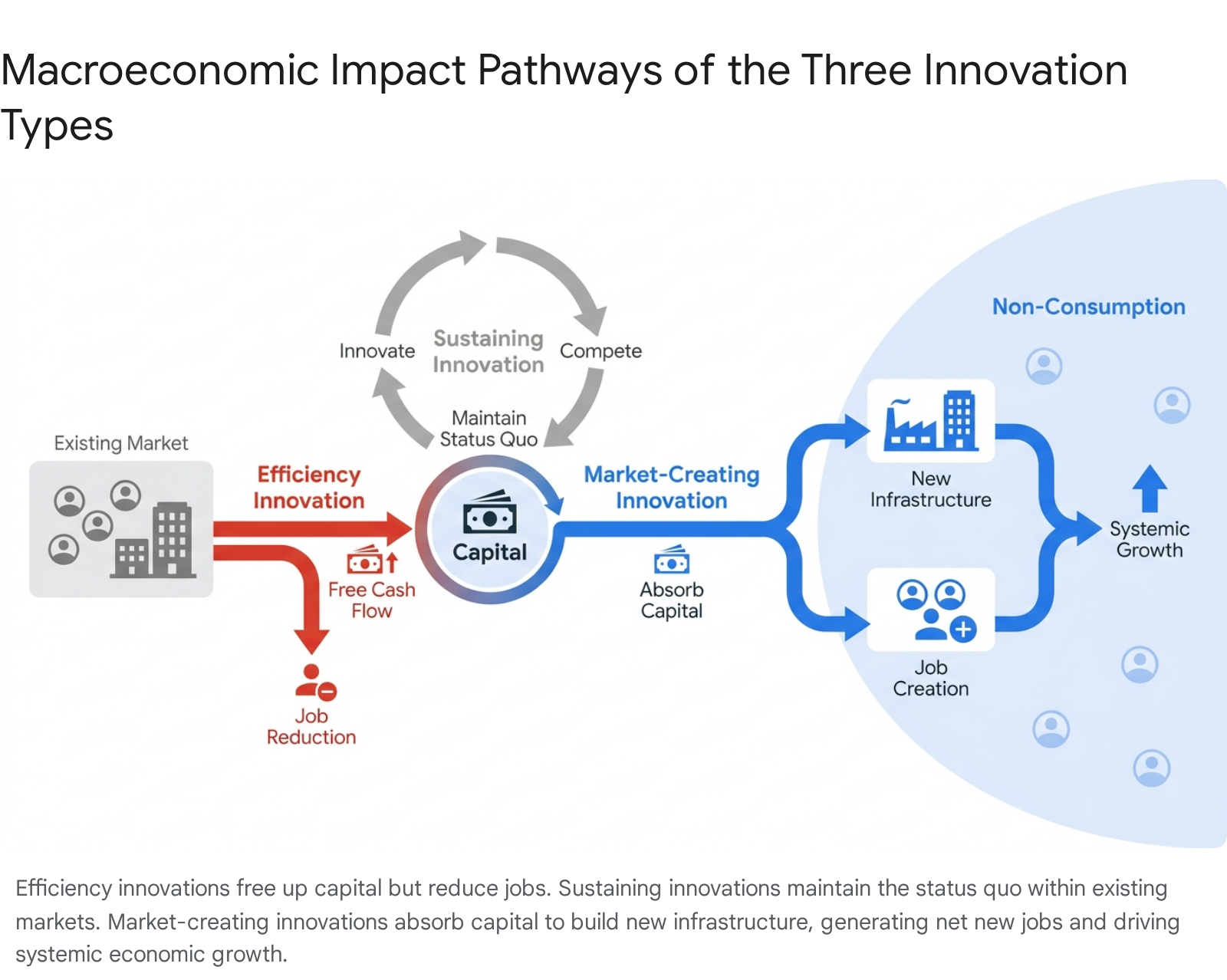
The updated framework divides all innovation activity into three distinct categories: sustaining innovations, efficiency innovations, and market-creating innovations 1519. This classification moves beyond the technological attributes of the product, focusing instead on the innovation's systemic impact on corporate finance, employment, and market expansion 9.
Sustaining Innovations
In the updated model, the definition of sustaining innovation remains consistent with its original formulation. Sustaining innovations focus on making existing products better to satisfy the demands of established customers within existing markets 191718. They encompass a wide spectrum of product development, ranging from minor incremental upgrades, such as new packaging or aesthetic redesigns, to major technological leaps, such as the transition from a dual-camera to a triple-camera system on an Apple iPhone 52324.
The macroeconomic function of a sustaining innovation is to keep markets competitive, vibrant, and profitable 38. However, their impact on systemic economic growth is strictly substitutive 919. Because sustaining innovations target populations that are already consuming within the market, they do not create net new consumption 1719. A consumer purchasing a newly released vehicle model is substituting that purchase for their older vehicle, or for a competitor's equivalent offering 2420.
Consequently, sustaining innovations have a neutral effect on net job creation and capital formation 321. Corporations producing sustaining innovations generally utilize the same human resources, distribution channels, marketing engines, and manufacturing facilities required for earlier iterations of the product 1521. While these innovations are essential for the survival of individual firms, they do not function as the primary engines of national economic expansion 1722.
Efficiency Innovations
The most significant diagnostic addition to the framework was the isolation of efficiency innovations. Efficiency innovations are process-oriented advancements that enable an organization to produce and deliver existing products or services using fewer resources, less capital, and less labor 152421. Rather than focusing on the product's features or the target demographic, efficiency innovations optimize the underlying business model and supply chain 15.
Common examples of efficiency innovations include corporate outsourcing, the implementation of robotic process automation, the deployment of advanced data analytics for supply chain logistics, and the consolidation of retail models 151923. The rise of large-scale discount retailers like Walmart, for instance, operated as a massive efficiency innovation in the retail sector. While Walmart's business model severely disrupted traditional department stores, its macroeconomic function was to make retail distribution vastly more efficient, which ultimately resulted in fewer net retail jobs relative to the volume of goods sold 3.
The defining macroeconomic characteristic of efficiency innovations is their capacity to liberate capital while simultaneously eliminating jobs 322. By streamlining operations and reducing human intervention, companies lower their operating expenses and maximize free cash flow 172424. In crowded, mature market sectors where competition is intense and sustaining innovations offer diminishing returns, efficiency innovations are critical for corporate survival 1531. However, because they inherently aim to do more with less, they cannot generate systemic economic growth or expand the labor force 2421.
Market-Creating Innovations
Market-creating innovations serve as the growth engine within the updated framework. These innovations transform complicated, expensive, or inaccessible products into simpler, highly affordable alternatives, specifically targeting a demographic defined as "non-consumers" 151718. Non-consumers are individuals who experience a pressing need or a "job to be done," but are entirely excluded from existing markets due to a lack of financial resources, technical skill, or geographic availability 151722.
Unlike sustaining innovations, which utilize established channels, market-creating innovations require the construction of entirely new value networks 4825. Because the targeted population has historically been ignored by established industries, the requisite infrastructure to serve them - such as distribution logistics, marketing channels, and even basic utilities - often does not exist 152627.
The requirement to build new infrastructure is precisely why market-creating innovations drive macroeconomic prosperity. When a company successfully develops a market-creating innovation, it must inevitably hire vast numbers of new employees to manufacture, market, distribute, and service the product 31519. Furthermore, the establishment of this new value network creates secondary and tertiary industries, pulling in related infrastructure such as roads, power grids, and regulatory frameworks 222728.
A historical benchmark for this phenomenon is Henry Ford's Model T. Prior to its introduction, automobiles were custom-built luxury items accessible only to the extreme wealthy. Ford did not invent the automobile, but through the implementation of assembly-line manufacturing and a radically affordable business model, he transformed it into a product accessible to the average consumer 192930. Serving this vast new market of non-consumers necessitated the creation of massive supply chains for steel, rubber, and glass, as well as the construction of national road networks and localized service stations, generating unprecedented net job growth and institutional development 222829.
Theoretical Overlap and Distinction
The evolution of the terminology has generated scholarly debate, particularly regarding the precise theoretical distinction between "new-market disruption," a term from the original framework, and "market-creating innovation," the focal point of the updated framework. While the two concepts demonstrate significant operational overlap, they represent distinct theoretical lenses applied to different units of analysis 7.
Market-Creating Innovation Versus New-Market Disruption
New-market disruption, formally introduced in Christensen and Raynor's 2003 work The Innovator's Solution, is a firm-centric concept 731. It describes a specific strategic pathway utilized by a disruptive entrant to defeat an incumbent. The theory outlines how an innovator begins by offering simpler, cheaper products to non-consumers - creating a new market segment - and then systematically improves the technology over time. Eventually, the performance of the disruptive product intersects with the demands of mainstream customers, causing a massive shift in customer spending away from incumbent firms in focal or adjacent markets 7. In this context, the focus is on competitive displacement, market share acquisition, and the incumbent's strategic blind spots 53233.
Market-creating innovation, while acknowledging the mechanics of new-market disruption, shifts the analytical lens to macroeconomic and systemic impact 151825. The focus is not on the defeat of the incumbent, but on the societal outcomes of serving non-consumption. It emphasizes the foundational requirement to build new value networks, the necessity of integrating across deficient supply chains, and the resultant generation of net new jobs, institutional capabilities, and physical infrastructure 41525.
Thus, new-market disruption and market-creating innovation often describe the exact same historical event, but interrogate it for different purposes. New-market disruption explains how a startup upended an established industry; market-creating innovation explains how that same startup built a nation's middle class and catalyzed regional economic development 101522. Recent academic efforts, such as the proposed "Creation and Disruption (CD) Theory," seek to formally unify these concepts, positing that market creation and disruption are inherently intertwined processes where the creation of superior customer value for non-consumers inevitably leads to cross-market displacement and broader systemic transformation 734.
Corporate Capital Allocation and Financial Metrics
The macroeconomic utility of the three-category framework is most clearly demonstrated in its diagnosis of capital allocation behaviors within large corporations. The framework identifies a systemic mismatch between the types of innovation required for economic growth and the financial metrics utilized to assess corporate performance 91314.
The Capitalist's Dilemma
In The Capitalist's Dilemma, Christensen and van Bever articulated a contradiction at the core of modern finance. Ideally, the efficiency innovations executed by mature corporations liberate capital, which should then be reinvested into highly capital-intensive market-creating innovations to drive future growth 924. However, this cycle is broken. Despite the abundance of global capital and historically low interest rates, business leaders continue to deploy capital as though it is a scarce resource, systematically prioritizing short-term efficiency over long-term market creation 1335.
The root cause of this systemic failure lies in the orthodox financial metrics used to evaluate managerial performance and shareholder value: Return on Net Assets (RONA), Return on Invested Capital (ROIC), and Internal Rate of Return (IRR) 1135.
Ratio-Based Financial Metrics and Denominator Management
The fundamental flaw of RONA, ROIC, and IRR is that they are expressed as ratios - fractions comprising a numerator and a denominator 11. Consequently, executives are provided with two distinct levers to improve their measured performance. They can undertake the difficult, uncertain work of developing new markets to increase the numerator (total profit), or they can mathematically improve the ratio by shrinking the denominator (total assets or total time) 1136.
- Return on Net Assets (RONA) and ROIC: To improve RONA and ROIC, executives are incentivized to aggressively reduce their asset base. This is achieved by outsourcing manufacturing, liquidating physical plants, and moving assets off the balance sheet 1136. This behavior drives a relentless pursuit of efficiency innovations. While shrinking the denominator rapidly inflates the financial ratios and appeases short-term shareholder expectations, it systematically hollows out the corporation's core capabilities and forecloses avenues for organic, long-term growth 1644.
- Internal Rate of Return (IRR): IRR measures the annualized rate of return on an investment, essentially utilizing time as its denominator. To maximize IRR, managers prioritize projects that yield returns quickly 1136. Market-creating innovations inherently depress IRR because they require massive upfront investments in unproven value networks and infrastructure, typically requiring five to ten years to reach profitability 1337. Conversely, efficiency innovations yield rapid, predictable returns. When corporations impose high hurdle rates - often 15 percent or more - investments are forced to pay for themselves within five years, effectively eliminating market-creating innovations from consideration 1336.
Innovation Performance Measurement Strategies
To overcome the Capitalist's Dilemma, researchers and venture capitalists emphasize the necessity of aligning specific key performance indicators (KPIs) with the distinct nature of the innovation being pursued, moving away from universal reliance on RONA and IRR 373847.
For efficiency innovations, process metrics are appropriate, including reductions in process cycle time, error rate reduction, and employee productivity gains 3747. For sustaining innovations, output metrics such as Net Promoter Score (NPS), market share growth, and customer retention are optimal indicators of whether the product improvements are resonating with the existing customer base 373847.
For market-creating innovations, which exhibit high uncertainty and long maturation horizons, early-stage financial orthodoxies are actively detrimental 3949. Instead, strategic impact metrics and growth-oriented venture capital metrics must be applied. Investors assessing market-creating startups focus on Monthly Recurring Revenue (MRR) growth to validate early demand among non-consumers, and evaluate the Customer Acquisition Cost (CAC) payback period 4041. A critical benchmark for sustainable market-creating business models is the ratio of Customer Lifetime Value to Customer Acquisition Cost (LTV:CAC), with high-growth firms generally requiring a ratio of at least 3:1 to signal long-term viability 384142.
| Innovation Type | Primary Objective | Impact on Net Jobs | Capital Dynamics | Orthodox Financial Bias | Recommended Non-Financial & Growth KPIs |
|---|---|---|---|---|---|
| Efficiency | Reduce cost, optimize existing processes. | Eliminates jobs. | Liberates capital; minimizes required asset base. | Heavily favored by RONA, ROIC, and IRR due to denominator reduction and rapid returns. | Process Cycle Time, Error Rate Reduction, Employee Productivity. |
| Sustaining | Improve product performance to retain top-tier clients. | Neutral; maintains status quo. | Neutral; leverages existing infrastructure. | Favored by margin analyses; produces steady, predictable cash flows. | Net Promoter Score (NPS), Market Share Growth, Retention Rates. |
| Market-Creating | Increase affordability to serve non-consumption. | Generates massive net job growth. | Absorbs capital; requires building new value networks. | Heavily penalized by RONA and IRR due to high initial asset requirements and long maturation. | MRR Growth, LTV:CAC Ratio (≥3:1), Strategic Ecosystem Partnerships. |
Table 1: Comparison of the operational objectives, macroeconomic impacts, and measurement frameworks associated with the three types of innovation. 112237384741.
Global Economic Development and the Prosperity Paradox
The macroeconomic principles established by the three-category framework find their most consequential application in the field of international development. In the 2019 publication The Prosperity Paradox, Christensen, Efosa Ojomo, and Karen Dillon applied the concept of market-creating innovation to explain the historical failures of global poverty alleviation and to propose a new paradigm for sustainable economic growth in emerging markets 102930.
Failures of Traditional Development Models
For over half a century, traditional development economics has operated on a "push" model. Governments, international institutions, and non-governmental organizations identify visible symptoms of poverty - such as poor health, lack of education, or crumbling infrastructure - and attempt to push resources into the system through billions of dollars in foreign aid 162230. Despite massive investments, these efforts frequently fail to generate sustainable prosperity; in many instances, wells break down, schools lack teachers, and recipient nations remain economically stagnant 102730.
The framework argues that these failures occur because the resources are pushed into environments that lack the underlying economic engine required to maintain them 222729. Infrastructure and institutions are not the prerequisites for economic development; rather, they are the lagging indicators of a thriving market economy 1527.
In contrast to the push model, market-creating innovations act as a "pull" mechanism. By identifying vast areas of non-consumption and developing affordable business models to serve them, entrepreneurs create a powerful profit motive 162729. This demand pulls in the necessary resources, catalyzes the construction of private infrastructure, and inevitably drives the development of supporting institutions and regulatory frameworks required for sustained economic growth 152227.
Market-Creating Innovation in Africa
The African continent provides compelling empirical evidence for the transformative power of market-creating innovation. The telecommunications sector, pioneered by entrepreneurs like Mo Ibrahim (founder of Celtel), is a definitive example. In 1998, mobile phones in Africa were considered luxury items for a tiny elite, and international telecoms avoided the continent due to a profound lack of landline and power infrastructure 1527. Ibrahim viewed this non-consumption as an unprecedented opportunity. By deploying pre-paid business models and building independent cellular networks, Celtel created a new market that rapidly scaled 2728. The demand for mobile access pulled billions in foreign direct investment to construct cell towers, established extensive retail distribution networks for pre-paid cards, and generated millions of jobs, ultimately serving as the foundational infrastructure for subsequent market-creating innovations like mobile banking and fintech 2728.
The Tolaram Group's introduction of Indomie instant noodles to Nigeria further illustrates the infrastructural pull of market creation. In 1988, Nigeria was under military rule, the average citizen lived on less than two dollars a day, and no market for instant noodles existed 2627. Traditional market segmentation would have deemed the investment unviable. However, Tolaram recognized the profound non-consumption of affordable, convenient food 2643.
Because public infrastructure was insufficient, Tolaram was forced to integrate backward and construct its own value network. The company built thirteen manufacturing plants across Nigeria and provisioned them with independent power generation facilities to bypass the unreliable national energy grid 2643. To solve logistical bottlenecks, Tolaram established a massive transport subsidiary with a fleet exceeding 1,000 trucks, and invested heavily in employee training to overcome the local deficit in technical education 2643. The result of this market-creating endeavor was the establishment of a billion-dollar industry that created nearly 8,000 direct jobs, supported over 100,000 indirect jobs across a network of 600,000 retailers, and fundamentally improved regional prosperity 2643.
Similar dynamics are observed in the renewable energy sector. M-KOPA, a Kenyan startup, recognized the non-consumption of reliable electricity among populations reliant on expensive and dangerous kerosene 2728. By pairing solar panel technology with a pay-as-you-go financing model facilitated by mobile money, M-KOPA made clean energy accessible without requiring steep upfront capital, pulling millions of citizens into a modernized energy grid 2728. In the healthcare and insurance sectors, MicroEnsure targeted low-income populations across Africa and Asia who had never experienced formal insurance 44. By utilizing mobile network operators as distribution channels and designing simplified, context-specific health and life insurance products, MicroEnsure reached over 60 million consumers, creating a safety net for demographics previously ignored by incumbent financial institutions 44.
Market-Creating Innovation in Latin America
Latin America also serves as a robust incubator for market-creating models, where local entrepreneurs leverage technological innovation to overcome systemic regional barriers such as high economic inequality, bureaucratic friction, and political instability 5545.
Grupo Bimbo's origins in Mexico demonstrate foundational market creation. In 1945, Mexico was an impoverished nation with a GDP per capita of approximately $2,000, and fresh, hygienic bread was inaccessible to the working class 46. The founders of Bimbo identified this non-consumption and established a centralized baking and distribution model. Facing a severe lack of quality agricultural inputs, Bimbo provided capital directly to Mexican farmers to secure high-quality seed stock, guaranteeing the purchase of their harvests 46. To overcome educational deficits, they implemented rigorous internal management and technical training programs 4546. By wrapping their bread in novel cellophane packaging to guarantee freshness, Bimbo created a massive consumer base. Today, Bimbo is a $14 billion global conglomerate, demonstrating how building value networks in emerging markets yields deeply entrenched competitive advantages 4546.
In the contemporary digital era, Latin American technology firms are accelerating prosperity through market-creating platforms. Nubank, founded in Brazil, recognized the massive non-consumption of financial services caused by highly concentrated, predatory incumbent banks that charged exorbitant interest rates and fees 5547. By leveraging data analytics and a branchless digital model, Nubank provided accessible credit cards and banking services to millions of unbanked citizens, fundamentally disrupting the regional financial sector and driving financial inclusion 5547.
Similarly, the Colombian platform Rappi evolved from a simple delivery service into a comprehensive regional "super-app" by adapting to the highly fragmented retail environments of Latin American cities, creating logistical infrastructure where public systems failed 5547. In Chile, NotCo utilizes proprietary artificial intelligence algorithms to decode the molecular structure of animal-based foods and replicate them using widely available plant inputs, creating affordable and sustainable alternatives that address broader regional constraints regarding agricultural water usage and emissions 5548.
| Company | Origin Region | Targeted Non-Consumption | Market-Creating Mechanism / Infrastructural Pull |
|---|---|---|---|
| Tolaram Group | Nigeria | Lack of affordable, convenient nutritional options. | Built 13 manufacturing plants, independent power grids, and a 1,000-truck logistics network. |
| Celtel (Mo Ibrahim) | Pan-Africa | Exclusion from global telecommunications. | Deployed pre-paid business models; attracted billions in FDI to build cellular towers. |
| M-KOPA | Kenya | Reliance on toxic, expensive kerosene for lighting. | Introduced pay-as-you-go micro-financing linked to mobile money for home solar kits. |
| Grupo Bimbo | Mexico | Inaccessibility of fresh, hygienic baked goods. | Financed local agricultural supply chains and established rigorous internal technical training. |
| Nubank | Brazil | Exclusion of the working class from formal banking. | Leveraged branchless digital infrastructure and alternative data to offer fee-free financial inclusion. |
Table 2: Notable examples of market-creating innovations in emerging economies and the infrastructural value networks they established. 262743554647.
Academic Critiques and Theoretical Debates
Despite its widespread adoption by policymakers, corporate strategists, and international development organizations, Christensen's evolving innovation framework has been the subject of rigorous academic critique. Peer-reviewed literature highlights methodological ambiguities, questions the empirical generalizability of the theory, and points to significant socio-political blindspots 4950.
Ambiguity in the Unit of Measure
A primary methodological critique of disruptive innovation theory - applicable to both the original binary model and the updated three-category framework - is the fluidity of its unit of measure 49. Epistemological rigor dictates that a theory must possess a stable unit of analysis to be testable and generalizable. Critics argue that Christensen's work continually shifts its foundational unit depending on the specific case study being analyzed 49.
In certain iterations, the theory analyzes the attributes of a specific technology; in others, it focuses on firm-level organizational structures and resource allocation; elsewhere, it analyzes the business model or broad market demographics 49. Some methodologists assert that this shifting baseline allows for post-hoc rationalization, where the framework is retroactively mapped onto successful companies while failures are dismissed as having misunderstood the theory 4951. While defenders of the theory argue that this evolution reflects necessary refinements in response to complex, real-world market dynamics, the lack of a standardized empirical metric remains a point of contention in management science 49.
Generalizability and Empirical Validity
The generalizability of the framework's predictive power has also been heavily scrutinized. To test the empirical foundation of the theory, researchers King and Baatartogtokh surveyed an extensive cohort of academic experts regarding the 77 historical cases of disruption explicitly cited by Christensen in his foundational texts 4952.
The researchers evaluated each case against four strict criteria of the theory: whether incumbents were improving along a sustaining trajectory, whether the pace of innovation outstripped consumer needs, whether incumbents possessed but failed to exploit the capability to respond, and whether the incumbents faltered strictly due to disruption 4952. The findings were highly critical, concluding that only a very small fraction - approximately nine percent - of the cited cases adhered strictly to all theoretical conditions of disruption 4952. While this does not completely invalidate the phenomenological utility of the framework for practitioners, it suggests that the theory is less universal in its predictive accuracy than frequently claimed in popular business literature 49.
Institutional and Socio-Political Considerations
When applied to global economic development via the concept of market-creating innovation, the framework encounters profound socio-political critiques. Scholars analyzing the Prosperity Paradox from the perspective of critical development theory argue that the framework exhibits a narrow, overly capitalistic focus on technological and market-based solutions, systematically downplaying the impact of historical colonialism, entrenched institutional corruption, and systemic political disenfranchisement 4950.
Critics drawing on alternative epistemological paradigms, such as the Andean concept of Buen Vivir (Good Living), argue that defining prosperity exclusively through the lens of capitalist market expansion reinforces unsustainable models of extraction, individualism, and hyper-consumption 50. From this perspective, assuming that poverty in the Global South is primarily the result of a lack of entrepreneurial innovation ignores structural global inequalities 5053.
Furthermore, historical precedents like the Appropriate Technology movement of the 1970s - which similarly advocated for low-cost, simplified technologies for low-income populations - demonstrate that product innovation alone cannot overcome severe political instability or the absence of fundamental human rights 50. Critics argue that while market-creating innovation provides valuable tools for localized economic empowerment, elevating it to a universal panacea risks excusing governments from their fundamental obligations to provide public education, equitable healthcare, and stable governance 5053.
Conclusion
The evolution of Clayton Christensen's innovation framework from a two-category model focused on firm-level competitive strategy into a three-category model examining macroeconomic systems represents a critical advancement in management science. The original binary distinction between sustaining and disruptive innovations effectively explained incumbent failure but failed to account for the stagnation of global capital and the complexities of international economic development.
By categorizing innovation into sustaining, efficiency, and market-creating typologies, the updated framework directly addresses the macroeconomic impacts of capital allocation and labor. It provides a robust diagnostic tool for the "Capitalist's Dilemma," revealing how an over-reliance on efficiency-based financial metrics like RONA and IRR systematically starves organizations of long-term, organic growth. Furthermore, it establishes the foundation of the "Prosperity Paradox," illustrating that traditional push-based aid models are insufficient for poverty alleviation, and demonstrating how market-creating innovations targeting non-consumption can pull vital physical and institutional infrastructure into emerging economies. While subject to valid academic critiques regarding empirical measurement and socio-political blindspots, the updated three-category framework remains a profound lens for understanding the intricate relationship between business strategy, capital markets, and global prosperity.