
Operationalizing value innovation in Blue Ocean Strategy
Theoretical Foundations of Strategic Market Creation
The evolution of strategic management throughout the late twentieth century was largely dominated by structuralist economics and the positioning school of thought, most notably encapsulated by Michael Porter's generic strategies of cost leadership, differentiation, and focus . Under this conventional logic, industry structures are assumed to be fixed, exogenously given environments 12. Organizations, therefore, must choose a definitive competitive position within those rigid boundaries to secure a sustainable advantage 2. Firms are forced into a zero-sum game, competing for a greater share of existing demand within defined parameters 23. This approach inevitably leads to a value-cost trade-off, dictating that a company can either create greater value for customers at a higher cost or create reasonable value at a lower cost, but cannot simultaneously achieve both 256.
W. Chan Kim and Renée Mauborgne introduced a fundamental departure from this competition-based approach through the concept of "Blue Ocean Strategy," which advocates for a reconstructionist view of market boundaries 12. At the core of this strategic framework is the concept of value innovation 345. Value innovation operationalizes the creation of uncontested market spaces by rendering the existing competition irrelevant 167. The empirical foundation of this framework rests on a longitudinal study of business launches spanning over 100 years and 30 industries 67. The researchers found that while 86 percent of launches were incremental line extensions operating within existing markets (red oceans), they accounted for only 39 percent of profits 68. Conversely, the 14 percent of launches that created new markets (blue oceans) generated 38 percent of total revenues and a disproportionate 61 percent of total profits 68.
The strategic logic of value innovation fundamentally rejects the value-cost trade-off 36. Instead of benchmarking competitors and attempting to outpace rivals through marginal improvements, value innovators seek to simultaneously pursue drastic cost reduction and unprecedented buyer value 1345. This alignment alters the competitive landscape, shifting the focus from fighting over existing customers to reaching beyond current demand to attract non-customers 379.
Value Innovation Distinctions
A critical theoretical distinction within the framework is the divergence between value innovation and pure technological innovation 101112. Academic literature and market history demonstrate that technological advancements frequently fail to translate into market creation if they are disconnected from practical buyer utility 1012.
Divergence from Technological Innovation
Inventions such as the Segway and Google Glass are frequently cited as examples of profound technological innovations that ultimately failed to create compelling new markets 10. Despite the advanced engineering involved, these products lacked a grounded value proposition. The Segway failed due to high costs, lack of a complementary infrastructural ecosystem, and a failure to address practical buyer pain points regarding storage and transportation 10. Similarly, Google Glass suffered from high pricing, privacy concerns, and a lack of aesthetic appeal, representing technology that outpaced actual consumer demand 10.
Conversely, highly successful value innovations often utilize existing technologies or no new technologies at all, recombining standard elements to deliver a quantum leap in buyer utility 31011. Organizations that anchor their innovation strictly to value avoid the trap of investing heavily in research and development for features that the market does not demonstrably prioritize 1011. Technology acts merely as a catalyst or enabler for value creation, not the value itself 11. To consistently operationalize this alignment between innovation, utility, price, and cost, the Blue Ocean framework relies on specific diagnostic and action tools: primarily the Strategy Canvas and the Four Actions Framework 451314.
Mechanics of the Strategy Canvas
The Strategy Canvas is the central diagnostic and action framework utilized to visualize the competitive landscape and design a divergent value proposition 13141516. As a specific form of information visualization, it addresses the inherently abstract nature of strategic management by providing a graphical representation of an industry's current state and a company's relative strategic profile 15.
Diagnostic Functions and the As-Is State
In its diagnostic capacity, the Strategy Canvas captures the "as-is" state of a known market space 132117. The horizontal axis of the canvas maps the range of key factors upon which the industry currently competes and invests 141618. These factors typically encompass product features, service elements, pricing structures, and delivery mechanisms, which are identified through comprehensive market analysis 131819. The vertical axis represents the offering level that buyers receive across these key factors, measured on a numerical scale, often from 1 (minimal value) to 10 (maximum value) 1619.
By plotting the performance of existing market players across these factors, organizations can identify the dominant strategic profiles within an industry. In red oceans, the value curves of competing firms almost always converge, reflecting a herd mentality 169. Companies routinely benchmark against one another, leading to a homogenization of strategy where firms offer largely indistinguishable propositions 169. This convergence inevitably drives the market toward commoditization, forcing firms to compete primarily on marginal pricing adjustments or minor feature enhancements 235.
Constructing the To-Be Value Curve
To transition from a diagnostic overview to actionable strategy, organizations use the canvas to map a "to-be" value curve that visually defines the new strategic offering 2120. A successful value innovation curve must pass three rigorous tests to ensure it has successfully broken away from the competition 6.
First, the strategy must demonstrate strict focus. The organization must not diffuse its efforts across all industry factors 618. It must selectively prioritize specific variables, indicating a deliberate allocation of resources rather than an attempt to be all things to all customers 618. Second, the shape of the new value curve must show marked divergence 618. The profile must stand apart fundamentally from the profiles of competitors 618. If the curve closely shadows existing players, the organization remains trapped in competitive mimicry 69. Third, the strategy must support a compelling tagline 618. The organization must be able to compress the idea into a clear, unified message that immediately communicates the leap in buyer utility 6. If the positioning requires extensive explanation, the underlying strategy is likely muddled 6.
To achieve this divergence, organizations must cease utilizing competitors as their primary benchmarks 192122. Instead of looking at existing rivals, the framework requires practitioners to look across alternative industries and target non-customers to understand the pain points and intimidation factors that restrict broader market adoption 3716.
The Four Actions Framework and ERRC Grid
While the Strategy Canvas provides the visualization of value innovation, the Four Actions Framework, operationalized through the Eliminate-Reduce-Raise-Create (ERRC) Grid, supplies the specific mechanisms required to reconstruct buyer value elements and mathematically alter the value curve 451423. The ERRC matrix systematically forces managers to scrutinize implicit industry assumptions and execute the value-cost trade-off break 1423.
Cost Structure Compression: Eliminate and Reduce
The first two actions target the reduction of the organization's cost structure by stripping away variables that no longer offer proportional buyer value 56529.
The mandate to "Eliminate" requires organizations to identify factors that the industry has long competed on and takes for granted, yet which must be removed entirely 5529. Often, these factors have lost their relevance due to shifting consumer preferences, but incumbent firms continue to invest in them out of institutional inertia or routine benchmarking habits 5. Eliminating these factors fundamentally alters the core business model and drastically reduces operational costs 5514.
The mandate to "Reduce" asks which factors should be scaled back well below the industry standard 5529. In the race to match or beat rivals, industries often overdesign their products, adding layers of complexity and cost that exceed what the mass of buyers actually demands or is willing to pay for 523. By reducing these elements, companies streamline their offerings, mitigate feature bloat, and further compress their cost base 55.
Value Proposition Elevation: Raise and Create
The latter two actions focus on elevating buyer utility and capturing new demand by introducing elements that differentiate the offering from the market standard 56529.
The mandate to "Raise" dictates that organizations must identify factors that should be elevated well above the current industry norms 5529. This involves amplifying the specific elements of a product or service that drive the most significant buyer satisfaction, ensuring the offering vastly outperforms alternatives in these highly targeted areas 5.
The mandate to "Create" pushes the organization to invent entirely new factors that the industry has never offered 5529. By creating new variables, the firm introduces distinct sources of value, effectively shifting the basis of competition and appealing to previously unserved "non-customers" who had previously rejected the industry entirely 3516.
Integration within the ERRC Matrix
The ERRC Grid serves as a 2x2 matrix that enforces the simultaneous execution of all four actions 52330. According to strategic management literature, managers exhibit a strong cognitive bias toward adding features (Raising and Creating) while neglecting to subtract them 623. This additive bias traditionally leads to over-engineered products and bloated cost structures, resulting in premium pricing that restricts market size 523. The ERRC Grid mitigates this by flagging strategies that are overly focused on value creation without concurrent cost elimination 23. It is only through the disciplined application of all four quadrants that a firm can achieve true value innovation 523.
| Operational Action | Strategic Objective | Economic Impact |
|---|---|---|
| Eliminate | Remove factors taken for granted by the industry. | Drastic cost reduction; simplification of the business model. |
| Reduce | Scale back overdesigned factors below industry standards. | Marginal cost reduction; reduction of operational friction. |
| Raise | Elevate critical utility factors well above industry norms. | Increase in perceived buyer value and satisfaction. |
| Create | Introduce entirely new factors never offered by the industry. | Unlocking new demand and non-customers; breaking market boundaries. |
Reconstructing Market Boundaries via the Six Paths Framework
To answer the questions posed by the ERRC grid, Blue Ocean Strategy employs the Six Paths Framework 41724. This framework provides a structured methodology for looking across conventional boundaries to identify which factors to eliminate, reduce, raise, or create 1724. Rather than accepting the existing definitions of the market, managers systematically explore six distinct perspectives to reconstruct market realities 24.
The first path involves looking across alternative industries 24. Instead of focusing on direct competitors, companies analyze alternatives that serve the same core buyer need, capturing broader market insights 24. The second path requires looking across strategic groups within an industry 1724. Firms analyze why customers trade up to premium groups or trade down to budget groups, identifying factors that can be combined 24. The third path examines the chain of buyers 24. Industries often focus on a single target buyer, such as the purchasing agent; the framework suggests shifting focus to users or influencers to unlock new value 24.
The fourth path looks across complementary product and service offerings, acknowledging that products are rarely used in a vacuum 1724. By identifying what happens before, during, and after a product is used, companies can eliminate pain points 24. The fifth path scrutinizes the functional or emotional appeal to buyers 24. Industries tend to become entrenched in either a functional, price-driven appeal or an emotional, relationship-driven appeal 24. Flipping this orientation often reveals new strategic space 24. Finally, the sixth path involves looking across time to assess external trends 24. Rather than projecting current trends linearly, value innovators identify irreversible trends and assess how they will fundamentally alter buyer value 24. By processing market data through these six paths, organizations populate the ERRC grid with empirically grounded variables 1724.
Empirical Application in Traditional Industries
To fully understand how the Strategy Canvas and ERRC Grid operationalize value innovation, it is necessary to examine empirical case studies across diverse industries, spanning traditional entertainment, hospitality, emerging market financial services, and cutting-edge artificial intelligence 5182526.
Entertainment: Cirque du Soleil and Marvel
One of the most heavily cited paradigms of Blue Ocean Strategy is Cirque du Soleil 163427. Operating in a rapidly declining industry plagued by high costs, alternative entertainment competition, and growing animal rights controversies, the company utilized the ERRC framework to completely reconstruct market boundaries 163427.
The organization eliminated highly expensive animal acts and star performers, which were immense logistical and financial burdens that no longer aligned with modern consumer sensibilities 162728. They reduced the extreme danger, slapstick humor, and the traditional three-ring format 27. Simultaneously, they raised the artistic dimension, production quality, and venue comfort 163428. Finally, they created entirely new factors for the industry, including a singular theatrical narrative, original musical scores, and intellectual adult themes 1634. This fundamental shift in the value curve allowed Cirque du Soleil to target a completely new demographic - adults and corporate clients willing to pay premium theater ticket prices - thus making traditional circus competitors irrelevant 71618.
Similarly, Marvel provides a potent example of a corporate turnaround utilizing Blue Ocean principles 18. Facing bankruptcy, Marvel redefined the motion picture production model by breaking the value-cost trade-off 18. By creating an interconnected cinematic universe and maintaining strict creative control while reducing reliance on exorbitant A-list star salaries in early phases, Marvel achieved unprecedented value at lower relative risk, restoring its viability and establishing the most profitable movie franchise in history 18.
Hospitality: OYO Rooms
In the Indian hospitality sector, OYO Rooms disrupted the budget hotel space through rigorous value innovation 224. The budget accommodation sector was historically highly fragmented, offering inconsistent and unpredictable quality that deterred many travelers 224. OYO utilized the ERRC grid to fundamentally redefine the offering and standardize the budget experience 22437.
| ERRC Action | OYO Rooms Strategic Execution |
|---|---|
| Eliminate | Extravagant amenities typical of higher-tier hotels, such as spas, sports clubs, and elegant lounges, which budget travelers did not require 2242837. |
| Reduce | The overall price per night and the variability of room quality, mitigating the uncertainty associated with local guesthouses 242837. |
| Raise | Core hygiene and essential comforts, mandating strict minimum standards for bed linen, air conditioning, and cleanliness 3738. |
| Create | High predictability and standardization through strict auditing, alongside a seamless, tech-enabled digital booking experience via mobile applications 2242837. |
By focusing strictly on hygiene, predictability, and basic technological comforts such as free Wi-Fi and flat-screen TVs, OYO constructed a divergent strategy canvas 22438. This approach appealed to both budget travelers seeking reliability and mid-tier travelers looking to trade down for better value, allowing the company to rapidly scale to thousands of properties internationally 22437.
Empirical Application in Emerging Markets and Digital Platforms
While initially popularized by case studies in physical industries, the ERRC grid and value innovation frameworks are equally robust when applied to digital platforms, financial technology, and artificial intelligence markets 122634.
Financial Services in Emerging Markets: Nubank
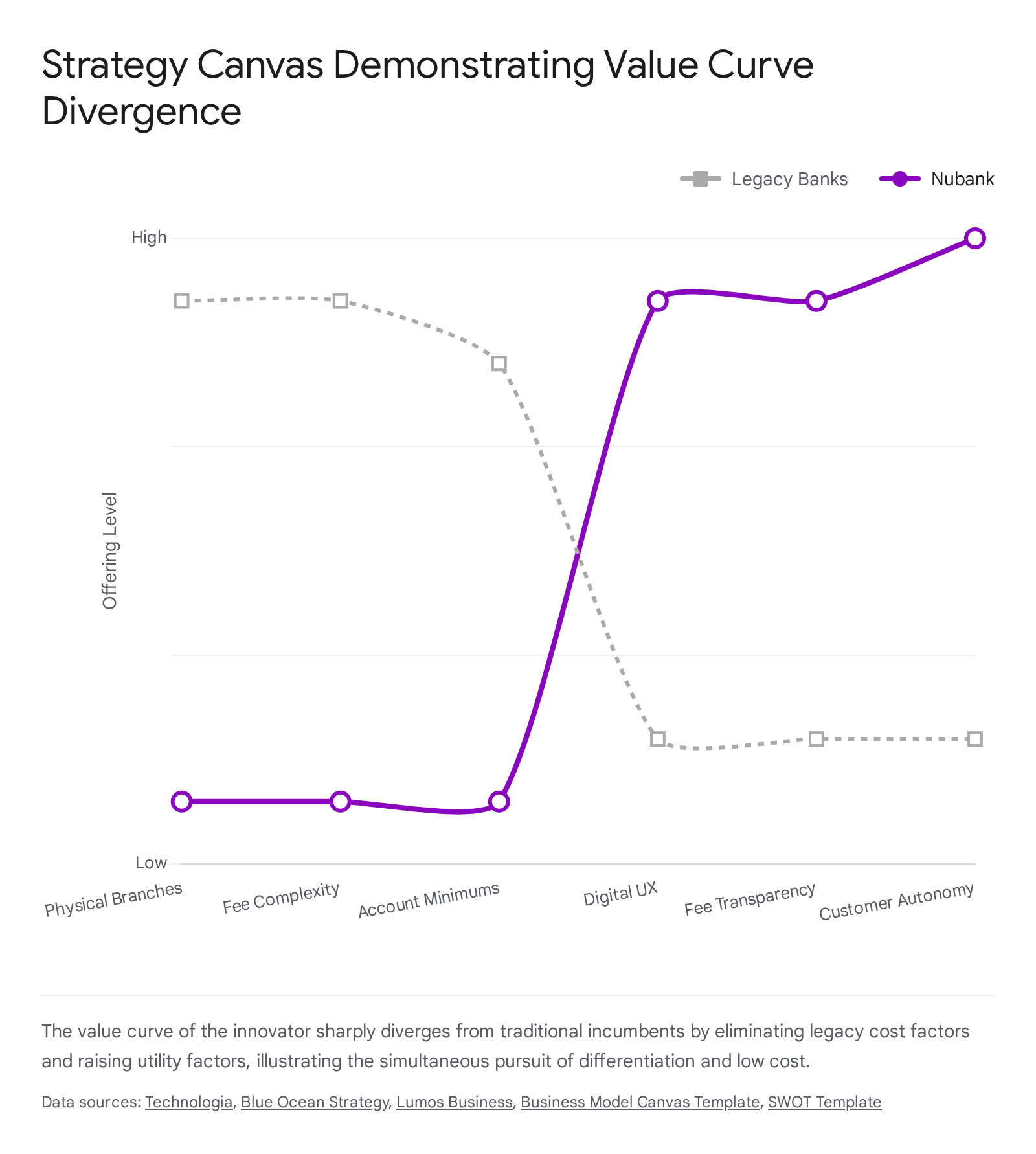
In Latin America, the banking sector has historically been characterized by high concentration, oligopolistic pricing, and massive bureaucratic friction 2639. Legacy banks required physical branch visits for routine tasks, charged complex and opaque fees, and left tens of millions of citizens unbanked or severely underbanked 2639. Nubank, founded in Brazil, successfully deployed a Blue Ocean logic to capture this uncontested space 2639.
Nubank eliminated physical branch networks entirely, alongside the complex fee structures and the bureaucratic friction associated with traditional account opening 263940. This strategic elimination radically altered their cost structure 26. It reduced the customer acquisition cost (CAC) drastically - achieving a CAC of approximately $10 per customer compared to the $100 or more average of traditional incumbent banks - by relying heavily on organic, word-of-mouth growth and referral mechanics 3941.
Concurrently, the firm raised customer autonomy, transparency, and the speed of service through a highly optimized, 100 percent mobile interface 263940. Finally, it created a digital-first ecosystem that inherently targeted the pain points of the unbanked and younger demographics 2640. This resulted in a Net Promoter Score (NPS) consistently above 80, far exceeding the low double-digit scores of traditional banks 2640. As a result of this value curve reconstruction, Nubank penetrated roughly 60 percent of the adult Brazilian market, serving over 90 million customers globally by 2024 and demonstrating deep structural advantages over legacy banks burdened by physical overhead 3940.
Artificial Intelligence and Hardware Constraints: DeepSeek
The principles of Blue Ocean Strategy are increasingly applicable to deep-tech environments, as demonstrated by the rise of the Chinese AI startup DeepSeek 122529. In the generative AI market, US-based industry giants like OpenAI, Google, and Meta became locked in a "red ocean" race defined by exponential parameter scaling and multi-billion-dollar computing budgets, heavily reliant on massive clusters of advanced GPUs 122943.
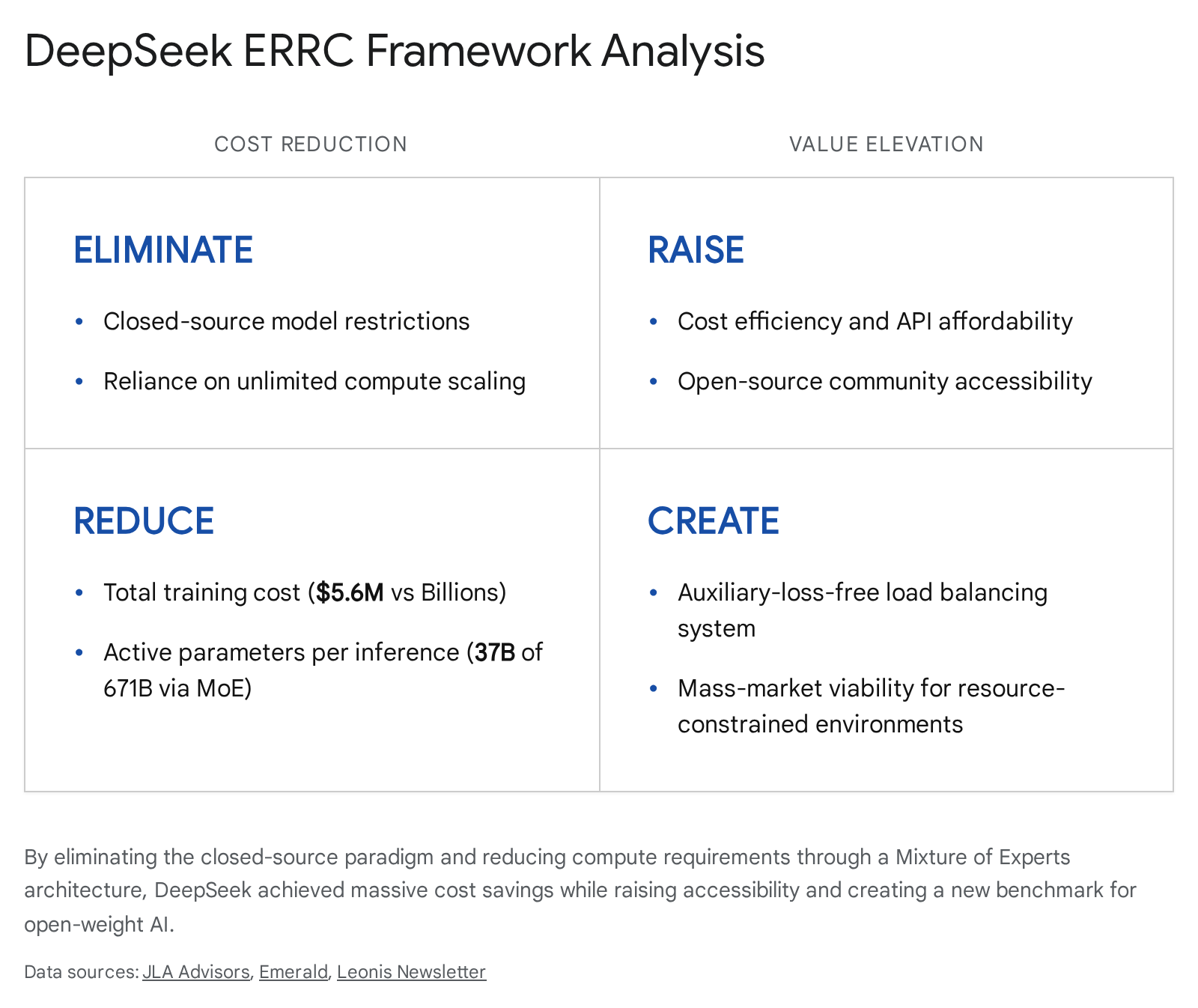
Operating under the geopolitical constraints of US export embargoes on advanced hardware, DeepSeek utilized a divergent approach to Large Language Model (LLM) training 2529. Examining the strategic landscape through an ERRC lens reveals a clear value innovation pathway 2543. The company eliminated the necessity of operating strictly within a closed-source, high-subscription-fee paradigm, as well as the absolute reliance on the highest-tier proprietary hardware ecosystems 2529.
They reduced the overall training cost to a reported $5.6 million - a fraction of competitors' costs - by utilizing 2048 older-generation Nvidia H800 GPUs 2943. Crucially, they reduced computational load during inference by implementing a sophisticated Mixture of Experts (MoE) architecture, activating only 37 billion of the total 671 billion parameters for any given token 2543. In doing so, DeepSeek raised the accessibility, cost-efficiency, and training stability of advanced models 2943. Finally, they created an auxiliary-loss-free load balancing system that optimized hardware utilization, shifting the industry paradigm from raw compute supremacy to algorithmic and architectural efficiency 43. By breaking the deeply entrenched assumption that state-of-the-art AI requires prohibitive capital expenditure, DeepSeek fundamentally reshaped the economics of AI development 2943.
Nondisruptive Creation: Ping An Good Doctor and Stitch Fix
The framework also accommodates "nondisruptive creation," where a blue ocean is established without necessarily displacing existing industries 12. Ping An Good Doctor in China created an internet platform for healthcare management that addressed the scarcity and uneven distribution of high-quality healthcare 1230. Rather than competing with overcrowded physical hospitals, the platform reduced social costs by providing high-quality basic care online, creating accessible, tech-enabled primary care that generated a win-win ecosystem 1230.
In retail, Stitch Fix merged artificial intelligence analytics with human styling expertise 1218. While the fashion retail industry competed heavily on physical store presence or purely algorithmic e-commerce, Stitch Fix eliminated the physical store browsing experience, reduced the paradox of choice for consumers, raised the level of personalization, and created a subscription-based personal styling service delivered to the home 1218. This allowed them to offer a service previously reserved for the wealthy at a mass-market price point, scaling to a multi-billion dollar valuation 12.
Organizational Execution and Adoption Hurdles
Generating a new value curve on a Strategy Canvas is an analytical exercise; operationalizing it across a large enterprise introduces severe execution friction 631. Academic and industry critiques frequently highlight that Blue Ocean frameworks often understate the monumental organizational hurdles required to adopt value innovation 64.
The 'Eliminate' and 'Reduce' quadrants of the ERRC grid almost invariably target business units, operational processes, or legacy features in which an organization has invested heavily over decades 6. Asking an established organization to abruptly abandon industry standards or ignore the competition it has historically benchmarked against triggers massive internal resistance and cognitive dissonance among legacy management 6432. The theoretical neatness of the Strategy Canvas belies the chaotic, friction-heavy reality of reallocating capital, dismantling institutional norms, and betting on untested customer segments 631.
To mitigate this, Kim and Mauborgne advocate for "Tipping Point Leadership" and "Fair Process," requiring leaders to vividly demonstrate the need for change by exposing executives directly to the worst operational realities and customer complaints 730. Strategic alignment across the entire value chain - ensuring that the value proposition, the profit proposition, and the people proposition are mutually reinforcing - is necessary to overcome the natural inertia of a red ocean mentality 3033.
Academic Critiques and Structural Limitations
Despite its widespread corporate adoption, the Blue Ocean Strategy has faced rigorous academic scrutiny within the strategic management literature 634. Critics argue that while the visualization tools are highly intuitive, their underlying epistemology and long-term practical implementation carry significant methodological risks.
Methodological Vulnerabilities and Survivorship Bias
The most pervasive academic critique of Blue Ocean Strategy centers on survivorship bias 693551. The foundational research conducted by Kim and Mauborgne relied on analyzing 108 successful business launches and working backward to isolate their commonalities 6636. By selectively sampling companies that successfully created new markets - while excluding firms that attempted radical value innovation but went bankrupt due to a lack of actual consumer demand in those uncontested spaces - the framework describes what success looks like ex-post without offering statistically reliable ex-ante predictive power 63637.
As analysts point out, for every success story like Cirque du Soleil, numerous experimental entertainment concepts attempted unconventional differentiation and failed entirely 651. Creating a blue ocean without competitors inherently means creating a market without existing customers; the risk that the market demand is zero is a massive hazard that the methodology largely obscures 36. Furthermore, some researchers note that the technology sector exhibits specific structural characteristics that make longitudinal claims of Blue Ocean success highly volatile, suggesting the framework may be less applicable to highly dynamic digital markets compared to traditional manufacturing or services .
Tensions with Porter's Positioning School
The relationship between the Blue Ocean reconstructionist view and the structuralist theories of Michael Porter remains a subject of debate 6. Kim and Mauborgne argue that the focus should be on strategic moves that make competition irrelevant, bypassing structural industry forces 618. However, classical strategy scholars note that this immunity is strictly temporary 633.
When a firm successfully unlocks a highly profitable blue ocean, it inevitably attracts rapid imitation 6433. Over time, the uncontested space fills with competitors, transitioning back into a red ocean 633. For example, the uncontested space created by early digital disruptors quickly normalizes as legacy firms adapt, meaning that the structural forces of supplier power, threat of new entrants, and competitive rivalry (Porter's Five Forces) eventually reassert themselves 641. Consequently, Blue Ocean Strategy is increasingly viewed by academics not as a permanent replacement for competitive positioning, but as a complementary tool specifically suited for discrete phases of organizational renewal and initial market creation, after which traditional competitive defense mechanisms must be employed 633.
Conclusion
The operationalization of value innovation through the Blue Ocean Strategy relies fundamentally on the interplay between the Strategy Canvas and the Four Actions Framework (ERRC Grid). By shifting the unit of analysis from matching competitor benchmarks to fundamentally redefining buyer utility, organizations can systematically visualize competitive landscapes and engineer strategic divergence. The framework's rigorous requirement to simultaneously eliminate legacy costs and create unprecedented value mathematically breaks the traditional value-cost trade-off. Empirical evidence across sectors - from OYO Rooms' standardization in hospitality to Nubank's digital democratization of banking, and DeepSeek's architectural disruption of artificial intelligence - demonstrates the efficacy of these tools in unlocking latent demand.
However, strategic management practitioners must apply these tools with a clear awareness of their inherent limitations. The framework's vulnerability to survivorship bias, the acute execution friction involved in dismantling legacy operations, and the inevitability of blue oceans reddening over time require that value innovation be treated as a dynamic, iterative capability rather than a static endpoint. When utilized rigorously as a diagnostic challenge to industry orthodoxies rather than an infallible predictive model, the Strategy Canvas and Four Actions Framework remain potent instruments for navigating complex, saturated markets.