
Neuroscience and Psychology of Intuition
The concept of intuition, historically characterized by vague colloquialisms such as a "gut feeling," a "hunch," or a "sixth sense," has undergone a rigorous redefinition within contemporary scientific paradigms. For decades, intuition oscillated between being revered as a profound source of non-conceptual wisdom and being dismissed as a highly flawed, bias-prone artifact of evolutionary cognition. However, recent advancements across cognitive psychology, systems neuroscience, and neurobiology have converged to construct an empirical framework for understanding this phenomenon 112.
Rather than a mystical occurrence, intuition is now formally understood as a complex, biologically grounded computational process. It operates primarily below the threshold of conscious awareness, relying on rapid pattern recognition, the continuous processing of interoceptive signals via the gut-brain axis, and the dynamic modulation of large-scale neural networks 112. The emerging scientific consensus models intuition as an evolutionary pathfinding mechanism - a predictive coding strategy that optimizes an organism's interaction with a volatile environment by compressing decades of experiential data into immediate, actionable physiological and cognitive signals 23.
Cognitive Psychology Models of Decision-Making
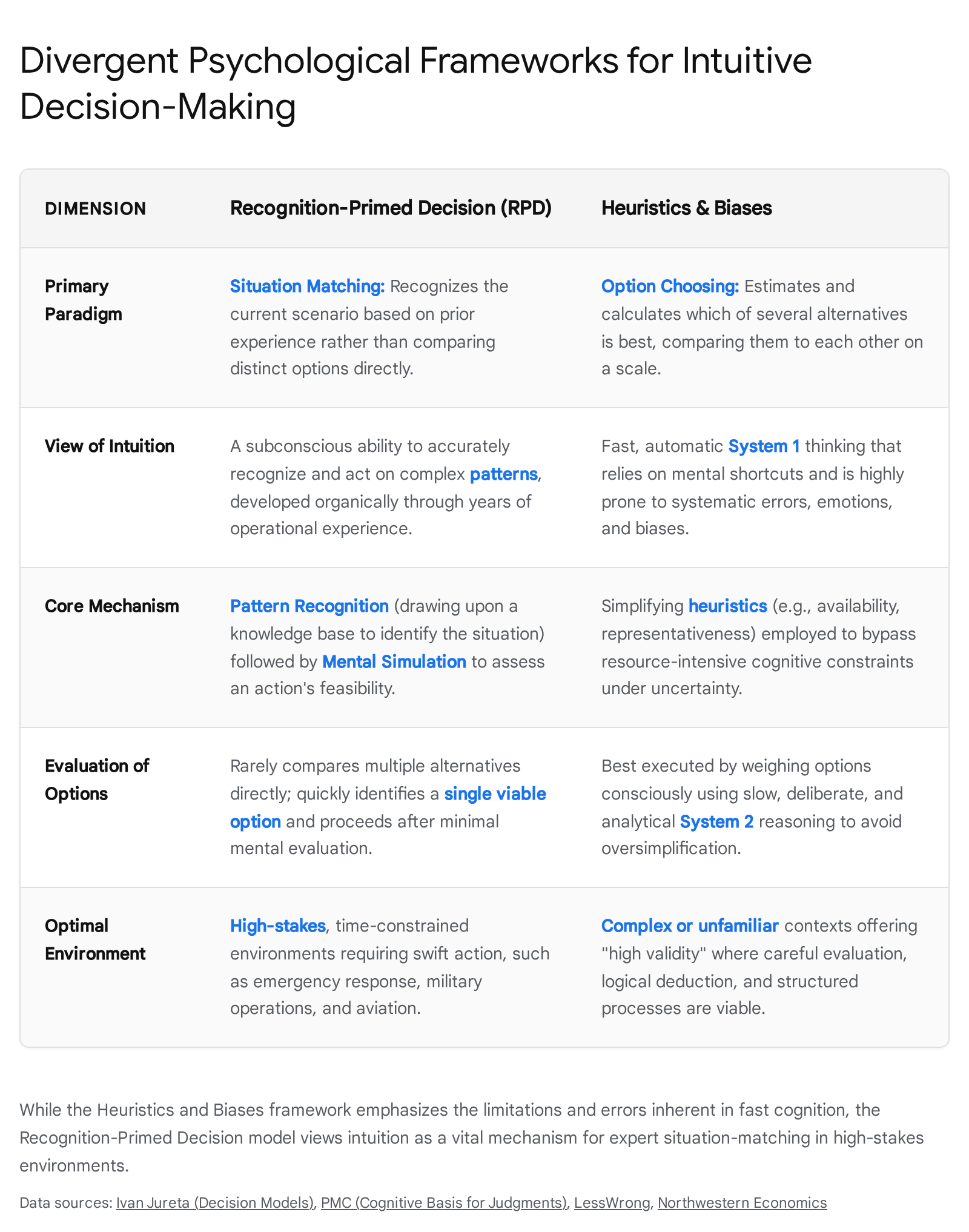
The psychological study of decision-making and intuition has predominantly been shaped by two distinct, and historically conflicting, research traditions: the Heuristics and Biases framework and the Naturalistic Decision Making (NDM) paradigm.
Dual-Process Theory and Cognitive Heuristics
Dual-Process Theory, a foundational framework in cognitive psychology, posits that human cognition is divided into two distinct operating modes. System 1 is characterized as fast, automatic, associative, and emotionally driven, operating with minimal cognitive effort. System 2 is defined as slow, deliberate, analytical, and highly resource-intensive 45. Within this architectural framework, intuition is strictly categorized as a System 1 process.
Research spearheaded by psychologists such as Daniel Kahneman and Amos Tversky highlighted how this fast, intuitive system relies heavily on cognitive heuristics - mental shortcuts used to simplify complex probability assessments and decision-making under uncertainty 46. While these heuristics allow for rapid processing, they systematically deviate from normative rational standards, leading to predictable cognitive biases. Prominent examples include the availability heuristic, where judgments are heavily influenced by the ease with which examples come to mind, and the representativeness heuristic, where probability is assessed based on similarity to established stereotypes while ignoring statistical base rates 47. From this perspective, intuitive decision-making is frequently viewed as a source of systemic error, particularly in modern, statistically complex environments where evolutionary shortcuts are misaligned with empirical realities 67.
The Recognition-Primed Decision Model
In stark contrast to the Heuristics and Biases school, the Naturalistic Decision Making (NDM) tradition, pioneered by Gary Klein, studies how domain experts make decisions in real-world, high-stakes, and time-compressed environments (e.g., firefighters, military commanders, chess masters, and critical care physicians) 479. Klein's Recognition-Primed Decision (RPD) model fundamentally reframes intuition. Rather than viewing it as a flawed heuristic, the RPD model defines intuition as the rapid matching of situational cues to an extensive internal library of recognized patterns 1910.
In the RPD framework, experienced operators do not engage in the concurrent comparison of multiple options - a hallmark of classical analytical decision-making that requires significant System 2 resources. Instead, they quickly recognize a situation as belonging to a prototypical class of events they have encountered previously. This recognition immediately generates relevant situational cues, expectations regarding how the event will unfold, plausible operational goals, and a single, viable course of action 9. The decision-maker then subconsciously mentally simulates this action to check for obvious failure points; if the simulation is successful, they execute the action without further deliberation 4711.
Expert intuition is thus functionally understood as "compressed data" 1. It is the output of a subconscious recognition process operating on domain-specific patterns acquired through years of observation, execution, and feedback 1.
Contextual Validity and Expert Reliability
The longstanding tension between the Heuristics and Biases school and the NDM school has been largely reconciled by identifying the precise environmental conditions required for intuition to be reliable. Collaborative research by Kahneman and Klein concluded that intuitive expertise can only be trusted if two stringent conditions are met. First, the environment must be of "high validity," meaning there are stable, reliable cues that consistently predict outcomes. Second, the individual must have had adequate opportunities to practice their judgment with high-quality, rapid feedback 7912.
In high-validity environments, such as chess or firefighting, pattern recognition yields highly accurate intuitive judgments. Conversely, in low-validity environments lacking clear causal feedback loops - such as long-term political forecasting or stock market picking - subjective confidence in one's intuition frequently outstrips actual accuracy, rendering System 1 judgments highly unreliable and prone to the biases identified by Tversky and Kahneman 9.
Expert Versus Novice Feature Selection
The operational mechanics of the RPD model have been validated through studies directly comparing expert and novice decision-making patterns. For instance, expert fingerprint examiners demonstrate vastly superior non-analytic skills compared to novices, accurately determining matches within a fraction of a second or when images are embedded in heavy visual noise 513. While novices tend to rely on slow, deliberate comparative analysis across multiple features, experts rely on rapid perceptual processing, utilizing a finely discriminated feature set to recognize matching patterns almost instantly 1113.
Similarly, in diagnostic medical contexts, novices frequently follow a rigid "garden path," comparing all available symptoms systematically. Experts, however, employ a flexible intuitive approach, immediately recognizing the holistic pattern of a disease and intuitively detecting when a diagnosis is incorrect without needing to trace back through a structured logical sequence 711.
Empirical Comparisons and Societal Bias
While neurobiology and experimental psychology demonstrate the immense computational power and necessity of intuitive processing, empirical studies comparing the perceived value of intuition versus analytical reasoning reveal a complex picture heavily influenced by societal biases.
Folk Beliefs Regarding Deliberation and Intuition
Despite the documented efficacy of expert intuition, human populations exhibit a strong, subconscious bias against it. A comprehensive 2025 psychological study across 13 distinct experimental vignettes revealed a pervasive "folk theory" of reasoning: participants consistently rated individuals who utilized slow, deliberative reasoning as significantly more intelligent and trustworthy than those who relied on fast, intuitive reasoning 815.
Crucially, this preference held firm even when participants were explicitly informed that the intuitive thinker's accuracy was identical to that of the deliberative thinker 815. The bias against intuition was resilient even under conditions of high cognitive load and time pressure, suggesting that the preference for deliberation is, paradoxically, an intuitive heuristic itself 8. Strikingly, when the identical experimental vignettes were evaluated by large language models (ChatGPT 3.5 and 4), the artificial intelligence replicated the human bias perfectly, systematically downgrading intuitive thinkers in favor of analytical ones 815. This widespread societal discounting of intuition highlights a fundamental disconnect between how efficiently the brain's subconscious computational architecture functions and the degree of conscious trust society places in it.
The Impact of Stress on Cognitive Strategy
The reliability of intuitive decision-making is also highly sensitive to systemic physiological stress. Under conditions of acute stress, the brain undergoes a strategic shift in information processing, formalized as the "stress-induced deliberation to intuition" (SIDI) hypothesis 9.
According to the SIDI hypothesis, stress forces individuals to abandon resource-intensive, goal-directed analytical choices in favor of habitual, intuitive responses 9. Neuroimaging studies tracking this phenomenon demonstrate heightened activation in the basal ganglia - specifically the caudate and putamen - during stress-induced decision-making 9. While shifting to intuition preserves cognitive energy during a crisis, it can degrade the quality of complex risk assessments if the individual lacks the requisite expert pattern library to navigate the specific high-stakes scenario intuitively.
Neurobiological Substrates and Brain Networks
The phenomenological experience of a "gut feeling" or a sudden "hunch" is underpinned by distinct, measurable neural activity. Neuroimaging and electrophysiological studies have identified several key brain structures that facilitate the rapid, subconscious integration of sensory data, memory, and emotional valence required for intuitive judgments.
| Brain Region / Network | Primary Function in Intuitive Processing | Empirical Observation |
|---|---|---|
| Ventromedial Prefrontal Cortex (vmPFC) | Value computation, affective integration, and rapid pattern recognition. | Early encoding of confidence signals prior to conscious choice; real-time fMRI shows rapid regulatory control acquisition 1011. |
| Basal Ganglia (Putamen / Caudate) | Implicit learning, habit formation, and execution of automated choices. | Increased connectivity with vmPFC during motivational learning; dominant during stress-induced decision-making 91012. |
| Anterior Cingulate Cortex (ACC) | Cognitive control, monitoring cognitive effort, and strategy selection. | Optogenetic silencing increases impulsivity; theta oscillations regulate resistance-based versus resource-based cognitive effort 1314. |
| Default Mode Network (DMN) | Autobiographical memory, episodic future thinking, and opportunistic assimilation. | Generates intuitive hunches via nonconscious mapping of future trajectories during rest or mind-wandering states 21516. |
| Hippocampal-Entorhinal Complex | Sequence encoding, spatial mapping, and memory replay. | Sharp-wave ripples act as a neural correlate for rapid pattern matching, triggering insights into consciousness 23. |
The Ventromedial Prefrontal Cortex and Motivation
The ventromedial prefrontal cortex (vmPFC) acts as a critical hub for processing risk, reward, and value computation. The vmPFC is heavily implicated in rapid pattern recognition and the integration of affective (emotional) information into decision-making. Electroencephalography (EEG) and simultaneous fMRI studies reveal that trial-to-trial variability in early confidence signals - occurring prior to an individual's explicit, conscious choice - is uniquely associated with responses in the vmPFC 11. This suggests that the vmPFC holds an early confidence representation arising from subconscious decision dynamics before it reaches metacognitive awareness.
Recent clinical trials utilizing real-time fMRI neurofeedback have demonstrated that individuals can rapidly acquire regulatory control over the vmPFC. Enhanced activity in this region directly correlates with increased anticipated pleasure and regulatory efficacy, suggesting that the vmPFC translates subconscious pattern recognition into conscious motivational states 10. Network analyses further reveal that network-level plasticity in motivational learning circuits - specifically strengthened connectivity between the vmPFC and the putamen (a component of the basal ganglia) - facilitates this regulatory control 10.
Basal Ganglia Dynamics and Habitual Pathways
The basal ganglia are essential for habit formation, implicit learning, and the execution of previously learned choices 12. They serve as a primary engine for the rapid, automated responses characteristic of expert intuition. The rostral intralaminar nuclear complex (rILN) projects to the dorsal striatum, signaling at the precise moment of action initiation and reward acquisition, positioning the basal ganglia-thalamic node as a critical controller of context-dependent gating and action selection 12. As detailed in the SIDI hypothesis, the brain frequently defaults to these basal ganglia-driven circuits under high stress, substituting careful deliberation with immediate, intuitive reflex actions 9.
The Anterior Cingulate Cortex as a Cognitive Gatekeeper
The Anterior Cingulate Cortex (ACC) serves as an essential arbiter of cognitive strategy, tracking the costs of cognitive effort and signaling whether a decision requires slow deliberation or fast, intuitive execution. Because of its extensive bilateral connections with regions regulating autonomic tone, the ACC is anatomically well-suited to integrate physiological states with cognitive demands 14.
Optogenetic studies in rodents performing delay-discounting tasks - a measure of cognitive impulsivity requiring choices between immediate small rewards and delayed larger rewards - have illuminated the ACC's role in guiding decision-making strategies. When the ACC is transiently inhibited via optogenetics, impulsive choices drastically increase, specifically during trials with long delays that require extended deliberation 13. Large-scale multiple single-unit recordings indicate that neural ensembles in the ACC exhibit distinct encoding states corresponding to the strategy employed: stable, procedural encoding for rapid, intuitive choices, and dynamic, temporally evolving states for deliberative choices 13.
Furthermore, inhibiting the ACC disrupts the ability of the subject to initiate trials and maintain the sustained attention required for deliberation, defaulting the brain to sub-optimal, automatic responses 17. Research indicates that the ACC tracks option values and allocates effort via two distinct strategies: a "resource-based" form of cognitive effort for tracking values over time, and a "resistance-based" form linked to ACC theta oscillations 14. Ultimately, the ACC acts as a central gatekeeper, modulating the brain's reliance on intuitive pattern-matching versus analytical reasoning based on task demands and internal resource allocation.
Default Mode Network and Hippocampal Sharp-Wave Ripples
Intuition frequently arises during periods of rest, mind-wandering, or when attention is defocused from external tasks. This cognitive state corresponds with the activation of the Default Mode Network (DMN), a large-scale network encompassing the medial prefrontal cortex, posterior cingulate cortex, and angular gyrus. The DMN is deeply involved in autobiographical memory retrieval, episodic future thinking, and self-reflection, providing the vast database of past experiences required for pattern matching 1516.
Within this network, the hippocampal-entorhinal complex plays a critical role. Researchers propose that hippocampal sharp-wave ripples - high-frequency bursts of neural activity that replay encoded sequences of spatial and episodic memories - act as a neural correlate for intuition. These ripples facilitate a process termed "opportunistic assimilation," nonconsciously mapping out potential future trajectories and action plans based on past experiences 23. When a neural pattern is successfully matched, the resulting signal is transmitted to the cortex, culminating in the sudden, conscious awareness of an intuitive hunch.
Interoception and the Gut-Brain Axis
One of the most profound paradigm shifts in the neuroscience of intuition is the recognition that it is not solely a cephalic (brain-bound) process. Intuitive decision-making relies heavily on interoception - the nervous system's continuous monitoring of internal visceral states.
The Somatic Marker Hypothesis
Antonio Damasio's Somatic Marker Hypothesis provides the foundational neurobiological framework for understanding visceral "gut feelings." The theory posits that emotionally significant events leave a physiological residue - a somatic marker - encoded in the body's peripheral systems 1418. When an individual encounters a situation structurally similar to a past experience, the brain rapidly reinstates the associated bodily state (e.g., changes in heart rate, skin conductance, or gastric motility) before any conscious reasoning occurs 1819.
These somatic markers act as a high-bandwidth, subconscious alarm or reward signal. They drastically narrow the decision space by highlighting advantageous options and preemptively eliminating dangerous ones 19. As previously noted, the vmPFC is crucial for mapping these emotional and bodily states. Patients with focal lesions in the vmPFC exhibit profound deficits in real-world decision-making despite possessing intact analytical intelligence and working memory; they fail to generate the anticipatory physiological responses - the literal gut feelings - necessary to guide adaptive behavior in uncertain environments 420.
Vagus Nerve Anatomy and Afferent Signaling
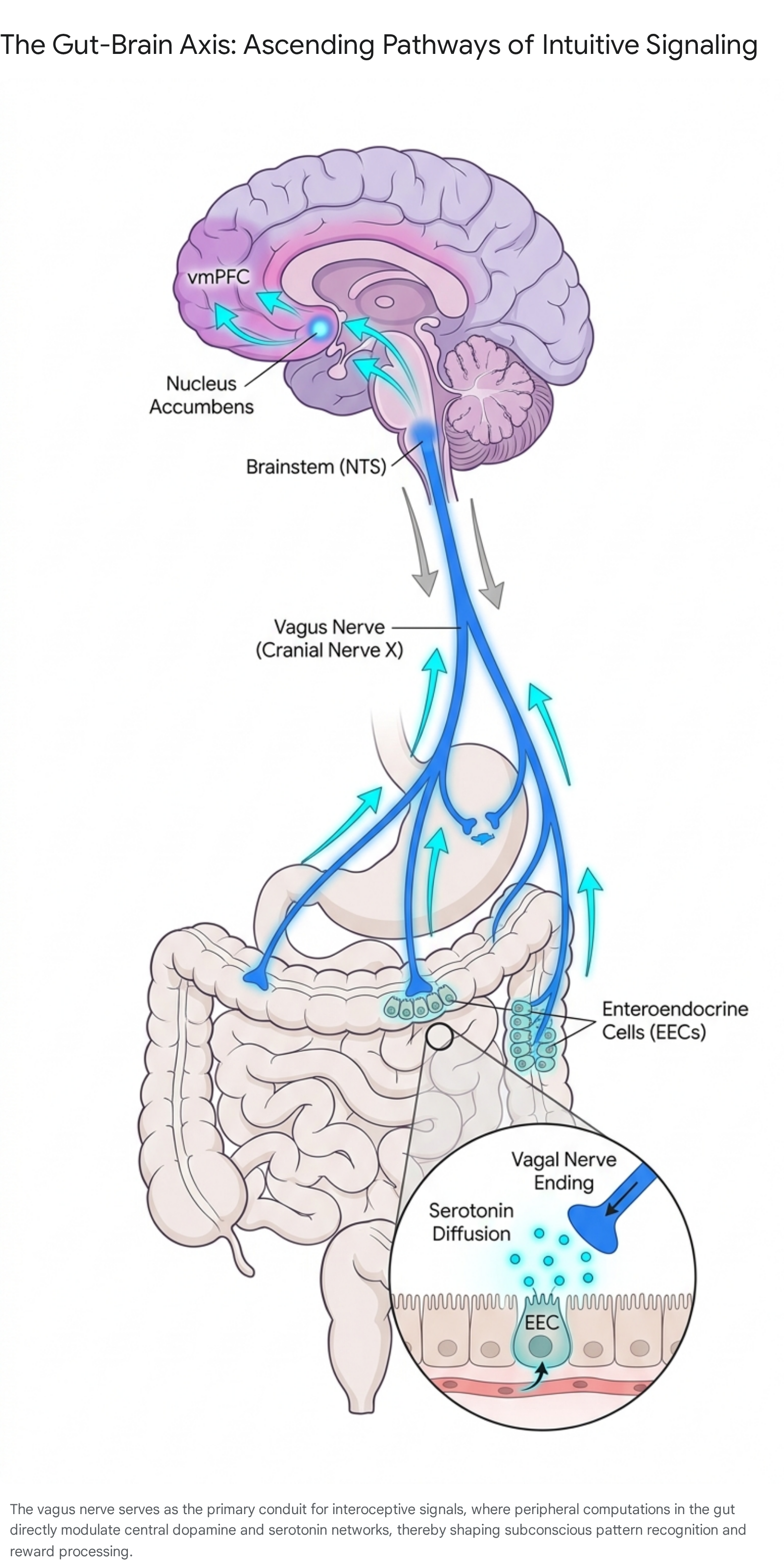
The primary anatomical conduit for somatic markers and interoceptive data is the gut-brain axis, predominantly mediated by the vagus nerve (Cranial Nerve X). The vagus nerve acts as a massive biological information superhighway. Approximately 80% of its fibers are afferent (carrying sensory information from the viscera to the brain), while only 20% are efferent (carrying motor signals from the brain to the organs) 121.
The vagus nerve stems from the medulla oblongata and meanders through the neck and chest into the abdomen. It contains two main sensory ganglia: the nodose (inferior) ganglion, whose fibers terminate in the solitary nucleus of the brainstem, and the jugular (superior) ganglion, which terminates in the spinal trigeminal nucleus 2129. It monitors a vast array of physiological metrics, from gastric emptying, peristalsis, and nutrient levels to immune responses, heart rate variability, and systemic inflammation 130.
Historically, the afferent vagus nerve was viewed merely as a passive relay cable. However, emerging 2023 and 2024 genetic and structural evidence challenges this passive model. Researchers now propose that the vagus nerve engages in active signal processing. Similar to the visual system's retina, ascending viscerosensory signals compute complex spatial and temporal features before they even reach the brain stem, suggesting that rudimentary "gut feelings" undergo peripheral computation in the nervous tissue of the viscera itself 22.
Peripheral Computation and Serotonin Diffusion
The computational complexity of the gut is staggering. Second only to the brain, the gastrointestinal tract contains the body's largest network of neurons, forming the enteric nervous system (ENS) 123. The ENS produces chemical messengers, hosts a complex microbiome, and interfaces directly with vagal nerve endings 2333.
Groundbreaking 2024 research from Flinders University fundamentally altered the understanding of how these peripheral signals are generated. Utilizing intricate anterograde neuronal tracing, researchers demonstrated that enteroendocrine cells (EECs) in the gut wall produce vast amounts of serotonin, a neurotransmitter critical for mood and mental health 24. Remarkably, these EECs do not use traditional, fast synaptic transmission to communicate with vagal afferent nerve endings. The mean distance between the serotonin-containing EECs and the vagal nerve endings in the colon was found to be hundreds of times greater than a standard synaptic cleft. Therefore, the serotonin acts via diffusion across the tissue, representing a novel, non-synaptic mechanism by which gut states activate ascending sensory pathways 24.
Dopamine Modulation and Reward Circuitry
Vagal signaling fundamentally shapes the brain's central reward and motivation circuitry. A 2024 neurobiological study demonstrated that severing the vagus nerve below the diaphragm drastically alters dopamine responses in the brain's nucleus accumbens - a region central to reinforcement learning and motivation 33.
Using fiber photometry, researchers directly measured dopamine signals. When the vagus nerve was cut, dopamine responses in the nucleus accumbens were significantly delayed or reduced during food anticipation, eating, and after drug administration, while movement-related dopamine signaling remained largely intact 33. Without intact vagal input, dopamine neurons fired less and received weaker excitatory input, indicating that the cognitive experience of reward, intuitive reinforcement, and motivation is not computed entirely within the brain. Instead, central dopamine circuits are continuously dependent on ascending visceral states carried by the vagus nerve 33.
Vagus Nerve Stimulation and Cortical Processing
The influence of the vagus nerve extends upward to dictate the balance of signal processing in the cerebral cortex. Clinical applications, such as Vagus Nerve Stimulation (VNS) - an FDA-approved intervention for epilepsy and treatment-resistant depression - have provided insights into how ascending interoceptive signals alter cognition 2129.
Research indicates that VNS alters the balance between feedforward and feedback signaling in the brain via distinct neurotransmitter systems. VNS enhances acetylcholine transmission, which strengthens targeted feedforward sensory pathways, particularly in the point-to-point connections of the supragranular layers of the cortex 2526. Conversely, VNS relies on noradrenergic modulation to attenuate diffuse feedback pathways in the deeper infragranular layers, suppressing slow theta wave oscillations while enhancing fast gamma band activity 2526. This dual neurochemical mechanism provides the structural basis for predictive coding, allowing the cortex to seamlessly transition between precise, rapid sensory pattern matching (intuition) and flexible contextual interpretation (deliberation).
Neurodynamical Frameworks
To move beyond anatomical mapping and fully comprehend the mechanics of intuition, cognitive neuroscientists are increasingly turning to advanced theoretical models of brain dynamics, specifically predictive coding, active inference, and metastability.
Predictive Coding and the Free Energy Principle
According to the Free Energy Principle, formulated by Karl Friston, the brain functions as an advanced biological inference engine perpetually attempting to minimize "surprise" or uncertainty (free energy) regarding the external world. It accomplishes this by maintaining a hierarchical internal model that constantly generates top-down predictions about incoming sensory data 23.
Within the framework of active inference, intuition is understood as the brain's nonconscious generation of expectations about the consequences of different actions, leading to Bayes-optimal navigation of the environment 2728. When ascending sensory inputs from the environment or the viscera match the brain's internal top-down predictions, the pattern is confirmed instantaneously. This confirmation bypasses the metabolic expense of conscious, deliberative processing 23. Intuition, therefore, is not an anomaly of thought, but the default evolutionary pathfinding mechanism shaped by the biological imperative to reduce uncertainty as efficiently as possible.
Metastability and Coordination Dynamics
The brain does not process intuitive insights through static pathways; it operates in a state of "metastability." Metastability is a neurodynamical regime characterized by the simultaneous coexistence of regional functional autonomy and global cooperative integration across the brain's networks 23.
Intuitive breakthroughs, or sudden hunches, often occur when the brain transiently shifts its attractor landscapes. This allows disparate, highly specialized neural networks to briefly synchronize, share information (opportunistic assimilation), and then decouple back into autonomy 23. The fleeting nature of this synchronized coordination dynamics perfectly describes the neurophenomenology of an intuitive insight - a sudden flash of comprehension that rapidly integrates multifaceted sensory, emotional, and cognitive data streams.
Flow States as Intuition in Action
This metastable, nonconscious information integration reaches its apex during psychological "flow states." Originally described by Mihaly Csikszentmihalyi, flow is an intrinsically rewarding state characterized by complete task absorption, the merger of action and awareness, a loss of reflective self-consciousness, and optimal performance 2729.
Neurobiologically, flow is increasingly posited to be the ultimate manifestation of "intuition in action" 27. While standard intuition manifests as a rapid, offline decision-making process (an affective tendency toward a "go or no-go" signal), flow facilitates the execution of these nonconscious predictions in real-time, continuous action, bypassing conscious deliberation entirely 272930. During flow, the cognitive control networks (such as the ACC) align seamlessly with automated sensory-motor loops. Subjects in flow states consistently report that their intuition feels clearer and more accurate, likely due to the suppression of analytical, second-guessing (System 2) interference that normally interrupts automated pattern recognition 2729.
Cross-Cultural Philosophical Perspectives
The modern Western scientific understanding of intuition as rapid, nonconscious pattern matching shares profound structural and conceptual similarities with Eastern philosophical and psychological traditions. For millennia, these traditions have formalized the cultivation and categorization of intuitive states.
Prajna and Buddhist Psychology
In Buddhist philosophy and psychology, Prajñā (often translated as wisdom or insight) is a core epistemological concept. It refers to a direct, non-conceptual, and intuitive understanding of reality as it is, free from delusion 4131. Prajñā is explicitly contrasted with vijñāna (conventional, conceptual knowledge), which relies on sensory categorization, dualistic distinctions, and analytical reasoning 41.
While vijñāna analyzes phenomena through divisions, Prajñā is characterized by experiential clarity. It is seen as a holistic cognitive shift that penetrates the constructed, fragmented nature of ordinary perception to grasp the interconnectedness of phenomena 413233. In the Mahayana tradition, Prajñā is considered a super-rational state - an unfathomable, infinite realization beyond the reach of language, logic, and standard sensory perception, yet essential for actualizing non-dual awareness 4132.
The Concept of Zhijue in Chinese Philosophy
During the early 20th century, Chinese philosophers such as Qian Mu and Liang Shuming integrated these ancient concepts with Western philosophy, leading to a profound intellectual cross-pollination. When the philosophy of Henri Bergson (who emphasized intuition over intellect) was introduced to China, Bergson's concept of intuition was translated into the Chinese term zhijue 34353637.
The introduction of zhijue resonated deeply with existing Confucian and Buddhist frameworks, quickly becoming associated with "the knowledge of virtue" (dexing zhi zhi) and Confucian self-cultivation 353649. In modern Chinese philosophy, zhijue is often elevated above rational intellect (lizhi). For instance, Qian Mu argued that intellect relies on the spatial and temporal divisions inherent in language. In contrast, he identified zhijue as the wordless, silent ground of thought - a state of non-differentiated completeness akin to a pure, unconditioned instinct, conceptually aligning with the modern neurobiological understanding of holistic pattern recognition 3234.
Meditative States and Self-Pattern Reorganization
These philosophical states are not merely abstract concepts; they map directly onto observable neurological changes induced by contemplative practices. Through sustained meditation (such as samatha for concentration and vipassanā for insight), practitioners train the brain to suppress the narrative, analytical self and cultivate mindful awareness 313851.
Advanced meditative states can induce a profound reorganization of the "self-pattern," culminating in self-transcendent experiences (STEs) and states of non-dual awareness 3839. A recently proposed heuristic model, the Pattern Theory of Selflessness (PTSL), details how meditation deconstructs the conventional self-pattern iteratively, moving the practitioner from basic mindfulness to profound self-liberation 38.
Neuroimaging of STEs reveals specific neural signatures, notably decreased activity in the Default Mode Network (associated with egoic, self-referential thought) and enhanced integration of interoceptive and sensory networks 3851. By intentionally dampening conceptual, linguistic overlays, contemplative practices effectively tune the brain's predictive coding machinery. This allows raw sensory and somatic inputs to be processed with greater fidelity. In this optimized state, intuition (prajna) arises not as a flawed heuristic bias, but as a highly refined, frictionless alignment between the organism's internal predictive model and the external environment.
Artificial Intelligence and Neuro-Symbolic Architectures
The psychological dichotomy between fast intuition (System 1) and slow, analytical reasoning (System 2) has a direct and highly active parallel in the architecture of Artificial Intelligence (AI). The ongoing quest to replicate human-like cognition in machines relies heavily on understanding how to integrate these two modes of information processing.
Deep Learning as an Analogue to System 1
Modern deep learning, particularly the Transformer architectures underlying Large Language Models (LLMs), fundamentally operates as an artificial analogue to System 1 intuitive thinking 404142. LLMs excel at processing vast quantities of unstructured data to detect subtle statistical connections between words and concepts across billions of parameters 41. This process is effectively fast, associative pattern matching, functionally mimicking human intuition.
However, because current LLMs rely purely on these associative probabilities without a verifiable, underlying logical grounding, they exhibit judgment biases remarkably similar to human cognitive heuristics. They frequently prioritize eloquent, plausible-sounding associations (known as hallucinations) over strict factual accuracy, prioritizing the "gut feeling" of the neural net over objective logic 41.
Even the physical spatial organization of artificial neural networks has been shown to mirror biological intuition. A 2024 Stanford study introduced the Topographic Deep Artificial Neural Network (TDANN). Trained via self-supervised learning with spatial constraints on its connections, the TDANN spontaneously developed spatial maps that perfectly replicated the layout of the human visual cortex. Specifically, it developed pinwheel structures mirroring those in the primary visual cortex (V1) and category-selective clusters mirroring those in the ventral temporal cortex (VTC) 43. This indicates that fundamental pattern-matching architectures, whether biological or artificial, naturally organize themselves topographically to minimize wiring costs and optimize rapid information processing 43.
Neuro-Symbolic AI and Metacognitive Controllers
To overcome the limitations of purely intuitive, associative AI, computer scientists are actively developing Neuro-Symbolic AI (NeSy). This hybrid paradigm seeks to merge the intuitive pattern-matching capabilities of neural networks (the "neuro" part) with the verifiable, explicit, rule-based logic of symbolic AI (the "symbolic" part) 404142.
Techniques such as Knowledge Graph Transformers inject factual triples into the neural network's encoding process, allowing the fast-acting neural layer to interface with explicit, deliberate reasoning modules 4044. By establishing a "metacognitive controller," these systems can dynamically assess when a computational task requires rapid pattern recognition versus slower, deliberate logical proofs 4144. In essence, researchers are attempting to build an artificial Anterior Cingulate Cortex, endowing machines with the ability to dynamically route cognitive effort between artificial intuition and artificial deliberation, achieving a more robust, human-like intelligence.
Conclusion
The neuroscience and psychology of intuition reveal that it is neither a mystical phenomenon nor a mere artifact of cognitive bias. Rather, intuition is a highly sophisticated, biologically grounded computational strategy. It represents the brain's ability to compress extensive experiential data into rapid, nonconscious pattern recognition.
This process is orchestrated by distributed neural networks - including the ventromedial prefrontal cortex, basal ganglia, and anterior cingulate cortex - and is continuously modulated by interoceptive, ascending signals from the gut-brain axis via the vagus nerve. Through the lens of active inference and predictive coding, intuition acts as an evolutionary pathfinding mechanism, actively minimizing uncertainty by rapidly aligning internal models with environmental realities. Whether viewed through the ancient philosophical concept of prajna, the modern pursuit of neuro-symbolic artificial intelligence, or the rapid, life-saving decisions of experts in the field, intuition stands as a profound testament to the efficiency, complexity, and depth of subconscious human cognition.