
Neuroscience of intuition and subconscious information processing
Human cognition operates through a highly complex, multi-layered architecture that continuously processes vast quantities of information. While conscious deliberation - the slow, effortful, and sequential analysis of data - dominates human subjective experience, the overwhelming majority of cognitive processing occurs below the threshold of conscious awareness. This sub-conscious or implicit processing is frequently categorized under the umbrella term "intuition." From an empirical perspective, intuition is not a mystical faculty or an innate biological reflex, but rather a sophisticated product of associative learning, pattern recognition, and rapid neural computation that occurs largely outside of working memory 1.
The scientific investigation of intuition requires untangling a web of overlapping psychological constructs, examining the dual-process architecture of the mind, identifying the precise neurobiological correlates of implicit decision-making, and evaluating the boundary conditions under which intuitive judgments are either remarkably accurate or systematically flawed. Furthermore, modern cognitive science has increasingly scrutinized the cross-cultural variations in cognitive styles that influence how individuals intuitively process their environments. Historically, the British empiricist philosophers of the 18th and 19th centuries, including Locke, Hume, and Mill, operated under the assumption that basic cognitive processes were universal among all normal adults 2. This assumption of universality was subsequently adopted by mainstream 20th-century psychology and strengthened by the analogy to the computer, wherein the brain was viewed as universal hardware processing universal software rules 2. It was only during the late 1980s, driven by the advent of personal computers that allowed for the precise measurement of reaction times and subliminal stimuli, that experimental social psychology rediscovered the unconscious, sparking an "implicit revolution" that began to map the distinct architectures of non-conscious thought 3.
Taxonomic Distinctions in Implicit Cognition
In scientific literature, the terminology surrounding non-conscious processing is frequently conflated, leading to theoretical imprecision. To study intuition rigorously, cognitive psychology distinguishes it from related phenomena such as instinct, insight, and common sense.
Instinct refers to hard-wired, involuntary biological survival mechanisms that are encoded in the genetic code of an organism. Reflexes such as the impulse to blink, shiver, or trigger the fight-or-flight response operate automatically to ensure survival and adaptation to the environment 3. These behaviors do not require prior experiential learning and are highly rigid. Common sense, on the other hand, represents a culturally and socially acquired baseline of practical judgment. It relies heavily on social norms, cultural upbringing, and shared societal knowledge, forming a rational basis for everyday navigation 3.
Insight is frequently confused with intuition, yet the two represent distinct cognitive pathways. Insight involves a sudden, conscious realization of the logical relations necessary to solve a problem - often preceded by a period of unconscious incubation 4. This culminates in a "eureka" or "aha" moment. During insight, a specific temporal pattern emerges as the solution becomes progressively more conscious, resulting in an explicit awareness of the relationship between the problem and the answer 4.
Intuition is uniquely defined as the capacity to evaluate the coherence of context-relevant information and generate an immediate judgment, hunch, or behavioral response rapidly, without conscious deliberation or the ability to explicitly articulate the underlying logical relations 145. It relies heavily on implicit learning, associative memory, and experiential pattern matching 146. When an individual utilizes intuition, there is typically no conscious insight into the logical relations driving the judgment; rather, it is experienced as a direct perception of truth or a "gut feeling" 47.
| Cognitive Construct | Origin and Mechanism | Conscious Effort | Speed of Processing | Flexibility and Adaptability |
|---|---|---|---|---|
| Instinct | Genetic encoding; evolutionary survival mechanisms 3. | None (involuntary and automatic). | Immediate (reflexive). | Fixed and rigid; slow to adapt over individual lifespans. |
| Intuition | Associative learning, pattern recognition, and implicit memory 14. | None (operates outside working memory) 1. | Fast (milliseconds to seconds) 98. | Highly adaptable based on individual expertise and repeated exposure 11. |
| Insight | Subconscious incubation followed by sudden recognition of logical relations 4. | High during initial problem-solving, low during incubation. | Sudden onset after a variable delay. | Novel and highly flexible; often breaks existing paradigms 4. |
| Common Sense | Socialization, cultural norms, and shared societal knowledge 3. | Low to moderate. | Variable. | Culturally bound; adaptable across societal shifts. |
Dual-Process Theories of Cognitive Architecture
Most contemporary cognitive psychologists conceptualize human thought through the framework of dual-process theory, which posits that the mind operates via two distinct but interacting cognitive systems 910. Although the terms "System 1" and "System 2" are simplifications of complex, distributed neural networks, they provide a robust theoretical model for understanding how intuition functions alongside deliberate reasoning 91112.
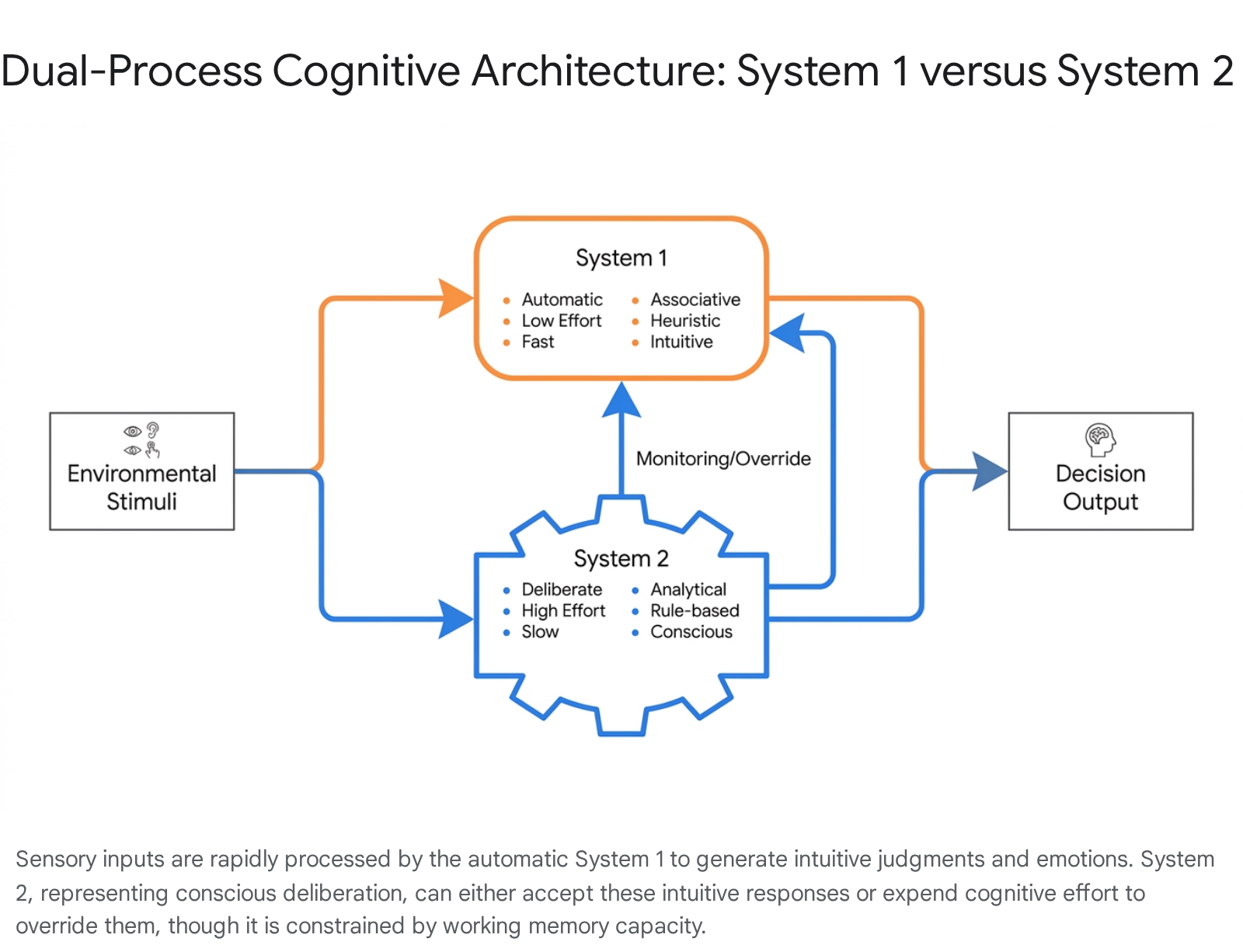
System 1 is characterized as fast, automatic, effortless, and predominantly unconscious 91112. It continuously monitors the environment, utilizing heuristics (mental shortcuts) and associative memory to generate rapid impressions, emotional responses, and intuitive judgments 69. System 1 is heavily dependent on the associative coherence of stimuli and processing fluency. It is vulnerable to cognitive biases because it frequently substitutes complex computational problems with simpler, more easily accessible attributes - a phenomenon known as attribute substitution 6.
System 2 is the controlled system. It is slow, deliberate, rule-based, and cognitively demanding, requiring the allocation of scarce working memory resources 991213. System 2 is responsible for complex computation, conscious monitoring, and overriding the initial, heuristic-driven impulses generated by System 1 1112. However, System 2 is often described as a "lazy controller" that defaults to the low-effort suggestions of System 1 unless sufficiently motivated or alerted to a cognitive error 12.
Evolutionary Psychology and Domain Specificity
While the dual-process framework is widely accepted in mainstream cognitive psychology, it remains a subject of intense debate within the field of evolutionary psychology 91014. Many evolutionary psychologists contest the existence of a domain-general System 2. They argue that the mind is highly domain-specific, composed of numerous specialized, modular circuits evolved to handle distinct environmental challenges 914. From an evolutionary standpoint, processing visual information necessitates different neural mechanisms than processing linguistic data; specializing cognitive processes into domains improves overall processing speed and prevents debilitating neural interference 14.
Thus, fast and intuitive System 1 heuristics are viewed as discrete evolutionary adaptations forged by natural and sexual selection to rapidly identify threats and secure survival 14. Detractors of the dual-process theory argue that it relies too heavily on artificial laboratory experiments that fail to capture the ecological realities of decision-making 9. However, archaeological evidence supports the emergence of a broader, domain-general processing capacity. Approximately 50,000 years ago, human civilization experienced a sudden explosion of representational art, religious imagery, and rapid transformations in tool design, suggesting the evolutionary development of a System 2 capable of overriding autonomous subsystems to engage in abstract, cross-domain reasoning 10. Modern theoretical syntheses increasingly favor a mind that integrates both domain-specific heuristic modules and domain-general deliberative oversight 914.
Evaluation of Cognitive Override Mechanisms
The complex interplay between intuitive and analytical processing is frequently measured using the Cognitive Reflection Test (CRT). Developed to gauge an individual's proficiency in utilizing System 2 to counteract System 1 inclinations, the CRT consists of mathematical word problems deliberately designed to evoke a compelling, intuitive, yet incorrect response 915. A canonical example is the bat-and-ball problem: "A bat and a ball cost $1.10 in total. The bat costs $1.00 more than the ball. How much does the ball cost?" The intuitive System 1 response is 10 cents, whereas the correct normative System 2 calculation yields 5 cents 916.
To assess the prevalence of intuitive reliance in highly educated cohorts, researchers conducted a study utilizing the CRT among 128 medical students, comparing pre-clinical students (Years 2 and 3) with clinical students (Year 4) 1517. The results demonstrated that reliance on System 1 thinking is pervasive. Fully 10% of the medical students provided the intuitive (incorrect) answer to all three questions, suggesting a general failure to engage metacognitive override mechanisms 15. Only 44% of the participants answered all three questions correctly, indicating full analytical System 2 engagement 1517.
Interestingly, cultural and linguistic factors significantly modulated cognitive reflection. International students for whom English was not a childhood language scored a mean of 1.0 correct answers, compared to a mean of 2.12 for native English speakers (p < 0.01) 1517. This suggests that processing information in a non-native language may consume additional cognitive load, leaving fewer working memory resources available for System 2 to override System 1 heuristics.
| Metric Evaluated | Study Cohort | Performance Outcome | Implications for Dual-Process Theory |
|---|---|---|---|
| Complete System 1 Reliance | 128 Medical Students | 10% answered 0 questions correctly (all intuitive). | Strong intuitive heuristics frequently bypass metacognitive monitoring even in highly trained individuals 15. |
| Complete System 2 Override | 128 Medical Students | 44% answered all 3 questions correctly. | Less than half of the cohort successfully engaged deliberate analytical reasoning across all tasks 15. |
| Linguistic Cognitive Load | Non-Native vs. Native Speakers | 1.0 mean score (Non-Native) vs. 2.12 mean score (Native). | Increased cognitive load impairs System 2 activation, forcing greater reliance on System 1 15. |
| Intuitive Confidence | College Students (Multiple Choice) | >85% accuracy when highly confident in intuitive response. | System 1 is not inherently flawed; when intuition is accompanied by high confidence, it is highly accurate 16. |
Dual-process theory, however, does not dictate that System 1 is strictly erroneous while System 2 is flawless. Research by Couchman et al. (2016) highlights that when students indicated high confidence in their initial, intuitive responses on multiple-choice exams, those responses were correct over 85% of the time, compared to a near 50% success rate when guessing 16. Furthermore, researchers like Frederick (2005) have noted that successful performance on the CRT is heavily mediated by underlying numeric ability. When controlling for general numeracy, the independent predictive power of "cognitive reflection" (the pure act of overriding intuition) diminishes, suggesting that biases affect both unconscious and highly analytical decision-making pathways 1618. Ultimately, as individuals acquire proficiency and skill, complex cognitive operations migrate from the deliberate System 2 into the automated pattern-matching of System 1, allowing experts to rely safely on sophisticated intuition 15.
Neural Correlates of Intuitive Decision-Making
Advances in functional magnetic resonance imaging (fMRI) and electroencephalography (EEG) have allowed cognitive neuroscientists to map the specific neuroanatomy of implicit and intuitive processing. Neuroimaging data strongly refutes the notion of intuition as a localized "sixth sense." Instead, intuition arises from a coordinated, widely distributed network involving both the prefrontal cortex and deeper subcortical structures 51920.
A landmark 2025 Activation Likelihood Estimation (ALE) meta-analysis synthesized findings from 76 fMRI studies involving 4,186 participants to identify the consistent neural correlates of uncertainty processing and intuitive decision-making 2122. The voxel-wise analysis revealed a comprehensive neural architecture comprising nine distinct activation clusters 2122.
The Anterior Insula and Prefrontal Cortex
The 2025 meta-analysis identified the anterior insula and the inferior parietal lobule as paramount to intuitive processing. The inferior parietal lobule demonstrated the highest representation across studies, appearing in up to 78.1% of the relevant activation foci 2122. The anterior insula exhibited up to 63.7% representation, while the inferior frontal gyrus (IFG) was active in up to 40.7% of representations 2122.
Crucially, the meta-analysis established a profound functional specialization and hemispheric asymmetry between emotional-motivational processes (clusters 1-5) and cognitive processes (clusters 6-9) 2122. The left anterior insula is heavily implicated in emotional-motivational processes and the rapid evaluation of rewards, whereas the right anterior insula manages implicit learning and cognitive control under conditions of uncertainty 2122. Similarly, the right inferior frontal gyrus is intimately linked to impulse control - serving as an inhibitory brake on errant heuristics - while the left IFG is associated with motor planning and the execution of the intuitive choice 2122.
The ventromedial prefrontal cortex (vmPFC) consistently emerges as a critical hub for intuitive value integration 192023. Simultaneous EEG-fMRI studies, utilizing computational modeling of value-based choices, demonstrate that the posterior-medial frontal cortex reflects an evidence accumulation process during decision-making. This region exhibits highly task-dependent coupling with the vmPFC and the striatum 20. These areas encode the subjective, idiosyncratic value of decision alternatives, integrating diverse streams of implicit data before the subject commits to a conscious choice 20.
The Basal Ganglia and Implicit Coherence
Intuition frequently involves evaluating the semantic or social coherence of a situation without the ability to explicitly articulate why it feels coherent 5. In experimental tasks where subjects must quickly judge whether three clue words share a common weak association (the triad task), implicit judgments of coherence - where subjects accurately perceive a link but cannot name the solution word - correlate with targeted neural activation. Implicit perception of coherence results in significant activation within bilateral parietal regions and the right superior temporal sulcus, indicating that intuitive perception is mediated by a posterior associative pattern-recognition mechanism 5.
Furthermore, the basal ganglia, particularly the ventral striatum and nucleus accumbens, play a profound role in implicit, instrumentally learned intuition. These subcortical structures mediate reinforcement learning independently of functional domains, gradually encoding the statistical regularities and probabilities of the environment 1924. The basal ganglia are also critically involved in affective Theory of Mind (ToM) - the intuitive capacity to rapidly infer and mirror the emotional states of others 25. While cognitive Theory of Mind (calculating beliefs and explicit intentions) relies heavily on the dorsomedial prefrontal cortex, event-related fMRI scanning reveals that affective ToM utilizes the basal ganglia to provide an intuitive, simulated motor component of emotional recognition 25.
The Somatic Marker Hypothesis
The precise mechanism by which these implicit neural calculations translate into conscious feelings and guide behavior is best articulated by the Somatic Marker Hypothesis (SMH), proposed by neurologist Antonio Damasio and his colleagues 262731. The SMH fundamentally challenges traditional economic theories that view rational decision-making as a purely logical process devoid of emotion. Instead, the hypothesis posits that emotional processes and their physiological representations are indispensable for rational behavior in complex, uncertain environments 2628.
According to the SMH, as individuals navigate life, the brain records the physiological states - termed somatic markers - associated with various experiences, choices, and outcomes 2631. These somatic markers (e.g., a rapid heartbeat associated with anxiety, or a subtle visceral drop indicating disgust or risk) are processed primarily in the ventromedial prefrontal cortex (vmPFC) and the amygdala 2631. When an individual faces a similar decision in the future, the vmPFC triggers the re-experiencing of these physiological states. Operating largely below conscious awareness, these bodily signals function as intuitive alarm bells or incentive signals, heavily biasing the decision-making process before conscious analytical reasoning is complete 263128.
The Iowa Gambling Task Paradigm
The primary experimental paradigm supporting the SMH is the Iowa Gambling Task (IGT), developed by Antoine Bechara and Damasio. In this task, subjects must select cards from four distinct decks (A, B, C, and D) with the goal of maximizing hypothetical monetary profit 2631. Decks A and B are engineered to offer high immediate rewards but possess devastating long-term penalties, inevitably yielding a net loss. Conversely, Decks C and D offer smaller immediate rewards but incur much smaller penalties, yielding a steady net gain 2631.
Healthy participants generally deduce the optimal strategy over time, gravitating toward Decks C and D. Crucially, physiological measurements reveal that healthy subjects begin generating anticipatory skin conductance responses (sweating) when reaching for the disadvantageous decks long before they can consciously articulate the mathematical rules governing the game 31. Their intuitive somatic markers accurately warn them of impending danger 3128.
Conversely, patients with bilateral lesions in the vmPFC - reminiscent of the famous 19th-century neurological patient Phineas Gage - fail to generate these anticipatory somatic markers 2631. Despite possessing intact intellect, working memory, and language comprehension, vmPFC patients demonstrate profound deficits in organizing behavior and learning from previous mistakes 26. Without intuitive emotional guidance, these patients continue pulling from the high-risk decks, repeatedly bankrupting themselves in the simulation. This clearly demonstrates that intact emotional and somatic processing is a biological prerequisite for long-term rational decision-making 2631.
Modern Revisions and Computational Critiques
While highly influential, the SMH remains a subject of ongoing theoretical refinement and controversy. Critics, including Verweij and Damasio (2019) themselves, note that the hypothesis leaves open questions about the extent to which emotions unilaterally dictate choice 27. Damasio acknowledges that somatic markers may not be sufficient for normal human decision-making, as logical competence and reasoning often take place subsequent to the emotional response 27. Humans frequently utilize cognitive effort to reject biological or cultural propensities - a capability Damasio links to both "sublime human achievements" and the behaviors of the insane 27.
Furthermore, modern computational and systems neuroscience refines the concept of the "bodily storage" of emotion. Recent literature clarifies that the body does not literally store trauma or memories in non-innervated tissue; rather, the brain dynamically reenacts emotional states through predictive coding and maladaptive inference 29. In this updated neurodynamic view, intense emotional intuitions - such as those experienced in Post-Traumatic Stress Disorder (PTSD) - represent a collapse of neural metastability 29. The brain assigns excessive precision to prior threat predictions, hyper-weighting somatic feedback in the convergence-divergence zones of the cortex 29. Functional imaging of PTSD patients reveals a dominant dissociation: amygdala hyperactivation coupled with medial prefrontal hypoactivation, demonstrating how weakened top-down regulatory connections allow intuitive fear responses to overwhelm rational assessment 29.
Boundary Conditions for Intuitive Expertise
A central question in the science of intuition is determining when an intuitive judgment can be trusted as a manifestation of genuine expertise, versus when it is a product of cognitive bias. This dichotomy was historically the source of a major academic schism between two distinct psychological camps: the Heuristics and Biases (HB) approach, pioneered by Daniel Kahneman and Amos Tversky, and the Naturalistic Decision Making (NDM) approach, championed by Gary Klein 34303138.
The HB approach emphasizes the flaws of intuition. By studying professionals in highly unpredictable fields, HB researchers demonstrated how simplifying heuristics lead to systematic errors, overconfidence, and irrational economic behavior 3832. Conversely, the NDM approach focuses on the marvels of expert intuition. NDM researchers studied professionals like firefighters, intensive care nurses, and chess masters, documenting how they utilize experience-based pattern recognition to make split-second, highly accurate decisions in life-or-death environments 343833.
In a landmark 2009 collaborative paper titled "Conditions for Intuitive Expertise: A Failure to Disagree," Kahneman and Klein reconciled their theoretical perspectives by mapping the precise boundary conditions that separate valid intuitive skill from flawed impressions 31383234. They concluded that the validity of an intuitive judgment absolutely cannot be determined by the subjective confidence of the decision-maker 313233. Subjective experience is an unreliable indicator of accuracy, as processing fluency and associative coherence can produce profound feelings of certainty even when the underlying data is redundant or flimsy 313233.
High-Validity Environments versus Heuristic Bias
Instead, Kahneman and Klein established that the quality of intuitive expertise depends entirely on two external, environmental factors: 1. The Predictability of the Environment (High-Validity vs. Low-Validity): The environment must possess stable, highly predictable regularities and cues. 2. The Opportunity to Learn: The individual must have prolonged practice within that environment, accompanied by rapid, unequivocal feedback 313334.
A firefighter operates in a high-validity environment; the physical properties of a fire are highly consistent, and the environmental feedback is immediate (e.g., a building behaves in predictable ways based on heat intensity and structural integrity). Thus, a seasoned firefighter's intuition to evacuate a collapsing floor is a highly reliable manifestation of learned expertise 35.
Conversely, stockbrokers, political forecasters, and venture capitalists operate in low-validity environments. The stock market is highly chaotic, governed by unprecedented variables, and lacks consistent, immediate feedback 35. In low-validity domains, algorithms, checklists, and deliberate statistical reasoning will consistently outperform expert intuition 3835. When intuition is applied in a low-validity environment, or when an expert faces a unique, unprecedented problem, System 1 resorts to attribute substitution. It unconsciously replaces the complex question with an easier one, leading to anchoring effects, representativeness biases, and fundamentally flawed conclusions 636.
This limitation is evident even among highly trained mental health professionals. A study comparing the psychodiagnostic decisions of novice (n = 20) and experienced (n = 20) clinical psychologists found that experience alone did not lead to better diagnostic accuracy 37. Experienced psychologists demonstrated a higher preference for rational, deliberative thinking, and greater accuracy was strictly associated with this deliberation, whereas a preference for intuitive reasoning was associated with less accurate decisions 37.
The Unconscious Thought Theory Controversy
Building upon the idea that implicit processing possesses immense bandwidth, the mid-2000s saw the emergence of Unconscious Thought Theory (UTT), proposed by psychologists Ap Dijksterhuis and Loran Nordgren 3839. UTT posited a radical and highly debated claim: while conscious thought is superior for simple decisions with few variables, unconscious thought is vastly superior for solving complex decisions where many variables must be weighed simultaneously 33839.
The foundational experiment supporting UTT involved subjects choosing between several hypothetical apartments or roommates, each described by numerous positive, negative, and neutral attributes. Subjects were divided into three conditions: (1) immediate choice, (2) ample time for conscious deliberation, and (3) ample time, but occupied with a demanding cognitive distraction task to prevent conscious thought 3839. Dijksterhuis reported that the distracted group (relying purely on unconscious thought) consistently outperformed the deliberate thinkers in choosing the objectively best option 3839. Dijksterhuis and Nordgren formulated the "Weighting Principle," arguing that the conscious mind has a strict capacity limit and weights variables poorly over time, introducing "decisional noise." In contrast, the unconscious mind supposedly has vast processing capacity and naturally weights the relative importance of attributes accurately 3839.
Replication Failures and Meta-Analytic Critiques
UTT directly contradicted four decades of prior cognitive research, which maintained that unconscious processing is characterized by simple associative responses and is fundamentally incapable of executing complex, rule-based operations 38. Unsurprisingly, UTT sparked intense scrutiny, leading to a replication crisis within this specific sub-field.
Independent laboratories repeatedly failed to replicate the "deliberation-without-attention" effect 384041. The earliest meta-analysis of UTT, conducted by Acker, found no support for the claim that unconscious thought is superior to conscious thought in complex decision-making 38. A subsequent meta-analysis comprising 17 experiments similarly found little to no statistical evidence supporting an advantage for normative decision-making using unconscious thought 4041. Critics argued that the original UTT effects were methodological artifacts, driven by differential rates of forgetting or inadequate sample sizes, pointing out that even in the foundational papers, some critical comparisons failed to reach statistical significance 41. Furthermore, methodological reviews highlighted that brief periods of conscious attention inevitably occur during the "distraction" period, muddying the definition of pure unconscious thought 38.
The credibility of the UTT literature was further diminished by an expansive z-curve analysis conducted by Schimmack (2022). Evaluating 534 test statistics across 44 matched articles in major social psychology journals, the analysis revealed that while 64% of the published results were statistically significant, the Estimated Discovery Rate (EDR) was only 30% 3. This severe discrepancy implies massive publication bias, suggesting that up to 49% of the significant results in the UTT literature could be false positives 3. Today, the scientific consensus indicates there is little to no empirical support for the broad claims of UTT; complex, multi-variable decisions continue to require the structuring capacity of System 2, even if intuition can provide valuable initial inputs 31338.
Cross-Cultural Variations in Cognitive Styles
A critical question in the study of implicit processing is whether basic cognitive styles - how the brain automatically attends to and categorizes stimuli - are universal or shaped by culture. For decades, mainstream cognitive science assumed that fundamental processes like categorization and inductive inference were uniform across all human populations 2.
This assumption was challenged by cultural psychologists, most notably Richard Nisbett, who proposed the theory of Analytic versus Holistic cognitive styles 2424344. According to this framework, cognitive processes are deeply embedded in varying social systems and tacit epistemologies 24344. * Analytic Thinking (Western Cultures): Rooted in ancient Greek philosophical traditions, this style defaults to detaching a focal object from its context. Attention is directed to the salient object, its individual attributes, and the assignment of formal rules and categories to explain its behavior 24244. * Holistic Thinking (East Asian Cultures): Rooted in ancient Chinese philosophical traditions, this style defaults to attending to the entire perceptual field. Causality is assigned to the context and relational structures, and reasoning relies more on dialectical approaches rather than formal logic 24244.
Neuroimaging Correlates of Cultural Paradigms
These distinct cognitive styles represent points on a continuum rather than absolute binaries, and variations exist within single cultures 45. Neuroimaging supports the behavioral observation that analytic and holistic thinkers process visual fields differently. A 2024 study utilizing multivariate pattern analysis (MVPA) on fMRI data sought to distinguish the neural representations of these two styles using the frame-line task and triad task 46.
The study found that the fundamental brain regions differentiating holistic from analytic processing include the bilateral frontal lobes, bilateral parietal lobes, bilateral precentral and postcentral gyrus, supplementary motor areas, the bilateral fusiform gyrus, the bilateral insula, the bilateral angular gyrus, the left cuneus and precuneus, and the right caudate and putamen 46. Interestingly, the involvement of specific culture-related brain regions linked to language function provides initial neurobiological evidence for how cultural-linguistic constructs shape the fundamental, automatic processing of visual and contextual data 46.
Re-evaluation of the Geography of Thought
While the analytic/holistic dichotomy has been a cornerstone of cultural psychology, recent large-scale replication efforts have challenged its generalizability. A pre-registered 2024/2025 study investigated cross-cultural differences in cognitive styles among 993 university students across 11 diverse countries (Armenia, Australia, Brazil, Bulgaria, Czechia, Germany, Ghana, Philippines, Slovakia, Taiwan, and Türkiye) 4748.
| Cultural Study Paradigm | Sample Size & Scope | Methodology | Key Findings |
|---|---|---|---|
| Traditional Analytic/Holistic Theory (e.g., Nisbett et al.) | Variable across historical studies; primarily East vs. West comparisons. | Behavioral tasks, self-reporting, framed-line tests 245. | East Asians rely on holistic, contextual processing; Westerners rely on analytic, object-focused processing 24244. |
| 2024 fMRI MVPA Study | Variable (fMRI cohort). | Frame-line task, triad task, Multivariate Pattern Analysis 46. | Neural differentiation occurs in bilateral frontal/parietal lobes, fusiform, and insula; links to language function observed 46. |
| 2024/2025 11-Country Geography of Thought Replication | 993 university students across 11 diverse nations. | Navon hierarchical figures, Gottschaldt embedded figures, Reaction Time Modeling (Bayesian shifted Wald distribution) 4748. | Cross-cultural variations exist but do not align with traditional Analytic/Holistic predictions. No evidence of a "rigidity metastyle" 4748. |
Using simple perceptual tasks (Navon's hierarchical figures and Gottschaldt's embedded figures) and analyzing the data via reaction time modeling, the researchers found notable cross-cultural variations in cognitive styles. However, these variations did not align with the predictions of the traditional analytic/holistic theory 4748. Countries conventionally characterized as predominantly holistic or analytic failed to consistently demonstrate the expected cognitive patterns 4748.
Multilevel modeling revealed that while broad cultural dimensions like individualism and long-term orientation were associated with thinking styles, many country-level cultural predictors had no significant impact 4748. Furthermore, an exploratory latent profile analysis failed to find evidence of a "rigidity metastyle" - meaning individuals rarely exhibited a strict preference for one cognitive dimension to the complete exclusion of the other 4748. These findings indicate that while cultural conditioning undoubtedly shapes the brain's intuitive processing filters, the traditional binary model of East-West, Holistic-Analytic thought is overly simplistic and requires substantial theoretical re-evaluation 4748.
Conclusion
The science of intuition demystifies the phenomenon of "gut feelings," framing them not as supernatural insights but as the output of highly evolved, extraordinarily fast neural computations. Intuitive processing (System 1) relies on associative memory, somatic markers, and implicit pattern recognition mediated by a widely distributed brain network including the ventromedial prefrontal cortex, the anterior insula, and the basal ganglia.
While intuition is indispensable for survival and highly effective in predictable, high-validity environments where expertise can be honed, it remains vulnerable to systematic biases in chaotic, low-validity environments. The failure of Unconscious Thought Theory to replicate robustly confirms that while the subconscious mind is a powerful pattern-matcher, deliberate, conscious reasoning (System 2) remains strictly essential for normative evaluations of complex, multi-variable problems. Ultimately, effective decision-making requires a calibrated interplay between the brain's rapid, culturally conditioned intuitive networks and its slow, analytical oversight mechanisms.