
The Cognitive and Neural Basis of Mathematical Beauty
Introduction
The intersection of mathematics, cognitive neuroscience, and aesthetics represents one of the most profound frontiers in understanding human intelligence. For centuries, theoretical physicists and pure mathematicians have reported an overwhelming sense of aesthetic arrest when encountering an elegant proof or a unifying equation. Hermann Weyl famously remarked that if forced to choose between truth and beauty, he would usually choose beauty, while Paul Dirac argued that the aesthetic elegance of an equation is the ultimate measure of its veracity 12. However, modern cognitive science and neurobiology have begun to deconstruct this phenomenon, asking whether the perception of mathematical beauty is a transcendent recognition of universal truth, an evolutionary mechanism rewarding data compression, or a cognitive bias that actively leads modern science astray.
Recent empirical studies in neuroaesthetics provide an unprecedented window into how the human brain processes abstract mathematical constructs. By bridging Western axiomatic traditions with non-Western frameworks - such as the intuitive heuristics of Srinivasa Ramanujan, the spiritual geometry of Islamic art, and the ontological pragmatism of classical Chinese mathematics - a nuanced architecture of mathematical cognition emerges 334. This report exhaustively analyzes the neurobiological foundations of mathematical beauty, its evolutionary origins in dopaminergic reward pathways, the divergence in aesthetic perception between experts and laypeople, and the growing critique that aesthetic reliance in theoretical physics has precipitated a crisis of scientific stagnation.
The Neurobiological Architecture of Mathematical Beauty
The field of neuroaesthetics, which historically focused on visual and auditory stimuli, has recently expanded to investigate abstract intellectual experiences 56. To understand mathematical beauty, it is necessary to examine how the brain processes concepts devoid of immediate sensory reference, weaving together spatial processing, logical abstraction, and affective valuation.
The Medial Orbitofrontal Cortex (mOFC) and the Emotion-Valuation System
Landmark functional magnetic resonance imaging (fMRI) studies have demonstrated that the experience of mathematical beauty recruits the identical neural infrastructure responsible for appreciating a masterpiece painting or a profound piece of music 78. When mathematicians view equations they subjectively rate as beautiful (such as Euler's identity, $e^{i\pi} + 1 = 0$), there is a parametric activation in field A1 of the medial orbitofrontal cortex (mOFC) 78.
The mOFC is a critical node in the brain's emotion-valuation system. Crucially, the intensity of mOFC activation correlates linearly with the declared intensity of the aesthetic experience, even when statistical controls for the subject's comprehension of the equation are applied 27. This suggests that mathematical beauty is not merely a cognitive byproduct of understanding, but a distinct affective response. In contrast, equations rated as "ugly" or conceptually dissonant correlate with increased activity in the amygdala and motor cortex, brain regions associated with negative affect, threat detection, and the physical manifestation of confusion or aversion 7.
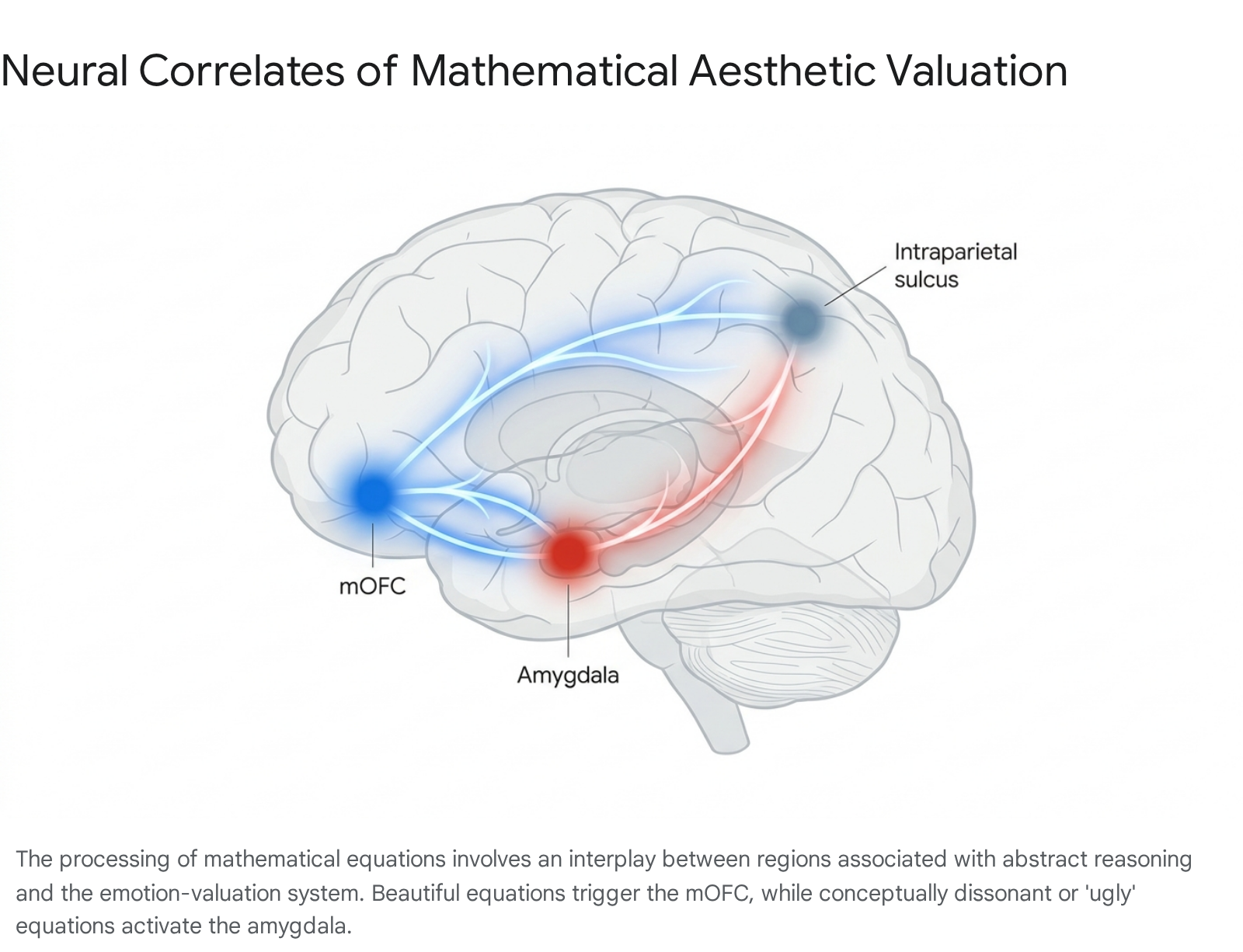
Neuroaesthetics researchers separate beauty into two broad categories: biological and artifactual 2. Biological beauty (such as the appeal of a symmetrical human face or a natural landscape) is dictated by inherited brain concepts and demonstrates minimal cross-cultural variability. Artifactual beauty (such as modern architecture or avant-garde art) is determined by post-natally acquired concepts and shows massive individual variability 2. Mathematical beauty presents a paradox: it requires intense post-natal learning to comprehend the "language," yet once fluency is achieved, the aesthetic evaluation of equations behaves neurologically like biological beauty, showing remarkable consistency and low variance across different individuals and cultures 29.
Predictive Processing and Contrastive Conceptual Networks
From the perspective of predictive processing, the brain operates as an inference machine, constantly generating schemas to minimize surprise (or "free energy") 5. Mathematical elegance often involves the sudden resolution of complexity into a unified, simple schema. When a mathematician grasps a proof that links disparate fields - such as the bridge between modular forms and elliptic curves - the brain experiences a massive reduction in predictive error 510.
Recent cognitive architectures modeled on human reasoning, such as the Contrastive Perceptual-Conceptual Network (CPCNet) introduced in 2023, suggest that abstract visual and mathematical reasoning relies on an iterative, self-contrasting learning process 12. Mathematical cognition interleaves perceptual processing (the spatial arrangement of symbols, visual symmetry) and conceptual processing (the logical operators and underlying semantics) 1211.
Recent 2025 fMRI and eye-tracking studies on abstract algebraic reasoning reveal that experts navigate a dual "procedural-structural" pathway 11. While novices spend their visual attention attempting to decode unfamiliar symbols incrementally, experts utilize internalized symbolic schemas, allowing for hierarchical abstraction 11. The aesthetic pleasure in mathematics arises when there is absolute consistency and seamless translation between the perceptual representation and the conceptual truth, satisfying the brain's drive for coherent schemas.
Evolutionary Mechanisms: Dopamine, Symmetry, and Algorithmic Information
Why would the human brain evolve to experience profound pleasure from abstract mathematics, a skill that emerged far too recently in hominid history to have directly influenced Pleistocene survival? The answer lies in the deep evolutionary roots of the dopaminergic reward system and its imperative to maximize environmental predictability through data compression.
The Dopaminergic Reward Prediction Error (RPE)
Organisms survive by accurately predicting rewards and threats. This fundamental mechanism is mediated by midbrain dopamine neurons, particularly within the ventral tegmental area (VTA) and the substantia nigra pars compacta (SNc), which project to the nucleus accumbens (NAc) and the medial prefrontal cortex (mPFC) 121314. These neuronal networks encode a Reward Prediction Error (RPE) - the quantifiable discrepancy between an expected outcome and the actual outcome 13151619.
In advanced human cognition, "reward" is not limited to immediate homeostatic survival needs like food or mating; information itself holds immense subjective utility 17. When a scientist seeks to understand a complex phenomenon, the brain operates in a state of high entropy and uncertainty 18. The discovery of an elegant mathematical equation acts as an ultimate informational reward. By compressing a vast amount of chaotic, high-dimensional data into a singular, symmetrical formula (e.g., Maxwell's equations of electromagnetism), the brain achieves a massive positive RPE 151718.
Dopamine excitations increase the subjective value of the cognitive action, reinforcing the neural pathways and behavioral loops that led to the discovery 1516. The positive RPE drives predictions higher, advancing a recursive iteration toward better intellectual rewards 1516. Recent 2024 revisions to the classical RPE model by researchers like Nathaniel Daw suggest that dopamine neurons also signal the rate of learning and encode distributional maps of future rewards 1319. Regardless of the exact computational model (whether standard Temporal Difference learning or Distributional Reinforcement Learning), dopamine serves as the biological tether linking abstract data compression to visceral pleasure. Mathematical beauty is thus the phenomenological manifestation of a dopaminergic rush rewarding the brain for successfully reducing cognitive load.
Algorithmic Information Theory and the Biological Symmetry Bias
Evolutionary biology provides an even deeper foundational explanation for why symmetry, parsimony, and simplicity are perceived as inherently beautiful. Recent interdisciplinary studies leveraging Algorithmic Information Theory (AIT) and Kolmogorov complexity have demonstrated that the preponderance of symmetry in nature (from the structure of polyominoes to complex multimeric protein clusters) is not solely the result of natural selection 19.
Instead, a severe bias toward symmetry arises primarily from the arrival of variation - the algorithmic nature of random mutations 19. Biological algorithms are exponentially more likely to generate phenotypes with low descriptional complexity (i.e., high symmetry) than asymmetric ones 19. Because the universe operates on underlying physical and biological algorithms that inherently favor low Kolmogorov complexity, the human brain has evolved to intuitively recognize, predict, and favor symmetrical, parsimonious structures.
Therefore, a mathematician's aesthetic preference for symmetrical, elegant proofs is an inherited biological heuristic that aligns with the fundamental algorithmic bias of the natural world 219. The aesthetic pleasure derived from mathematics is the brain successfully resonating with the algorithmic simplicity underlying physical reality.
Expert Versus Novice Perception: The Semantics of Beauty
A central debate in the philosophy of mathematics asks whether mathematical beauty is an innate, objective property (aesthetic realism) or a socially conditioned preference that requires vast domain knowledge 920. Empirical studies comparing the cognitive responses of mathematical experts to laypeople provide critical insights into this divide.
The Role of Semantic Comprehension and Expertise
Studies investigating the aesthetic evaluation of equations reveal a stark divergence between domain experts (mathematics majors, professors) and novices. While both groups possess equal baseline capacities for aesthetic judgment in general visual domains (as measured by instruments like the Visual Aesthetic Sensitivity Test, VAST), their evaluations of mathematical syntax differ entirely in mechanism 21.
For laypeople, the aesthetic appreciation of an equation is largely tied to its sensory and superficial visual properties. Novices prefer equations with lower visual complexity, fewer symbols, and basic typographical symmetry 92122. For experts, aesthetic judgment is heavily informed by semantics, familiarity, and structural meaning 212223. The formal training of experts allows them to look past the ink on the page and experience the "structural duality" of the mathematics, recognizing profound connections between concepts 1124.
This dynamic is supported by research using the Aesthetic Fluency Scale, which demonstrates that experts experience higher levels of "interest" and lower levels of "confusion" when confronted with highly abstract concepts compared to novices 2825. Experts construct complex mental schemata that allow them to process deep structural relationships rapidly; when an equation cleanly traverses these schemata, the expert experiences a profound aesthetic response 2627.
Aesthetic Agreement and Resistance to Revision
If mathematical beauty were entirely subjective, one would expect massive disagreement among experts regarding which theorems are beautiful. However, researchers have found that mathematicians exhibit a remarkably high degree of agreement on which equations are beautiful, reflecting a shared variance driven by their formal training 92122. Cross-cultural studies comparing British mathematicians to Chinese mathematicians demonstrate that aesthetic intuitions regarding proofs and equations are shared globally, bypassing cultural differences 9.
Furthermore, this aesthetic consensus is highly resistant to external peer pressure. In a robust 2021 study, mathematicians were asked to rate the beauty of equations and were subsequently presented with fictitious "expert ratings" that contradicted their own 1. The subjects showed a remarkably high resistance to revising their initial judgments, yielding high Intraclass Correlation Coefficients (ICC) 1. This resistance closely mirrors the cognitive behavior observed when humans judge biological beauty (such as human faces or natural landscapes) rather than artifactual beauty (such as contemporary art), which is highly modifiable by peer influence 12. This data solidifies the hypothesis that while the language of mathematics must be learned, the underlying aesthetic appreciation of mathematical structure operates via innate, biologically hardwired pathways once cognitive fluency is achieved 12.
Non-Western Frameworks: Epistemological Diversity in Mathematical Aesthetics
The aesthetic evaluation of mathematics is frequently viewed through a Eurocentric, axiomatic lens originating with Euclid's Elements, which established the deductive proof as the gold standard of mathematical truth 28. However, expanding the scope of cognitive research to include non-Western traditions reveals that mathematical beauty manifests through diverse epistemological, spiritual, and cultural frameworks.
Srinivasa Ramanujan: The Aesthetic Filter as Heuristic
The Indian mathematician Srinivasa Ramanujan presents one of the most extraordinary case studies in mathematical cognition in recorded history. Entirely self-taught and working in intense isolation in Madras, Ramanujan produced thousands of identities in number theory, infinite series, and continued fractions with virtually no formal proofs or procedural scaffolding 293430. He famously attributed his insights to the Hindu goddess Namagiri, an incarnation of Lakshmi, who he claimed wrote complex elliptic integrals in blood on a red screen in his dreams 310.
Cognitive scientists and philosophers analyze Ramanujan's genius not as a supernatural phenomenon, but as a highly integrated cognitive system where an intensely calibrated aesthetic filter functioned as an unparalleled heuristic device 3. During sleep and deep contemplation, Ramanujan's unconscious processing generated vast amounts of combinatorial mathematical output. His highly trained aesthetic sense acted as an autonomous filter, discarding "ugly" or inelegant formulas (which are statistically likely to be false in his specific domains of study) and elevating beautifully structured ones into conscious awareness 3.
Because Ramanujan operated in specific mathematical domains - such as modular functions, partitions, and mock theta functions - where aesthetic intuition correlates exceptionally highly with mathematical truth, his aesthetic filter was unusually reliable 329. His process bypassed the procedural, step-by-step scaffolding of European analysis, treating mathematics as a holistic, perceptual domain where identities were grasped via intuitive correspondences 34. By immediately recording his dream outputs upon waking and subjecting them to obsessive numerical verification, Ramanujan avoided the survivorship bias that plagues most intuitive thinkers, cementing his legacy as a mathematician whose aesthetic cognition was nearly infallible 3.
Islamic Geometric Proofs: Symmetry and the Metaphysics of Infinity
In the Islamic Golden Age, mathematics, philosophy, and aesthetics were inextricably linked through the medium of geometric design. Due to strict theological proscriptions against idolatry and figurative representation, Islamic artisans, architects, and mathematicians channeled their intellectual and creative efforts into pure abstraction, developing a visual language of complex geometry, arabesques, and calligraphy 363738.
Islamic geometric patterns (such as intricate girih tiling) are not merely decorative elements; they serve as a contemplative technology designed to induce a specific cognitive and spiritual state 438. Mathematically, these tessellations explore complex symmetries, fractal scaling, and the covering of the Euclidean plane without gaps, reflecting profound algebraic mastery that often anticipated modern crystallographic mathematics 363931.
Philosophically, the infinite extensibility and perfect symmetry of these patterns serve as a direct visual metaphor for Tawhid - the indivisible oneness, unity, and infinite nature of God 373931. The Ikhwān as-Ṣafā (Brethren of Purity) famously posited that geometry was a gateway to the knowledge of the soul, a sentiment echoed by Ibn Khaldun, who argued that geometric application purifies the intellect 4. By projecting exact mathematical proportions onto architecture (such as the Alhambra or the Great Mosque of Damascus), Islamic geometry functions as a "projective aesthetic space." The geometry acts as a visual proof, drawing the observer's mind away from the corruption of the sensory world and toward the eternal perfection of the intellect 43132.
Classical Chinese Mathematics: Ontological Pragmatism
Ancient Chinese mathematical philosophy offers a distinct contrast to the Western axiomatic-deductive model 28. Chinese mathematics, exemplified by seminal texts like The Nine Chapters on the Mathematical Art (Jiuzhang suanshu) and Liu Hui's commentaries, is deeply rooted in algorithmic thinking and practical application, governed by the Confucian and Hegelian-aligned principle that "action precedes knowledge" 2833.
In Chinese philosophy, mathematics is viewed as a dynamic tool to investigate the correlative relationship between nature and humanity, heavily utilizing the metaphysical schemata of the Yi Jing (Book of Changes) and the Wuxing (Five Phases) 3. Ancient Chinese mathematical cosmology revolves around concepts like Hundun benglie (Chaos-Crack) and the infinite bifurcations of Yin and Yang 3.
Modern scholars have noted the profound aesthetic and philosophical resonance between Yin/Yang and the fundamental theorem of calculus: differentiation (revealing instantaneous change, the active Yang) and integration (the accumulation of minute parts into a harmonious whole, the receptive Yin) 343. Furthermore, the Taoist principle of wu wei (effortless action or non-interference) aligns beautifully with the mathematical "principle of least action," a core concept in the calculus of variations and modern theoretical physics 43. Chinese mathematical aesthetics thus eschews isolated, abstract axiomatics in favor of functional elegance, algorithmic efficiency, and the harmonious mirroring of natural laws 2843.
The Aesthetic Primitives of Mathematics
If mathematical beauty is a complex interaction of neurobiology, evolutionary adaptation, and cultural epistemology, what are its fundamental components? By synthesizing the neuroaesthetic literature, the cognitive philosophies of expert mathematicians, and cross-cultural analyses, several "aesthetic primitives" emerge. These primitives form the cognitive grammar by which the human brain evaluates abstract mathematics.
Breakdown of Aesthetic Primitives
| Aesthetic Primitive | Definition & Cognitive Function | Application in Mathematics & Physics |
|---|---|---|
| Symmetry & Invariance | The preservation of structure under transformation. Cognitively, it drastically reduces Kolmogorov complexity, making data highly compressible and algorithmically efficient for the brain to process 1931. | Foundational to Noether's Theorem (linking continuous symmetries to conservation laws), Islamic girih geometric proofs, and modern gauge theories 1939. |
| Parsimony (Simplicity) | Achieving the maximum explanatory output with the minimum conceptual input. Directly aligns with the brain's predictive processing drive to minimize free energy and cognitive load 53445. | Euler's Identity ($e^{i\pi} + 1 = 0$), which combines five fundamental mathematical constants in a strictly minimalist equation, universally rated as highly beautiful 945. |
| Depth & Fruitfulness | The capacity of a single mathematical concept to generate cascading, unexpected insights across distinct domains. Engages the knowledge-meaning system and rewards hierarchical abstraction 1134. | Ramanujan's mock theta functions, which initially appeared isolated but later unlocked critical frameworks in modern string theory and black hole thermodynamics 29. |
| Unification | The sudden bridging of seemingly unrelated phenomena or fields. Triggers a massive dopaminergic Reward Prediction Error (RPE) as the brain rapidly resolves conceptual dissonance into harmony 151934. | The Langlands Program, which acts as a grand unifying theory linking number theory to harmonic analysis and geometry 10. |
| Logical Inevitability | The sensation that a proof unfolds with absolute necessity; the conclusion could not possibly be otherwise. Provides affective satisfaction by perfectly aligning perceptual layout and conceptual processing 12. | Euclid's Elements, where geometric proofs advance with rigorous, unassailable logical precision, creating a "perfect form" 28. |
Beauty as a Cognitive Bias: The Hossenfelder Critique
While aesthetic intuition has historically guided profound discoveries - such as Paul Dirac's postulation of antimatter or Albert Einstein's formulation of General Relativity - a growing and vocal chorus of scientists argues that the elevation of beauty to an epistemic criterion has become a hazardous cognitive bias. This critique is most powerfully articulated by theoretical physicist Sabine Hossenfelder in her seminal book Lost in Math: How Beauty Leads Physics Astray 474849503552.
The Trap of "Naturalness" and "Elegance"
For the last four decades, the foundations of theoretical physics have experienced a period of severe stagnation 3654. Despite the construction of massive, multi-billion-dollar particle accelerators like the Large Hadron Collider (LHC), empirical evidence for predicted "new physics" - such as supersymmetry, extra dimensions, and dark matter particles - has repeatedly failed to materialize, resulting in a persistent and frustrating string of null results 365556.
Hossenfelder contends that physicists have become lost because they rely on unscientific aesthetic methods to develop new theories. The field operates on the deeply entrenched assumption that the ultimate laws of nature must be "beautiful," defined specifically by arbitrary human criteria such as: * Naturalness: The expectation that the dimensionless constants in a theory should be close to 1, without requiring fine-tuning, "ugly" mathematical cancellations, or arbitrary adjustments 4750. * Simplicity and Unification: The desire for a Grand Unified Theory that condenses all fundamental forces into a single, perfectly symmetrical framework 5052.
When empirical data from the LHC fail to support these beautiful theories, rather than abandoning them in accordance with the scientific method, physicists often invent increasingly abstract mathematical scaffolding (such as the untestable multiverse) to protect their models from falsification 4850. Hossenfelder notes that what humans consider "intuitive" or "elegant" changes over time (e.g., the belief that planets must move in perfect circles because ellipses were considered ugly by classical astronomers) 4950. The brain's innate preference for symmetry and simplicity - which evolved to optimize data compression on the African savanna - does not guarantee that the universe itself operates according to human aesthetic sensibilities at the quantum or cosmological scale 5057.
The Sociological Echo Chamber
The reliance on aesthetic bias is deeply compounded by sociological factors and collective action problems within academia. Because researchers are heavily incentivized to secure grants, gain tenure, and publish papers, they adhere to the popular methodologies of their peers rather than undertaking risky, novel mathematical approaches 493654. Theoretical physics has institutionalized beauty as a primary justification for research, confusing a historically conditioned, fallible heuristic with scientific truth 525737.
While some philosophers of science, such as Jeremy Butterfield, defend the pursuit of beautiful theories like string theory and supersymmetry as invaluable tools for understanding quantum field theories regardless of empirical manifestation, the overarching critique remains 5759. When the pursuit of beauty supersedes the pursuit of empirical data, science transforms into philosophy, leading to thousands of academic papers exploring variations on models that provide no new insights into physical reality 4836.
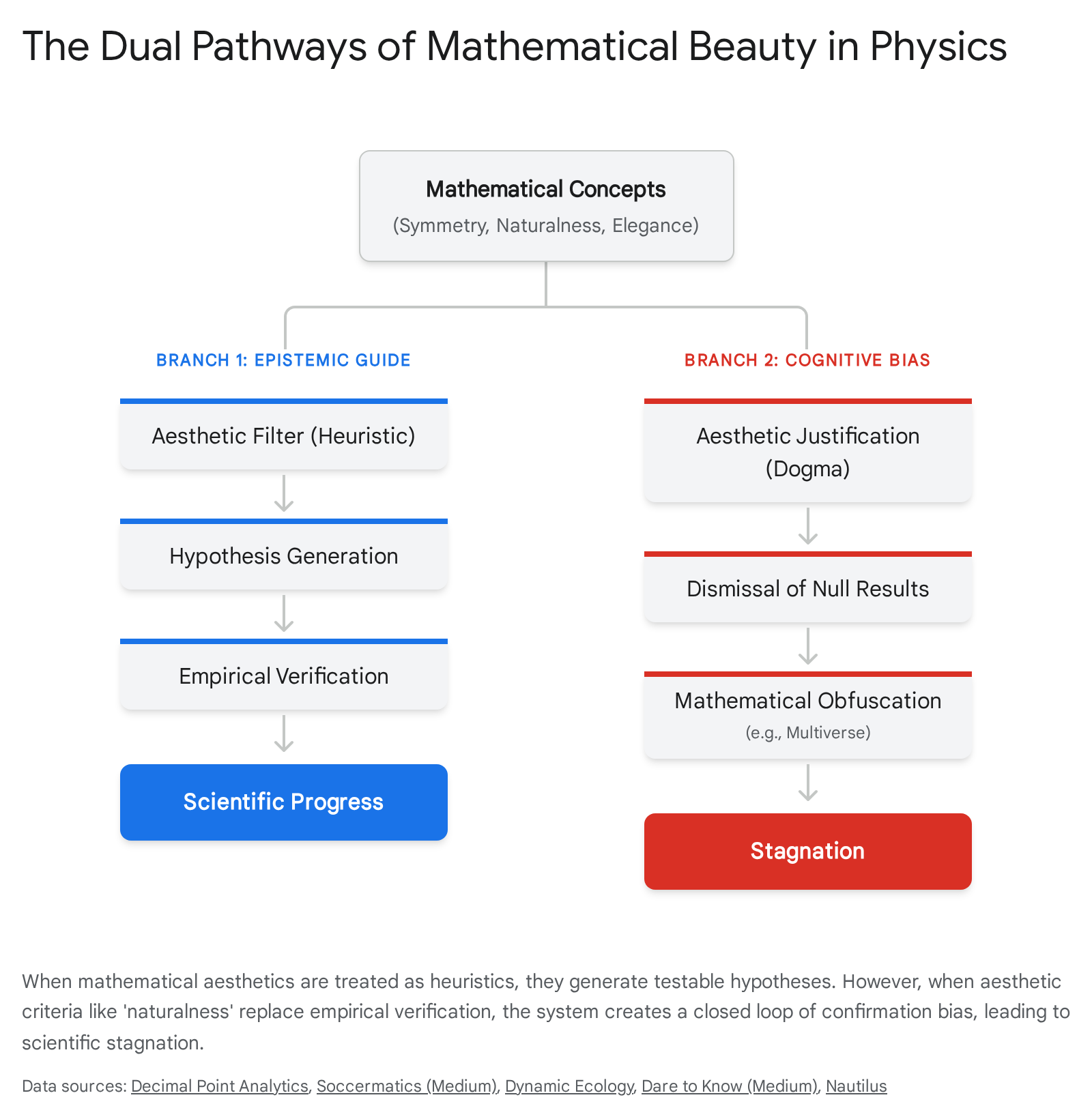
To clearly delineate how the perception of mathematical beauty functions across different scientific and cognitive paradigms, the following table compares its role as a valid epistemic guide versus a detrimental cognitive bias:
Comparative Analysis: Epistemic Guide vs. Cognitive Bias
| Dimension | Beauty as an Epistemic Guide (Heuristic) | Beauty as a Cognitive Bias (Dogma) |
|---|---|---|
| Primary Function | Acts as a heuristic filter to select promising hypotheses from vast combinatorial possibilities, conserving cognitive energy (e.g., Ramanujan) 357. | Acts as a rigid, unyielding justification for a theory's validity in the total absence of empirical evidence (e.g., Supersymmetry) 525737. |
| Cognitive Mechanism | Signals successful data compression, pattern recognition, and error minimization, leading to a functional dopaminergic reward (RPE) 1517. | Triggers severe confirmation bias; researchers ignore null results from colliders to preserve the internal aesthetic coherence of the model 4849. |
| Role of Simplicity | Favors parsimonious explanations (Occam's Razor) that efficiently map to observed, testable physical realities 3445. | Demands mathematical "naturalness" even when the universe may fundamentally rely on asymmetrical or fine-tuned parameters 4750. |
| Historical Context | Guided the successful formulation of historically verified theories such as General Relativity, the Dirac Equation, and the Standard Model 157. | Has led to 40 years of profound stagnation in fundamental physics, driving resources toward untestable concepts like the Multiverse 3654. |
| Sociological Impact | Fosters deep interdisciplinary connections, revealing unifying structures between disparate fields (e.g., geometry and arithmetic) 1129. | Creates a stagnant academic echo chamber where funding, tenure, and publication are awarded based on conformity to aesthetic orthodoxy 493654. |
Conclusion
The experience of aesthetic beauty in mathematics is not a singular phenomenon, but a vastly complex intersection of neurobiology, evolutionary adaptation, cognitive heuristics, and cultural epistemology. As evidenced by robust fMRI studies, the human brain processes elegant mathematics through the exact same medial orbitofrontal networks that mediate profound emotional and sensory pleasure 78. This capacity, rather than being an evolutionary accident, likely stems from deeply conserved dopaminergic reward pathways that intrinsically favor data compression and low algorithmic complexity. These systems actively reward the mind for successfully parsing the chaos of the universe into symmetrical, predictable schemas, providing an informational high that drives human discovery 151819.
Furthermore, mathematical beauty is not a monolithic construct confined to Western axiomatic deduction. The intuitive, dream-derived heuristics of Srinivasa Ramanujan, the spiritual and infinite tessellations of Islamic geometric art, and the ontological pragmatism of classical Chinese mathematics demonstrate that aesthetic primitives - such as symmetry, unity, and parsimony - are universal, even as their cultural applications diverge 3339. As domain expertise deepens, mathematicians cross a cognitive threshold where they no longer perceive just the syntax of equations, but directly and emotionally appraise their semantic and structural depths, converging on an aesthetic consensus that behaves biologically rather than purely socially 12122.
However, the very evolutionary mechanisms that make mathematical elegance deeply satisfying also predispose the human mind to profound cognitive biases. As modern physics confronts the hard limits of empirical measurement, the reliance on aesthetic criteria like "naturalness" and "simplicity" has transitioned from a useful heuristic into a rigid dogma 485054. The resulting decades of theoretical stagnation in fundamental physics serve as a crucial warning: while mathematical beauty provides a powerful, evolutionarily honed compass for human cognition, it cannot usurp the role of the physical universe as the ultimate arbiter of truth. Understanding the neuroaesthetics of mathematics therefore requires a delicate balance - celebrating the profound capability of the human brain to perceive universal harmonies, while remaining strictly vigilant against the seduction of our own cognitive architecture.