
Neural basis of mathematical cognition and individual differences
The capacity for advanced mathematical reasoning presents a profound evolutionary paradox. Formal mathematics - encompassing algebra, geometry, calculus, and topology - is a recent cultural invention, emerging only within the last few millennia. Yet, the human brain seamlessly acquires and manipulates highly abstract mathematical concepts. The resolution to this paradox lies in the neuronal recycling hypothesis, which posits that culturally acquired mathematical skills co-opt ancient, evolutionarily conserved neural circuits originally dedicated to spatial navigation, temporal processing, and the estimation of basic magnitudes 1. Through the integration of functional neuroimaging, cognitive developmental psychology, and computational modeling, researchers have mapped the intricate networks that allow the brain to translate raw numerical perception into advanced mathematical thought.
Evolutionary and Developmental Foundations
The foundation of human mathematical cognition is not linguistic or symbolic, but rather perceptual. Long before a child learns to count or recognize visual symbols, the brain possesses a foundational cognitive architecture known as the Approximate Number System (ANS) 23. This innate system permits the rapid, non-verbal estimation and comparison of quantities, a trait shared with numerous non-human species, including primates, dolphins, and certain avian species 13.
Core Knowledge in Infancy
In human infants, core knowledge systems specialized for object representation and magnitude perception are active within the first months of life. Behavioral experiments demonstrate that pre-verbal infants can discriminate between distinct numerosities and display prolonged looking times - an indicator of cognitive surprise - when fundamental arithmetic laws are violated, such as when the physical addition of objects yields a mathematically impossible quantity 13. Neuroimaging of both infants and adults indicates that this primal number sense is predominantly localized within the parietal cortex, forming the physiological bedrock upon which subsequent formal mathematics education is built 34.
The independence of this core knowledge from formal language is further corroborated by anthropological cognitive studies. Research conducted with the Mundurukú, an Indigenous society in the Amazon whose lexicon lacks exact number words beyond five, reveals robust intuitive mathematical cognition. When tested on magnitude comparison and basic geometry, Mundurukú individuals perform proficiently on approximate arithmetic tasks, despite failing at exact large-number calculations due to the absence of a symbolic counting system 5. This highlights that the fundamental architecture for perceiving numerical magnitude operates independently of the linguistic faculties required for exact calculation 5.
Core Cortical Networks for Numerical Processing
The processing of numbers does not occur in a single, isolated "math center." Instead, it relies on a highly distributed, interconnected network spanning the parietal, frontal, and temporal lobes 267. The prevailing theoretical framework, the Triple Code Model of numerical cognition, theorizes three distinct representations of numbers: visual (Arabic numerals), verbal (number words), and magnitude (semantic quantity). Neuroimaging meta-analyses have consistently mapped these representations to distinct neuroanatomical hubs 28.
The Intraparietal Sulcus and Magnitude Representation
The bilateral intraparietal sulcus (IPS) serves as the primary cortical hub for the semantic representation of numerical magnitude 7910. Whether an individual views a dot array, an Arabic digit, or hears a spoken number word, the IPS is consistently activated to extract the underlying quantitative meaning 29.
The IPS demonstrates a robust "numerical distance effect," wherein neural activation and behavioral response times scale inversely with the numerical distance between two quantities being compared. Discriminating between 8 and 9 requires greater metabolic effort and longer response times than discriminating between 2 and 9. This phenomenon reflects the analog, overlapping nature of quantity representations in the parietal cortex 10. Furthermore, single-cell recordings in non-human primates and functional magnetic resonance imaging (fMRI) adaptation studies in humans have identified distinct neuronal populations within the IPS that are tuned to specific numerosities. These neuronal populations fire maximally for their preferred number and progressively less for adjacent numbers, creating a topographically organized mental number line 110.
High-resolution imaging has further parsed the parietal contributions, distinguishing between estimation and comparison circuits. Estimation tasks tend to recruit inferior parietal areas (such as PGa) and superior parietal areas, while exact numerical comparison activates adjacent areas on the opposite side of the IPS 10.
The Angular Gyrus and Arithmetic Fact Retrieval
Adjacent to the IPS, the angular gyrus (AG) situated in the inferior parietal lobule plays a divergent but equally critical role. Rather than computing continuous magnitudes, the AG is heavily implicated in the retrieval of overlearned, discrete arithmetic facts, such as single-digit multiplication tables and simple addition 1211.
The AG serves as a cross-modal hub that interfaces closely with the brain's language networks and the default mode network 11. As children mature and receive formal mathematical education, their brains exhibit a well-documented functional shift: calculating simple arithmetic transitions from an effortful, quantity-based procedural strategy located in the IPS and prefrontal cortex, to an automatic, memory-based retrieval strategy localized in the left AG 7912. Consequently, exact arithmetic relies heavily on language-dependent memory structures, whereas approximate arithmetic exclusively recruits the bilateral IPS 79.
Prefrontal and Inferior Temporal Contributions
The execution of multi-step arithmetic requires holding intermediate values in mind, applying rule-based algorithms, and suppressing irrelevant data. This executive control is governed by the dorsolateral prefrontal cortex (dlPFC) and the anterior cingulate cortex 101412. The prefrontal cortex manages the working memory demands of calculation and acts as a temporal sequence coordinator, evaluating the outputs generated by the parietal modules 10.
Furthermore, the initial visual decoding of written digits occurs in the ventral visual stream. Research has isolated a specialized region in the inferior temporal gyrus known as the Inferior Temporal Numeral Area (ITNA) 13. The ITNA exhibits category-sensitive representations, preferentially activating in response to Arabic numerals compared to letters or meaningless geometric shapes. It acts as the visual gateway that translates abstract written symbols into neural signals, which are then routed to the parietal cortex for magnitude evaluation 13.
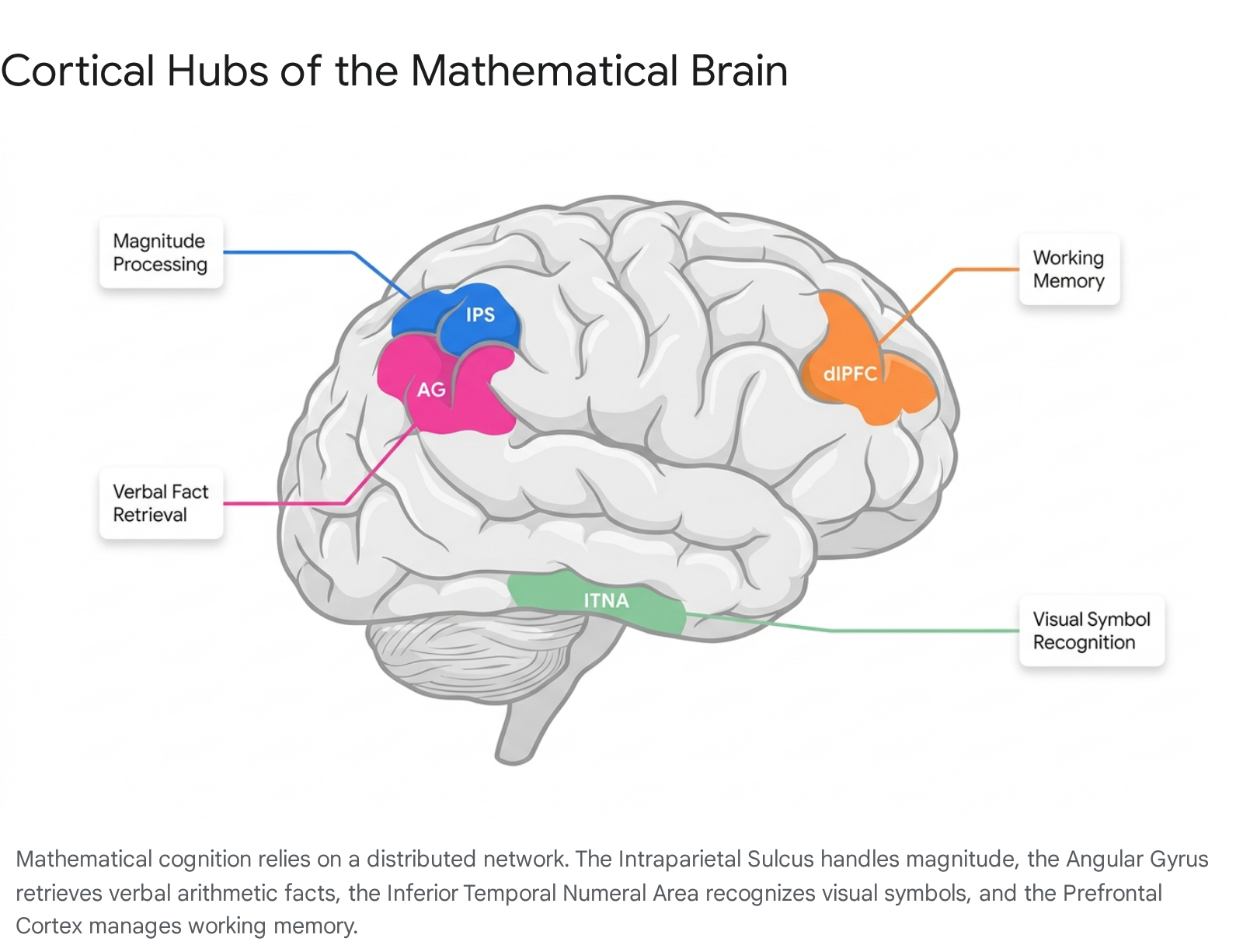
| Cognitive Function | Primary Neural Correlate | Network Role | Operational Modality |
|---|---|---|---|
| Magnitude Representation | Bilateral Intraparietal Sulcus (IPS) | Quantity estimation, spatial mapping, number line | Non-verbal, approximate |
| Arithmetic Fact Retrieval | Left Angular Gyrus (AG) | Multiplication tables, rote memorization | Verbal, exact |
| Executive Control | Dorsolateral Prefrontal Cortex (dlPFC) | Working memory, strategy application, sequencing | Modality-general |
| Visual Symbol Recognition | Inferior Temporal Numeral Area (ITNA) | Decoding Arabic digits and mathematical symbols | Visual |
| Emotion & Threat Detection | Amygdala & Anterior Insula | Triggering math anxiety, visceral threat response | Affective |
Neural Dynamics of Advanced Mathematics
A central debate in cognitive science historically centered on whether advanced, formal mathematics relies on the brain's language processing centers. Because high-level mathematics employs a rigid syntax and symbolic grammar, early theorists posited that mathematical thought was an offshoot of human linguistic capacity.
Recent functional neuroimaging definitively resolves this debate. When professional mathematicians evaluate complex statements across diverse domains - including algebra, analysis, topology, and geometry - fMRI data reveals that these high-level tasks recruit the exact same bilateral fronto-parietal and inferior temporal networks that activate when non-mathematicians perform basic arithmetic or view simple dot arrays 68.
Crucially, mathematical reflection in experts entirely spares the perisylvian language areas associated with general semantic knowledge and sentence comprehension 68. Even when advanced mathematical statements are presented verbally, the expert brain bypasses linguistic semantics, directly routing the information to the ancient "space and number" networks 6. This neurobiological dissociation explains why profound aphasia (the loss of language due to brain injury) can leave algebraic and geometric reasoning entirely intact, and why early childhood proficiency in basic spatial and number sense is a powerful predictor of late-stage mathematical achievement 68.
The Role of Geometric Regularity
Higher mathematical thought is also deeply rooted in the visual perception of structural regularities. A 2026 study analyzing both fMRI and magnetoencephalography (MEG) data demonstrated that humans possess a unique neural mechanism for encoding geometric shapes 1415. When individuals perceive regular polygons (e.g., squares, equilateral triangles), the brain compresses this visual information based on discrete geometric properties like parallelism and right angles 1416.
This perception induces a specific regularity effect: relative to processing other visual categories like faces or tools, regular geometric shapes cause a hypoactivation of ventral visual areas and a massive overactivation of the intraparietal and dorsal prefrontal regions - the identical math-responsive network 1415. The magnitude of this activation is proportional to the "minimal description length" of the shape, indicating that the human brain relies on symbolic, abstract geometric compression rather than purely visual processing, laying the perceptual groundwork for advanced mathematical compositionality 1416.
Structural and Functional Connectivity
Mathematical cognition cannot be understood solely through isolated cortical localizations; it requires an analysis of functional connectivity - the dynamic, moment-to-moment synchronization of distinct brain regions 1718.
Debunking the Left-Brain/Right-Brain Fallacy
The distributed nature of mathematical connectivity serves to thoroughly debunk the popular neuromyth that mathematical ability resides exclusively in the "left brain" (often mischaracterized as purely logical), while creativity is relegated to the "right brain" 192021.
While certain specific sub-tasks show lateralization - such as language and arithmetic fact retrieval typically demonstrating left-hemisphere dominance via the AG - mathematics as a whole is a profoundly bilateral endeavor 1920. Complex problem-solving, spatial reasoning, and magnitude comparison demand intense bilateral coordination across the corpus callosum. Indeed, connectivity studies indicate that mathematically gifted youth exhibit significantly greater inter-hemispheric cooperation than their non-gifted peers, efficiently passing data back and forth across both hemispheres to synthesize logical and spatial information 22. Furthermore, the brain's "innovation circuits," necessary for divergent mathematical problem solving, exist and operate bilaterally 21.
Topological Network Dynamics
To understand the immense complexity of these brain networks, neuroscientists are increasingly applying mathematical methods - specifically algebraic topology - to model the brain's connectome 2324. Algebraic topology, a field that studies shapes unaltered by continuous deformation, is highly effective at identifying invariant properties in the structure of neural firing patterns 2325.
By mapping the pairwise correlations of neural activity as multi-dimensional topological spaces, researchers have discovered highly organized geometric structures, or "cliques," in neuronal firing 25. This emerging field of higher-order topological dynamics reveals that brain activity relies on multi-body interactions that extend beyond simple pairwise neural connections 26. The topological structures of these neural networks define the brain's capacity to process complex, multi-layered mathematical variables, demonstrating a fascinating symmetry: the brain utilizes complex topological dynamics to understand the mathematical field of topology itself 2326.
Furthermore, resting-state fMRI reveals that math-space integration relies heavily on the hippocampus 27. The hippocampus, traditionally associated with memory and spatial navigation, demonstrates functional connectivity with frontoparietal networks during mathematical learning. Stronger baseline connectivity between the dlPFC, posterior parietal cortex (PPC), and the hippocampus strongly predicts an individual's ability to generalize mathematical algorithms across novel problems 2728.
Neurocognitive Mechanisms of Mathematical Struggle
While the neurotypical brain relies on the synchronized firing of fronto-parietal regions to parse numbers, aberrations in this neural development lead to profound, persistent difficulties. Mathematical struggle generally falls into two distinct clinical profiles: Developmental Dyscalculia (a specific cognitive learning disorder) and Mathematics Anxiety (an affective and emotional disorder).
Developmental Dyscalculia and Neural Excitability
Developmental Dyscalculia (DD) affects approximately 5% to 7% of the school-age population and is characterized by a fundamental, persistent deficit in representing and processing numerical magnitude 29. Individuals with DD struggle to map numerical symbols to physical quantities, require immense working memory to execute basic addition, and show an inability to seamlessly subitize 229.
Historically, neuroimaging literature indicated that DD was caused by structural gray matter deficits and functional hypoactivity (under-activation) within the IPS 3034. However, a groundbreaking 2025 study utilizing Artificial Intelligence significantly altered this paradigm 3132. Researchers generated "digital twins" - biologically plausible personalized deep neural networks (pDNNs) - trained on fMRI data to precisely mimic the learning rates, behavioral accuracy, and neural activity of children with and without dyscalculia 323334.
The digital twin models revealed that the core neurological issue in DD is not a lack of neural activity, but rather neural hyper-excitability 313234. In the struggling brain, regions responsible for numerical thinking fire with an excess of poorly tuned, uncalibrated activity. This hyper-excitability creates a phenomenon known as "representational overlap" 3132.
In a neurotypical brain, the neural activation manifold for an arithmetic problem like "3 + 4" is geometrically distinct from the manifold for "5 + 2". In the dyscalculic brain, hyper-excitability blurs these neural manifolds, causing the representations of different math problems to structurally overlap 313334.
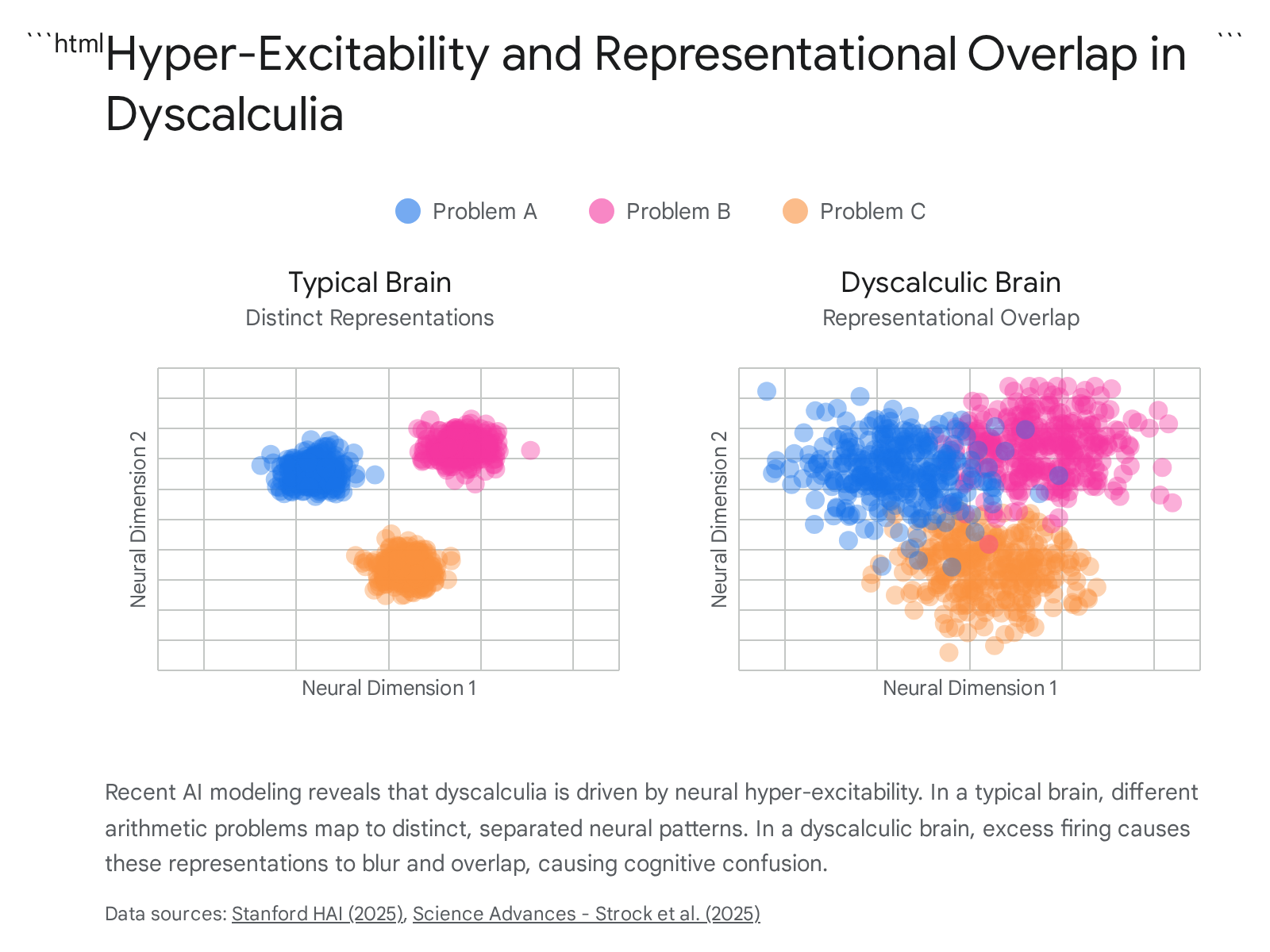
The brain is computationally incapable of distinguishing the overlapping representations, leading to systemic confusion, elevated error rates, and delayed processing speed 3132. Furthermore, aberrant resting-state functional connectivity plays a role; hyper-connectivity of the IPS during adolescence remains a strong predictor of persistent low mathematical ability, indicating a failure to prune inefficient synaptic pathways 35.
Mathematics Anxiety: The Emotional Hijack
Distinct from the magnitude processing deficits of dyscalculia, mathematics anxiety (MA) is an affective phenomenon where the mere anticipation of a mathematical task triggers profound physiological stress, tension, and fear 3637. MA operates neurologically as a specific phobia, overriding otherwise intact mathematical aptitude.
A comprehensive 2024 meta-analysis synthesizing 50 fMRI studies on math anxiety demonstrated that anticipating or engaging in math triggers robust, pathological hyperactivation of the right amygdala (the brain's primary threat detection center) and the anterior insula (a region associated with visceral pain processing and interoception) 3037. To the highly math-anxious brain, numerical symbols register as literal physical threats, initiating an immediate "fight-or-flight" autonomic response 3742.
This severe affective response causes an "emotional hijack" of the brain's higher cognitive resources 37. The amygdala hyperactivation actively suppresses and decouples functional connectivity from the working memory networks in the dlPFC and the magnitude processing networks in the IPS 303742. The limited working memory capacity typically used to hold numbers in mind, sequence calculations, and retrieve arithmetic facts is entirely depleted by the cognitive effort required to regulate the intense fear response. Consequently, individuals with MA severely underperform their actual mathematical aptitude. They fail not because they lack the core neuronal architecture for numbers, but because their analytical "System 2" networks are starved of metabolic resources by the overactive limbic system 303742.
Prolonged exposure to this stress can lead to enduring structural changes; children and adolescents with chronic, high math anxiety demonstrate reduced gray matter volume in the right amygdala over time, reflecting a maladaptive neuroplastic response to chronic stress 36.
| Clinical Profile | Primary Neural Correlates | Core Mechanism | Behavioral Outcome |
|---|---|---|---|
| Developmental Dyscalculia | IPS, dlPFC, Striatum | Neural hyper-excitability leading to representational overlap 313233 | Impaired magnitude perception, inability to subitize, arithmetic inaccuracy |
| Mathematics Anxiety | Amygdala, Anterior Insula, VMPFC | Emotional hijack; visceral threat response depletes working memory capacity 303742 | Avoidance of math tasks, performance drops under pressure, intact underlying aptitude |
Neural Correlates of Mathematical Giftedness
At the opposite end of the proficiency spectrum, researchers have identified specific structural and functional neural markers associated with mathematical giftedness and high-level intuition. Mathematical expertise does not necessarily correlate with greater overall brain volume, but rather with extraordinary neural efficiency and optimized microstructural white-matter connectivity 101243.
Structural equation modeling of fMRI data from mathematically gifted adolescents reveals heightened intra-hemispheric fronto-parietal connectivity 12. The axonal tracts (white matter) connecting the IPS to the prefrontal and premotor cortices are denser and more structurally robust. This facilitates high-speed, high-bandwidth data transfer between the posterior spatial representation of numbers and anterior executive decision-making networks 1243. Brain-wide white matter integrity serves as a primary freeway system; gifted brains suffer fewer "traffic jams" in signal processing, leading to rapid calculation speed and enhanced visuospatial manipulation 1243.
Resting-state functional connectivity reveals further idiosyncrasies. Professional mathematicians express highly optimized, specific levels of functional connectivity within targeted resting-state networks 38. For example, studies have observed lower functional connectivity between the left and right caudate nuclei in expert mathematicians compared to non-mathematicians 38. While seemingly counterintuitive, this localized reduction in functional connectivity is a recognized hallmark of extreme expertise. It demonstrates that the math-gifted brain functions with less "neural noise," pruning inefficient background connections to isolate highly specialized circuitry, thereby requiring less metabolic effort to achieve complex cognitive states 1038.
It must be noted, however, that current literature regarding mathematical giftedness often suffers from low statistical power and a reliance on invalid backward inference in neuroimaging studies 39. While the correlations between high mathematical performance, spatial processing, and fluid intelligence are robust, the exact causal mechanisms driving these connectivity optimizations require larger, longitudinal cohort studies 39.
Linguistic and Cultural Moderation of Mathematical Processing
While the core IPS architecture for processing continuous quantities is a biologically universal trait across the human species, the broader fronto-parietal math network exhibits high neuroplasticity. Cultural tools, language syntax, and educational systems drastically remodel how the brain calculates, proving that mathematical cognition is inherently intertwined with the environment of acquisition 4041.
Bilingualism and the Cognitive Cost of Calculation
Because exact arithmetic relies heavily on linguistic encoding (e.g., the rote memorization of multiplication tables), bilingualism introduces unique neurological variables to brain imaging profiles 4249.
When bilingual individuals perform exact, complex arithmetic in a second language of instruction, fMRI reveals a measurable cognitive "extra effort" 4249. Monolingual individuals, or bilinguals calculating in their native tongue, rely smoothly on the left temporal lobe and the angular gyrus to retrieve overlearned facts. However, when complex calculation is forced into a second language, the brain abandons this highly efficient verbal pathway 4249. Instead, subjects exhibit widespread, compensatory activation in occipital and visual processing networks, indicating a sudden reliance on figurative and visual-spatial thinking to bypass the linguistic bottleneck 4249. This functional shift demands greater metabolic resources, requires more processing time, and correlates with higher error rates, demonstrating that exact mathematical processing remains deeply tethered to the specific phonological rules of the acquisition language 4249.
Number Word Structure and the Inversion Effect
The morpho-syntactic structure of a culture's language fundamentally alters the cognitive load required to perform math. A prominent example of this linguistic moderation is the "inversion effect," observed in languages such as German, Dutch, and Arabic 414344.
In English or Chinese counting systems, the number 42 is read linearly as "forty-two" (decades, then units). In German, it is read as "zweiundvierzig" (literally "two-and-forty" - units, then decades). This linguistic inversion creates a massive cognitive incongruency between the visual, left-to-right processing of Arabic digits and the sequential phonological representation 4143.
Neuroimaging and behavioral studies confirm that German-speaking adults and children suffer from elevated unit-interference and require additional working memory capacity to actively re-order the digits in their mind before the IPS can accurately evaluate the magnitude 434546. This results in significantly higher rates of transcoding errors in early childhood (e.g., a child mistakenly writing 72 when hearing "twenty-seven") compared to their peers learning in non-inverted languages like Italian or English 4445. Furthermore, the profound transparency of East Asian counting systems (e.g., reading 12 as "ten-two") dramatically lightens the working memory load required to manipulate numbers, facilitating faster behavioral integration into the semantic representations of the IPS 4445.
| Language Characteristic | Example Languages | Cognitive Impact | Transcoding Error Rate in Children |
|---|---|---|---|
| Transparent / Base-10 | Chinese, Japanese | Low working memory load, clear decade-unit mapping | Very Low 4445 |
| Linear / Non-Inverted | English, Italian | Moderate working memory load, consistent left-to-right reading | Moderate 4345 |
| Inverted (Unit-Decade) | German, Dutch, Arabic | High working memory load, requires mental re-ordering | High (Inversion-specific errors) 414345 |
Visuospatial Plasticity Through Abacus Training
Cultural mathematics learning strategies, such as Abacus-Based Mental Calculation (AMC) prevalent in various Asian educational systems, showcase the brain's profound capacity for functional reorganization 474849.
AMC requires students to perform rapid, complex arithmetic by manipulating an imaginary, mental abacus. Long-term fMRI studies comparing abacus experts and AMC-trained children against untrained controls reveal a massive shift in neural processing strategies. While untrained individuals rely primarily on the language-dependent left hemisphere (the AG) for exact calculation, AMC-trained individuals recruit a robust bilateral visuo-premotor and occipital-temporal network 4850.
By visualizing the physical geometry of abacus beads in three-dimensional space, trained individuals successfully bypass the strict working memory constraints of verbal language. Instead, they leverage the visual cortex and spatial tracking regions to hold and manipulate massive quantities of data simultaneously 4750. Long-term practice physically alters the structural white matter volume in the right frontoparietal network and left fusiform gyrus, highlighting that prolonged engagement with cultural mathematical tools can completely rewrite the biological encoding of numbers 4849.
Environmental Influences and Demographic Factors
Beyond language and cultural tools, broader environmental factors substantially influence the neurodevelopment of mathematical cognition.
A comprehensive meta-analysis of 66 global neuroimaging studies evaluating the impact of family poverty and low socioeconomic status (SES) revealed significant developmental alterations. Low SES correlates with measurable deficits in cortical volume, executive functioning, and attention networks, yielding small-to-intermediate effect sizes in concurrent mathematical performance 51. Chronic environmental stress and lack of early cognitive stimulation associated with poverty compound to delay the robust formation of fronto-parietal white matter tracts necessary for proficient numeracy 51. However, the literature is heavily skewed, with 85% of studies originating from Western, high-income nations, prompting a need for caution regarding universal deficit attributions that ignore specific regional and structural ecologies 51.
Conversely, neuroimaging definitively debunks long-standing behavioral stereotypes regarding innate gender differences in mathematical aptitude. A 2025 fMRI study of 156 children utilizing advanced wavelet time-frequency analysis examined dynamic brain processes rather than static activation patterns during mathematical tasks 52. The time-frequency analysis demonstrated an 89.1% similarity in dynamic neural activation patterns between genders, featuring identical temporal sequences and frequency profiles 52. Sophisticated machine learning classifiers achieved only 53.8% accuracy (essentially chance level) in attempting to distinguish gender based on neural math patterns, providing robust physiological evidence that gender similarities entirely dominate mathematical cognition at the process level 52.
Neuroplasticity and Cognitive Interventions
Because the neural pathways governing mathematical cognition - specifically the fronto-parietal tracts - remain highly plastic throughout development and into adulthood, neurocognitive interventions can successfully remediate structural and functional deficits.
Behavioral and Cognitive Rehabilitation
Brain imaging provides empirical evidence that targeted behavioral intervention physically strengthens underperforming networks in individuals with developmental dyscalculia 3453. Meta-analyses of digital and specialist-led cognitive interventions report moderate to large effect sizes (ranging from 0.52 to 0.55) when interventions are symptom-specific, intensive, and sustained for an optimal duration of 6 to 12 months 53.
For example, children diagnosed with dyscalculia who undergo intensive, adaptive number-line training exhibit significant increases in IPS activation, normalizing their neural response and reducing the hyper-excitability of their neural manifolds 3432. Effective interventions must be explicitly targeted. Generalized working memory training yields mixed results with limited transfer to specific mathematical competency. In contrast, interventions that explicitly link visual spatial magnitudes to Arabic symbols successfully rebuild the specific fronto-parietal tracts required for number sense 3453. Furthermore, gamified cognitive training models and visuo-motor rehabilitation techniques, such as prismatic adaptation (which shifts the perceived visual field to induce bottom-up neuroplasticity), have shown promising preliminary results in remodeling the spatial attention networks vital to calculation in adolescents 54.
Addressing mathematics anxiety requires a different interventional paradigm focused on emotion regulation and cognitive reappraisal. These interventions are specifically aimed at down-regulating amygdala reactivity, reducing the visceral threat response to free up prefrontal working memory resources, allowing the underlying mathematical aptitude to express itself without interference 3053.
Neuromodulation and Neurochemistry
Experimental neuromodulation presents a nascent but highly promising frontier in actively enhancing mathematical learning. Research employing non-invasive brain stimulation, such as transcranial direct current stimulation (tDCS) and transcranial random noise stimulation (tRNS), has demonstrated that applying mild, targeted electrical currents to the dlPFC and PPC during mathematical training can selectively alter the brain's learning curve 2854.
A 2025 study evaluating participants over a 5-day math training paradigm utilized magnetic resonance spectroscopy to measure underlying brain chemicals. The results indicated that targeted electrical stimulation alters the regional balance of glutamate and GABA - the primary neurotransmitters facilitating cellular excitation and inhibition 28. By modulating this chemical environment, stimulation artificially enhances the brain's baseline capacity for plasticity. Individuals with initially weak connectivity between the dlPFC and PPC exhibited significantly improved calculation learning after receiving stimulation, suggesting that neuromodulation could serve as a viable remediation strategy for individuals struggling with biological or structural connectivity disadvantages 28.
Conclusion
The neuroscience of mathematical cognition reveals that human beings are fundamentally wired for numerical thought, yet the brain achieves this proficiency through an intricate, highly adaptive recycling of evolutionarily ancient networks. By co-opting the intraparietal sulcus for magnitude estimation and dynamically linking it to visual pattern recognition, linguistic memory, and executive control centers, the human brain constructs the capacity for everything from basic counting to advanced topological reasoning.
Differences in mathematical intuition - spanning from the profound processing bottlenecks of dyscalculia and the paralyzing emotional hijack of math anxiety, to the extraordinary microstructural efficiency of mathematical giftedness - do not emerge from a single modular defect or advantage. Instead, they arise from the complex interplay of neural excitability, limbic emotional regulation, and brain-wide network connectivity. Crucially, the mathematical brain is not rigidly fixed. As demonstrated by the profound neural costs of bilingual calculation, the cognitive burdens of linguistic inversion, and the structural remodeling induced by both cultural tools and targeted clinical neuromodulation, human mathematical cognition remains exquisitely sensitive to its environment, possessing the continuous potential for profound neuroplastic adaptation.