
Charge order and its effects on cuprate superconductors
Introduction to Cuprate Charge Order
The phenomenon of high-temperature superconductivity in cuprate materials, first discovered by Bednorz and Müller in 1986, emerges when mobile charge carriers - either holes or electrons - are chemically doped into a parent Mott insulator state 1234. In the un-doped state, strong Coulomb repulsion localizes electrons on the copper sites, establishing a long-range antiferromagnetic (AFM) order 15. As doping disrupts this antiferromagnetism, the material transitions through a series of complex electronic states before achieving macroscopic phase coherence as a superconductor. Among these intermediate and competing states, charge order (CO) - often referred to interchangeably with charge density waves (CDW) or charge stripes - has been recognized as a universal and fundamental property of the cuprate phase diagram 123.
Charge order refers to the spontaneous breaking of translational symmetry within the highly correlated $\text{CuO}2$ atomic planes, characterized by a periodic modulation of the local electron density 67. Initially, charge and spin modulations were detected jointly as strictly unidirectional "stripes" in lanthanum-based cuprates, such as $\text{La}{1.6-x}\text{Nd}{0.4}\text{Sr}_x\text{CuO}_4$ (Nd-LSCO) and $\text{La}{1.875}\text{Ba}_{0.125}\text{CuO}_4$ (LBCO). In these specific compounds, a low-temperature structural transition to a low-temperature tetragonal (LTT) phase was thought to pin and stabilize the electronic order 18. For nearly two decades, the scientific consensus treated charge ordering as a material-specific peculiarity limited to the 214-cuprate family near a specific fractional doping level of $p \approx 1/8$ 8.
However, subsequent advancements in detection methodologies revealed that charge order is not an anomaly but a ubiquitous feature. It has now been firmly established across virtually all hole-doped and electron-doped cuprate families, including $\text{YBa}2\text{Cu}_3\text{O}{6+x}$ (YBCO), $\text{Bi}2\text{Sr}_2\text{CaCu}_2\text{O}{8+\delta}$ (Bi2212), $\text{HgBa}2\text{CuO}{4+\delta}$ (Hg1201), and electron-doped variants like $\text{Nd}_{2-x}\text{Ce}_x\text{CuO}_4$ (NCCO) 691011.
The pervasive presence of charge order places it on equal footing with other defining features of the cuprate normal state, such as the enigmatic pseudogap phase and the strange metal regime 12. Determining whether charge order is a primary driver of the anomalous normal-state properties, an inevitable byproduct of the underlying electron correlations, or an active competitor to superconducting pairing remains a central objective in condensed matter physics 13. The current empirical landscape suggests a highly nuanced relationship. While static charge order undeniably competes with superconductivity for available density of states at low temperatures, the dynamic fluctuations of charge order extend well into the high-temperature strange metal regime and exhibit a complex phase-coherence interplay with the superconducting condensate 1415.
Experimental Detection Techniques
The comprehensive mapping of charge order across the cuprate phase diagram has relied on the synergistic application of multiple bulk and surface probes. Because charge order often manifests as short-range, incommensurate correlations rather than true long-range periodic crystals, distinguishing its signature from structural disorder and quasiparticle interference (QPI) requires exceptionally high-resolution techniques 1516. The following subsections detail the primary instrumental approaches utilized to isolate and characterize these charge modulations.
Resonant Inelastic X-ray Scattering
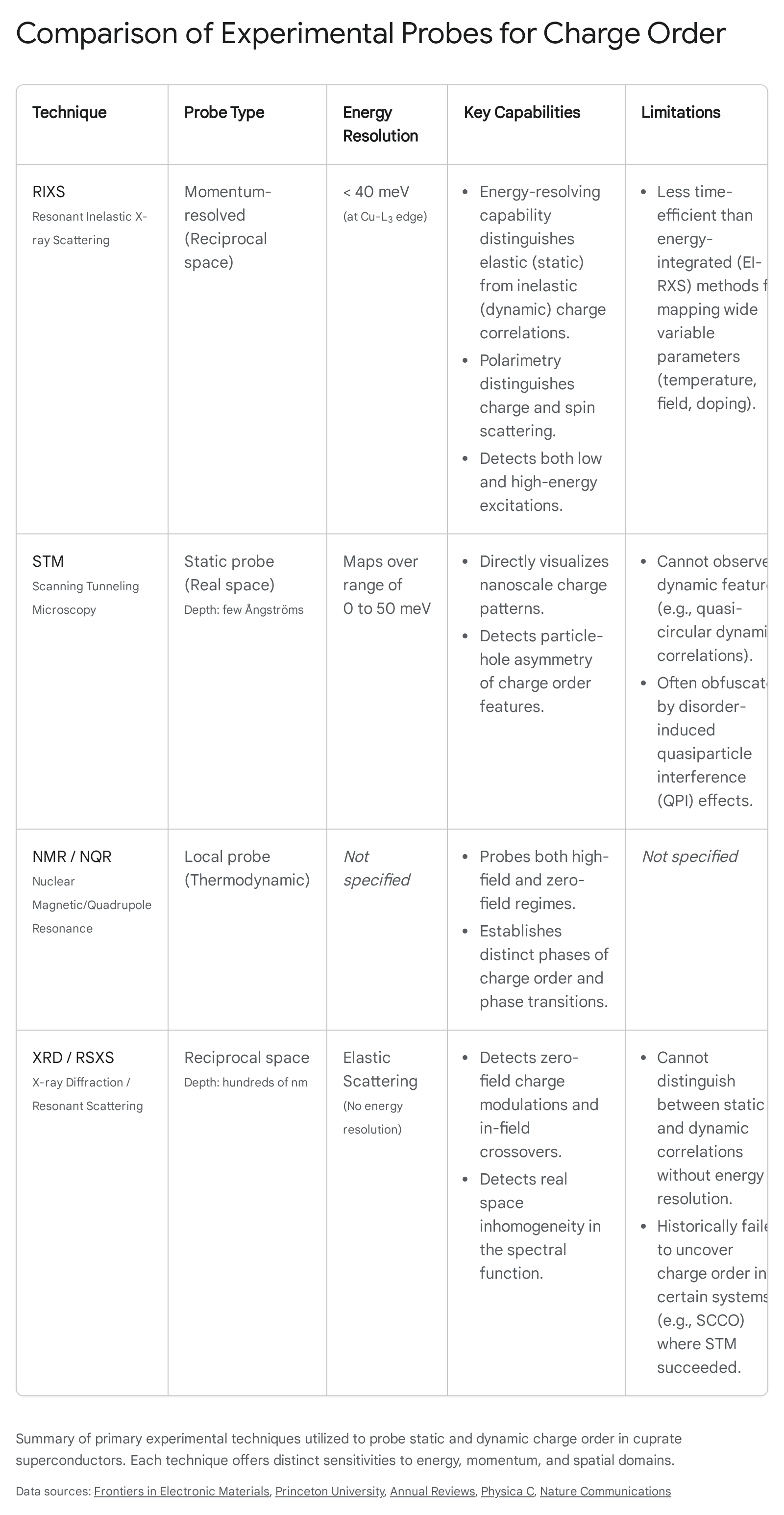
Resonant Inelastic X-ray Scattering (RIXS) has emerged as the premier momentum-resolved probe for studying dynamic charge order correlations in cuprate materials 1517. By tuning the incident photon energy to a specific atomic resonance - most notably the Cu-$L_3$ edge at approximately 931.5 eV - the scattering cross-section for valence electrons within the critical $\text{CuO}_2$ planes is dramatically enhanced 171819. The RIXS process involves a core-level transition (from $2p$ to $3d$), creating a highly localized intermediate state ($3d^{10}$) before decaying back to the $3d^9$ configuration, leaving behind various elemental excitations such as phonons, magnons, or charge density fluctuations 17.
The primary advantage of RIXS is its combined momentum and energy resolution. High-resolution spectrometers, such as the ERIXS instrument at the European Synchrotron Radiation Facility (ESRF) ID32 beamline and the SIX beamline at the National Synchrotron Light Source II (NSLS-II), have successfully pushed the energy resolution below 40 meV 1518. This resolving power allows researchers to separate strictly elastic scattering, which is associated with static charge modulations, from inelastic scattering, which is associated with dynamic charge fluctuations, high-energy $d-d$ orbital excitations, and paramagnons 1215.
Within the Cu-$L_3$ RIXS spectrum, static charge order appears prominently as an enhancement of the quasi-elastic line at in-plane wavevectors along the Cu-O bond directions, geometrically denoted as $\mathbf{q} = (\pm q_{CO}, 0)$ and $\mathbf{q} = (0, \pm q_{CO})$ 15. Furthermore, polarimetric RIXS (pol-RIXS) can analyze the polarization of the scattered photons to unambiguously distinguish between charge scattering and spin scattering. This polarization analysis is critical for resolving overlapping signals, effectively separating charge excitations from single- and two-magnon processes 1518.
Energy-Integrated Resonant X-ray Scattering
Energy-Integrated Resonant X-ray Scattering (EI-RXS) - also widely referred to simply as Resonant Soft X-ray Scattering (RSXS) - functions by counting all scattered photons using a finite area detector without resolving their specific energy loss 1520. While EI-RXS lacks the capability to easily distinguish between static correlations and low-energy dynamic fluctuations, it boasts significantly higher signal throughput and data acquisition efficiency compared to RIXS.
This operational efficiency makes EI-RXS the preferred technique for systematically characterizing the intensity, wavevector position, and correlation length of charge order as a function of temperature, external magnetic field, and extensive doping concentrations 15. Major systematic studies utilizing this technique have been conducted at facilities such as the UE46_PGM1 beamline at the BESSY II synchrotron and the REIXS beamline at the Canadian Light Source, allowing researchers to track the evolution of charge order across broad swathes of the phase diagram 1115.
Scanning Tunneling Microscopy and Spectroscopy
Scanning Tunneling Microscopy (STM) acts as a static, real-space probe that measures the local density of states (LDOS) at the material's surface with atomic resolution. STM provided the foundational evidence for charge order in the bismuth-based cuprates, specifically Bi2212 and Bi2201 1521. By acquiring differential conductance maps across a fine grid and a range of applied bias voltages, STM analysis can execute discrete Fourier transforms to identify periodic real-space modulations in the electronic structure.
A unique analytical strength of STM is its ability to measure the precise energy dependence of these spatial modulations. In underdoped Bi2212, STM spectroscopic mapping successfully distinguishes genuine charge order from Bogoliubov quasiparticle interference (BdG-QPI). While BdG-QPI exhibits strongly dispersive, particle-hole symmetric wavevectors resulting from impurity scattering in the coherent superconducting state, the true charge order modulation behaves entirely differently 16. The CDW signal is non-dispersive across a wide energy range and exhibits severe particle-hole asymmetry, appearing primarily at empty states (positive bias voltages) centered around $+20$ meV above the chemical potential 16.
However, a critical limitation of STM is its inherent operational timescale. It is fundamentally a static probe. STM is unable to capture the high-energy, fast-moving dynamic charge correlations detected by inelastic scattering techniques like RIXS, thereby restricting its observations primarily to pinned, static, or highly localized glassy charge arrangements 15.
Nuclear Magnetic Resonance and Hard X-Ray Diffraction
Nuclear Magnetic Resonance (NMR) and hard X-ray Diffraction (XRD) function as powerful bulk probes, offering insights that complement surface and resonant techniques. XRD provides high-precision structural data, directly measuring the minute lattice distortions that mechanically accompany the electronic charge density waves. It detects the subtle incommensurate superlattice peaks arising from the modulation 152021. However, standard hard XRD struggles to isolate the purely electronic component of the charge order from the accompanying phononic lattice strain without the specific resonance enhancements employed in soft X-ray scattering 20.
Conversely, NMR is exceptionally sensitive to the local magnetic and charge environments deep within the bulk of the material. It measures the quadrupolar broadening of nuclear spin states caused by variations in electric field gradients, which are directly altered by local charge density modulations 2223. NMR has been instrumental in studying charge order behavior under extreme magnetic fields. It provided the definitive evidence that suppressing the competing superconducting state allows a robust, long-range, 3D coherent charge order to spontaneously emerge from the short-range 2D fluctuations present at zero field 2123.
Advanced Coherence and Time-Domain Probes
To answer whether charge order is truly static or merely fluctuating slowly on the timescale of the measurement, researchers turn to X-ray Photon Correlation Spectroscopy (XPCS). This technique requires a highly coherent photon source to measure diffraction from the sample's domain structure. By continuously monitoring the resulting complex speckle interference pattern as a function of time, XPCS tests for fluctuations in the underlying order 124. XPCS studies on $\text{La}{1.875}\text{Ba}{0.125}\text{CuO}_4$ demonstrated that the speckle patterns remain stable for periods exceeding two hours at low temperatures, providing rigorous evidence for the pinned, static character of low-temperature charge-stripe order on macroscopic timescales 1.
Furthermore, nonlinear conductivity and third-harmonic generation (THG) spectroscopy have been deployed to probe the onset of broken symmetries. In systems like $\text{La}{1.8-x}\text{Eu}{0.2}\text{Sr}_x\text{CuO}_4$ (LESCO) and YBCO, these non-equilibrium techniques have detected anomalous precursors to static charge order. Specifically, THG signals emerge exactly at the pseudogap temperature ($T^*$) and exhibit beat patterns below $T_c$, suggesting that collective modes within the pseudogap phase couple directly to the superconducting Higgs mode 25.
Topology of the Phase Diagram
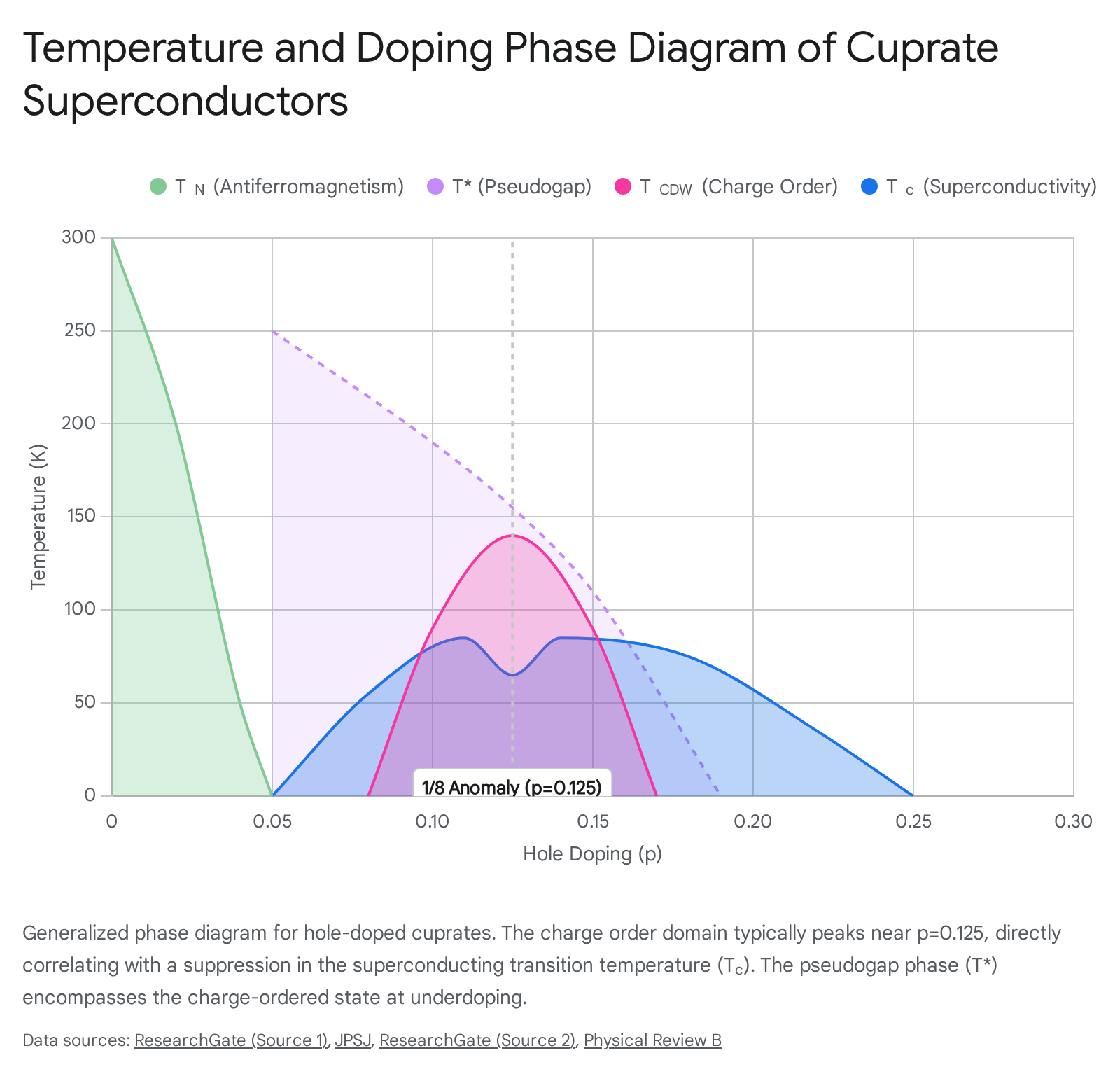
The global cuprate phase diagram is defined by the chemical substitution of charge carriers into the insulating $\text{CuO}_2$ planes, quantified by the doping level $p$. The resulting normal state is notoriously anomalous, deviating sharply from classical Fermi liquid theory by exhibiting properties like linear-in-temperature resistivity 526. Charge order fundamentally reshapes the topology of this phase diagram, intertwining heavily with the pseudogap transition ($T^*$), the superconducting dome ($T_c$), and the antiferromagnetic Mott insulator state ($T_N$).
The Underdoped Regime and the 1/8 Anomaly
Charge order exerts its most prominent influence in the underdoped regime of the phase diagram, specifically between doping levels of $0.08 < p < 0.16$. In this domain, measurements across multiple distinct cuprate families reveal a highly systematic doping dependence. The charge order onset temperature - variously denoted in the literature as $T_{CDW}$ or $T_{CO}$ - forms an internal dome-like structure that typically peaks near $p = 0.12$ to $0.125$. This specific concentration is often referred to historically as the $1/8$ doping anomaly 81627.
At $p \approx 1/8$, the static charge order reaches its maximum intensity, highest onset temperature, and longest correlation length. Because charge order and superconductivity compete for the same electronic states at the Fermi level, this maximal CDW strength results in a pronounced suppression of the superconducting transition temperature, $T_c$. This competitive suppression is visually evident as a distinct "dip" in the superconducting dome of La-based cuprates (such as LBCO and LSCO) and is also observable, albeit to a slightly lesser extent, in YBCO 12627.
Table 1 summarizes the critical temperature scales for several representative cuprate compounds near this optimal charge-ordering doping level, illustrating the hierarchy of energy scales.
| Material Family | Doping ($p$) | $T_c$ (K) | Pseudogap $T^*$ (K) | Charge Order Onset $T_{CDW}$ (K) | Source |
|---|---|---|---|---|---|
| Hg1201 | 0.14 | 94.0 | - | Broad onset | 28 |
| YBCO | 0.12 | 65.5 | $\approx 220$ | $\approx 140$ | 729 |
| LSCO | 0.125 | 31.0 | $\approx 140$ | $\approx 60 - 70$ | 2831 |
| Bi2212 (Underdoped) | $\approx 0.12$ | 75.0 | $\approx 205$ | Broad onset | 101632 |
The precise onset of static charge order in systems like Bi2212 and Hg1201 is often difficult to define as a sharp thermodynamic phase transition due to strong inherent structural disorder, though dynamic CDW fluctuations persist to much higher temperatures 10.
Fermi Surface Reconstruction
One of the most consequential macroscopic effects of charge order in the underdoped regime is Fermi surface reconstruction (FSR). In the theoretical absence of charge order, the cuprate Fermi surface at high temperatures is characterized by large, open hole-like arcs 21. When static charge order sets in at lower temperatures, the periodic potential of the charge density wave breaks the translational symmetry of the lattice. This physical symmetry breaking effectively folds the Brillouin zone, reconstructing the large, disjointed Fermi arcs into small, closed, electron-like pockets 273330.
Experimentally, this Fermi surface reconstruction is unambiguously confirmed by longitudinal and transverse transport measurements conducted under high magnetic fields (which suppress superconductivity to expose the ground state). Below a characteristic temperature $T_{FSR}$, both the Hall coefficient ($R_H$) and the Seebeck coefficient ($S$) undergo a dramatic sign change from positive (indicating hole-dominated transport) to negative (indicating electron-dominated transport) 273035. The temperature at which this sign change occurs closely tracks the emergence of the 3D charge order, confirming that the CDW physically modulates the fundamental electronic architecture of the normal state .
Extension into the Overdoped Regime
For decades, a rigid consensus held that extremely overdoped cuprates (where $p > 0.25$) were highly conventional, weakly correlated Fermi liquid metals completely devoid of exotic electronic orders like the pseudogap or charge density waves 31. In this heavily doped regime, the system possesses a large, continuous, unbroken Fermi surface, and its planar resistivity exhibits the standard quadratic ($T^2$) scaling expected from Fermi liquid theory 5.
However, high-resolution RIXS measurements published in 2023 and 2024 have completely disrupted this conventional paradigm. In heavily overdoped $\text{La}_{2-x}\text{Sr}_x\text{CuO}_4$ (LSCO) thin films, with extreme doping levels ranging from $x = 0.35$ up to $x = 0.6$, distinct charge order correlations have been definitively detected far outside the boundaries of the superconducting dome 31.
This overdoped charge order possesses remarkable physical characteristics that differentiate it entirely from its underdoped counterpart. First, the overdoped charge order persists from cryogenic temperatures (10 K) all the way up to 300 K with almost no temperature dependence, unlike the fragile underdoped CDW 31. Second, it exhibits a commensurate periodicity of approximately 6 lattice units ($q_{CO} \approx 0.166$ r.l.u.), whereas underdoped LSCO shows incommensurate wavevectors that shift with doping closer to 0.25 r.l.u. 31. Finally, the correlation lengths of this overdoped order are highly localized, spanning only about 20 lattice units 31. The discovery of this reentrant charge order fundamentally alters the cuprate phase diagram, indicating that strong electronic correlations remain actively dominant even when macroscopic superconductivity and the pseudogap have fully collapsed.
Static Versus Dynamic Charge Order
A major conceptual evolution in cuprate physics has been the firm separation of charge order into two distinct phenomena: strictly static, pinned spatial domains and highly fluctuating, dynamic temporal correlations. Recognizing how these two forms manifest across different temperature regimes is critical for understanding their impact on the material's properties.
Low-Temperature Static and Quasi-Static Order
At low temperatures, specifically below $T_{CDW}$, charge order generally manifests as a quasi-static, short-range spatial modulation. In idealized theoretical scenarios devoid of any crystalline defects, the CDW would form a perfect, long-range periodic crystal extending infinitely across the planes. However, inherent chemical disorder in the real cuprate lattice - arising from the random distribution of dopant atoms like Strontium or out-of-plane oxygen interstitials - acts as a pinning potential. This disorder pins the charge density waves, restricting their spatial correlation length to a few tens of Angstroms 2324.
X-ray Photon Correlation Spectroscopy (XPCS) confirms that this low-temperature order is essentially static on macroscopic experimental timescales. By monitoring the complex speckle interference pattern of diffracted coherent x-rays over time, XPCS studies on $\text{La}{1.875}\text{Ba}{0.125}\text{CuO}_4$ demonstrated that the charge stripes do not fluctuate or migrate over time scales exceeding two hours, confirming their pinned, glassy nature 124.
In materials like YBCO, a distinct dimensional transition occurs when high magnetic fields are applied. Zero-field static charge order is fundamentally two-dimensional (2D); the charge waves are confined within the individual $\text{CuO}_2$ planes with minimal to zero correlation along the perpendicular crystallographic $c$-axis. However, when massive external magnetic fields (up to 28-30 Tesla) suppress the competing superconducting state, the 2D order abruptly couples along the $c$-axis. This coupling results in a robust, long-range 3D coherent charge density wave that reconstructs the Fermi surface 21.
High-Temperature Dynamic Fluctuations
While static charge order is strictly confined to a specific low-temperature dome below the pseudogap temperature $T^*$, recent high-resolution RIXS measurements demonstrate that charge correlations do not simply vanish above $T_{CDW}$. Instead, they transition into a dynamic, rapidly fluctuating state that persists to remarkably high temperatures, deep into the strange metal regime 1426.
These dynamic fluctuations - often termed precursor CDW (PCDW) in the literature - exhibit an ultra-short correlation length that remains completely independent of temperature as the system heats up 1019. The high-resolution RIXS cross-section detects these fast fluctuations not as static diffraction peaks, but as inelastic energy-loss features.
In Bi2212, extensive RIXS momentum mapping has uncovered the presence of Quasi-Circular Dynamic Correlations (QCDCs). While static charge order only ever appears sharply along the orthogonal Cu-O bond directions ($0^\circ$ and $90^\circ$ azimuthal angles), QCDCs form continuous ring-like patterns in momentum space. By tracking the anomalous energy softening of the bond-stretching (BS) phonon across the entire 2D Brillouin zone, researchers established that these dynamic charge fluctuations exist at low energies (below 70 meV) and heavily populate azimuthal angles (e.g., $45^\circ$) where static order is strictly forbidden 15. The ubiquitous presence of these dynamic fluctuations deep into the high-temperature strange metal phase suggests they act as the isotropic scattering centers responsible for the anomalous, linear-in-temperature electrical resistivity that defines the cuprates 515.
Theoretical Origins and Formation Mechanisms
The fundamental physical mechanism driving the formation of charge order remains a subject of intense theoretical debate. The discourse primarily centers on two opposing mathematical frameworks: weak-coupling momentum-space instabilities (Fermi surface nesting) versus strong-coupling real-space electron correlations (Mott physics). As the empirical dataset has expanded across multiple cuprate families, the theoretical consensus has heavily shifted toward the strong-coupling paradigm.
Inadequacies of Fermi Surface Nesting
The classical mechanism for Charge Density Wave formation in simple, conventional metals is a Peierls instability driven by Fermi Surface Nesting (FSN). In the FSN model, if large, parallel segments of a material's Fermi surface can be perfectly connected (nested) by a specific spatial wavevector $\mathbf{q}$, the electronic susceptibility (calculated via the Lindhard function) diverges mathematically at that exact wavevector 832. The electron-phonon interaction subsequently drives a physical structural distortion in the lattice, opening a band gap at the Fermi level and lowering the total electronic free energy 32.
Early theories proposed that cuprate charge order was merely a consequence of this Fermi surface geometry 15. However, exhaustive modern datasets reveal severe contradictions with the weak-coupling FSN model. First, calculations of the static Lindhard susceptibility for Bi2212 indicate that a nesting-driven instability should produce strong scattering intensity at an angle $45^\circ$ away from the Cu-O bond. Experimentally, static charge order strictly aligns parallel to the Cu-O bond, representing a massive wavevector mismatch 15. Furthermore, the overdoped charge order recently discovered in LSCO locks at a commensurate vector of $q \approx 0.166$, completely decoupling from the strongly doping-dependent nesting vectors of the ARPES-measured Fermi surface 31.
Second, a nesting-driven CDW universally opens a symmetric gap around the Fermi level. STM spectroscopic maps of Bi2212 reveal that the charge order signal is highly asymmetric, existing almost entirely in the empty states above the chemical potential 16. Finally, true Peierls CDWs generally induce a clear macroscopic metal-insulator transition; cuprate charge order does not fully gap the spectrum, leaving the conducting Fermi arcs partially intact 832.
Strong Electron Correlations and Frustrated Phase Separation
Given the glaring inadequacies of weak-coupling models, theoretical consensus now views charge order as an inevitable, emergent consequence of the strong electron-electron correlations inherited directly from the parent Mott insulating state 1533.
In a doped Mott insulator, the short-range Hubbard-like magnetic exchange interactions ($J$) drive the system to minimize magnetic frustration by locally segregating the doped holes away from the rigid antiferromagnetic background. Left unchecked, this natural tendency would result in total macroscopic phase separation - creating massive metallic puddles wholly separate from massive insulating AFM domains 15.
However, long-range Coulomb repulsion strictly prevents the massive clustering of macroscopic charge. The system frustrates this separation, resulting instead in micro-phase separation at a characteristic short wavelength 15. This micro-phase separation manifests structurally as charge "stripes" - unidirectional, linear tracks of localized holes. To minimize any disruption to the broader magnetic exchange energy of the lattice, these hole-rich charge stripes (with a local charge density of approximately 0.25 holes per Cu site) act as physical antiphase domain walls for the intervening spin-rich, hole-poor AFM regions 14.
Because the antiferromagnetic spin phase flips exactly 180 degrees upon crossing a charge stripe, the macroscopic spin order repetition distance is exactly twice that of the charge order (e.g., an 8-lattice-unit spin periodicity corresponding to a 4-lattice-unit charge periodicity) 14. This intertwined stripe model elegantly bridges the theoretical Mott physics with the experimental scattering wavevectors.
The Role of Electron-Phonon Coupling
While strong correlations provide the driving force for segregation, they do not act alone. Recent Determinant Quantum Monte Carlo (DQMC) simulations on extended Hubbard-Holstein models further refine this picture by incorporating lattice dynamics. While pure Hubbard models successfully reproduce the general propensity for charge segregation, they fail to perfectly predict the specific $\mathbf{q} \approx (\pi/3, 0)$ wavevectors observed in the heavily overdoped regime.
The inclusion of non-local electron-phonon coupling (EPC) is absolutely necessary in these models to correctly select and stabilize the specific charge pattern. This indicates that while strong electronic correlations are the primary driver of the instability, the structural lattice coupling acts as the critical director, ultimately determining the precise geometric topology of the charge density wave 1234.
Interplay Between Charge Order and Superconductivity
The functional relationship between charge order and high-$T_c$ superconductivity is perhaps the most heavily scrutinized dynamic in modern cuprate physics. For decades, the interaction was viewed through a strictly competitive, zero-sum lens. Recent coherent scattering experiments, however, indicate a deeply intertwined relationship suggesting shared underlying quantum architecture and cooperative phase dynamics.
Competitive Amplitude Suppression
At a fundamental level, macroscopic superconductivity and static charge order both require a substantial density of electronic states at the Fermi level to condense; thus, they inherently compete for the same electronic real estate 1623.
This competition is directly observable in multiple thermodynamic and scattering parameters. When a cuprate is cooled below its superconducting transition temperature ($T_c$), the zero-field amplitude of the static charge order peak - measured via XRD or RXS - abruptly ceases to grow, plateaus, and often decreases 102627.
Conversely, if superconductivity is violently suppressed by applying intense external magnetic fields (up to 30 Tesla in specialized facilities), the charge order experiences a massive resurgence. Relieved of its competitor, the charge order transforms from a fragile 2D fluctuation into a robust, 3D coherent state with vastly increased correlation lengths and scattering amplitudes 2335. Furthermore, experiments utilizing uniaxial strain to physically distort the lattice and destabilize the superconducting state invariably report a proportional increase in the intensity of the charge order peaks, confirming the antagonistic relationship regarding signal amplitude 813.
Phase Coherence and Intertwined Orders
If the relationship were purely antagonistic, the onset of superconductivity would strictly disorder and dismantle the CDW state. However, groundbreaking resonant soft x-ray scattering data published in 2026 demands a radical rethinking of this dynamic.
By applying a novel coherence-sensitive momentum-profile analysis to La-based cuprates, researchers investigated the underlying phase rigidity of the charge order independently from its raw scattering amplitude. Surprisingly, the data revealed that while superconductivity suppresses the physical amplitude of the charge wave, it concurrently enhances its macroscopic phase coherence. Cooling below $T_c$ triggers a BCS-like growth in the phase rigidity of the CDW, manifesting phenomenologically as near-perfect wavevector locking and a complete halt to the thermal broadening of the CDW diffraction peak 15.
This enhancement of phase coherence occurs even in heavily aged, disorder-dominated samples, indicating it is a fundamental intrinsic property across Bi-, Hg-, Y-, and Nd-based cuprates. Superconductivity essentially reshapes the charge order: it cannibalizes its overall amplitude but forces the surviving, diminished charge modulations into strict macroscopic lockstep 15.
This highly nuanced interplay strongly supports the concept of intertwined orders, particularly the Pair Density Wave (PDW) hypothesis. In a proposed PDW state, the superconducting Cooper pairs themselves carry a finite momentum, and the superconducting gap mathematically oscillates in space at the exact same periodicity as the charge order. Rather than outright destroying the charge stripes, the superconducting condensate may be actively pairing the holes within the quasi-1D charge stripes, creating a composite quantum fluid where the spatial order parameters of both phases are intricately bound 115.
Nematicity and Broken Rotational Symmetry
The interaction between these phases also gives rise to unique symmetry-breaking states. High-precision transport measurements, specifically investigating the anisotropy of the Nernst effect and the Seebeck coefficient between the $a$ and $b$ crystallographic axes, have revealed the existence of a "charge nematic" phase.
In materials like YBCO and LESCO, researchers observe an onset of strong in-plane anisotropy that perfectly tracks the pseudogap energy scale. This nematic phase exhibits a spontaneous loss of rotational symmetry (reducing the $C_4$ symmetry of the copper-oxide plane to $C_2$) without breaking translational symmetry 72327. This suggests that before the charge carriers fully lock into the translationally broken stripe order at lower temperatures, they first pass through an intermediate nematic fluid phase. This nematic precursor aligns directionally but fluctuates spatially, further complicating the transition from the isotropic high-temperature metal to the highly ordered low-temperature superconductor 723.
Conclusions
The study of charge order in cuprate superconductors has evolved dramatically from viewing it as an accidental, sample-specific nuisance to recognizing it as an intrinsic, universal consequence of doping a strongly correlated Mott insulator. The development of high-resolution, momentum-resolved scattering techniques like RIXS and XPCS has conclusively demonstrated that static charge density waves heavily modulate the normal state, culminating in the physical reconstruction of the Fermi surface and fiercely competing with superconductivity for available spectral weight at low temperatures.
Simultaneously, the discovery that dynamic charge fluctuations permeate the phase diagram far beyond the confines of the pseudogap - persisting up to 300 K even in heavily overdoped, supposedly Fermi-liquid regimes - challenges the foundational assumptions of cuprate fermiology. The emerging evidence of phase coherence locking between the superconducting condensate and the charge density wave points to a profound quantum entanglement between these states, strongly supporting intertwined models like the Pair Density Wave. Ultimately, a complete mechanistic description of high-$T_c$ superconductivity cannot be isolated from the physics of charge order; understanding how the cuprate lattice manages the frustrated micro-phase separation of its doped carriers remains the critical key to unlocking the mysteries of the strange metal and the pairing mechanism itself.