
The Kondo Effect in Condensed Matter Physics
Introduction to the Phenomenon
The Kondo effect represents one of the most fundamental and intensively studied paradigms of many-body quantum physics. Originally observed as an unexplained anomaly in the low-temperature electrical resistance of metallic alloys, it has evolved over nearly a century into a foundational concept for understanding strongly correlated electron systems, quantum phase transitions, and the complex behavior of magnetic impurities in a variety of host materials. The phenomenon manifests when a localized magnetic impurity - typically a transition metal or rare-earth ion - is embedded within a non-magnetic metallic host matrix. This embedding leads to a highly intricate, many-body interaction between the impurity's quantum spin and the surrounding sea of itinerant conduction electrons 112.
For decades in the early twentieth century, the electrical resistivity of metals was believed to be governed strictly by Matthiessen's rule. This classical rule posits that the total electrical resistivity of a metal arises from the summation of independent scattering mechanisms 13. According to this framework, the primary contributions are temperature-independent potential scattering from static lattice defects and non-magnetic impurities, combined with temperature-dependent inelastic scattering from lattice vibrations (phonons) and electron-electron interactions 14. In a standard metal, the phonon scattering contribution scales with the fifth power of temperature at low energies, while the electron-electron scattering scales quadratically 4. Consequently, classical solid-state theory predicted that as a metal cools toward absolute zero, the thermal scattering components should gradually vanish, leaving the resistivity to plateau monotonically at a constant residual value determined solely by the static imperfections 35.
However, in 1934, researchers W. J. de Haas, J. de Boer, and G. J. van den Berg at the Kamerlingh Onnes Laboratory in the Netherlands observed a striking departure from Matthiessen's rule in dilute magnetic alloys 135. While studying the resistivity of gold wires contaminated with trace amounts of transition metals, they discovered that as the temperature decreased, the resistivity initially dropped as expected, but instead of plateauing, it reached a distinct minimum and then began to rise logarithmically as the temperature approached zero 135.
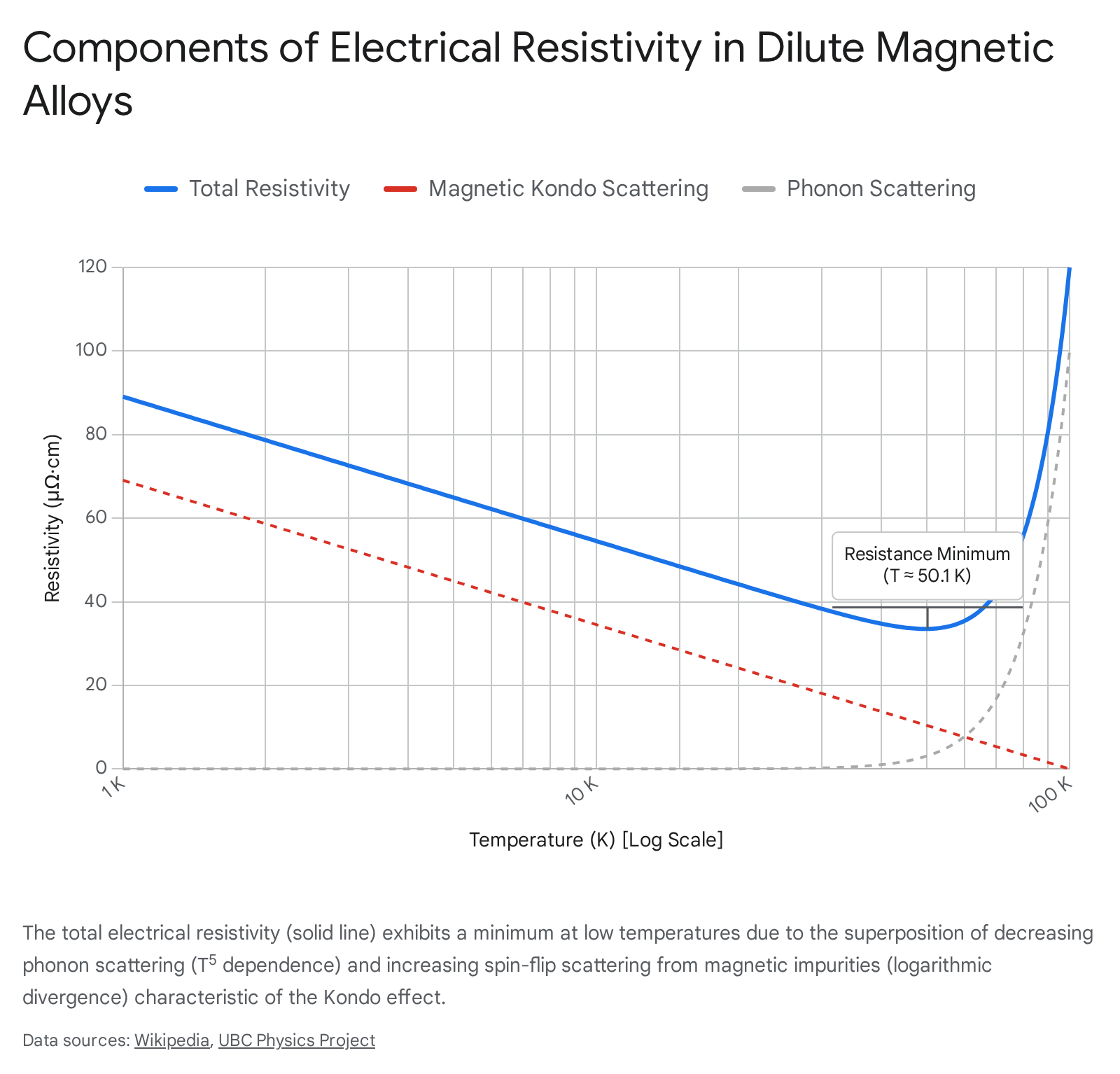
This resistance minimum indicated the presence of a novel, anomalous scattering mechanism that paradoxically grew stronger at lower thermal energies - a direct contradiction of the established non-interacting electron theory. The underlying cause of this minimum was famously described by theoretical physicist A. H. Wilson in 1953 as being "entirely obscure" and constituting a "most striking departure" from known physical laws 1.
The cause of this anomaly remained an unsolved mystery in solid-state physics for thirty years until 1964, when Japanese theoretical physicist Jun Kondo provided the mathematical solution. Kondo applied third-order perturbation theory to the interaction between the conduction electrons and the magnetic impurities 124. Unlike static impurities that solely provide a spin-independent scattering potential, magnetic impurities possess an internal quantum degree of freedom - their localized spin. The interaction is modeled by an exchange integral characterizing the coupling between the spin of the itinerant conduction electrons and the localized spin of the impurity atom 1.
In a standard first-order Born approximation, the impurity spin provides a simple scattering potential, yielding a temperature-independent scattering rate that cannot explain the resistivity minimum 1. Kondo extended the perturbation calculation to higher orders, analyzing scattering events that proceed through intermediate virtual states where the impurity spin flips its orientation 123. Because electrons are indistinguishable fermions subject to the Pauli exclusion principle, the availability of these intermediate states is heavily restricted by the sharp step-function of the Fermi sea at low temperatures 126. Kondo's perturbative calculation revealed that the scattering rate - and consequently the magnetic contribution to the resistivity - contains a correction term proportional to the logarithm of the temperature 124. As the temperature approaches absolute zero, this logarithmic term diverges, perfectly describing the observed increase in resistivity and explaining the fundamental physics behind the resistance minimum 24.
Microscopic Mechanisms and Theoretical Frameworks
While Kondo's third-order perturbation theory successfully explained the resistance minimum, it inadvertently introduced a severe theoretical crisis. The logarithmic divergence implied that at a sufficiently low temperature, the scattering rate and the electrical resistance would become infinite 25. This unphysical divergence indicated a breakdown of perturbation theory and signaled that the weak-coupling assumption was entirely invalid at low energy scales 58.
The Anderson Impurity Model
The microscopic origins of the localized magnetic moment and its exchange interaction with the conduction band were elucidated by physicist P. W. Anderson in 1961 587. The Anderson Impurity Model describes a localized, interacting atomic orbital hybridized with a continuum of non-interacting conduction band electrons. The Hamiltonian of this model relies on three primary parameters: the energy of the localized degenerate level relative to the Fermi energy, the strong on-site Coulomb repulsion penalty for double occupancy of the localized state, and the hybridization matrix element representing the quantum tunneling of electrons between the impurity and the conduction band 57.
When the Coulomb repulsion is significantly larger than the hybridization broadening, and the localized energy level lies well below the Fermi energy while the doubly occupied state lies well above it, the impurity is locked into a singly occupied state 57. In this regime, local charge fluctuations are strongly suppressed, and the impurity behaves exclusively as a localized magnetic moment. Through a canonical unitary transformation known as the Schrieffer-Wolff transformation, the Anderson model in this specific local-moment regime maps directly onto the $s-d$ exchange model utilized by Kondo 58. The effective antiferromagnetic exchange coupling emerges dynamically from virtual second-order charge excitation processes, providing a rigorous microscopic foundation for the Kondo Hamiltonian 15.
Dimensional Transmutation and the Renormalization Group
The resolution to the perturbative divergence was achieved through the development of the Renormalization Group formalism. In 1970, Philip Anderson introduced the concept of "Poor Man's Scaling," demonstrating that as the high-energy conduction electron states located far from the Fermi surface are progressively integrated out of the model, the effective exchange coupling is renormalized to increasingly larger values 2511. The system flows inherently from a weak-coupling regime at high temperatures to a strong-coupling regime at low temperatures.
Kenneth Wilson provided the definitive exact solution to the single-impurity Kondo problem in 1975 using the Numerical Renormalization Group technique, a profound breakthrough that established a new framework for understanding strongly correlated systems 5119. Wilson's non-perturbative approach tracked the evolution of the system continuously across all energy scales. He demonstrated that as the temperature drops below a characteristic scale known as the Kondo temperature, the effective exchange coupling diverges toward infinity 25. In this strong-coupling limit, the localized impurity spin forms an infinitely strong, many-body bound state with the surrounding conduction electrons 128.
This resulting ground state is a spin singlet. Because the combined many-body state has zero net spin, the magnetic moment effectively vanishes, removing the internal degree of freedom that caused the spin-flip scattering 1710. Consequently, at absolute zero, the system acts as a standard local Fermi liquid with a finite, temperature-independent residual resistivity, effectively averting the unphysical infinite divergence predicted by the early perturbative models 1710. The Kondo effect thus serves as an archetypal example of dimensional transmutation, wherein a dimensionless coupling constant is replaced by a dynamically generated, emergent energy scale 28.
Analogies to Quantum Chromodynamics
The mathematical and theoretical architecture of the Kondo problem shares profound symmetries with Quantum Chromodynamics, the fundamental gauge theory describing the strong nuclear force 4811. Both theoretical frameworks are characterized by a coupling constant that runs dynamically with the energy scale of the probe, exhibiting fundamental shifts in physical behavior across extreme limits.
At high temperatures and high energies, the impurity spin in a metallic host appears essentially free, interacting only weakly with the conduction electrons. This behavior is mathematically analogous to the concept of asymptotic freedom in Quantum Chromodynamics, where quarks and gluons behave as free, non-interacting particles when probed at extremely high energy scales 481112. Conversely, as the temperature is lowered toward absolute zero, the Kondo coupling grows non-perturbatively strong, ultimately binding the conduction electrons to the impurity to form a total spin-zero singlet 411. This strong-coupling bound state is structurally analogous to color confinement in hadron physics, where quarks are permanently bound into color-neutral hadrons, such as protons and neutrons, at low energies 811. The logarithmic increase of the electrical resistance observed in the Kondo effect closely mirrors the logarithmic increase of the strong coupling constant as the fundamental quantum chromodynamic scale is approached and hadronization occurs 81113.
The Macroscopic Kondo Screening Cloud
One of the most profound physical manifestations of the Kondo effect is the formation of the Kondo screening cloud - a macroscopic, spatially extended many-body entanglement between the highly localized impurity spin and the itinerant conduction electrons 81415. While the magnetic impurity itself is strictly localized to a single atomic site, the conduction electrons that participate in screening the impurity are wave-packets that remain coherent over a vast characteristic length 81415.
The spatial extent of this screening cloud, defined as the Kondo coherence length, is theoretically determined by the ratio of the Fermi velocity to the Kondo temperature 15. Because the Kondo temperature is an exponentially small energy scale, the coherence length is macroscopic. Theoretical calculations suggest the cloud spans hundreds of nanometers to several micrometers in typical metals and semiconductor heterostructures, dwarfing the scale of the atomic lattice by several orders of magnitude 1416.
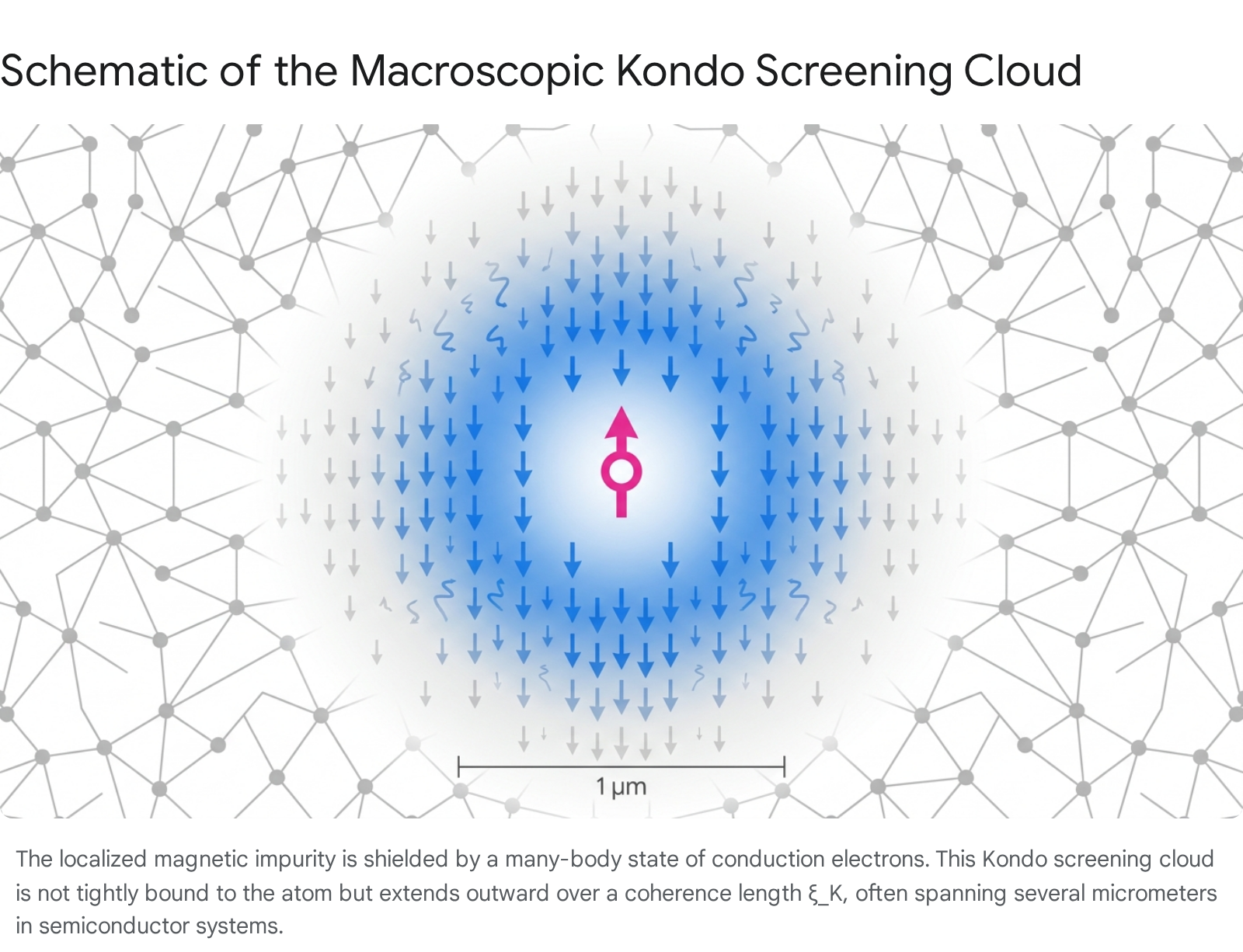
Despite functioning as a cornerstone of condensed matter theory for over half a century, the physical existence and spatial extension of the Kondo cloud remained heavily controversial 1415. The cloud entails pure quantum entanglement and lacks any direct electrostatic signature, rendering it entirely invisible to standard scanning probe microscopy techniques 1417.
This fifty-year observational quest culminated in 2020, when an international collaboration published findings in a major peer-reviewed journal demonstrating the direct, real-space detection of the Kondo screening cloud 1415. The research team engineered an artificial Kondo impurity utilizing a semiconductor quantum dot coupled to a quasi-one-dimensional conduction channel 1516. To detect the invisible cloud, they integrated electrostatic gates at specific distances along the channel, creating a highly sensitive Fabry-Pérot interferometer 1516.
By modulating the voltage on these remote gates - situated up to several micrometers away from the quantum dot - the researchers induced controlled quantum interference in the conduction electrons 1516. They discovered that if the remote gate was situated inside the theoretical spatial boundary of the Kondo cloud, the induced interference actively perturbed the screening mechanism. This perturbation manifested as measurable oscillations in the macroscopic Kondo temperature observed at the quantum dot 1516. Crucially, when the gate distance exceeded the calculated coherence length, the oscillations abruptly vanished 15. The experiment robustly verified that the length and shape of the cloud are universally scaled by the inverse of the Kondo temperature, proving that the coherence length is the sole spatial parameter governing the effect 1415.
Classification of Kondo Screening Regimes
The standard theoretical formulation of the Kondo effect involves a simple spin-1/2 impurity that is perfectly compensated by a single channel of conduction electrons. However, real physical materials frequently harbor transition metal or actinide ions with higher local spin states governed by Hund's rules, or multiple degenerate orbital channels within the conduction band 5710. To address these complexities, Nozières and Blandin formulated a comprehensive classification of the generalized multi-channel Kondo problem, segregating the phenomena into three distinct low-temperature regimes based on the arithmetic relationship between the number of screening channels and the magnitude of the impurity spin 710.
The Exactly Screened Regime
When the number of available conduction channels perfectly matches twice the magnitude of the impurity spin, the localized impurity is completely neutralized as the temperature approaches absolute zero 71110. The resulting ground state is a pure, non-degenerate spin singlet 7. In this exactly screened regime, the low-energy physics of the system is robustly described by Landau's local Fermi liquid theory 71012. Thermodynamic and transport measurements reveal a finite, temperature-independent zero-temperature magnetic susceptibility, a specific heat capacity that scales linearly with temperature, and a residual electrical resistivity that depends quadratically on the temperature 11012.
The Underscreened Regime
When the magnitude of the impurity spin is larger than the available screening channels can fully compensate, the Kondo effect only partially screens the local moment 111819. A classic theoretical example involves a spin-1 impurity interacting exclusively with a single conduction channel 71118. As the system cools to absolute zero, one spin-1/2 conduction electron binds strongly to the impurity, neutralizing a portion of the spin but leaving a residual, partially unscreened spin-1/2 local moment 1118.
The underscreened state exhibits a remnant magnetic moment that couples ferromagnetically to the conduction band in the infrared limit, resulting in a singular form of asymptotic freedom where complete quenching of the magnetic moment is impossible 711. Physical realizations of underscreened Kondo physics are heavily documented in specific actinide compounds, such as Uranium and Neptunium alloys possessing specific electronic configurations, where an unusual coexistence of Kondo screening and ferromagnetic ordering occurs 8. Furthermore, experimental validation has been achieved in advanced single-molecule transistors. Researchers utilizing mechanical break-junctions stretched an individual cobalt coordination complex possessing a spin of 1 2024. By physically modifying the molecular symmetry in the total absence of an external magnetic field, they successfully tuned the magnetic anisotropy and directly observed the unique transport signatures of the underscreened phase 2024.
The Overscreened Regime
The most exotic and mathematically complex regime arises when the number of available conduction channels strictly exceeds twice the impurity spin 11910. In this scenario, the conduction electrons attempt to over-compensate the impurity, driving the system into an endless, frustrated state where the local spin fluctuates dynamically between multiple degenerate configurations 91021.
The overscreened state violently breaks the assumptions of standard Fermi liquid theory 1110. Instead, the system flows to an intermediate-coupling non-Fermi-liquid fixed point, which is rigorously governed by Boundary Conformal Field Theory as formulated by Affleck and Ludwig 11910. This non-Fermi-liquid regime is characterized by highly anomalous transport properties, a residual zero-temperature entropy, and a specific heat coefficient that diverges logarithmically with decreasing temperature 1012. Physical manifestations of the overscreened effect are exceptionally delicate, as any slight channel asymmetry tends to collapse the fragile non-Fermi-liquid state back into a single-channel Fermi liquid 12. However, careful experimental tuning in specific uranium-based compounds exhibiting hastatic order, and advanced single-molecule transistors based on divanadium molecules, have revealed compelling evidence of overscreened dynamics 212223.
The defining characteristics of these three fundamental regimes are summarized below to highlight the divergent physical outcomes governed by the relationship between spin and conduction channels.
| Kondo Regime | Mathematical Condition | Ground State Physics | Thermodynamic and Transport Signature | Physical Realizations |
|---|---|---|---|---|
| Exactly Screened | Channels = 2 * Spin | Local Fermi Liquid | Specific heat scales linearly with temperature; susceptibility approaches a constant. | Iron impurities in Gold; Odd-electron Semiconductor Quantum Dots 4512 |
| Underscreened | Channels < 2 * Spin | Remnant Spin with Ferromagnetic Coupling | Partial quenching of magnetic moment; potential coexistence with magnetic order. | Uranium and Neptunium alloys; Mechanically stretched Cobalt molecules 82028 |
| Overscreened | Channels > 2 * Spin | Non-Fermi Liquid (Frustrated State) | Logarithmic divergence in specific heat; fractional residual zero-temperature entropy. | Divanadium single-molecule transistors; Specific boundary defects in spin chains 92122 |
Spin Dynamics: Redefining the Magnetic Boundary
For decades, the standard theoretical paradigm within condensed matter physics dictated that the Kondo effect inherently suppresses magnetism by locking isolated spins into highly entangled, non-magnetic singlets 24. However, groundbreaking experimental and theoretical work published in early 2026 fundamentally overturned this generalized assumption, revealing a profound dependence on the absolute magnitude of the impurity spin 24.
Researchers demonstrated that the macroscopic outcome of the Kondo effect diverges sharply depending on the quantum spin size of the lattice impurities. In dense matrices populated exclusively by spin-1/2 impurities, the traditional Kondo interaction universally forms local singlets, resulting in the expected paramagnetic, non-magnetic state 24. Conversely, when the localized spin strictly exceeds 1/2, the identical Kondo coupling mechanism entirely fails to silence the magnetic moments 24. Instead, the active coupling to the conduction band generates an effective indirect magnetic exchange interaction between the underscreened moments distributed across the material lattice 24. Rather than suppressing magnetism, the Kondo effect in high-spin systems actively stabilizes and promotes robust, long-range magnetic order. This discovery establishes a definitive quantum boundary based solely on spin magnitude, with extensive implications for the design of future spintronic devices and the theoretical modeling of highly correlated magnetic materials 24.
Heavy Fermion Systems and the Kondo Lattice
When magnetic impurities are not isolated within a dilute alloy but instead form a dense, periodic crystalline array, the system transitions theoretically from the single-impurity Kondo model to the Anderson Lattice Model 4252627. These periodic systems are found predominantly in specific intermetallic compounds containing rare-earth elements or actinide elements characterized by partially filled and highly confined orbitals 42527. In these dense matrices, the independent Kondo screening clouds surrounding each atomic site begin to overlap significantly, fundamentally altering the macroscopic electronic properties 42527.
At high temperatures, the localized electrons behave as entirely independent magnetic moments, interacting only weakly with the surrounding conduction electrons 2627. In this regime, the material acts as a standard metal exhibiting high magnetic susceptibility 2627. However, as the temperature falls below a specific lattice coherence scale, the individual Kondo screening processes lock into a highly coherent, macroscopic quantum state 262829. The localized orbitals hybridize heavily with the itinerant conduction electrons, resulting in the opening of a narrow hybridization gap in the vicinity of the Fermi surface 2930.
This coherent lattice scattering mechanism creates an entirely new band of composite quasi-particles. Because these hybridized energy bands are exceptionally flat, indicating very little kinetic energy dispersion, the electrons propagate through the lattice with extreme sluggishness 2931. When analyzed within the framework of Landau Fermi liquid theory, these emergent quasi-particles exhibit an effective dynamical mass that can be several hundred to a thousand times greater than the rest mass of a free electron 252728. Due to this extraordinary mass enhancement, these intermetallic compounds are designated as Heavy Fermion materials 252728.
The defining experimental signature of heavy fermion materials lies in their profound thermodynamic anomalies, specifically regarding the electronic specific heat capacity 2527. In a standard metal described by the Drude-Sommerfeld model, the heat capacity at low temperatures is dominated by the electronic contribution, which is strictly proportional to temperature via the Sommerfeld coefficient 2532. According to Fermi liquid theory, this coefficient is directly proportional to the density of states at the Fermi level, which is in turn mathematically proportional to the effective mass of the charge carriers 2533.
Normal noble metals possess highly mobile, light electrons and exhibit correspondingly minute Sommerfeld coefficients 253234. In stark contrast, heavy fermion compounds exhibit massive coefficients, serving as direct experimental proof of their enormous dynamical mass enhancement 2535. A comparison of the specific heat metrics highlights the stark thermodynamic differences between conventional metals and strongly correlated heavy fermion systems.
| Material | Classification | Sommerfeld Coefficient (mJ/mol·K2) | Effective Mass Ratio | Ground State Properties |
|---|---|---|---|---|
| Copper | Normal Metal | ~ 0.69 | ~ 1 | Conventional conductor 3234 |
| Aluminum | Normal Metal | ~ 1.35 | ~ 1 | Conventional s-wave superconductor 414236 |
| CeCu2Si2 | Heavy Fermion | ~ 1,100 | ~ 200 | Even-parity unconventional superconductor 252737 |
| CeCu6 | Heavy Fermion | ~ 1,600 | ~ 300 - 400 | Paramagnetic heavy Fermi liquid 2530 |
| UPt3 | Heavy Fermion | ~ 420 - 450 | ~ 180 | Odd-parity unconventional superconductor 253537 |
| UBe13 | Heavy Fermion | ~ 1,100 | ~ 260 | Unconventional superconductor 252737 |
Beyond their massive thermodynamics, heavy fermions provide a critical testing ground for studying quantum criticality and unconventional mechanisms of superconductivity 2837. Traditional Bardeen-Cooper-Schrieffer theory dictates that localized magnetic moments violently destroy Cooper pairing via spin-flip scattering 2527. Consequently, the discovery that the heavy fermion material CeCu2Si2 undergoes a phase transition into a superconducting state at low temperatures was revolutionary 2728. In heavy fermion superconductors, the extraordinarily massive quasi-particles themselves condense to form the superconducting state 2528. Theoretical models indicate that the electron pairing in these materials is heavily mediated by magnetic spin fluctuations rather than standard lattice phonons, resulting in exotic, non-s-wave order parameters characterized by specific parity states 2537.
Topological Kondo Insulators
In specific configurations of the Kondo lattice where the compound possesses an even number of valence electrons, the narrow hybridization gap opens exactly at the Fermi energy 3839. This specific alignment transforms the material from a highly conductive high-temperature metal into a strongly correlated low-temperature insulator, forming what is known as a Kondo insulator 3839.
Recent theoretical and experimental advancements have demonstrated that the intersection of strong electronic correlations and spin-orbit coupling within these specific materials can give rise to non-trivial band topology 39. In Topological Kondo Insulators, the intense hybridization forces a robust insulating gap throughout the three-dimensional bulk of the crystal 3848. However, time-reversal symmetry and the inherent topological invariants of the band structure necessitate the existence of highly conductive, gapless metallic states strictly confined to the surfaces of the material 383948.
Samarium hexaboride has historically served as the most intensively studied Topological Kondo Insulator, exhibiting an unexpected plateau in electrical resistivity at ultra-low temperatures - a direct consequence of the conductive surface states dominating transport as the bulk electrons freeze out 3839. However, the extreme difficulty in synthesizing purely insulating macroscopic specimens hampered advanced device fabrication 38. In 2023, materials scientists successfully synthesized high-quality untwinned single crystals of Ytterbium dodecaboride utilizing an advanced laser floating-zone technique 3840. Subsequent planar tunneling spectroscopy confirmed that this new material acts as a distinct Topological Kondo Insulator, hosting highly mobile surface Dirac fermions with non-trivial topology 383940. This successful synthesis significantly expanded the frontier for utilizing strongly correlated insulators in topological quantum computing and low-dissipation spintronics architectures 3840.
Non-Equilibrium Kondo Dynamics
Historically, the theoretical architecture of the Kondo effect has been formulated and rigorously solved entirely within the bounds of thermal equilibrium. However, the rapid advancement of nanoscale semiconductor devices, particularly quantum dots coupled to metallic leads subjected to finite bias voltages or severe temperature gradients, has demanded the creation of a rigorous framework for non-equilibrium Kondo dynamics 4142. Driving the system aggressively out of equilibrium via an applied voltage fundamentally disrupts the delicate Kondo screening cloud, suppressing the many-body resonance that enables conduction 424344.
Theoretical modeling of the out-of-equilibrium Anderson model remains notoriously difficult, as traditional thermal formalisms utilizing imaginary time fundamentally fail 42. Recent computational breakthroughs have successfully overcome these hurdles through the implementation of hybrid Numerical Renormalization Group frameworks combined with time-dependent Density Matrix Renormalization Group techniques based on thermofield quench approaches 4245.
These advanced simulations accurately map the electron transport across a Kondo-correlated quantum dot subjected to entirely independent lead temperatures and distinct chemical potentials 4245. By sweeping the thermal and voltage biases far beyond the linear response regime, researchers have identified a distinct geometric parameter space outlining where non-equilibrium Kondo correlations successfully persist 45.
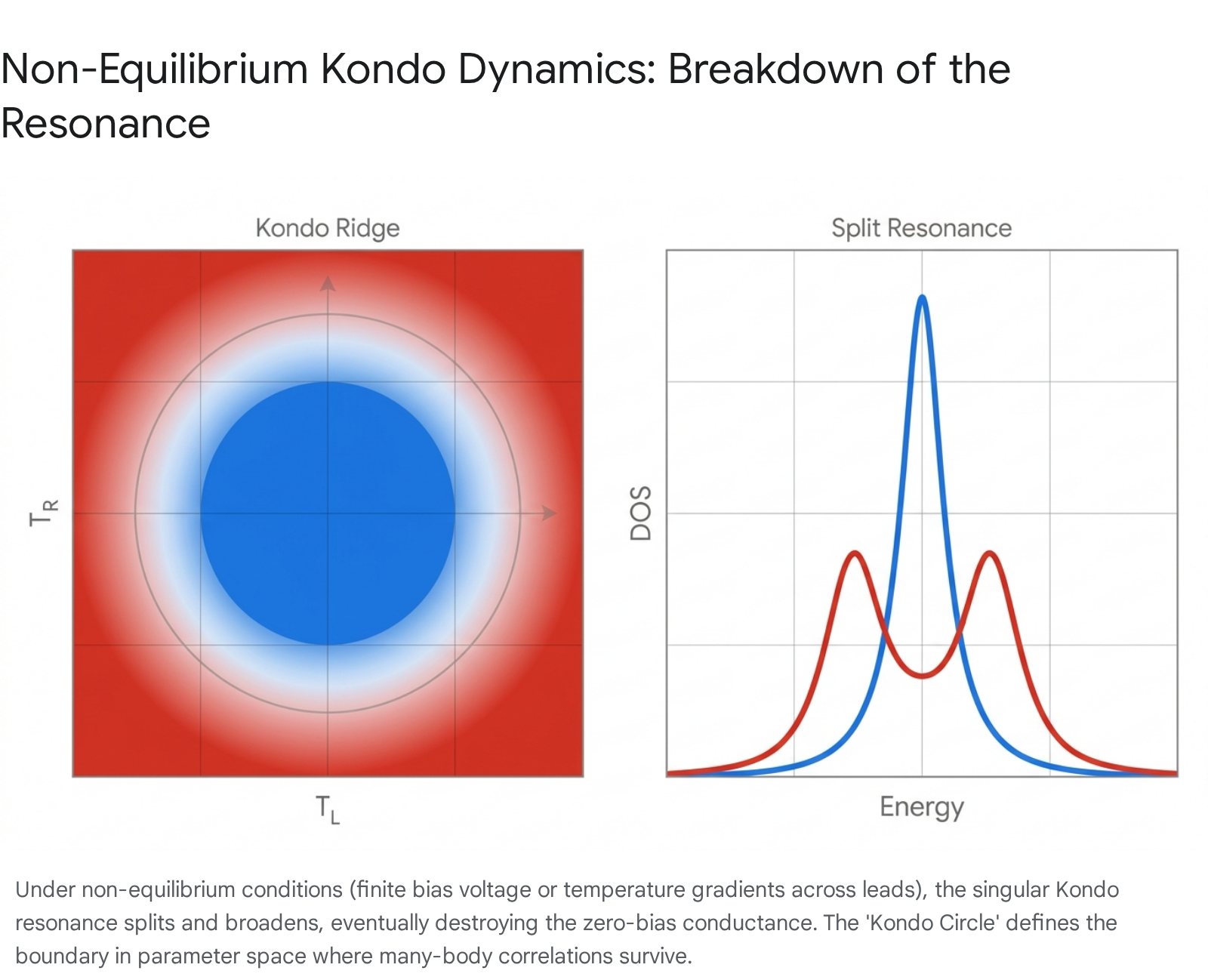
Furthermore, state-of-the-art computational methods employing tensor cross-interpolation have allowed theorists to calculate the perturbative series up to twenty-five orders in the Coulomb interaction parameter 4143. These numerically exact tools permit physicists to map the full non-equilibrium Coulomb diamond, including the resilient low-voltage structures responsible for zero-bias conduction, and can simulate the real-time formation dynamics of the Kondo cloud following a sudden quantum quench 4143. In parallel to driven electrical systems, researchers have demonstrated that robust Kondo effects can be induced purely through non-linear dissipative channels, without requiring any coherent interaction on the impurity site, providing a pathway to simulate many-body phenomena using ultracold atomic gases 46.
Conclusion
The Kondo effect remains an enduring testament to the mathematical complexity and physical elegance of quantum many-body theory. What initially began as an obscure resistance anomaly in dilute alloys has expanded systematically into a master framework for decoding the behavior of strongly correlated electrons. From the exact theoretical symmetries it shares with quark confinement in quantum chromodynamics, to the physical realization of micrometer-long entangled screening clouds, the Kondo problem continually bridges fundamentally disparate fields of modern physics.
As material science and fabrication techniques progress, the core principles of the Kondo effect are being actively leveraged to understand the massive quasi-particles of heavy fermion superconductors, to probe the non-trivial, symmetry-protected surface states of topological insulators, and to precisely control isolated quantum spins within molecular electronics. The recent revelations regarding non-equilibrium transport dynamics and spin-dependent magnetic ordering boundaries confirm that, even after sixty years of intense analytical and numerical study, the localized interaction between a single magnetic impurity and a vast sea of electrons continues to hold profound implications for the future of condensed matter physics and quantum information technology.