
Majorana fermions in condensed matter and quantum computing
Introduction to Majorana Quasiparticles
The theoretical foundation of the Majorana fermion dates back to 1937, when the Italian theoretical physicist Ettore Majorana analyzed the Dirac equation - a fundamental equation that successfully married quantum mechanics with special relativity 123. While Paul Dirac's formulation predicted the existence of antimatter by allowing for complex wavefunctions representing distinct particles and antiparticles (such as electrons and positrons), Majorana discovered that the equation could be mathematically constrained to yield purely real solutions 134. This mathematical adaptation posited the existence of an elementary spin-1/2 particle that acts as its own antiparticle 256. In the domain of high-energy particle physics, the search for fundamental Majorana particles remains active but inconclusive, with neutrinos being the primary candidates investigated through highly sensitive neutrinoless double beta decay experiments 178.
However, the concept of the Majorana fermion has experienced a profound renaissance in the realm of condensed matter physics 159. In condensed matter systems, particles do not exist in a vacuum; rather, researchers study the collective behavior of billions of interacting electrons governed by the underlying crystal lattice and electromagnetic forces. Under specific conditions, these collective many-body interactions give rise to emergent "quasiparticles" that mimic the behavior of fundamental particles 11011. In exotic materials known as topological superconductors, researchers have identified emergent fractionalized quasiparticle excitations that perfectly mirror the mathematical properties of Ettore Majorana's purely real solutions 5812.
These emergent entities in condensed matter are fundamentally different from the proposed Majorana neutrinos. They are charge-neutral, massless, and spinless - free of standard internal quantum numbers 12. Because the creation operator ($\gamma^\dagger$) and annihilation operator ($\gamma$) for a Majorana quasiparticle are mathematically identical ($\gamma = \gamma^\dagger$), the creation or destruction of a Majorana mode does not alter the total energy of the superconducting system 410. Consequently, they reside precisely at the Fermi level within the superconducting energy gap, earning them the designation of Majorana zero modes (MZMs) when localized as zero-dimensional bound states 101213.
A defining characteristic of MZMs is that they must exist in pairs. A single conventional fermionic state, such as an electron, can be mathematically and physically fractionalized into two spatially separated Majorana zero modes 31114. This spatial separation is not merely a theoretical curiosity; it is the fundamental mechanism that allows quantum information to be encoded non-locally. By storing the quantum state in the shared, global parity of two distant MZMs, the information becomes effectively invisible to local environmental perturbations, providing a theoretical foundation for intrinsically fault-tolerant topological quantum computing 1815.
Non-Abelian Statistics and Topological Degeneracy
To understand the technological potential of Majorana zero modes, it is necessary to examine their exotic quantum statistics. In three-dimensional space, the fundamental laws of quantum mechanics dictate that all elementary particles must be classified as either bosons or fermions 1016. This classification depends on how the multiparticle wavefunction behaves when the positions of two identical particles are exchanged. For bosons, the wavefunction remains symmetric (multiplied by $+1$), whereas for fermions, the wavefunction becomes antisymmetric (multiplied by $-1$) 1016.
However, when a physical system is constrained to two spatial dimensions, the topological rules governing particle exchange are fundamentally altered. In two dimensions, the trajectories (or worldlines) of particles exchanging positions can form knots and braids that cannot be continuously untangled in three-dimensional spacetime 1718. This topological restriction allows for the emergence of quasiparticles known as "anyons," which, upon exchange, multiply the wavefunction by an arbitrary fractional phase rather than a simple $+1$ or $-1$ 182019.
Majorana zero modes belong to a highly specialized and rare subclass known as non-Abelian anyons 171820. The defining feature of a system hosting multiple non-Abelian anyons is the presence of topological degeneracy. A collection of $2n$ Majorana zero modes generates a highly degenerate ground state manifold, meaning there are multiple distinct quantum states that all share the exact same lowest possible energy level 101922.
When two non-Abelian anyons are exchanged in space - a process referred to as "braiding" - the system does not merely accumulate a phase shift. Instead, the braiding operation applies a unitary matrix transformation that actively rotates the system's quantum state within the degenerate ground state manifold 161720. Because matrix multiplication is non-commutative (the order of operations changes the final result), these quasiparticles are termed "non-Abelian" 1420.
The outcome of this unitary transformation is dictated entirely by the topology of the braid - that is, the sequence in which the particles were exchanged and how their worldlines intertwined over time 151722.
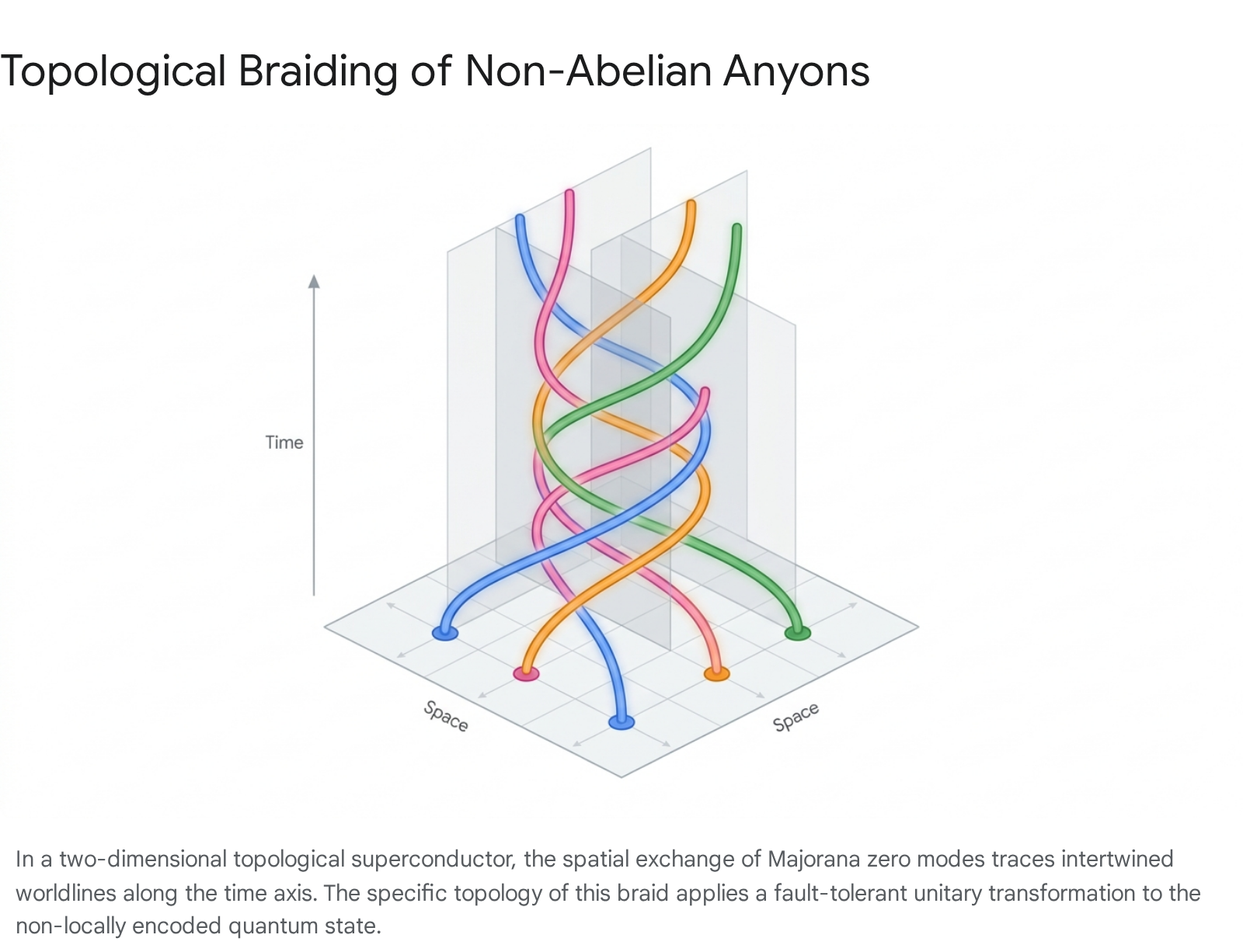
The operation is completely independent of the precise geometric path taken, the distance traveled, or the speed of the exchange, provided the movement remains adiabatic (slow enough to prevent exciting the system out of the ground state) 2223. This topological immunity means that local fluctuations, electromagnetic noise, and small variations in the control parameters cannot alter the outcome of the braiding operation, rendering the resulting quantum logic gates intrinsically fault-tolerant 1318.
Comparative Analysis of Quantum Computing Architectures
The pursuit of practical, utility-scale quantum computation requires overcoming the fundamental fragility of quantum states. Because quantum information is highly susceptible to decoherence from environmental interactions, researchers must employ sophisticated error-correction protocols to maintain the integrity of the data. This challenge has driven the development of several distinct hardware modalities, each presenting a unique profile of strengths, technical maturity, and approaches to fault tolerance 152021.
The three leading paradigms in the current era of quantum hardware development are superconducting circuits, trapped atomic ions, and topological systems based on Majorana fermions 2022.
Superconducting qubits, which rely on the non-linear inductance of Josephson junctions to create artificial atoms, represent the most technologically mature platform 202223. Industry leaders such as IBM and Google have demonstrated processing units containing hundreds of qubits, benefiting from established semiconductor fabrication techniques and rapid gate speeds in the nanosecond to microsecond range 2024. However, the physical states of these transmons are stored locally and are highly vulnerable to noise, crosstalk, and thermal fluctuations 152024. Their coherence times are typically restricted to the microsecond range 2024. To achieve fault-tolerant computation, superconducting architectures must rely on massive active quantum error correction (QEC), most commonly utilizing surface codes. In these schemes, logical information is distributed across a two-dimensional lattice of physical qubits, requiring thousands of physical qubits to generate a single reliable logical qubit 32025.
Trapped ion qubits take a different approach, utilizing the internal electronic and nuclear hyperfine states of individual charged atoms suspended in electromagnetic fields 222426. This architecture boasts unparalleled qubit quality, demonstrating two-qubit gate fidelities exceeding 99.9% and coherence times measured in seconds or even minutes 2024. Furthermore, because the ions interact via collective vibrational modes within the trap, they offer native all-to-all connectivity, which significantly reduces the depth of the algorithmic circuits required to run complex programs 2024. The primary drawbacks of trapped ions are their relatively slow gate operation speeds (microseconds to milliseconds) and the formidable engineering complexity involved in scaling the requisite optical lasers and ultra-high vacuum systems to the thousands or millions of qubits needed for commercial utility 232426.
Topological qubits represent a paradigm shift in addressing the decoherence problem. Rather than relying entirely on active, software-level error correction to fix errors after they occur, topological qubits aim to prevent errors at the hardware level through physical encoding 152527. By encoding quantum information in the global parity of spatially separated Majorana zero modes, the system is rendered intrinsically immune to local noise 315. A localized disturbance, such as a stray electromagnetic field interacting with one end of a nanowire, cannot alter the joint parity state of the qubit because the information is not stored in that single location 3. This hardware-level protection suggests that topological quantum computers could operate with drastically reduced QEC overhead, requiring an order of magnitude fewer physical qubits per logical qubit compared to superconducting surface codes 32528.
| Feature / Architecture Paradigm | Superconducting Transmons | Trapped Atomic Ions | Topological (Majorana) Qubits |
|---|---|---|---|
| Physical Encoding Basis | Artificial atoms via Josephson junctions and LC circuits 222324 | Electronic/hyperfine states of individual charged atoms 222326 | Global fermion parity of non-local Majorana zero modes 1522 |
| Typical Coherence Times | Short (tens to hundreds of microseconds) 2024 | Very Long (seconds to minutes) 202426 | Theoretically infinite against local perturbations 315 |
| Gate Operation Speed | Fast (nanoseconds to microseconds) 202426 | Slow (microseconds to milliseconds) 232426 | Moderate (limited by measurement times, typically microseconds) 324 |
| Qubit Connectivity | Limited (typically nearest-neighbor planar grids) 2029 | All-to-all connectivity within a specific trap array 2024 | Architecture-dependent (wire networks or measurement buses) 202235 |
| Error Correction Overhead | Extremely High (thousands of physical qubits per logical qubit via surface codes) 3202528 | Moderate to High (complex logical encodings required) 1520 | Extremely Low (hardware-level protection for Clifford operations) 3252830 |
| Current Scalability / Maturity | High (processors exceeding hundreds of physical qubits) 20 | Moderate (challenging laser and vacuum infrastructure scaling) 2426 | Embryonic (proof-of-concept multi-qubit devices currently emerging) 1531 |
Material Platforms for Realizing Majorana Zero Modes
The isolation of Majorana zero modes is not a trivial undertaking. It requires synthesizing exotic states of matter that exhibit topological superconductivity, which in turn demands a precise confluence of specific physical symmetries, spin-orbit interactions, and pairing mechanisms. Since the theoretical proposals of the early 2010s, experimental condensed matter physicists have explored several distinct material platforms to engineer and control these elusive quasiparticles.
Proximitized Semiconductor Nanowires
The most intensely researched platform for realizing MZMs consists of quasi-one-dimensional semiconductor nanowires coupled to conventional superconductors, an approach heavily championed by industry research groups, most notably Microsoft Station Q 51527. In this architecture, a high-mobility semiconductor nanowire characterized by strong spin-orbit coupling (such as Indium Arsenide or Indium Antimonide) rests on a substrate and is partially coated with a conventional s-wave superconductor (such as Aluminum or Niobium Titanium Nitride) 15.
Through the proximity effect, the s-wave superconductor induces a superconducting pairing gap within the semiconductor 532. When an external magnetic field is applied axially along the nanowire, the Zeeman energy breaks time-reversal symmetry 532. Once the Zeeman energy surpasses a critical threshold determined by the induced superconducting gap and the semiconductor's chemical potential, the system undergoes a topological quantum phase transition, effectively manifesting the one-dimensional Kitaev chain model 2532.
In this topological superconducting phase, the bulk interior of the nanowire remains gapped and insulating to low-energy excitations. However, robust zero-energy bound states - the Majorana zero modes - emerge strictly localized at the physical boundaries, or ends, of the one-dimensional wire segment 53233. To control the chemical potential and drive specific segments of the wire in and out of the topological phase, researchers utilize an array of electrostatic gates positioned beneath or alongside the nanowire 163240. Early iterations of this platform suffered from high levels of disorder at the semiconductor-superconductor interface, but subsequent breakthroughs in epitaxial growth have yielded pristine "topoconductor" materials that significantly mitigate the formation of trivial sub-gap states 334.
Iron-Based Superconductors
An alternative and highly promising paradigm centers on iron-based superconductors (IBS). Unlike the nanowire approach, which relies on fabricating complex heterostructures to artificially induce the necessary physics, specific iron-based materials naturally provide a single-material platform harboring both high-temperature superconductivity and topological Dirac surface states 68.
When a strong perpendicular magnetic field is applied to an iron-based superconductor, magnetic flux penetrates the material in the form of quantized vortex cores. Within specific materials such as FeTe0.55Se0.45, scanning tunneling microscopy and spectroscopy (STM/S) have revealed distinct zero-energy states localized inside these vortex cores 635. These states exhibit a half-integer level shift in their energy spectra, which is a hallmark signature distinguishing Majorana bound states from conventional Caroli-de Gennes-Matricon vortex states 635. When extrinsic instrumental broadening is mathematically deconvoluted from the measurements, the conductance of these zero-bias peaks approaches a quantized value of $2e^2/h$, offering compelling evidence for the presence of pure MZMs 35.
Between 2022 and 2024, researchers from the Chinese Academy of Sciences achieved significant milestones in advancing the IBS platform 83637. A critical challenge in utilizing vortex-bound Majoranas for computation has been the uncontrollable and disordered nature of vortex lattices, coupled with alloying-induced disorder in materials like FeTe0.55Se0.45 3537. However, the researchers discovered that naturally strained samples of LiFeAs produce biaxial charge density wave (CDW) stripes 3738. These CDW stripes strongly modulate the local superconductivity, forcing the magnetic vortices to align exclusively along specific crystallographic axes 3738. This mechanism enables the creation of large-scale, highly ordered, and tunable MZM lattices, where the density and geometry of the Majorana modes can be controlled by varying the external magnetic field, providing a highly scalable physical layout for future topological circuits 83537.
Planar Josephson Junctions
Planar Josephson junctions offer a versatile two-dimensional approach to topological superconductivity. In this configuration, a two-dimensional electron gas (2DEG) featuring strong spin-orbit coupling (such as Mercury Telluride or Indium Arsenide) is sandwiched laterally between two superconducting contacts, leaving a narrow, exposed normal region that acts as the junction channel 394041.
To drive the planar junction into a class-D topological superconducting state, researchers apply an in-plane magnetic field and manipulate the superconducting phase difference across the two contacts 4042. The reliance on phase biasing provides an additional tuning knob, often allowing the system to achieve topological superconductivity at significantly lower external magnetic fields than required for 1D nanowires, which is advantageous for preserving the overall strength of the superconductivity 4042.
Furthermore, planar junctions present unique localization dynamics for Majorana quasiparticles. Depending on the specific tuning of the magnetic field and the phase bias, the system can host two distinct spatial distributions of MZMs. It can manifest highly localized "end-like" Majorana states that reside strictly at the opposite ends of the normal channel, or it can host extended "edge-like" Majorana states that propagate along the edges of the system perpendicular to the junction 4142. The extended nature of edge-like MZMs has been proposed as a mechanism to create effective interconnects, facilitating the coupling of topological states across adjacent planar junctions without the need for complex physical wire routing 4142.
Quantum Anomalous Hall Insulator Hybrids
Another significant avenue for exploring non-Abelian physics involves the synthesis of hybrid structures combining a Quantum Anomalous Hall Insulator (QAHI) with a conventional s-wave superconductor 24344. The quantum anomalous Hall effect creates a state of matter characterized by a full insulating gap in the bulk but possessing gapless, resistance-free, chiral edge states, achieved through intrinsic magnetization rather than external magnetic fields 21344.
When a QAHI thin film is proximity-coupled to a superconducting reservoir, the interface can host one-dimensional chiral Majorana edge modes (CMEMs) 243. Unlike the zero-dimensional bound states found in nanowires or vortex cores, CMEMs are propagating wave packets that travel continuously along the perimeter of the topological boundary 243. The one-dimensional nature of these chiral channels introduces the possibility of using high-speed propagating modes to perform quantum logic, serving as an alternative to the slow braiding of static zero-dimensional particles 43.
The primary transport signature used to identify CMEMs is a half-integer quantized longitudinal conductance plateau of $0.5 e^2/h$ 21345. This signature occurs during the reversal of the external magnetic field sweeping across the coercive field of the QAHI's magnetization 213. When the system transitions through a specific topological phase change, the incident QAHI edge state splits at the superconducting interface: one chiral Majorana mode transmits perfectly across the junction, while its pairing mode is reflected 13. Because a single CMEM represents exactly half the degrees of freedom of a standard electron edge state, the resulting transmission yields the precise half-integer conductance anomaly 13. While pioneering experiments in 2017 reported this signature, the findings have faced scrutiny, and current efforts are shifting toward advanced microwave spectroscopy to probe the unique dispersive properties of the Majorana edge mode and definitively differentiate it from trivial Andreev scattering 4345.
Quantum Spin Liquids
Beyond the realm of proximity-induced superconductivity, researchers are hunting for Majorana fermions within bulk magnetic insulators known as Quantum Spin Liquids (QSLs) 105346. QSLs are highly frustrated quantum systems where the localized magnetic spins fail to establish long-range magnetic order even at absolute zero temperature, instead forming a highly entangled, fluctuating liquid-like state 4647.
The theoretical framework for this platform is anchored by the Kitaev honeycomb model, an exactly solvable spin-1/2 model where extreme exchange frustration causes the fundamental electron spin operators to fractionalize 474849. In this model, the spin degrees of freedom split into two distinct emergent quasiparticles: itinerant Majorana fermions (spinons) and static $\mathbb{Z}_2$ gauge fluxes (often termed visons) 484950.
Researchers have identified several candidate materials that approximate Kitaev interactions, most notably the ruthenium chloride compound $\alpha$-RuCl3 and certain iridates such as Li2IrO3 and Na2Co2TeO6 464849. While pure Kitaev models yield gapped or gapless spin liquids depending on exchange anisotropies, recent theoretical and numerical studies indicate that applying a moderate external magnetic field to these antiferromagnetic insulators can stabilize a novel intermediate gapless phase 4647. In this phase, the proliferating magnetic fluxes trap Majorana zero modes that subsequently overlap to create a bulk, neutral superconducting state characterized by a Majorana Fermi surface - a state acting as a "Majorana metal" 464850. Because these particles are electrically neutral, their detection relies heavily on observing fractionalized dynamics through Raman scattering, dynamic spin correlations, and inelastic neutron scattering spectra rather than direct electrical transport 4649.
| Platform | Primary Material Base | Origin of Majorana Mode | Distinctive Signatures | Key Challenges |
|---|---|---|---|---|
| Proximitized Nanowires | InAs / InSb with Al / NbTiN 5 | Ends of 1D topological superconductor 532 | Zero-Bias Conductance Peaks (ZBP) 1639 | Interface disorder, trivial Andreev bound states 3233 |
| Iron-Based Superconductors | FeTe0.55Se0.45, LiFeAs 6837 | Vortex cores under perpendicular B-field 635 | Half-integer level shift, $2e^2/h$ plateau 35 | Uncontrollable vortex lattices, alloying disorder 3537 |
| Planar Josephson Junctions | 2DEG (HgTe, InAs) with superconducting contacts 3940 | Ends or edges of the phase-biased normal channel 4142 | 4$\pi$ fractional Josephson effect, extended edge states 3942 | Precise phase and field control required across 2D plane 4042 |
| QAHI Hybrids | Magnetic Topological Insulators + s-wave SC 213 | Chiral 1D boundary at the QAHI-SC interface 243 | $0.5 e^2/h$ quantized conductance plateau 213 | Fragility of QAH effect, distinguishing from trivial scattering 4345 |
| Quantum Spin Liquids | Kitaev candidates ($\alpha$-RuCl3, Iridates) 464849 | Spin fractionalization into Majorana spinons 4849 | Broad multi-spinon scattering continua 4649 | Indirect detection methods required, competing magnetic orders 4749 |
Verification Standards and the Topological Gap Protocol
The history of experimental condensed matter physics concerning Majorana fermions has been turbulent, marked by periods of intense optimism followed by rigorous re-evaluation. A critical issue stems from the fact that the defining signature of a Majorana zero mode in a nanowire - the zero-bias conductance peak (ZBP) - is not exclusive to topological phenomena 323351.
In earlier experiments, observations of ZBPs were often heralded as definitive proof of MZMs. However, subsequent theoretical and experimental scrutiny revealed that local defects, potential fluctuations, and unintentional quantum dot formation at the ends of the nanowires could easily spawn trivial localized Andreev bound states 323351. Under certain magnetic field conditions, these trivial Andreev states can be driven to zero energy, perfectly mimicking the local conductance profile of a true Majorana mode 33251. This ambiguity precipitated a reproducibility crisis, culminating in a series of high-profile retractions in 2021 and 2022, which forced the community to abandon informal pattern matching in favor of stringent, statistically rigorous validation frameworks 332.
In response to this crisis, a collaborative team of physicists developed the Topological Gap Protocol (TGP) 335152. The TGP is designed as an automated, unbiased statistical test to determine the presence of a topological phase in a three-terminal hybrid device without human confirmation bias 405153. To pass the protocol, a device must satisfy a stringent sequence of concurrent criteria across a large, multidimensional parameter space (varying magnetic field, semiconductor electron density, and junction transparencies) 5254.
First, the protocol demands the presence of highly stable zero-bias conductance peaks at both ends of the nanowire simultaneously, and these peaks must withstand intentional variations in the tunnel junction transparency to rule out local artifacts 334052. Crucially, the protocol supplements these local measurements with non-local transport conductance checks 4051. Because true topological transitions represent a fundamental change in the phase of matter, they must be accompanied by a closing and subsequent reopening of the bulk superconducting energy gap 3340. The non-local conductance measurements are designed to detect this bulk gap transition, verifying that the zero-bias peaks observed at the boundaries are genuinely tethered to a global topological phase rather than localized impurities 323340. Measurements in topoconductor devices that have passed the TGP report topological gaps on the order of 20 to 30 $\mu$eV, exceeding the thermal and instrumental noise floors by a factor of three 335254.
Despite its rigorous design, the TGP remains a subject of intense academic debate. Critics of the protocol, such as researchers publishing independent analyses in 2025, have argued that the TGP can yield false positives depending on highly specific parameter selections, such as the exact magnetic field range or the specific cutter pair utilized in the analysis 55. Furthermore, some critiques contend that a re-examination of the raw public conductance data for regions that ostensibly passed the TGP reveals heavy disorder and a lack of a clear, contiguous bulk superconducting gap, suggesting the nanowires remained gapless 55.
Conversely, the architects of the TGP robustly defend the protocol's statistical integrity. They maintain that the protocol's key metric - the false discovery rate (FDR) - is demonstrably bounded below 8%, meaning the probability of incorrectly identifying a trivial region as topological is exceedingly low 53. Proponents assert that while the TGP may yield false negatives (failing a device that actually possesses a topological phase), passing the stringent multi-variable criteria remains the highest-confidence indicator currently available for validating a parameter regime suitable for operating topological qubits 4053.
The Mechanism of Topological Quantum Gate Operations
Translating the physical existence of Majorana zero modes into a functional universal quantum computer requires mapping the exotic physics of non-Abelian anyons onto the mathematical framework of quantum logic gates.
Braiding and the Clifford Group
The fundamental logical operation in a topological quantum computer is braiding. To understand this mathematically, consider a collection of $2n$ Majorana operators, $\gamma_i$. These operators satisfy the fundamental Clifford algebra anti-commutation relations: $\gamma_i \gamma_j + \gamma_j \gamma_i = 2\delta_{ij}$ (where $\delta_{ij}$ is the Kronecker delta) 1156.
When two adjacent Majorana modes, $\gamma_i$ and $\gamma_j$, are physically exchanged, the quantum state undergoes a unitary evolution governed by the braiding operator $U = \exp(\frac{\pi}{4} \gamma_j \gamma_i) = \frac{1}{\sqrt{2}}(1 + \gamma_j \gamma_i)$ 112023. Applying this exchange operation rotates the encoded logical quantum state 2056.
Remarkably, it has been rigorously demonstrated that the set of all possible braiding operations on a register of encoded Majorana qubits perfectly generates the single-qubit Clifford group 233057. Specifically, by braiding different combinations of MZMs within a designated logical qubit, a topological computer can execute the Hadamard (H) gate, which creates superposition, and the Phase (S) gate 233066. Because these gates are exact mathematical consequences of the braiding topology - insensitive to the precise speed or trajectory of the particle exchange - they are executed with essentially zero-time overhead for error correction at the physical hardware level 3530.
However, the non-Abelian braiding of Majorana fermions encounters a fundamental mathematical limitation concerning computational universality. The image of the braid group representations generated by Majorana zero modes is restricted strictly to the Clifford gate set 222330. According to the Gottesman-Knill theorem, any quantum circuit consisting exclusively of Clifford gates and computational basis measurements can be efficiently simulated by a classical computer in polynomial time 3057. Therefore, braiding Majoranas alone cannot achieve quantum advantage.
To achieve universal quantum computation, the topologically protected Clifford set must be supplemented with at least one non-Clifford gate, typically the T-gate (a $\pi/8$ phase rotation) 223067. Because the T-gate cannot be executed via physical braiding, topological architectures must rely on a process known as "magic state injection" 253067. In this process, noisy non-topological resource states are prepared, heavily distilled using standard quantum error correction protocols to increase their fidelity, and then teleported into the topological logical qubit 353067. Consequently, the vast majority of the error-correction overhead in a mature topological quantum computer will be dedicated almost entirely to managing these magic states 2535.
Measurement-Based Braiding and Parity Readouts
Early theoretical proposals for topological quantum computing envisioned physically transporting Majorana zero modes along intricate two-dimensional networks of T-junction nanowires 203558. However, physically moving these quasiparticles presents severe experimental hazards. Rapid or erratic movement risks diabatic transitions, which excite the system out of the degenerate ground state and violently destroy the topological protection 32235.
To circumvent these hazards, modern architectures have entirely abandoned the concept of physical movement in favor of measurement-based braiding 3567. In this paradigm, the physical Majorana zero modes remain completely static at the ends of their respective nanowire segments 33567. Gate operations are instead induced via a carefully orchestrated sequence of projective joint parity measurements 32267.
The mechanics of this measurement process represent a pinnacle of quantum engineering. By temporarily coupling specific sets of MZMs to an adjacent auxiliary quantum dot via tunable tunnel barriers, researchers form an interferometer 6759. The combined fermion parity of the coupled MZM-dot system dictates the allowed energy transitions within the interferometer 6759. Crucially, this state-dependent energy level induces a measurable shift in the quantum capacitance of the auxiliary dot 59.
In a landmark 2025 publication, researchers successfully demonstrated this interferometric single-shot parity measurement in InAs-Al hybrid devices. By monitoring the quantum capacitance - which shifted by up to 1 fF depending on the parity state - the system achieved a clear bimodal readout 5960. The devices maintained the parity state for dwell times exceeding 1 millisecond, allowing the measurement apparatus to determine the joint parity with an assignment error probability of merely 1% within 3.6 microseconds 359.
By executing a specific sequence of these non-commuting projective measurements (a process known as Majorana tracking or forced measurement), the logical quantum state undergoes the exact same mathematical unitary evolution as if the physical particles had been braided in two dimensions 33567.
Hybrid Encodings for Universal Computation
To efficiently execute multi-qubit entangling gates - such as the Controlled-NOT (CNOT) gate required for universal algorithms - topological arrays utilize hybrid encoding schemes 223530. Logical qubits are instantiated as specific hardware arrangements, most commonly "tetrons" (islands containing four MZMs) or "hexons" (islands containing six MZMs) 33067.
These structures operate by transitioning dynamically between "sparse" and "dense" logical encodings 56. Single-qubit Clifford operations are performed efficiently while the qubit resides in a sparse encoding, leveraging the rapid measurement-based braiding protocols 3556. When an entangling operation between two distant logical qubits is required, the states are temporarily mapped into a dense encoding 56. This dense representation allows the system to utilize lattice surgery techniques - a method borrowed from surface code error correction - to execute long-range, multi-target CNOT gates 3556. The operational time overhead for these lattice surgery CNOT gates scales logarithmically with the physical distance separating the control and target qubits, drastically improving algorithmic throughput compared to standard nearest-neighbor architectures 35.
Development Roadmaps and Scalable Architectures
The translation of abstract non-Abelian physics into functioning quantum processors has accelerated rapidly, marked by explicit engineering roadmaps aiming to bridge the gap between single-qubit demonstrations and utility-scale quantum advantage.
In early 2025, Microsoft announced the "Majorana 1," a proof-of-concept 8-qubit topological quantum processor powered by gate-defined topoconductor materials 3134. Operating as part of the DARPA Underexplored Systems for Utility-Scale Quantum Computing (US2QC) program, the Majorana 1 chip demonstrated the ability to control the topological state entirely via digital voltage pulse modulation - akin to flicking a light switch - departing from the highly complex, continuous analog fine-tuning that hindered earlier experimental setups 61.
To systematically advance this technology, the engineering teams have published a comprehensive four-stage device roadmap targeting fault-tolerant computation 276263. 1. Single-Tetron Device: The foundation of the roadmap focuses on a single logical qubit device designed to enable rigorous measurement-based benchmarking, focusing on high-fidelity logical X and Z parity readouts 6263. 2. Two-Tetron Array: The second generation expands to two logical qubits, focusing on demonstrating two-qubit parity measurements and executing measurement-based single-qubit Clifford braiding operations to establish the fundamental gate set 6263. 3. Eight-Qubit Array: Building upon the two-tetron system, this intermediate array is designed to execute specific quantum error detection protocols, such as Floquet codes and ladder codes 6263. Because the underlying physics of the Majorana devices heavily biases the noise model toward Z-errors (phase flips) while exponentially suppressing bit flips, these tailored codes are expected to demonstrate that logical operations exhibit superior fidelities compared to unencoded physical operations - a critical milestone known as breakeven 62. 4. Large-Scale Topological Array: The final near-term milestone envisions a device comprising approximately 300 to 350 physical qubits 62. This scale is necessary to perform full lattice surgery demonstrations on multiple logical qubits and to execute scaling experiments utilizing sophisticated three-dimensional topological constructs, such as the Hastings-Haah code, laying the architectural groundwork for scaling to the one-million-qubit threshold required for commercial applications 6263.
Future Outlook
The field of topological quantum computing, anchored by the unique properties of Majorana fermions, is navigating a critical transition from fundamental physical discovery to rigorous systems engineering. While alternative hardware architectures - such as superconducting transmons and trapped ions - currently maintain a commanding lead in raw physical qubit counts and public demonstrations of algorithmic execution, the intrinsic fault tolerance associated with non-Abelian anyons presents the most mathematically elegant solution to the quantum decoherence bottleneck 31520.
The primary advantage of the Majorana approach remains its unparalleled potential to reduce quantum error correction overhead. By circumventing the need to actively correct local continuous control errors, phase flips, and bit flips through hardware-level protection, a topological quantum computer could drastically shrink the physical footprint required to solve classically intractable problems in chemistry, materials science, and cryptography 1522.
However, the path to utility-scale computation remains fraught with rigorous tests. The scientific community must definitively resolve ongoing debates regarding verification protocols like the TGP, ensuring that the detected zero-energy modes are unequivocally non-Abelian rather than trivial artifacts 355. Furthermore, mastering the scalable fabrication of pristine topoconductor heterostructures or ordered iron-based superconductor lattices, alongside perfecting the speed and fidelity of single-shot parity readouts, represents an ongoing global engineering challenge 83760. If these hurdles are surmounted, the deployment of robust Majorana zero modes will effectively rewrite the operational logic of quantum hardware, replacing the noisy, error-prone accumulation of localized physical gates with the pristine, topologically protected braiding of quantum information.