The fractional quantum Hall effect
The discovery of the fractional quantum Hall effect (FQHE) is universally regarded as a watershed moment in the history of condensed matter physics, fundamentally altering the theoretical frameworks utilized to classify and understand macroscopic states of matter. Originally observed in 1982 by Daniel Tsui, Horst Störmer, and Arthur Gossard, and subsequently explained by Robert Laughlin, the FQHE demonstrated that under conditions of extreme low temperatures and powerful magnetic fields, a two-dimensional gas of interacting electrons condenses into a remarkable quantum liquid 1. Unlike conventional phases of matter, this liquid exhibits excitations that carry a fraction of the elementary electron charge and obey fractional braiding statistics.
The profound nature of the FQHE lies in its direct contradiction of the established Landau symmetry-breaking paradigm. It introduced the physics community to the concept of topological order, catalyzed theories describing non-Abelian anyons, and currently serves as the foundational architecture for proposed fault-tolerant topological quantum computers 123. The historical trajectory of this field has seen continuous evolution, moving from the requirement of immense external magnetic fields to recent breakthroughs in moiré superlattices that host fractional quantum anomalous Hall effects at strictly zero magnetic field 456.
Fundamental Physics and Historical Context
To contextualize the fractional quantum Hall effect, it is necessary to examine the progression from classical electrodynamics to quantum transport phenomena. The classical Hall effect, discovered by Edwin Hall in 1879, occurs when a magnetic field is applied perpendicularly to a current-carrying conductor 78. The Lorentz force deflects the moving charge carriers to one side of the material, establishing a transverse voltage gradient known as the Hall voltage. In a classical system, the Hall resistance (the ratio of the transverse voltage to the longitudinal current) increases linearly with the strength of the applied magnetic field 9.
The Integer Quantum Hall Effect
In 1980, Klaus von Klitzing subjected a two-dimensional electron gas (2DEG) formed in a silicon metal-oxide-semiconductor field-effect transistor (MOSFET) to extremely low temperatures and high magnetic fields 910. Under these conditions, classical linearity breaks down. The Hall resistance develops precise, perfectly flat plateaus at values of $R_{xy} = h / (\nu e^2)$, where $h$ is Planck's constant, $e$ is the elementary charge, and $\nu$ is an exact integer 19. Concurrently, the longitudinal resistance $R_{xx}$ drops to zero, indicating dissipationless transport along the edges of the material 1.
This phenomenon, the integer quantum Hall effect (IQHE), is driven by the quantization of continuous electron energy spectra into discrete, highly degenerate levels known as Landau levels. The integer $\nu$, termed the filling factor, corresponds to the number of fully occupied Landau levels 11. The IQHE can be comprehensively understood within a single-particle framework where electrons do not interact; the precision of the plateaus is protected by the topological invariants of the bulk band structure, formally described by the TKNN (Thouless, Kohmoto, Nightingale, and den Nijs) invariant or the first Chern number 312.
Discovery of the Fractional Quantum Hall Effect
In 1982, Tsui, Störmer, and Gossard extended these measurements using ultra-clean gallium arsenide/aluminum gallium arsenide (GaAs/AlGaAs) heterostructures grown via molecular beam epitaxy 1912. The superior mobility of these samples minimized electron scattering from impurities. By applying even stronger magnetic fields and lower temperatures, they observed a plateau in the Hall resistance at a fractional filling factor of $\nu = 1/3$, alongside a vanishing longitudinal resistance 1.
This fractional quantization implied that the Hall conductance was quantized in units of $e^2/3h$. Soon after, a multitude of other fractional states were discovered at filling factors such as $2/5$, $3/7$, and $5/2$ 19. Because the lowest Landau level is only partially filled in these regimes, macroscopic degeneracy prevents a single-particle kinetic energy gap from forming. Consequently, the FQHE cannot be explained by non-interacting band theory; it is fundamentally driven by the strong Coulomb repulsion between electrons, which forces the system into a highly correlated, many-body ground state 1314.
The Failure of the Landau Paradigm and the Emergence of Topological Order
For decades prior to the discovery of the quantum Hall effects, the Landau theory of spontaneous symmetry breaking was the universally accepted framework for describing phases of matter and their transitions 1. According to this paradigm, different states of matter (e.g., crystalline solids, ferromagnets, superconductors) are characterized by local order parameters and the specific physical symmetries they break 115. For instance, a liquid transitioning into a solid breaks continuous translational symmetry, and a paramagnet transitioning into a ferromagnet breaks rotational symmetry. It was widely held that symmetry breaking could successfully classify all possible macroscopic quantum and classical phases.
The fractional quantum Hall effect demonstrated the definitive limits of Landau's theory. Distinct fractional quantum Hall states - such as the $\nu = 1/3$ and $\nu = 2/5$ states - possess the exact same fundamental symmetries 1. They do not break translational, rotational, or time-reversal symmetries of the underlying lattice in a manner that distinguishes one fractional state from another. Consequently, no local order parameter can differentiate these states 115.
Defining Topological Order
This theoretical impasse necessitated a paradigm shift, leading to the introduction of topological order 115. Topological phases are defined not by local symmetries, but by global, non-local topological invariants 15. In the context of the FQHE, these invariants include: 1. Ground State Degeneracy: On compact manifolds with non-trivial topology (such as a torus), FQH states exhibit ground state degeneracy that depends on the topological genus of the surface, a feature entirely absent in trivially gapped insulators 131516. 2. Many-Body Chern Numbers: The bulk insulating state is characterized by a many-body generalization of the Chern number, ensuring robust quantization of the transverse conductance 1517. 3. Fractional Excitations: The elementary excitations of the system manifest fractional charge and fractional braiding statistics, phenomena uniquely supported by topological frameworks 115.
Topological order demonstrates the power of quantum entanglement in many-body systems; the wavefunctions of FQH states encode long-range entanglement that renders their physical properties inherently robust against local perturbations or impurities 101218. Because the order is encoded globally, a localized defect cannot destroy the quantization or alter the fractional statistics, providing a theoretical foundation for error-resistant quantum computation 219.
Theoretical Frameworks: Laughlin Liquids and Composite Fermions
The microscopic origin of the FQHE is deeply rooted in strong electron-electron interactions 114. When a Landau level is partially filled, the single-particle kinetic energy is quenched due to macroscopic degeneracy, and the Coulomb repulsion between electrons becomes the defining energy scale governing the system's behavior 1214.
The Laughlin Wavefunction
In 1983, Robert Laughlin proposed a trial many-body wavefunction to describe the incompressible ground state at primary filling fractions $\nu = 1/m$, where $m$ is an odd integer for interacting fermions 111. Using complex coordinates $z_j = x_j + i y_j$ to represent the position of the $j$-th electron in the two-dimensional plane, the Laughlin wavefunction for $N$ electrons is written as:
$$\Psi_m(z_1, \dots, z_N) = \prod_{j < k}^N (z_j - z_k)^m \exp\left( - \sum_{i=1}^N \frac{|z_i|^2}{4 l_B^2} \right)$$
where $l_B = \sqrt{\hbar / e B}$ is the magnetic length 1416. This analytical expression exhibits several profound features that accurately capture the physics of the FQH state.
First, the Jastrow factor $(z_j - z_k)^m$ ensures that the wavefunction goes to zero rapidly as any two electrons approach each other 14. By vanishing as the $m$-th power of the particle separation, the wavefunction effectively keeps electrons apart, minimizing the repulsive Coulomb interaction energy 14. Second, because $m$ is restricted to odd integers, the wavefunction is strictly antisymmetric under particle exchange, perfectly satisfying the Pauli exclusion principle for fermions 1114. The Laughlin state represents an incompressible quantum liquid; adding or removing an electron costs a finite amount of energy, creating an excitation energy gap that stabilizes the quantized Hall plateau at low temperatures 1314.
Composite Fermion Theory
While the Laughlin wavefunction beautifully explained primary fractional states like $\nu = 1/3$ and $1/5$, a broader and more comprehensive theoretical framework was required to explain the dense hierarchy of other observed fractions, such as $2/5$, $3/7$, and $4/9$ 113. This was achieved by Jain's Composite Fermion (CF) theory, which was later expanded upon by Halperin, Lee, and Read 1.
According to CF theory, interacting electrons in a strong magnetic field minimize their interaction energy by binding an even number of magnetic flux quanta (vortices) to themselves. An electron inextricably bound to an even number of flux quanta forms a new, emergent topological quasiparticle known as a "composite fermion" 1213.
Because the attached flux exactly cancels out a portion of the external magnetic field, these composite fermions experience a significantly weaker effective magnetic field 13. Remarkably, the strongly interacting regime of bare electrons undergoing the fractional quantum Hall effect maps exactly onto weakly interacting composite fermions undergoing the integer quantum Hall effect 113.
The filling fractions of the original electrons, $\nu$, relate directly to the integer filling factors of the composite fermions, $p$, through the formula $\nu = p / (2mp \pm 1)$ 13. This equation generates the "Jain sequence" of fractional states, which perfectly matches the hierarchy of plateaus observed in high-mobility transport experiments 13. Furthermore, at a filling factor of $\nu = 1/2$, the effective magnetic field experienced by composite fermions possessing two flux quanta becomes exactly zero. Under these conditions, the composite fermions form a gapless Fermi sea, resulting in a compressible state known as a Composite Fermi Liquid (CFL) 120.
Characteristics of Topological Excitations: Anyons and Fractional Charge
The most striking consequence of the FQHE is the nature of its elementary excitations. When the FQH fluid is perturbed - for example, by adding a localized magnetic flux or inserting an electron - the resulting defects in the quantum fluid behave as localized, particle-like entities with properties that defy the standard model of particle physics 19.
Charge Fractionalization
In the conventional universe of fundamental particles, electric charge is strictly quantized in integer multiples of the elementary electron charge, $e$. However, the quasiparticle and quasihole excitations of the Laughlin liquid carry a fractional charge of $e^* = e/m$ 1914. For example, in the $\nu = 1/3$ state, the fundamental excitations carry precisely one-third of an electron charge 9.
It is crucial to understand that this fractionalization is not a physical splitting or destruction of a fundamental electron 2122. Instead, it represents a highly correlated collective excitation of the many-body system 2122. When a quasihole is created, the many-body electron fluid rearranges itself, leaving behind a localized deficit of charge that integrates exactly to $e/m$ 13. The presence of these fractionally charged quasiparticles was directly verified in 1995 through quantum antidot electrometer experiments at Stony Brook University, and subsequently confirmed with extreme precision through shot noise partitioning measurements 1.
Fractional Braiding Statistics
In three-dimensional space, all elementary and composite particles must be classified as either bosons (whose wavefunctions are symmetric under particle exchange) or fermions (whose wavefunctions are antisymmetric under exchange) 19. This binary classification is a rigid geometric constraint of quantum mechanics in three dimensions. However, in strictly two-dimensional systems like the 2DEG, particles are not confined to this binary; they can exhibit intermediate, or "fractional," statistics. Such particles are termed anyons 1923.
When one quasihole in a Laughlin state at $\nu = 1/m$ is adiabatically transported around another identical quasihole, the many-body wavefunction acquires a statistical geometric Berry phase of $\phi_{exch} = 2\pi / m$ 914. A single exchange of two particles yields a phase of $\theta = \pi / m$. Since this acquired phase is neither an integer multiple of $2\pi$ (the signature of bosons) nor an odd multiple of $\pi$ (the signature of fermions), the excitations are true anyons 914. This fractional exchange statistics demonstrates that two-dimensional FQHE systems host exotic collective behavior fundamentally prohibited in the three-dimensional vacuum 9.
Experimental Probes and Metrology
The extreme delicacy of FQH states demands highly specialized experimental conditions and intricate device geometries. FQHE measurements require ultra-clean two-dimensional electron gases, heavily relying on GaAs/AlGaAs semiconductor heterostructures manufactured via molecular beam epitaxy 11224. The high electron mobility of these samples minimizes potential scattering from impurities and disorder, which would otherwise localize the electrons, widen the energy levels, and destroy the many-body quantum liquid 118.
Transport Measurement Geometries
The measurement of macroscopic transport coefficients requires precisely designed geometries, primarily the Hall bar and the Van der Pauw configurations 72526.
A typical Hall bar is a rectangular mesoscopic device featuring a current source and drain at opposite ends (often labeled contacts 5 and 6), with multiple localized voltage probes positioned along the lateral edges (contacts 1 through 4) 725. A strong magnetic field is applied perpendicular to the 2D plane 25. When a constant DC current $I$ is driven longitudinally through the device, the transverse Hall voltage $V_H$ is measured across opposite lateral probes (e.g., between 2 and 4), while the longitudinal voltage $V_L$ is measured between adjacent probes on the same side (e.g., between 1 and 2) 726.
The Hall resistance is strictly defined as $R_{xy} = V_H / I$, and the longitudinal resistance as $R_{xx} = V_L / I$ 7. At a fractional filling factor $\nu$, the system enters its incompressible topological state characterized by an exactly quantized Hall plateau $R_{xy} = h / (\nu e^2)$ and a simultaneous, sharp drop of the longitudinal resistance $R_{xx}$ to zero 128.
For samples with arbitrary shapes, the Van der Pauw geometry is utilized. This involves placing four contacts on the perimeter of a homogeneous, unperforated sample 726. By sourcing current along one edge and measuring voltage across the opposite edge, and then rotating the configuration, experimentalists can precisely extract the sheet resistivity and Hall coefficient without requiring the strict linear geometry of a Hall bar 726. Alternatively, the Corbino geometry - a disk with inner and outer concentric contacts - is employed to measure bulk conductivity directly by eliminating the edge states entirely 1325.
Quantum Shot Noise and Fractional Charge Verification
While macroscopic Hall transport definitively proves the existence of the gapped FQH state, proving the existence and precise magnitude of fractionally charged quasiparticles requires highly sensitive microscopic probes. The most successful technique for this endeavor has been the measurement of quantum shot noise 272829.
Shot noise arises from the discrete, granular nature of electrical charge carriers partitioning across a potential scattering barrier 3031. In a typical experiment, a quantum point contact (QPC) - a narrow electrostatic constriction defined by split gates on the surface of the 2DEG - is used to pinch the conducting, chiral edge channels of the FQH fluid 2428. By bringing opposite edge states close together, quasiparticles acquire a finite probability $t$ of stochastic tunneling across the incompressible bulk of the fluid from one edge to the other 2428.
The spectral density of the current fluctuations (the shot noise power $S_I$) in the weak backscattering regime is governed by a modified Schottky equation for a binomial distribution:
$$S_I(0) = 2 e^* I t(1-t)$$
where $I$ is the impinging edge current, $t$ is the transmission probability, and $e^$ is the effective charge of the tunneling quasiparticles 242829. By precisely measuring the low-frequency noise power (utilizing cryogenic preamplifiers and filtering out background thermal and 1/f noise), researchers successfully verified that $e^ = e/3$ at $\nu = 1/3$, providing undeniable proof of charge fractionalization 242830.
However, recent studies have revealed that shot noise interpretations can be confounded by edge reconstruction and the presence of upstream neutral modes 29. At extremely low temperatures, spontaneous edge reconstruction in states like $2/3$ and $3/5$ can lead to noise signatures that do not strictly correlate with the bulk quasiparticle charge, emphasizing that the Fano factor of the shot noise may in some cases reflect the bulk filling factor rather than a pure fractional charge 29. To combat this, researchers engineer artificial interface edge modes between bulks of different filling factors, utilizing the relation $\nu_{int} = \nu_{bulk} - \nu_{gate}$ to independently control and measure the partitioning dynamics without relying on natural edges 29.
The Filling Factor 5/2 Anomaly and Non-Abelian Statistics
Among the roughly 100 observed fractional quantum Hall states, the plateau at filling factor $\nu = 5/2$, discovered in 1987 in ultra-high mobility GaAs heterostructures, occupies a unique and intensely debated position in modern physics 1219.
Almost all robust FQH states occur at filling factors with odd denominators, which is a direct mathematical consequence of the requirement for the multi-electron wavefunction to be totally antisymmetric under particle exchange 12. The existence of a robust, even-denominator state at $5/2$ indicated a radically different underlying physical mechanism, triggering decades of intensive theoretical and experimental investigation 1232.
Weak Pairing and Candidate Wavefunctions
The prevailing theoretical consensus suggests that the $5/2$ state arises not from a simple Laughlin-type interaction, but from a pairing instability 1232. In the half-filled first excited Landau level, the effective interaction between composite fermions is slightly attractive at short ranges 1232. This attraction allows the composite fermions to undergo a process analogous to Cooper pairing in standard superconductors, but inherently possessing $p$-wave spatial symmetry due to the internal structure of the fermions 1233.
Several competing topological ground states have been proposed to mathematically describe this $p$-wave pairing:
- The Pfaffian (Moore-Read) State: Proposed by Gregory Moore and Nicholas Read in 1991, this state describes chiral, fully spin-polarized composite fermions undergoing weak $p$-wave pairing 1219. Its excitations are predicted to support non-Abelian braiding statistics, and its edge structure features a chiral Majorana fermion mode co-propagating with a charged mode 1233.
- The Anti-Pfaffian State: The exact particle-hole conjugate of the Pfaffian state. Theoretical and numerical analyses involving non-perturbative Landau level mixing and realistic Coulomb interactions often favor the Anti-Pfaffian state over the Pfaffian in realistic GaAs systems 121936. The Anti-Pfaffian features three upstream Majorana modes on its edge 12.
- The PH-Pfaffian State: A topological state that possesses exact particle-hole symmetry. While energetic calculations deem it disfavored in pristine systems without disorder, recent thermal transport experiments have unexpectedly pointed toward this state as a strong candidate 1236.
- Abelian Candidates (e.g., the 331 state): Multi-component wavefunctions that support conventional Abelian statistics, lacking Majorana zero modes 1927. While early tunneling experiments found some consistency with Abelian behavior, later studies largely dismissed them in favor of non-Abelian descriptions for the robust $5/2$ plateau 1927.
Non-Abelian Anyons and Quantum Computation
If the $5/2$ state is governed by the Pfaffian, Anti-Pfaffian, or PH-Pfaffian order, its fundamental quasihole excitations are non-Abelian anyons 1233. Unlike Abelian anyons - where exchanging particles merely multiplies the global wavefunction by a phase factor $e^{i\theta}$ - exchanging non-Abelian anyons applies a unitary matrix transformation to a multidimensional space of degenerate ground states 21233.
Braiding these particles physically changes the quantum state of the system in a way that is highly dependent on the precise sequence (order) of the exchanges 233. Because non-Abelian anyons can store and process quantum information in a distributed, non-local manner that is inherently protected from local environmental decoherence, they are considered the fundamental building blocks for fault-tolerant topological quantum computers 21219.
The Thermal Hall Conductance Debate
Determining the true topological ground state of the $5/2$ plateau remains one of the most pressing unresolved challenges in condensed matter physics 1232. Because standard electrical transport, interference, and shot noise cannot easily distinguish between the closely related competing non-Abelian states (and even some Abelian states), physicists turned to an alternative, highly rigorous topological invariant: the thermal Hall conductance, $K_H$ 3334.
The thermal Hall conductance quantifies the transverse flow of heat across a device in response to an applied longitudinal temperature gradient 33. Topologically, $K_H$ is directly proportional to the central charge $c$ of the gapless chiral edge modes of the system, expressed in fundamental units of $\kappa_0 T = (\pi^2 k_B^2 / 3h)T$, where $k_B$ is the Boltzmann constant and $T$ is temperature 3336.
Because each proposed topological order dictates a different edge structure, each predicts a distinct value for $K_H$: * The Abelian 331 state predicts $K_H = 2 \kappa_0 T$. * The Anti-Pfaffian state predicts $K_H = 1.5 \kappa_0 T$. * The Pfaffian state predicts $K_H = 3.5 \kappa_0 T$. * The PH-Pfaffian state predicts $K_H = 2.5 \kappa_0 T$.
In a landmark 2018 experiment, Mitali Banerjee and colleagues successfully measured the thermal Hall conductance of the $\nu = 5/2$ state in extremely high-quality GaAs structures 3334. Remarkably, they obtained a fractional value of precisely $2.5 \kappa_0 T$ 3334. This half-integer quantization strongly affirmed the presence of a Majorana edge mode (which contributes $0.5$ to the central charge) and provided the first compelling experimental evidence that the $5/2$ state is definitively non-Abelian 3336.
However, the specific measured value of $2.5$ ignited massive theoretical controversy. The result aligns perfectly with the PH-Pfaffian state, which exact diagonalization numerical simulations had previously deemed energetically unviable in pure, homogeneous systems 36. The Anti-Pfaffian state, which is heavily favored by numerics, predicts $1.5 \kappa_0 T$ 36.
Subsequent theoretical work has aggressively attempted to reconcile this discrepancy. Commentaries, such as those by Simon in 2018, proposed mechanisms wherein sample disorder and large momentum mismatches between contra-propagating edge modes prevent the upstream Majorana modes of the Anti-Pfaffian state from thermally equilibrating 3635. In the absence of complete equilibration, the thermal conductance measured at the macroscopic contacts could manifest as $2.5 \kappa_0 T$ even if the true underlying bulk state is Anti-Pfaffian 3635. As of 2024, the exact topological identity of the $5/2$ state remains heavily debated, representing a frontier of ongoing theoretical and experimental inquiry 12.
Moiré Superlattices and the Fractional Quantum Anomalous Hall Effect
For over forty years, the experimental study of the FQHE was entirely restricted to conditions of extreme transverse magnetic fields, typically scaling above 10 Tesla, which necessitate the use of massive superconducting magnets and dilution refrigerators 22.
However, theorists predicted that if an interacting 2D lattice system possessed topologically non-trivial, perfectly flat energy bands (Chern bands), the fractional quantum Hall effect could theoretically manifest at strictly zero magnetic field 32336.
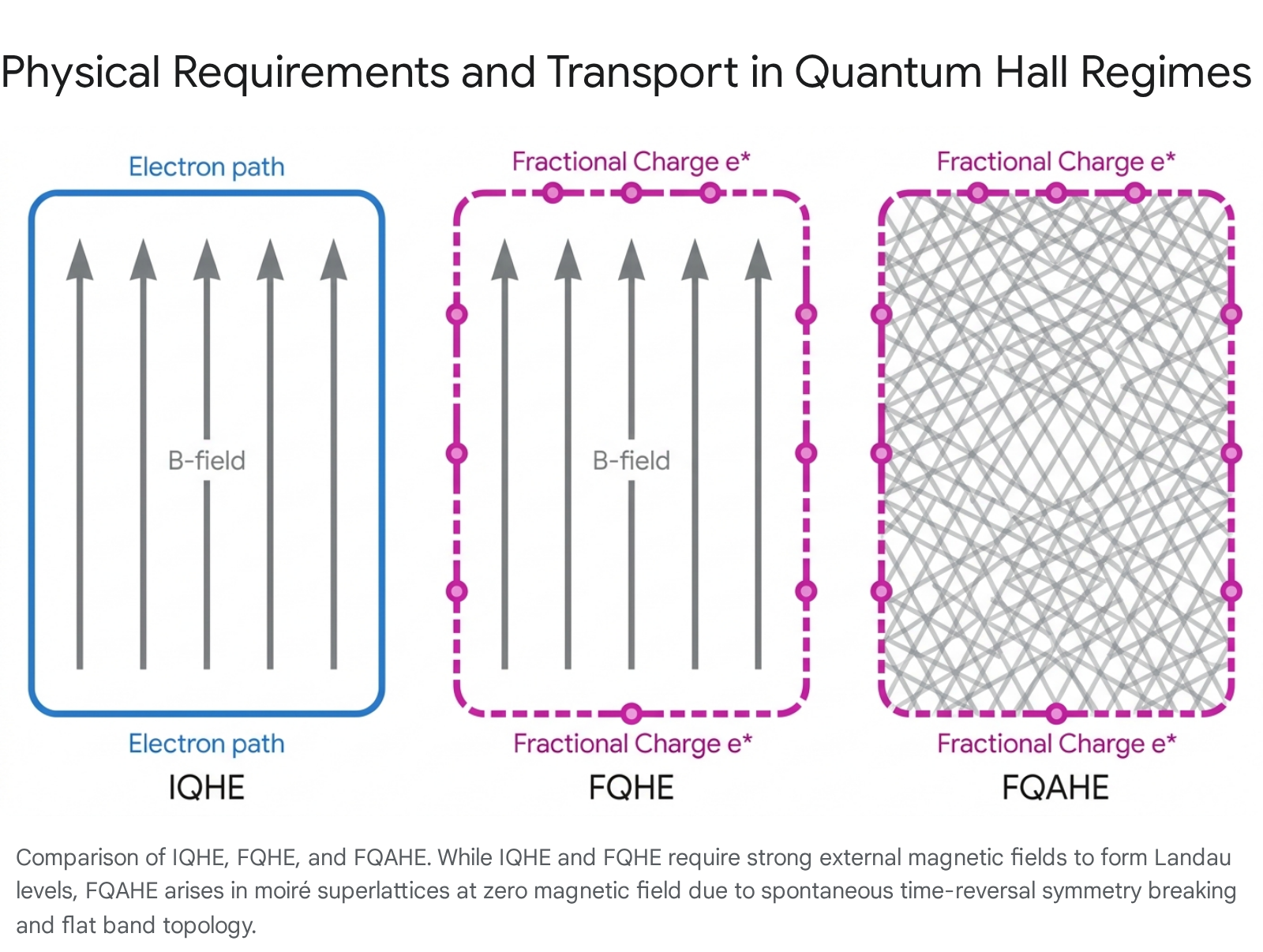
These hypothesized topological phases were termed Fractional Chern Insulators (FCIs) or the Fractional Quantum Anomalous Hall Effect (FQAHE) 32336.
Between 2023 and 2024, an explosive wave of experimental breakthroughs realized this long-sought phenomenon in the laboratory, utilizing the revolutionary material platform of two-dimensional moiré superlattices 5637.
Topological Flat Bands via Moiré Lattices
When two atomically thin sheets of 2D materials (such as graphene or transition metal dichalcogenides) are stacked upon each other with a slight relative rotational twist angle or a minor lattice mismatch, the misaligned crystal structures form a large, artificial periodic interference pattern known as a moiré superlattice 413839.
This long-range periodic spatial potential deeply reorganizes the electronic band structure. At specific "magic" twist angles, it flattens the electron dispersion curves, severely quenching the kinetic energy of the charge carriers 40. In these flat minibands, the ratio of interaction energy to kinetic energy diverges, forcing Coulomb repulsion to dictate the system's ground state 4041. If the flat band additionally carries a non-zero Chern number, the system perfectly replicates the necessary conditions for the fractional quantum Hall effect without requiring Landau levels 323.
Discoveries in Twisted Molybdenum Ditelluride
In 2023, independent research teams from the University of Washington (Xiaodong Xu's group), Cornell University, and Shanghai Jiao Tong University (Tingxin Li and Xiaoxue Liu) reported the first robust evidence of the FQAHE in twisted homobilayers of the transition metal dichalcogenide Molybdenum Ditelluride ($t$-MoTe$_2$) 56104243.
By utilizing the intrinsic spin-valley locking and strong electronic correlations within the moiré flat bands, these experimental teams successfully observed fractional states at moiré filling factors such as $\nu = -2/3$ and $-3/5$ 5643. Magnetic circular dichroism and low-temperature electrical transport measurements revealed zero longitudinal resistance and Hall resistance perfectly quantized to fractional values of $h/e^2$ 56. Crucially, this was achieved solely through spontaneous time-reversal symmetry breaking (intrinsic ferromagnetism) driven by electron-electron interactions, with zero external magnetic flux applied 5644.
Observations in Rhombohedral Pentalayer Graphene
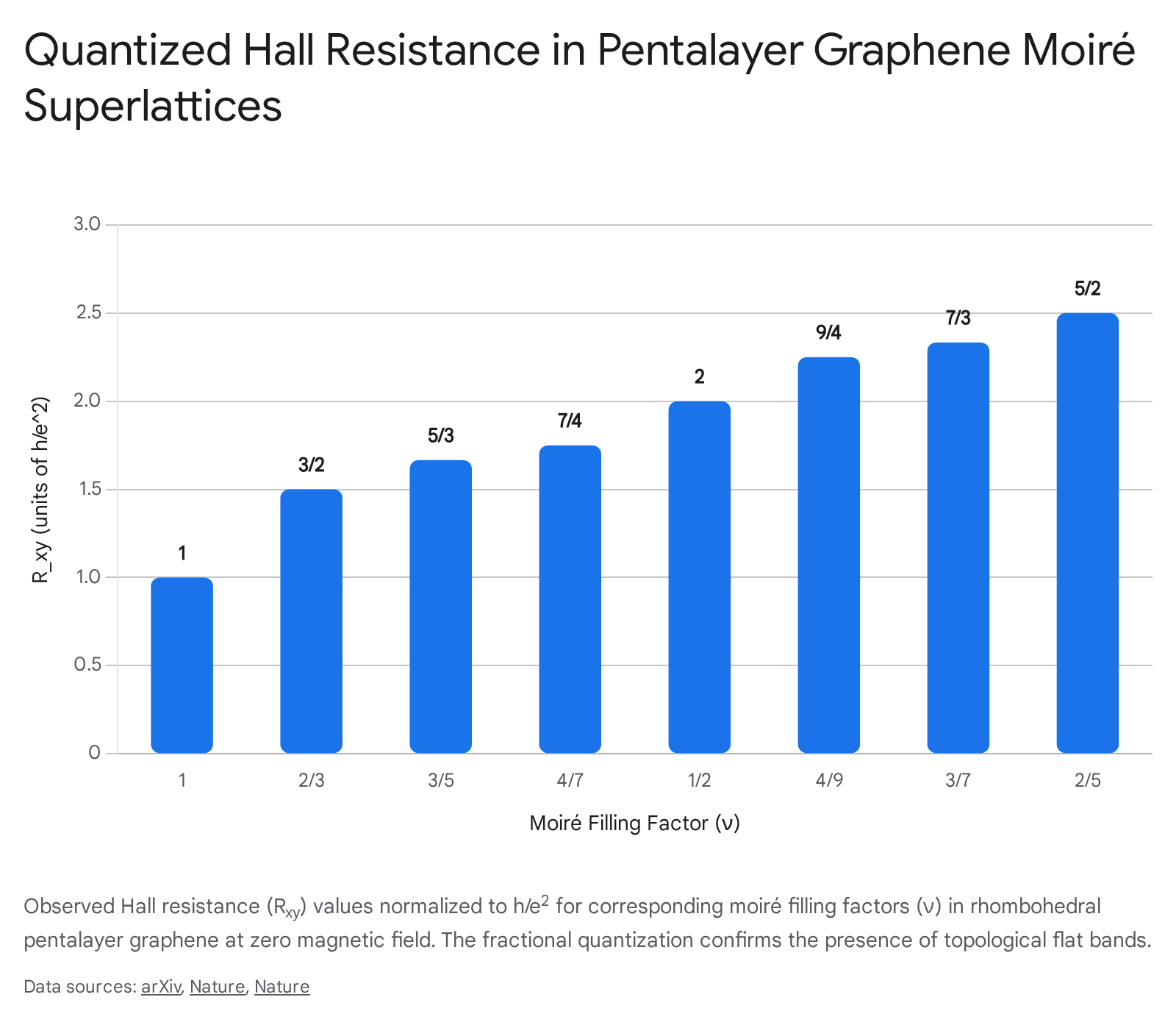
In early 2024, the scope of Fractional Chern Insulators expanded dramatically when researchers at the Massachusetts Institute of Technology (led by Long Ju) observed the FQAHE in a purely carbon-based moiré system: rhombohedral pentalayer graphene aligned with hexagonal boron nitride (hBN) 4204546.
Graphene-based superlattices offer immense advantages over TMDs, including superior crystalline material quality, ultra-high electron mobility, and deeply tunable displacement fields that allow researchers to dynamically manipulate the topology of the bands 42046. At strictly zero magnetic field, the MIT team documented an incredibly robust sequence of FQAHE states utilizing DC transport techniques 42047.
In the graphene-hBN system, plateaus of precisely quantized Hall resistance were measured at filling factors $\nu = 1$, $2/3$, $3/5$, $4/7$, $4/9$, $3/7$, and $2/5$ 42048. Furthermore, exactly at half-filling ($\nu = 1/2$), the system exhibited transport behavior indicative of an unquantized Composite Fermi Liquid (CFL), perfectly analogous to the metallic state found in the half-filled lowest Landau level at extreme magnetic fields 42048. The observation of the CFL at zero field suggests that composite fermions can be artificially synthesized through moiré engineering 420.
The realization of FQAHE in graphene and TMDs is a massive technological and theoretical leap. By decoupling topological states from intense magnetic fields, researchers can now interface FQAHE states directly with conventional superconductors in lateral heterojunctions - an architecture previously impossible due to the destruction of superconductivity by strong magnetic fields 42046. Additionally, in mid-2024, teams at the University of Science and Technology of China (USTC) reported parallel breakthroughs utilizing engineered arrays of highly anharmonic "Plasmonium" superconducting qubits and optical resonators to simulate the FQAHE in interacting photons, completely bypassing natural material constraints and unlocking programmable topological simulators 84950.
Comparison of Quantum Hall Phases
To effectively contextualize the evolutionary leaps from the classic Integer Quantum Hall Effect to the modern zero-field Fractional Quantum Anomalous Hall Effect, the operational parameters and core topological invariants of these states can be systematically compared:
| Regime | System Paradigm | External Magnetic Field Required | Key Interactions | Charge Carriers / Excitations | Topological Invariant | Example Filling Factors ($\nu$) |
|---|---|---|---|---|---|---|
| Integer Quantum Hall Effect (IQHE) | 2DEG in Semiconductor Heterostructures | Yes (Strong, ~1-10 T) | Negligible (Single-particle physics) | Electrons (Charge $e$, Fermions) | TKNN Invariant / Single-Particle Chern Number | $1, 2, 3 \dots$ |
| Fractional Quantum Hall Effect (FQHE) | 2DEG in ultra-clean Semiconductor Heterostructures | Yes (Extreme, ~10-30 T) | Dominant (Strong Coulomb repulsion) | Composite Fermions / Anyons (Charge $e/m$) | Many-Body Chern Number / Ground State Degeneracy | $1/3, 2/5, 5/2 \dots$ |
| Fractional Quantum Anomalous Hall Effect (FQAHE) | Moiré Superlattices (e.g., $t$-MoTe$_2$, Pentalayer Graphene) | No (Strictly Zero Field) | Dominant (Hubbard interactions on flat bands) | Anyons (Charge $e/m$) | Fractional Chern Number | $2/3, 3/5, 4/7 \dots$ |
Table 1: Physical and topological distinctions between classical, fractional, and anomalous quantum Hall states. Notice the shift from external magnetic fields to intrinsic lattice properties as the source of topology 13112351.
Implications and Future Outlook
The intense, sustained interest in the fractional quantum Hall effect - particularly complex states like the $\nu = 5/2$ plateau and the newly discovered zero-field FCIs - is heavily driven by their imminent potential application in topological quantum computation 10121920.
Conventional quantum computers suffer from inherent physical fragility; classical quantum bits (qubits) are highly susceptible to local environmental noise, thermal fluctuations, and electromagnetic interference, leading to rapid decoherence and calculation failure 246. Topological quantum computing seeks to circumnavigate this dilemma by encoding quantum information non-locally within the braided worldlines of non-Abelian anyons 121934.
If the fundamental excitations of the $5/2$ state (or equivalent non-Abelian FQAHE states) are indeed Majorana anyons, the quantum state of the computational system relies strictly on the global mathematical topology of how these particles are braided around one another, rather than their exact physical positions, scattering events, or localized energetic states 233. Because localized noise cannot alter global geometric topology without physically moving particles across macroscopic distances, topological qubits would be highly fault-tolerant at the fundamental hardware level, drastically reducing the overhead required for algorithmic error correction 21950.
The fractional quantum Hall effect remains one of the most profound discoveries in condensed matter physics because it entirely dismantled the deeply entrenched notion that symmetry-breaking is the sole descriptor of macroscopic quantum phases 115. By revealing that highly interacting electrons can reorganize into topologically ordered quantum liquids supporting fractionally charged anyons, the FQHE forced the physics community to embrace an entirely new vocabulary of topological invariants, Berry phases, and fractional exchange statistics 91417. Decades after its initial discovery in standard semiconductors, the FQHE continues to act as the most robust and deeply complex playground for interacting many-body physics, continuously offering blueprints for the next generation of fault-tolerant quantum technology via moiré engineering 446.