
Pairing mechanisms in cuprate superconductors
Foundational Physics of Cuprate Materials
The discovery of high-temperature superconductivity in copper oxide compounds (cuprates) by J. Georg Bednorz and K. Alex Müller in 1986 dismantled the established boundaries of condensed matter physics. Prior to this discovery, superconductivity was understood almost entirely through the framework of Bardeen-Cooper-Schrieffer (BCS) theory, which posited that electron pairing is mediated by the exchange of phonons, or quantized lattice vibrations 123. Because phonon-mediated pairing interactions are relatively weak and face severe disruption from thermal energy, BCS theory established a theoretical upper limit for the superconducting transition temperature ($T_c$) at approximately 30 Kelvin 13. The cuprates, however, routinely exhibit superconductivity well above the boiling point of liquid nitrogen (77 K), with the record held by mercury barium calcium cuprate (HgBa2Ca2Cu3O8+δ, or Hg1223) at approximately 138 K under ambient pressure 3456.
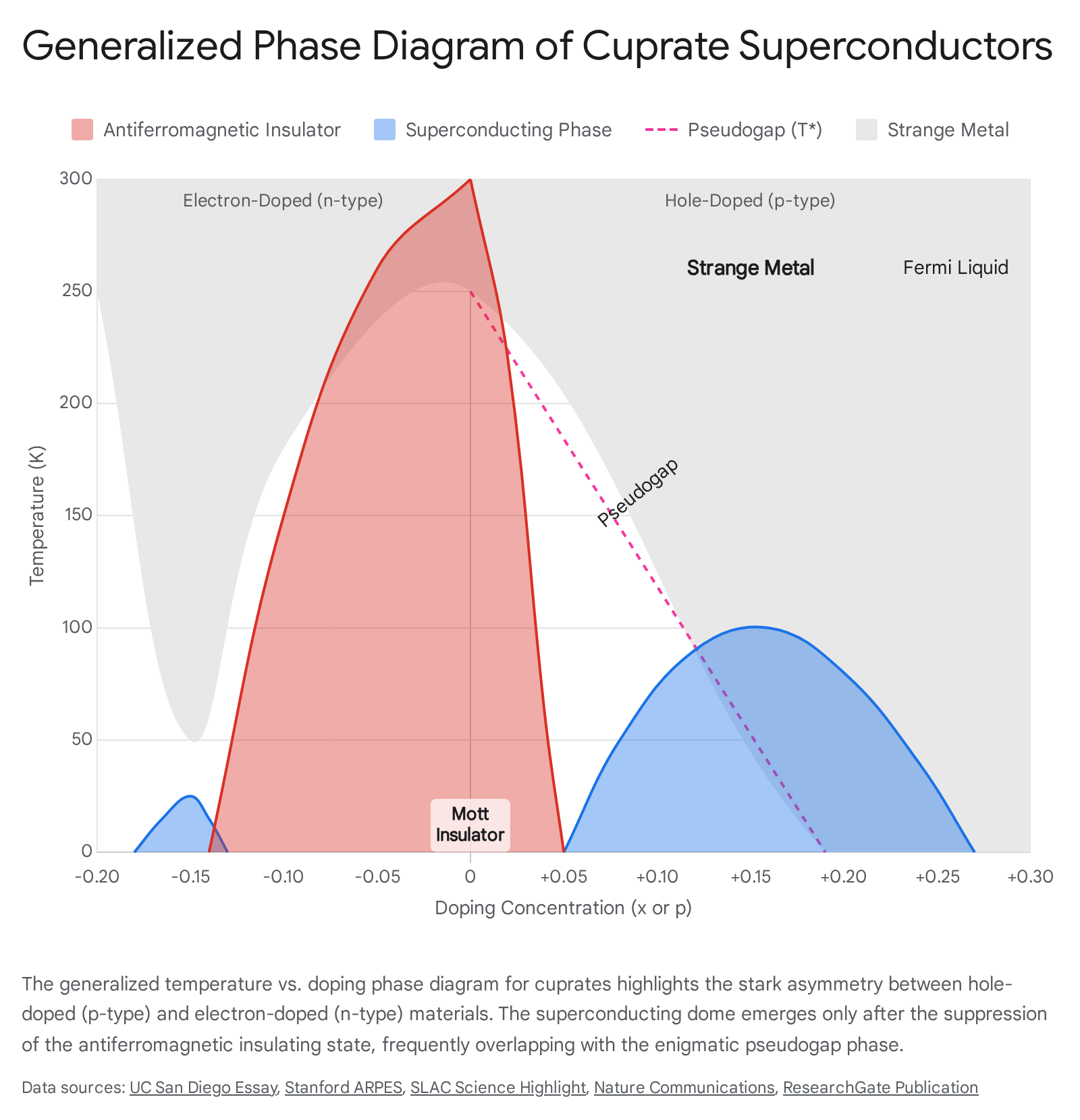
Nearly four decades after their discovery, the microscopic pairing mechanism in cuprates remains one of the most profound unresolved mysteries in physics. Unlike conventional metallic superconductors, cuprate parent compounds are Mott insulators. Band theory predicts that these materials should be metallic conductors due to partially filled electronic bands; however, they act as insulators due to the extremely strong electrostatic repulsion between electrons localized on the copper atoms 789. Superconductivity only emerges when these insulating parent compounds are chemically doped with charge carriers, either by removing electrons (hole-doping) or adding them (electron-doping) 210.
The central difficulty in establishing the cuprate pairing mechanism is that the phenomenon emerges from a highly correlated, quantum many-body system lacking a clear analytical small parameter for perturbation theory 1112. In this strong-coupling regime, electrons lose their individual single-particle identities and behave collectively. Consequently, the cuprate phase diagram hosts a menagerie of poorly understood states - including the pseudogap, strange metal, and intertwined charge and spin density waves - which obscure whether a specific interaction acts as the isolated "pairing glue" or if superconductivity is merely one facet of a broader collective instability governed by quantum criticality 131415.
Mott Insulators and the Hubbard Model
To understand the difficulty in isolating the pairing mechanism, one must outline the structural and electronic boundary conditions that separate cuprates from conventional BCS superconductors. Cuprates are characterized by quasi-two-dimensional crystallographic planes of copper and oxygen atoms (CuO2 planes) separated by insulating spacer layers composed of rare-earth or alkaline-earth elements. The essential physics of high-temperature superconductivity occurs exclusively within these extremely thin CuO2 planes 37. The electrons in these planes are highly confined, amplifying electron-electron interactions (the Coulomb repulsion, denoted as $U$) to energy scales that vastly exceed the kinetic energy associated with the electrons hopping between adjacent atoms (the transfer integral, denoted as $t$) 216.
When the Coulomb repulsion $U$ is much greater than the hopping energy $t$, electrons are restricted from occupying the same atomic site, resulting in a localization of charge carriers. The localized spins interact via a superexchange mechanism, creating a long-range antiferromagnetic order where adjacent electron spins point in alternating, opposite directions. This establishes the parent compound as an antiferromagnetic Mott insulator 7917.
When chemical dopants are introduced into the spacer layers, they donate charge carriers (electrons or holes) to the CuO2 planes. At a critical doping threshold, the long-range antiferromagnetic order collapses, the charge carriers become mobile, and the material transitions into an anomalous metallic state, eventually exhibiting superconductivity at low temperatures 3917. The single-band Hubbard model, which incorporates these competing $t$ and $U$ parameters, serves as the standard theoretical minimal model for simulating this behavior 1518. However, the strong correlations render the Hubbard model mathematically intractable for exact analytical solutions in two dimensions, forcing physicists to rely on advanced numerical approximations 1218.
Symmetry and the Superconducting Gap
A definitive deviation from conventional BCS theory is the symmetry of the superconducting order parameter. Conventional phonon-mediated superconductors exhibit isotropic s-wave pairing, meaning the energy gap - the energy required to break a Cooper pair into individual quasiparticles - is uniform in all momentum directions. Cuprates, however, exhibit d-wave pairing 27919.
In a d-wave state, the superconducting gap possesses a highly anisotropic, four-leaf clover shape in momentum space. The gap reaches its maximum amplitude along the Cu-O bond directions (the antinodes) and drops entirely to zero along the diagonals (the nodes) 279. This specific geometric symmetry strongly indicates that the fundamental pairing interaction includes a massive repulsive component at extremely short distances. The d-wave symmetry effectively forces the paired electrons to avoid each other in real space, minimizing the strong Coulomb repulsion $U$, while still remaining bound in momentum space to form a macroscopic superconducting condensate 279.
Theoretical Models for the Pairing Glue
Approximations and sophisticated numerical simulations of the Hubbard model have yielded several competing theories to explain the cuprate pairing mechanism. These theories attempt to identify the "pairing glue" - the highly correlated analog to the phonon in BCS theory - that overcomes the massive Coulomb repulsion to bind electrons into Cooper pairs without destroying the underlying crystalline stability.
Antiferromagnetic Spin Fluctuations
The most heavily supported candidate for the cuprate pairing glue is the exchange of antiferromagnetic spin fluctuations 1318. In the undoped parent compound, electrons are locked in a rigid antiferromagnetic lattice where adjacent spins alternate direction. When doped, this rigid, long-range order melts, but short-range, dynamic patches of antiferromagnetism - known as spin fluctuations or paramagnons - persist well into the superconducting and normal phases 20.
The spin fluctuation model posits that a moving charge carrier leaves a transient "wake" of disturbed spins in the local antiferromagnetic background. A second charge carrier can lower its overall energy by interacting with this disturbed spin environment, creating an effective, retarded attractive force 16. Advanced numerical techniques, specifically fluctuation diagnostics using dynamical cluster approximation (DCA), have demonstrated that antiferromagnetic spin fluctuations can directly drive d-wave pairing in the intermediate-to-strong coupling regime of the Hubbard model 18. Inelastic photon scattering and resonant inelastic x-ray scattering (RIXS) experiments further corroborate this theory, confirming that high-energy spin excitations possess sufficient energy and persist at high enough doping levels to account for the high $T_c$ observed in cuprates 1820.
However, the spin fluctuation framework is not without shortcomings. Many foundational spin-fluctuation models rely on random phase approximation (RPA) derivations that assume weak-to-intermediate coupling, an assumption that violates the fundamental reality of the deep strong-coupling regime present in cuprate Mott insulators 18. Furthermore, while the model excels at producing d-wave symmetry, it frequently struggles to fully replicate the exact temperature dependencies observed in the strange metal phase without significant phenomenological adjustments 18.
The Resonating Valence Bond Theory
Proposed by P. W. Anderson shortly after the discovery of cuprates, the Resonating Valence Bond (RVB) theory approaches the problem entirely from the strong-coupling limit. RVB theory suggests that the ground state of a two-dimensional frustrated antiferromagnet is not a static ordered lattice but a quantum superposition of all possible pairings of adjacent spins into singlet states (valence bonds) 7821.
In the RVB framework, these singlet pairs are highly mobile and constantly exchange partners (resonating). When the material is undoped, the electrons are confined to their atomic sites by the Mott gap, but the spin-singlet bonds still resonate - creating a phase known as a "quantum spin liquid." Upon doping, empty sites (holes) allow the electrons to physically move through the lattice, and the pre-existing spin-singlets immediately manifest as mobile, charged Cooper pairs, leading directly to superconductivity 821.
While intellectually elegant, RVB theory faces severe predictive challenges. Strict RVB models have historically struggled to output quantitative predictions for molecular geometry, exact spectral properties, or macroscopic magnetic responses without incorporating significant modifications 2223. Furthermore, recent unbiased fluctuation diagnostics applied to the single-band Hubbard model have found virtually no numerical evidence supporting the pure RVB mechanism when compared against the overwhelming spectral weight generated by spin fluctuations 18.
SU(2) Gauge Theories and Fractionalization
More recent theoretical efforts have attempted to mathematically formalize the complex spin-charge separation implied by strong correlations using SU(2) lattice gauge theories. In these models, the electron is theoretically "fractionalized" into two distinct quasiparticles: a spinon (which carries the electron's spin but lacks electric charge) and a chargon or holon (which carries the electric charge but lacks spin) 172728.
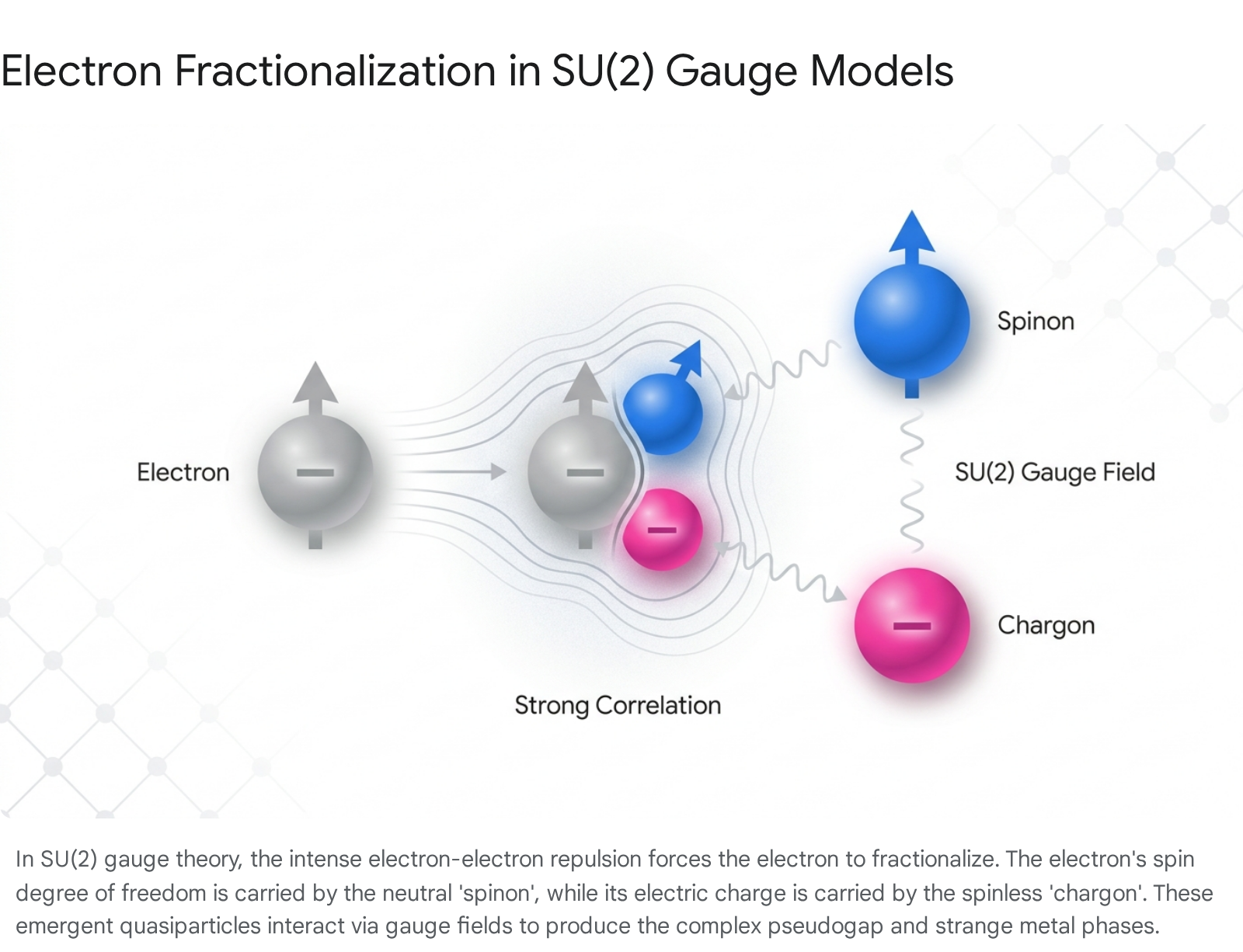
These fractionalized particles interact via an emergent SU(2) gauge field. Extensive Monte Carlo simulations of SU(2) gauge theory featuring interacting fermionic sectors have successfully replicated some of the most puzzling phenomenological aspects of cuprates. The theory accurately reproduces a Kosterlitz-Thouless transition that drives the onset of d-wave superconductivity via the expulsion of topological vortices 2425. Furthermore, the model predicts the appearance of fractional hole pockets (with an area of $p/8$, where $p$ is the doping density) in the density of states, and precisely replicates the shape of the disconnected Fermi arcs observed in photoemission spectroscopy 25263227.
Despite this mathematical success, SU(2) gauge theories face criticism as highly abstract phenomenological constructions. While they accurately post-dict experimental observations and unify seemingly unrelated properties of the pseudogap, detecting a definitive, isolated signature of a free spinon or chargon in a solid-state experiment remains exceptionally difficult, rendering the gauge theory framework challenging to falsify 172628.
| Theoretical Model | Proposed Pairing Mechanism / "Glue" | Experimental Evidence & Strengths | Primary Shortcomings |
|---|---|---|---|
| Spin Fluctuations | Dynamic, short-range antiferromagnetic spin disturbances providing a retarded pairing interaction. | Explains d-wave symmetry perfectly; RIXS confirms persistent paramagnons; DCA numerical simulations strongly support it 131820. | Traditional equations rely on weak-coupling approximations; struggles to fully explain the strange metal phase dynamics without phenomenological tuning 18. |
| Resonating Valence Bond (RVB) | Pre-formed spin singlet pairs in a quantum spin liquid become mobile upon doping. | Provides an intuitive link between Mott insulators and pairing; correctly predicts the suppression of long-range magnetic order 821. | Fails to provide quantitative predictions for spectral features; recent numerical diagnostics show minimal support compared to spin models 182223. |
| SU(2) Gauge Theory | Fractionalization of electrons into spinons and chargons interacting via emergent gauge fields. | Accurately predicts fractional hole pockets ($p/8$), Kosterlitz-Thouless vortex transitions, and Fermi arcs 242632. | Highly abstract; emergent gauge fields and fractionalized particles are notoriously difficult to isolate and directly verify in solid-state experiments 242628. |
The Pseudogap Phenomenon
The most formidable barrier to isolating the pairing mechanism is the existence of the pseudogap phase. In a conventional BCS superconductor, the normal state existing directly above the transition temperature is a standard Fermi liquid, where the density of electronic states at the Fermi energy remains continuous and fully populated. In underdoped cuprates, however, researchers observe a severe, anomalous depletion of the electronic density of states at temperatures far above the actual superconducting transition - a phenomenon designated as the pseudogap 2172930.
Fermi Surface Reconstruction
The pseudogap onset temperature, denoted as $T^$, can rise as high as 300 K in heavily underdoped samples. As the material cools below $T^$, angle-resolved photoemission spectroscopy (ARPES) reveals that the full Fermi surface of the material undergoes a radical reconstruction. Instead of a continuous, closed contour in momentum space typical of metallic systems, the Fermi surface breaks apart into disconnected segments known as "Fermi arcs" 21726.
The scientific community remains deeply divided regarding the physical origin of the pseudogap, with theories generally coalescing around two distinct hypotheses:
- The Precursor Pairing Hypothesis: This theory argues that the pseudogap is a state where electrons have already formed Cooper pairs (hence the gap opening in the density of states), but the material lacks the macroscopic quantum phase coherence required for zero-resistance superconductivity 313233. Under this model, the pairs are "pre-formed" due to a massive pairing energy scale embedded in the strong correlations, but thermal and quantum fluctuations prevent them from condensing into a unified superfluid until cooled to $T_c$.
- The Competing Order Hypothesis: This alternative theory contends that the pseudogap is an entirely distinct phase of matter characterized by a separate symmetry-breaking order (such as charge density waves, loop currents, or nematicity) 2142934. This separate order drains the density of states and actively competes with superconductivity for the available electrons, effectively suppressing the maximum possible $T_c$.
Insights from Cold Atom Quantum Simulators
Because the chemical complexity of cuprate crystals makes it difficult to definitively settle the pseudogap debate, researchers have turned to ultracold atomic gases acting as highly tunable quantum simulators. By confining fermionic lithium atoms (such as Lithium-6) in an optical lattice, physicists can utilize Feshbach resonances to precisely tune the interaction strength between the atoms, simulating the extreme electron correlation of a cuprate without the confounding variables of lattice impurities 31323335.
In 2024, researchers from the University of Science and Technology of China (USTC) and Swinburne University of Technology utilized a uniform box potential to trap attractively interacting fermionic lithium atoms, successfully observing definitive pseudogap pairing. They measured a many-particle pairing gap persisting well above the critical temperature required for macroscopic quantum superfluidity 3133. Because the optical lattice is pristine and free of the chemical defects found in crystalline cuprates, this breakthrough confirmed that strong attractive interactions alone are sufficient to cause fermions to pre-pair and generate a pseudogap prior to the onset of phase coherence 3133. While atomic gases are only analogs, this provides potent, bias-free evidence supporting the precursor pairing hypothesis in the strongly interacting regime.
Intertwined Orders and Competing Phases
Further complicating the search for the core pairing mechanism is the realization that high-temperature superconductivity does not emerge in a vacuum; it shares the phase diagram with a multitude of "intertwined orders" 314363738. Cuprates exhibit a robust propensity toward breaking various spatial, rotational, and electronic symmetries simultaneously, creating a landscape where multiple ground states sit exceptionally close in energy.
Charge Density Waves and Stripe Order
In the underdoped regime, charge carriers frequently organize themselves into "stripes" - unidirectional modulations of charge and spin. In a stripe phase, the doped holes concentrate into microscopic, charge-rich rivers (charge density waves, or CDWs) separated by insulating, antiferromagnetically ordered domains 9.
Scanning tunneling microscopy (STM) and resonant x-ray scattering confirm that these CDWs exist across almost all cuprate families. However, their specific relationship to superconductivity is highly debated. Traditional interpretations view CDWs as parasitic states that actively compete with superconductivity for the same available electrons, effectively suppressing $T_c$ 1415.
Recent advanced computational modeling using the three-band Hubbard model - which explicitly accounts for the intricate hybridization between the copper $3d$ and oxygen $2p$ orbitals, unlike the simplified single-band model - has revealed that spin and charge stripes can actually decouple. In hole-doped cuprates, simulations indicate the charge ordering wavevector decreases with doping while the spin incommensurability increases 15. This suggests that the high-temperature charge correlations are physically distinct from the interlocked, static stripes observed at extremely low temperatures 15. This decoupling points to a deeply complex phase space where charge, spin, and pairing instabilities are not merely competing antagonists, but are parallel, intertwined outcomes of the same overarching correlated physics 1538.
The Pair Density Wave State
Adding an entirely new dimension to the discussion is the Pair Density Wave (PDW) state. First proposed to explain spectral anomalies deep within the pseudogap, a PDW is an exotic superconducting state where the Cooper pairs exhibit a finite center-of-mass momentum. This finite momentum causes the superconducting order parameter to vary periodically in real space, rather than remaining uniform as in a standard BCS superconductor 33039.
In 2025, high-resolution STM and scanning tunneling spectroscopy (STS) measurements of the Bi2+xSr2 - xCuO6+δ (Bi2201) system revealed striking evidence of PDW physics. Researchers successfully observed a distinct spatial modulation of the local density of states (LDOS) with a periodicity of $4a_0/3$ (where $a_0$ is the characteristic Cu-O-Cu bond length) deep within the pseudogap energy region of 20-60 meV 2930. Crucially, the LDOS exhibited a distinct antiphase feature below and above the Fermi energy 2930.
This spatial modulation of paired states strongly suggests that the pseudogap is intrinsically tied to finite-momentum Amperean pairing 2930. If the PDW is indeed the primary fundamental order parameter defining the pseudogap, it implies that cuprate superconductivity is not simply fighting against static charge density waves, but is fundamentally intertwined with a highly exotic, spatially varying superconducting parent state 339.
| Ordered State | Distinguishing Characteristics | Relationship to Superconductivity | Experimental Signature |
|---|---|---|---|
| Antiferromagnetism | Static, alternating spin alignment localized on atomic sites. | Parent state; must be suppressed by doping for macroscopic superconductivity to emerge 79. | Neutron scattering, muon spin rotation. |
| Charge Density Waves (CDW) | Spatial modulations of electron density creating charge-rich rivers. | Generally competes for states, though dynamic fluctuations may assist pairing 1415. | X-ray scattering, STM imaging 3639. |
| Pair Density Waves (PDW) | Superconducting state where Cooper pairs have finite center-of-mass momentum. | Highly intertwined; potentially the underlying order parameter driving the pseudogap 33039. | Modulations of the local density of states (LDOS) with antiphase features in STS 2930. |
Spectroscopic Advances and Experimental Boundary Conditions
The deadlock regarding the precise pairing mechanism has necessitated the development of increasingly sophisticated experimental probes. Between 2024 and 2026, major technical advances in angle-resolved photoemission spectroscopy (ARPES) and resonant inelastic x-ray scattering (RIXS) have provided critical new boundary conditions that any viable theory must satisfy.
Resolving Normal-State Gaps in Electron-Doped Cuprates
While the vast majority of research has historically focused on hole-doped (p-type) cuprates, exhaustive studies of electron-doped (n-type) cuprates offer a crucial comparative baseline. In n-type cuprates, the antiferromagnetic phase is significantly more robust, extending much further across the doping phase diagram and forcing the superconducting dome into a substantially smaller, lower-temperature region 4041.
In August 2024, researchers from Stanford University and the SLAC National Accelerator Laboratory utilized ultra-high-resolution ARPES to examine the underdoped n-type cuprate Nd2 - xCexCuO4. Conventional wisdom held that this specific region of the phase diagram was merely a simple antiferromagnetic metal with small reconstructed Fermi pockets 4041. Astonishingly, the researchers identified a prominent energy gap near the Fermi level opening directly on these small Fermi pockets 40.
This "normal state gap" persisted up to 150 K - a temperature vastly exceeding the material's bulk $T_c$ of 25 K 404142. The spectral signature was wholly inconsistent with standard magnetic or charge ordering, indicating that the gap originates from local electron pairing. However, due to the coexistence of strong long-range antiferromagnetic order, the macroscopic phase coherence required for bulk superconductivity is blocked, and the characteristic nodes of the d-wave gap are completely nullified 4042. This discovery is monumental because it explicitly isolates the microscopic process of electron pairing from the macroscopic process of phase coherence, proving that the high pairing energy scale survives even when embedded deeply within a hostile antiferromagnetic insulator 4042.
Resonant Inelastic X-Ray Scattering Capabilities
Determining the exact strength of the electron-phonon and electron-spin coupling requires precisely measuring the energy and momentum of fundamental excitations across the Brillouin zone. RIXS has emerged as the premier tool for this task, utilizing the Kramers-Heisenberg second-order process to excite core electrons and analyze the energy loss of the scattered photon 43.
Recent developments in hard x-ray RIXS instrumentation have driven energy resolution to unprecedented levels, resolving features down to the 30-40 meV scale at the Cu L3-edge 44. This extreme resolution allows researchers to directly extract the dimensionless electron-phonon coupling constant by measuring the coupling matrix elements for specific Cu-O bond-stretching (breathing) and bond-bending (buckling) phonon branches 4445. The capacity to disentangle paramagnon signals from non-spin-flip spectral weight has confirmed the persistent nature of high-energy spin excitations, reinforcing the viability of spin fluctuations while strictly defining the numerical limits that theoretical models must respect 204344.
Comparative Superconducting Systems
To ascertain whether the cuprate pairing mechanism is a unique anomaly of the CuO2 plane or a general feature of strongly correlated transition metal oxides, the community actively searches for analogous high-temperature superconducting systems.
High-Pressure Hydrides and Phonon Mediation
Operating on an entirely different physical paradigm, hydrogen-rich compounds under extreme pressure have set the absolute temperature records for conventional superconductivity. Materials such as hydrogen sulfide (H3S) and lanthanum decahydride (LaH10) exhibit superconductivity at temperatures up to 250 K (-23 °C) 464748.
Unlike cuprates, these hydrides are conventional BCS superconductors; their pairing is conclusively mediated by phonons. Because hydrogen is the lightest element, its lattice vibration frequencies are incredibly high, yielding an immense pairing energy according to standard BCS equations 4647. In 2025, the Max Planck Institute for Chemistry successfully utilized a novel planar electron tunneling spectroscopy technique to directly measure the superconducting gap of H3S at 60 meV under extreme pressure. This unequivocally confirmed the conventional, fully open gap nature of the hydride pairing mechanism, demonstrating exactly how efficiently electrons can pair when phonon frequencies are radically elevated 4748.
While hydrides do not solve the cuprate problem, they definitively prove that room-temperature superconductivity does not fundamentally require exotic, non-BCS physics. The core challenge is not whether high-$T_c$ is possible, but why the cuprate strong-correlation mechanism operates so effectively at ambient pressure while the phonon mechanism requires the immense pressure equivalent to the Earth's core.
Nickelate Analogues and Moiré Architectures
Infinite-layer nickelates (such as Nd1 - xSrxNiO2) share a nearly identical crystal structure to cuprates, featuring square-planar NiO2 layers. Because the Ni1+ ion is isoelectronic with the Cu2+ ion (both featuring a $3d^9$ electron configuration), nickelates were long theorized to host analogous high-temperature superconductivity 1949.
Following the initial discovery of superconductivity in thin-film nickelates in 2019, the field experienced a massive acceleration. In late 2025 and early 2026, researchers at the Chinese Academy of Sciences (CAS) and Shandong University reported a staggering breakthrough: achieving a record $T_c$ of 96 K in bulk pressurized nickelate single crystals (La2SmNi2O7 - δ) 4950. Even more critically, employing an innovative ambient-pressure flux method, Chinese researchers successfully eliminated the reliance on extreme high-pressure synthesis, stabilizing superconductivity in nickel-based materials under normal atmospheric pressure at temperatures exceeding 40 K (-233 °C) 5158.
The realization of high-$T_c$ in nickelates provides a crucial comparative axis. It remains a matter of intense debate whether the pairing mechanism in nickelates is completely identical to cuprates. While nickelates seemingly lack the robust, long-range antiferromagnetic parent insulator found in cuprates, they exhibit remarkably similar charge density waves and strange-metal behavior 19. If the pairing mechanism is definitively proven to be shared, it heavily prioritizes theories based on orbital hybridization and general $3d^9$ correlation physics, potentially discounting theories reliant strictly on the highly specific antiferromagnetic exchange parameters unique to copper.
Parallel to the nickelate discoveries, researchers have begun mechanically twisting thin flakes of crystalline superconductors to engineer moiré flat bands, a technique borrowed from the study of "magic-angle" graphene. In 2025, researchers at the RIKEN Center for Emergent Matter Science demonstrated that twisting atomically thin layers of niobium diselenide allows precise tuning of the superconducting gap exclusively in momentum space 52. Manipulating the twist angle effectively creates a physical dial to tune the kinetic energy and orbital hybridization of the electrons without introducing the chaotic chemical disorder characteristic of traditional doping 3852. Translating this moiré architecture to cuprate materials represents the most promising future avenue for isolating the pairing interaction.
| Superconductor Family | Primary Pairing Mechanism | Max Achieved $T_c$ | Pressure Requirement | Structural Motif |
|---|---|---|---|---|
| Cuprates | Unconventional (d-wave, strong correlation, likely spin fluctuations) 218. | ~138 K 46. | Ambient Pressure. | Quasi-2D CuO2 planes. |
| Nickelates | Unconventional (highly debated, likely analogous to cuprates) 1950. | ~96 K 50. | Moderate/High Pressure (Ambient recently achieved at 40 K) 505158. | Quasi-2D NiO2 planes. |
| Hydrides (e.g., H3S) | Conventional BCS (s-wave, high-frequency phonon mediated) 4748. | ~250 K 464748. | Extreme (>100 GPa) 4647. | Hydrogen-rich lattices. |
Methodological and Sociological Dimensions
The 35-year pursuit of the cuprate pairing mechanism is not merely a story of deep physical complexity; it is also intrinsically entangled with sociological and methodological dynamics within the global scientific enterprise.
The LK-99 Controversy and Experimental Verification
The intense global desire to discover an ambient-pressure, room-temperature superconductor routinely leads to high-profile controversies, illustrating the immense difficulty of rigorous materials synthesis and verification.
This hazard was most starkly demonstrated in the summer of 2023 with the claim of room-temperature superconductivity in a copper-doped lead-oxyapatite named LK-99 5354. The original researchers from South Korea reported observing abrupt drops in electrical resistivity and magnetic levitation, classic macroscopic hallmarks of superconductivity 5354. However, the unprecedented global rush to replicate the findings quickly uncovered that the material is inherently a diamagnetic insulator 54. The purported superconducting transition was definitively linked to a structural phase transition in a common synthesis impurity - copper(I) sulfide (Cu2S) - which undergoes a sharp, natural resistivity drop at 104 °C, mimicking the onset of a superconducting state 535455.
Furthermore, sophisticated density functional theory (DFT) and topological data analysis (TDA) benchmarking applied to LK-99 demonstrated extremely weak electron-phonon coupling and high persistent entropy, completely lacking any of the topological or electronic descriptors associated with viable superconducting pathways 63. The LK-99 episode underscores the primary methodological hazard in the search for new mechanisms: in highly complex, multiphase compounds, mundane phenomena like structural transitions, localized ferromagnetism, and diamagnetism frequently conspire to mimic the macroscopic signatures of superconductivity, requiring exacting scrutiny 5354.
The Shifting Global Research Landscape
The sustained, interdisciplinary effort required to unravel the cuprate mechanism demands immense institutional backing, specialized facilities (such as synchrotron light sources for advanced RIXS and ARPES), and stable, multi-generational funding. The geographical landscape of this vital infrastructure is shifting rapidly.
According to the 2024 and 2025 evaluations by the Nature Index and the World Intellectual Property Organization (WIPO) Global Innovation Index, a profound transformation in research dominance has occurred. China has established itself as a premier global scientific powerhouse, prioritizing heavy, state-backed investment in the physical sciences, chemistry, and advanced materials 5657. Chinese research institutions, led by the Chinese Academy of Sciences (CAS), now dominate the global top 10 rankings in physical sciences, directly driving the recent world-first breakthroughs in ambient-pressure nickelate synthesis 505158575859.
Meanwhile, traditional bastions of materials science like Japan maintain high-impact output - ranking fifth globally in scientific publications and first in patent families - but face acknowledged structural challenges in bridging hardware materials science with software integration, leading to relative vulnerability in AI-driven material discovery 6061. The United States and Europe retain deep institutional capacities and world-class high-performance computing facilities, maintaining clear leadership in biomedical sciences and translational research, but are facing intense, well-funded competition in the core physical sciences that dictate superconductor development 565759. This geopolitical shift indicates that future theoretical and experimental breakthroughs in cuprate physics will likely emerge from globally distributed, highly competitive state-backed initiatives rather than isolated academic silos in the West.
Thirty-five years after their discovery, the absence of a consensus regarding the pairing mechanism in cuprates is not due to a lack of data, but rather an overabundance of fiercely entangled phenomena. The cuprate CuO2 plane is a remarkably sensitive quantum ecosystem where kinetic energy, massive Coulomb repulsion, spin exchange, and lattice vibrations operate on nearly identical energy scales. The resolution of this mystery will likely not arrive as a single, elegant equation analogous to BCS theory. Instead, it will emerge as a comprehensive mapping of quantum criticality, where electron pairing is understood not as a simple exchange of virtual bosons, but as a holistic consequence of electronic fractionalization, symmetry breaking, and topology in strongly correlated matter.