
Quantum spin liquids and topological magnetism
Introduction to the Quantum Spin Liquid State
Within the established paradigms of condensed matter physics, systems of interacting magnetic moments characteristically succumb to spontaneous symmetry breaking at sufficiently low temperatures. Driven by the thermodynamic imperative to minimize exchange interaction energies, these systems transition into statically ordered macroscopic states, such as ferromagnetism or antiferromagnetism. This conventional phase transition behavior is mathematically codified by the Landau theory of symmetry breaking, which relies on local order parameters to describe the thermodynamic state of the material. However, the quantum spin liquid (QSL) represents a profound and radical departure from this conventional framework 12. First conceptualized in 1973 by P. W. Anderson, a quantum spin liquid is a highly entangled, macroscopic quantum phase wherein intense zero-point quantum fluctuations completely suppress long-range magnetic ordering, sustaining a highly dynamic state down to absolute zero temperature 12.
In a quantum spin liquid, the localized magnetic moments - or spins - remain intricately correlated but physically unfrozen, continually fluctuating in a manner analogous to molecules within a conventional liquid 34. This exotic phase of matter inherently resists symmetry breaking; it possesses no local order parameter and completely evades the traditional Landau classification 56. Instead, the defining characteristics of the QSL phase are non-local topological quantum entanglement, an extensive ground-state degeneracy, and the remarkable phenomenon of fractionalization. Through fractionalization, conventional magnetic excitations splinter into novel, emergent quasiparticles - such as charge-neutral spinons and non-Abelian Majorana fermions - that carry fractional quantum numbers and exhibit exotic statistics 157. What began as a purely theoretical curiosity has evolved over the past fifty years into a central pillar of modern condensed matter physics. This rapid escalation in research interest is largely driven by the deep theoretical connections between QSLs and the mechanisms underlying high-temperature superconductivity, as well as the immediate practical potential to harness these fractionalized topological excitations as the hardware foundation for fault-tolerant quantum computing 69.
The Mechanics of Geometric Frustration
The manifestation of a quantum spin liquid requires a fundamental physical mechanism capable of preventing the magnetic spins from satisfying their localized pairwise exchange interactions. In pristine crystalline lattices, this is primarily achieved through geometric frustration - a phenomenon where the inherent spatial topology of the lattice structure strictly precludes the simultaneous minimization of all interacting inter-atomic magnetic forces 811.
The Triangular Lattice: Overconstrained Competitions
The classical mechanics of geometric frustration are most intuitively elucidated within the context of an antiferromagnetic Ising model situated on a two-dimensional triangular lattice, a concept initially explored by G. H. Wannier in 1950 812. Consider an elementary triangular plaquette composed of three spins coupled by a nearest-neighbor antiferromagnetic exchange interaction. The energetic minimum of this interaction strongly favors an antiparallel (up-down) alignment between any two adjacent spins. If the first two spins in the triangle successfully align antiparallel to satisfy their shared bond, the third spin is thrust into an intractable geometric conflict: it cannot simultaneously align antiparallel to both of its established neighbors 910. The spatial geometry of the triangle forces the interactions into direct competition, meaning that the absolute energetic minimum for all local bonds cannot be reached simultaneously.
When translated from binary Ising spins to a classical Heisenberg model utilizing continuous spatial spin vectors, this geometric incompatibility is partially resolved through a structural compromise, resulting in the spins adopting a coplanar, non-collinear $120^\circ$ orientational arrangement 610. However, the true macroscopic depth of this frustration must be evaluated through the lens of lattice-wide constraints. Utilizing a Maxwellian constraint-counting methodology, the number of independent degrees of freedom residing in a system's ground state ($F$) is equivalent to the total available degrees of freedom ($D$) minus the total number of constraints ($K$) required to satisfy the energetic minima 10. In a standard two-dimensional triangular lattice, the coordination is extremely dense; each lattice site is shared by six distinct, contiguous triangles 10. Because of this edge-sharing architecture, the triangular lattice is mathematically "overconstrained." Consequently, despite the localized frustration, a purely classical Heisenberg triangular lattice will eventually succumb to the overarching constraints and order into the $120^\circ$ ground-state configuration at low temperatures. Stabilizing a true, dynamically fluctuating quantum spin liquid on a triangular lattice demands the introduction of additional perturbative forces, such as intense quantum mechanical fluctuations natively found in low-spin ($S=1/2$) systems, or strong competition from next-nearest-neighbor exchange couplings that further destabilize the semi-ordered state 1011.
The Kagome Lattice: Underconstrained Topology and Macroscopic Degeneracy
If the triangular lattice represents the introductory model of geometric frustration, the kagome lattice - a two-dimensional network comprised of corner-sharing triangles structurally separated by interstitial hexagons - represents a vastly superior, highly frustrated alternative 91213. The fundamental mechanical distinction lies in the topology of the lattice intersections. In the kagome architecture, each constituent lattice site is entirely vertex-sharing, belonging to only two adjoining triangles, in stark contrast to the six triangles shared by a site in the edge-sharing triangular matrix 10.
By drastically reducing the interconnectivity of the lattice, the vertex-sharing arrangement severely diminishes the number of macroscopic constraints ($K$) acting upon the total degrees of freedom ($D$). Consequently, the kagome lattice is heavily "underconstrained." This topological freedom manifests physically as an extensive, macroscopic ground-state degeneracy 1018. Instead of being funneled toward a single, compromised ordering arrangement (like the $120^\circ$ state), the kagome lattice possesses an exponentially vast manifold of spin configurations that all reside at the exact same energetic minimum 10.
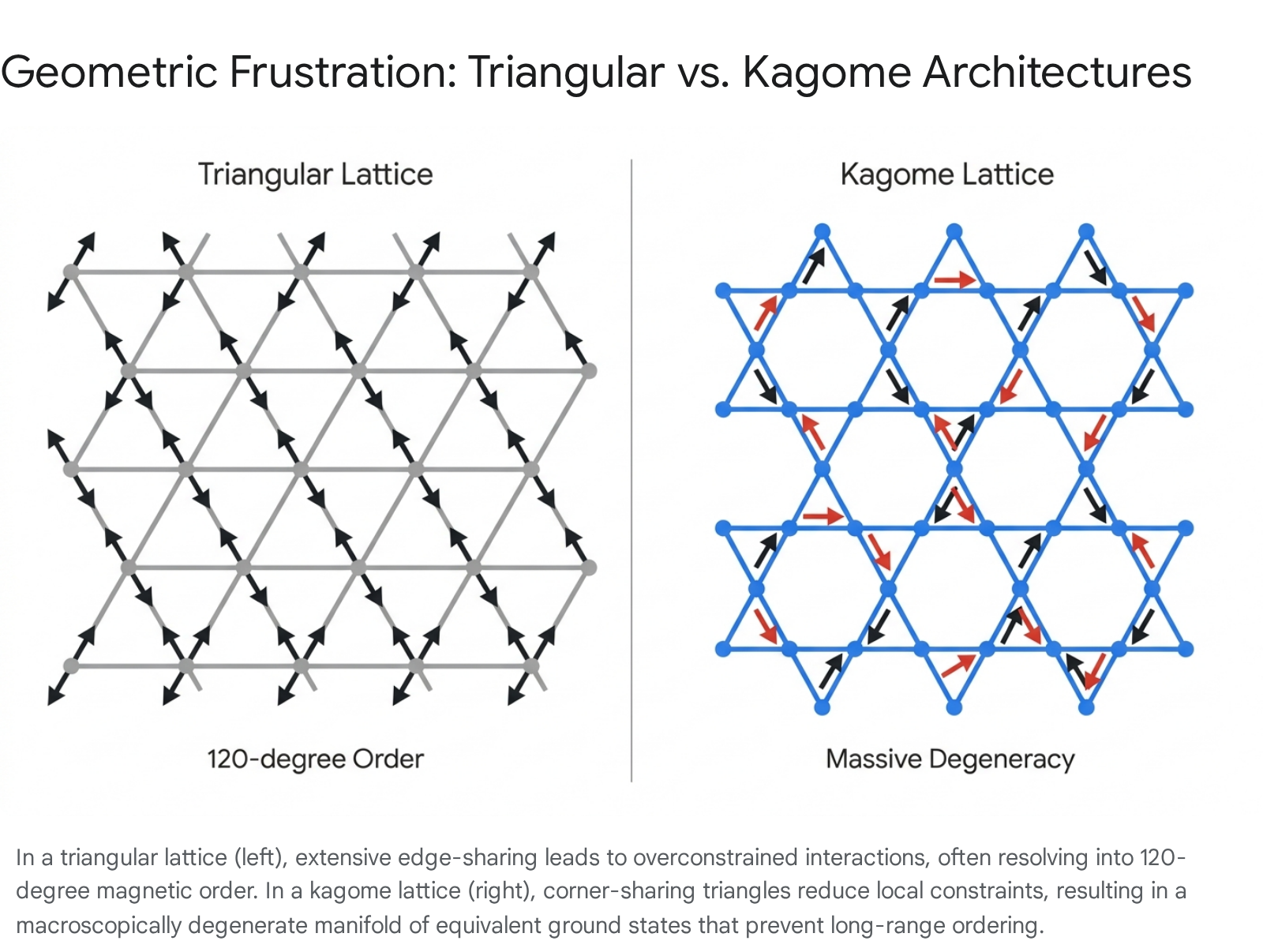
This underconstrained environment permits localized, zero-energy deformations - analogous to mechanical buckling mechanisms in metamaterials or flat bands in momentum-space electronic transport - where isolated clusters of spins can continuously rotate and fluctuate without perturbing the ground-state energy of the surrounding lattice structure 1319. Because of this pervasive, macroscopic degeneracy, the system is fundamentally incapable of selecting a single ordered ground state to freeze into as the temperature approaches zero, establishing the spin-1/2 kagome antiferromagnet as one of the most theoretically robust and actively sought-after platforms for hosting a pristine quantum spin liquid 122021.
Differentiating Quantum Spin Liquids from Spin Glasses
A persistent source of analytical ambiguity in condensed matter physics is the phenomenological distinction between a quantum spin liquid and a spin glass. While both states of matter exhibit a conspicuous lack of conventional long-range magnetic ordering at macroscopic scales - remaining paramagnetic-like even at extreme cryogenic temperatures - their underlying physical mechanics, thermodynamic properties, and quantum state profiles are fundamentally disparate 38.
A spin glass is inherently driven by stochastic chemical or structural disorder interacting with competing magnetic couplings 8. This disordered state is typically modeled using frameworks such as the Sherrington - Kirkpatrick model or through RKKY (Ruderman - Kittel - Kasuya - Yosida) interactions, where the magnetic exchange coupling between any two localized ions is critically dependent upon their physical separation distance 8. Due to the presence of non-stoichiometric lattice defects or random alloying, the inter-atomic distances within a spin glass are highly variable, resulting in an unpredictable spatial mixture of both ferromagnetic and antiferromagnetic bonds. Consequently, the energy landscape of a spin glass is rugged and non-convex, characterized by deep, extended local minima structures (often described in the literature as "dales") that are separated by immense thermodynamic energy barriers 9. As the system cools toward absolute zero, it rapidly breaks ergodicity. The kinetic energy of the spins dissipates, and the system becomes thermodynamically trapped within one of these specific, localized minima. The spins entirely lose their dynamics and "freeze" into a static, random orientation 3. A spin glass possesses a quantifiable Edwards-Anderson order parameter, confirming that while the spins lack global periodic order, they are rigidly and statically locked in place relative to their local environment 312.
Conversely, an intrinsic quantum spin liquid exists exclusively within a chemically pristine and structurally ordered crystalline lattice 8. The frustration experienced by the spins is purely geometric and deeply intrinsic to the overarching Hamiltonian, rather than being an artifact of random lattice defects. The QSL ground state preserves all macroscopic symmetries of the host lattice, including strict time-reversal symmetry and spatial translational invariance 2. Because the thermodynamic energy barriers between the macroscopically degenerate states in a QSL are incredibly small or non-existent, quantum mechanical tunneling permits the entire system to continuously seamlessly transition between countless equivalent configurations 1415. The spins never lock into local minima; they remain entirely dynamic and "liquid-like" down to absolute zero, animated purely by persistent zero-point quantum fluctuations 23. Thus, while a spin glass represents a classical, frozen, and extrinsically disordered state, a quantum spin liquid represents a highly dynamic, intrinsically symmetric, and quantum-mechanically entangled state of matter 23. In real-world experimental environments, distinguishing a true intrinsic QSL from a defect-driven "spin-liquid mimic" (such as a random singlet state induced by disorder) remains one of the primary hurdles in quantum materials characterization 24.
Foundational Theoretical Frameworks
The profound theoretical development of quantum spin liquids relies primarily upon two seminal frameworks that transitioned the field from abstract conjecture to rigorous mathematical classification: Anderson's Resonating Valence Bond state and the exactly solvable Kitaev honeycomb model.
Anderson's Resonating Valence Bond (RVB) State
The modern theoretical foundation of the QSL was initially established by P. W. Anderson in 1973 while investigating the ground state properties of the nearest-neighbor antiferromagnetic Heisenberg model on a triangular lattice 216. Anderson postulated that in a heavily frustrated lattice environment, adjacent spin-1/2 electrons could lower their local energy by pairing up to form localized, rotationally invariant quantum spin singlet states, referred to in quantum chemistry as valence bonds 2. If the rigid lattice geometry compels every spin to pair with a specific neighbor, the system ultimately forms a Valence Bond Solid (VBS). A VBS state is characterized by static, short-range entanglement; it breaks lattice translational symmetry by adopting a rigid periodic pattern of paired bonds, effectively rendering it a non-magnetic insulator but failing to qualify as a true quantum spin liquid 2.
However, Anderson theorized an alternative paradigm where the true thermodynamic ground state consists of an immense, coherent quantum superposition of all conceivable valence bond spatial configurations covering the entire macroscopic lattice. Because these countless singlet pairing configurations continuously and dynamically transition into one another, the ground state is said to "resonate" among them 224. This Resonating Valence Bond (RVB) state represents a massive, globally entangled wavefunction wherein local magnetic moments are utterly quenched, ensuring the total spin remains zero. Anderson dramatically expanded the implications of this theory in 1987 by applying the RVB framework to the newly discovered copper oxide (cuprate) high-temperature superconductors 2. He proposed that the ground state of the undoped cuprate Mott insulator was an RVB spin liquid, and that selectively removing electrons (doping the lattice) could liberate the paired valence bonds into highly mobile charge carriers. This crucial hypothesis established an enduring, foundational theoretical linkage tying the exotic properties of topological quantum spin liquids directly to the elusive mechanisms driving high-temperature superconductivity 217.
The Kitaev Honeycomb Model
While Anderson's RVB state provided a robust conceptual foundation, proving its definitive existence within a specific physical Hamiltonian remained mathematically intractable for decades. This formidable analytical barrier was finally dismantled in 2006 by theoretical physicist Alexei Kitaev, who engineered an exactly solvable quantum model mapped onto a two-dimensional honeycomb lattice 2518.
The genius of the Kitaev model resides in its deployment of bond-directional Ising interactions. In this rigorously defined framework, the localized $S=1/2$ spins positioned at the tripartite vertices of the honeycomb lattice interact strictly with their three nearest neighbors. Crucially, the nature of the exchange interaction along each of the three distinct spatial bond directions (designated as $x, y,$ and $z$) is dictated exclusively by the corresponding individual spin component ($S_x, S_y,$ and $S_z$, respectively) 519. This extreme orientational anisotropy dictates that the alignment interaction enforced along one specific bond fiercely and fundamentally competes with the interactions operating along the other two. Since an individual quantum spin cannot simultaneously satisfy mutually exclusive spin-component alignments across disparate spatial axes, the entire system experiences a state of profound quantum frustration 19.
The profound exact solvability of the Kitaev model allows for the rigorous, mathematical demonstration of quantum spin fractionalization without relying on approximations. Through a meticulous mathematical mapping procedure utilizing Pauli algebra, Kitaev demonstrated that the strongly interacting, localized physical spins completely fractionalize into two distinct types of emergent quantum quasiparticles: a background field of localized, gapped $Z_2$ gauge fluxes (often termed visons), and a highly mobile sea of itinerant, gapless Majorana fermions 51920. The realization that the pure Kitaev model could theoretically be physically manifested in actual solid-state materials possessing extremely strong spin-orbit coupling - such as specific transition metal iridates and ruthenates - immediately catalyzed an unprecedented explosion of experimental materials research across the global physics community 5.
Emergent Fractionalized Excitations and Fault-Tolerant Topological Quantum Computing
The most profound and measurable physical consequence of transitioning into a QSL phase is the exotic phenomenon of quantum fractionalization. In conventional, magnetically ordered materials (such as standard ferromagnets), the elementary low-energy excitation is the magnon - a propagating spin wave that acts as a coherent, bosonic quasiparticle carrying a quantized integer spin ($\Delta S = 1$) 20. In stark contrast, the highly entangled nature of the QSL ground state acts as an emergent quantum vacuum, allowing traditional magnetic excitations to fragment and tear apart into entirely novel quasiparticles that carry highly unusual fractional quantum numbers 12.
In generic isotropic QSL models, these fractionalized particles are typically referred to as spinons. A spinon is an exotic entity that carries a localized fractional spin-1/2 magnetic moment but is completely devoid of electrical charge (exhibiting pure spin-charge separation) 121. Depending on the overarching gauge structure of the specific spin liquid phase, spinons can obey either bosonic or fermionic quantum statistics 1. However, in the highly anisotropic Kitaev QSLs, the localized spins fractionalize uniquely into Majorana fermions. A Majorana fermion is a profound theoretical construct representing a particle that acts exactly as its own antiparticle, exhibiting a fractionalized half-degree of freedom compared to a standard electron 52232.
When an external magnetic field is applied to the Kitaev model, it breaks time-reversal symmetry, thereby driving the QSL through a phase transition into a topologically non-trivial chiral spin liquid phase 5. Within this specific phase, the bulk itinerant Majorana fermions acquire a finite thermodynamic energy gap. Simultaneously, strictly gapless, topologically protected chiral edge modes emerge, perpetually propagating along the one-dimensional boundary of the sample 1920. The remaining bulk excitations trapped in this gapped state act as non-Abelian anyons 523.
The Mechanism of Fault-Tolerant Topological Quantum Computing
The existence of non-Abelian anyons is considered the theoretical holy grail for realizing genuinely fault-tolerant quantum computing architecture 522. In standard, conventional quantum computing paradigms (such as systems utilizing superconducting transmons, semiconductor quantum dots, or trapped atomic ions), the delicate qubits are encoded within localized, microscopic degrees of freedom, such as the discrete energy level of a single atom or the spin state of an isolated electron 3234. Because these states are entirely localized, they are acutely susceptible to decoherence initiated by microscopic environmental noise - such as stray thermal fluctuations, minor electromagnetic interference, or material defects - which can irreversibly collapse the quantum wavefunction and destroy the processed information 1823.
Topological quantum computing completely evades this decoherence vulnerability by encoding the quantum information non-locally across the highly entangled, macroscopically degenerate ground states of a topological phase 223223. When non-Abelian anyons (such as individual Majorana zero modes bound tightly to structural defects or localized vortices within the QSL) are physically maneuvered and moved around each other in two-dimensional space - a precise physical process known as "braiding" - the state of the entire macroscopic system undergoes a distinct, non-commutative unitary transformation 2223.
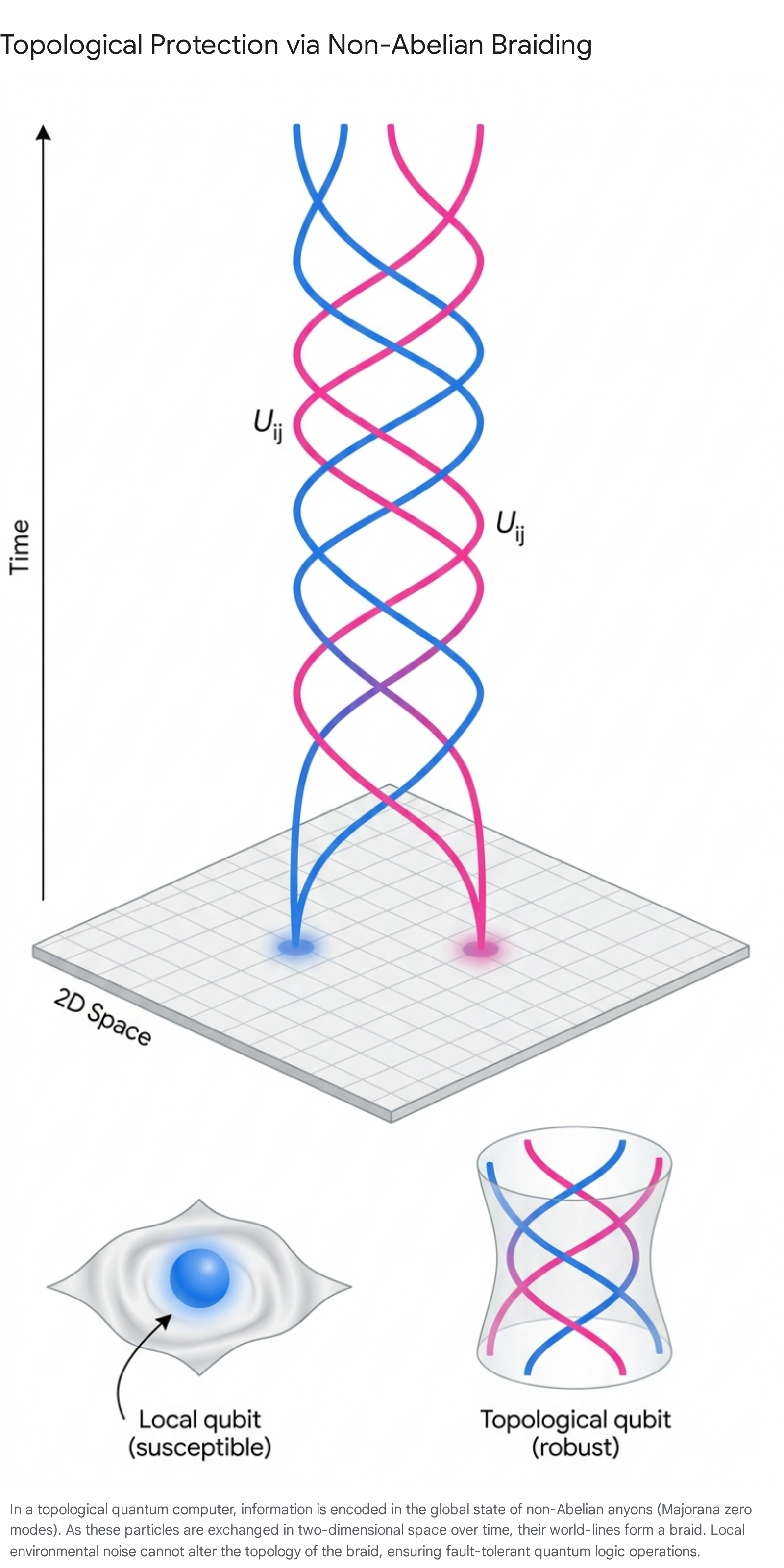
Because the resulting quantum information is defined entirely by the macroscopic topological trajectory of the braiding procedure (the sequence in which the particles wrap around one another), and is completely independent of the specific geometric path taken or the highly localized energy states of the particles themselves, the system is virtually immune to local perturbations 223223. A computational error in this architecture can only manifest if an extreme thermal fluctuation manages to span the entire macroscopic distance between the braided anyons simultaneously, an event with a statistical probability that is exponentially suppressed as the system approaches absolute zero temperatures 23. Consequently, the Majorana fermions hosted within Kitaev QSLs provide a rigorously defined theoretical blueprint for realizing advanced qubits that are intrinsically, permanently protected from environmental decoherence at the absolute hardware level 182224.
Experimental Techniques: Signatures and Blind Spots
Confirming the existence of a quantum spin liquid within a real, synthesized material is a notoriously complex endeavor fraught with interpretative hazards. Because QSLs are defined fundamentally by the absence of conventional magnetic order, diagnosing them experimentally requires proving a negative (the definitive lack of spin freezing) while simultaneously capturing highly subtle, transient positive signatures indicating the presence of fractionalized quantum excitations 36. The primary experimental methodologies employed in this search include Inelastic Neutron Scattering, Thermal Hall Effect mapping, and ultra-low temperature Specific Heat measurements. Each technique possesses profound diagnostic strengths, but also significant interpretive blind spots that can easily mislead researchers toward false positives.
Matrix of Experimental Methodologies and Limitations
| Experimental Technique | Primary Quantum Spin Liquid Signature | Key Interpretive Blind Spots & Experimental Limitations |
|---|---|---|
| Inelastic Neutron Scattering (INS) | Identifies a broad, diffuse continuum of magnetic excitations at ultra-low temperatures, indicative of multi-particle fractionalized spinon scattering rather than the sharp, coherent magnon peaks found in ordered ferromagnets 21. | A diffuse continuous spectrum can be deceptively mimicked by extensive structural disorder, mixed-ion site occupancy, or a standard spin glass state . INS struggles to definitively distinguish intrinsic quantum fractionalization from extrinsic "spin-liquid mimicry." |
| Specific Heat ($C_p$) & Thermodynamics | The complete absence of sharp $\lambda$-anomalies (which typically signal thermodynamic phase transitions) down to millikelvin temperatures. Residual linear $\gamma T$, quadratic $T^2$, or exponential terms indicate the density of states of gapless Dirac or gapped $Z_2$ spinons 21. | Isolating the purely magnetic specific heat ($C_m$) requires the highly complex, error-prone subtraction of immense phononic lattice backgrounds and nuclear Schottky anomalies 21. Subtle power-law variations are easily obscured by minor sample impurities or structural defects. |
| Thermal Transport & Thermal Hall Effect ($\kappa_{xy}$) | Non-zero residual thermal conductivity in bulk insulators indicates mobile entropy carriers (spinons). Half-integer quantization in Kitaev materials directly indicates topologically protected chiral Majorana edge currents 192025. | Highly susceptible to phonon-driven transport (phonon Hall viscosity) induced by spin-orbit interactions 3839. Displays extreme sample-dependence based on stacking faults. Difficult to separate the bosonic (magnon/phonon) background signal from the true fractionalized fermionic signal 540. |
| NMR and Muon Spin Relaxation ($\mu$SR) | Spin-lattice relaxation rates ($1/T_1$) demonstrating persistent, unfrozen spin dynamics at absolute zero. Confirms the lack of static internal magnetic fields 242126. | Acts primarily as a strictly local probe. While it effectively verifies the absence of local spin freezing, it cannot definitively map or prove the existence of long-range macroscopic quantum entanglement, which is the defining topological feature of a QSL 2421. |
Review of Primary Material Candidates (2023 - 2026 Landscape)
The intensive global search for optimal QSL host materials spans a wide variety of crystalline lattice geometries and transition metal complexes. Recent high-profile research from leading institutions across Europe, Asia, and North America has focused sharply on minimizing structural defects to isolate the intrinsic, delicate QSL physics from pervasive disorder-induced artifacts.
Comparison of Key QSL Material Candidates
| Material Candidate | Lattice Geometry | Magnetic Ion & Spin | Primary Exchange Interaction | Major Structural Challenge / Disorder Profile |
|---|---|---|---|---|
| Herbertsmithite | Kagome | $Cu^{2+}$ ($S=1/2$) | Strong Isotropic Heisenberg ($J \sim 17$ meV) | Antisite Disorder: $Cu^{2+}$ ions sporadically substituting into the interstitial non-magnetic $Zn^{2+}$ layers 1626. |
| 1T-TaS$_2$ | Triangular (Superlattice) | $Ta^{4+}$ ($S=1/2$) | Correlation-driven Mott Insulator | Interlayer Coupling: Bulk layers stack randomly, complicating the pure 2D Star of David CDW physics 127. |
| YbMgGaO$_4$ | Triangular | $Yb^{3+}$ ($S=1/2$) | Anisotropic Exchange / Spin-Orbit | Severe Chemical Disorder: Random site mixing between non-magnetic $Mg^{2+}$ and $Ga^{3+}$ creates widely varying local crystal fields 4328. |
| $\alpha$-RuCl$_3$ | Honeycomb | $Ru^{3+}$ ($S=1/2$, $l_{eff}=1$) | Bond-Directional Ising (Kitaev) | Stacking Faults & Non-Kitaev Interactions: Weak van der Waals bonding leads to twinning; Heisenberg terms cause low-T magnetic order 203945. |
Herbertsmithite [ZnCu$_3$(OH)$_6$Cl$_2$]
Initially synthesized in high-purity single-crystal form in 2012 by researchers at the Massachusetts Institute of Technology, herbertsmithite remains the prototypical, foundational candidate for a kagome lattice QSL 2129. The active magnetic copper ions ($Cu^{2+}$) form near-perfect $S=1/2$ two-dimensional kagome planes, which are structurally separated by diamagnetic zinc layers. Despite exceptionally strong antiferromagnetic nearest-neighbor exchange interactions ($J \sim 17$ meV), exhaustive low-temperature measurements indicate absolutely no long-range magnetic ordering down to millikelvin temperatures 21.
Recent Advances (2023 - 2025): The principal recurring barrier in herbertsmithite characterization has been severe Cu/Zn antisite disorder - instances where magnetic copper ions accidentally substitute directly into the non-magnetic zinc interlayer planes, creating a localized grid of impurity spins that obscure the intrinsic planar kagome physics during bulk measurements 1626. Breakthrough 2024 studies utilizing site-resolved $^{17}$O Nuclear Magnetic Resonance (NMR) techniques equipped with MRI-like contrast methods successfully segregated the slow-relaxing impurity sites from the fast-relaxing intrinsic planar sites. The isolated, intrinsic spectral contribution strongly supports a gapless QSL state, largely invalidating competing theoretical frameworks that posited a gapped Dirac spin liquid state as energetically favorable 26. Concurrently, high-pressure in situ X-ray diffraction and Raman scattering studies executed up to 30 GPa (2023) demonstrated that physical compression acts inversely to structural Zn-doping, driving a displacive phase transition from the parent trigonal structure to a highly distorted monoclinic clinoatacamite-like structure. This transition, triggered by an enhanced cooperative Jahn-Teller effect, vividly illustrates how exquisitely balanced and fragile the structural parameters must remain to preserve the delicate QSL phase 16.
1T-TaS$_2$
1T-tantalum disulfide is a highly complex, quasi-two-dimensional transition metal dichalcogenide. Uniquely among dichalcogenides, it drops into a commensurate charge density wave (CDW) state below 200 K, characterized by the formation of complex 13-site "Star of David" superlattice clusters 12730. Each distinct cluster traps one unpaired localized electron at its core, effectively establishing a highly frustrated Mott insulator mapped onto a triangular superlattice 1.
Recent Advances (2024 - 2026): Because the bulk crystalline form of 1T-TaS$_2$ is immensely complicated by randomized interlayer stacking configurations that couple the discrete magnetic layers, researchers have increasingly directed their focus toward exploring the true two-dimensional limit via exfoliation or precision molecular beam epitaxy 14931. High-resolution angle-resolved photoemission spectroscopy (ARPES) and scanning tunneling microscopy (STM) experiments conducted throughout 2025 and 2026 on single-layer (SL) 1T-TaS$_2$ (and its closely related isostructural analogue 1T-TaSe$_2$) have provided robust, undeniable evidence for the existence of a U(1) Dirac spin liquid state accompanied by a distinct spinon Fermi surface 493132. By engineering precise vertical heterostructures - physically placing insulating 1T layers directly atop metallic 1H layers - researchers have recently succeeded in detecting spinon-induced Kondo resonances. These findings definitively prove that the localized unpaired electron within the core of the Star of David can act as an itinerant, fractionalized spinon capable of interacting quantum-mechanically with the underlying metallic substrate, serving as a massive confirmation of the material's underlying QSL state 493132.
YbMgGaO$_4$
YbMgGaO$_4$ is an anisotropic rare-earth triangular lattice antiferromagnet where heavy $Yb^{3+}$ ions populate the primary magnetic plane. Early pioneering measurements between 2015 and 2016 verified a complete lack of long-range magnetic ordering down to 50 mK, alongside a broad, continuous spectrum of low-energy magnetic excitations detected via inelastic neutron scattering. Consequently, the material was initially hailed across the literature as a structurally perfect, highly symmetric QSL candidate completely free of obfuscating Dzyaloshinskii-Moriya (DM) interactions 41133.
The Disorder Debate (2024 - 2026): The initial enthusiasm surrounding YbMgGaO$_4$ has been heavily tempered by the subsequent realization that the lattice features inherent, unavoidable random site-mixing between the non-magnetic $Mg^{2+}$ and $Ga^{3+}$ cations 244328. This severe chemical disorder actively generates spatially varying crystal electric fields and drastically randomizes the local magnetic exchange interactions across the lattice, sparking a fierce and ongoing debate across the global research community: Is the widely observed behavior indicative of a true, intrinsic quantum spin liquid, or is it merely "spin-liquid mimicry" - a random singlet state artificially generated by atomic disorder trapping the spins into localized, disconnected random pairs? 2428.
Recent ultra-low temperature specific heat and sensitive magnetic torque measurements (published in 2024) successfully detected a residual linear thermal conductivity term ($\kappa_0/T$). This data strongly suggests that highly mobile, itinerant spin excitations actually survive the pervasive structural disorder, heavily pointing back toward the presence of an intrinsic, robust QSL state operating beneath the lattice noise 28. Nonetheless, the lingering controversy has driven researchers to actively seek out pristine, entirely disorder-free material analogues. The 2024 synthesis of PrMgAl${11}$O${19}$ - a novel architecture where pristine, disorder-free AlO$_6$ octahedra reliably separate the active magnetic layers - has rapidly emerged as a significantly cleaner comparative platform. This new material displays ideal easy-axis Ising behavior and features continuous spin excitations utterly free from the obfuscation of spin-liquid mimicry 9.
The Contentious Thermal Hall Effect in α-RuCl$_3$
The single most heavily debated and fiercely analyzed experimental topic in topological quantum magnetism from 2023 to 2026 has unquestionably been the manifestation of the planar thermal Hall effect in the layered honeycomb magnet $\alpha$-RuCl$_3$, currently viewed as the premier physical candidate for realizing the Kitaev quantum spin liquid model 52540.
The Half-Integer Quantization Claim
In the absolute absence of an external magnetic field, $\alpha$-RuCl$3$ invariably orders into a zigzag antiferromagnetic state below a Néel temperature of $T_N \approx 7$ K due to the unavoidable presence of non-Kitaev Heisenberg interactions 2039. However, applying a strictly in-plane magnetic field of roughly 7 - 8 Tesla effectively suppresses this zigzag ordering, forcefully driving the material into a field-induced quantum disordered (FIQD) state 2539. Working strictly within this incredibly precise parameter window, leading research groups from the University of Tokyo and Kyoto University reported a monumental, unprecedented finding: the planar thermal Hall conductivity ($\kappa{xy}$) exhibits a highly distinct intermediate plateau that is quantized at exactly half the value of the universal quantum of thermal conductance ($K_0/2 = (\pi/6)(k_B^2/\hbar)T$) 192034. Within the rigorous theoretical constraints of the Kitaev model, this half-integer quantization is widely considered the incontrovertible "smoking gun" signature for the physical presence of a chiral edge current carried entirely by neutral Majorana fermions exhibiting non-Abelian topological order 1935.
The Phonon and Magnon Counter-Theories
This groundbreaking interpretation has immediately been met with intense skepticism and analytical scrutiny. Several independent global research groups, attempting to replicate the delicate experiments, observed vastly different non-monotonic field dependencies and repeatedly failed to capture the elusive half-integer plateau 520.
- The Phonon Hall Viscosity Argument: Prominent critics argue vehemently that $\kappa_{xy}$ in $\alpha$-RuCl$3$ is actually heavily dominated by standard acoustic phonons rather than exotic Majorana fermions 383940. Comprehensive thermal transport studies indicating a sudden, sharp increase in both the longitudinal ($\kappa{xx}$) and transverse ($\kappa_{xy}$) thermal conductivity immediately below $T_N$ strongly suggest a common, intertwined phononic origin resulting from drastically reduced spin-fluctuation scattering once the lattice orders 39. Advanced first-principles calculations of the "acoustic Faraday effect" published in late 2025 clearly demonstrated that exceptionally strong spin-orbit coupling inside the crystal naturally generates chiral spin-phonon interactions. These interactions mathematically imbue the acoustic phonons with an intrinsic "Hall viscosity" and a distinct Berry curvature sufficient to quantitatively account for the massive observed thermal Hall signal, completely independent of the presence of any fractionalized Majorana quasiparticles 3840.
- The Topological Magnon Argument: Alternative theoretical groups have posited that the intermediate field-induced phase is not a pure, pristine QSL, but rather a complex, hybridized state heavily populated by topological bosonic modes, specifically highly energetic magnons 20. These magnons intrinsically possess a finite Chern number and could theoretically propagate transversally to the applied thermal current, effectively inducing a substantial, albeit unquantized, thermal Hall signal that easily mimics the expected fermionic signature 2025.
The 2025 Consensus: Bulk-Edge Correspondence and Strict Sample Purity
By late 2024 and 2025, the fierce debate began to clarify and crystallize around critical nuances in bulk sample quality and the highly complex mechanics of edge-phonon thermal coupling. It is now widely established across the literature that the half-integer plateau is extraordinarily, critically sensitive to minute stacking faults within the delicate van der Waals layers of the crystal 519. The original Tokyo/Kyoto groups definitively demonstrated that only absolutely "ultraclean" crystals (synthesized via highly controlled two-step sublimation processes) possessing exceptionally high longitudinal thermal conductivity are capable of exhibiting the quantized effect 519. In lower-quality crystals produced via standard Bridgman methods, intense internal defect scattering immediately destroys the fragile chiral edge currents before they can traverse the sample.
Furthermore, groundbreaking 2025 experiments utilizing highly advanced focused ion beam nanofabrication directly measured thermal edge currents on artificially restricted micro-scale samples. These studies revealed a pronounced, undeniable size dependence: in small physical samples ($\sim 100 \mu m$) operating inside the ballistic regime, the thermal edge current definitively decouples from the overarching bulk phonon network 5. Concurrently, meticulous field-angle-dependent specific heat measurements conclusively verified a gap-closing thermodynamic behavior that is wholly characteristic of a topological fermionic phase transition, thereby effectively ruling out bosonic magnons as the primary heat carriers residing in the FIQD state 525. Consequently, the prevailing 2025 scientific consensus cautiously supports the original Kitaev Majorana interpretation, actively acknowledging that while phonons undeniably provide a necessary thermal equilibrium background for the system, they are ultimately not the fundamental origin of the topological half-integer quantization 525.
Emerging Material Synthesis Breakthroughs (2025 - 2026)
The profound, repeating experimental limitations of existing, naturally occurring mineral candidates have spurred a rapid, massive acceleration in synthesis innovations, heavily driven by tightly coordinated European and Asian advanced materials research networks (most notably QuantERA III and HUN-REN) 5536.
A major structural breakthrough in December 2025 was the successful synthesis of TbTi$_3$Bi$_4$, categorized as a fundamentally new "interwoven" kagome metal 37. Traditional magnetic kagome materials suffer severely from inescapable geometric frustration that limits their functional electronic tunability. TbTi$_3$Bi$_4$ elegantly solves this impasse by physically separating the competing quantum subsystems: highly magnetic Terbium (Tb) atoms form isolated, quasi-1D zigzag chains, while highly itinerant electrons independently inhabit a purely non-magnetic Titanium (Ti) kagome bilayer 37. This novel architectural design actively lifts the deleterious geometric frustration while simultaneously preserving an exceptionally strong, engineered coupling between the underlying magnetism and the topological charge transport, ultimately generating an anomalous Hall conductivity that vastly surpasses all known conventional kagome magnets 37.
Concurrently, the historical search for true, uncompromised three-dimensional quantum spin liquids gained massive momentum in July 2025 following high-resolution polarized neutron scattering experiments conducted on Cerium zirconate (Ce$2$Zr$_2$O$_7$) 38. Formed strictly in a highly frustrated, tightly bound pyrochlore lattice comprising corner-sharing tetrahedra, this complex material showed absolutely no discernible magnetic ordering down to 20 mK. More importantly, precise inelastic neutron scattering detected highly coherent, collective spin excitations possessing distinct linear energy-momentum relationships - a thermodynamic behavior explicitly characteristic of theoretical "emergent photons" manifesting in a 3D U(1) quantum spin liquid 38. This finding completely differentiates it from heavily disordered structural mimics, such as the false-positive CeMgAl${11}$O$_{19}$ 14. These recent 2025/2026 synthesis breakthroughs represent a profound, necessary shift across the field, moving away from retrofitting accidental mineral properties and toward the deliberate, rational, bottom-up design of robust quantum magnetic topologies 3739.
Conclusion
Quantum spin liquids currently stand at the absolute frontier of condensed matter physics, representing a profound, tangible manifestation of macroscopic quantum entanglement. The underlying physical operation of geometric frustration within constrained lattices - such as the underconstrained kagome geometry - guarantees a massive, macroscopic ground-state degeneracy. This degeneracy provides the necessary energetic vacuum from which highly exotic fractionalized excitations, ranging from gapless spinons to non-Abelian Majorana fermions, actively emerge. The theoretical framework explicitly linking these non-Abelian anyons to the construction of a hardware-level fault-tolerant topological quantum computing infrastructure remains exceptionally sound, rigorously mapped and mathematically verified by constructs such as the Kitaev honeycomb model.
However, the experimental reality of physically identifying and manipulating these states remains highly contentious. Conventional diagnostic techniques, including inelastic neutron scattering and thermal Hall effect measurements, are undeniably powerful but suffer from severe interpretive blind spots, particularly regarding extensive phonon interference and the pervasive specter of disorder-induced "spin-liquid mimicry." The intense, multi-year debates surrounding the exact role of structural disorder in YbMgGaO$_4$ and the precise physical origin of the half-integer thermal Hall effect in $\alpha$-RuCl$_3$ aggressively highlight the extreme vulnerability of topological phases to minute material imperfections. Moving forward into 2026 and beyond, the definitive resolution of these debates relies less upon the incremental refinement of novel measurement techniques, and far more heavily upon the successful synthesis of ultra-pure, geometrically engineered designer materials. Architectures such as the interwoven topological structures of TbTi$_3$Bi$_4$ and the pristine 3D pyrochlore lattices will eventually provide the stable, uncompromised environments absolutely required to finally harness, control, and commercialize fractionalized quantum matter.