
Behavioral and Organizational Dynamics of Manufactured Urgency
Modern organizational, economic, and behavioral systems are increasingly governed by temporal compression. Across public and private sectors, decision-making environments are frequently characterized by "manufactured urgency" - the deliberate or systemic imposition of artificial time constraints, rapid-response expectations, and spurious deadlines. While true urgency dictates immediate action to avert objective harm or capture fleeting value, manufactured urgency applies the psychological and structural pressures of an emergency to routine, low-stakes, or strategically ambiguous tasks 1. Intersubjective time is a powerful force in human systems; manipulating it through temporal work influences organizational behavior and strategic action profoundly .
This report provides an exhaustive analysis of manufactured urgency, integrating perspectives from behavioral economics, neuroendocrinology, organizational psychology, public policy, and national security. By synthesizing empirical data, clinical markers, and structural evaluations, the analysis dissects how artificial time constraints subvert rational prioritization, exact severe neurological tolls, and ultimately degrade long-term productivity and institutional resilience.
Part I: The Behavioral Economics of Spurious Urgency
Traditional economic and time-management frameworks, such as the Eisenhower Matrix, assume that individuals rationally weigh the importance of a task against its temporal proximity, optimally prioritizing tasks that are both important and urgent, and subsequently deferring to tasks that are important but not urgent 23. However, contemporary behavioral economics literature reveals a persistent deviation from this normative principle, demonstrating a systemic human vulnerability to the illusion of expiration.
The Mere Urgency Effect and the Violation of Dominance
The cornerstone of the behavioral understanding of manufactured urgency is the "mere urgency effect," a cognitive bias formalized by researchers Meng Zhu, Yang Yang, and Christopher Hsee in 2018. The effect describes the human tendency to systematically pursue urgent tasks with lower objective payoffs over important tasks with higher objective payoffs, even when the urgency is entirely spurious 1456.
This phenomenon violates the fundamental normative principle of dominance in decision-making theory - the expectation that individuals will choose objectively better options over objectively worse ones 5789. To demonstrate this, Zhu et al. conducted a series of controlled experiments that isolated the variable of urgency from importance.
In their foundational experiment involving 124 students choosing between two tasks yielding different quantities of Hershey's Kisses, the introduction of an illusion of expiration (an artificial deadline) shifted behavior dramatically. When no urgency was applied, only 13.3% of participants chose the low-payoff task. However, when the low-payoff task was characterized by spurious urgency, 31.3% of participants chose it, willingly sacrificing a prize 1.67 times more valuable simply because the lesser prize had a restricted window 5.
This irrational prioritization scales directly to financial remuneration. In subsequent tests utilizing MTurk workers, participants were offered a choice between a task paying 16 cents (high payoff, open deadline) and a task paying 12 cents (low payoff, urgent deadline). In the control condition, 13.9% chose the lower payoff. Under conditions of manufactured urgency, 35.3% selected the lower-paying task 5.
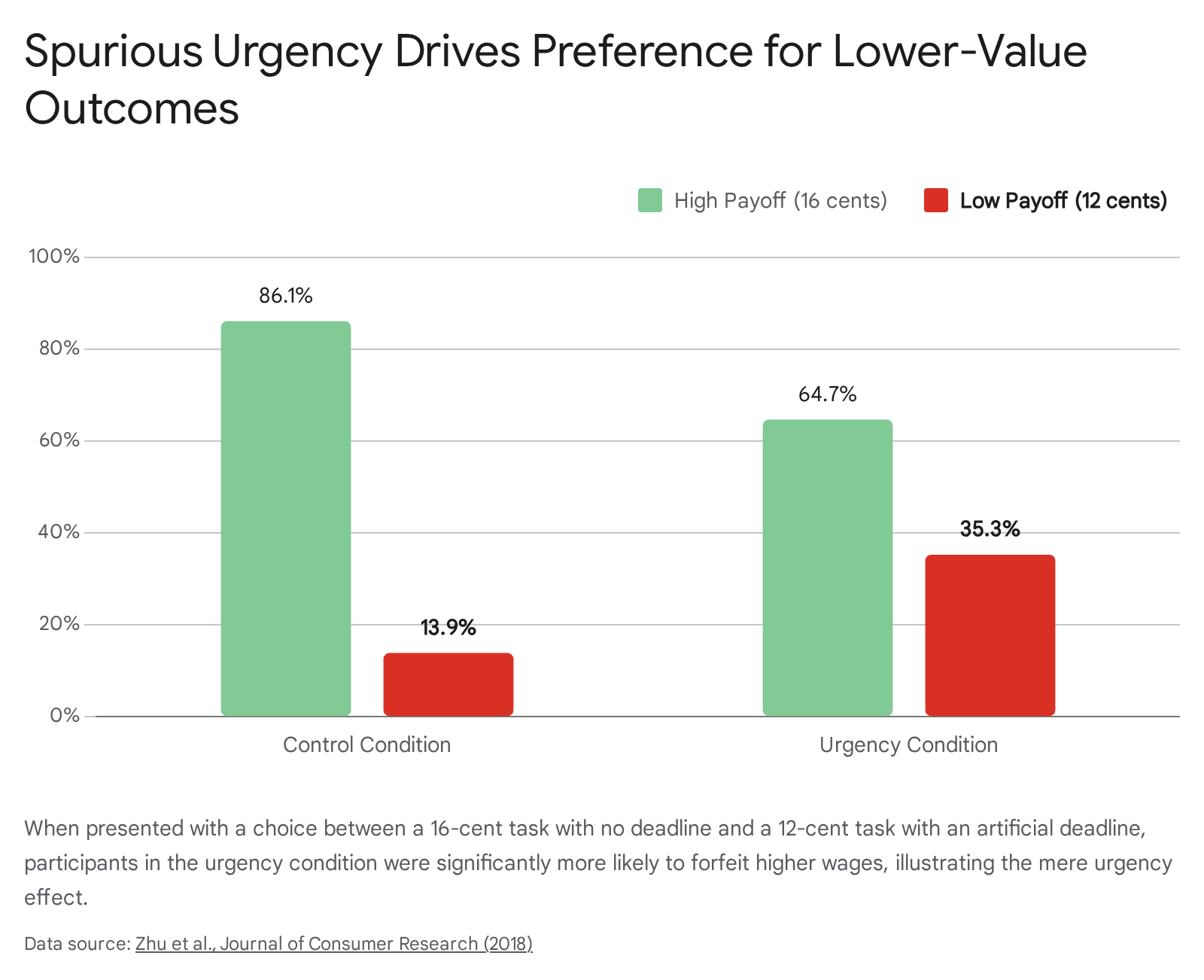
Workers essentially forfeited a significant percentage of their potential wage to satisfy an arbitrary time constraint 25.
The Attentional Shift Mechanism and Moderating Variables
The mechanism driving the mere urgency effect is an involuntary shift in attentional focus. Human cognition treats restricted time frames as threat signals, which aggressively hijack the attention system regardless of actual importance 1. The brain is conditioned to respond to immediate environmental stimuli; thus, an impending deadline elicits disproportionate attention, diverting cognitive resources away from calculating the magnitude of the task's final outcome 4510. When individuals were asked to report their decision-making criteria, those in the urgency condition paid significantly more attention to the expiration time (M=5.56 vs. M=4.02) and significantly less attention to the bonus amounts (M=5.70 vs. M=7.26) 5.
Furthermore, researchers identified key moderators that either exacerbate or attenuate this bias:
| Moderating Variable | Impact on Decision Making | Empirical Findings |
|---|---|---|
| Perceived Busyness | Exacerbates the Effect | Individuals who self-identify as highly busy are chronically tuned to the time dimension. In trials, highly busy subjects were nearly twice as likely to succumb to spurious urgency across multiple rounds, willingly opting for lottery prizes $5 lower - equivalent to 7.69 times their wage for the task 5711. |
| Outcome Salience | Attenuates the Effect | When the superior financial payoff of the non-urgent task was made explicitly salient, the mere urgency effect was neutralized. Task choice parity was restored (20.6% in urgency vs. 15.0% in control, a non-significant difference) 5. |
The Mere Deadline Effect: Time Abundance as a Liability
While manufactured urgency (artificial shortness of time) sabotages prioritization, the inverse manipulation - artificial length of time - also drastically distorts behavior. The "mere deadline effect," documented in 2019 by Zhu, Bagchi, and Hock, demonstrates that when long, incidental deadlines are imposed, individuals mistakenly infer that the task is inherently more difficult than it actually is 121314.
Contrary to the logical assumption that more time facilitates goal pursuit by providing flexibility, extended deadlines prompt individuals to over-allocate resources, overestimate required effort, and ultimately increase procrastination. If a standard administrative task is given a four-week deadline rather than a one-week deadline, the assignee unconsciously categorizes the task as highly complex. This leads to elevated resource estimates, increasing the likelihood of goal abandonment or delayed initiation 1315.
Efficacy of Artificial vs. Organic Deadlines
Given the distortive properties of deadlines, assessing the efficacy of artificial, self-imposed deadlines is crucial. Research indicates that artificial deadlines set by individuals upon themselves often lack psychological "teeth" 1617. In a landmark experiment evaluating how people perform under different deadline conditions, students were asked to write three papers. One group was allowed to set their own deadlines, while another had evenly spaced, externally assigned deadlines 18.
Theoretically, the students with a choice had a clear optimal path: set all deadlines for the last day of class, maximizing instruction and drafting time 18. However, only 27% chose this optimal path. The majority attempted to self-impose evenly spaced deadlines out of a fear of their own tendency to procrastinate. Ultimately, the students with externally assigned, rigid deadlines performed just as well, if not better, because external deadlines trigger genuine loss-aversion mechanisms 1718. Fake, self-imposed deadlines create cognitive load without triggering the necessary neurochemical loss-aversion responses that drive execution, often resulting in "deadline inflation" where everything feels urgent but nothing feels truly important 17.
Part II: Neurobiology, Cognitive Load, and the Physiological Toll
The behavioral deviations observed in economic experiments are rooted in profound neurobiological responses. When urgency is manufactured, the human body cannot distinguish between a socially constructed corporate deadline and a genuine physical threat. The resultant physiological state fundamentally alters brain architecture, hormone regulation, and cognitive capacity.
The Dopamine-Cortisol Feedback Loop and Urgency Addiction
Urgency operates as a potent neurological stimulant, triggering a flood of catecholamines, including adrenaline and dopamine. This chemical influx creates a narrow, laser-like focus that initially mimics the sensation of high productivity 19202122.
In a chronically urgent environment, the brain's reward system undergoes a structural rewiring. Dopamine, the primary neurotransmitter in the motivation circuit, begins to be released not upon the completion of a meaningful goal, but in the anticipation of urgent stimuli - the incoming notification, the shifting deadline, the manufactured crisis 192023. This state, clinically categorized as "urgency addiction," occurs when the brain requires the spike of a manufactured emergency merely to feel engaged 19212425. The individual loses the capacity to operate under "cool" motivation (intention-driven, strategic work) and becomes entirely reliant on "hot" motivation (stress-driven, reactive work) 1921.
Simultaneously, the hypothalamus-pituitary-adrenal (HPA) axis is persistently activated, producing high levels of cortisol 262728. In acute doses, cortisol effectively prepares the body for physical action. However, the continuous presence of spurious deadlines means the baseline arousal level is set artificially high, leading to chronic cortisol elevation and severe downstream health impacts 19.
Pathological Atrophy and The Cortisol Paradox
The long-term physiological costs of this state are clinically observable. Sustained cortisol exposure results in neurological damage. Research indicates that chronic stress causes the prefrontal cortex (PFC) - the area responsible for higher cognitive functions, objectivity, and long-term planning - and the hippocampus (responsible for memory) to physically atrophy and decrease in size 29. Conversely, the amygdala, the brain's fear and emotion center, hypertrophies 29.
This structural shift explains the behavioral changes seen in leaders subjected to chronic manufactured urgency. Leaders become risk-averse, hyper-reactive, and lose their capacity for creative problem-solving because cortisol directly decreases the amount of sugar available to neurons in the PFC and hippocampus 29. Furthermore, elevated cortisol induces a down-regulation of testosterone, increasing anxiety, uncertainty, and a loss of dominance 29. In an attempt to ameliorate this stress, dopamine and oxytocin drive leaders to surround themselves with agreeable subordinates, punishing dissent to maintain a chemically soothing echo chamber 29.
Clinical studies utilizing the Trier Social Stress Test (TSST) to measure salivary and serum cortisol reveal a paradoxical trajectory in workers transitioning from healthy engagement to burnout:
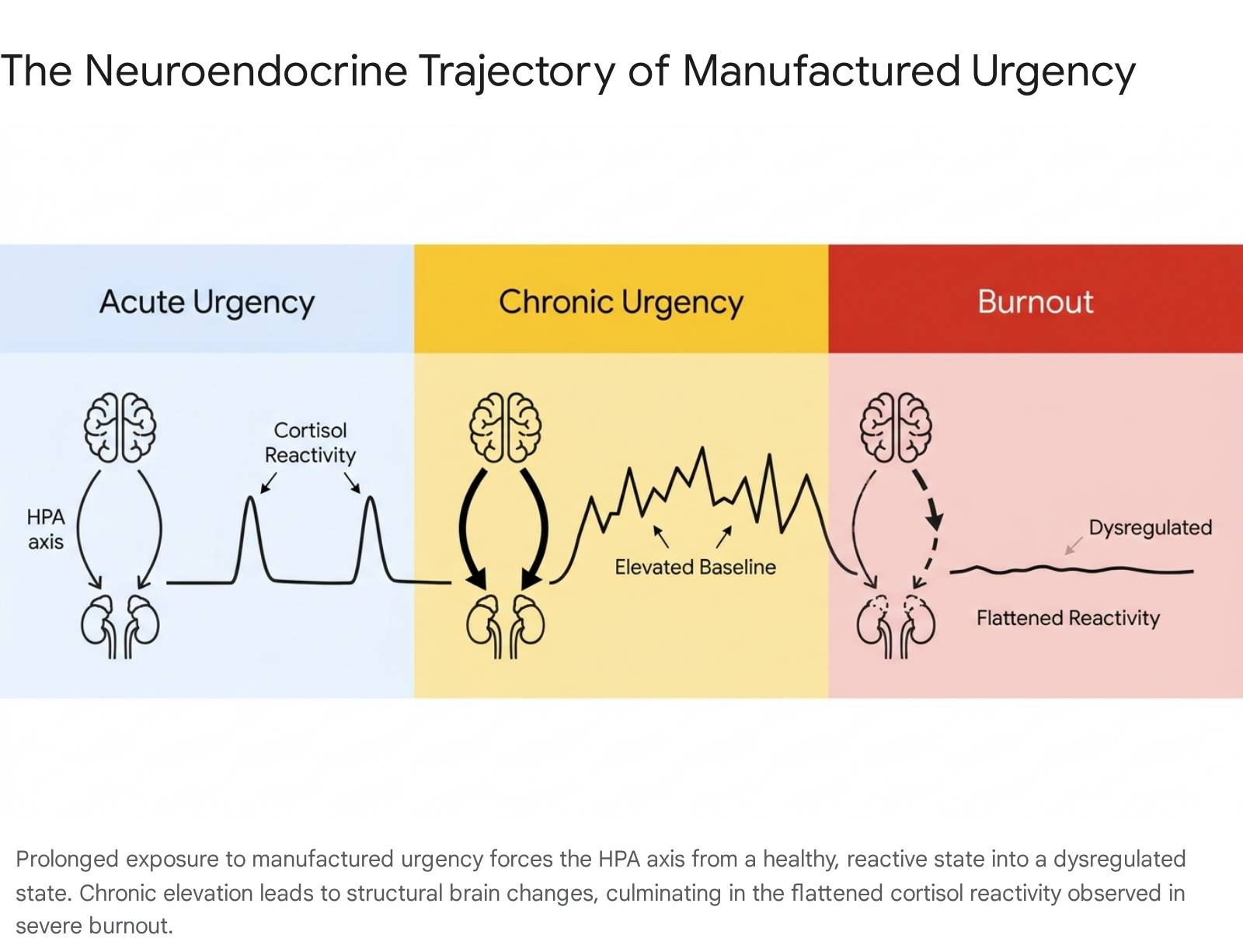
- The Engaged State: Characterized by moderate, healthy cortisol fluctuations 27.
- The Strained/Cynical State (Early Burnout): Characterized by hypercortisolism. Male physicians with moderate burnout exhibited significantly greater cortisol reactivity post-stress, reflecting a system in overdrive trying to meet chronic demands 272830.
- The Burned-Out State (Severe Burnout): Characterized by hypocortisolism. As job demands become completely uncontrollable, the HPA axis loses its reactivity. Patients with severe clinical burnout exhibit a "flat-line" effect, showing a significantly lower response to acute stressors (Area Under the Curve Increase [AUCI] of serum cortisol = 7,288 versus 13,731 in lower burnout patients) 26272930. The body literally loses its ability to produce sufficient cortisol to mount a response to actual emergencies.
Cognitive Load and the Arithmetic of Task-Switching
Beyond hormonal disruption, manufactured urgency relies heavily on multitasking and rapid context-switching. Cognitive Load Theory demonstrates that working memory is severely limited; the brain cannot truly multitask complex cognitive operations, but rather switches processing streams rapidly between tasks 31323334. Task representations in the brain are cognitive map-like; the greater the conceptual distinction between two tasks, the more cognitive updating is required to switch between them 33.
Every switch incurs a mathematical penalty, formally recognized as the "Switch Cost in Time" (SCT) and the "Switch Cost in Errors" (SCE) 3134.
| Task Condition | Switch Cost Metric | Quantitative Impact |
|---|---|---|
| Sequential Task Execution | Baseline | N/A |
| Task-Switching (Average) | SCT (Switch Cost in Time) | ~351.5 milliseconds per switch 31. |
| High School Cohort Multitasking | Aggregated Time Penalty | Required 95% more time to complete tasks compared to sequential processing 3134. |
| High School Cohort Multitasking | Aggregated Error Penalty | Committed 120% more errors compared to sequential processing 3134. |
| General Adult Cohort | Overall Productivity Loss | Meyer's research indicates a total productivity reduction of up to 40% when multitasking 31. |
Quantitative computer-assisted testing across demographics reveals that when individuals are forced to alternate between complex tasks (a hallmark of environments filled with spurious, competing deadlines), efficiency collapses. By treating every incoming stimulus as urgent, organizations inadvertently engineer severe reductions in baseline cognitive productivity 3135.
Part III: Organizational Pathology and "Firefighting" Culture
If manufactured urgency is biologically destructive and economically irrational, its persistence in corporate, military, and institutional environments requires explanation. The phenomenon survives because it serves distinct sociological, political, and psychological functions within organizational hierarchies, often masking deeper systemic dysfunctions.
Managerial Ego and the Illusion of Control
In many organizations, the vast majority of deadlines - upwards of 99%, according to some project management experts - are entirely artificial. They are arbitrary dates selected without detailed evaluation of scope, resource capacity, dependencies, or actual business impact if missed 363738. Setting a deadline functions as a performative act of management. Announcing an urgent date during a meeting forces teams into visible motion, creating the appearance of leadership, urgency, and decisiveness, regardless of whether the date holds strategic weight 3638.
This dynamic is classified in critical management studies as a dispositif - a regime of governmentality. Project management frameworks often champion collective solidarity and agility while practically enforcing compliance through the sustained pressure of manufactured urgency 39. Leaders who lack a coherent long-term vision frequently utilize manufactured crises to reposition themselves as indispensable saviors, thriving on the adrenaline of "all hands on deck" scenarios and spotlight behaviors 40. The short-term benefit is relevance for the leader; the long-term cost is systemic instability and team exhaustion.
Deadline Inflation and the Erosion of Trust
When artificial deadlines are routinely missed without consequence - or when a project is completed via extreme overtime only for the deliverable to sit unread for days because the requestor was on vacation - teams rapidly recognize the manipulation 384142. This breeds deep organizational cynicism and fundamentally erodes trust.
In behavioral terms, the repeated use of artificial deadlines strips them of their power. Once the lack of consequence is exposed, the cognitive threat signal dampens 16. However, the organizational response is rarely to remove the fake deadlines or employ flexible milestone approaches, which Harvard Business Review research indicates yield higher-quality outcomes with less burnout 36. Instead, managers engage in "deadline inflation," pulling due dates increasingly earlier to account for expected delays 1738. When an organization mixes real and fake deadlines indiscriminately, employees suffer from attention residue, unable to distinguish actual existential threats to the business from arbitrary managerial milestones, resulting in the truly urgent tasks being delivered late 1738.
Normalized Deviance and Firefighting Culture
In high-risk environments, the culture of constant urgency can lead to fatal organizational outcomes. Studies of firefighter culture, including analyses of the Dallas Fire Rescue Department and the Essentials of Firefighting manual, reveal that localized workgroups often adapt to strain and production demands by accepting risks that make safety negotiable 434445. This leads to the sociological phenomenon of the "normalization of deviance," where aberrant decision-making and the bypassing of safety protocols in the name of speed become institutionalized 45. The toll is measurable; PTSD prevalence rates among firefighters range from 6.5% to 37%, demanding specialized, peer-led psychological interventions that understand the nuances of this high-pressure culture 46.
When the "firefighting" metaphor is imported into corporate settings, it manifests similarly. Time pressure and artificial deadlines encourage teams to apply "band-aids" rather than solve root problems. Teams will deliberately skip quality assurance, push back on design tweaks, or reduce testing phases to meet an arbitrary date 3747. The urgency trap ensures that the organization remains locked in a reactive, tactical mode, permanently deferring strategic, important work in favor of putting out artificial fires 2447.
The Financial Cost of Burnout vs. Productivity
The corporate justification for maintaining a culture of high pressure is the assumption that urgency yields greater output. Quantitative macroeconomic and labor analyses definitively refute this, demonstrating that the short-term gains of overwork are eclipsed by the astronomical financial and productivity costs of the resultant burnout.
Working under continuous urgency inevitably leads to longer hours, yet the output does not scale linearly. Economic studies confirm the principle of diminishing marginal returns in human capital. For example, a comprehensive study of call center agents revealed that a 1% increase in working time yielded only a 0.9% increase in output 48.
Furthermore, a global Slack survey of over 10,000 desk-based workers revealed that while 40% of employees regularly work after hours due to competing priorities and lack of time, those who log off at the end of the standard workday register 20% higher overall productivity scores 49. In an environment where urgency dictates behavior, the average workday shrinks in efficiency even as it expands in duration. Half of all respondents in high-urgency environments reported skipping breaks, making them 1.7 times more likely to suffer burnout 49.
When urgency transitions into clinical burnout, the economic damage is profound. Burnout directly impairs cognitive capacity, decision-making, and emotional resilience 304850. Academic staff experiencing high emotional exhaustion exhibit absenteeism rates 3.3 times higher and presenteeism rates (working while impaired) 4.7 times higher than healthy peers 48. Computational simulation models based on data from the American Journal of Preventive Medicine estimate the direct annual cost of burnout per employee:
| Employee Classification | Estimated Annual Cost of Burnout (Per Employee) | Cost Ratio Equivalencies |
|---|---|---|
| Hourly Non-Manager | $3,999 ($3,958 - $4,299) | ~3.3 to 17.1 times the cost of employee training. |
| Salaried Non-Manager | $4,257 ($4,215 - $4,299) | ~0.2 to 2.9 times the average cost of health insurance. |
| Manager | $10,824 ($10,700 - $10,948) | Severe impact on team retention and operational stability. |
| Executive | $20,683 ($20,451 - $20,915) | High risk of strategic failure and institutional memory loss. |
Source data: Computational models of employee disengagement and burnout 5051.
For a standard 1,000-employee company, the aggregate cost of employee burnout averages $5.04 million annually 5051. Globally, employee burnout costs healthcare systems an estimated $322 billion annually, contributing heavily to a global productivity loss of $8.8 trillion due to disengagement 52.
Moreover, the damage is not easily reversed by a vacation. A 2025 longitudinal study from Sweden identified "economic scarring" resulting from overwork. Two years following a clinical burnout diagnosis, individuals suffered a permanent 12.36% earnings loss, indicating that the neurological and cognitive damage exacted by chronic urgency irreversibly reduces long-term human capital and resilience 48.
Part IV: Sector-Specific Applications: Academia, Healthcare, and Humanitarianism
The dynamics of urgency do not operate uniformly across all sectors. Examining how manufactured urgency permeates specific professional domains reveals the depth of its structural impact.
Nursing, Academia, and Moral Injury
In healthcare and academic settings, manufactured urgency generates severe ethical and operational friction. Systematic reviews indicate that burnout affects over 70% of nursing faculty, driven heavily by a pervasive sense of urgency generated by external mandates, continuous assessment cycles, and performance management systems operating on accelerated timelines 53.
Theoretical frameworks, such as the HUMANE framework, explicitly contest these regimes of manufactured urgency. Scholars argue that the institutional cultures equating speed with excellence and productivity with value actually perpetuate colonial continuities - systems that demand obedience and subservience, marginalizing voices advocating for sustainable transformation 53. In these environments, faculty face "moral distress" as they are expected to model compassion and trauma-informed leadership for students while simultaneously navigating escalating workload pressures that undermine their own health and ethical commitments 53.
Medical Education and the Urgency Index
The psychological toll begins early in medical training. Studies utilizing the "urgency index" among Medical (MBBS) and Dental (BDS) students demonstrate high levels of temporal distress. Out of a surveyed cohort, nearly half (49.7%) exhibited a high urgency index, while 37.6% met the criteria for urgency addiction 25.
The data reveals significant demographic disparities: urgency addiction was statistically higher in first-year students (44.9%) compared to final-year students, suggesting that the initial shock of the medical education environment severely disrupts time-management psychology 25. Furthermore, female students suffered significantly higher levels of urgency index than males, and children of working women exhibited higher rates of urgency addiction, highlighting the intersection of academic pressure with broader societal and familial expectations 25.
Visual Culture and Humanitarian Photography
Beyond operational environments, urgency is also manufactured in visual culture to manipulate public perception and resource allocation. Historically, humanitarian photography has utilized a politically instrumental practice to manufacture urgency by constructing specific visual and narrative contexts 54.
Rather than merely reflecting suffering, these images actively shape what crises become morally actionable. This form of "spectatorial sympathy" often relies on displaying victims while erasing perpetrators from the frame, inviting audiences to experience pity as a way to affirm their own moral virtue rather than to address the root causes of the crisis 54. In this domain, manufactured urgency is deployed as an emotional lever to rapidly aggregate funding or political support, occasionally at the expense of nuanced, long-term geopolitical solutions.
Part V: Cybernetics, Security, and Military Operations
In the realms of digital security and kinetic military action, manufactured urgency transitions from a productivity drain into a direct vector for exploitation and systemic risk.
Cybersecurity and AI-Driven Detection
In the digital domain, malicious actors exploit the mere urgency effect via phishing and social engineering. Threat actors flood targets with emotional manipulation, isolation, and manufactured urgency (e.g., "Your account will be suspended in 24 hours") to bypass skepticism and demand immediate decisions 55.
The defense against this relies heavily on recognizing these psychological patterns. Recent research presented at Virus Bulletin demonstrates the efficacy of "multimodal" AI in classifying spam and phishing. While traditional machine learning models struggled with unseen phishing samples (achieving F1 scores as low as 0.53), multimodal AI systems achieved F1 scores up to 0.97 by specifically detecting social engineering tactics such as manufactured urgency, unusual requests for sensitive information, and linguistic manipulation patterns .
Psychological Inoculation against Extremism
The same tactics used in financial fraud and phishing are deployed by extremist groups and foreign adversaries to recruit active-duty military and veterans 55. These populations are subjected to targeted emotional flooding and urgency manipulation.
To counter this, security practitioners utilize "psychological inoculation." Grounded in decades of empirical research, this approach teaches individuals to recognize manipulation tactics before encountering them 55. By teaching threat recognition - specifically identifying urgency tactics and authority impersonation - practitioners activate cognitive defenses. This pattern recognition protects freedom of thought, allowing service members and civilians to independently evaluate information without falling prey to the amygdala hijack that manufactured urgency attempts to provoke 55.
Military Operations and Machine-Speed Combat
In kinetic military operations, particularly "by, with, and through" partnered operations (where U.S. forces operate alongside local partners), artificial timelines carry lethal risks. Entering into strategic partnerships driven by politically manufactured urgency leaves commanders with little room to assess institutional safeguards 56. This operational compression distorts the means to implement measures of distinction, proportion, and precaution, dramatically increasing the risk of civilian casualties 56.
Furthermore, as military operations increasingly rely on AI-powered command systems and coordinated drone swarms, combat begins to operate at machine speed 57. The urgency of algorithmic combat forces human decision-making into a bottleneck. A human commander evaluating a threat assessment for sixty seconds may find the engagement over before a decision is reached 57. The intersection of manufactured political urgency and machine-speed tactical urgency creates a profound crisis in maintaining human accountability and ethical oversight in warfare 57.
Part VI: Regulatory Frameworks and Public Policy: The Efficacy of Artificial Time Limits
While manufactured urgency is broadly detrimental in cognitive, organizational, and security contexts, the structural mechanics of deadlines can be utilized effectively when deployed as precise, ethical instruments within public policy.
Deadlines as Nudges in Public Health
Because human beings suffer from limitations in memory, attention, and a natural bias toward procrastination, setting an artificial deadline for a self-benefiting action can break behavioral inertia. In behavioral economics, this is known as using "deadlines as nudges" 585960.
A randomized controlled trial in Pennsylvania tested behaviorally-informed household communications regarding radon testing. By incorporating a sense of temporal finality (a deadline) alongside spatial risk mapping, the uptake rate for testing kits jumped from 22% in the control group to 33% - a highly significant 50% increase 61. Similar interventions have successfully utilized deadlines to improve tax compliance and vaccination rates 5861. In these highly specific contexts, the deadline acts as a structural antidote to procrastination, shifting a desired action from the "important but not urgent" quadrant into immediate attentional focus without resorting to coercion 586263.
Statutory Deadlines in Government Regulation
In federal regulatory frameworks, the utility of statutory deadlines is highly contested. Congress frequently imposes statutory deadlines to force administrative agencies to act quickly on rulemaking 6465. However, agencies regularly fail to meet these deadlines because rigid temporal constraints are often incompatible with the complex, deliberative requirements of policy design 64.
Scholars leveraging a transaction cost politics approach suggest that utilizing positive incentives ("carrots") for timely completion is significantly more effective than enforcing rigid, punitive deadlines ("sticks") 6465. Punitive statutory deadlines impose severe litigation risks and costs on agencies, often encouraging them to cut analytical corners to meet arbitrary dates 65. The Administrative Conference of the United States (ACUS) emphasizes the need for administering laws with efficiency and accuracy, balancing the use of algorithmic tools to speed up regulatory enforcement with the absolute necessity of safeguarding civil liberties - a balance frequently disrupted by excessive statutory haste 66.
Rethinking Deadlines: The National Science Foundation Example
Recognizing the detrimental impact of rigid deadlines on the quality of complex intellectual work, some major institutions have completely rearchitected their temporal expectations. The National Science Foundation (NSF) conducted a massive shift toward "no-deadlines" approaches for grant solicitations across five of its directorates 67.
The rationale was to remove the immense pressure to submit under a strict deadline, theorizing that Principal Investigators (PIs) would submit more fully developed, higher-quality proposals that were easier to review 67. The empirical result of this policy shift was a significant reduction in overall proposal volume, indicating that without the artificial urgency of a deadline, researchers ceased submitting rushed, lower-quality work just to "beat the clock" 67. While evidence regarding the absolute impact on task quality is mixed, the NSF experiment confirms that eliminating manufactured urgency reduces administrative burden, mitigates panic-induced labor, and realigns focus toward the intrinsic importance of the research 67.
Conclusion
The pursuit of rapid execution through manufactured urgency is fundamentally a structural failure of design. While artificial time constraints, spurious deadlines, and emergency posturing can reliably generate short-term bursts of motion, they systematically dismantle the neurobiological, cognitive, and economic foundations required for sustained, high-level human performance.
Behavioral economics confirms that urgency blinds individuals to objective value, forcing them into a reactive posture that prioritizes immediacy over magnitude. Neuroendocrinological evidence maps the devastating physical toll of this posture: the chronic elevation of cortisol, the atrophy of higher reasoning centers, and the ultimate descent into the flattened reactivity of clinical burnout. Financially, the millions of dollars lost annually to turnover, presenteeism, and task-switching errors dwarf the marginal gains achieved through forced acceleration.
Whether assessing the normalization of deviance in firefighting cultures, the moral distress of nursing faculty, or the vulnerability of populations to cybersecurity threats, the data is unequivocal. Organizations and policy frameworks must undertake a radical restructuring of their temporal architecture. This involves auditing internal deadlines to eliminate spurious urgency, decoupling managerial authority from crisis generation, and protecting the cognitive bandwidth of human capital. True strategic advantage belongs not to the institutions that manufacture the most haste, but to those that protect the psychological safety, objective reasoning, and deep focus required to execute what is truly important.