
Can You Appeal a College Rejection
An applicant can officially appeal a college rejection, but successful reversals are exceptionally rare and typically granted only in cases involving significant, documented administrative errors or profound extenuating circumstances previously unknown to the committee. Merely disagreeing with the decision, expressing continued interest, or presenting minor academic improvements does not constitute valid grounds for an appeal. Because many selective institutions explicitly prohibit appeals altogether, candidates must meticulously review individual university policies before initiating the process.
A college rejection feels painfully final, but understanding exactly when that door is still slightly open can save families from lingering 'what-ifs' or wasted false hope. The immediate aftermath of an admission denial is frequently characterized by a desire to fight the outcome, leading many families to search for an avenue to overturn the decision. However, the modern college admissions apparatus is a highly calibrated, data-driven machine. By the time a decision letter is released, an applicant's file has typically navigated multiple layers of evaluation, regional committee debates, and sweeping institutional audits 1. Consequently, overturning a finalized decision requires dismantling the premise upon which that decision was originally built. It requires incontrovertible proof that the admissions committee evaluated a fundamentally flawed or incomplete file.
To navigate this complex terrain, it is necessary to explicitly debunk a pervasive myth: an admissions appeal is never an opportunity to beg the committee to "look again." The "pretty please" argument is universally ineffective 1. An appeal is not a venue to complain about perceived unfairness, compare an applicant's profile to a peer who was admitted, or send a slightly improved test score achieved months after the deadline 23. Deans of admission operate under strict yield management protocols, meaning their decisions are mathematically modeled to fill a precise number of beds and classrooms. The National Association for College Admission Counseling (NACAC) reports that in the Fall 2023 admission cycle, member institutions weighted high school GPA in college prep courses and the overall strength of the high school curriculum as the absolute top factors in their decisions 43. If these fundamental metrics were accurately reported and considered, an appeal challenging the academic judgment of the committee will be swiftly dismissed 16. Understanding the rigid parameters of what actually constitutes appealable criteria is the first step in determining whether a case warrants the emotional and logistical investment required to proceed.
What actually counts as new information?
For an appeal to possess any legitimate merit, the applicant must introduce "new and compelling information" that was completely absent from the original application 348. This standard is exceedingly high. Admissions offices define "new" not merely as events that occurred after the application was submitted, but as paradigm-shifting context that fundamentally alters the academic or personal narrative of the candidate 8.
The situations that successfully trigger an overturned decision typically fall into one of two narrow categories: severe administrative errors or catastrophic extenuating circumstances 1249.
An administrative error occurs when the institution makes a decision based on factually incorrect data. For example, a high school guidance counselor might accidentally upload the transcript of another student with a similar name, resulting in a highly qualified applicant being evaluated on a mediocre academic record 1. Alternatively, standardized test scores or core GPA metrics might be reported incorrectly through a digital platform malfunction 24. While automated checks prevent many of these mix-ups, they do occasionally slip through the cracks. If a student or counselor discovers that a rejection was predicated on a missing midterm report or a swapped transcript, this constitutes ironclad grounds for an appeal 1105.
The second category involves extreme extenuating circumstances. This refers to major life events, such as a sudden, severe medical diagnosis, the death of an immediate family member, or a profound disruption in living circumstances (such as homelessness, domestic displacement, or becoming a victim of a violent crime) that occurred during the academic evaluation period but was not disclosed on the application 24126. Often, students omit these details out of a fear of stigma or a desire to be judged solely on their perceived merits 715. If an applicant suffered a dramatic drop in grades during their junior year due to an undisclosed hospitalization, providing clinical documentation of this event could theoretically compel a committee to re-evaluate the academic record with the appropriate context 7.
Another highly specific, albeit rare, scenario involves missing institutional connections. In some cases, a major institutional or philanthropic connection (e.g., a family connection to a primary university donor) may not have been flagged by the university's development office during the admissions sweep, perhaps due to differing last names 1. While this reality highlights the inner workings of holistic admissions at certain private institutions, it remains a procedural error on the university's end that could prompt a reversal if the development office intervenes 1.
What does not count as new information? Earning an 'A' in a senior spring semester calculus class, being elected president of the debate club in March, or winning a regional science fair after the application was submitted 38. The University of California, Los Angeles (UCLA) explicitly notes that high grades received in the senior year or recently acquired extracurricular awards are not a basis for a reversal, as decisions are rooted in the academic information available at the time of application 3.
The following table distinctly categorizes valid versus invalid grounds for an admissions appeal:
| Valid Grounds for Appeal (Actionable) | Invalid Reasons to Appeal (Will be Denied) |
|---|---|
| Documented Administrative Error: Proof that a high school counselor uploaded the wrong transcript or failed to submit required core materials 12. | Incremental Academic Updates: Stronger senior year spring semester grades, minor GPA bumps, or a slightly improved ACT/SAT score 38. |
| Data Inaccuracy: Demonstrable evidence that a demographic, curricular, or testing data point was logged incorrectly by the application portal 25. | "Look Again" Pleas: Begging the committee to re-read the file because the institution is the applicant's "dream school" 13. |
| Undisclosed Severe Trauma: Newly revealed, documented medical crises, family deaths, or housing instability that explains a prior drop in academic performance 247. | Peer Comparisons: Arguing that a classmate with a lower GPA or fewer extracurriculars was admitted while the applicant was denied 2. |
| Major Institutional Oversight: A failure by the university's development office to flag a significant, legitimate institutional connection 1. | Late Extracurricular Achievements: Earning a new club leadership position or regional award after the initial application deadline 38. |
How do I write an admissions appeal?
If an applicant determines that their situation genuinely meets the criteria for new and compelling information, the execution of the appeal must be flawless, timely, and professional.
Before drafting a single word, applicants must verify whether the denying institution even permits appeals. Many highly selective private institutions, particularly within the Ivy League and elite liberal arts colleges, maintain a strict policy prohibiting appeals 1817. For these schools, a rejection is an absolute finality. Conversely, large public university systems, such as the University of California (UC) system, maintain formalized, albeit highly stringent, appeal procedures 19. The timeline for these procedures is remarkably brief; for instance, the UC system typically requires first-year applicants to submit appeals by April 15, while transfer applicants generally have until May 15 810. Submitting an appeal past the established deadline or in an incorrect format guarantees an outright dismissal before the substance of the letter is ever reviewed 9.
The tone of the appeal letter is paramount. It must be composed by the student, not a parent, guardian, or counselor 220. Admissions officers evaluate the maturity and accountability of the candidate; an appeal written by an aggressive parent fundamentally undermines the student's agency. Furthermore, the applicant must completely avoid accusatory, bitter, or entitled language 29520. The letter should not imply that the admissions committee was "overworked," "rushed," or "unfair" 2. Instead, it should open with a respectful greeting addressed to the Dean of Admissions or the specific Appeals Committee, clearly state the applicant's name and ID number, and express gratitude for the initial review of the application 1122.
The body of the letter must concisely deliver the core argument. It should not resubmit essays, reiterate extracurricular involvement, or repeat "Why Us" arguments that were already processed and evaluated in the original file 249. If the appeal is based on an administrative error, the student should state the error clearly, attach the objective proof (such as an updated official transcript from the high school), and kindly request a re-evaluation based on the accurate data 411. If the appeal relies on extenuating circumstances, the student should provide a clear, factual explanation of how the hardship prevented them from performing academically, avoiding overly emotional or hyperbolic language 411.
An appeal without corroborating evidence is merely an assertion. If citing a medical crisis, the applicant should include a letter from a physician 2. If an application error occurred, a formal letter from the high school principal or guidance counselor taking responsibility for the oversight is mandatory 120. Importantly, applicants should adhere strictly to the university's rules regarding supplementary letters of recommendation. Some universities explicitly forbid new recommendation letters, viewing them as attempts to circumvent the standard process, while others may allow a short note from a current instructor 422.
The conclusion of the letter should briefly reaffirm the student's genuine, enduring interest in attending the institution and state clearly that they will enroll if the decision is overturned 411. This reassures the committee that an accepted appeal will definitively yield an enrollment, which is a crucial consideration for enrollment managers strictly monitoring their yield rates. According to NACAC data, the average yield rate for four-year not-for-profit colleges was only 30 percent in 2022, meaning institutions are highly sensitive to predicting exactly which admitted students will actually attend 12.
Can you appeal a waitlist decision?
Waitlist decisions occupy a unique psychological space in college admissions, often generating more anxiety and confusion than outright rejections. However, the procedural reality is quite straightforward: one cannot appeal a waitlist decision 101024.
To understand why, one must distinguish between the mechanics of a rejection and the mechanics of a waitlist. A rejection implies that the applicant did not meet the institutional priorities or academic thresholds required for admission. An appeal seeks to challenge the data underlying that conclusion. Conversely, a waitlist offer is not a denial of merit; rather, it is a declaration of capacity limits. When a college places a student on a waitlist, the admissions committee is communicating that the student is highly qualified and a strong cultural fit, but the institution simply lacks the physical bed space or classroom capacity to offer immediate admission 7.
Because waitlists are primarily tools for yield management - allowing colleges to protect against "melt" (students who accept offers but later withdraw) - appealing the decision is structurally illogical. The waitlist is an unranked pool of qualified candidates waiting to see if admitted students decline their offers 7. As one higher education forum accurately analogized, appealing a waitlist is akin to demanding a seat on a fully booked commercial flight; the airline cannot invent a seat that does not exist, regardless of the passenger's credentials 10. In fact, institutions within the UC system explicitly state that waitlisted students cannot initiate the appeals process while their waitlist status is pending 910.
Furthermore, the odds of transitioning from a waitlist to an accepted status fluctuate wildly based on annual enrollment trends and institutional needs. In the 2024 admissions cycle, UC Berkeley saw 7,853 students opt into its waitlist; the university ultimately admitted only 26 of those students, resulting in a waitlist admission rate of roughly 0.3% 82526. UCLA similarly utilizes waitlists to manage its highly competitive applicant pool, which exceeded 146,000 first-year applications for Fall 2024. For that cycle, almost 9,200 applicants accepted a spot on the UCLA waitlist, and only 1,211 were ultimately admitted 27.
Instead of an appeal, the appropriate protocol for a waitlisted student is to formally "opt in" to the waitlist by the required deadline (e.g., April 15 for UC first-years) and submit a Letter of Continued Interest (LOCI) 10910. A LOCI differs fundamentally from an appeal; it does not challenge a decision but rather updates the college on minor recent achievements and reaffirms that the institution remains the student's absolute first choice 10. However, applicants must carefully read instructions, as some massive public universities, like UC Berkeley, strictly prohibit the submission of LOCIs or supplementary materials for waitlisted students, utilizing the waitlist purely on a quantitative, numbers-needed basis 8.
Contextualizing the Modern Admissions Landscape (2023+)
To accurately evaluate the viability of an appeal, applicants must understand the macroeconomic and administrative forces shaping higher education today. Several massive variables have fundamentally disrupted recent admissions cycles, altering how committees view applicants and how flexible they can be with their decisions.
The 2024 FAFSA Delays and Financial Aid Appeals
The Free Application for Federal Student Aid (FAFSA) underwent a congressionally mandated simplification for the 2024-2025 academic year, driven by the FAFSA Simplification Act. The rollout was catastrophic. Typically available in October, the new "Better FAFSA" was delayed until late December 2023, and subsequent technical glitches prevented millions of students - particularly those from mixed-citizenship-status families - from completing the form 282913. The Department of Education failed to accurately adjust its financial aid formulas for historic inflation, leading to significant delays in transmitting Institutional Student Information Records (ISIRs) to universities 3133. As a result, colleges could not generate financial aid award letters until late March or April, leaving families in a state of prolonged financial limbo 29.
This systemic failure triggered a massive administrative domino effect. Advocacy groups, including NACAC, the American Council on Education, and the National Association of Student Financial Aid Administrators, successfully urged hundreds of colleges - including the massive UC and CSU systems - to push their traditional May 1 commitment deadlines to May 15 or June 1 to accommodate the crisis 29331415.
This crisis drastically altered the landscape of financial aid appeals. While admissions appeals are exceptionally rare, financial aid appeals are common, expected, and frequently successful 1. Because the FAFSA relies on prior-prior year tax data, it often fails to capture sudden changes in family circumstances, such as a recent job loss, high medical bills, or divorce 18. Due to the 2024 FAFSA delays and algorithmic changes - such as the controversial exclusion of the "number of students in college" from the new eligibility calculation - universities were acutely aware that their initial aid offers might be inaccurate or insufficient for many families 28.
Crucially, families must distinguish between appealing a denial of admission and appealing a financial aid award. If a student is admitted but cannot afford the tuition due to a recent change in family finances or a flawed FAFSA output, they should immediately engage the financial aid office, not the admissions office 8. This process involves submitting formal documentation of the financial hardship (e.g., termination letters, medical invoices) to request a professional judgment review 18. However, families should maintain realistic expectations when asking for need-based aid from out-of-state public universities, as state tax revenue primarily subsidizes in-state residents 1.
The Demographic "Enrollment Cliff"
While highly selective universities like Harvard, Stanford, and UC Berkeley face an overwhelming deluge of applications and boast acceptance rates hovering below 12% 253616, the vast majority of American colleges operate in a vastly different reality. Higher education is currently colliding with the "enrollment cliff" - a severe demographic contraction stemming from declining birth rates following the 2008 Great Recession 3839.
According to data cited by Inside Higher Ed and the Chronicle of Higher Education, projections indicate that the number of college-bound high school graduates will plummet by up to 15% between 2025 and 2029 3839. Consequently, regional public universities and smaller private liberal arts colleges are desperately competing for a shrinking pool of traditional 18-year-old students. In fall 2022, NACAC reported that the average acceptance rate at four-year, not-for-profit colleges was actually 73 percent, a far cry from the single-digit rates dominating the news cycle 12.
If an applicant is rejected from a moderately selective institution currently facing intense enrollment pressures, an appeal - or a request to negotiate a merit scholarship based on a competing offer from another university - has a statistically higher chance of success than an appeal filed at an elite institution 15838. Institutions anxious about filling their freshman class are inherently more receptive to reconsidering a candidate who demonstrates strong interest and presents a viable case for admission.
The Impact of Test-Optional Policies on Admissions Appeals
In the post-2020 era, the proliferation of test-optional policies has complicated the definition of "new information" in the appeals process. As of the Fall 2023 cycle, 83 percent of four-year bachelor-degree-granting institutions in the US maintained test-optional or test-blind frameworks 1741. However, the landscape is shifting rapidly. Highly selective institutions such as Yale, Dartmouth, and MIT have recently reinstated standardized testing requirements, arguing that test scores serve as crucial predictors of academic success, particularly for identifying high-achieving applicants from under-resourced backgrounds 17. Conversely, institutions like Columbia University have extended their test-optional policies indefinitely 3617.
If an applicant was rejected from a test-optional institution and subsequently receives a perfect or near-perfect SAT score in the spring, does this constitute valid grounds for an appeal? Generally, no. Admissions committees evaluate the file based on the parameters the student selected at the time of submission 3. If a student opted into a test-optional review, the committee assessed their high school curriculum rigor and GPA as the primary indicators of merit. While a less selective institution struggling to meet enrollment targets might entertain a late test score 56, highly rejective universities will disregard it as an invalid attempt to alter the evaluation criteria retroactively 3.
The Post-SFFA Legal Landscape
The 2023 Supreme Court decision in Students for Fair Admissions v. Harvard (SFFA), which struck down the use of race-based affirmative action in college admissions, has also fundamentally altered how universities evaluate applications 181920. Institutions are now pivoting toward targeted geographical recruiting, guaranteed admission for top percentiles, and an increased focus on socioeconomic indicators to maintain diverse incoming classes 2046. Applicants navigating appeals should be aware that the legal landscape strictly prohibits universities from utilizing race as a factor in admission or in an appeal 20. Any new information presented must strictly adhere to the applicant's individual academic trajectory, personal character attributes, or objective administrative oversights.
The UK Alternative: Appealing within the UCAS System
For students applying to universities in the United Kingdom via the Universities and Colleges Admissions Service (UCAS), the appeals process operates under a distinctly different philosophical and legal framework. While American admissions emphasize "holistic" evaluation (weighing personal essays, character attributes, and extracurricular leadership heavily alongside grades), the UK system is relentlessly academic. UK universities focus almost exclusively on predicted grades, subject mastery, and standardized exam results (such as A-Levels, IB, or APs) to determine if a candidate can handle a highly specialized degree course 1747.
Because UK admissions are inherently data-driven and objective, appealing a UK university rejection is a quasi-legal, highly procedural undertaking. Students do not appeal through the central UCAS portal; rather, they must appeal directly to the individual university's admissions department 4849. Under the oversight of the UK Quality Assurance Agency (QAA) and the Office of the Independent Adjudicator (OIA), universities will universally reject any appeal based on a "disagreement with academic judgement" 6. An applicant cannot argue that they deserved an offer based on their potential or because they felt their interview went well. According to the OIA's 2023 Annual Report, academic appeals account for 45% of all student complaints to the OIA, yet a vast majority fail because students fundamentally misunderstand what constitutes valid grounds 6.
Instead, UK appeals are strictly limited to the following valid grounds: 1. Procedural Irregularity: Demonstrable proof that the university failed to follow its own published admissions procedures, or made a severe administrative calculation error when tallying UCAS tariff points 61549. 2. Extenuating or Mitigating Circumstances: Compelling clinical or legal evidence of a severe crisis (e.g., bereavement, acute mental health episode, domestic violence) that materially affected academic performance, and a valid justification for why the applicant could not disclose this information to the university or exam board prior to the decision 615. 3. Bias or Prejudice: Documented evidence of discriminatory practices during the evaluation or interview stage 49.
If a UK appeal is successful prior to the UCAS decision deadlines in May, the applicant may receive a conditional or unconditional offer 15. However, because UK courses strictly cap enrollment, a late successful appeal may only result in a deferred place (a "deferred entry") for the following academic year 15. Applicants should also be aware that an appeal does not automatically hold their spot; they should simultaneously explore clearing options while awaiting an appeal decision to ensure they have a backup plan 4921.
What this means for you
Navigating a college rejection requires emotional resilience and analytical objectivity. When faced with a denial, students and their families should operate under the assumption that the decision is absolute and immediately pivot their focus toward the institutions that have offered acceptance.
To assess whether a case genuinely warrants an appeal, an applicant should execute a ruthless self-audit. Did the high school upload the wrong transcript? Is there undeniable medical documentation of a severe, undisclosed trauma that explains a temporary collapse in academic performance? Did a digital portal malfunction erase a critical component of the application? If the answer is no, the appeal will almost certainly fail. Seeking a reversal based on a profound desire to attend the institution, a minor extracurricular update, or a post-deadline SAT score is a futile exercise that wastes time and prolongs emotional closure.
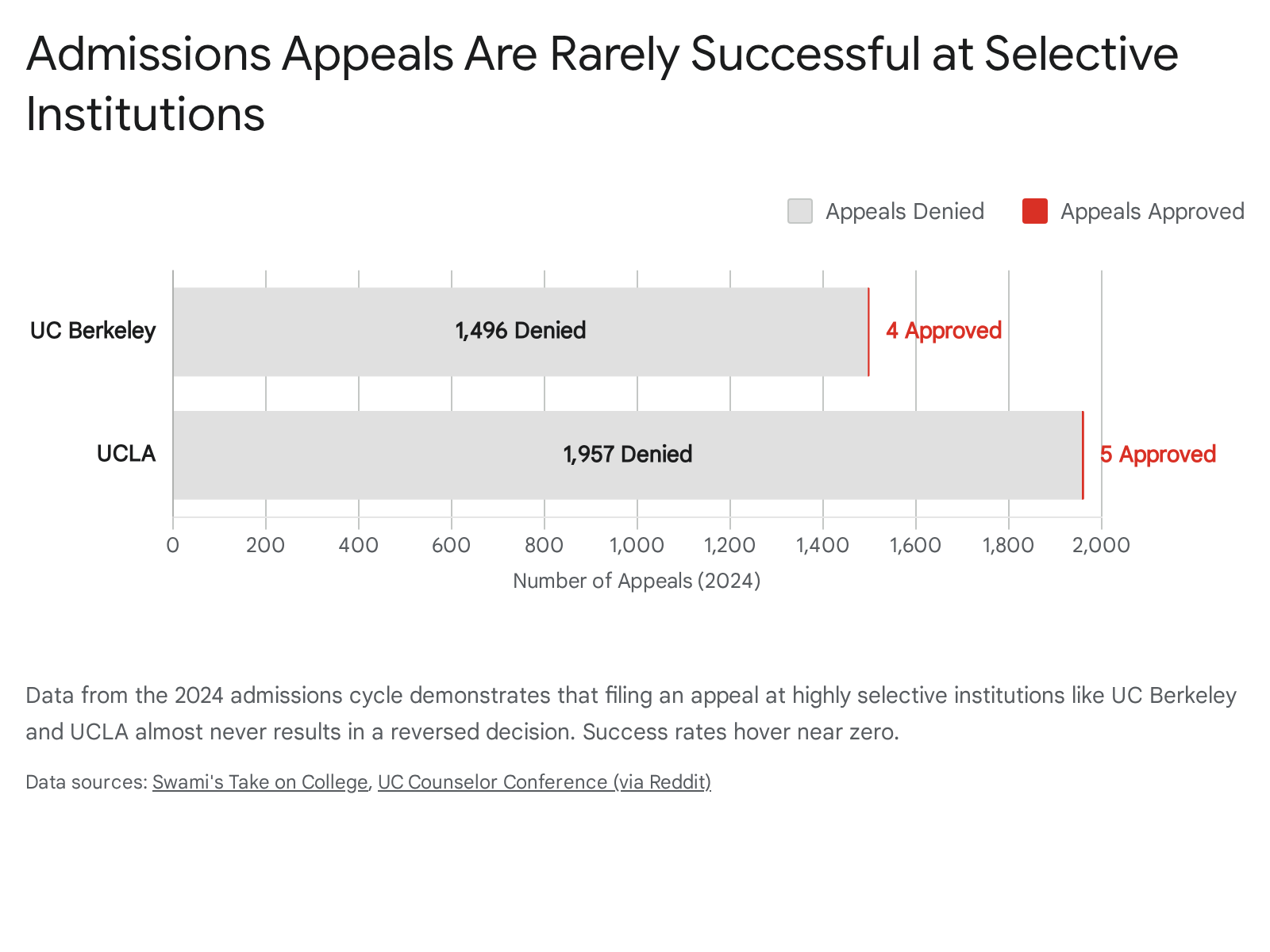
The statistics demand calibrated realism. At highly rejective institutions, the odds of a successful appeal often hover near absolute zero 82551. In the 2024 cycle, UC Berkeley approved only 4 appeals out of 1,500 submitted; UCLA approved just 5 out of 1,962 31251.
Because the process is so exceptionally stringent, students must secure their enrollment at another institution by the traditional May 1 deadline (or the extended FAFSA-adjusted deadlines of mid-May or June) 7933. Waiting in limbo for an appeal decision that has a 99.7% mathematical probability of denial is a perilous strategy that can leave an applicant without any collegiate home in the fall.
If an objective administrative error or severe extenuating circumstance did occur, the applicant must act swiftly. They should draft a concise, respectful letter addressed to the admissions committee, attach the requisite independent documentation (such as a principal's letter acknowledging the transcript error or a doctor's note), and submit the package well before the strict institutional deadlines 4911.
Simultaneously, families must separate the finality of admissions appeals from the operational flexibility of financial aid appeals. If the chaotic FAFSA rollout obscured true financial need, or if a parent recently suffered a documented loss of income, families are highly encouraged to appeal their financial aid awards 18. Financial aid offices expect these conversations and possess the professional judgment authority to adjust aid packages to ensure long-term affordability 18.
Bottom line
A college rejection is not an invitation to negotiate, and an admissions appeal is not a second chance for the committee to reconsider a holistic profile. Appeals are rigorous, highly structured procedural mechanisms designed exclusively to rectify objective administrative errors or account for profound, previously hidden extenuating circumstances. Given that success rates at selective institutions are statistically infinitesimal, applicants are best served by accepting the finality of the decision, securing their placement at an admitting university, and redirecting their energy toward the campuses where they are already welcomed and valued.