
What Acceptance Rate Data Shows About Early Decision
Applying Early Decision provides a massive statistical advantage, with acceptance rates at elite universities routinely running two to five times higher than Regular Decision rates. However, this early boost is heavily inflated by the presence of recruited athletes and legacy students, and it requires applicants to surrender their ability to compare financial aid and merit scholarship offers. For affluent students with a clear first choice, Early Decision remains the most powerful strategic lever in college admissions, but for those requiring financial flexibility, the binding commitment is rarely worth the risk.
The college admissions landscape has evolved into an increasingly complex and high-stakes environment. High school seniors are no longer just competing on the basis of grade point averages and extracurricular achievements; they are navigating an intricate system of institutional priorities, legal shifts, and enrollment management strategies. At the center of this system sits the Early Decision application pathway.
For decades, admissions counselors, parents, and students have debated the true value of committing to a single institution months before the traditional application deadline. Universities heavily promote their early application rounds, often highlighting the elevated acceptance rates as an incentive for top-tier candidates to apply. However, beneath the surface of these headline statistics lies a complicated web of institutional yield protection, demographic engineering, and financial leverage.
The admissions cycles for the Classes of 2028, 2029, and 2030 have been particularly volatile. The Supreme Court's landmark ruling dismantling race-conscious admissions, the chaotic modernization of the Free Application for Federal Student Aid (FAFSA), and a widespread reversal of pandemic-era test-optional policies have all fundamentally altered how universities build their incoming freshman classes. To understand whether Early Decision is truly worth it, it is necessary to move beyond anecdotal success stories and conduct an exhaustive examination of the data, the financial implications, and the underlying business of higher education.
The Raw Data: Quantifying the Early Admissions Multiplier
To assess the value of applying early, one must first understand the distinction between the various early application plans. Early Decision (ED) is a binding agreement; if a student is accepted, they are contractually obligated to enroll and must immediately withdraw all applications to other institutions 12. Early Action (EA) operates on a similar timeline but is non-binding, allowing students to receive an early response while retaining the freedom to compare offers until the traditional May 1 deadline 21. Restrictive Early Action (REA) or Single-Choice Early Action (SCEA), utilized by institutions like Harvard, Yale, and Stanford, is non-binding but prohibits the student from applying early to any other private university 12.
Across nearly every highly selective university that offers a binding or restrictive early pathway, the acceptance rate for early applicants is substantially higher than the rate for those who apply in the Regular Decision (RD) round 4. In a landscape where overall acceptance rates at elite institutions frequently plummet below six percent, the early round often represents the only statistically viable path to admission for many students.
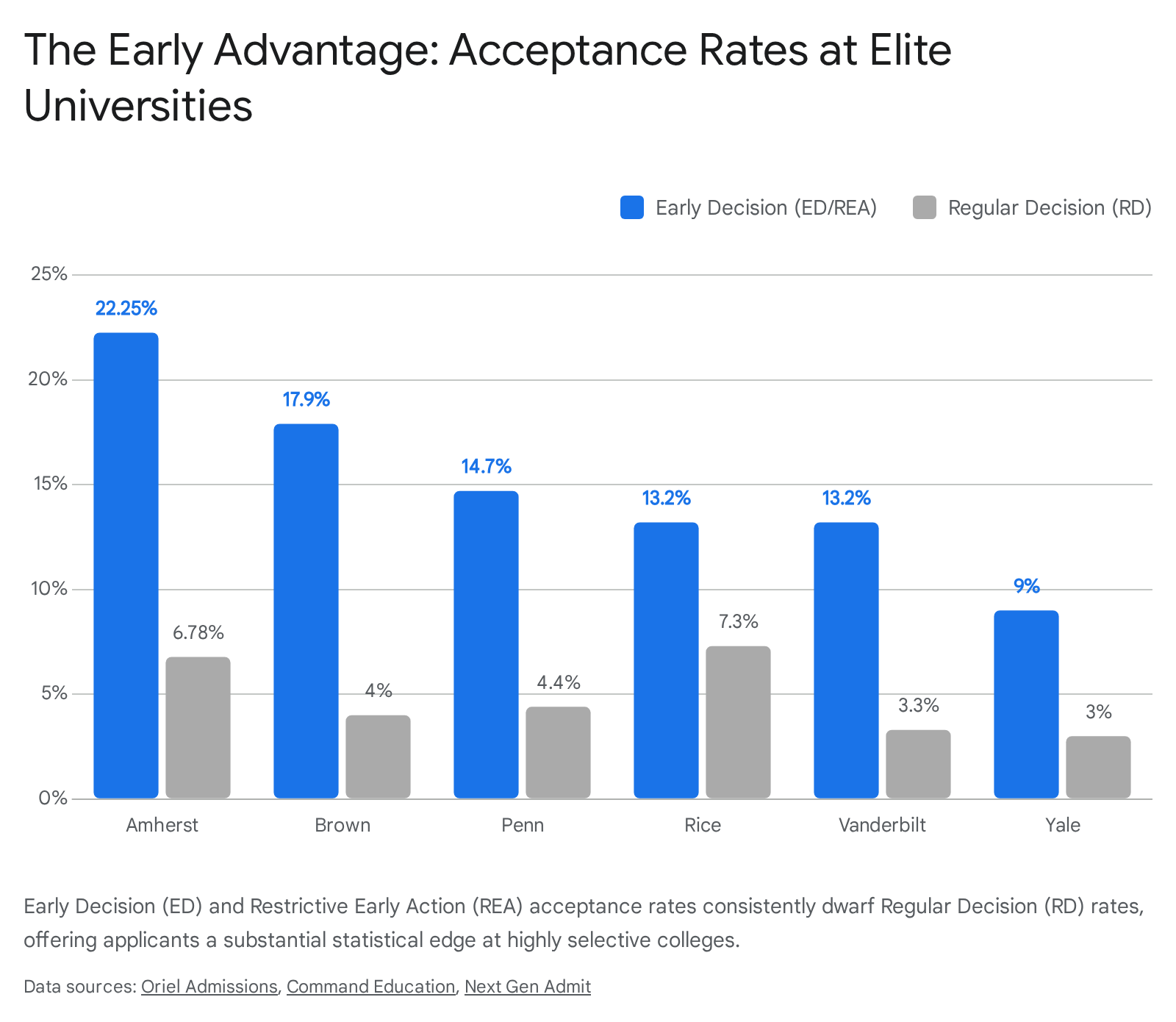
Data from recent admissions cycles reveals the stark reality of this division. At Brown University, the Early Decision acceptance rate for the Class of 2029 was 17.9%, a figure that dwarfed the university's Regular Decision admit rate of approximately 4.0% 426. Vanderbilt University exhibited an even more dramatic contrast, admitting 13.2% of its Early Decision candidates compared to a mere 3.3% of its Regular Decision applicant pool 47.
This statistical multiplier is not confined to massive research universities; it is equally prevalent among the nation's elite liberal arts colleges. Amherst College admitted 22.25% of its Early Decision applicants for the Class of 2029, while its Regular Decision acceptance rate lingered at roughly 6.78% 8.
The following table synthesizes the acceptance rate disparities at several highly selective institutions, highlighting the mathematical advantage of the early round.
| Institution | Early Decision/Action Acceptance Rate | Regular Decision Acceptance Rate | The Early Multiplier |
|---|---|---|---|
| Vanderbilt University | 13.2% (ED) | 3.3% | 4.0x |
| Brown University | 17.9% (ED) | ~4.0% | 4.4x |
| Dartmouth College | 17.0% (ED) | 5.3% | 3.2x |
| Yale University | 10.8% (REA) | ~3.0% | 3.6x |
| Amherst College | 22.2% (ED) | 6.7% | 3.3x |
| Duke University | 13.8% (ED) | ~4.5% | 3.0x |
| Rice University | 13.2% (ED I) | 7.3% | 1.8x |
The pattern is undeniable. For a student with academic credentials that align with a university's historical medians, applying Early Decision provides a statistically significant boost 4. It is not uncommon for early applicants to be admitted at two to five times the rate of their regular-round counterparts 4.
However, it is crucial to recognize that the early admissions round is not a mechanism for turning an academic reach into a guaranteed acceptance. Universities do not lower their academic standards for the early pool; rather, the applicant pool itself is highly self-selecting 4. Students who apply in November are generally better prepared, have completed their standardized testing early, and have engaged in thorough research to identify a definitive first-choice institution 43.
The Institutional Perspective: The Mathematics of Yield Management
To fully comprehend why colleges are so eager to admit students through early decision plans, one must look at the process through the lens of institutional enrollment management. From an administrative standpoint, college admissions is an exercise in risk mitigation and statistical forecasting.
The most critical metric for any enrollment manager is "yield" - the percentage of admitted students who ultimately choose to matriculate and pay tuition 10. Yield is a vital indicator of an institution's desirability and prestige, directly influencing its performance in national ranking algorithms, such as those published by U.S. News & World Report 110. A high yield rate signals to the market that a college is a destination of choice, rather than a backup plan.
Beyond prestige, yield is a fundamental operational necessity. Universities must accurately predict how many students will arrive on campus in the fall to balance their operating budgets, allocate housing accommodations, and determine faculty workloads 10. If an enrollment manager underestimates yield, the university faces a severe budget shortfall. If they overestimate yield, the campus is plunged into an over-enrollment crisis, forcing the administration to scramble for temporary housing solutions and to expand class sizes beyond their optimal capacity 10.
Regular Decision introduces an immense amount of volatility into this forecasting process. Because modern digital application platforms like the Common App have made it incredibly easy to apply to multiple schools, students frequently cast a wide net, submitting ten to twenty applications 412. If a highly qualified student is admitted to five elite universities during the regular round, they can only attend one. Consequently, four of those institutions will suffer a negative hit to their yield rate 4.
Early Decision eliminates this volatility entirely. Because the ED agreement is a binding contract, every student admitted through this pathway represents a guaranteed enrollment. The yield rate for an Early Decision cohort is effectively 100 percent 14.
Recognizing the immense value of this certainty, many top-tier universities have steadily increased the proportion of their freshman class that they fill through early binding programs. By locking down a massive percentage of their target enrollment before the calendar even turns to January, universities secure their baseline tuition revenue and protect their yield statistics 4.
The scale at which institutions rely on early admissions is staggering. Tulane University, Claremont McKenna College, and Middlebury College frequently fill up to 68% of their incoming freshman classes strictly through Early Decision 5. Northwestern University has crossed the threshold of filling over 50% of its class during the early rounds, leaving less than half of the available seats for the tens of thousands of applicants who wait for Regular Decision 1516. Duke University similarly fills approximately 49% of its incoming class through its binding ED program 4, while Amherst College admitted 43% of its Class of 2030 through early evaluation 8.

When a university preemptively consumes half of its available inventory, the Regular Decision applicant pool is subjected to a severe bottleneck. Tens of thousands of applicants are left competing for a drastically reduced number of seats. This artificial scarcity predictably drives the Regular Decision acceptance rate down into the single digits 4. The resultingly low overall acceptance rate creates an aura of extreme exclusivity, which ironically serves to drive up application volume even further in subsequent years, perpetuating a cycle of hyper-competitiveness 1718.
Deconstructing the Applicant Pool: The "Hooked" Illusion
While the raw numerical data undeniably favors the early applicant, interpreting these statistics requires significant nuance. The early applicant pool is not a representative cross-section of the general applicant population. It is disproportionately populated by "hooked" students - applicants who possess a specific institutional advantage that aligns with the university's internal priorities 171819.
In the parlance of higher education, a "hook" is a specialized attribute that elevates a candidate's profile beyond standard academic metrics. The most powerful hooks include being a recruited varsity athlete, a legacy student (the child or grandchild of an alumnus), the child of a significant university donor, or the child of a faculty member 192021.
For these high-priority applicants, participating in the Early Decision process is not merely encouraged; it is practically mandated. Ivy League institutions and highly selective Division III athletic programs routinely use the early admissions round to formalize agreements with their athletic recruits 51722. Coaches identify their top prospects over the summer, and these students are funneled through the Early Decision pipeline to ensure they are locked into the roster for the coming year 1.
The volume of seats consumed by these targeted demographics is immense. At Harvard University, recruited athletes typically constitute roughly 10% of the entire incoming class, and virtually all of them are processed through the early action route 17. At Dartmouth College, data has shown recruited athletes comprising up to 25% of the early admit pool, with legacy students accounting for an additional 15% 23. Brown University has historically reserved more than 200 spots for recruited athletes, who have accounted for nearly 29% of the university's early decision offers in previous cycles 17.
Because these hooked applicants are admitted at exceptionally high rates, their presence severely inflates the aggregate Early Decision acceptance percentage. When a university reports an overall early acceptance rate of 18%, that number blends the near-guaranteed acceptance of a recruited quarterback with the highly uncertain prospects of a standard applicant.
If one were to mathematically remove the recruited athletes, legacy students, and institutional VIPs from the denominator, the acceptance rate for a standard, "unhooked" applicant would drop significantly. Industry analysts and former admissions officers frequently refer to this remaining population of standard applicants as the "AYOs" - All You Others 18.
While the exact internal statistics are fiercely guarded by universities, estimates suggest that the unhooked early acceptance rate at an Ivy League institution might be closer to 10% or 12%, rather than the published 16% or 18% 1.
Does this mean the early advantage is entirely a myth for the standard student? No. An unhooked Early Decision rate of 10% is still mathematically superior to an unhooked Regular Decision rate of 3%. By applying early, an unhooked student signals undeniable demonstrated interest, which enrollment managers inherently value because it protects their yield 1822. However, unhooked students must view the published, headline-grabbing early acceptance rates with a high degree of skepticism. Their personal odds of admission, while improved by applying early, are materially lower than the aggregate data implies 1924.
The Financial Trade-Off: Giving Up Leverage for Admission
The most significant hazard associated with Early Decision is not the risk of academic rejection, but the threat of financial entrapment. By signing a binding Early Decision agreement, a student explicitly commits to attending the university if admitted, under the condition that the institution meets their family's demonstrated financial need as determined by federal and institutional formulas 1425.
This binding mechanism requires the admitted student to immediately withdraw all pending applications to other colleges and universities 16. Consequently, the student entirely forfeits their ability to receive, compare, and leverage financial aid packages or merit scholarship offers from competing institutions 7. For families where college affordability is a primary concern, this loss of consumer leverage can have devastating long-term financial consequences.
The Disappearance of Merit Aid
The Early Decision system is particularly treacherous for middle-class and upper-middle-class families. These families often earn too much income to qualify for substantial need-based federal or institutional grants, but they do not possess the liquid wealth necessary to comfortably absorb the astronomical $80,000 to $90,000 annual sticker price of an elite private university 57. For these students, securing non-need-based merit scholarships is often the only pathway to making an elite education financially viable.
However, the intersection of Early Decision and merit scholarships represents a massive conflict of interest for the university. Very few institutions offer both a significant Early Decision admissions advantage and generous merit-based financial aid 7. From an enrollment management perspective, merit scholarships are a strategic tool used to entice highly desirable students away from competing universities. If a student has already legally bound themselves to attend a university via an Early Decision contract, the institution has absolutely no financial incentive to offer them a discounted rate 728.
The policies surrounding merit aid at top-tier universities clearly reflect this reality. Vanderbilt University, which offers highly coveted signature merit scholarships, explicitly informs applicants that applying Early Decision provides "neither an advantage nor a disadvantage" in the merit selection process. Crucially, however, Vanderbilt notes that merit scholarship recipients are not notified of their awards until late March 288. Because Early Decision admitted students must commit to the university in December or January, they are forced to blindly accept their offer of admission months before they know if they have secured a merit scholarship 288. If a family's ability to pay for Vanderbilt is contingent upon receiving merit aid, applying Early Decision represents a massive, and potentially ruinous, gamble 28.
Similarly, highly selective liberal arts colleges such as Amherst College, Williams College, and Rice University have eliminated non-need-based merit scholarships entirely from their financial aid models 7. Their institutional aid is distributed strictly on the basis of demonstrated financial need. Families who do not qualify for need-based support but still seek financial assistance are left with no recourse if they apply early 87.
For students who require merit aid to offset tuition costs, the strategic choice is often to bypass the binding Early Decision route entirely. Instead, these students look toward institutions that utilize non-binding Early Action programs, or they target universities where merit aid is heavily emphasized as a recruitment tool, even if those schools do not offer the same statistical admissions boost as their ED counterparts 7. For instance, institutions like the University of Southern California (USC) and Boston University require students to apply by early priority deadlines (often November 1 or December 1) to be considered for major merit scholarships, but these deadlines do not bind the student to attend 9.
The Antitrust Lawsuit: Allegations of Price Fixing
The structural financial inequities embedded within the Early Decision process have recently escalated from a matter of public debate to the subject of fierce legal scrutiny. In August 2025, a sweeping federal class-action lawsuit was filed in the U.S. District Court of Massachusetts against 32 elite colleges and universities - including Columbia, Dartmouth, Duke, Northwestern, the University of Pennsylvania, and Vanderbilt 6.
The lawsuit, brought forward by current and former students, accuses these institutions of violating federal antitrust laws by utilizing the Early Decision admissions process to artificially inflate tuition prices and suppress competition 6. Also named as defendants in the suit are the Consortium on Financing Higher Education - an organization of highly selective private colleges that shares data on admissions and financial aid - as well as the Common Application 6.
The core argument of the plaintiffs is that binding Early Decision plans create an illegal "horizontal agreement" among competing universities 6. Because students are locked into a commitment before they can view competing financial offers, colleges are inherently disincentivized from providing generous, competitive financial aid packages to their early admits 6. The complaint alleges that the participating universities know that no other school can attempt to outbid them for an Early Decision student, effectively allowing the colleges to engage in a form of price-fixing that drives up the overall "top line" tuition levels 6.
Attorneys representing the students argue that this system actively exacerbates wealth inequality in higher education. By encouraging students to commit early, the process heavily favors affluent applicants who can confidently sign a blank check without fear of the final cost 4. For families requiring financial assistance, the inability to comparison-shop for the best aid package makes Early Decision a financially perilous endeavor . The outcome of this litigation remains pending, but it marks the second major antitrust claim against prestigious universities' admissions policies in recent years, following a 2022 lawsuit regarding collusion in financial aid methodologies that resulted in hundreds of millions of dollars in settlements 631.
The Post-Affirmative Action Shift: Redefining Diversity
The strategic calculus regarding Early Decision was thrown into complete disarray in June 2023, when the United States Supreme Court delivered a landmark ruling in the consolidated cases of Students for Fair Admissions (SFFA) v. President & Fellows of Harvard College and SFFA v. University of North Carolina. The Court ruled that race-conscious admissions programs violated the Equal Protection Clause of the Fourteenth Amendment, effectively dismantling the affirmative action framework that elite universities had utilized for decades to build diverse student bodies 101112.
The elimination of race as a "plus factor" in admissions sent shockwaves through the higher education sector. Administrators and analysts immediately warned that without the ability to explicitly consider race, highly selective institutions would struggle to maintain the demographic diversity of their campuses 31112.
As enrollment data from the first cohorts admitted under the new legal standard - the Classes of 2028 and 2029 - began to surface, those warnings materialized into stark reality at several elite universities.
- The Massachusetts Institute of Technology (MIT) reported a severe demographic shift, with Black student enrollment plummeting from a historical average of 13% down to just 5% of the incoming class. Hispanic student enrollment similarly declined from 15% to 11% 12131437.
- Amherst College experienced a precipitous drop, with the proportion of Black students in its freshman class falling from 11% to 3% 141539.
- The University of North Carolina at Chapel Hill, a primary defendant in the Supreme Court case, saw its Black student enrollment decrease from 10.5% to 7.8% 123716.
Conversely, several of these institutions reported corresponding increases in the enrollment of Asian American students following the ban on affirmative action 1214.
Redesigning Yield and Equity Strategies
Faced with these alarming demographic declines, university enrollment managers have been forced to fundamentally alter their recruitment and admissions strategies. Unable to use race as an evaluative metric, institutions are attempting to cultivate diversity through race-neutral proxies, placing a massive new premium on socioeconomic status, first-generation college status, and geographic origin 1241.
This strategic pivot has deeply impacted how universities utilize the Early Decision process. To counter the narrative that ED is solely a tool for the wealthy elite, and to actively build a socioeconomically diverse foundation for their incoming classes, highly selective colleges are leaning even harder into early admissions to recruit underrepresented students 3917.
For example, Amherst College significantly ramped up its recruitment of students from rural areas, utilizing the early rounds to secure these candidates. This resulted in a 37% increase in admitted students with home addresses in rural regions for the Class of 2029, alongside a record-high 25% of the admitted class identifying as first-generation college students 3917. By identifying and admitting these students early, universities protect them from being poached by competing institutions in the spring.
Simultaneously, the Supreme Court ruling triggered intense public pressure on universities to eliminate admissions policies that disproportionately favor wealthy, white applicants. The most immediate casualty of this pressure has been the practice of legacy admissions 1218. Recognizing that they could no longer publicly justify awarding a distinct advantage to the children of alumni while simultaneously losing the legal tools to recruit students of color, several prominent institutions - including Amherst College, Wesleyan University, Johns Hopkins University, and Virginia Tech - formally abolished legacy preferences 41214. For the Early Decision applicant pool, which has historically been heavily populated by legacy candidates, this policy shift represents a significant leveling of the playing field.
Administrative System Shocks: The FAFSA Crisis and the Testing Reversal
While the Supreme Court ruling fundamentally altered the philosophy of college admissions, the operational mechanics of the process have been battered by severe administrative failures and abruptly changing standardized testing policies over the past two years. Both of these system shocks have deeply influenced applicant behavior and the viability of the Early Decision pathway.
The FAFSA Modernization Fiasco
The federal government's attempt to launch a modernized, simplified Free Application for Federal Student Aid (FAFSA) for the 2024-2025 academic cycle resulted in a historic technological and bureaucratic disaster 444519. The FAFSA, which is typically available to families in October, was severely delayed as the Department of Education struggled to implement a new calculation formula - the Student Aid Index (SAI) - and update its processing systems 44.
Because of these widespread technical failures, colleges and universities did not begin receiving the Institutional Student Information Records (ISIRs) necessary to generate financial aid packages until March or April, months behind the standard timeline 4420. This chaotic rollout plunged millions of applicants into financial uncertainty.
The crisis disproportionately harmed low-income, first-generation, and underrepresented students, who rely heavily on federal Pell Grants and institutional aid to afford higher education 2021. Data tracked by the National College Attainment Network (NCAN) revealed that at its lowest point in the spring, FAFSA completion rates had plummeted by nearly 24% year-over-year - an unprecedented decline 19.
The FAFSA delays severely disrupted the Early Decision process. Students who were accepted in the ED rounds for the Class of 2028 were forced to sign binding enrollment commitments with absolutely no guarantee of what their out-of-pocket costs would be 21. This intense financial risk pushed many middle- and lower-income students out of the early applicant pool entirely, exacerbating the trend of Early Decision operating as a mechanism primarily for affluent families who can afford to bypass financial aid considerations 1.
Fortunately, the crisis appears to have stabilized. The Department of Education reported a much smoother, accelerated launch for the 2026-2027 cycle, announcing that over 5 million FAFSA forms were successfully submitted by mid-December 2025, representing a nearly 150% increase compared to the same period during the botched rollout year 2223. This earlier processing timeline allows universities to generate accurate financial aid estimates for early applicants, restoring some viability to the ED process for need-dependent students 22.
The End of the Test-Optional Era
During the COVID-19 pandemic, nearly every university in the United States adopted "test-optional" admissions policies, allowing students to apply without submitting SAT or ACT scores. This removal of a major barrier to entry triggered a massive, multi-year surge in application volume, driving acceptance rates down to historic lows 2425.
However, the pendulum has now decisively swung back in the opposite direction. Armed with internal data suggesting that standardized test scores remain the most reliable predictor of collegiate academic success, a wave of elite institutions has abruptly reinstated mandatory testing requirements 2425. For the Classes of 2029 and 2030, universities including Harvard, Yale, Brown, Dartmouth, MIT, Georgetown, and the University of Texas at Austin have all returned to requiring the SAT or ACT 25262728.
This widespread policy reversal has immediately cooled the artificial inflation of application numbers at the top tier. Brown University, for example, saw its Early Decision application volume drop by roughly 1,200 students - an 18% decline - immediately after reinstating its standardized testing requirement for the Class of 2029 2627. Because the university was evaluating a smaller, more self-selected pool of applicants who possessed the requisite test scores, Brown's Early Decision acceptance rate subsequently rose to 17.9%, its highest level in five years 26.
Similarly, the University of Pennsylvania experienced an 18% decline in early applications for the Class of 2030 following its return to mandatory testing, dropping from a record 9,500 applicants down to approximately 7,800 27. Conversely, institutions that have opted to remain test-optional, such as the University of Notre Dame, have continued to see their early application pools swell, resulting in record-low acceptance rates 27.
For current applicants, the strategic takeaway is clear: the test-optional hiding spot is rapidly disappearing at the highest levels of higher education. Submitting a highly competitive standardized test score is once again a baseline prerequisite for taking advantage of the Early Decision admissions boost at elite institutions 2528.
Strategic Synthesis: When is Early Decision Worth the Risk?
The aggregation of admissions data, financial realities, and institutional behaviors proves that the Early Decision advantage is not a myth - it is a highly potent tool that substantially increases the statistical probability of admission. However, it is not a panacea for a weak academic profile, nor is it the correct financial choice for every family. Determining whether to utilize the Early Decision pathway requires a ruthless assessment of a student's qualifications and their family's financial flexibility.
An applicant should strongly consider applying Early Decision if:
- They have a definitive, unquestionable first-choice institution. The student has conducted exhaustive research, visited the campus, and is entirely certain they wish to attend this specific university above all others.
- Their academic profile aligns with the university's historical medians. Early Decision provides a statistical boost to qualified applicants; it does not miraculously transform an extreme "reach" school into a guaranteed "safety." If a student's GPA and standardized test scores are well below the institution's 25th percentile, applying early is likely a wasted opportunity that will result in a rapid rejection 2229.
- Their family can comfortably afford the total cost of attendance, OR their expected need-based aid is highly predictable. If a family has utilized the university's official Net Price Calculator and determined that the projected cost is manageable without relying on hypothetical, non-guaranteed merit scholarships, Early Decision is a financially safe maneuver 728.
Conversely, an applicant should strictly avoid applying Early Decision if:
- They require the ability to compare financial aid or merit scholarship offers. If a student's ultimate college decision will be dictated by which institution offers the lowest out-of-pocket cost or the most lucrative merit scholarship, the binding nature of Early Decision is far too dangerous 47. These students should utilize non-binding Early Action programs to demonstrate interest without forfeiting their consumer leverage.
- Their application profile will be significantly stronger by January. If a student experienced a difficult junior year and requires their first-semester senior grades to demonstrate an upward academic trajectory, or if they plan to retake the SAT or ACT in November or December to improve their scores, they should wait for the Regular Decision round 15. Applying early with a weaker profile negates the statistical advantage of the early round.
- They are simply attempting to "game the system." Wasting an Early Decision application on an extreme reach school simply because the acceptance rate looks higher on paper is a poor strategy. Top-tier schools like MIT and Stanford still hover below a 5% admit rate even in their early rounds 29. Students must ensure their academic niche, test scores, and extracurricular narratives align with the admitted pool before committing their single ED bullet 29.
Bottom line
The comprehensive admissions data unequivocally demonstrates that applying Early Decision significantly increases a student's statistical chances of admission at elite colleges, often multiplying the acceptance rate by a factor of three or four compared to the regular round. However, this advantage is inherently skewed toward affluent families who do not need to compare financial aid offers, and the headline acceptance rates are heavily inflated by recruited athletes and legacy students. In a volatile landscape defined by the end of affirmative action, the return of standardized testing, and federal lawsuits over price-fixing, Early Decision remains the most powerful strategic lever available, but it should only be pulled by students who are both academically competitive and financially prepared to make a binding, irrevocable commitment.