
What to Do if Your College Application Is Deferred
Being deferred means your early college application has been moved into the regular decision pool for a second review, releasing you from any binding early agreements. Your most effective next steps are to follow the specific update instructions provided by the institution, submit your mid-year senior grades, and write a concise Letter of Continued Interest if permitted. Above all, you should immediately redirect your focus toward completing your remaining applications to ensure you have a balanced list of collegiate options in the spring.
The Mechanics of a College Deferral
When high school seniors apply to colleges during the Early Action (EA) or Early Decision (ED) rounds, they typically expect a binary outcome in December or January: acceptance or rejection. However, a significant portion of applicants receive a third, more ambiguous response: the deferral.
A deferral indicates that the admissions committee has reviewed the application but is not ready to make a final decision. Instead, the application is paused and pushed into the Regular Decision (RD) pool, where it will be re-evaluated alongside the massive wave of traditional applicants who submit their materials later in the winter [60, 62, 64].
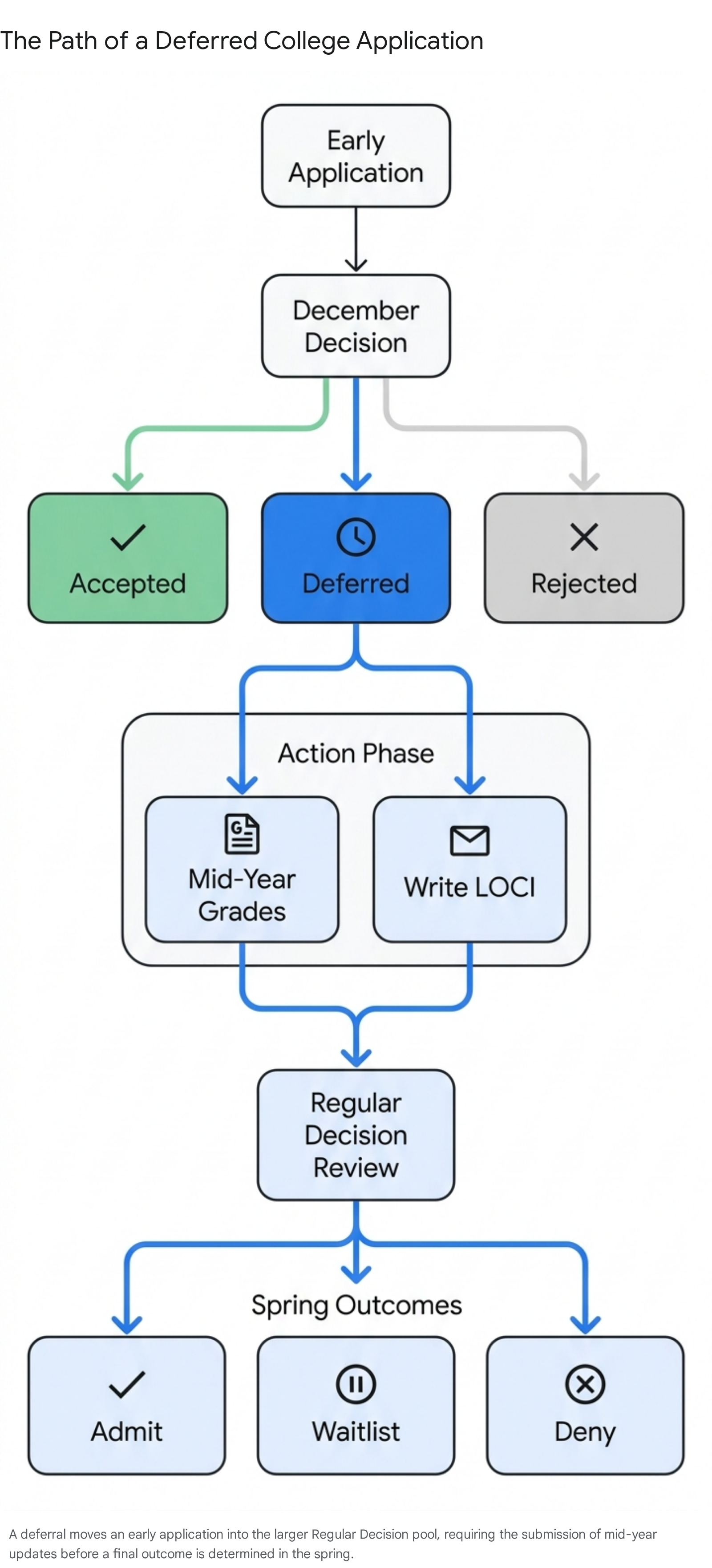
The most critical functional mechanism of a deferral is that it dissolves any prior binding agreements. If a student applies under a binding Early Decision program - meaning they legally committed to attending that specific institution and withdrawing all other applications if accepted - a deferral instantly nullifies that contract [3, 14, 62]. The student is now a "free agent." Even if the deferring college eventually admits them in the spring, the student is no longer legally or ethically bound to attend and may freely compare financial aid packages and offers from other universities [3].
Deferral vs. Waitlist vs. Denial
Students and families frequently confuse deferrals with waitlists, as both involve a delay in gratification and an extended period of uncertainty. However, they occur at entirely different phases of the enrollment management cycle, operate under different statistical probabilities, and require different strategic responses from the applicant [62, 63].
| Feature | Deferral | Waitlist | Rejection / Denial |
|---|---|---|---|
| Timing of Decision | December / January (Early application rounds) [62, 64]. | March / April (Regular decision round) [61, 62]. | Any admissions round. |
| What It Means | The application is paused and moved to the Regular Decision pool for a comprehensive second review [60]. | The student is fully qualified, but the college has run out of available seats for the incoming class [60, 63]. | The college has determined the student is not a competitive fit for the incoming class. |
| Binding Status | Releases the student from any Early Decision binding commitment [14, 62]. | Non-binding. Students must deposit elsewhere by May 1 while they wait [64, 70]. | N/A |
| Probability of Admission | Varies wildly by institution. Students are reviewed holistically against the broader pool [60]. | Highly uncertain. Strictly dependent on how many accepted students decline their offers ("yield") [61, 63]. | 0% |
| Applicant Action Required | Submit mid-year grades and a Letter of Continued Interest (if allowed) [60, 61]. | Formally accept the waitlist spot and submit a Letter of Continued Interest [64, 70]. | Move on and focus on other collegiate options. |
A deferral simply means the admissions office needs more context before extending an offer. A waitlist, on the other hand, is a tool used to manage "yield" - the percentage of admitted students who actually enroll. Colleges cannot perfectly predict human behavior, so they create a waitlist as a holding pattern in case too many accepted students choose to attend elsewhere [60, 63].
Why Deferrals Are Surging in the Modern Admissions Era
To understand how to respond strategically to a deferral, applicants must first understand the macroeconomic and institutional pressures that lead colleges to use them. The deferral is a multifaceted tool that serves the operational, statistical, and demographic needs of a university's enrollment management team. In recent years, the use of deferrals at highly selective universities has surged due to several converging factors.
The Application Volume Explosion and Test-Optional Whiplash
The college admissions landscape underwent a dramatic transformation following the onset of the COVID-19 pandemic. According to the National Association for College Admission Counseling (NACAC) and data from the Common Application, application volumes have surged by 41% compared to pre-pandemic cycles [86, 87]. A primary driver of this massive surge has been the widespread adoption of test-optional policies.
When standardized test scores (SAT/ACT) became optional, it encouraged tens of thousands of students to apply to highly selective "reach" institutions that they might previously have avoided due to lower-than-average test scores [11, 86, 89]. Students who used to apply to five or six colleges are now frequently applying to 15 or 20 schools each, artificially inflating the applicant pools at top-tier universities [86].
For the Fall 2026 admissions cycle, institutions like Emory University, Northwestern University, and the University of Virginia reported double-digit percentage increases in early applications [89]. For example, the University of Virginia received a staggering 57,495 early action applications for the Class of 2030, ultimately deferring 8,480 of those students - a deferral rate of 14.7% [12, 53].
Faced with an overwhelming volume of highly qualified candidates in November, admissions committees simply cannot admit everyone who meets their academic thresholds without risking severe over-enrollment. Deferring a large block of these students allows the college to "wait and see" what the rest of the national and international applicant pool looks like in January before locking in the class [4, 60].
Interestingly, institutions that recently reinstated standardized testing requirements - such as Brown, Dartmouth, MIT, and Yale - have seen the opposite effect. Brown University, for instance, received 1,200 fewer early decision applications in the cycle immediately following the reinstatement of its testing mandate, marking its smallest pool in five years [86]. Yet, even at these schools, deferrals remain a vital tool for managing the applicant pipeline.
The Supreme Court Decision and Demographic Uncertainty
The entire framework of college admissions was fundamentally altered by the June 2023 Supreme Court decision in Students for Fair Admissions, Inc. v. President and Fellows of Harvard College, which effectively struck down race-based affirmative action in higher education [11, 54, 75, 77].
Following the ruling, colleges were forced to urgently re-evaluate how they build diverse incoming classes without relying on racial checkboxes. Institutions pivoted their recruitment focus toward socioeconomic status, geographic diversity, and first-generation college student metrics [13, 77]. Schools like MIT and Stanford expanded recruitment in rural and underserved regions, while Brown University reported that 19% of its early decision admits were first-generation students and 65% had applied for financial aid [13].
Because colleges are now operating under new legal constraints and extreme public scrutiny, many have become far more cautious during the early admission rounds [19, 54]. Admissions officers want the opportunity to view the entire socioeconomic makeup of the global Regular Decision pool before finalizing the majority of the freshman class [11, 13, 76]. The early applicant pool traditionally skews wealthier and less diverse than the regular decision pool. Consequently, deferrals offer institutions the flexibility to hold onto academically qualified early applicants while they assess the broader demographic puzzle of the overall applicant pool in the spring.
Managing the Enrollment Cliff
Another macro-level factor influencing college behavior is the impending "enrollment cliff." Due to birth rate declines stemming from the 2008 financial crisis, the United States is expected to see a roughly 15% decline in the number of high school graduates beginning in 2026 [2, 86].
While elite, highly selective Ivy League universities will likely weather this demographic shift without issue, regional public universities and small private liberal arts colleges are bracing for a severe contraction in their applicant pools [2, 86]. This demographic reality makes colleges incredibly protective of their enrollment targets. They use early decision rounds to lock in guaranteed tuition revenue, and they use deferrals to build a deep "bench" of qualified applicants they can draw from later if their regular decision numbers fall short of financial projections [2, 32].
The FAFSA Fiasco
Recent delays and systemic issues with the rollout of the simplified Free Application for Federal Student Aid (FAFSA) have also injected chaos into the admissions timeline [2, 18]. Because colleges have faced delays in receiving Institutional Student Information Reports (ISIRs), they have struggled to generate timely financial aid packages [2, 18].
When students cannot see their financial aid offers, they are less likely to commit to a school. This creates a ripple effect of uncertainty regarding yield rates [86]. To combat this unpredictability, colleges have increased their reliance on deferrals and waitlists, essentially keeping a larger percentage of students on standby until the financial aid landscape stabilizes [86].
Institutional Philosophies: Not All Deferrals Mean the Same Thing
It is crucial for students to understand that a deferral means something entirely different depending on the specific university. Colleges employ vastly different philosophies regarding how they treat their early applicant pools. Applicants should research historical deferral data for their specific institutions to properly calibrate their expectations.
The "Defer Most" Strategy
Some highly selective institutions use the early round to accept a very small, elite cohort and defer almost everyone else who meets the baseline academic criteria. For example, in recent cycles, Harvard University deferred an astonishing 83% of its early applicants, denying only about 8% [14]. Similarly, the Massachusetts Institute of Technology (MIT) deferred 64% of its early applicants, pushing over 8,000 students into the regular round [13, 14]. Georgetown University and the University of Southern California (USC) famously have policies of deferring essentially all students who are not accepted in the early round [14].
If you receive a deferral from a "Defer Most" school, you should not take it as a special indicator of your competitiveness. It is simply standard operating procedure for the vast majority of their applicants. The deferral functions more like a receipt acknowledging that your application was read and passed the minimum threshold for regular review.
The "Deny Most" Strategy
Conversely, universities like Stanford, Duke, Northwestern, Middlebury, and Notre Dame actively deny the majority of students who are not accepted in the early round [14]. At these institutions, the admissions committee prefers to rip the band-aid off quickly.
If you receive a deferral from a "Deny Most" institution, it is a distinct compliment. It signals that the admissions committee found your application highly competitive and is giving you serious, legitimate consideration for the final class [14]. At these schools, a deferral is a clear invitation to send updates and fight for your spot.
The "Shifting" Strategy
Some schools change their deferral policies dynamically based on application volume and internal data. Yale University provides the starkest recent example of this shift. For the Class of 2025 and prior years, Yale deferred roughly 50% of its early applicants [1, 14]. However, admissions leadership realized this was stringing too many students along. Yale drastically altered its approach for the Class of 2028, deferring only 19% of early applicants and denying 70% outright [1, 14].
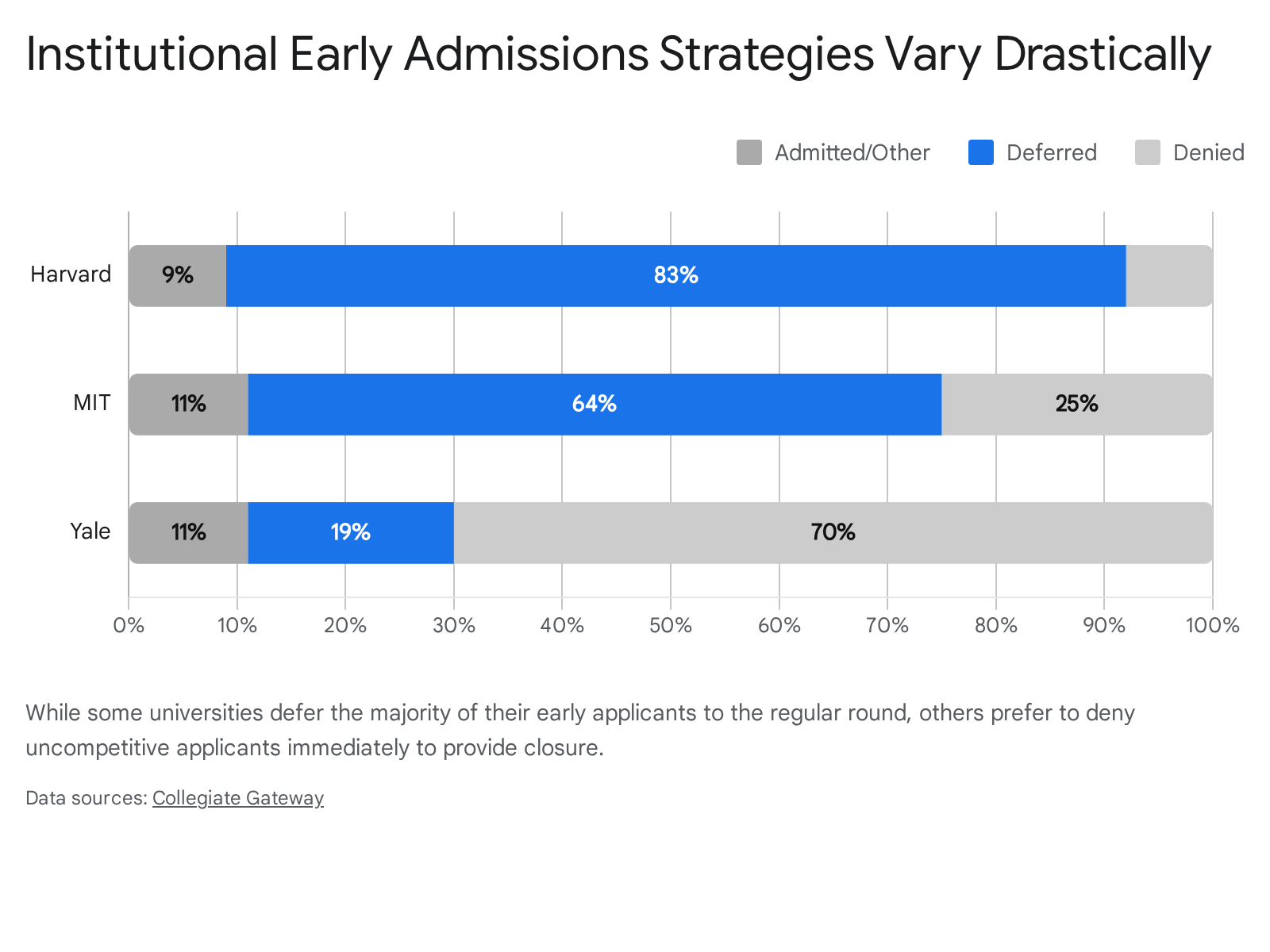
Brown University enacted a similar shift. Where it once deferred 60% of Early Decision applicants (for the Class of 2021), it recently dropped its deferral rate to just 17%, denying 68% of the pool [14]. By denying more students earlier, these universities provide applicants with closure, allowing them to confidently recalibrate their lists for the regular decision round [1].
The Hidden Mechanics of Yield Protection
In higher education enrollment management, "yield" is a metric of massive importance. It represents the percentage of admitted students who ultimately choose to enroll [4, 62]. High yield rates are the hallmark of elite institutions; they allow colleges to accurately forecast housing needs, tuition revenue, and class sizes, while simultaneously boosting the institution's perceived prestige and selectivity rankings [49, 86].
When a college reviews an early application, they are not only asking, "Is this student academically qualified?" They are also asking, "If we admit this student, will they actually come here?" [40, 68].
This dynamic leads to a phenomenon colloquially known as "yield protection" (or "Tufts Syndrome"). Occasionally, a student with exceptional test scores and a flawless GPA will apply to a "target" or "safety" school during the early action round, fully expecting an acceptance, only to be hit with a deferral [22, 49].
Why does this happen? The admissions algorithm at that college has flagged the applicant as overqualified. The college assumes the student is using them as a backup plan while waiting for an Ivy League acceptance [22]. Rather than accepting the student and risking a hit to their yield rate when the student inevitably declines the offer, the college defers them [4, 22].
This is precisely why a deferral is not a rejection. It is often a test of the applicant's demonstrated interest. If the deferred student takes the time to write a compelling update, it signals to the college that the student is highly likely to enroll if accepted in the regular round, overcoming the college's yield protection anxieties [64, 65].
The Committee Room: How Your File Is Actually Read
To understand how to position yourself after a deferral, it helps to demystify the physical process of application review. Admission offices divide the globe into geographic regions. Each region is assigned a specific admissions officer who becomes the "regional reader" for all applications originating from that area (e.g., "parts of Europe, New Zealand, and Brooklyn") [37].
This regional officer is the first person to read your file. They review your transcripts, essays, and recommendations, and they evaluate you within the context of your specific high school [1, 37]. During the reading season - stretching from October to March - an admissions officer may review dozens of applications a day, totaling thousands over the cycle [67]. Because they read at such a high volume, they spend a relatively short amount of time on each file - sometimes only 10 to 15 minutes [67].
If the regional officer believes an applicant is strong, they become the applicant's shepherd and advocate, presenting the file to the broader Admissions Committee [37]. In the committee room, a group of officers will debate the merits of borderline candidates [37].
When an applicant is deferred, it often means the regional officer liked the file but lacked the definitive ammunition needed to win over the rest of the committee. Perhaps there was a slight downward trend in junior year math grades, or the extracurricular list lacked a major leadership role [37].
Your goal after a deferral is to provide your regional officer with new, concrete ammunition to take back into the committee room in February [36].
Your Strategic Action Plan: What to Do Immediately
The days following a deferral notification can be emotionally taxing, but they represent a critical window for strategic action. Deferred applicants should follow a deliberate, step-by-step process to maximize their chances in the regular round while protecting their broader collegiate options.
Step 1: Read the College's Instructions Carefully
The single biggest mistake a deferred student can make is ignoring the specific instructions provided in their applicant portal or deferral letter [94]. Colleges handle deferrals very differently, and compliance is the first test of your candidacy.
- Some schools explicitly forbid updates: If a university states, "No further information is needed from the applicant unless requested," sending unsolicited letters, extra recommendations, or updated resumes will not show passion; it will signal arrogance and an inability to follow basic directions [9, 94]. Unsolicited materials in these cases simply annoy busy admissions officers [9].
- Some schools use specific forms: Institutions like MIT and Purdue University require deferred students to fill out specific, proprietary update forms (e.g., MIT's "February Update Form" or Purdue's 500-word form) rather than sending an open-ended email [49, 71].
- Some schools welcome traditional letters: Many schools, such as Notre Dame, encourage deferred students to upload an "intentional and authentic" letter through the applicant portal explaining why the school is the right fit [94].
A strong deferral strategy begins with exact compliance. Log into your portal, read the deferral letter line by line, and follow the institution's specific pathway.
Step 2: Ensure Mid-Year Grades Are Submitted
Because your application is moving to the regular decision pool, the admissions committee will want to see how you performed during the first semester of your senior year [1, 60, 61]. Colleges want to ensure you are maintaining your academic rigor and not falling victim to "senioritis."
You must proactively communicate with your high school guidance or college counseling office to ensure that mid-year transcripts are sent to the deferring college as soon as they become available in late January or early February [1, 97]. If your grades have improved, or if you have taken on more rigorous Advanced Placement (AP) or International Baccalaureate (IB) coursework and succeeded, this data point alone can significantly move the needle in the regular round [1, 60].
Step 3: Evaluate Early Decision II (ED2) Options
If you applied via a binding Early Decision I (ED1) program and were deferred, you are officially released from that contract. This opens a strategic window: the Early Decision II (ED2) pivot [3, 22].
Many selective private universities offer an ED2 round. This functions exactly like ED1 - it is a binding agreement to attend if accepted - but the deadline is typically aligned with Regular Decision deadlines in early January or February [3, 22].
If you have a clear second-choice school that offers ED2, you can convert your existing Regular Decision application to an ED2 application simply by signing a new agreement [3]. Because colleges love the guaranteed yield that comes with Early Decision, ED2 acceptance rates are frequently higher than Regular Decision rates [3, 7].
However, you must be absolutely certain you want to attend the ED2 school and that your family can afford the tuition without comparing financial aid packages [3]. If you are accepted via ED2, you will be required to formally withdraw your deferred application from your original top-choice school [3].
Step 4: Finish Regular Decision Applications
A deferral is not an acceptance. Statistically, the majority of deferred applicants will ultimately be denied in the spring [49]. Therefore, you must not halt your broader college application process to obsess over a single deferral.
The immediate priority should be completing and polishing applications for target and likely (safety) schools before the January deadlines [3, 36]. The goal is to build a balanced, well-researched list of Regular Decision options. Doing so ensures that you will have genuine choices - and potential financial aid leverage - when National Decision Day arrives on May 1 [89].
How to Master the Letter of Continued Interest (LOCI)
If the deferring college allows the submission of additional materials, the most powerful tool in your arsenal is the Letter of Continued Interest (LOCI). A LOCI is a concise, professional update sent to the admissions office that reaffirms your desire to attend and provides meaningful updates on your senior year [65, 91].
Timing, Formatting, and Delivery
A LOCI should typically be sent between one to three weeks after receiving the deferral notice, ensuring your file is updated well before the admissions committee reconvenes for the regular review phase in February [90, 91].
The letter should be formatted as a professional email or uploaded directly as a PDF to the applicant's status portal, depending entirely on the school's preference [73, 91]. If sending via email, the subject line should be clear and professional (e.g., "Letter of Continued Interest - [Your Name] - [Applicant ID]").
Crucially, the letter should be addressed directly to the regional admissions officer responsible for your high school - not the Dean of Admissions or a generic "To Whom It May Concern" [37, 69, 73, 98]. As discussed, the regional officer is your primary advocate; addressing them by name shows initiative and respect [67, 73].
The letter must be brief. Admissions officers read thousands of applications during the winter months and suffer from severe reading fatigue [67]. A LOCI should be no longer than one page, or roughly 400 to 500 words [70, 71, 93].
The Anatomy of an Effective LOCI
A highly effective LOCI is not a passionate plea for acceptance; it is a strategic character addendum [94]. It should follow a specific, four-part architecture:
- Gratitude and Reaffirmation of Intent: The opening paragraph should thank the admissions committee for their continued consideration of your application [8, 10, 93]. Most importantly, if the college remains your absolute first choice, you should state clearly and unequivocally: "If admitted, I will enroll." [10, 65, 97]. Because colleges are fiercely protective of their yield rates, a definitive promise to attend provides a tangible incentive for the committee to advocate for you [4, 62, 96]. If the school is not your absolute first choice, simply express your strong continuing interest without making a binding promise.
- Substantive, Third-Party Validated Updates: The body of the letter should feature one or two paragraphs detailing major achievements that have occurred since the application was submitted in October or November [65, 90, 94]. Strong updates include winning a state-level award, being named captain of a spring sport, securing a new internship, or executing a major community service project [65, 70, 74]. These updates should rely on third-party validation and include concrete metrics (e.g., "Our fundraiser collected $5,000 for local shelters") to provide scale and proof of impact [65, 70].
- Specific Institutional Fit: Briefly reconnect your new achievements or academic interests to the specific campus culture, academic programs, or faculty research at the college [70, 93]. Mention a specific professor's lab you hope to join, or a newly opened campus facility [70]. This demonstrates that your interest is highly informed, sustained, and not just based on prestige or rankings [40, 94].
- Professional Sign-off: The conclusion should be polite, reiterating gratitude for the officer's time. Include your full name, high school name, and applicant ID number below your signature to make it easy for the officer to locate your file [93].
What to Avoid in a LOCI
Admissions officers frequently note that a poorly executed LOCI can actively harm a student's chances [36, 94]. Applicants must carefully avoid several common pitfalls:
- Do Not Regurgitate the Application: The admissions officer has already read your Common App essay, your activities list, and your transcripts. Repeating this information wastes their time and makes the file unnecessarily thick [36, 65, 94]. A LOCI must be dedicated to new information [94].
- Do Not Use Artificial Intelligence: In recent cycles, admissions offices have been flooded with highly generic, overly polished letters generated by ChatGPT and other AI language models [19, 94]. Admissions readers are highly trained to recognize authentic student voices; an artificially generated letter strips you of your humanity, sincerity, and credibility [94]. You must write the letter yourself.
- Do Not Be Bitter or Presumptuous: The tone of the letter should be positive, confident, and forward-looking. You should never complain about being deferred, express anger, whine about the injustice of the process, or assume you know why you were not admitted in the early round [8, 10].
- Do Not Stalk the Admissions Office: There is a persistent myth that constant contact shows "passion." In reality, frequent, unprompted communication irritates busy admissions professionals [7, 36]. You should send one comprehensive LOCI [93, 96]. Sending weekly email updates, calling the office repeatedly, or treating the regional admissions officer's inbox like a social media feed is highly unprofessional and will likely result in a rejection [7, 96]. You cannot annoy your way into a university.
The Role of External Advocacy
When faced with a deferral, students often wonder if they should mobilize a small army of teachers, alumni, and counselors to advocate on their behalf. In most cases, restraint is the better strategy.
Counselor Advocacy
Your high school guidance or college counselor can sometimes act as a valuable intermediary. Depending on their relationship with the university, a counselor might make a brief phone call or send a targeted note to the regional admissions officer to provide context for a slight dip in grades or to reiterate your strong interest [10]. However, this should supplement - not replace - your own efforts. Admissions officers want to see that the applicant is taking agency over their own future [74]. The LOCI itself must come directly from the student.
Additional Letters of Recommendation
Most elite universities already require two teacher recommendations and one counselor recommendation. Sending a flurry of extra recommendations after a deferral is generally frowned upon; it clutters the file [10, 36, 40].
The only exception to this rule is if an additional letter provides a completely different perspective on your abilities that is absent from your original application [10]. For example, if your original letters were from a math teacher and a history teacher, an additional short letter from an internship supervisor or a community organization director might be valuable. Even then, you should only send one additional letter, and only if the college's portal explicitly allows it [10, 48].
Managing the Mental and Emotional Game
The psychological toll of the modern college admissions process is significant. High-achieving students invest years of their lives building resumes, studying for standardized tests, volunteering, and writing deeply personal essays, only to have their applications sorted and judged by unseen committees [67]. Receiving a deferral can feel incredibly destabilizing, bruising the ego and inducing what counselors call "portal panic" [4, 22, 70].
When a deferral arrives, it is essential for both students and parents to logically contextualize the decision.
First, a deferral is not a referendum on a student's worth, intelligence, or future potential [42]. Often, it is simply a reflection of structural supply and demand. If a university has 2,000 seats in its freshman class and receives 50,000 applications, thousands of valedictorians, team captains, and brilliant scholars will inevitably be turned away or deferred [39, 46].
Second, institutional priorities play a massive, invisible role in who is admitted in the early round. A college may need to fill the orchestra's oboe section, balance the gender ratio in the computer science department, or fulfill geographic diversity targets to ensure every state is represented [22, 23, 62]. If you do not fit the specific puzzle piece the college needs in December, you may be deferred to see how you fit into the larger puzzle in March.
Third, parents must be mindful of projecting their own anxieties onto their children. Independent educational consultants warn against the phenomenon of "toxic grit," where college planning becomes a stressful second job for high-achieving parents [26]. If a student is not overly devastated by a deferral, parents should not manufacture a crisis [22]. Instead, parents should "read the room" and help their child gracefully pivot toward completing their remaining applications [22].
Students should allow themselves the grace to feel disappointed, but they must quickly pivot away from catastrophizing thoughts like, "I won't get in anywhere" [22]. A deferral from a dream school has no bearing on decisions from other institutions.
Counselors often advise students to reframe the deferred application as a "lottery ticket" - an investment that has been made and is now out of their hands [36, 68]. If the ticket pays off in the spring, it is a wonderful surprise. If it does not, the student has already built a robust list of alternative options. By accepting the uncertainty and letting the cards fall where they may, students can reclaim their peace of mind and actually enjoy the final months of their high school experience [36].
Bottom line
A college deferral is a temporary pause, not a final denial, serving primarily to move an early application into the regular decision pool for a broader comparative review. Deferred students must prioritize finishing their remaining applications to ensure a balanced list of options, submitting updated mid-year grades, and - if the college expressly allows it - writing a single, highly specific Letter of Continued Interest that highlights new achievements. While the final outcome remains statistically uncertain due to soaring application volumes and complex institutional yield management strategies, a calm, strategic, and professional response ensures the application remains as competitive as possible in the spring.