
How to Write a College Letter of Continued Interest
A Letter of Continued Interest is a concise, professional message sent to a college admissions office after an applicant is placed on a waitlist or deferred. It serves to reaffirm the student's desire to attend and highlights meaningful achievements that occurred after the original application was submitted. When crafted with specific institutional details and an authentic voice, this letter provides risk-averse admissions committees with the confidence needed to offer a final spot in their incoming class.
Understanding the College Waitlist and Deferral Mechanisms
When college applicants receive their decisions, the results are rarely limited to simple acceptances and rejections. Many students find themselves placed on a waitlist or deferred to a later admissions round, leaving them in a state of administrative limbo 12. A Letter of Continued Interest, frequently abbreviated as a LOCI, serves as the primary vehicle for students to communicate their ongoing enthusiasm for a specific institution after receiving one of these uncertain outcomes 34.
The strategic context of the letter depends entirely on the student's current admissions status. Deferrals typically occur when a student applies during an early admissions window, such as Early Action or Early Decision. In these instances, the college decides it needs more time to review the applicant against the broader Regular Decision pool, often waiting to see senior-year grades, new test scores, or how the overall demographic makeup of the applicant pool evolves 235. Waitlisted applicants, conversely, encounter their status at the end of the admissions cycle. A waitlist decision means that a college has already filled its projected incoming class but wants to keep a roster of fully qualified applicants on standby 245. Because universities cannot perfectly predict how many accepted students will ultimately enroll, they turn to the waitlist to fill any remaining seats after the national commitment deadline passes 252.
In both scenarios, the letter is the most direct tool an applicant possesses to influence the final outcome. It functions as a mechanism for "yield protection" - a metric that colleges care deeply about 78. Yield refers to the percentage of admitted students who choose to enroll. Because high yield rates protect institutional bond ratings, elevate national rankings, and stabilize tuition revenue, universities want to offer admission only to students who are highly likely to accept 783. A well-crafted letter that explicitly promises attendance drastically lowers the institutional risk of offering that student a highly coveted spot 8.
The Statistical Reality of Waitlist Admissions
Colleges actively read these letters of interest, provided they have not explicitly asked students to refrain from sending them. According to data from the National Association for College Admission Counseling (NACAC), highly selective institutions utilize waitlists heavily to manage their enrollment targets. During a typical admissions cycle, over forty percent of all institutions report using a waitlist, and that number surges to over eighty percent among highly selective universities 24.
However, writing a letter does not guarantee admission. Waitlist acceptance rates fluctuate wildly depending on the year, the specific university, and the volume of available space. While the national average of students admitted from waitlists hovers around twenty percent, at highly selective institutions, that number plummets to roughly seven percent 2. At Ivy League and equivalent tier schools, waitlist acceptance rates often range between zero and seventeen percent depending on the enrollment volatility of any given year 1112.
Despite these daunting odds, admissions experts note that sending a targeted communication remains one of the few proactive steps a student can take. Because many waitlisted students view the decision as a soft rejection and simply move on to other universities, submitting a thoughtful, highly specific update signals a level of commitment that separates active candidates from those holding a waitlist spot out of sheer inertia 121314.
How Institutional Priorities Dictate Waitlist Movement
A common misconception among applicants is that waitlists operate as strictly ranked academic ladders, where the student with the highest grade point average is the first to receive a call. In reality, colleges rarely rank their waitlists 1516. The movement of a waitlist is dictated almost entirely by "institutional priorities" - the specific, shifting needs of the university as administrators attempt to balance and shape the incoming class 15161718.
Institutional priorities encompass highly nuanced demographic and academic goals that are set at the highest levels of university leadership, often by the board of trustees or the university president 1819. These priorities can include balancing the ratio of in-state to out-of-state students, managing gender parity across specific departments, or hitting targets for first-generation college students 1718. If a college expected fifty mathematics majors to enroll but only forty submitted deposits by the May deadline, the admissions committee will specifically filter the waitlist for students who indicated an intent to study mathematics 15.
Furthermore, institutional priorities often intersect with financial realities. While many elite institutions are need-blind during the regular admissions round, they frequently become need-aware when pulling students from the waitlist 1518. Universities with exhausted financial aid budgets may be forced to prioritize waitlisted students capable of paying full tuition without institutional assistance 1519. Other priorities might include legacy considerations, recruitment for specific athletic programs, or geographic diversity aimed at ensuring all fifty states are represented in the freshman class 1819. Because these macroeconomic and institutional factors are entirely outside an applicant's control, a waitlist rejection should never be viewed as a reflection of the student's academic worth or future potential 21619.
Crafting the Letter: A Structural Framework
Admissions officers reading waitlist appeals are exhausted, facing massive volumes of reading during the spring admissions cycle. They are looking for two specific pieces of information: whether the student will attend if admitted, and whether anything new has happened to strengthen their academic or extracurricular profile 81220. Any content outside of these two parameters is generally considered unhelpful filler.
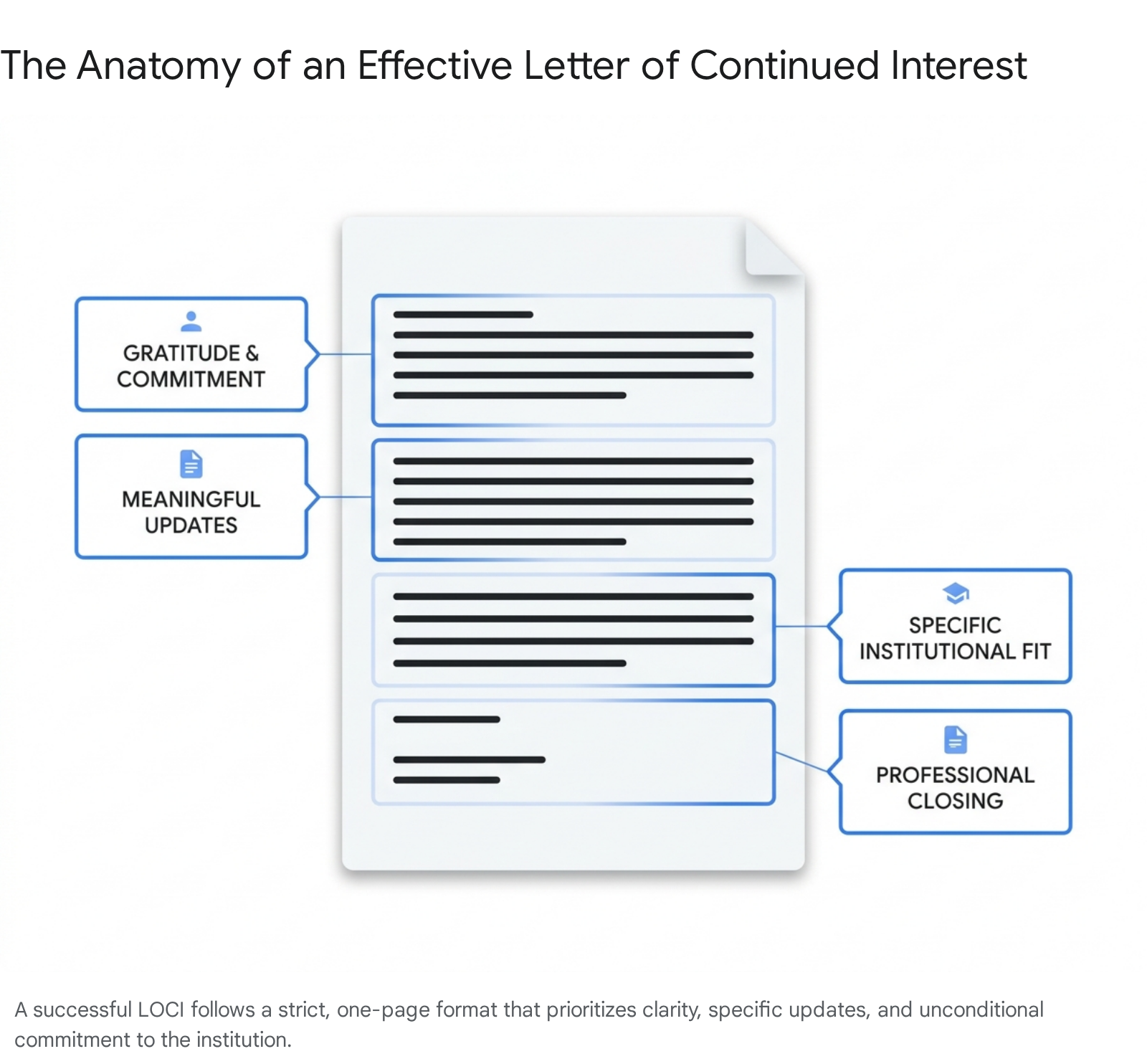
The most effective letters are roughly half a page to one full page in length, usually totaling between 350 and 500 words 81321. Successful letters strictly avoid serving as a secondary personal statement and instead function as a professional piece of correspondence. The structure generally follows a precise, four-part narrative flow 481321.
Step One: Gratitude and Unconditional Commitment
The opening paragraph must be entirely direct. It begins by thanking the admissions committee for their continued consideration and stating clearly that the school remains a top choice 56. If the applicant is completely certain they will enroll if admitted, they must state this unconditionally. Admissions readers appreciate certainty; an unambiguous declaration that the student will accept an offer without hesitation removes all guesswork regarding yield protection 857. Students applying to multiple waitlists should only make this unconditional promise to one institution, as reneging on such a promise is highly unprofessional.
Step Two: Meaningful Updates and Narrative Progression
The body of the letter serves as a narrative resume update. It highlights one to three significant developments that occurred after the initial application was submitted in the winter 48420. Acceptable updates include improved senior-year academic performance, newly acquired leadership roles, recent competition results, published research, or higher standardized test scores 48205. Crucially, students must not simply rehash their original application or summarize their existing Common App essays, as the admissions committee already has that extensive file on hand 485. This section exists solely to demonstrate continued momentum and intellectual vitality during the final months of high school.
Step Three: Specific Fit and Institutional Connection
The third section bridges the applicant's recent growth with the specific, unique offerings of the university. Rather than offering generic praise for the campus architecture, the pleasant weather, or the dining hall, the applicant points to specific professors, research centers, or academic programs that align perfectly with their stated career goals 482021. If the student recently visited the campus, sat in on a virtual lecture, or spoke at length with an alumnus, mentioning these interactions provides concrete evidence of deep, ongoing research into the institution 77. This demonstrates that the student's interest is informed and mature, rather than superficial.
Step Four: Professional Closing
The conclusion remains brief and highly respectful. It reiterates gratitude for the committee's time, reaffirms the student's hope for a positive outcome, and cleanly signs off 856. It strictly avoids demanding language, emotional manipulation, or an entitled tone, recognizing that the admissions office owes the student nothing 5.
Tactical Approaches to Tone and Phrasing
The tone of the correspondence dictates how the updates are received by an admissions committee. Letters that sound desperate, boastful, or overly generic often harm a student's chances more than sending no letter at all. The following table illustrates how repetitive phrasing can undermine the message, compared to specific, actionable statements that provide true value to an admissions reader.
| Letter Component | Ineffective or Generic Phrasing | Effective and Specific Phrasing |
|---|---|---|
| Commitment Statement | "I am writing to express my continued interest in your university. It is a great school." 21 | "Since applying in October, [University Name] remains my absolute first choice. If admitted from the waitlist, I will deposit immediately." 8217 |
| Academic/Activity Updates | "I want to remind you that I have maintained a 4.0 GPA and I continue to grow as a person." 821 | "Last month, I was elected captain of the varsity debate team and recently placed first in the regional policy tournament." 47 |
| Institutional Fit Evidence | "I love your beautiful campus and vibrant student community. The dining hall was amazing." 821 | "After attending Professor Smith's virtual lecture on sustainable urban planning, my desire to join your Environmental Design program has only deepened." 4721 |
| Professional Closing | "Please reconsider my application soon because I need to make a decision by May 1st." 5 | "Thank you again for your time and continued consideration of my application to the Class of 2029." 57 |
Strategies for Applicants with No New Achievements
A pervasive source of anxiety for waitlisted applicants is a lack of major awards, promotions, or academic breakthroughs between the initial application deadline and the spring waitlist notification. If a student has no groundbreaking news to share, they should still write a letter to reaffirm their commitment and visibility 252627.
In the absence of a major award, students highlight sustained excellence. Mentioning the maintenance of strong grades in rigorous advanced courses serves as a solid baseline update 142627. Furthermore, applicants use this space to discuss deepening their involvement in existing extracurricular activities rather than inventing new ones. Discussing a recent book read outside of class, a small community service project, or even significant personal obligations - such as acting as a caretaker for a sick family member during the spring semester - provides valuable context to an admissions reader regarding how the student handles responsibility and time management 1426. The primary goal is to remain visible, interested, and engaged, preventing the admissions office from assuming the student has simply moved on to another institution.
Navigating the Ethical Do's and Don'ts
Understanding the logistical boundaries of waitlist correspondence is as critical as the writing itself. An aggressive, overly eager, or rule-breaking approach easily crosses the line into annoyance, actively harming an applicant's profile.
The absolute first step a student must take is to follow the college's specific instructions for formally accepting their spot on the waitlist, which is almost always done through the university's digital applicant portal 48. Sending an email to an admissions officer without clicking the official "opt-in" button renders the letter useless. Similarly, if a university explicitly requests that waitlisted students send no additional materials - a policy maintained by institutions like Stanford University, New York University, and the University of Virginia - applicants must adhere to that guideline 1208. Disregarding a direct instruction to avoid sending letters demonstrates an inability to follow basic rules and frustrates busy admissions staff 1208.
Timing also plays a critical role in the efficacy of the correspondence. For deferred students, the letter is generally expected within roughly four weeks of the deferral notice, ideally ensuring the admissions team receives it before they dive deeply into the Regular Decision reading period 29. For waitlisted students, the letter should be dispatched within one to two weeks of receiving the initial waitlist offer in the spring 209. Sending the letter too early, such as within hours of the decision, appears reactive and unpolished. Sending it in late May, well after the initial wave of waitlist movement has occurred, often means the opportunity has already passed 89.
Furthermore, students must secure a backup plan. Because waitlist offers are entirely precarious, applicants must submit a non-refundable financial deposit to an institution that accepted them by the standard May commitment deadline 4931. This guarantees a seat in a freshman class somewhere. If the student is later admitted off their preferred waitlist, they accept the new offer and withdraw from their backup school, forfeiting the initial deposit 931. Finally, students must avoid bombarding the admissions office. One high-quality letter sent at the right time is sufficient. Sending multiple follow-up emails, submitting unsolicited portfolios, or orchestrating campaigns where family members call the office is universally viewed as counterproductive 48205.
Artificial Intelligence and the Search for Authentic Voice
In the post-2024 admissions cycle, generative Artificial Intelligence tools like ChatGPT have fundamentally disrupted how students write and how admissions officers evaluate applications. As AI integration expands into the college search process, a massive premium has been placed on the "authentic voice" of the applicant 103311. This technological shift alters the stakes of waitlist correspondence, turning the letter into an authenticity test.
Admissions committees, whose professionals read thousands of applications annually, have become highly adept at spotting AI-generated text without needing to rely on specialized, often flawed detection software 333536. AI tends to produce essays and letters that are structurally and grammatically flawless but emotionally hollow and profoundly generic 333536. These texts often rely on predictable, formulaic paragraph structures and an overuse of soulless, corporate vocabulary. Words like "delve," "augment," "optimize," and "testament" are frequent tells that a machine has sanitized the prose 36. When an admissions officer reads a letter that sounds like a smoothed-out, risk-averse adult rather than an enthusiastic seventeen-year-old, the student's unique personality is entirely erased 3537.
The core issue is that large language models cannot genuinely experience failure, vulnerability, or authentic personal growth 3335. Relying on an algorithm to draft a personal statement or a waitlist appeal strips the application of the exact human elements that top-tier colleges are actively searching for. The concern among educators is severe; in a recent College Board survey, seventy-four percent of higher education faculty noted that students are using AI to write essays, and over eighty-four percent agreed that this automation reduces critical thinking, originality, and deep engagement 37.
Universities are now explicitly addressing this paradigm shift in their public-facing application instructions. For example, Boston University's admissions guidelines state clearly that while the university encourages the exploration of new technologies like ChatGPT, the Board of Admissions believes the most compelling personal statements represent a writer's authentic voice - a distinct nuance that generative AI tools have yet to achieve 12. Students are permitted, and sometimes encouraged, to use AI as a collaborator to brainstorm ideas, overcome writer's block, or generate questions for campus tours, but the final prose must be unequivocally their own 10113536. An application component that features a few minor grammatical imperfections but sounds unmistakably like a real high school student will consistently outperform a polished, soulless essay generated by an algorithm 3337. To win the "authenticity arms race," applicants are advised to lean into hyper-specific micro-moments, localized context, and genuine self-reflection that an AI lacks the lived experience to fabricate 3336.
Systemic Disruptions Reshaping the Waitlist
Beyond the technological shifts of artificial intelligence, the mechanics of college admissions and waitlist management have been severely disrupted by macroeconomic and legal shocks in recent years. Understanding these external pressures provides critical context for why waitlists operate unpredictably and why a well-timed letter of interest is necessary.
The End of Affirmative Action
In June 2023, the United States Supreme Court issued a landmark 6-3 decision in the consolidated cases of Students for Fair Admissions v. Harvard and Students for Fair Admissions v. UNC. This ruling struck down decades of race-conscious admissions practices, determining that the consideration of an applicant's race violates the Equal Protection Clause of the Fourteenth Amendment and Title VI of the Civil Rights Act 134041. Chief Justice John Roberts, writing for the majority, emphasized that students must be evaluated as individuals based on their skills and lessons learned, rather than the color of their skin 1314. Justice Sonia Sotomayor dissented, arguing that race-conscious policies remained necessary to address systemic societal inequities 13.
This legal earthquake forced highly selective colleges to instantly redesign their holistic review processes to comply with the law while still attempting to build diverse student bodies 134041. The immediate fallout was visible in the subsequent enrollment cycles. At the Massachusetts Institute of Technology (MIT), the incoming class following the ruling saw Black student enrollment drop significantly from thirteen percent to five percent, while Hispanic enrollment dropped from fifteen percent to eleven percent 15. Asian-American enrollment, meanwhile, rose from forty-one percent to forty-seven percent 15. These shifts mirror historical data from California, which banned affirmative action via Proposition 209 in 1996 and subsequently saw long-term declines in Black and Hispanic enrollment at flagship public universities 13.
The Supreme Court ruling did include a caveat: universities are not prohibited from considering an applicant's discussion of how race affected their life, provided that discussion is tied to the student's unique courage, determination, or ability to contribute to the university community 4014. As universities navigate this strictly race-neutral landscape, admissions offices may utilize waitlists even more aggressively to carefully manage class composition across other legal vectors, such as socioeconomic status, geographic origin, and intended major 151315.
The FAFSA Rollout Crisis
Simultaneously, the higher education sector faced a massive logistical crisis regarding financial aid. The 2024-2025 rollout of the newly simplified Free Application for Federal Student Aid (FAFSA) - mandated by Congress to expand Pell Grant access - resulted in historic delays and processing errors by the U.S. Department of Education 161746.
Under normal circumstances, colleges receive an Institutional Student Information Record (ISIR) in the winter, allowing them to calculate a student's financial need and distribute financial aid award letters alongside acceptance letters in March 1646. However, widespread technological failures, coupled with a controversial new methodology for calculating the Student Aid Index (SAI), meant that colleges did not receive accurate FAFSA data until mid-March or April 161746. The crisis disproportionately affected low-income, first-generation, and mixed-documentation families, leading to a massive drop in overall FAFSA completion rates 17.
Because colleges could not distribute accurate financial aid packages, students could not make informed enrollment decisions. Consequently, institutions across the country were forced to push their traditional May 1 national commitment deadlines deep into May or even June 317. A survey by the National Association of Independent Colleges and Universities (NAICU) indicated that nearly half of private, nonprofit colleges found their incoming class "more difficult to fill" due to these unprecedented delays 47. For waitlisted students, the FAFSA crisis translates to a much longer, more agonizing period of administrative limbo. Colleges simply do not know how many spots they have available, or what their yield will be, until much later in the summer 93148. This extended timeline makes the prompt submission of a continued interest letter even more crucial, ensuring the student remains highly visible when the delayed enrollment dust finally settles and spots open up 33146.
Institutional Ethics and NACAC Guidelines
To protect students from predatory practices during these periods of high stress and extended waiting, the National Association for College Admission Counseling (NACAC) publishes a Guide to Ethical Practice in College Admission. This document serves as the foundation for professional conduct among high school counselors and university admissions officers 31819.
Regarding waitlists, the ethical guidelines establish strict boundaries for how colleges operate. Universities are advised to include historical data in their waitlist offers, showing the range of students admitted from the list in previous years, to prevent students from holding onto false hope 318. Crucially, colleges are strictly forbidden from requiring a financial deposit or setting a fee simply to remain on a waitlist 318.
If a student is pulled from the waitlist after the traditional May 1 deadline, the institution must grant the student at least forty-eight hours to make a verbal or written commitment, preventing high-pressure, exploding offers that force students into rash decisions 318. Furthermore, the college must notify the student of their complete financial aid offer and housing availability before demanding that final enrollment commitment 318. Finally, universities are expected to close their waitlists and notify all remaining candidates of their final rejection no later than August 1, allowing students to proceed with their collegiate careers elsewhere without lingering uncertainty 318.
Comparative Analysis: International Waitlist Procedures
The concept of the Letter of Continued Interest is primarily a phenomenon of the holistic admissions system utilized in the United States. International applicants exploring universities outside the U.S. will encounter vastly different, and often highly rigid, procedures regarding enrollment waitlists. The following table summarizes how major international education markets handle applicants who are not immediately offered a seat.
| Country | Waitlist System Mechanics | Letter of Continued Interest Efficacy |
|---|---|---|
| United States | High utilization. Waitlists are unranked and managed holistically to shape class demographics and meet institutional priorities. 21517 | High. LOCIs are expected, widely read, and serve as a primary metric for determining an applicant's likelihood to enroll (yield). 8412 |
| Canada | Centralized and heavily data-driven. Massive public universities rely almost exclusively on high school grade distributions. 51 | None. Canadian institutions generally do not utilize LOCIs. Admissions are strictly metric-based, and lobbying the admissions office yields no results. 51 |
| United Kingdom | Waitlists exist primarily for highly competitive, quota-capped courses (e.g., Medicine, Dentistry) where applicants undergo extensive interviews. 2053 | Very Low. Handled locally by the provider outside the centralized UCAS portal. Admissions are driven by entrance exams and interview scores rather than holistic appeals. 205321 |
| Australia | Domestic students apply via Tertiary Admissions Centres based strictly on ATAR scores. International students face rolling admissions tied strictly to English proficiency and academic thresholds. 22562324 | None. The system lacks the holistic "fit" component of the US. If score thresholds are met and space is available, admission is granted. Negotiation via letters is not practiced. 22562425 |
As the comparison demonstrates, international students applying to schools in Sydney or London should not expend energy crafting persuasive letters. In Australia, for example, students apply through state-based systems and are admitted almost entirely on their Australian Tertiary Admission Rank (ATAR) or equivalent international exams 2224. Universities in these jurisdictions function under strict regulatory oversight, such as Australia's Tertiary Education Quality and Standards Agency (TEQSA), which emphasizes objective entry requirements over subjective measurements of institutional fit 5625.
Distinguishing Between a LOCI and an Admissions Appeal
A frequent point of confusion for families navigating the college process is the distinction between a Letter of Continued Interest and an Admissions Appeal Letter. While both are forms of written communication sent to an admissions office after a decision is rendered, they serve entirely different purposes, are triggered by different outcomes, and carry vastly different probabilities of success.
An Admissions Appeal is a formal request asking a university to reverse a final decision of rejection 6026. This route should only be pursued under extreme, highly specific circumstances. Appeals are generally only successful if the applicant can provide documented evidence of a severe administrative error - such as a high school counselor failing to transmit a critical transcript, a grading error on a standardized test that has since been corrected, or a massive, previously undisclosed medical emergency that derailed an otherwise stellar academic record 6026. Writing an appeal letter simply because a student desires to attend the school or feels they are qualified will result in a swift denial; rejections are considered final in the vast majority of cases 260.
Conversely, the LOCI is utilized strictly when a student is deferred or placed on a waitlist 360. In these instances, the university has explicitly signaled that the student is qualified to attend and remains in the running for a seat 260. The LOCI is an expected, professional follow-up that many universities actively rely upon to gauge the true interest of the remaining applicant pool 412. Where an appeal attempts to overturn a closed door, the LOCI simply aims to walk through a door that has been left intentionally ajar.
Bottom line
A Letter of Continued Interest remains an essential tactical component for any student looking to convert a waitlist or deferral status into a final offer of admission. By submitting a concise, one-page letter that unequivocally reaffirms interest and highlights recent, meaningful achievements, applicants reassure risk-averse colleges that they will enroll if accepted, thereby protecting the institution's yield. While macroeconomic factors - ranging from FAFSA delays and the end of affirmative action to shifting institutional priorities - make waitlist odds inherently unpredictable, a well-written, authentic letter stands as the most effective mechanism for a student to advocate for their place in an incoming class.