
What to Do If You're Waitlisted for College
Being placed on a college waitlist indicates that an admissions committee found you academically and personally qualified for their institution, but they lacked the physical space to offer you an immediate spot in their incoming class. Your immediate response must be to accept your position on the waitlist, formally commit to a backup college by paying an enrollment deposit by their deadline, and submit a concise Letter of Continued Interest to the waitlisted school. Once you have taken these active steps, it is imperative to psychologically move on and prepare for your backup institution, as waitlist movement is historically volatile and entirely dependent on unpredictable institutional needs.
The Mechanics of the College Waitlist
To navigate a waitlist decision effectively, applicants must first understand the internal mechanisms driving modern university admissions. A waitlist is not an arbitrary holding pen, nor is it a mechanism to softly reject applicants. It is a highly calculated enrollment management tool designed to protect the institution from the unpredictable nature of human behavior.
Understanding Yield and Enrollment Modeling
The foundation of the waitlist system is a concept known as "yield." Yield refers to the percentage of admitted students who ultimately choose to accept their offer and enroll at the institution 12. No college, not even the most prestigious university in the world, has a yield rate of one hundred percent. Because students apply to multiple schools and weigh competing offers of financial aid, geography, and academic fit, colleges know that a significant portion of their accepted students will decline the offer.
To hit their enrollment targets - which are strictly dictated by physical dorm capacity, classroom space, and faculty availability - colleges use complex predictive models. They analyze decades of historical data to estimate how many acceptance letters they must send out to secure their exact target class size. However, these models are imperfect. If a college over-admits and too many students say yes, the institution faces catastrophic housing shortages and overcrowded lecture halls. To avoid this, risk-averse enrollment managers intentionally under-admit their incoming class by a slight margin 134.
The waitlist acts as the institutional safety net. If a college's yield model holds true, or if more students accept their offers than expected, the waitlist goes entirely unused. If the yield falls short of expectations, the admissions office will turn to the waitlist to precisely fill the remaining vacant seats without risking over-enrollment 135.
The Myth of the Ranked Waitlist
Perhaps the most pervasive misconception among applicants and their families is that a college waitlist operates like a numbered queue at a deli counter. In this flawed mental model, students assume there is a "number one" applicant waiting to be called, followed by a "number two," and so forth. In reality, almost no selective college utilizes a ranked waitlist 567.
When the traditional May 1 enrollment deadline passes, the admissions committee conducts a comprehensive audit of the students who have formally committed to the incoming freshman class. They look for specific demographic, academic, and extracurricular gaps. This process is known as "class shaping." The admissions office will evaluate whether they have enough engineering majors, whether they successfully recruited students from rural geographies, or whether the campus orchestra has secured enough specific instrument players 178.
If the audit reveals that an unexpectedly high number of prospective physics majors declined their offers, the admissions team will return to the waitlist and specifically pull highly qualified physics applicants to backfill those exact institutional needs 79. A student's chances of being admitted from a waitlist have less to do with their overall academic superiority over other waitlisted candidates, and almost everything to do with how their specific profile aligns with the micro-deficiencies of the committed class 589.
Why Waitlists Are Expanding in the Modern Era
Over the past several years, the size of college waitlists has grown exponentially. At some large public universities, the number of students offered a spot on the waitlist can exceed the size of the entire freshman class by a factor of three or four 41011. This explosion in waitlist size is not a coincidence; it is a direct response to a series of unprecedented systemic shocks to the higher education landscape that have rendered traditional yield modeling nearly obsolete.
The Application Inflation Phenomenon
The proliferation of the Common Application, alongside widespread test-optional policies introduced during the COVID-19 pandemic, has fundamentally altered student application behavior. The friction of applying to college has been dramatically reduced, leading to a massive surge in the average number of applications submitted per student. For the class of 2029, application volumes on the Common App crossed 10 million, representing a 41 percent increase compared to pre-pandemic levels 1213.
As students cast wider nets - with a growing share of applicants applying to ten or more institutions - they naturally generate a higher volume of acceptance letters, while still only being able to enroll in a single school. This system-wide inflation artificially depresses yield rates across the entire higher education sector. To combat the statistical noise of students who are simply applying to see if they can get in without any real intention of attending, colleges have expanded their waitlists to protect their final enrollment numbers from this rampant unpredictability 131415.
The Fallout of FAFSA Delays
The 2024 - 2025 admissions cycle was defined by a catastrophic failure in the rollout of the newly updated Free Application for Federal Student Aid (FAFSA). The federal system experienced profound delays, technical glitches, and calculation errors that prevented colleges from receiving accurate financial data about their applicants until late spring 161710.
Because higher education requires a massive financial commitment, the vast majority of families cannot commit to an institution without seeing a comprehensive financial aid package 1719. With financial aid offers delayed for months, students withheld their enrollment deposits, leaving colleges completely blind to their yield trajectories. Faced with the terrifying prospect of "summer melt" - where students commit but quietly withdraw over the summer due to unexpected financial hurdles - admissions offices deployed massive waitlists as a defensive buffer, resulting in waitlist activity stretching deep into the summer months 3101911.
Post-Affirmative Action Demographic Shifts
In June 2023, the United States Supreme Court effectively banned race-based affirmative action in college admissions, forcing highly selective institutions to fundamentally rewrite their holistic review processes 212212. The immediate fallout of this ruling created what analysts call a demographic "cascade effect."
Preliminary enrollment data indicates that highly qualified students from underrepresented minority groups, who historically might have enrolled at elite Ivy Plus institutions, began cascading into highly selective state flagships and public universities 2413. Because elite institutions could no longer rely on explicit demographic data during the initial admissions rounds, many admissions offices utilized expanded waitlists to carefully monitor and shape the socio-economic and geographic diversity of their incoming classes after the initial dust had settled 221214. Waitlists became a crucial secondary tool for universities attempting to build varied, dynamic student bodies through legal, race-neutral proxies such as first-generation status and regional background 1214.
Statistical Realities: Understanding the Waitlist Odds
When analyzing the probability of moving from a waitlist to an accepted student, the most vital piece of advice an applicant can receive is to assume the answer will be no. Waitlist acceptance rates are arguably the most volatile and unpredictable metrics in the entire college admissions ecosystem 23.
The Volatility of Waitlist Movement
A university's overall acceptance rate provides a relatively stable picture of its selectivity year over year. Waitlist conversion rates, however, can swing wildly from zero to twenty percent in consecutive cycles based entirely on microscopic fluctuations in yield 2. For example, historical data from Stanford University shows waitlist acceptance rates fluctuating from an inspiring 36 percent down to an abysmal 0 percent over a ten-year period 3.
At the Massachusetts Institute of Technology (MIT), admissions officers transparently note that their waitlist admit rate has ranged anywhere from 0 to 18 percent in recent years, heavily dependent on the specific needs of the incoming class 715. During years when a university over-enrolls its initial target, the waitlist is simply closed with zero students admitted.
Evaluating Waitlist Size and Conversion Data
Analyzing the most recent Common Data Set (CDS) disclosures from the 2024 - 2025 academic year provides a sobering look at the statistical reality of waitlists at top-tier institutions.
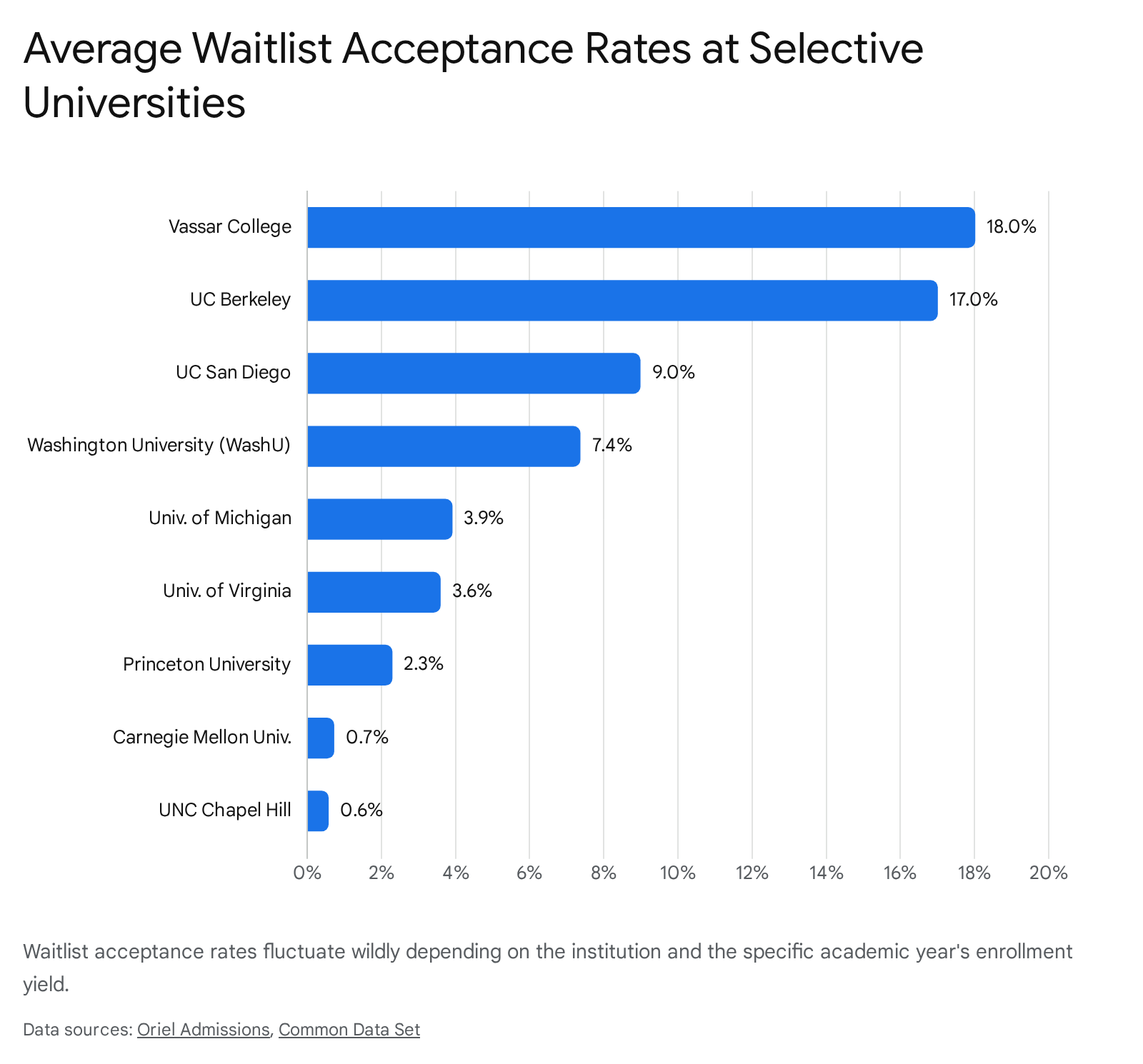
The data reveals that while thousands of students are offered the glimmer of hope that a waitlist provides, the actual number of students admitted is often a tiny fraction of the pool.
| University | Applicants Opting Into Waitlist | Students Admitted from Waitlist | Estimated Conversion Rate |
|---|---|---|---|
| UC Berkeley | 7,001 | 1,191 | 17.0% |
| University of Chicago | ~2,200 | 100 - 400 | 5.0% - 15.0% |
| Cornell University | ~3,500 | 50 - 400 | 1.0% - 11.0% |
| Rice University | ~1,800 | ~78 | 4.3% |
| University of Michigan | 24,804 | 973 | 3.9% |
| Amherst College | 623 | 8 | 1.2% |
| Carnegie Mellon University | 4,937 | 32 | 0.6% |
(Data derived from institutional Common Data Set publications and historical admissions tracking. Figures fluctuate annually based entirely on enrollment yield 242829.)
This table highlights a distinct divergence in institutional behavior. Massive state universities and certain private institutions utilize incredibly deep waitlists to buffer against the high volatility of out-of-state and international enrollment patterns 42829. The University of Michigan, for example, maintained a waitlist pool three times larger than its entire freshman class 411. Conversely, highly specialized institutions like Carnegie Mellon operate with exceptionally tight margins, leading to waitlist conversion rates that fall below one percent 2.
Strategic Actions: The Step-by-Step Playbook
If a student receives a waitlist decision and determines that they still possess a strong desire to attend that specific college, they must transition out of an emotional mindset and execute a strategic, professional campaign.
Step 1: Secure Your Backup Institution
The single most critical mistake a waitlisted student can make is treating their waitlist status as a pending acceptance and failing to secure a spot at another college. Most colleges require a formal commitment and a financial deposit by a specific date, traditionally known as National Decision Day 11631.
Students must review their actual offers of admission, select the best fit among them, and formally deposit at that institution. Doing so guarantees that they will have a bed to sleep in and a place to study in the fall 1516. Furthermore, students must fully engage with their backup school. They should sign up for housing, register for orientation, and mentally embrace the idea of attending 1.
If the waitlisted institution eventually calls, the student will have the luxury of choosing between the two options. If they choose the waitlisting school, they will simply inform their backup school that their plans have changed. While the initial enrollment deposit at the backup school is forfeited and non-refundable, this financial loss is simply the cost of doing business and keeping all educational avenues open 116. The National Association for College Admission Counseling (NACAC) explicitly permits this practice; colleges understand that waitlist movement necessitates students breaking prior commitments to other universities 311733.
Step 2: Formally Opt In
A waitlist offer is not an automatic reservation. Because a large percentage of waitlisted students will have already fallen in love with another college and wish to move on, admissions offices require students to actively claim their spot 71819.
This process is typically executed through the student's digital applicant portal. The student will be prompted to fill out a brief form confirming their continued interest in remaining in the applicant pool 1936. Failing to complete this step by the stated deadline acts as a silent withdrawal of the application. Once the student has formally opted in, they have officially entered the holding pool.
Step 3: Write a Letter of Continued Interest (LOCI)
Beyond opting in, the Letter of Continued Interest (LOCI) is the primary vehicle through which an applicant can influence their waitlist outcome. A LOCI is a formal, professional communication sent to the admissions office that updates the committee on the student's recent achievements and reiterates their unwavering commitment to the university 182038.
In an era where "demonstrated interest" plays a significant role in yield protection, the LOCI signals to the college that an offer of admission will not be wasted. If a college decides they need to admit fifty students from the waitlist, they ideally want to make exactly fifty phone calls to students who will immediately say yes, rather than calling two hundred students who might decline. A compelling LOCI assures the admissions office that the student represents a guaranteed enrollment 1639.
Crafting the Perfect Letter of Continued Interest
Writing an effective LOCI requires a delicate balance of enthusiasm, professionalism, and conciseness. Admissions officers are notoriously fatigued by May, having just completed the monumental task of reading tens of thousands of regular decision applications. A dense, multi-page essay will likely be skimmed or ignored entirely. The ideal LOCI is brief, well-structured, and strictly limited to roughly one single-spaced page or approximately 500 words 7202141.
The Introduction: Gratitude and Absolute Commitment
The opening paragraph of the LOCI must set a gracious and direct tone. The applicant should immediately thank the admissions committee for their continued review of the application 61820. It is essential to avoid any language that sounds disappointed, bitter, or entitled.
More importantly, if the waitlisting institution is genuinely the student's first choice, the introduction is the place to state this unequivocally. The student should explicitly declare that if they are offered admission from the waitlist, they will absolutely accept the offer and enroll 61639. This definitive commitment addresses the admissions office's core concern regarding yield management. However, if the school is merely a top choice but not an absolute certainty, the student should refrain from making a binding promise, opting instead to state that the school "remains a top choice" 69.
The Body: Meaningful and Actionable Updates
The core of the LOCI is dedicated to presenting new, substantive information that was not available when the student originally submitted their application months prior. Admissions offices explicitly warn against regurgitating facts, essays, or extracurricular activities that have already been evaluated 62021. The original application proved the student was qualified; the LOCI must demonstrate ongoing growth and momentum.
Students should meticulously select two or three major updates to highlight. These may include: * Academic Milestones: Significant improvements in senior year grades, a higher standardized test score, or the completion of a rigorous independent research project 921. * Extracurricular Achievements: A new leadership position within a club, a major athletic or artistic award won during the spring semester, or a recently launched community service initiative 69. * Professional Developments: The acquisition of a relevant summer internship, a new job, or acceptance into a prestigious summer academic program.
If a student genuinely has no major updates to report, they should not invent trivial accomplishments. Instead, the letter should pivot entirely to emphasizing institutional fit 915.
The Conclusion: Reinforcing Institutional Fit
The final section of the LOCI should seamlessly connect the student's updated profile to the specific offerings of the university. The applicant must articulate exactly why they belong on that specific campus. Vague praises about the school's "prestige" or "beautiful architecture" offer no value.
Instead, the student should demonstrate deep, nuanced research into the institution. They should mention specific upper-level courses they wish to take, laboratories they hope to assist in, or unique campus traditions they plan to join 203841. This level of specificity proves that the student has thoughtfully considered how they will actively contribute to the campus ecosystem, rather than simply consuming its resources. The letter should close with a final expression of gratitude and a respectful sign-off 91820.
Navigating the Waitlist: Behaviors to Avoid
The stress and anxiety inherent in the waitlist process frequently drive students and their parents to engage in counterproductive behaviors. Many families mistakenly believe that sheer persistence and aggressive self-promotion will force an admissions office to yield. In reality, crossing professional boundaries is one of the fastest ways to ensure an application is permanently shelved 5722. Admissions blogs from highly selective universities routinely publish explicit warnings regarding applicant conduct during the waitlist period.
Understanding the Boundaries of Communication
To navigate the waitlist gracefully, applicants must understand the distinction between appropriate advocacy and outright harassment.
| Strategic and Appropriate Actions | Detrimental and Prohibited Actions |
|---|---|
| Submitting a single, comprehensive LOCI through the official applicant portal or via email to the regional admissions representative in mid-April 7936. | Bombarding the admissions office with weekly update emails, constant phone calls, or unsolicited physical mail 73622. |
| Maintaining stellar academic performance throughout the final semester of high school to ensure final transcripts remain competitive 71618. | Succumbing to "senioritis" and allowing grades to drop, which can instantly disqualify a waitlisted candidate 716. |
| Asking a high school guidance counselor to make a brief, professional advocacy call to the university's regional representative on your behalf 38. | Having parents call the admissions office to argue the decision, demand a spot, or express frustration regarding the process 67. |
| Uploading relevant, supplementary materials (such as a significant new award certificate) only if the university's waitlist policy explicitly allows it 536. | Attempting to bribe the university, sending elaborate baked goods, mailing gimmicky gifts, or submitting an entirely new application 722. |
Perhaps the most common misstep is the unannounced campus visit. Desperate applicants will occasionally travel across the country to physically present themselves at the admissions office, demanding a face-to-face meeting to "plead their case." Admissions officers universally condemn this behavior. It disrupts their highly scheduled workflow, places undue pressure on the staff, and demonstrates a concerning lack of boundaries and self-awareness on the part of the applicant 715. The admissions process is fundamentally an evaluation of a written dossier; it is not a courtroom where verbal arguments can overturn a verdict.
The Endgame: How Waitlist Admissions Unfold
The timeline for waitlist movement is entirely dependent on the calendar of the admissions office. Because universities cannot begin auditing their committed class until after the national enrollment deadline has passed, the vast majority of waitlist activity occurs in May and June 1319. During years of extreme volatility, such as those impacted by FAFSA delays, waitlist offers can stretch into July or even August as colleges struggle to finalize their rosters against the threat of summer melt 117.
If an admissions committee determines that they have space and selects a student from the waitlist, the endgame moves at a breakneck pace. The leisurely contemplation that defines the regular decision cycle vanishes, replaced by a high-pressure, rapid-fire enrollment process.
The Rapid Response Window
When a college calls a student off the waitlist, they are operating under intense time constraints to finalize their class. The notification is typically delivered via a direct phone call from an admissions officer, followed by an official email update in the student's portal 3943.
The student is almost never given weeks to consider the offer. In most cases, the university will demand a definitive response - and a financial deposit - within 24 to 72 hours of the notification 1. This tight turnaround requires families to have already engaged in serious conversations about whether they are truly willing to pivot from their backup school at a moment's notice.
The Realities of Late-Stage Financial Aid
For many students, the excitement of a waitlist acceptance is quickly tempered by the realities of higher education financing. Financial aid is inherently finite. By the time a university begins extending offers to waitlisted students in May or June, the vast majority of their institutional grant money and scholarship funds have already been allocated to the students who committed during the regular decision rounds 11939.
While a handful of elite universities possess endowments large enough to remain strictly "need-blind" and fully meet the demonstrated financial need of every admitted student regardless of when they are accepted, this is the exception, not the rule 3944. At many institutions, waitlist admits are offered financial aid packages that are significantly less generous than those offered earlier in the cycle. These late-stage packages often rely heavily on student loans rather than institutional grants 19.
Before accepting a spot off the waitlist, a student must immediately contact the financial aid office to secure a firm, written commitment regarding their specific aid package 15. If the revised cost of attendance is prohibitive, the student must have the maturity to decline the offer and stick with their more affordable backup option.
Navigating Housing and Logistical Hurdles
Because waitlist admits are the final students to join the incoming class, they are systematically placed at the back of the line for all logistical campus services. Housing assignments are often the most immediate casualty. While the regular freshman class has spent weeks selecting their preferred dormitories and matching with compatible roommates, waitlisted students are typically assigned to whatever beds remain vacant 1.
This can result in placements in less desirable residence halls, temporary overflow housing, or forced triples. In extreme cases of campus overcrowding, some universities cannot guarantee on-campus housing for late waitlist admits, requiring the student to navigate the local off-campus rental market on incredibly short notice 117. Furthermore, waitlisted students may find that orientation dates are fully booked and that registration for popular introductory courses has already closed, necessitating flexibility in building their first-semester academic schedule.
Bottom line
Being placed on a college waitlist is a reflection of high academic qualification, but ultimately signals that a university is using the applicant as a buffer against unpredictable enrollment yields. A student's immediate priority must be securing their future by paying an enrollment deposit at a backup institution, while simultaneously submitting a concise Letter of Continued Interest to the waitlisting school. While macroeconomic factors like FAFSA delays and the end of affirmative action have caused waitlist sizes to swell, conversion rates remain highly volatile and mathematically unfavorable. Ultimately, applicants should view their waitlist status as a closed door that might miraculously unlock, rather than a reliable pathway to admission.