
Andragogy and Pedagogy in Adult Learning Theory
Historical Foundations of Adult Learning
The systematic study of how individuals acquire, process, and retain knowledge has long been dominated by models originally designed for the instruction of children. For centuries, educational systems across the Western world relied upon pedagogy. Derived from the Greek words paid (child) and agogos (leading), pedagogy fundamentally positioned the learner as a dependent entity requiring direct, authoritative guidance 12. In the pedagogical model, which traces its formal roots to the monastic schools of the Middle Ages, the student is historically viewed as a blank slate or tabula rasa 2. The teacher assumes complete responsibility for dictating what must be learned, how the instruction will be delivered, and when comprehension will be evaluated 23.
However, as industrialization, corporate training paradigms, and the demand for lifelong professional development expanded in the twentieth century, the inadequacy of the pedagogical model for mature learners became increasingly apparent. The rigid, teacher-centric approach failed to accommodate the complex psychological realities, practical experiences, and immediate problem-solving needs of adults in the workforce 456. This operational failure facilitated the formalization of andragogy, defined broadly as the art and science of helping adults learn 789.
The term "andragogy" itself is not a modern invention. It was initially coined in 1833 by the German educator Alexander Kapp to describe the educational theories of Plato, distinguishing the philosophical education of mature individuals from the rote instruction of youth 1910. The concept remained relatively dormant until it was reintroduced by the German social scientist Eugen Rosenstock-Huessy in 1925, who argued that adult education must be derived from practical necessity and lived experience 1011. Shortly thereafter, in 1926, the American educator Eduard Lindeman brought the concept to North America, emphasizing that adult learning must focus on experiential, non-formal environments 912.
Despite these early foundations, the concept did not achieve widespread institutional recognition until the late 1960s and early 1970s. During this period, the American adult educator Malcolm S. Knowles propelled andragogy to international prominence 131415. Through a series of foundational texts, Knowles utilized andragogy to unify the disparate field of adult education, providing a cohesive rallying point that explicitly separated adult learning principles from those applied to primary and secondary schooling 111314. Knowles' framework fundamentally challenged the pedagogical assumption that mature learners are passive receptacles for pre-determined subject matter, asserting instead that adults require entirely different instructional architectures to thrive 456.
Evolution of Theoretical Framework
Malcolm Knowles did not present his andragogical framework as a static, immutable doctrine. Rather, his theories evolved over two decades of applied research, clinical observation, and critical feedback from his peers in the adult education sphere. The assumptions underlying andragogy shifted both in number and in their perceived universality over time, reflecting a growing sophistication in the academic understanding of adult cognition and motivation 1316.
In his seminal 1970 publication, The Modern Practice of Adult Education: Andragogy Versus Pedagogy, Knowles initially outlined four core assumptions that definitively distinguished adult learners from child learners. These original four assumptions focused heavily on the internal psychological maturation and social development of the individual 131617. Specifically, he argued that adults develop a self-concept centered on self-direction, accumulate a vast reservoir of experience, experience readiness to learn based on shifting social roles, and exhibit a problem-centered orientation to learning 1315.
As the theory gained traction in corporate training, academic continuing education, and non-formal organizational settings, it also attracted critical academic scrutiny. Researchers noted that the original four assumptions described the mechanics of adult learning but did not adequately account for the deeper, underlying psychological drivers of adult behavior. Responding to this empirical feedback, Knowles significantly revised and expanded his framework.
In the 1980 edition of his foundational text - which he notably retitled The Modern Practice of Adult Education: From Pedagogy to Andragogy - Knowles softened the strict dichotomy between children and adults, acknowledging that the two models exist on a continuum 21617. Concurrently, he added a fifth assumption emphasizing that adult motivation to learn is primarily internal rather than dependent on external rewards or punishments 1718. Finally, in subsequent publications including the 1984 text Andragogy in Action and his 1989 autobiography The Making of an Adult Educator, Knowles formally introduced a sixth assumption: the "need to know." This final assumption posited that adults must understand the intrinsic value and pragmatic rationale for learning something before they will expend cognitive energy to engage with the material 131619.
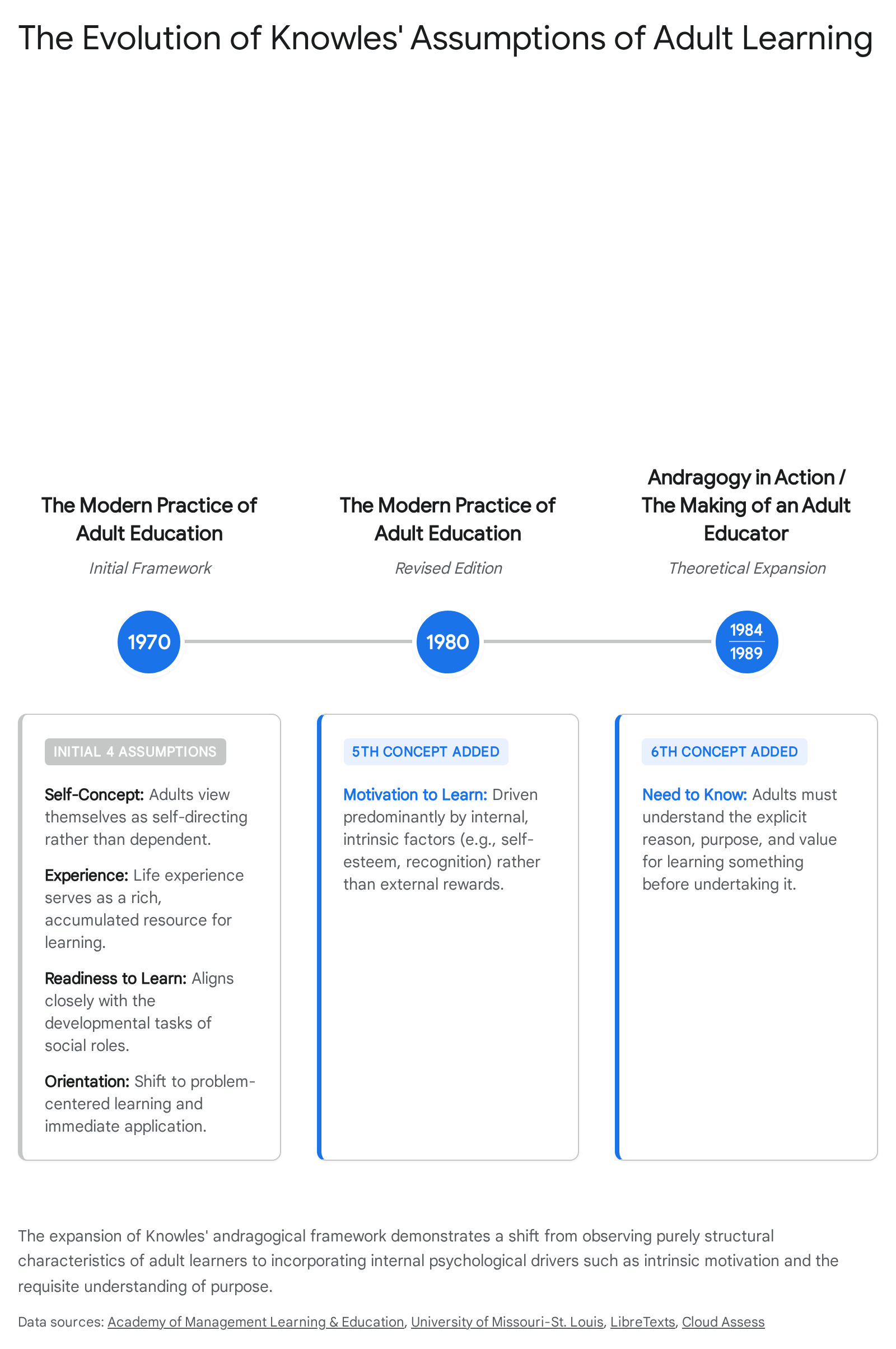
This theoretical expansion from four to six principles reflects a broader evolution in the field of adult education, shifting from viewing the learner purely through an operational or sociological lens to understanding them through complex cognitive and motivational frameworks. The resulting six assumptions form the undisputed bedrock of contemporary andragogy.
Foundational Assumptions of Adult Learning
To comprehend how andragogy functions as a distinct instructional framework, it is necessary to perform a rigorous theoretical analysis of the six assumptions Knowles established. The most defining characteristics lie in how the model conceptualizes the learner's self-direction, their prior experience, their readiness and orientation, and the fundamental nature of their motivation.
Learner Autonomy and Self-Concept
The most profound psychological distinction between a child and an adult, according to Knowles, resides in the evolution of the self-concept. In a classic pedagogical framework, the learner is inherently dependent upon the educational apparatus 23. The instructor assumes total, unquestioned responsibility for all aspects of the learning experience, dictating the syllabus, the pace of instruction, the methods of delivery, and the criteria for success 220. This dependency is socially reinforced over years of traditional schooling; children are conditioned to await direction, fostering a passive role where they receive information transmitted unidirectionally by an authority figure 162020.
Andragogy, conversely, rests on the assumption that as individuals mature, their psychological self-concept transitions from dependency toward independence and robust self-direction. Knowles theorized that an individual effectively becomes an adult at the precise psychological point where they view themselves as being fully responsible for their own lives, decisions, and outcomes 619. Consequently, adults develop a deep-seated psychological need to be perceived and treated as capable, autonomous agents by their peers and instructors.
When adult learners are placed in restrictive environments that impose strict pedagogical controls - where they are lectured at without being given a voice in the educational process - they often experience a psychological regression to their childhood educational traumas. This frequently triggers resentment, resistance, and a severe decline in engagement 22122. Therefore, andragogy demands an instructional climate characterized by mutuality, transparency, and respect 22. The role of the teacher shifts fundamentally from an authoritative "sage on the stage" to an active facilitator who supports the adult learner in taking the initiative. Adults thrive when they are empowered to diagnose their own learning needs, participate in the planning of their curriculum, and self-evaluate their progress 11623.
Accumulated Experience as a Learning Resource
The second foundational divergence between pedagogy and andragogy involves the value placed on prior experience. Pedagogical methodology historically assumes that children, due to their youth, possess limited life experiences that are of substantive value to the formal educational process 2024. In this traditional view, the experience that matters belongs entirely to the teacher, the textbook author, and the curriculum designer.
Adults, however, bring a massive, highly diverse, and deeply personal reservoir of life, work, and educational experiences into any learning environment 5625. Knowles posited that for adults, their experience is not merely an external event that happened to them; it forms the core of their personal identity. To ignore, dismiss, or devalue an adult's experience is, psychologically, to reject the adult themselves 626.
Because of this accumulated background, effective adult education requires experiential learning techniques. Adults process and retain information most effectively when new concepts are explicitly anchored to their existing mental models and past experiences 182426. Instructional techniques such as group discussions, case studies, scenario-based problem-solving, and peer-to-peer mentoring leverage the collective experience of the classroom. This approach essentially makes the learners themselves the richest resource for knowledge acquisition, decentralizing the authority of the instructor 1621.
This assumption aligns seamlessly with constructivist theories of learning, which argue that individuals actively construct new knowledge through the synthesis of previous skills and new social interactions 2627. However, this wealth of experience also presents a unique pedagogical challenge: adults may arrive in the classroom with deeply entrenched biases, rigid professional habits, and outdated mental models 6. Consequently, adult education frequently requires a difficult process of "unlearning" or perspective transformation to clear the psychological pathway for new paradigms 282930.
Intrinsic Motivation to Learn
Motivation represents a stark dividing line between classic pedagogy and andragogy. Pedagogy relies almost exclusively on extrinsic motivators and behavioral conditioning. Children are routinely conditioned to learn through external pressures: parental expectations, the desire for teacher approval, competition for class rankings, tangible rewards, and the fear of failure or disciplinary consequences 452031.
While adults are certainly not entirely immune to extrinsic forces - a mandate from an employer, the threat of termination, or the prospect of a salary increase can frequently initiate participation in corporate training - Knowles observed that the most potent, sustainable, and enduring motivators for adults are strictly internal 63233. Adults are driven by intrinsic factors such as the desire for heightened self-esteem, the pursuit of a better quality of life, increased job satisfaction, self-actualization, and an innate curiosity to achieve competence in their chosen fields 5203334.
This assumption aligns closely with modern psychological frameworks, particularly Self-Determination Theory (SDT), which posits that human motivation rests on three essential pillars: autonomy, competence, and relatedness 2935. When an adult learner is granted autonomy over their learning path (Self-Concept), is recognized for their prior knowledge (Experience), and is provided tools to master a relevant skill (Competence), their intrinsic motivation surges. Instruction that relies heavily on pedagogical, carrot-and-stick reward systems often fails in adult contexts precisely because it bypasses the internal drivers that make learning meaningful to a mature individual 1435.
Readiness to Learn and Social Roles
The structure and timing of traditional educational curricula are fundamentally challenged by the andragogical assumption of readiness. In pedagogy, readiness is dictated primarily by biological development and sequential academic prerequisites. Learners are deemed "ready" to learn complex mathematics only when they have passed prerequisite courses and reached a specific chronological age and grade level 20. The system dictates the timeline.
In stark contrast, adult readiness is dictated by the immediate developmental tasks of their specific social and professional roles. Adults become intrinsically ready to learn when they experience a pressing need to cope effectively with a real-life situation or transition 51722. Learning is highly responsive to life triggers. An adult becomes ready to study management theory not because it is the next module in a syllabus, but because they have just been promoted to a leadership role. An adult becomes ready to learn early childhood psychology because they have recently become a parent. Education, in the andragogical model, must be timed to intersect with these moments of high developmental readiness 51922.
Problem-Centered Orientation to Learning
Because traditional primary and secondary schooling is designed to prepare youth for a distant, largely unwritten future, pedagogy is fundamentally subject-centered. Knowledge is compartmentalized into discrete academic subjects (history, mathematics, natural sciences) to be stored away in a cognitive bank for postponed, generalized application later in life 4152036.
Adults, however, operate with a life-centered, task-centered, or problem-centered orientation. Because they are currently navigating immediate challenges in their personal, civic, and professional lives, they seek "just-in-time" learning rather than "just-in-case" learning 53136. Adult learners are generally resistant to survey courses or abstract theory that lacks direct application. They do not want to memorize the history of software engineering; they want to learn the specific coding syntax required to fix a software bug affecting their current workflow. Instruction must therefore be organized around real-world problems and scenarios rather than rigid academic disciplines 12833.
The Need to Know and Rationale
The final assumption, added later in Knowles' career trajectory, highlights the critical importance of a clear rationale. Adult learners demand a clear value proposition before they will invest time and cognitive energy in a learning endeavor. Children, conditioned by the structure of compulsory schooling, will generally learn what they are told simply because the school system requires it for advancement 3137.
Adults demand to know "What's in it for me?" (WIIFM) 1933. If the practical utility, the intended outcomes, and the underlying reason for acquiring the information are not explicitly clear from the outset, the adult learner will likely disengage or resist the instruction 93233. Facilitators must prioritize transparency, explaining exactly how a specific module, theory, or exercise directly benefits the learner's performance, efficiency, or personal growth 61933.
Methodological Divergence from Pedagogy
While Knowles initially presented pedagogy and andragogy as a stark dichotomy - one strictly for children, one strictly for adults - he revised this stance in his 1980 publications. Recognizing that biological age alone does not perfectly dictate learning styles, he proposed that pedagogy and andragogy actually represent two ends of a continuous spectrum of learning methodologies 21516.
There are specific circumstances where a highly mature adult learner, stepping into an entirely novel, high-stakes technical field with zero prior experience, may temporarily require a dependent, highly structured pedagogical approach to establish baseline competence 216. Conversely, naturally curious children engaged in self-directed extracurricular projects may exhibit highly andragogical behaviors, seeking out information to solve immediate problems.
However, as a foundational philosophy for designing distinct instructional systems, the comparative distinctions between the two models remain highly robust and informative for curriculum designers. The fundamental shift moves from a teacher-centered paradigm of transmission to a learner-centered paradigm of facilitation.
The following table summarizes the foundational differences across the dimensions of learning defined by Knowles and his contemporaries:
| Learning Dimension | Pedagogical Counterpart (Child Learner) | Andragogical Framework (Adult Learner) |
|---|---|---|
| Self-Concept | Dependent. The learner relies entirely on the teacher for direction. The instructional climate promotes submissiveness and obedience to authority 22031. | Self-Directed. The learner desires autonomy and takes initiative. The educational climate is collaborative, mutual, and respectful 252838. |
| Role of Experience | Limited Resource. The learner's experience is seen as having little worth. Education centers exclusively on the teacher's knowledge and textbook content 2031. | Rich Resource. The learner's vast experience is the foundation for learning. Experiential techniques (discussion, problem-solving, peer review) are prioritized 1633. |
| Readiness to Learn | System-Driven. Readiness is dictated by biological age, societal pressure, and sequential, standardized curriculum requirements 2028. | Need-Driven. Readiness is triggered organically by the developmental tasks of social roles and real-life transitions or crises 112528. |
| Orientation to Learning | Subject-Centered. Focuses on building a comprehensive body of conceptual knowledge for postponed, generalized future application 42036. | Problem-Centered. Focuses on solving immediate challenges with an intense emphasis on the immediate, practical application of knowledge 12533. |
| Motivation to Learn | Extrinsic. Driven by external rewards and punishments, such as report card grades, parental approval, or fear of academic failure 2031. | Intrinsic. Driven primarily by internal desires for self-esteem, professional growth, quality of life, and personal self-actualization 42033. |
| The Need to Know | Authority-Dictated. Learners consume information to pass tests or advance to the next grade; understanding real-world application is secondary or irrelevant 2031. | Value-Dictated. Learners must definitively understand why they need to learn something and how it will benefit their lives before engaging 193133. |
The Staged Self-Directed Learning Model
While andragogy advocates for robust self-directed learning as the ultimate, optimal goal for adult education, the psychological transition from a dependent learner to an autonomous learner is rarely instantaneous. Adults who have spent decades being conditioned by rigid, pedagogical, teacher-centered environments cannot always be expected to immediately thrive in a fully autonomous, unstructured setting 2940. Thrusting an unprepared adult into a purely self-directed environment often leads to anxiety and disengagement.
To address this crucial operational gap, Gerald Grow developed the Staged Self-Directed Learning Model (SSDLM) in 1991. Drawing heavily upon the Situational Leadership Model developed by Paul Hersey and Kenneth Blanchard, Grow posited that self-direction is not a binary state but a situational, fluid spectrum ranging from heavy dependency to full autonomy 203940. Consequently, the educator cannot rely on a single teaching style. They must dynamically assess and adjust their instructional role to match the learner's current stage of readiness, deliberately empowering the student to advance to higher stages of self-direction over time 203940.
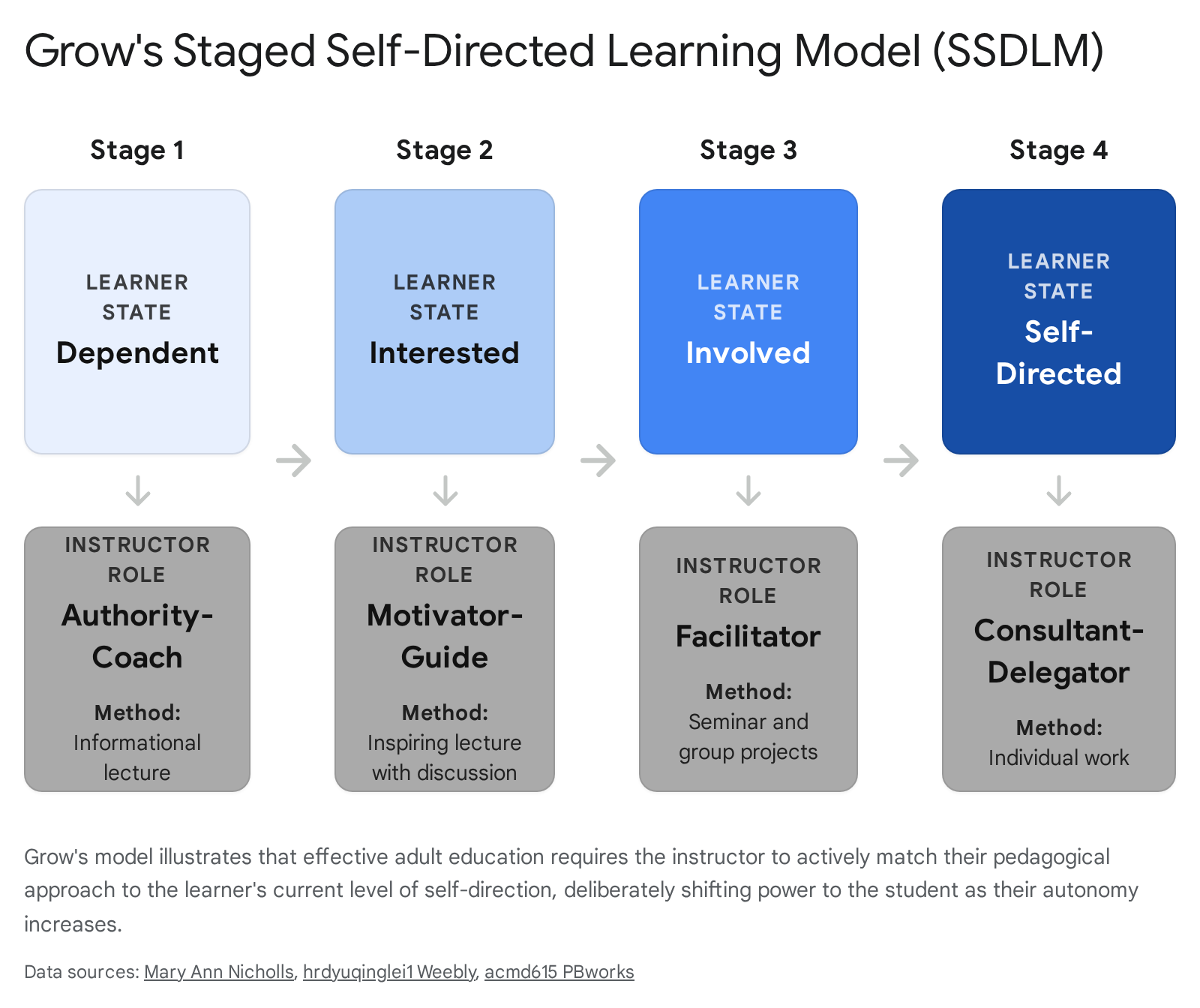
The SSDLM identifies four distinct stages of learner autonomy and details the corresponding instructional roles required to facilitate learning and encourage progression 203940:
- Stage 1: The learner is highly dependent, lacking subject knowledge and expecting a traditional, teacher-centered approach. At this stage, the teacher must act as an Authority or Coach, providing explicit direction, clear objectives, informational lectures, and rigorous structure 2040.
- Stage 2: The learner is interested and responsive but still lacks full confidence and autonomy. The teacher shifts to the role of Motivator or Guide, providing inspiring lectures combined with guided discussions, helping the learner see the real-world relevance of the material 2040.
- Stage 3: The learner is involved, possessing foundational skills and viewing themselves as an active participant in their education. The teacher steps back from a didactic role to become a Facilitator, organizing seminars, group projects, and discussions while participating as an equal rather than a superior 2040.
- Stage 4: The learner is fully self-directed, taking absolute initiative in planning, executing, and evaluating their learning journey. The teacher serves merely as a Consultant or Delegator, acting as a sounding board for independent study, dissertations, or professional internships 2040.
The SSDLM highlights a crucial operational vulnerability in adult education: the severe danger of an instructional mismatch. If an educator applies a Stage 4 consulting approach to a Stage 1 dependent learner, the resulting lack of structure generates extreme anxiety, confusion, and frustration, as the learner feels abandoned 4040. Conversely, if an instructor applies a rigid, Stage 1 authoritative approach to a Stage 4 self-directed adult, it produces deep resentment, active resistance, and a stifling of the adult's natural initiative 240. Therefore, the successful application of andragogical principles requires high levels of dynamic instructional agility on the part of the educator.
Theoretical Critiques of Andragogy
Despite its widespread adoption as the preeminent framework for corporate human resource development and adult continuing education, Knowles' conceptualization of andragogy has not escaped intense scholarly criticism. A persistent debate within the academic community questions whether andragogy qualifies as a scientifically validated empirical theory of learning, or if it is more accurately described as a set of philosophical assumptions or practical heuristics for instructional design 163035.
Universalism and Western Individualistic Bias
One of the most profound and sustained critiques of andragogy is that it presents a "generic adult learner" completely stripped of socio-cultural, historical, and economic context. Critical scholars such as Sandlin, Flannery, and Merriam argue that the foundational assumptions underlying andragogy - specifically its fierce focus on autonomy, independence, and the rational pursuit of individual self-interest - are deeply rooted in a very specific, privileged worldview: that of a white, middle-class, Western male 41.
By universalizing this specific cultural perspective, critics argue that andragogy inadvertently normalizes one highly individualized way of being while marginalizing diverse learners whose identities, motivations, and learning styles are shaped by different cultural, racial, and gender dynamics 4142. Furthermore, critical theorists assert that andragogy fundamentally ignores the structural inequalities, power dynamics, and systemic oppressions inherent in wider society. Because it focuses almost exclusively on the individual's self-improvement, cognitive development, and corporate utility, andragogy promotes passive adaptation to the existing status quo rather than challenging systemic societal issues 3641.
Latin American Critical Pedagogy
This focus on individual, corporate accommodation stands in stark contrast to the emancipatory educational models that emerged in the Global South, most notably the work of the influential Brazilian educationalist Paulo Freire. While both Knowles and Freire fiercely criticized traditional pedagogical methods - which Freire famously disparaged as the "banking model" of education, where authoritative teachers deposit disconnected facts into the minds of passive, oppressed students - their ultimate objectives diverged sharply 2345.
Knowles' andragogy is highly pragmatic and structurally reformist. It is often utilized to help adults become more proficient, efficient practitioners within their existing corporate environments or social structures 4145. Freire's Pedagogy of the Oppressed, however, views adult literacy and education as deeply political acts designed explicitly for liberation and sweeping societal transformation.
Freire argued that true adult learning requires a process of critical dialogue that entirely dismantles the hierarchy between teacher and student. The goal of adult education, in the Freirean model, is to empower the oppressed to critically "read their world" and take organized political action to change it 4543. Where Knowles focuses on the mechanics of self-directed learning to increase individual workplace competence, Freire focuses on collective conscientization (the development of critical consciousness) to achieve lasting social justice and dismantle oppressive systems 2345.
Cross-Cultural Perspectives on Adult Education
The foundational assertion that adults universally crave autonomous, self-directed individualism is further contested when examining non-Western educational paradigms. Differing cultural values surrounding community cohesion, respect for hierarchy, and the integration of spirituality fundamentally alter how adult learning is experienced and facilitated across the globe 2747.
Middle Eastern Contexts and Hierarchical Learning
The Western presumption of self-directedness encounters significant friction in regions characterized by high power-distance cultures and a strong, enduring reverence for tradition, such as the Middle East. Academic research focusing on adult education in the United Arab Emirates, Saudi Arabia, and surrounding nations indicates that adult learners often experience high levels of uncertainty, stress, and cultural disorientation when thrust suddenly into self-directed, problem-based learning environments championed by Western andragogy 4044.
In many Middle Eastern contexts, traditional, teacher-centered education is culturally ingrained from a young age, and society maintains a profound respect for authoritative experts and "the old ways" of knowledge transmission 40. Furthermore, the Western concept of autonomy - which is deeply rooted in personal liberty and unconstrained individual choice - conflicts with foundational Islamic principles where individual autonomy is generally considered subservient to the collective good and the public interest of the broader community 40. Consequently, adult learners in these regions often expect, and paradoxically perform better under, highly structured, instructor-led environments. This dynamic directly challenges the universal applicability of Knowles' first assumption regarding the innate adult desire for self-direction 4044.
Confucian Principles and Self-Cultivation
In East Asian regions heavily influenced by Confucian philosophy, the strict dichotomy between teacher-directed pedagogy and autonomous andragogy is complexly reframed. Western observers sometimes misinterpret the Confucian emphasis on deep respect for teachers, rote memorization, and rigorous moral discipline as a purely passive, pedagogical system that limits adult autonomy 4546. However, this surface-level observation fails to capture the depth of the Confucian adult learning paradigm.
For the Confucian adult learner, education is an unending, lifelong pursuit of self-cultivation. Unlike the Western humanistic perspective underpinning andragogy, which isolates individual self-actualization as the ultimate goal of learning, Confucianism posits that an individual can only become fully human through their relationships with others 4546. The self is fundamentally relational. Therefore, experience and learning are not merely pragmatic tools to solve immediate workplace problems; they are profound tools utilized to correct moral behavior, build guanxi (vital interpersonal networks), and achieve lasting harmony within the family, the community, and the nation 4547. Learning in this context is holistic, encompassing spiritual and moral dimensions alongside the cognitive, and is fundamentally socially oriented rather than individually isolated.
Ubuntu Pedagogy in African Traditions
African educational philosophies offer another powerful counter-narrative to Western individualism through the concept of Ubuntu, an ancient philosophy which translates roughly to "I am because we are." Ubuntugogy - an emerging educational paradigm championed by African scholars - explicitly transcends both traditional pedagogy and Western andragogy by placing collective learning, social cohesion, and deep interconnectedness at the absolute center of the educational experience 525348.
In an Ubuntu framework, learning is never viewed as an isolated cognitive acquisition of skills intended for personal advancement. It is a deeply relational, communal process. Through active engagement and participation with others, the adult learner grows more fully human and cements their identity; as the philosophy dictates, "I participate, therefore I am" 5349. This paradigm demands an educational environment rooted heavily in mutual respect, sympathy, sharing, and care, explicitly dismantling the Eurocentric hegemony of the competitive classroom 5349. While Knowles advocates for individual self-direction to achieve personal autonomy, Ubuntu pedagogy fiercely advocates for active, communal collaboration to achieve solidarity and collective well-being 534850.
Indigenous Australian Learning Frameworks
Indigenous Australian learning frameworks further illustrate the limitations of standardized, Western andragogical assumptions by seamlessly connecting adult learning to deep historical continuity, the physical environment, and non-linear logic. The "8 Aboriginal Ways of Learning" framework outlines a highly holistic, interconnected pedagogical approach that significantly diverges from the rationalized, compartmentalized models typical of Western education 515253.
The framework comprises eight fundamental, interrelated learning processes utilized by Indigenous communities:
| Aboriginal Way of Learning | Description of the Educational Process |
|---|---|
| Story Sharing | Connecting to knowledge through personal narratives, oral traditions, and shared histories rather than abstract, depersonalized lectures 5260. |
| Learning Maps | Visualizing pathways of knowledge and overall structures explicitly before attempting to address granular details or isolated facts 5260. |
| Non-verbal | Applying intra-personal and kinesthetic skills; prioritizing learning through direct observation, internal reflection, and physical action over verbal instruction 5260. |
| Symbols and Images | Utilizing culturally relevant metaphors, visual images, and art to understand and transmit complex concepts and content 5260. |
| Land Links | Engaging heavily in place-based learning, acknowledging that all knowledge is intrinsically tied to local geography, ecology, and nature 5260. |
| Non-linear | Producing innovation and understanding by thinking laterally, combining different systems synergistically rather than following sequential logic 5260. |
| Deconstruct/Reconstruct | Working from the whole down to the parts. Understanding the end-goal holistically before examining the individual steps (watching first, then doing) 5260. |
| Community Links | Ensuring that all newly acquired knowledge is centered on local viewpoints and applied for the direct benefit and survival of the local community 5260. |
These indigenous methods emphasize a global, heavily scaffolded approach to learning where the primary motivation is explicitly communal inclusion, cultural preservation, and group survival, standing in stark contrast to the isolated, individualistic self-improvement prioritized by classic Western andragogy 475360.
Synthesis and Implications for Practice
Malcolm Knowles' formulation of andragogy represented a watershed moment in the history of educational theory. By formally articulating the distinctions between child and adult learners, he permanently disrupted the assumption that the didactic, authority-driven methods used in primary schooling were appropriate or effective for mature individuals. By establishing a cohesive framework based on the evolution of the self-concept, the vital importance of accumulated life experience, the necessity of intrinsic motivation, and the demand for immediate, problem-centered application, Knowles provided a pragmatic blueprint that continues to dominate corporate human resource development, higher education, and lifelong learning design today.
However, a nuanced, expert-level understanding of adult learning requires recognizing that andragogy is not a universally applicable, empirical law. It exists on a fluid continuum with pedagogy, requiring educators to dynamically adjust their instructional methods - as clearly outlined by Grow's Staged Self-Directed Learning Model - to precisely match the specific readiness and situational autonomy of the learner.
Furthermore, the theory's inherently Western, hyper-individualistic bias must be critically acknowledged. As emancipatory pedagogues like Paulo Freire, alongside indigenous and non-Western frameworks such as Ubuntu, Confucianism, and the Aboriginal Ways of Learning clearly demonstrate, adult education is a deeply contextual phenomenon. True educational mastery in the modern, globalized era requires blending the operational autonomy and practical relevance championed by andragogy with a profound understanding of the socio-cultural, communal, and structural forces that shape the vastly diverse realities of adult learners worldwide.