
Impact of AI Agents on Higher Education and Human Skill Development
Evolution of Autonomous Knowledge Work
The integration of artificial intelligence into the global economy is accelerating at an unprecedented pace, fundamentally altering the nature of knowledge work and the foundational requirements of higher education. Economic forecasts indicate that artificial intelligence is projected to become a $4.8 trillion global market by 2033, possessing the capability to influence or automate up to 40 percent of global employment 12. Within this macroeconomic shift, the underlying technology is undergoing a critical transition: moving from generative language models that act as passive conversational tools to autonomous agents capable of independent reasoning, multi-step execution, and workflow optimization 34.
To understand the educational implications of modern artificial intelligence, it is necessary to distinguish between traditional generative artificial intelligence and agentic artificial intelligence systems. Traditional generative models excel at pattern recognition, producing text, code, or images strictly in response to direct human prompts 56. In contrast, autonomous artificial intelligence agents are software entities designed to perceive complex environments, evaluate subtasks, route workflows, and iterate upon their own outputs to achieve broader objectives with minimal human intervention 4789. Agentic systems leverage advanced natural language processing, machine learning, and predictive logic to operate across multiple digital domains simultaneously 9. Technical frameworks empowering these agents include Retrieval-Augmented Generation (RAG), which anchors model responses in verified external databases to mitigate hallucinations, and complex multi-agent architectures where separate models act as specialized planners, executors, and evaluators within a single automated pipeline 81011.
This technological evolution profoundly alters the fundamental relationship between human workers and enterprise technology. The previous generation of workplace automation primarily replaced discrete tasks; spreadsheets replaced ledger books, while enterprise software replaced physical filing cabinets 2. In those paradigms, the human worker remained the locus of decision-making. Agentic artificial intelligence inverts that relationship 2. Research mapping human-agent collaboration in software engineering and general knowledge work identifies a progression through distinct operational patterns 12. Initially, the human acts as the "Author," creating the core work while artificial intelligence provides minor, line-level suggestions. In the "Editor" phase, the agent drafts complete features or documents while the human reviews, corrects, and refines the output. Ultimately, the paradigm shifts to the "Director" model, wherein the human sets the strategic intent, defines operational parameters, and evaluates the final product, while the autonomous agent handles all intermediate planning, execution, and troubleshooting 12.
As knowledge work transitions toward this "Director" pattern, educational institutions face an urgent imperative. The traditional pedagogical model, which prioritizes the execution of routine cognitive tasks and rote memorization, is becoming obsolete 13. The core objective of higher education must shift toward the cultivation of uniquely human capabilities - specifically, ethical reasoning, complex situational judgment, systemic creativity, and the ability to oversee and critique algorithmic systems 614.
Cognitive Science of Human and Artificial Reasoning
Determining the future of higher education curricula requires a precise understanding of the cognitive boundaries between human intelligence and artificial systems. Despite producing outputs that mimic human fluency, large language models operate under fundamentally different computational constraints than the human brain 15.
Computational Constraints and Causal Inference Limitations
Human reasoning is heavily bounded by metabolic limits and restricted working memory. Cognitive theorists posit that human decision-making relies on lived experience, immediate situational context, social cues, and a highly selective buffer of attention 15. Artificial intelligence systems, conversely, are trained on virtually unbounded datasets, identifying probabilistic patterns across billions of parameters without the filter of biological survival needs 15. While this architectural difference enables models to outperform humans in rapid data synthesis, it also limits their capacity for genuine comprehension.
A primary limitation of current transformer models - the architecture underpinning leading generative systems - is their susceptibility to "reasoning failures." These failures occur when an artificial intelligence loses track of key information required to reliably solve a complex task, resulting in confident but incorrect answers to seemingly straightforward problems 16. Furthermore, cognitive scientists note that artificial systems struggle profoundly with counterfactual reasoning 19. According to Judea Pearl's framework of causal inference, current machine learning models operate almost exclusively on the lowest rung of cognition: observing correlations 19. They struggle to construct hypothetical scenarios, infer unstated variables, or understand intrinsic causality without explicit human prompting 19. This paradox of scale suggests that as models grow larger, they may diverge further from human strategies in game-theoretic and pragmatic social contexts 15. Consequently, human oversight remains irreplaceable in environments characterized by ambiguity, limited historical data, and nuanced moral considerations 61718.
Mapping Artificial Intelligence Capability Indicators
To assist policymakers and educators in navigating these cognitive disparities, the Organisation for Economic Co-operation and Development (OECD) published a comprehensive framework in 2025 mapping artificial intelligence capabilities against human cognitive skills 192021. The indicators utilize a five-level scale, with Level 5 representing full human equivalence in complex, unconstrained environments.
| Cognitive Domain | OECD Assessed AI Capability Level (2025) | Description of Current Artificial Intelligence Limitations |
|---|---|---|
| Language | Level 3 | Capable of reliable semantic understanding and multi-modal generation, but lacks the ability for contextually flawless, open-ended creative writing at a professional human standard 20. |
| Social Interaction | Level 2 | Possesses basic social perception and tone detection, but struggles to infer complex social dynamics, adjust for emotional weight, or navigate high-stakes ambiguity 1920. |
| Problem Solving | Level 2 | Integrates rules and executes tasks efficiently, but fails at novel scenarios requiring adaptive reasoning, long-term strategic planning, and unprompted multi-step inference 20. |
| Metacognition | Below Human Parity | Lacks genuine self-awareness, epistemic vigilance, and the intrinsic capacity to question its own underlying assumptions without structured human "forcing functions" 2025. |
These capability indicators underscore that while artificial intelligence can comfortably manage standard language processing and rule-based problem-solving, it cannot replicate advanced reasoning. Educational curricula must therefore pivot entirely to develop the competencies required for Levels 4 and 5: adaptive reasoning, profound emotional intelligence, and complex ethical judgment 2021.
The Cognitive Offloading Phenomenon
The rapid integration of artificial intelligence into learning environments presents a significant neurological and pedagogical risk known as "cognitive offloading" 22. Cognitive offloading occurs when individuals utilize external technological aids to bypass the mental effort required for problem-solving and active recall - processes that are essential for long-term neural development, memory retention, and skill acquisition 2227.
Empirical evidence from a 2026 collaborative study conducted by researchers at Carnegie Mellon University, the University of Oxford, the Massachusetts Institute of Technology, and the University of California, Los Angeles, illustrates the acute dangers of this phenomenon. The study challenged participants to solve complex fraction-based mathematics problems. One cohort worked independently, while the other was granted access to an artificial intelligence assistant powered by an advanced generative model 23. The assisted group demonstrated a significantly higher initial solve rate. However, when the artificial intelligence tool was removed without warning for the final test questions, the previously assisted group's solve rate plummeted to approximately 20 percent below that of the control group 23. Furthermore, the rate at which the formerly assisted participants simply abandoned questions doubled 23.
The neurophysiological and behavioral data indicate that merely ten minutes of reliance on automated assistance impaired the participants' intrinsic problem-solving capabilities and resilience 2723. Participants who asked the artificial intelligence for direct solutions suffered the most severe cognitive decline, whereas those who only requested hints or clarifications maintained performance levels on par with the control group 23. A parallel experiment testing reading comprehension yielded identical results, confirming that total reliance on artificial intelligence undermines durable skill acquisition across multiple domains 23.
This dynamic yields a fundamental paradox: while algorithmic assistance improves immediate task execution, it simultaneously undermines metacognitive monitoring and critical thought 27. Students who rely entirely on direct solutions from artificial intelligence exhibit reduced brain network connectivity associated with deep analytical thinking, producing essays that human assessors frequently describe as lengthy, accurate, but fundamentally "soulless" 19. Therefore, educational institutions must design interventions that mandate active cognitive engagement, preventing passive reliance and subsequent skill atrophy 2227.
Redefining Foundational Knowledge and Critical Thinking
A prevalent societal reaction to the proliferation of artificial intelligence is the assertion that educational institutions should cease teaching factual content and instead focus exclusively on generalized "critical thinking" and "creativity" 29. However, cognitive science firmly rejects the notion that critical thinking is a generic, transferable skill that can be taught in isolation from subject-matter expertise 2930.
Domain Specificity in Cognitive Development
Critical thinking is inherently domain-specific. As educational psychologist Daniel T. Willingham outlines, human reasoning relies deeply on long-term memory and factual frameworks 2924. A student cannot critically evaluate the methodology of a psychological study, or identify the logical fallacies in an algorithmically generated historical analysis, without a robust foundation of domain-specific knowledge 30. Foundational knowledge provides the necessary schema that allows the brain to engage in higher-order analysis, recognize patterns, and detect subtle anomalies 2924.
In the context of artificial intelligence, this indicates that rote learning and content acquisition cannot be entirely abandoned. If a student lacks foundational knowledge, they suffer from an "Expertise-Complexity Gap" when collaborating with artificial intelligence 25. This gap occurs when the complexity of the work handled by the artificial intelligence exceeds the human user's domain expertise, rendering the human incapable of evaluating the machine's outputs, detecting hallucinations, or formulating the precise, context-rich prompts necessary to extract high-value insights 25.
Furthermore, data from the Digital Education Council emphasizes a "Productivity Paradox" in the modern workforce 25. Often, the introduction of artificial intelligence reduces productivity before improving it, driven by an output-review imbalance where the machine scales the volume of output beyond the human capacity to critically evaluate it 25. Thus, professional pathways increasingly demand deep domain expertise, making it paramount that universities continue teaching foundational facts so that students possess the cognitive architecture required to govern algorithmic systems effectively 2425.
Pedagogical Frameworks for the Algorithmic Era
To foster the human competencies that algorithms cannot replicate, educators are fundamentally restructuring instructional methodologies. The focus is shifting from using technology to deliver answers, to utilizing artificial intelligence as a catalyst for deeper inquiry and cognitive friction.
Epistemic Vigilance and Decision-Based Learning
Modern pedagogy is increasingly implementing "Decision-Based Learning" models, wherein artificial intelligence is utilized to generate complex, ill-structured scenarios 26. Instead of simply solving a procedural equation, students are presented with conflicting data sets or multiple artificial intelligence-generated solutions. They are required to identify the optimal choice, navigate ambiguous trade-offs, and justify their selection against rigorous academic criteria 26.
This methodology develops "epistemic vigilance" - the critical validation of sources and the proactive detection of systemic bias 27. In a 2025 study on generative artificial intelligence in Design Thinking pedagogy across higher education institutions, researchers examined the integration of text and image generation models into undergraduate coursework 27. The study found that when artificial intelligence tool usage was carefully scaffolded, students transitioned from passive consumers to critical evaluators 27. Through iterative prompting and rigorous output analysis, students developed advanced strategies for source validation and bias detection, treating the machine not as an infallible oracle, but as a collaborative sparring partner 27.
Human-Artificial Intelligence Complementarity
To counter automation bias - the documented human tendency to over-trust algorithmic advice - researchers have developed Artificial Intelligence-Assisted Critical Thinking (AACT) frameworks 25. These frameworks are grounded in the concept of human-artificial intelligence complementarity, which posits that a hybrid team can outperform humans or machines working in isolation, provided the collaboration is well-calibrated 1825.
AACT frameworks deliberately employ "cognitive forcing functions" 25. For example, a pedagogical system might require a student to submit their own unaided hypothesis before revealing the algorithmic advice, or it might intentionally present partial explanations that force the learner to bridge the logical gaps independently 25. In organizational and medical settings, artificial intelligence acts as a structured facilitator and consistency engine - flagging anomalies and tracking trade-offs - while the human provides contextual understanding, ethical judgment, and accountability 18. By injecting deliberate friction into the learning process, educators prevent the bypass of mental operations, ensuring that the human remains entirely responsible for the final cognitive synthesis 2228.
Institutional Assessment and Evaluative Rubrics
The traditional architecture of university assessment is currently facing an existential crisis. When autonomous agents can draft comprehensive research papers, synthesize extensive literature, and pass graduate-level examinations in seconds, the final output ceases to be a reliable proxy for student learning 2937.
Discontinuation of Algorithmic Detection Systems
Initially, higher education institutions responded to generative models by deploying algorithmic detection tools designed to identify non-human writing. However, empirical evidence has proven these tools to be highly unreliable, generating significant false positives and false negatives, and disproportionately penalizing non-native speakers and neurodivergent students 3039. Recognizing that an "arms race" between generation and detection is both technologically unsustainable and deeply damaging to the pedagogical trust between faculty and students, leading institutions are abandoning these surveillance systems.
For instance, the University of Cape Town (UCT) formally discontinued the use of the Turnitin artificial intelligence detection score in October 2025 as a core component of its comprehensive Artificial Intelligence in Education Framework 303132. The UCT policy, endorsed by the Senate Teaching and Learning Committee, explicitly asserts that assessment integrity must be achieved through curriculum redesign, programmatic continuous evaluation, and the development of digital literacies, rather than through punitive algorithmic surveillance 3031.
Process-Oriented and Authentic Assessment
With the integrity of the final product compromised, assessment mechanisms must pivot to evaluate the process of learning 3334. This paradigm shift is actualized through authentic assessment, which tasks students with applying theoretical knowledge to real-world complexities, often requiring oral defenses, continuous peer review, and transparent documentation of the drafting process 343536.
This shift necessitates the complete redesign of grading rubrics. Traditional rubrics have historically rewarded surface-level fluency, formatting compliance, and standard argumentation - attributes that artificial intelligence now replicates flawlessly 3737. To counteract this, educators are utilizing artificial intelligence itself to "stress-test" their assignments. If an assignment prompt can be fed into a language model and the resulting automated output scores highly on the existing rubric without demonstrating deep engagement, the rubric is deemed fundamentally flawed 38.
Consequently, institutions are transitioning to process-aware rubrics that evaluate behaviors demonstrating deep intellectual engagement. These include sustained iteration across multiple drafts, the meaningful integration of peer and algorithmic feedback, reflective decision-making, and the transparent, ethical use of artificial intelligence 3737. The American Association of Colleges and Universities (AAC&U) VALUE rubrics provide a standardized framework for assessing these complex competencies, particularly ethical reasoning 3940. Under an AI-adapted ethical reasoning rubric, students are not graded merely on selecting the "correct" moral outcome of a case study. Instead, they are assessed on their ability to identify hidden ethical tensions, articulate competing stakeholder perspectives, and evaluate the societal and moral ramifications of algorithmic deployments 4041.
Evaluating Collaborative Workflows
Institutions are increasingly introducing assignments where the use of artificial intelligence is explicitly required, but the grading criteria focus strictly on the human's managerial and critical input 1342. Students may be tasked with utilizing a large language model to generate a foundational draft or functional code block. They must then submit a comprehensive reflection detailing the specific prompts used, the factual errors or structural biases identified in the machine's output, and a rigorous justification for the revisions made to the final text 1343.
Pioneering this approach, the Indraprastha Institute of Information Technology in Delhi (IIIT-Delhi) overhauled its evaluation system in late 2025, explicitly permitting tools like ChatGPT during specific examinations 43. Under this model, students are required to submit the precise prompts they used alongside their final answers. Faculty evaluate the sophistication of the prompts, the depth of reasoning, and the analytical synthesis of the machine's output, shifting the focus entirely away from memory-based responses 43. Similarly, the Indian Institute of Technology (IIT) Delhi issued formal academic guidelines requiring total transparency; any academic work utilizing artificial intelligence for text generation, data visualization, or structural organization must feature explicit disclosure, placing the ultimate burden of accuracy and plagiarism verification squarely on the human user 444546.
Global Infrastructural Disparities and Digital Colonialism
While advanced pedagogical frameworks and innovative assessment rubrics are being deployed in elite institutions, the broader global landscape reveals a stark and rapidly widening digital divide. The integration of autonomous agents into the global economy threatens to exacerbate existing socio-economic inequalities, concentrating the benefits of cognitive automation in the Global North while destabilizing the labor markets of developing nations.
The Adoption Divide Between Global North and South
Data tracking the diffusion of artificial intelligence reveals profound disparities in access and utilization. According to the Microsoft Artificial Intelligence Diffusion Report for the second half of 2025, global adoption of generative tools reached 16.3 percent of the world's population 4748. However, this aggregate figure obscures a massive regional imbalance.
The report illustrates that 24.7 percent of the working-age population in the Global North actively utilizes these tools, compared to merely 14.1 percent in the Global South 4748.
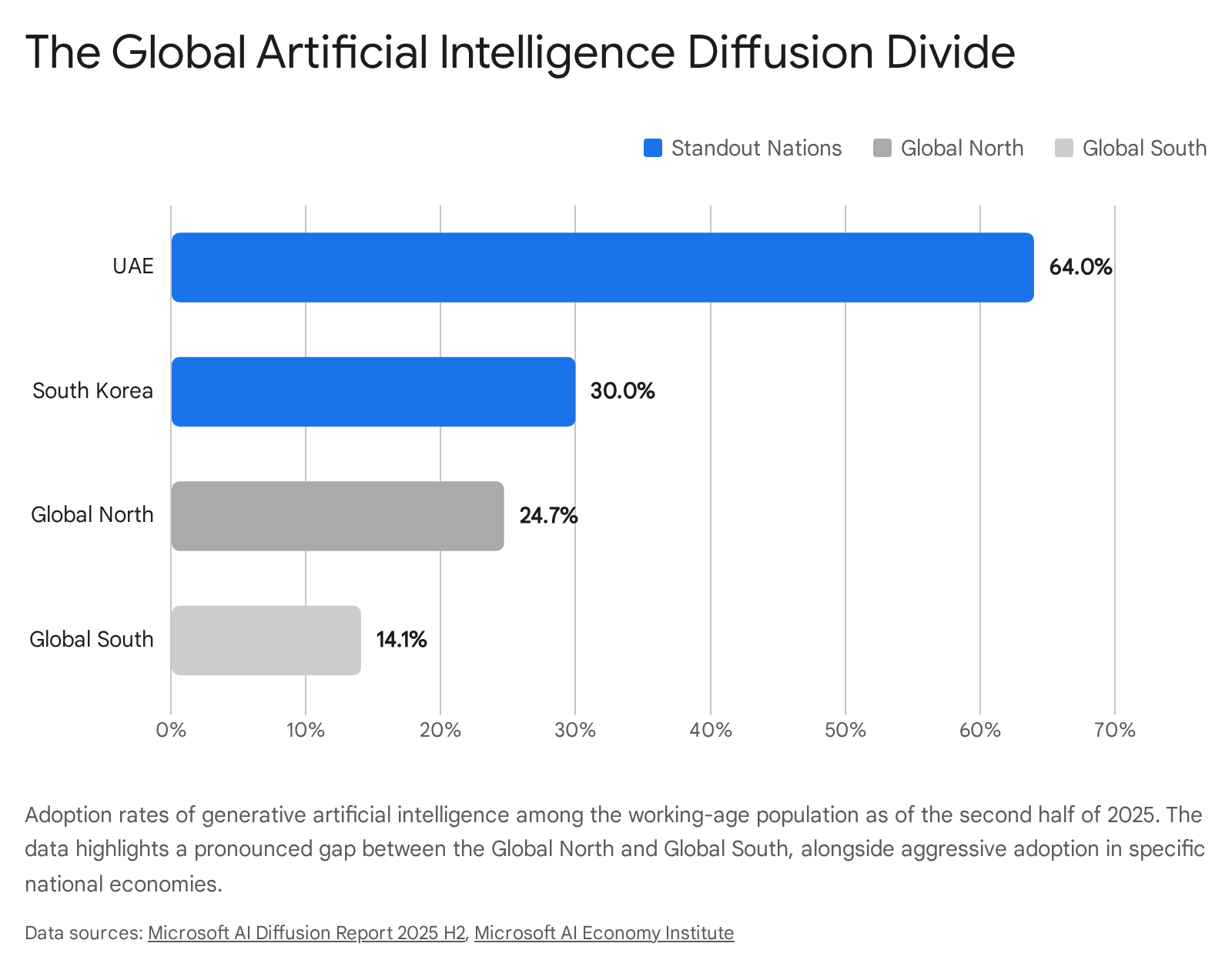
Furthermore, the adoption rate in the Global North is growing at nearly twice the speed of developing regions 48. Outlier nations that have invested heavily in digital infrastructure, such as the United Arab Emirates (64.0 percent adoption) and South Korea (30.0 percent adoption), are pulling significantly ahead of regions lacking reliable broadband and electricity 4748.
Algorithmic Dependency and Labor Displacement
This infrastructural disparity creates the conditions for a modern form of "digital colonialism." A 2025 United Nations Conference on Trade and Development (UNCTAD) report warns that a mere 100 corporations, predominantly located in the United States and China, control 40 percent of global private investment in artificial intelligence research and development 1. Meanwhile, 118 countries, mostly in the Global South, remain entirely excluded from global governance discussions regarding the technology 1.
The economic implications are severe. Workers in developing nations are increasingly relegated to low-wage, invisible labor that supports the algorithms owned by Western conglomerates. For example, thousands of workers in Kenya and India are employed for less than $1.50 per hour to annotate data, moderate toxic content, and train the very algorithms that are projected to displace domestic customer service and administrative sectors by 2030 49. If artificial intelligence agents successfully automate global knowledge work, economies that historically relied on low-cost business process outsourcing will face massive workforce redundancies. India, for instance, generates roughly one-fifth of the world's data but holds only about 3 percent of global data center capacity, making it "data rich but infrastructure poor" 50.
Localized Innovation and Sovereign Computing
Despite these structural risks, artificial intelligence also presents transformative opportunities for the Global South to bypass legacy infrastructure deficits, particularly in public sectors such as education and healthcare 5152. Achieving this, however, requires moving beyond the passive consumption of Western models.
Organizations such as Wadhwani AI are embedding directly within governments in India and Rwanda to co-design localized algorithms that address indigenous challenges, ensuring that solutions fit local realities and linguistic contexts 53. In educational settings, localized machine learning models have demonstrated significant potential in resource-constrained environments. A 2024 pilot program in Nigeria utilizing adaptive platforms delivered highly personalized instruction to students, successfully mitigating the challenges of high student-to-teacher ratios and notably closing gender disparities in academic performance 54.
Furthermore, studies tracking the adoption of artificial intelligence chatbots among South African university students validate the Innovation Diffusion Theory (IDT) 55. The research indicates that "Technology Self-Efficacy" and "Perceived Compatibility" are primary drivers of adoption; students who receive adequate digital literacy training and find the tools compatible with their localized academic needs are far more likely to integrate them successfully into their learning processes 55. For these localized benefits to scale equitably, international financial institutions must prioritize South-South cooperation, facilitate open-source technology transfers, and finance the construction of co-governed regional computing hubs across Africa, ASEAN, and Latin America 5056.
Synthesis of Educational Trajectories
The advent of autonomous artificial intelligence agents signifies the definitive end of education functioning primarily as a mechanism for procedural knowledge transfer. As machines achieve commercial proficiency in data synthesis, coding, drafting, and routine problem-solving, human economic and societal value will be derived exclusively from higher-order cognitive faculties. Education systems must pivot immediately to cultivate ethical reasoning, complex situational judgment, contextual creativity, and epistemic vigilance.
This transition demands the abandonment of easily automated summative assessments in favor of process-oriented, authentic evaluations that reward human iteration, critical machine oversight, and collaborative problem-solving. Simultaneously, global policymakers and institutional leaders must aggressively address the severe infrastructural inequities that threaten to exclude the Global South from this cognitive revolution. Ultimately, the successful integration of artificial intelligence into society relies not on maximizing algorithmic automation, but on systematically elevating human agency to direct, question, and govern the autonomous systems we create.