
Analogical reasoning and pattern recognition in disruptive strategy
Executive decision-making within highly volatile, uncertain, and novel environments demands cognitive frameworks that transcend simple extrapolation. When organizations face Knightian uncertainty - situations characterized by unquantifiable risk, a lack of historical precedent, and environments where statistical probabilities cannot be reliably calculated - traditional analytical models frequently falter 1. In these contexts, strategic management literature, particularly foundational and contemporary work published in the Strategic Management Journal, Academy of Management Review, and Harvard Business Review, increasingly positions analogical reasoning as a critical cognitive mechanism for executives 1234.
The updated research paradigm presented in this report broadens the conceptual scope of strategic cognition. It first contrasts analogical reasoning with competing strategic paradigms - namely, first principles thinking and purely data-driven optimization - to establish the unique computational and cognitive utility of analogies. It then deconstructs the cognitive architecture of analogical mapping, explicitly addressing the perilous misconception that equates surface-level mimicry with deep structural alignment 567. Furthermore, the analysis diversifies the empirical base by moving beyond Western-centric models, prioritizing non-Western and emerging market case studies such as M-Pesa, Grab, and Nubank, which illustrate how structural analogies operate across profound institutional voids 98910.
To provide a balanced, rigorous view, the limitations of analogical reasoning are deepened through well-documented case studies of strategic failure. These include the infamous "Uber for X" fallacy, Euro Disney's cultural miscalibrations, and the cognitive inertia of incumbents like Polaroid and Nokia 4131415. Finally, the report investigates developments stemming from the 2023 explosion of generative artificial intelligence (AI), analyzing how Large Language Models (LLMs) augment cross-domain pattern recognition by expanding the analogical search space, culminating in a proposed collaborative architecture between human executives and machine intelligence 161112.
The Triad of Strategic Decision-Making Paradigms
To understand the unique utility of analogical reasoning, it must be contextualized against alternative strategic approaches. The landscape of strategic problem-solving generally falls into three distinct cognitive paradigms: data-driven optimization, first principles thinking, and analogical reasoning. Each paradigm operates under different assumptions regarding data availability, problem decomposability, and computational cost, and each possesses distinct vulnerabilities when applied to strategic management 191314.
Data-Driven Optimization
Data-driven optimization relies on historical datasets, advanced statistical models, and machine learning algorithms to predict future outcomes and optimize current operational parameters 1415. In the era of big data, this paradigm excels at exploiting known variables within stable, continuous environments. For example, algorithmic pricing, supply chain routing, or predictive maintenance uses vast amounts of continuous data to find local optima, identifying patterns that human cognition could never process manually 1323. The fundamental advantage of this approach is its empirical grounding; it minimizes human cognitive bias by tethering decisions strictly to observable, quantifiable historical realities 16.
However, data-driven optimization suffers from a profound limitation in the context of high-level corporate strategy: it is inherently interpolative. When a firm faces a novel industry disruption, a structural break in the market, or a truly unprecedented crisis, historical data loses its predictive validity. Data-driven models, often functioning as "black boxes," lack physical fidelity, interpretability, and reliable extrapolation capabilities when pushed beyond their training distribution 15. They optimize the known but are largely blind to the fundamentally new. In environments characterized by high intersubjective uncertainty - where new ventures or disruptive technologies create entirely new market categories - the required data exhaust simply does not exist yet 3. Relying solely on data-driven models in these scenarios often leads to a phenomenon where algorithms over-index on irrelevant historical proxies, causing organizations to miss paradigm shifts entirely 14.
First Principles Thinking
First principles thinking, often associated with deductive logic, foundational physics, and classical rational choice theory, involves breaking down a complex problem into its most basic, foundational truths that cannot be deduced any further, and then building up a logically sound solution from that bedrock 117. This approach deliberately strips away assumptions, industry conventions, and historical baggage. In strategic management, a first-principles approach requires an exhaustive, a priori mapping of fundamental economic laws, technological constraints, and consumer utility functions 118.
While first principles thinking is highly effective for generating radical, paradigm-shifting innovations - as it prevents the replication of legacy inefficiencies - it is computationally and cognitively expensive. The sheer cognitive load required to deconstruct every business problem to its atomic level makes it impractical for the rapid, dynamic decision-making required in most executive suites. Furthermore, as organizational and market systems become highly complex with interacting variables, deductive solutions become analytically intractable. In complex $N,K$ performance landscapes (where $N$ represents the number of strategic choices and $K$ represents the degree of epistemic interdependence among those choices), exhaustive rational search leads to combinatorial explosion 31920. Consequently, pure deduction is rarely observed in real-world strategic maneuvering, as boundedly rational managers simply lack the cognitive bandwidth to process the necessary permutations 211.
Analogical Reasoning
Analogical reasoning occupies the vital, pragmatic middle ground between the blind extrapolation of data-driven models and the arduous, often paralyzing deduction of first principles. It operates on the premise of associative logic: transferring knowledge, policy frameworks, or causal mechanisms from a well-understood source domain to a novel, less familiar target domain based on perceived similarities 22122. As cognitive scientists and strategy scholars emphasize, analogical reasoning is uniquely powerful because it enables inference and action when data are scarce and deduction is impossible 311.
When a manager faces a novel competitive threat, they instinctively search their memory - or the broader corporate and historical archive - for a situation that "looks like" the current one, retrieving the strategic template that succeeded in the past 1823. This approach is cognitively efficient; it utilizes pre-existing mental schemas to bypass the need for ground-up deduction, allowing for rapid hypothesis generation and strategic framing in highly uncertain environments 723. Unlike other decision-making approaches that require relatively rich, domain-specific information, analogical reasoning functions as a form of abductive reasoning, offering provisional explanatory schemas that can guide action in novel environments 3.
Comparative Synthesis of Strategic Paradigms
The following table summarizes the structural differences, primary utilities, and inherent vulnerabilities of the three dominant strategic decision-making paradigms.
| Strategic Paradigm | Epistemological Basis | Computational / Cognitive Cost | Primary Utility & Best Use Case | Core Vulnerability in Novelty |
|---|---|---|---|---|
| Data-Driven Optimization | Empirical, Interpolative, Inductive | Low cognitive cost; High computational cost | Optimizing stable, continuous systems where historical data is abundant and reliable (e.g., pricing, logistics). | Fails during structural market breaks; cannot extrapolate outside of historical training distributions. |
| First Principles Thinking | Foundational, Deductive, Rational Choice | Extremely high cognitive cost | Breaking fundamental industry conventions; designing unprecedented technological innovations from the ground up. | Analytically intractable in highly complex, interdependent ($N,K$) landscapes; too slow for dynamic execution. |
| Analogical Reasoning | Associative, Abductive, Heuristic | Moderate cognitive cost | Navigating Knightian uncertainty, market entry, and cross-industry business model innovation with sparse data. | Susceptible to the misapplication of surface-level similarities, leading to severe strategic misalignment. |
The Cognitive Architecture of Strategic Analogies
The efficacy of analogical reasoning hinges entirely on the quality of the cognitive mapping between the source and target domains. Cognitive psychology and strategic management research outline a disciplined, multi-step process for analogical transfer.
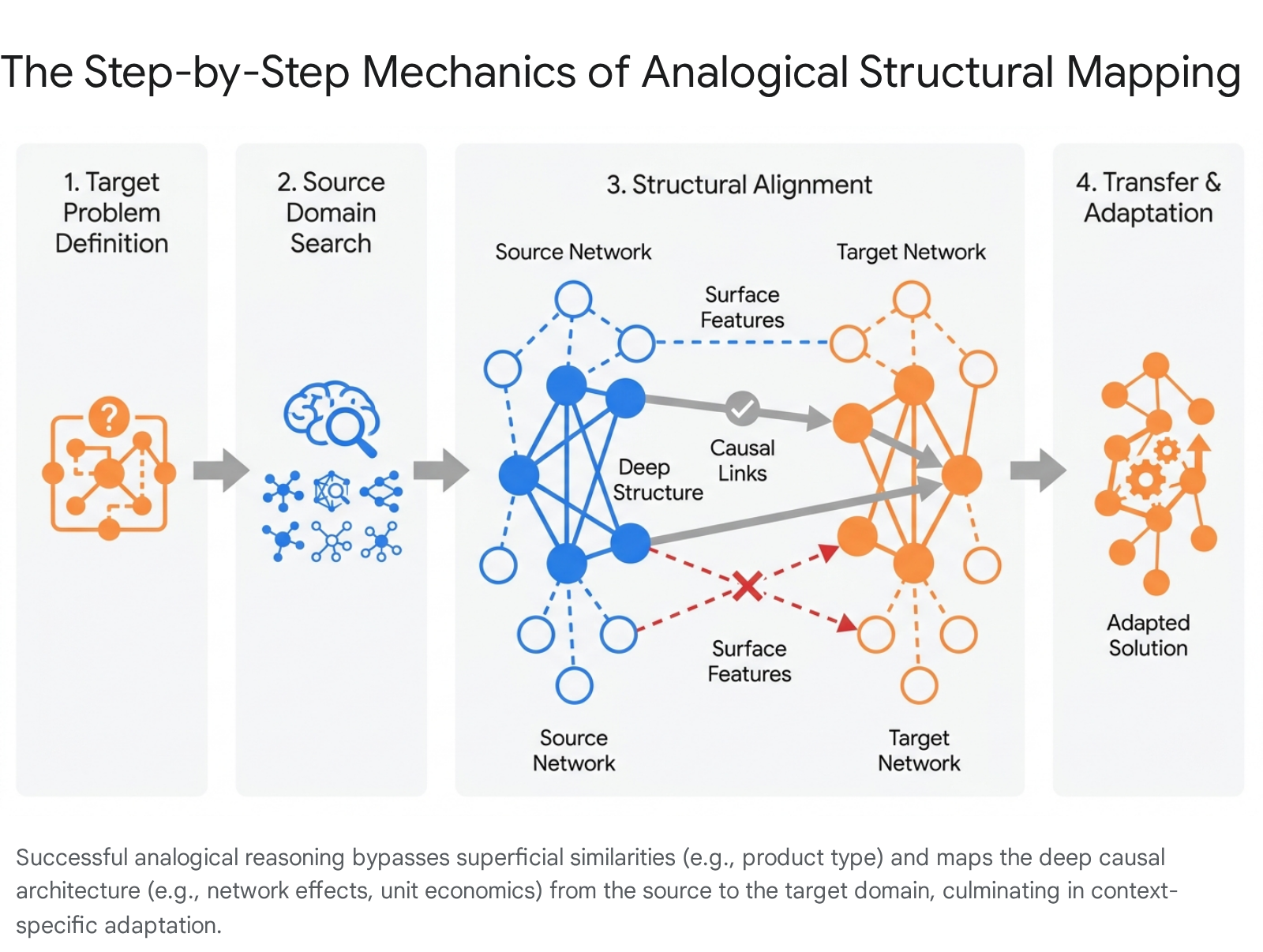
Unfortunately, this rigor is frequently bypassed by managers who rely on intuition, leading to catastrophic strategic errors 2122.
The Step-by-Step Cognitive Mapping Process
Synthesizing the frameworks proposed by Gavetti, Levinthal, and Rivkin alongside the rigorous procedural guidelines developed by Gruner and Power (2021), the analogical reasoning process can be codified into four sequential phases 212223:
- Target Problem Definition and Encoding: The strategist must first accurately encode the target situation. This requires isolating the core strategic challenge, deliberately stripping it of its industry-specific jargon and historical biases. For instance, rather than defining a problem narrowly as "how to sell microprocessors against low-cost entrants," the problem must be abstracted and encoded as "how to defend a premium market position against commoditization from below" 32. This abstraction expands the search space for potential analogies.
- Source Domain Search and Selection: The strategist scans their cognitive repertoire, organizational memory, or external databases for a source domain that has successfully solved a similar structural problem. The search can be within-domain (near analogies, e.g., an airline studying another airline) or outside-domain (far analogies, e.g., an airline studying Formula 1 pit stops for turnaround efficiency). Research indicates that while near analogies are easier to process, far-domain analogies possess significantly greater potential to change existing paradigms and generate breakthrough innovations 51732.
- Domain Image Mapping (Structural Alignment): This is the most critical and cognitively demanding step. The strategist maps the features of the source to the target. The objective is to identify a strict structural alignment between the causal mechanisms of both domains, deliberately ignoring superficial noise 2123. The mapping must verify that the underlying economic, behavioral, or physical relationships that drove success in the source domain are authentically present in the target domain.
- Candidate Solution Transfer and Adaptation (Proposition Drafting): The solution, policy, or operational framework from the source domain is extracted and translated into the context of the target domain. Because no two domains are perfectly identical, the candidate solution must undergo crucial adaptations to account for environmental, regulatory, cultural, or technological differences 212233. Failure to adapt the transferred knowledge to local realities is a primary driver of analogical failure.
Addressing the Misconception: Surface-Level vs. Deep Structural Mapping
The most pervasive and damaging misconception in strategic management is the conflation of surface-level feature similarity with deep structural similarity 5618. Cognitive psychologists meticulously distinguish between literal similarity (sharing overt, observable object attributes) and relational similarity (sharing underlying causal and functional structures) 619.
Surface-level analogies rely on observable, superficial characteristics that are cognitively effortless to identify. For example, a strategist might assume that because two products are both digital platforms or share a similar aesthetic interface (a surface feature), the go-to-market strategy that succeeded for one will seamlessly work for the other. This results in analogies that are essentially turns of phrase or metaphorical comparisons rather than robust strategic tools 5.
Deep structural mapping, however, requires the strategist to actively ignore superficial traits and focus entirely on the underlying system of relations. This involves mapping unit economics, supply-demand liquidity constraints, network effect velocity, or regulatory barriers 523. When decision-makers operate under high pressure and rely on heuristics or bounded rationality, they consistently default to surface-level analogies because they demand less cognitive effort and provide a false sense of certainty 71824. The ability to induce structural relations while ruthlessly ignoring distracting surface noise is the true hallmark of expert-level strategic cognition, enabling managers to recognize "cognitively distant" opportunities that competitors fail to perceive 41825.
Cross-Domain Pattern Recognition in Emerging Markets
To fully appreciate the power of deep structural mapping and the absolute necessity of contextual adaptation, it is vital to examine non-Western contexts. In emerging markets, profound infrastructural deficits, regulatory ambiguities, and unique socioeconomic constraints force radical adaptations of established models. In these environments, analogical reasoning is frequently utilized to bridge the massive gap between missing institutional voids and advanced digital services 3637.
M-Pesa (Sub-Saharan Africa): The Mobile Money Revolution
Launched in Kenya in 2007 by Safaricom and Vodafone, M-Pesa is a paradigmatic example of cross-industry analogical innovation that radically altered a nation's macroeconomic trajectory 910. The foundational analogy driving M-Pesa mapped the mechanics of pre-paid telecommunications airtime distribution to retail banking and remittance infrastructure.
In the source domain (telecommunications), mobile operators successfully utilized a vast, decentralized network of small merchants to sell physical scratch cards for airtime. The profound structural similarity mapped to the target domain (financial services) was the concept of a distributed agent network handling cash-in and cash-out liquidity 1026. Instead of attempting to build highly secure, capital-intensive bank branches - a surface-level feature of Western retail banking that was economically unviable in rural Africa - M-Pesa recognized that rural corner stores and petrol stations possessed the exact structural capability to serve as human ATMs 10.
The crucial adaptation required for this analogy to survive was regulatory and technological. The Central Bank of Kenya had to be convinced to treat M-Pesa not as a traditional bank requiring full prudential oversight and capital reserves, but as a specialized retail electronic payments platform focused purely on low-value, high-volume transmission 1027. By executing this structural mapping, M-Pesa transformed the Kenyan economy. As of 2020, the platform boasted 30.2 million active subscribers, processing an average of Ksh 13.1 billion daily, and acting as a primary driver pushing Kenya toward its optimal financial possibilities frontier 1027. Furthermore, empirical spatial mapping utilizing World Bank and FDS Kenya data reveals a profound correlation (0.7313) between M-Pesa adoption and regional food security, as the velocity of mobile liquidity enables timely agricultural labor hiring and mitigates localized economic shocks 2829.
Super-Apps: Grab and Gojek (Southeast Asia)
In Southeast Asia, platforms like Grab (originally founded in Malaysia and headquartered in Singapore) and Gojek (Indonesia) utilized highly effective cross-border analogical reasoning, using China's WeChat ecosystem as the primary source domain 942. The core analogy here is the "Super-App" concept: a multi-sided platform that aggregates high-frequency, low-margin daily habits to drive massive user acquisition and retention, which is subsequently monetized through high-margin digital financial services, lending, and advertising 9842.
Crucially, Grab and Gojek did not engage in blind surface-level mimicry of the Chinese model. WeChat's origin and anchor habit was digital messaging; Grab and Gojek's origins were in physical mobility - specifically, addressing the highly fragmented, unsafe, and unreliable taxi and motorcycle-taxi markets endemic to Southeast Asian megacities 3044. The structural similarity mapped was the concept of building an indispensable infrastructural operating system for daily urban life, inextricably anchored by a digital wallet 842.
The crucial adaptation was inherently physical and hyperlocal. Grab and Gojek had to integrate massive fleets of independent motorcycle drivers into the formal digital economy. Rather than treating them merely as ride-hailing assets, these platforms adapted the drivers into localized delivery nodes for food and groceries, and importantly, as mobile cash-collection points to onboard a heavily unbanked population into the digital wallet ecosystem 4431. This required adapting a digital-only Chinese software model to a region requiring extensive offline-to-online (O2O) infrastructural heavy lifting 3644. The success of this adapted analogy is evident in Grab's staggering scale: by 2026, the company not only dominated mobility and delivery dispatching - utilizing AI for over 90% of rides - but its financial arm amassed 7.4 million deposit customers and a loan portfolio expected to exceed $2 billion, demonstrating the successful execution of the Super-App monetization structure 44.
Nubank (Latin America): Unbundling Legacy Finance
In Latin America, Nubank utilized an analogy drawn from the global technology and digital platform sector to disrupt the highly concentrated, legacy banking oligopolies of Brazil, Mexico, and Colombia 9932. The source domain was the digital-first, asset-light technology company (e.g., SaaS or consumer tech); the target domain was traditional retail credit and banking. The structural similarity mapped was the dramatic reduction in marginal cost achieved through cloud infrastructure and digital distribution, which allows for the complete elimination of physical branches and the predatory fee structures required to maintain them 94748.
Nubank's crucial adaptation involved solving the structural bottleneck of credit underwriting in emerging markets. Traditional Brazilian banks relied almost exclusively on legacy credit bureaus, effectively locking out millions of "thin-file" consumers who lacked formal financial histories. Nubank adapted the tech-company model by deploying proprietary machine learning algorithms and alternative data sets to assess credit risk for these unbanked populations 94849. By solving this localized risk problem, Nubank used a single product - a no-fee credit card - as a highly effective "speedboat" or bridgehead to acquire millions of users before expanding into a comprehensive neobanking ecosystem 48. The validity of this analogical adaptation is reflected in their scale; by the end of 2025, Nubank reported 131 million customers and a 29% year-over-year increase in FX-neutral deposits, reaching $41.9 billion, alongside a highly scalable net income of $2.9 billion 9. Furthermore, Nubank actively uses AI to continuously optimize its digital infrastructure, such as utilizing LLM agents (like Devin) to execute massive 6-million-line code migrations, achieving 20x cost savings compared to traditional engineering, reinforcing their tech-first structural advantage 5051.
Tabular Synthesis of Successful Strategic Analogies
The following table deconstructs these emerging market case studies according to the four pillars of rigorous analogical transfer, highlighting the clear distinction between the structural logic mapped and the rigorous contextual adaptation required for survival.
| Case Study & Region | Source Domain | Target Domain | Structural Similarity Mapped (Causal Logic) | Crucial Adaptation Required |
|---|---|---|---|---|
| M-Pesa (Kenya) 910 | Telecom pre-paid airtime distribution networks | Retail financial services, savings, and domestic remittances | Utilizing a decentralized network of independent micro-merchants to solve the "last mile" cash-in/cash-out liquidity bottleneck without fixed infrastructure. | Navigating the Central Bank to establish a specialized, bespoke regulatory framework for non-bank telecom entities holding customer funds. |
| Grab / Gojek (SE Asia) 94244 | WeChat (China) digital ecosystem and platform model | Urban mobility, food delivery, and digital financial services | Using a high-frequency, low-margin daily habit to build a ubiquitous digital wallet, thereby creating a locked-in, multi-sided digital ecosystem. | Integrating massive physical logistics (motorcycle fleets) and functioning as an offline-to-online (O2O) bridge for a heavily unbanked regional population. |
| Nubank (Latin America) 94748 | Digital-first, asset-light global technology platforms | Legacy retail banking oligopolies and consumer credit | Leveraging zero-branch infrastructure and cloud-native operations to radically lower unit costs, enabling the elimination of customer maintenance fees. | Developing proprietary AI/ML risk engines relying on alternative behavioral data to accurately underwrite credit for thin-file, historically excluded consumers. |
The Vulnerability of Analogical Reasoning: Well-Documented Strategic Failures
While analogical reasoning is a potent tool for navigating ambiguity and driving innovation, it is equally a vector for catastrophic strategic failure when executed poorly. When executives fall victim to the cognitive bias of mapping surface-level features while ignoring structural dissonance - or when they refuse to adapt the analogy to new environmental realities - the resulting strategies inevitably collapse 724. The strategic management literature identifies several severe pathologies of analogical reasoning, driven by poor unit economic mapping, cognitive inertia, and cultural blindness 41422. A significant failure occurs not out of the blue, but as a consequence of a series of small, unverified analogical assumptions that eventually gather critical mass 3334.
The "Uber for X" Fallacy: Structural Misalignment of Unit Economics
Perhaps the most widespread and capital-intensive analogical failure of the 2010s venture capital era was the proliferation of the "Uber for X" business model 133735. Entrepreneurs and investors observed the hyper-growth and disruptive power of Uber (the source domain) and attempted to map its operational blueprint onto target domains representing virtually every facet of the service economy - ranging from home cleaning (Homejoy) and on-demand car washing (Cherry) to laundry services (Washboard) and dog walking 135556.
The failure of these enterprises was rooted in a profound, industry-wide misunderstanding of structural similarity. Strategists mapped the surface features perfectly: they built consumer-facing mobile apps that connected independent contractors with buyers via algorithmic dispatch interfaces 2335. However, they completely failed to map the deep structural unit economics and logistical realities of the underlying services 2337.
Uber's model worked structurally because driving a passenger from point A to point B relies on a highly commoditized skill (driving) utilizing latent excess capacity (personally owned vehicles), with high transaction frequency and high geographic demand density. This structure allows algorithms to optimize real-time routing highly efficiently, masking the underlying operational complexity 1323.
In stark contrast, target domains like on-demand home cleaning (exemplified by the spectacular failure of Homejoy, which burned through $38 million in funding and expanded to 30 cities in just six months) required non-commoditized, variable-quality labor operating inside the highly variable environments of private homes 1355. The structural dynamics of this market dictated that once a consumer found a satisfactory cleaner via the platform, both parties possessed a massive economic incentive to disintermediate the app and transact directly in cash, utterly destroying the platform's customer retention metrics 1355. Data showed that only 15-20% of Homejoy's customers booked again within a month, often relying entirely on highly subsidized promotional pricing to generate initial liquidity 55.
Furthermore, these startups fundamentally misclassified themselves. They viewed their enterprises as software companies - budgeting primarily for app development and marketing - when structurally they were complex, low-margin, human-resource-intensive logistics operations 1323. The management of worker classification compliance, safety incidents, and consistent service quality across independent contractors created operational nightmares that an elegant app interface could not solve 1323. By ignoring the underlying causal structure of the marketplace and fixating on the surface-level app interface, the analogical transfer proved fatal to billions of dollars of deployed capital 37.
Incumbent Cognitive Inertia: Polaroid and Nokia
Strategic failure often stems not from adopting a new analogy, but from the pathological persistence of a historical mental model that executives analogically force onto a newly emerging technological paradigm. This phenomenon, known in organizational psychology as cognitive inertia, results in analogical blindness. Decision-makers actively disregard or filter out environmental data that conflicts with their preferred, historically successful analogy to preserve their entrenched cognitive frames 424.
The demise of Polaroid is a classic, foundational case study analyzed by Tripsas and Gavetti (2000) in the Strategic Management Journal 58. As digital imaging emerged in the late 1990s, Polaroid's top management team mapped their historical, decades-long success in instant film (the source domain) directly onto the new digital landscape (the target domain). Structurally, Polaroid's legacy business model was built on a "razor-and-blades" strategy: the company sold the hardware (cameras) cheaply, often at a loss, to capture massive, recurring margins on the proprietary consumables (the instant film) 59.
When transitioning to digital photography, management analogously assumed that the physical printing of images would remain the primary profit pool. They failed to recognize that the digital paradigm structurally shifted value creation away from physical consumables entirely, moving it toward hardware ecosystems, software, and data storage. Polaroid possessed the technological capability to build early digital cameras, but their cognitive inability to abandon the analogical mapping of "imaging equals physical output" paralyzed their strategic renewal, leading to their eventual bankruptcy 436.
A parallel, equally devastating failure occurred at the Nokia Corporation during the transition from feature phones to the smartphone era. Nokia's management mapped the mobile phone industry as a hardware manufacturing, supply-chain, and logistics optimization game - an analogical model that had brought them undisputed global dominance in the early 2000s 59. When Apple and Google introduced iOS and Android, fundamentally altering the competitive landscape, Nokia continued to rely on their hardware-centric schema, treating software merely as a secondary feature required to support device segmentation and form-factor innovation.
The profound structural shift was that the mobile phone had ceased to be a standalone piece of consumer electronics and had become a software platform dependent on a vibrant third-party application ecosystem 5936. By relying on an outdated analogical framework that prioritized supply chain agility over software ecosystem building - a philosophy championed internally as "strategic agility" - Nokia made a series of erroneous technological and organizational design choices 36. Their protracted loyalty to the fragmented Symbian operating system, driven by hardware logic, ultimately led to the rapid collapse of their market dominance 45936.
Euro Disney: Cultural and Behavioral Miscalibrations
The expansion of The Walt Disney Company into Europe with the launch of Euro Disney (now Disneyland Paris) in 1992 serves as a premier example of analogical failure stemming from geographic, cultural, and behavioral blindness 1415. Disney executives utilized their highly successful, meticulously engineered theme parks in California, Florida, and Tokyo as the source domain. Relying on past triumphs, they assumed that both the operational model and the underlying consumer behavior patterns could be mapped directly and flawlessly to the European market (the target domain) 1561.
The surface-level analogy held true: European consumers possessed a high affinity for Disney intellectual property and demonstrated a strong desire for premium theme park entertainment. However, the deep structural assumptions regarding how those consumers would interact with the physical and economic infrastructure of the park were fundamentally flawed. Disney built the park's entire financial and operational projections on the assumption that European visitors would perfectly mirror American behaviors 1415.
The reality exposed the fragility of these assumptions. Disney assumed visitors would arrive by personal car, but the French and broader European populace preferred to travel by bus or rail, resulting in vast, empty parking lots and inadequate facilities for bus drivers 15. Disney projected that families would stay in onsite hotels for an average of four days; the actual average stay turned out to be only two days, immediately devastating the return on investment projections for the massive, capital-intensive hotel complexes Disney had constructed 14.
Furthermore, cultural norms dictated that European meals were consumed at specific, concentrated times (e.g., exactly at 1:00 PM for lunch), rather than continuously grazing throughout the day as Americans do. This behavioral structural difference completely overwhelmed the park's dining infrastructure at peak hours 15. Finally, Disney attempted to import its strict, dry (alcohol-free) park policy, failing to recognize that European consumers viewed a glass of wine with lunch not as a vice, but as a basic cultural necessity 15. The failure to recognize that infrastructure utilization and cultural habits are deep structural variables - not easily overwritten by brand power or surface-level marketing - resulted in a cascade of small misalignments that cost the company nearly $1 billion in unexpected losses during Euro Disney's first two years of operation 1437.
Augmenting Analogical Search: The Role of AI and LLMs (2023 - 2026)
The advent of highly capable generative artificial intelligence, specifically the maturation of Large Language Models (LLMs) such as GPT-4, Claude, and specialized enterprise models beginning around 2023, has introduced a profound paradigm shift in how organizations execute analogical reasoning 161112. Historically, the primary bottleneck in strategic analogizing was the bounded rationality and limited exposure of the human executive. Regardless of their brilliance, a manager can only draw analogies from the limited pool of their personal experience, their firm's institutional history, or the familiar industry case studies taught in business schools 718.
LLMs, which are pre-trained on vast, cross-disciplinary corpuses of global human knowledge, effectively remove this cognitive boundary. They possess an emergent capability for analogical reasoning and hypothesis formation, allowing for the rapid, inexpensive retrieval of cognitively distant source domains that a human team would likely never encounter 161538.
The Asymmetry of AI and Human Cognition
Recent, rigorous comparative studies conducted between 2025 and 2026 - most notably by Sen, Workiewicz, and Puranam published in Strategy Science - highlight a profound and actionable asymmetry between human and AI capabilities in analogical reasoning 1112. When tasked with solving complex strategic business problems via analogy, LLMs demonstrate exceptionally high recall but demonstrably low precision 1611.
Because the underlying transformer architecture of LLMs operates by mapping semantic proximity and statistical relationships embedded in their training text, these models are unparalleled at generating a massive, highly diverse set of candidate analogies from entirely unrelated industries 161139. An LLM can effortlessly draw parallels between evolutionary biology and supply chain logistics, or between deep-sea fluid dynamics and high-frequency financial market routing 3940. In this capacity, they radically expand the analogical search space.
However, as cognitive psychology dictates, similarity detection is necessary but far from sufficient for effective, implementable analogical transfer 1612. LLMs frequently falter at the crucial third step of the analogical mapping process: deep structural alignment. AI models are highly prone to surfacing spurious, internally coherent matches based on superficial linguistic similarities rather than genuine causal, physical, or economic alignment 1139. An LLM might confidently propose an analogy that sounds structurally profound but fundamentally misrepresents the underlying economic physics or regulatory constraints of the target domain. This "calibration paradox" - where models exhibit high confidence when generating falsehoods based on weak domain context - can lead to the AI-generated equivalent of the "Uber for X" fallacy 505139.
Conversely, the studies reveal that human strategists display the exact opposite cognitive profile: they exhibit low recall but high precision 11. Humans frequently overlook valid, distant analogies because they are constrained by industry silos, mental fatigue, and cognitive fixedness 3941. Yet, once presented with a candidate analogy, expert humans possess a significantly superior capacity for causal matching. They can mentally simulate the structural frictions, unwritten regulatory barriers, and human behavioral nuances (such as those missed by Euro Disney) that will ultimately dictate whether an analogy will survive contact with reality 111439.
A Collaborative Architecture for Strategic Cognition
The empirical evidence strongly suggests that utilizing AI purely as an autonomous strategic decision-maker is currently highly risky due to its propensity for structural hallucination and lack of grounded causal logic 111550. Instead, the most effective paradigm for the future of strategic management is an explicitly designed AI-human collaborative architecture 12.
In this strategic division of labor, LLMs are deployed as expansive retrieval engines at the very top of the cognitive funnel 1141. Strategists deliberately prompt the AI to generate dozens of cognitively distant source analogies for a given target problem, using the machine's vast associational memory to break the management team out of its incumbent cognitive inertia 1639.
The human executives then act as the critical adjudicators and evaluators. They apply their domain expertise, their understanding of tacit institutional norms, and their superior causal reasoning to rigorously screen the AI-generated candidates for true structural alignment 39. By combining the infinite recall and associational creativity of the machine with the causal precision and grounding of the human, organizations can synthesize highly novel, structurally sound strategic innovations that neither humans nor AI could reliably generate independently 1239.
Strategic Synthesis and Outlook
The continuous evolution of strategic management requires a definitive departure from rigid adherence to single cognitive models. While data-driven optimization remains indispensable for scaling known operational processes, and first principles thinking is required for fundamental scientific invention, analogical reasoning stands as the premier cognitive mechanism for navigating Knightian uncertainty, managing complex market entries, and fostering disruptive cross-industry innovation.
However, as the expansive graveyard of strategic failures - ranging from the cultural arrogance of Euro Disney to the cognitive paralysis of Polaroid, and the structurally flawed logic of the myriad "Uber for X" clones - amply demonstrates, the power of analogy is inextricably linked to the rigorous discipline of its application. The undisciplined mapping of surface-level features, executed without a profound understanding of underlying causal structures, unit economics, and local cultural constraints, consistently leads to massive value destruction.
Conversely, when executed with strict structural fidelity and a willingness to adapt, as seen in the breakthrough, gap-bridging innovations of M-Pesa, Grab, and Nubank, analogical reasoning can unlock entirely new macroeconomic markets and overcome massive regional infrastructural deficits. As global enterprises move further into the algorithmic age, the integration of Large Language Models into the strategy-making process will democratize access to distant, previously inaccessible knowledge domains. Yet, the ultimate success of these AI-augmented strategies will remain entirely dependent on the human executive's unique capacity to adjudicate structural truth, ensuring that the analogies guiding the future of the enterprise are rooted in robust causal reality rather than semantic illusion.