
Integrative Thinking in Disruptive Strategy Formulation
The formulation of disruptive strategy has conventionally been analyzed through the lenses of market dynamics, resource allocation, and technological innovation. However, the foundational driver of strategic transformation is fundamentally cognitive. The capacity of executive leadership to navigate paradoxes, synthesize conflicting models, and transcend zero-sum trade-offs dictates an organization's ability to survive systemic disruption. Roger Martin's framework of integrative thinking, articulated comprehensively in The Opposable Mind, provides a rigorous cognitive architecture for this process 11. Integrative thinking is defined as the ability to constructively face the tension of opposing ideas and, instead of choosing one at the expense of the other, generate a creative resolution in the form of a superior new idea 1123.
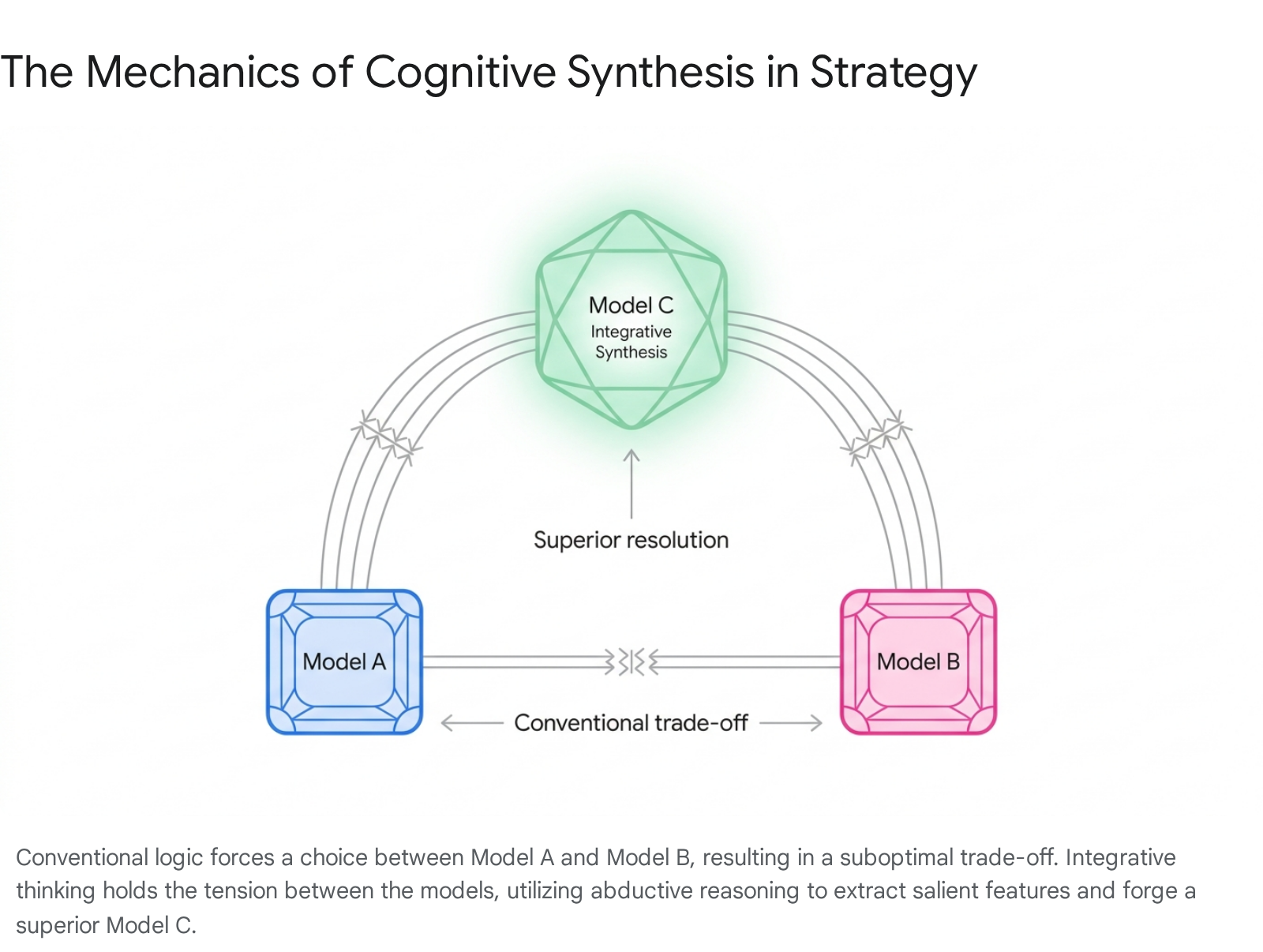
When applied to disruptive strategy formulation, integrative thinking shifts the analytical focus from the strategic actions exceptional leaders take to the cognitive processes underlying those decisions 114. In highly volatile, uncertain, complex, and ambiguous (VUCA) environments, traditional strategic planning - which relies heavily on deductive logic, simplification, and the acceptance of binary trade-offs - frequently results in strategic drift or organizational paralysis 56. Integrative thinking leverages complexity as the raw material for innovation, utilizing abductive reasoning and generative logic to formulate strategies that redefine industry boundaries 37.
The Cognitive Architecture of Strategy
The human brain is naturally predisposed toward simplification and specialization, an evolutionary mechanism designed to manage cognitive load in chaotic environments 1. In corporate settings, these inherent settings manifest as rigid functional silos, linear problem-solving methodologies, and a reliance on established best practices 147. While highly efficient for sustaining operations, this reductionist approach severely limits an organization's capacity during periods of disruption. Integrative thinking counters this by demanding that leaders hold competing models in tension 3.
The cognitive architecture required for integrative thinking comprises three interconnected elements of a personal knowledge system: stance, tools, and experience 9811. Stance refers to the leader's epistemological posture, specifically the belief that existing models are imperfect, that a superior model can be created, and that the leader possesses the agency to create it 8119. Tools consist of the specific analytical frameworks used to map complexity, such as systems thinking, causal modeling, and abductive reasoning 91110. Experience encompasses the deliberate practice of applying these tools to complex scenarios, a process that gradually shifts the individual along the cognitive spectrum from a conventional thinker to an integrative thinker 38.
Neurobiological Foundations of Integrative Cognition
Strategic literature frequently discusses executive decision-making as an abstract behavioral phenomenon, yet the mechanisms of integrative thinking are deeply grounded in neurobiology. Clinical and cognitive neuroscience models identify a "triple network" architecture in the human brain that governs complex reasoning and adaptation 1112. This architecture comprises the Default Mode Network (DMN), the Central Executive Network (CEN), and the Salience Network (SN) 1213.
The Default Mode Network is associated with internal rumination, self-referential processing, and creative ideation, whereas the Central Executive Network drives externally focused, goal-directed, and analytical problem-solving 121314. The capacity to synthesize opposing models hinges on the Salience Network, primarily anchored in the right anterior insula, which operates as a dynamic switchboard 1112. The Salience Network detects relevant internal and external stimuli and mediates the interaction between the DMN and CEN 12.
When organizational leaders face severe disruptions, cognitive rigidity often occurs due to hyperconnectivity in localized circuits or a failure of the Salience Network to appropriately regulate the DMN and CEN 1314. Conventional, binary decision-making effectively bypasses the necessity for complex network switching by defaulting to familiar, heavily myelinated pathways. Integrative thinking, conversely, requires intense neural synchronization, forcing the Salience Network to continuously balance the analytical rigor of the CEN with the divergent, abductive associations generated by the DMN 1213. Understanding this biological limitation explains why integrative thinking requires deliberate practice and specific cognitive tools to overcome the brain's natural bias toward simplification and rapid resolution 18.
The Stages of Integrative Decision-Making
Roger Martin operationalizes the cognitive architecture of the opposable mind through a four-stage process that contrasts sharply with conventional strategic planning methodologies 111915. These stages provide the operational scaffolding required to formulate disruptive strategies in unpredictable markets.
Salience
The initial phase of strategy formulation involves determining which factors are vital to the decision. Conventional strategic planning begins by filtering out extraneous data to make the problem manageable, effectively narrowing the scope of what is considered salient 19. The conventional thinker discards variables that do not neatly align with established paradigms or immediate financial metrics.
Conversely, the integrative thinker aggressively expands the boundaries of salience 916. They recognize that the raw materials for a disruptive breakthrough often lie in peripheral, chaotic, or seemingly contradictory data points 1. In the context of disruptive strategy, identifying unarticulated customer needs, distant macroeconomic anomalies, or adjacent technological shifts requires a high tolerance for expansive salience. The integrative thinker does not view complexity as an obstacle to be eliminated, but as the foundational context from which innovative solutions spring 1911.
Causality
Once salient factors are identified, the strategist must map the relationships and dependencies between them. Traditional managers favor linear, unidirectional models of causality, such as assuming that reducing prices will automatically increase market share or that specialized functional units operate independently of broader systemic outcomes 19.
Integrative thinkers reject this linear simplicity, recognizing that disruptive environments are defined by non-linear, multidirectional, and systemic causality 916. They employ systems thinking paradigms to understand feedback loops, second-order effects, and complex interdependencies across the organization and the broader market ecosystem 10. This depth of causal analysis prevents the organization from deploying superficial, linear solutions that trigger unintended strategic consequences, enabling leaders to design interventions that leverage systemic dynamics rather than fighting against them.
Architecture
When confronted with a multifaceted strategic problem, the conventional corporate approach is to disaggregate the issue into independent components, assigning each fragment to a specialized department for localized optimization 12. While this disaggregation creates administrative efficiency, it destroys the holistic nature of the strategic challenge and often results in misaligned operational outputs.
Integrative thinkers maintain the architecture of the entire problem in their minds while working on individual parts 2916. They approach strategy design holistically, continuously cross-referencing localized decisions against the overarching strategic objective. This ensures that a tactical shift in one operational area - such as supply chain procurement - does not compromise the strategic integrity of another area, such as brand equity or customer experience.
Resolution
The final stage is the generation of a creative resolution. Conventional thinkers view their role as making the tough choices between unpleasant alternatives, ultimately accepting a compromise or a zero-sum trade-off 1311. They assume that the available models represent the absolute limits of possibility.
The integrative thinker actively refuses to settle for mediocrity, half-measures, or sub-optimal trade-offs 19. If the available choices yield unsatisfactory results, the integrative thinker utilizes generative reasoning to invent a third option 39. This resolution actively resolves the tension between the opposing models and proves objectively superior to the original alternatives 139.
| Dimension | Traditional Strategic Planning | Integrative Strategy Formulation |
|---|---|---|
| Handling of Constraints | Viewed as absolute boundaries; problems are edited to fit constraints 117. | Viewed as parameters for innovation; constraints provoke generative reasoning 1718. |
| Approach to Complexity | Gravitates toward simplification, disaggregation, and specialization 12. | Welcomes chaos and complexity; views the entire system holistically 112. |
| Primary Logic Type | Deductive (what must be) and Inductive (what is operative based on past data) 717. | Abductive (what could possibly be true); focused on generative logic 71719. |
| View of Trade-offs | Inevitable; success requires making tough choices between sub-optimal options 39. | Unacceptable; tension between options is a catalyst for creating a superior third model 39. |
| Strategic Perspective | Top-down, deliberate, rigid long-term planning based on historical extrapolation 510. | Emergent, adaptive, utilizing strategic conversations and continuous hypothesis testing 102021. |
| Resolution Outcome | A definitive choice between existing models, resulting in compromise 3. | The synthesis of competing concepts into an entirely new, superior architecture 24. |
Disruptive Innovation Theory and Integrative Resolution
To fully understand the application of Martin's framework, it is necessary to contextualize it against the predominant theory of market disruption: Clayton Christensen's Theory of Disruptive Innovation. Christensen's model describes a phenomenon where a product or service takes root in simple applications at the bottom of a market - typically by being less expensive, lower performing by traditional metrics, and more accessible - and relentlessly moves upmarket, eventually displacing established competitors 25222324.
Christensen outlines how successful incumbent firms fail because they do everything ostensibly correctly. They listen to their most demanding customers, invest heavily in research and development, and focus on sustaining innovations that offer higher profit margins 252325. In doing so, they systematically ignore the low-end or new-market entrants because those markets possess tight profit margins and appear too small to provide adequate growth 2325.
While Christensen describes the mechanics of market disruption and the structural dilemma facing incumbents, Martin's integrative thinking provides the cognitive mechanism required to solve that dilemma 325. The "Innovator's Dilemma" presents a fundamental tension between two opposing business models. The first model, sustaining innovation, requires protecting the highly profitable core business, catering to legacy customers, and maximizing short-term shareholder returns. The second model, disruptive innovation, requires cannibalizing the core business, investing in lower-margin, unproven architectures, and targeting underserved or entirely new consumer segments 2223.
Conventional strategic thinking dictates a binary choice. An incumbent firm typically chooses the sustaining model, leaving itself inherently vulnerable to disruption from below 232425. Alternatively, a firm might aggressively pivot entirely to the disruptive model, destroying its current revenue base prematurely and risking insolvency.
Integrative thinking allows executive leadership to hold both models in tension simultaneously. Rather than choosing between protecting the core and pursuing the disruption, an integrative leader sequences the architecture of the organization to execute both. The resolution is an organizational structure that transcends the binary choice, creating a corporate ecosystem capable of simultaneous exploitation of existing markets and exploration of disruptive frontiers 2627.
| Innovation Vector | Sustaining Innovation | Disruptive Innovation |
|---|---|---|
| Market Target | Most profitable, demanding legacy customers 23. | Overserved (low-end) or unserved (new-market) customers 2325. |
| Product Attributes | Incremental or breakthrough improvements to existing functionality 22. | Simpler architecture, lower initial performance by standard metrics, lower cost 2425. |
| Profit Margin | High margins, driving short-term equity valuation 2225. | Low initial margins, demanding highly efficient cost structures 25. |
| Development Path | Steep trajectory along established performance metrics 2425. | New trajectory based on novel attributes, eventually intersecting mainstream needs 2428. |
| Incumbent Response | Aggressive investment to defend high-end market share 23. | Ignored or abandoned due to lack of immediate financial incentive 2325. |
Case Studies in Integrative Disruption
The theoretical validity of integrative thinking is best demonstrated through historical applications where executive leaders confronted seemingly intractable industry paradoxes and forged disruptive resolutions.
The Four Seasons Synthesis
A foundational case of integrative thinking in business model disruption is Issy Sharp's development of the Four Seasons hotel chain. In the mid-20th century, the hospitality industry operated on two dominant, opposing models 3. The first was the motel model: small, intimate properties with fewer than 200 rooms that offered warmth and comfort but lacked significant amenities. The second was the grand city-center hotel model: massive properties exceeding 750 rooms that offered comprehensive amenities and economies of scale but suffered from cold, highly impersonal service 3.
Conventional industry wisdom dictated that an operator had to choose one model and accept its inherent trade-offs. Sharp refused this binary limitation. Utilizing integrative thinking, he extracted the salient benefits of both opposing models: the intimacy and personalized service of the small motel, and the extensive luxury amenities of the large convention hotel. His resolution was the invention of a completely new category: a medium-sized luxury hotel, typically 200 to 350 rooms, that charged a premium price to offset the loss of massive scale, supported by a revolutionary culture of exceptional customer service 3. This synthesis completely disrupted the luxury hospitality market, proving that holding opposing ideas in tension can generate a superior business architecture.
Infosys and the Global Delivery Model
The tension between geographic proximity and cost efficiency dominated the IT services industry during the late 20th century. IT consultancies either utilized a local model, placing highly paid consultants directly at the client site to ensure close communication and rapid deployment, or an offshore model, centralizing development in lower-cost geographies at the expense of client communication and project nuance.
Nandan Nilekani, CEO of the Indian multinational Infosys, applied integrative thinking to this paradox 234. Nilekani recognized that neither the pure local model nor the pure offshore model was sustainable for the scale required in enterprise software development. His resolution was the creation of the Global Delivery Model. This framework synthesized the opposing ideas by maintaining a small, highly skilled client-facing team onsite to manage relationships and capture requirements, while seamlessly integrating them with massive, highly efficient development teams offshore. By viewing the problem not as a choice of location but as a challenge of workflow architecture, Nilekani created a dominant strategic model that fundamentally disrupted the global IT consulting industry 24.
Haier's Rendanheyi Organizational Platform
In the context of the modern, hyper-connected global economy, the Chinese white-goods manufacturer Haier provides a profound example of integrative thinking applied to organizational design. As manufacturing firms scale globally, they face a classic structural tension. They require the massive scale, capital efficiency, and standardization of a hierarchical bureaucracy to achieve operational margins, yet they simultaneously need the agility, customer-centricity, and rapid innovation of an entrepreneurial startup to survive in a VUCA environment 71026.
Conventional strategic planning relies on matrix structures or periodic reorganizations to balance this trade-off, which routinely results in administrative gridlock. Haier's leadership, facing these opposing constraints, developed the Rendanheyi model 102629. This model actively disintegrated the traditional corporate hierarchy, transforming Haier from a monolithic manufacturer into a decentralized platform of thousands of self-managing, micro-entrepreneurial nodes known as ZZJYTs 10.
Employees within these nodes take direct profit-and-loss responsibility and create value directly for users, aligning the extreme agility of a startup with the capital backing and supply chain advantages of a global multinational 26. By applying an abductive approach to organizational design and empowering self-organization, Haier resolved the tension between scale and agility, establishing a disruptive capability that defies traditional management orthodoxies 71026.
Nampak's Strategic Turnaround in Africa
The application of integrative thinking is equally critical in corporate turnarounds, where immediate survival imperatives frequently conflict directly with long-term strategic viability. In 2025, Phil Roux, CEO of the African packaging giant Nampak, faced a severe organizational crisis 3031. The firm had lost over 86% of its market value on the Johannesburg Stock Exchange within three years due to a highly leveraged expansion strategy into developing African markets 3031. This vulnerability was exacerbated by severe macroeconomic volatility and a massive US dollar debt overhang, leading shareholders to reject a proposed R2 billion rights issue 3031.
The conventional turnaround playbook dictates aggressive, unnuanced cost-cutting, rapid asset stripping, and operational retrenchment to appease nervous creditors. However, this reactionary approach often destroys the core organizational capabilities required for any future growth. Conversely, focusing solely on strategic expansion is impossible under the threat of imminent insolvency. Roux recognized this paradox and explicitly applied an integrative mindset, noting his reliance on assimilating data quickly and applying multiple intelligences to new contexts 3031.
Roux refused to settle for a trade-off that would leave the company solvent but strategically castrated. He sequenced his strategy meticulously. He executed an immediate, hard-line financial restructuring - securing a revised debt structure and a reduced R1.5 billion rights issue - while simultaneously launching a holistic "restoration of vitality" phase 3031. He utilized causal analysis to map the complex relationships between capital structure, African currency volatility, and human capital, ensuring that the disposal of non-core assets did not irreparably damage the firm's central manufacturing competence 3031. The resolution was a synthesized turnaround strategy that satisfied immediate creditor constraints while preserving the operational architecture necessary for post-crisis market leadership 30.
Tata Motors and Complex Ecosystems
The development of the Tata Nano by Tata Motors in India illustrates the application of integrative thinking in managing extreme constraints and complex stakeholder ecosystems. In 2008, Tata unveiled the Nano, designed as the world's most affordable automobile at approximately $2,500 9. The strategic formulation required balancing extreme cost constraints with safety, functionality, and manufacturing viability.
However, the strategy faced severe disruption when violent protests by local farmers erupted at the company's original manufacturing site in West Bengal 9. Conventional crisis management might have dictated forceful suppression or abandoning the low-cost strategy altogether due to rising supply chain disruptions. Instead, utilizing an integrative stance, Tata leadership embraced the reality of the multi-dimensional stakeholder environment. They relocated operations to Gujarat, a move that involved uprooting suppliers and navigating severe production shortfalls, but ultimately preserved the integrity of the strategic vision while respecting socio-political constraints 9. This required maintaining the entire complex architecture of the business model in mind while radically restructuring the physical supply chain elements.
Strategic Integration in the Era of Artificial Intelligence
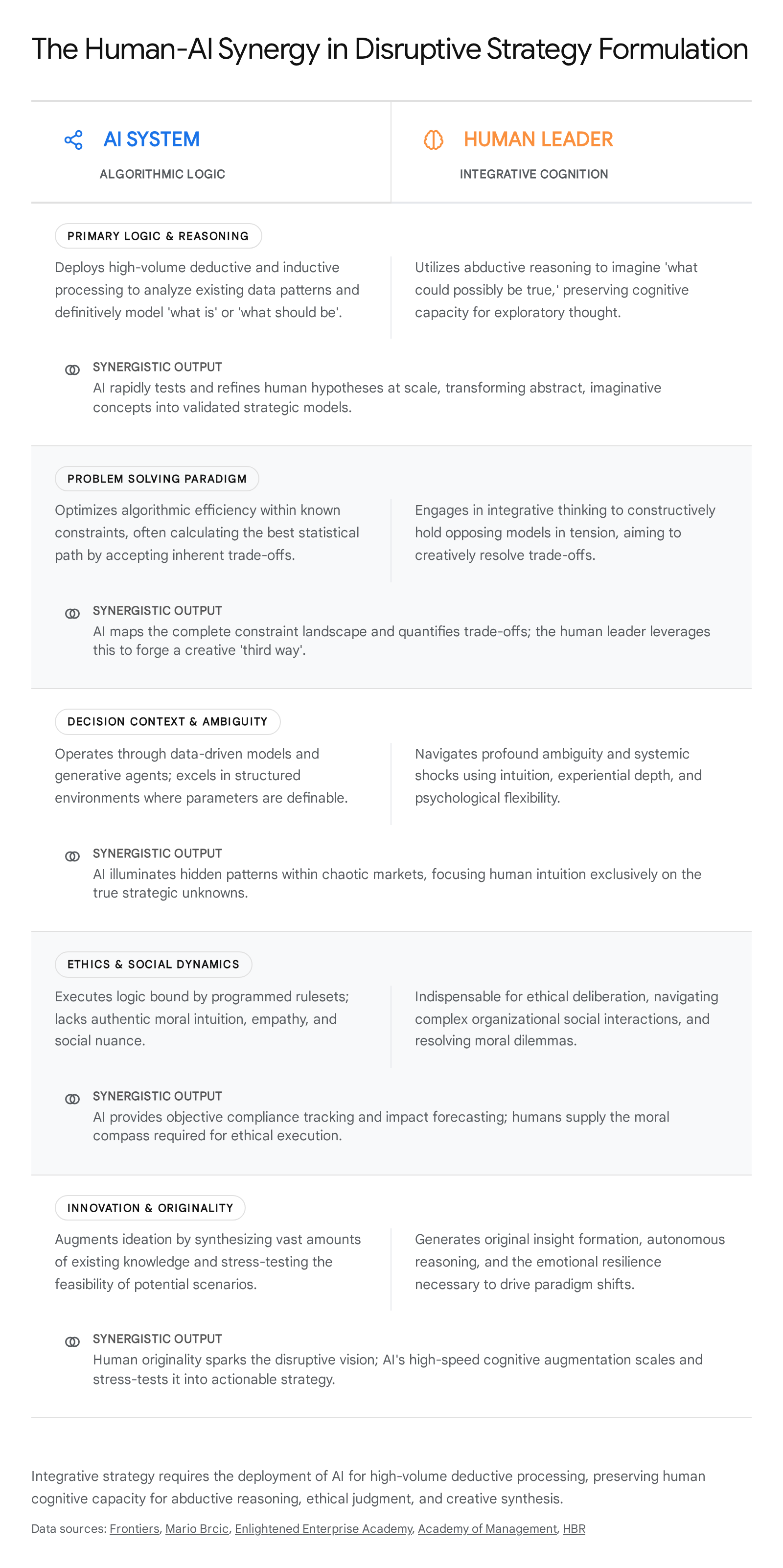
As organizations transition through the mid-2020s, the integration of Artificial Intelligence (AI) - particularly Generative AI (GenAI) and Large Language Models (LLMs) - into strategic workflows represents the most significant disruptive variable 323334. The pervasive adoption of AI forces leaders to confront a profound new strategic tension: the dichotomy between machine intelligence and human judgment 3335. Machine intelligence is defined by massive data processing, deductive logic, rapid pattern recognition, and algorithmic efficiency, whereas human judgment relies on intuition, ethical deliberation, empathy, and abductive reasoning 333435.
Resolving the Human-Machine Tension
Conventional management logic often views AI through a lens of substitution, seeking to replace human labor with digital labor primarily to reduce operational costs 3637. Alternatively, skeptical leadership views AI as an unmanageable risk, isolating it from core strategic formulation. The integrative leader views AI and human cognition not in competition, but as complementary components of a unified strategic architecture 323338.
Research indicates that the most profound disruptive innovations occur when organizations achieve "innovation ambidexterity," blending data-driven AI models with the nuanced understanding of human collective intelligence 3539. AI excels at the algorithmic exploitation of existing data, while human leaders excel at the exploration of unstructured "mysteries" and the postulation of novel futures 1940. By establishing a dynamic where AI handles the heavy lifting of deductive and inductive analysis, human leaders are liberated to focus on the highest-order cognitive task: integrative synthesis 3241.
AI as an Augmenter of Salience and Causality
The four-stage process of integrative thinking is directly augmented by the deployment of frontier AI models, particularly in the initial phases.
One of the fundamental limitations of human cognition is the inability to process vast amounts of unstructured data to identify weak signals. AI-driven analytics and natural language processing capabilities radically expand the aperture of what the leader considers salient 13642. By deploying advanced models - such as the iterations of GPT-5.1 or Claude Sonnet 4.5, which demonstrate heightened abilities to parse nuanced constraints and multi-part directives - strategists can rapidly identify anomalies in consumer behavior, regulatory shifts, and competitor movements at a global scale 364344.
Furthermore, AI systems excel at multivariate correlation and pattern recognition, directly enhancing the causality mapping stage. When leaders seek to understand the causal relationships in a disrupted market, advanced machine learning models can simulate complex supply chain variables, economic indicators, and environmental risks, handling multidimensional data sets that overwhelm human working memory 4546. The integration of AI also facilitates a continuous "Reinvention Cycle," where strategists use AI to rapidly bridge gaps between disparate fields (e.g., data analysis, brand strategy, and narrative psychology), deriving professional value from cross-domain integration rather than narrow specialization 47.
Despite these capabilities, AI lacks true reasoning and remains fundamentally an engine for statistical prediction 34. The final two stages of integrative thinking - Architecture and Resolution - remain distinctly human endeavors. AI cannot autonomously formulate the ethical stance of a company, navigate social paradoxes, or generate true abductive leaps that defy historical data sets 73335. Integrative thinkers use AI-generated insights merely as the high-fidelity raw material required to forge new business architectures that resolve deep societal or market tensions.
| Cognitive Capability | Artificial Intelligence Models | Human Integrative Leadership |
|---|---|---|
| Logic Foundation | Deductive and Inductive; bound by historical training data 34. | Abductive; capable of postulating novel futures without historical precedent 717. |
| Data Processing | Unlimited capacity for high-volume, structured, and unstructured data synthesis 3436. | Highly constrained working memory; prone to cognitive bias and simplification 134. |
| Application in Strategy | Expansion of Salience and mapping complex multivariate Causality 4344. | Defining strategic Architecture, asserting ethical Stance, and formulating Resolution 1133. |
| Constraint Handling | Optimizes mathematically within explicitly programmed boundaries 43. | Views constraints fluidly as creative parameters to be subverted or transcended 1718. |
| Ethical and Social Resonance | Lacks intrinsic ethical framework; risk of algorithmic bias 3348. | Possesses emotional intelligence, empathy, and capacity for moral deliberation 3335. |
Sustainable Operations and Global Supply Chain Synthesis
Beyond digital transformation and market entry strategy, integrative thinking is highly applicable to macro-level operational design, particularly in resolving the contemporary paradox of global supply chains. The geopolitical and health crises of the early 2020s exposed the extreme fragility of hyper-optimized, long-distance supply networks driven purely by cost efficiency 4950. Simultaneously, mounting regulatory pressure and the material realities of climate change have mandated strict adherence to Environmental, Social, and Governance (ESG) criteria 649.
Operations executives find themselves trapped between opposing forces: the financial mandate for localized, redundant resilience (which increases inventory costs) and the market mandate for efficiency and global scale 50. Furthermore, they face the constant tension between short-term corporate profitability and long-term ecological sustainability.
Traditional supply chain planning views sustainability and resilience as cost-centers or unavoidable constraints to be minimized 5051. The integrative approach reformulates this dynamic entirely. Recent strategic scholarship proposes the Integrated Sustainable Operational Strategy (ISOS) framework, which relies heavily on integrative thinking to bridge fragmented operational theories 4950. Instead of compromising between resilience and efficiency, ISOS synthesizes circular economy principles, localized digital adaptation, and workforce flexibility 4950.
By maintaining the entire architecture of the socio-ecological system in mind - rather than treating individual manufacturing units as isolated profit centers - integrative leaders redesign operations so that sustainability drives innovation and efficiency, rather than hindering it 4952. For example, transitioning to circular manufacturing loops reduces long-distance shipping dependencies (enhancing systemic resilience) while simultaneously lowering carbon footprints (enhancing sustainability) and insulating the firm from raw material price shocks (enhancing financial efficiency) 4549. This represents a definitive example of creative resolution outperforming a traditional zero-sum compromise, proving that an opposable mind is critical for achieving United Nations Sustainable Development Goals while maintaining industrial competitiveness 4950.
Conclusion
The formulation of disruptive strategy is inherently fraught with paradoxes, competing stakeholder demands, and volatile environmental constraints. Roger Martin's framework of integrative thinking demonstrates that the leaders who successfully navigate these disruptions do not succeed by making incrementally better choices between existing options; they succeed by refusing those choices altogether.
By systematically expanding the boundaries of salience, mapping complex causalities, retaining the holistic architecture of a problem, and relentlessly pursuing creative resolution, leaders can formulate strategies that transcend traditional boundaries. Whether applied to the structural tensions of Clayton Christensen's "Innovator's Dilemma," the organizational design of self-managing global platforms like Haier, the turnaround of distressed assets in emerging markets, or the systemic deployment of Generative AI, the opposable mind acts as the ultimate strategic asset. As technological, ecological, and geopolitical disruptions accelerate, the premium on human cognitive synthesis - the ability to hold two opposing ideas in the mind and forge a superior reality - will only increase, separating enduring organizations from those that merely react to the tide of change.