
AI Trading Agents vs. Simple Bots: What's the Difference
A simple trading bot executes pre-programmed mathematical rules to buy and sell assets, offering lightning-fast execution but zero adaptability to changing market conditions. An AI trading agent, by contrast, is an autonomous software system powered by machine learning that understands broader investment goals, reads unstructured market context, and continuously adapts its own strategies based on real-time feedback. If a traditional bot is a train running on a fixed track, an AI agent is a self-driving car capable of navigating chaotic financial traffic to reach a specific destination.
The Evolution of Automated Market Participation
Automated trading has been a fixture of financial markets for decades, long before the advent of modern artificial intelligence. Institutional hedge funds and retail day traders alike have relied on software to remove the friction of manual order entry and the psychological burden of human emotion 12. However, the terminology surrounding automation has become increasingly muddied. With the explosion of large language models and machine learning frameworks over the past few years, the distinction between a traditional trading bot and a true AI trading agent has become a critical dividing line in quantitative finance 34.
To understand the difference, one must look past the marketing terminology and examine the underlying decision-making architecture. A system's capacity for autonomy, contextual awareness, and continuous learning dictates whether it is merely a fast calculator or an independent market participant.
The Mechanics of Traditional Trading Bots
Traditional trading bots operate on deterministic logic. They are essentially algorithmic calculators designed to follow static, predefined scripts based on structured numerical inputs. Traders program these bots using technical indicators, such as moving averages, relative strength index thresholds, or Fibonacci retracements 35. The operational mandate of a bot is simple: if a specific mathematical condition is met, execute a specific action. For example, a bot might be programmed to buy a specific asset when the twenty-period exponential moving average crosses above the fifty-period average, provided the relative strength index remains below thirty 1.
Bots excel in environments where speed and rigid adherence to rules are paramount. They are perfectly suited for well-defined, repetitive strategies like dollar-cost averaging, grid trading within range-bound markets, or capturing arbitrage opportunities across different cryptocurrency exchanges 6. Because they do not need to pause and interpret the meaning behind the data, their execution speed is virtually instantaneous. In the realm of high-frequency trading, institutional firms utilize specialized bots running on co-located servers adjacent to exchange data centers to execute thousands of trades per second, capturing fractions of a penny on each transaction 1.
However, the greatest strength of a traditional bot - its rigid adherence to instructions - is also its fatal flaw. Bots possess absolutely no contextual awareness 5. A legacy trading bot treats a quiet Monday morning the exact same way it treats a chaotic Sunday night trading session immediately following an unprecedented macroeconomic crisis 5. They cannot differentiate between a normal market dip and a systemic collapse. When market regimes change and historical price patterns break down, bots continue executing their predefined scripts flawlessly, often resulting in catastrophic financial losses 1. Retail traders frequently experience what is known as the "rekt loop," where a grid-trading bot performs exceptionally well during a flat market but proceeds to wipe out an entire account the moment a strong directional trend takes over 5. Bots do not know when to stop unless a human trader manually intervenes and alters their code.
The Rise of Autonomous Agentic AI
An AI trading agent fundamentally alters the automation paradigm by shifting from script-based execution to goal-oriented autonomy. Instead of relying on rigid rules, agentic artificial intelligence utilizes dynamic learning models and large language models to perceive its environment, reason through complex variables, and formulate multi-step plans 78.
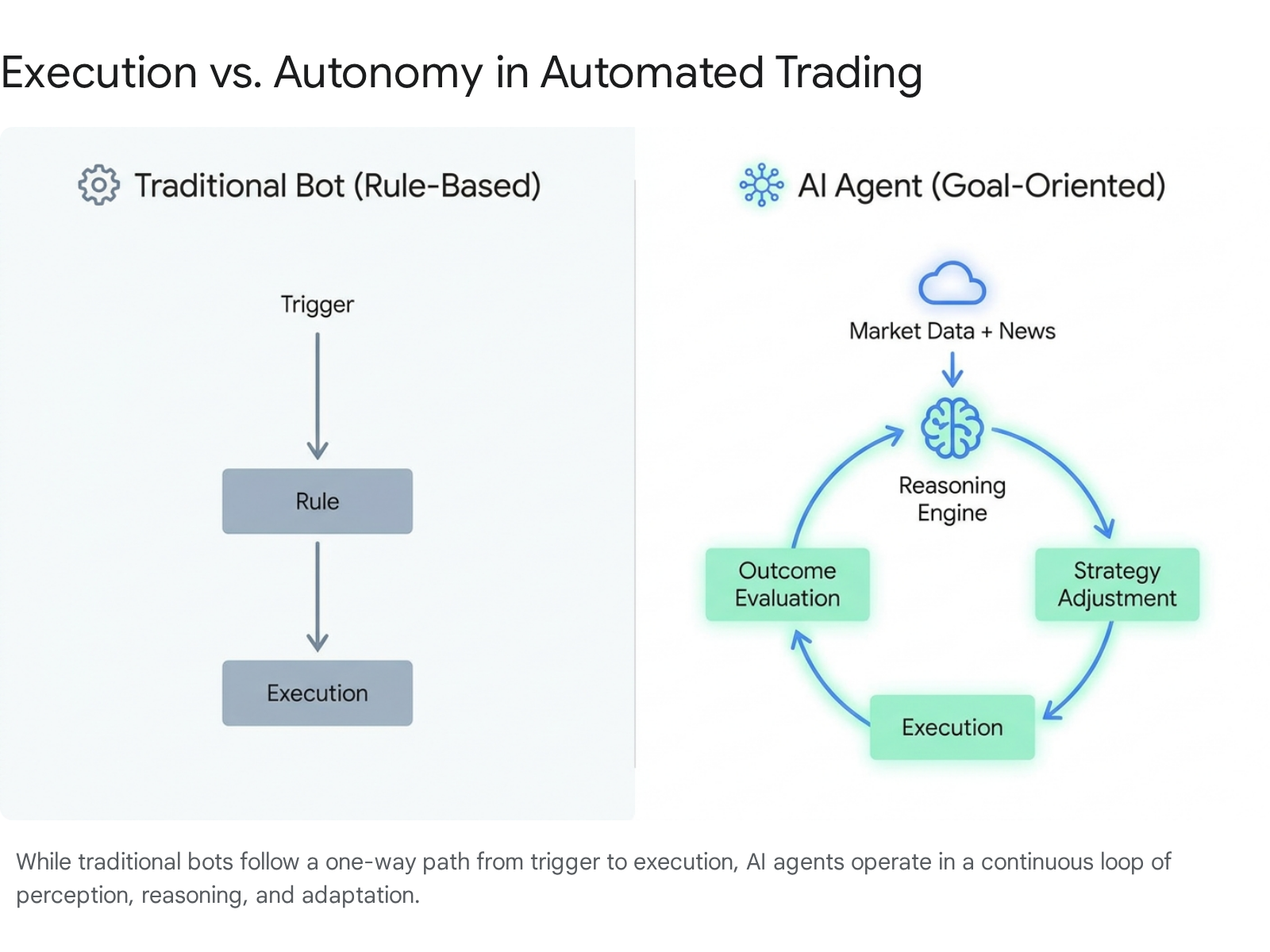
When deploying an AI agent, a trader does not provide a strict formula of when to buy or sell. Instead, the trader defines a high-level objective, such as maximizing returns over a specific quarter while hedging against volatility in the technology sector 3. The agent is then responsible for breaking this overarching goal down into actionable tasks. It autonomously scans the internet for real-time information, updates its internal models, and determines the optimal path to achieve the user's objective 89.
The defining characteristic of an AI agent is its ability to process heterogeneous, unstructured data. While a bot relies solely on price and volume numbers, an AI agent can ingest and comprehend news articles, central bank meeting minutes, social media sentiment, and lengthy corporate earnings transcripts 734. By employing sophisticated natural language processing, the agent can understand that a sudden drop in a stock's price is not a buying opportunity, but rather the result of a devastating regulatory lawsuit that was just announced on a news wire 4.
If an unexpected black swan event occurs, the agent does not blindly continue its previous strategy. Instead, it recognizes the anomaly, simulates potential "what-if" scenarios, and dynamically pivots its approach to protect the portfolio - all without requiring human intervention 36. This adaptability makes AI agents highly resilient in volatile and unpredictable market conditions 67.
Structural Comparison
| Feature | Simple Trading Bot | AI Trading Agent |
|---|---|---|
| Logic Foundation | Pre-programmed scripts, static mathematical formulas, and rigid algorithms 37. | Machine learning, Large Language Models (LLMs), and dynamic, goal-oriented reasoning 37. |
| Data Processing | Strictly structured numerical data (price, volume, technical indicators) 7. | Heterogeneous data (unstructured news, financial reports, social sentiment, macroeconomic events) 34. |
| Adaptability | None. Fails or requires manual recalibration when market regimes change 56. | High. Learns from past outcomes and adjusts strategies autonomously in response to market volatility 65. |
| Setup Complexity | Low. Often configured via simple graphical interfaces or basic scripting 7. | High. Requires complex data pipelines, vector databases, multi-agent orchestration, and prompt engineering 47. |
| Ideal Environment | Stable, predictable, range-bound markets; high-frequency execution scenarios 16. | Volatile, unpredictable markets requiring multi-variable interpretation and deep analysis 67. |
The Architecture of an AI Trading System
Developing an AI trading agent is a highly complex engineering endeavor that extends far beyond writing a simple prompt into a chat interface. By 2026, the architecture of a sophisticated trading agent closely mirrors the organizational structure of a professional human hedge fund 13. These systems rarely rely on a single, monolithic artificial intelligence model. Instead, they utilize multi-agent frameworks, where several specialized AI entities collaborate, debate, and verify information before executing a trade.
Multi-Agent Orchestration and Specialization
In advanced architectural frameworks, the trading system is divided into distinct operational modules. Research models like the FinAgent multimodal foundation agent demonstrate this sophisticated division of labor 5. A Market Intelligence module constantly collects and summarizes diverse data streams, classifying market sentiment and utilizing diversified retrieval systems to extract insights from daily news and quarterly financial reports 5.
Within multi-agent systems designed to replicate real-world trading firms, individual agents are assigned specific personas 1314. A fundamental analyst agent is tasked exclusively with evaluating corporate balance sheets and valuation metrics. A sentiment analyst agent monitors public perception and breaking news 13. Most importantly, a risk management agent monitors the portfolio's overall exposure, evaluating potential drawdowns and enforcing hard limits on capital allocation 136. Before a final decision is made, an execution agent synthesizes the conflicting insights from the specialized agents, often utilizing chain-of-thought reasoning to provide a transparent, reasoned explanation for why a specific asset should be bought, held, or sold 35.
Memory, Reflection, and Tool Integration
A critical differentiator between a simple bot and an AI agent is the capacity for memory and reflection. Traditional reinforcement learning systems often act as black boxes, providing outputs without explainable reasoning and struggling to adapt without extensive retraining 5. Modern trading agents address this by incorporating distinct memory modules utilizing vector storage architectures 5.
These memory systems allow the agent to evaluate its own historical performance. For instance, a high-level reflection module will analyze the agent's past trading decisions, assess the underlying reasoning that led to a loss, and implement safeguards to ensure the same mistake is not repeated in similar future scenarios 5. Furthermore, these agents do not operate in isolation. Through the use of application programming interfaces (APIs) and tool-augmented decision modules, AI agents can access professional expert guidance, query traditional technical indicators, and interact directly with brokerage systems to execute trades autonomously 395.
The Cost and Complexity of Development
Building a system capable of this level of orchestration requires significant technical and financial resources. The open-source community has rapidly advanced the foundational tools necessary for agent development, with frameworks like LangGraph, AutoGen, CrewAI, and Agno dominating developer ecosystems in 2026 71789. LangGraph has become a standard for stateful, graph-based workflows requiring enterprise-level observability, while CrewAI excels in role-based orchestration where developers assign specific backstories and tasks to cooperating agents 78.
Despite the availability of open-source frameworks, the actual cost of developing and deploying a production-grade AI trading agent is substantial. Developing a simple minimum viable product capable of executing predefined strategies might require an investment of twenty thousand to forty thousand dollars 20. However, creating an advanced, institutional-grade system featuring deep machine learning integration, real-time analytics, proprietary data feed subscriptions, and high-speed infrastructure can easily push development costs beyond three hundred thousand dollars 2021. The operational overhead also includes maintaining continuous, high-quality data pipelines, as an agent's decision-making is only as reliable as the information it processes 4.
Performance Realities: Empirical Evidence and Academic Skepticism
The financial industry is historically prone to extreme hype regarding new technologies, and AI trading agents are no exception. Proponents claim that AI will systematically outperform human analysts, while critics argue that the technology is over-promised and heavily reliant on flawed backtesting. The reality, supported by academic research and market data, lies somewhere in the middle.
Evidence of Superior Performance
There is substantial empirical evidence demonstrating that highly sophisticated AI agent architectures can significantly outperform traditional quantitative strategies and passive benchmarks. In recent studies, researchers evaluated adaptive multi-agent systems integrating large language models with deep reinforcement learning 3. During out-of-sample testing periods marked by extreme market volatility, these three-layer architectural frameworks achieved remarkable results.
While traditional buy-and-hold strategies suffered significant losses during high-volatility events, the multi-agent systems consistently adapted. In empirical validations across major US equities from mid-2024 to mid-2025, specific multi-agent frameworks achieved average annualized returns exceeding fifty-three percent, with a highly favorable Sharpe ratio of 1.702 3. Crucially, the systems demonstrated exceptional risk management, restricting maximum drawdowns to roughly twelve percent, compared to the thirty percent drawdowns experienced by passive benchmarks 3.
Ablation studies - which test a system by removing individual components to see how performance degrades - confirm that this success is directly attributable to the synergy of multiple agents working together 3. Removing the industry trend analysis agent or the black swan detection agent resulted in severe performance drops, proving that the multi-agent collaborative dynamic is the source of the edge, rather than just the raw predictive power of a single language model 3.
Academic Critiques and Limitations
Despite these localized successes, broad academic scrutiny reveals significant limitations in how LLM-based trading strategies operate in the long term. A major critique centers on the methodology of AI performance reporting, noting that many models are evaluated on narrow timeframes and limited stock universes, which introduces severe survivorship and data-snooping biases 22.
When researchers applied more rigorous, long-term backtesting frameworks over extensive periods and larger asset pools, the touted advantages of LLM strategies deteriorated significantly 22. Furthermore, market regime analysis highlights that AI agents often struggle with appropriate risk scaling; they can be overly conservative and underperform during strong bull markets, while paradoxically becoming overly aggressive and incurring heavy losses during bear market regimes 22.
Additionally, controlled experimental studies comparing LLMs to human traders reveal that language models fail to replicate complex human behavioral dynamics. In simulated endogenous markets, LLM agents exhibited "textbook-rational" behavior, pricing assets closely to their fundamental values 10. While this sounds positive, it means the AI models entirely failed to anticipate or participate in the formation of market bubbles, a defining characteristic of real-world, human-driven financial markets 10. If an AI cannot model or predict human irrationality, it remains blind to some of the most profitable, albeit dangerous, market movements.
Where Traditional Bots Still Dominate
The advent of autonomous agents does not render simple trading bots obsolete. Because AI and traditional bots solve fundamentally different operational problems, they are utilized in entirely different market contexts. There is no universal winner; performance is entirely dependent on the specific requirements of the trading strategy 6.
Traditional bots retain absolute dominance in environments where execution speed is the singular metric of success. High-frequency trading firms, utilizing multi-million-dollar infrastructure and co-located servers, deploy basic algorithmic bots to execute thousands of micro-trades within milliseconds 121. Large language models and agentic reasoning frameworks require substantial computational overhead. The process of retrieving data, parsing natural language, debating probabilities, and generating an output introduces inherent latency 56. By the time an AI agent comprehends a shift in order-book liquidity, a traditional bot has already entered and exited the position multiple times.
Furthermore, in highly stable, predictable environments, the complexity of an AI agent is an unnecessary liability. Strategies with strict mathematical definitions, such as statistical arbitrage, function perfectly on rule-based logic 16. If the goal is purely mechanical execution without the need for interpretation, a simple bot minimizes operational risk and ensures flawless consistency 6.
Recognizing these divergent strengths, institutional desks and advanced retail traders are increasingly moving toward hybrid architectures 6. In these systems, an AI agent operates as the strategic overarching brain - processing news, defining the macro strategy, and dynamically adjusting risk parameters based on shifting volatility. Once the agent determines the optimal parameters, it hands the actual execution over to a lightweight, traditional bot to ensure the trade is filled with minimal latency 46.
Technical Flaws and Systemic Dangers
Delegating financial capital to autonomous software introduces a unique set of technical and systemic risks. While human traders are susceptible to fatigue and emotional bias, AI agents present entirely new failure modes that can inflict severe financial damage before human oversight can intervene.
Financial Hallucinations
The most prominent danger inherent in large language models is their propensity to hallucinate. LLMs are probabilistic engines designed to predict the next logical word in a sequence, allowing them to generate highly articulate and plausible text that may be entirely divorced from factual reality 1112.
In a financial context, hallucinations are catastrophic. If an AI agent relies on noisy or outdated training data, it may misinterpret ambiguous context and confidently fabricate corporate earnings figures, invent nonexistent clinical trial results for pharmaceutical companies, or generate completely fictional macroeconomic inflation forecasts 11. Traders utilizing AI for news summarization risk acting on fabricated merger and acquisition announcements 11. If an autonomous agent directly executes a trade based on a hallucinated regulatory update, the resulting capital loss is instantaneous and irreversible.
Overfitting and Reinforcement Learning Failures
Another significant vulnerability lies in the training methodology used to develop trading agents. Many developers attempt to utilize deep reinforcement learning to align AI outputs with expected market behaviors 13. However, reinforcement learning is optimally designed for environments with sparse rewards and clear, deterministic rules - such as robotic navigation or playing chess 13.
Financial markets operate on a completely different paradigm. Market data is inherently noisy, and rewards are immediate rather than sparse. When agents are trained on static historical data, they suffer from severe overfitting; they learn to interpret historical noise as definitive signals, creating a false illusion of predictability 13. A model might achieve a ninety percent win rate during historical backtesting, only to suffer massive drawdowns when deployed in a live, forward-looking market where conditions have subtly shifted 14. Most importantly, an agent trained purely on historical quotes cannot learn how its own trading volume might impact live market liquidity, rendering its simulated strategies ineffective in reality 13.
The Threat of Monocultures and Systemic Risk
Beyond individual portfolio losses, regulators and academics are raising alarms about the systemic risks posed by the widespread adoption of AI trading agents. Market stability relies on diverse participants holding differing views on asset valuations. If the majority of retail traders and institutional funds begin relying on the exact same underlying foundational models - such as a single dominant LLM provided by a major technology corporation - the market risks evolving into a technological monoculture 1516.
If thousands of interconnected AI agents process the same news headline through the same neural network architecture, they are highly likely to arrive at the exact same trading conclusion simultaneously 1517. During periods of extreme stress or unexpected market shocks, this synchronized behavior could lead to massive herd-like selling, entirely draining market liquidity and exacerbating wild price swings 416. Academics point to the 2010 Flash Crash - where algorithmic flaws wiped out a trillion dollars in market value in minutes - as a stark warning of how minor data errors, amplified by correlated algorithmic behavior, can rapidly destabilize the entire global financial system 418.
The Regulatory Response: The SEC and ESMA
As AI technologies blur the lines between software tools and autonomous fiduciaries, regulatory bodies across the globe are scrambling to update enforcement frameworks. The overarching goal is to foster technological innovation without sacrificing market integrity or investor protection. However, the approaches taken by US and European regulators have diverged significantly.
The SEC's War on AI-Washing
In the United States, the Securities and Exchange Commission (SEC) has made the policing of artificial intelligence a premier enforcement priority 1920. Rather than immediately implementing sweeping, highly prescriptive regulations targeting the code itself, the SEC has focused heavily on corporate transparency and anti-fraud enforcement.
The primary target of the SEC has been "AI-washing" - the practice of companies or investment advisers making materially false or exaggerated claims about their use of artificial intelligence to attract capital or clients 193435. The SEC maintains that if an entity claims to utilize advanced AI for market analysis or execution, it must be able to thoroughly document the technical architecture supporting those claims 1921. This stance was solidified through high-profile enforcement actions against investment advisers like Delphia and Global Predictions, who were levied substantial civil penalties for falsely marketing sophisticated AI models that did not actually exist 193521. Similar parallel actions by the SEC and the Department of Justice against companies like Nate Inc. demonstrate the government's willingness to pursue severe consequences for AI-related securities fraud 3537.
While the SEC has aggressively pursued fraud, its stance on broader AI regulation underwent a massive shift between 2024 and 2026. Under former Chair Gary Gensler, the SEC had proposed stringent rules targeting "Predictive Data Analytics" (PDA), which would have required broker-dealers to meticulously document and neutralize any potential conflicts of interest embedded within their algorithmic models 383922412324. However, following intense industry pushback citing overly broad mandates that could stifle innovation, the SEC formally withdrew the PDA proposals in mid-2025 252646.
Under the leadership of SEC Chair Paul Atkins, the Commission has adopted a "technology-neutral" philosophy. Atkins has repeatedly emphasized that "misconduct remains misconduct, regardless of the medium," arguing that existing anti-fraud laws are generally sufficient to govern AI behavior 1947. The SEC's current strategy favors principles-based disclosures centered on strict materiality, avoiding overly prescriptive technology mandates while reforming internal investigative processes to ensure procedural fairness for firms developing new financial technologies 2047274950.
ESMA and the Prescriptive European Approach
Across the Atlantic, the European Securities and Markets Authority (ESMA) has adopted a vastly more prescriptive and preventative regulatory framework. Recognizing the distinct risks posed by advanced automation, ESMA has explicitly brought AI trading agents under the rigorous oversight of the Markets in Financial Instruments Directive II (MiFID II) rules governing algorithmic trading 285229.
In a comprehensive supervisory briefing published in February 2026, ESMA mandated that any investment firm utilizing AI in its trading systems must implement "bespoke controls" to monitor both the quality of data inputs and the accuracy of the algorithmic outputs 28293031. European regulators reject the notion that an AI agent can operate entirely autonomously without severe structural safeguards. Firms are required to conduct rigorous, continuous stress testing following any "material change" or software update to ensure the AI will not contribute to disorderly market conditions or execute abusive practices 3132.
Furthermore, ESMA requires strict pre-trade controls, such as hard limits on order sizes and price collars, to prevent an AI from executing catastrophic erroneous trades during periods of volatility 522932. Crucially, the European framework demands that compliance staff maintain a deep understanding of how their proprietary AI models make decisions, directly attacking the "black box" nature of deep learning 3032. European firms must also navigate a complex matrix of overlapping governance, including the data protection requirements of GDPR and the stringent, risk-tiered obligations mandated by the EU's landmark AI Act 3033.
The Retail Revolution and the Copilot Era
Historically, the sophisticated infrastructure necessary to run algorithmic, high-frequency trading models was guarded behind the doors of elite quantitative hedge funds 1. By 2026, the proliferation of open-source frameworks and accessible cloud computing has fundamentally democratized access to these institutional-grade tools 145834.
Retail investors are no longer restricted to executing manual trades based on delayed news alerts. Commercial platforms like ChartingLens, Trade Ideas, and Tickeron provide everyday traders with access to AI-driven scanners, pattern recognition libraries, and natural-language backtesting environments 3561. Simultaneously, advanced retail developers are utilizing frameworks like LangGraph to construct and deploy their own custom multi-agent environments to operate across equities, cryptocurrency, and prediction markets 662.
Despite this newfound power, widespread retail data indicates that users are heavily favoring augmentation over total automation. According to recent comprehensive surveys of self-directed investors, the vast majority are not utilizing AI to trade blindly on their behalf 3436.
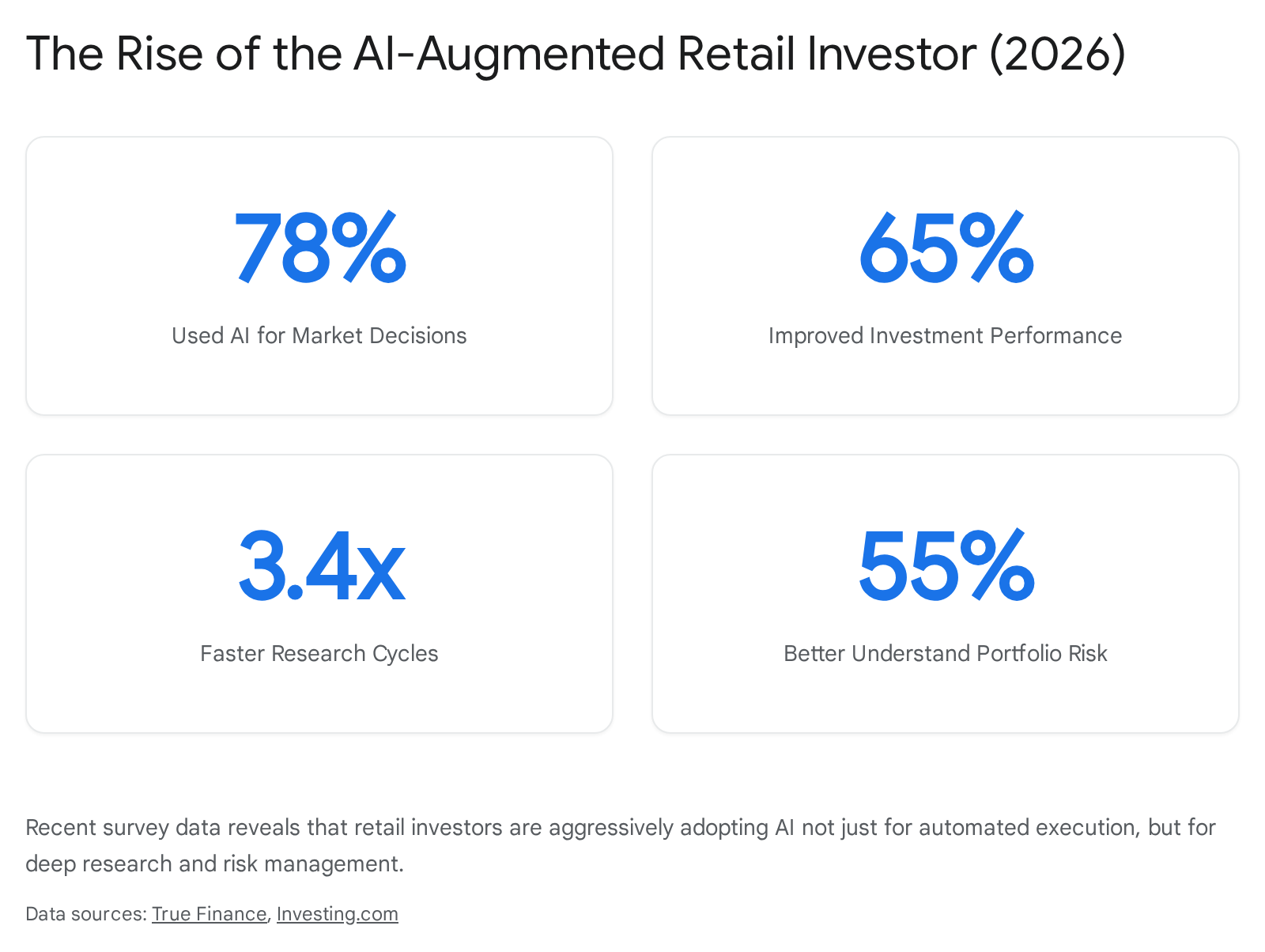
Instead, retail investors are adopting the "copilot" model. They utilize AI agents to rapidly synthesize complex financial filings, monitor real-time portfolio risk across multiple asset classes, and screen for specific macroeconomic setups that match their personal investment thesis 634. In this paradigm, the human investor retains the role of chief executive - setting strict risk boundaries, allocating capital, and making the final judgment call - while the AI agent serves as an indefatigable, deeply analytical research team 634.
Bottom line
The critical distinction between a traditional trading bot and an AI agent lies entirely in autonomy and contextual awareness. A simple bot acts as a fast but blind execution tool, adhering flawlessly to static mathematical rules, making it highly effective for simple, latency-sensitive tasks but incredibly dangerous when market conditions abruptly change. Conversely, an AI trading agent operates as a dynamic, goal-oriented system capable of interpreting global news, reasoning through complex strategies, and independently adapting to extreme market volatility. While the democratization of these agentic systems provides retail and institutional investors with unprecedented analytical power, users must navigate severe technical risks - including financial hallucinations, reinforcement learning failures, and the threat of systemic monocultures - while operating under the increasingly watchful eyes of global financial regulators.