
5 Scenarios for the Future of Global Migration
The future of global migration will be shaped by a complex interplay of demographic imbalances, localized environmental collapse, and systemic economic transformations rather than a singular trend. Planners and policymakers must confront five distinct scenarios - Climate-Driven Retreat, The Aging North's Labor Vacuum, 'Fortress' Border Policies, Tech-Driven Skill Mobility, and Conflict-Induced Spikes - that will restructure global labor markets, redistribute essential resources, and fundamentally alter everyday neighborhood dynamics worldwide.
Bottom Line
Global human mobility is undergoing a profound structural transformation driven by compounding environmental crises and irreversible demographic inversions. While political narratives frequently fixate on South-North border containment, the empirical reality reveals that internal displacement, South-South migration corridors, and highly specialized technological mobility are the primary engines of demographic change. Addressing these realities demands a pragmatic recalibration of international policy, focusing on planned climate relocations, strategic workforce replenishment in aging economies, and the safeguarding of essential sectors like healthcare and agricultural food supply against the ripple effects of restrictive, short-sighted immigration policies.
How Do Global Migration Trends Reshape Local Jobs and Everyday Neighborhood Demographics?
The macroeconomic forces of global migration do not remain abstract data points in international policy briefs; they materialize tangibly and immediately in the shifting demographics of local neighborhoods, suburban infrastructure, and municipal real estate markets. As populations relocate across international borders or migrate internally due to remote work flexibility, the demand, pricing, and architectural design of housing developments are undergoing profound transformations 12. Migration reconfigures local real estate dynamics, dictating not only the raw number of housing units required but also the layout, community amenities, and broader infrastructure planning necessary to sustain new demographic compositions 1.
In urban centers experiencing high influxes of international or domestic migrants, traditional single-family zoning is rapidly giving way to high-density, multi-family units situated near essential transit, educational, and healthcare hubs 12. Conversely, the stabilization of remote work has triggered a significant exodus from traditionally expensive coastal cities toward emerging metropolitan areas and suburban peripheries, radically altering local job markets and the availability of affordable housing 12. The resulting infrastructure strain on these destination neighborhoods is palpable. Suburban schools frequently operate beyond their designed capacity, forcing districts to deploy portable classrooms; arterial roads engineered for smaller populations face severe congestion; and municipal water and electrical grids endure unprecedented, sustained loads 1. In rapidly expanding American markets like Midland, Texas, robust employment expansion driven by the energy sector has generated consistent housing demand, attracting younger professionals and families who subsequently alter the local socio-economic fabric and consumer base 1.
The integration of migrants within local neighborhoods also presents complex spatial dynamics and challenges regarding social cohesion. In the Global South, the massive influx of Venezuelan migrants into Colombian cities such as Bogotá and Cali provides a critical, extensively documented case study of these rapid urban transformations 3. Rather than an even distribution, demographic analyses utilizing nighttime satellite imagery and socio-spatial indicators reveal distinct settlement clustering 1. In Bogotá, the Venezuelan population - which grew to constitute 87% of the city's foreign-born residents by 2018 - has predominantly concentrated in the southwestern localities such as Bosa, Ciudad Bolívar, and Kennedy 32. This spatial segregation is deeply linked to preexisting socio-economic stratifications. Migrants frequently settle in densely populated, lower-income areas that offer affordable housing, albeit often lacking adequate urban services and exposing newcomers to risks such as labor exploitation and informal housing precarity 32.
Similar patterns of micro-segregation are evident across non-Western cities and European urban cores, where non-Western migrants often cluster in specific city centers that serve as entry gates offering immediate economic and housing opportunities 73. Over time, these urban demographic patterns dictate the economic trajectories of cities. According to the United Nations Department of Economic and Social Affairs (UN DESA) in its 2025 World Urbanization Prospects, cities are now home to 45% of the global population, with the number of megacities projected to rise to 37 by 2050 4. As seen in Jakarta, Indonesia, which currently boasts a metropolitan population of 34 million, rapid urbanization fueled by migration exacerbates housing backlogs, pushes low-income residents into informal settlements, and requires profound urban regeneration strategies to maintain livability and economic competitiveness 5612. Ultimately, the neighborhood-level impacts of migration necessitate highly adaptive municipal planning that anticipates shifts in median age, income distribution, and housing density 7.
Why Are South-South and Internal Migration Corridors More Significant Than South-North Flows?
A pervasive misconception in global policy discourse is the assumption that the vast majority of international migration constitutes a unidirectional flow from the developing "Global South" to the industrialized "Global North." Empirical data from 2024 and 2025 comprehensively dismantles this narrative, demonstrating that migration corridors are overwhelmingly intra-regional and heavily concentrated within the Global South 89. The financial, logistical, and social costs of intercontinental migration remain prohibitively high for most individuals, resulting in a reality where movement is predominantly localized and deeply intertwined with regional economic cycles 1011.
For example, approximately 68% of all African migrants reside in other African nations, with the vast majority moving within established Regional Economic Communities 11. Furthermore, off-continent irregular migration from Africa saw a dramatic 50% decline in 2024, dropping to roughly 146,000 interceptions compared to 282,000 the previous year 9. This reduction is partially attributed to enhanced, externally funded interdiction efforts in North and West Africa, but it underscores a broader, systemic pivot toward internal mobility and South-South labor corridors 9. In Southern Africa, temporary employment migration heavily favors South Africa, which draws 84% of its international migrants from neighboring nations like Zimbabwe, Mozambique, and Lesotho, a trend exacerbated by localized climate shocks such as the severe El Niño-induced droughts of 2024 9.
The African Union's Migration Policy Framework for Africa (MPFA) and the Protocol on Free Movement of Persons (AU FMP) represent ambitious, institutional attempts to harness this intra-regional mobility for economic development 1812. Facilitating the free movement of labor is viewed by regional policymakers as a necessary catalyst for the African Continental Free Trade Area (AfCFTA) 1213. By creating a single market of over 1.3 billion people, the AfCFTA seeks to boost intra-African trade by an estimated 53% by 2045, with projected gains of 41.1% in agrifood and 39.2% in services 1314. Allowing seamless cross-border mobility addresses critical skills gaps, fosters entrepreneurship, and promotes the development of regional value chains that insulate the continent from global supply chain shocks 1214.
However, the realization of these economic benefits is frequently hindered by slow national ratification rates and persistent protectionist barriers. By mid-2025, out of the 32 African Union Member States that signed the AU FMP, only four had fully ratified the agreement 12. High non-tariff-related trade costs, poor border management, and national security concerns continue to constrict the free movement of economically active persons, relegating many of the ambitious integration goals to mere paper promises 1322. Nevertheless, the sheer volume of South-South movement dictates that global migration policy must prioritize regional integration and local capacity building rather than fixating exclusively on intercontinental border enforcement 818.
Scenario 1: What Will the 'Climate-Driven Retreat' Look Like for Vulnerable Regions?
The acceleration of environmental degradation has elevated climate-induced displacement from a theoretical, long-term projection to an immediate, highly disruptive humanitarian imperative. Global warming, currently on a trajectory to breach the critical 1.5°C threshold within the next decade, is driving the first major scenario defining the future of migration: the Climate-Driven Retreat 23. This scenario is not defined merely by sudden-onset disasters like hurricanes, but by slow-onset environmental changes - such as soil salinization, desertification, and coastal erosion - that permanently eradicate the economic viability of entire regions 1024.
The macroeconomic ramifications of this climate-driven migration are staggering, particularly for nations in the Global South that possess the least fiscal capacity to adapt. The African continent, despite contributing less than 4% of historical global greenhouse gas emissions, suffers disproportionately from climate shocks, losing an estimated 2% to 5% of its GDP annually 232526. Projections indicate that the cost of climate adaptation in sub-Saharan Africa alone will reach $50 billion annually by 2030 26. If global temperatures reach 3°C by 2100, the resulting ecological collapse could reduce cumulative global economic output by 15% to 34% 25. Standard & Poor's Global Ratings estimates that in a baseline scenario where governments shy away from major climate policies, lower-income countries will see GDP losses 3.6 times greater than richer nations, with South Asia facing 10% to 18% of its GDP at risk 15.
In West Africa, nations such as Niger face profound internal climate migration driven predominantly by persistent droughts, with models projecting up to 19.1 million people displaced internally by 2050 25. Along the coastlines of Ghana, accelerating coastal erosion and storm surges threaten essential human settlements and critical infrastructure, including the Akosombo Dam, the linchpin of the national hydroelectric grid 23. As agricultural yields plummet - having already reduced by up to 30% over the past decade in parts of the Sahel - pastoralist and farming communities are pushed into cycles of displacement and resource conflict 23.
While much of the global focus remains on forced, chaotic displacement, the Pacific Island nations provide a critical blueprint for proactive adaptation through formalized "planned relocation." Facing existential threats from rising sea levels, increased ocean acidification, and the destruction of marine habitats, nations like Fiji and the Solomon Islands are executing organized, community-led retreats 24. The community of Walande in the Solomon Islands serves as a poignant case study of this paradigm shift. After decades of attempting to adapt in place by building seawalls, repeated "king tides" rendered their artificial island uninhabitable 16. Acting largely without national or international financial support, the community independently executed a total relocation to a 46-acre site on the mainland where they held customary land tenure claims 16. Similarly, the Fijian village of Narikoso was forced to relocate 150 meters inland after losing 15 meters of coastline over three decades 2417.
Recognizing that planned relocation is a fraught measure of last resort that fundamentally disrupts livelihoods and cultural heritage, Pacific Island governments launched the world's first regional guide on climate-related relocation in March 2026 30. The Pacific Regional Guidance on Planned Relocation establishes rigorous human rights standards, emphasizing the preservation of cultural heritage, the absolute necessity of free, prior, and informed consent (FPIC), and the integration of customary land tenure systems into relocation planning 30. As climate impacts worsen, this model of pre-emptive, community-led retreat will increasingly replace ad-hoc disaster response in vulnerable geographies globally 2430.
Scenario 2: How Will 'The Aging North's Labor Vacuum' Impact Global Talent Distribution?
The demographic inversion of the industrialized world presents the second major scenario shaping future mobility. Much like the frequently cited real-world analogies of Japan and Canada's rapidly aging workforces, nations across Europe and East Asia are confronting severe, structural labor shortages that domestic birth rates can no longer replenish. This demographic deficit fundamentally alters the power dynamics of global labor migration, transitioning the conversation from border restriction to aggressive, international talent acquisition.
In South Korea, rapid population aging is projected to shrink the available labor force by more than 25% by the year 2050 18. This severe contraction in human capital is anticipated to generate an average annual decline of 0.67 percentage points in the nation's potential GDP growth, deeply diminishing future living standards and investment demand 18. While domestic policy reforms - such as increasing female labor participation, raising retirement ages, and rapidly deploying artificial intelligence across industrial sectors - can offset a fraction of this economic drag, targeted, high-volume immigration remains a mathematical necessity 18. In the South Korean long-term care sector, the supply of care workers is projected to peak in 2034 before declining, necessitating the urgent expansion of occupation-specific visas to recruit foreign care workers, who currently comprise a marginal 0.9% of the active workforce .
Similarly, the German Economic Institute's labor market forecast indicates that Germany requires an average annual employment growth of 537,000 individuals (a 1.6% increase per year) through 2027 simply to maintain baseline economic stability and compensate for the retirement of older cohorts 19. The 2022 census revealed that Germany's population was already 1.4 million lower than previously estimated, exacerbating the urgency of the skilled labor shortage 19. Without sustained net immigration, the economic output of the continent's largest economy will structurally weaken. The Organization for Economic Cooperation and Development (OECD) notes that while migration cannot wholly solve the challenges posed by aging populations, permanent and temporary labor migration are crucial mitigants, remaining 32% and 26% above pre-pandemic levels respectively by 2024 20.
Nowhere is the Aging North's labor vacuum more critical and potentially destabilizing than in the healthcare sector. By 2030, global demand for health workers is projected to rise to 80 million, outstripping an anticipated supply of 65 million and resulting in a worldwide deficit of 15 million professionals 2122. This shortfall will not be distributed evenly across the global economy. High-income and upper-middle-income countries, driven by the intense, non-negotiable care demands of their aging populations, are actively accelerating the international recruitment of doctors and nurses 21. Over the last two decades, the share of migrant doctors in OECD countries increased by seven percentage points, reaching 28% 20.
While this upward mobility sustains the advanced health systems of the Global North, it severely risks exacerbating the "brain drain" from the Global South 2021. For instance, despite bearing a disproportionately high disease burden, Sub-Saharan Africa and South Asia will face situations where both the supply and domestic economic demand for health workers fall far below the World Health Organization's basic threshold densities required for universal health coverage 2223. Without highly regulated, ethical recruitment practices and massive, cross-border investments in global medical education, the migration corridors of healthcare workers will further widen the health equity gap between the developed and developing worlds, stripping origin countries of the very professionals required to manage their own demographic transitions 202338.
Scenario 3: What Are the True Economic Costs of 'Fortress' Border Policies and Externalization?
As the economic necessity for labor migration grows across aging economies, domestic political rhetoric in the Global North has paradoxically pivoted toward highly restrictive "Fortress" border policies. The third scenario dictating the future of global migration involves the deep economic, spatial, and humanitarian contradictions of physically and legally hardening international boundaries in an era of unprecedented human mobility.
The construction of extensive physical border walls is frequently marketed to domestic electorates as a universal, cost-effective security solution, yet macroeconomic spatial modeling reveals complex, often highly counterproductive economic outcomes. Analyses of the extensive expansion of the United States-Mexico border barrier between 2007 and 2010 estimate construction costs at approximately $7 per U.S. resident 24. General equilibrium models indicate that while the wall's expansion marginally benefited low-skill U.S. workers - yielding an equivalent per capita income increase of merely $0.36 - it actively harmed both Mexican workers and high-skill U.S. workers 2440. Furthermore, stringent border enforcement mechanisms frequently backfire by disrupting historically stable circular migration patterns. When crossing becomes prohibitively dangerous and expensive - costing thousands of lives annually in treacherous regions like the Sonoran Desert and the Mediterranean Sea - migrants are perversely incentivized to settle permanently in the destination country rather than return home, swelling unauthorized resident populations and placing continuous strain on local urban infrastructure 41. Conversely, counterfactual economic policies aimed at reducing bilateral trade costs by 25% have been shown to be vastly more effective at reducing irregular migration pressures while delivering substantial, broad-based welfare gains to all demographic groups 24.
By 2025 and 2026, the concept of the border has evolved significantly from mere concrete and steel into multidimensional technological and diplomatic barriers 42. The U.S. southern border strategy now heavily integrates traditional bollard fencing with a sophisticated "Smart Wall" apparatus comprising biometric sensors, subterranean sensors, surveillance drones, and localized AI monitoring, physically channeling all movement toward highly regulated, technologically monitored ports of entry 42.
Simultaneously, the Global North is increasingly relying on the diplomatic "externalization" of border enforcement. In Fiscal Year 2025, U.S. border encounters plummeted to a 50-year low of just 237,538 - a drastic, unprecedented collapse from the record 2.2 million encounters recorded in FY2022 42. This "great reversal" was not solely the result of U.S. domestic policy deterrents, but was largely driven by heightened, militarized enforcement by the Mexican government acting as an enforcement buffer state 42.
A parallel dynamic is starkly evident in Europe. As the European Union moves to implement its new Pact on Migration and Asylum in 2025, policy has focused heavily on "innovative solutions," primarily the externalization of asylum procedures and the establishment of offshore "return hubs" in third countries, echoing controversial models like the Italy-Albania memorandum 25. Additionally, massive EU funding for interdiction operations by North African coast guards - such as Morocco preventing over 45,000 maritime crossings to Europe in 2024 - has drastically reduced off-continent arrivals 9. While these externalization policies succeed in reducing raw arrival metrics at the ultimate destination border, they often trap highly vulnerable populations in transit countries for prolonged periods, creating profound human rights blind spots, increasing reliance on dangerous smuggling cartels, and generating volatile geopolitical bottlenecks in regions already struggling with instability 925.
Scenario 4: How Will 'Tech-Driven Skill Mobility' Redefine the Global Digital Economy?
The fourth scenario shifts focus away from irregular migration toward the formalized, highly lucrative, and intensely competitive mobility required to power the global digital economy. This dynamic is vividly illustrated by the Association of Southeast Asian Nations (ASEAN). As global supply chains realign and major multinational technology firms expand cloud infrastructure, semiconductor initiatives, and artificial intelligence development across Southeast Asia, the region's labor landscape is undergoing a rapid, structural transformation 26.
Despite robust macroeconomic expansion, ASEAN confronts a severe, looming mismatch between its educational output and immediate industrial demand. By 2030, the region requires an estimated 9 million additional Information and Communications Technology (ICT) professionals to sustain its ambitious digital transformation 27. The gap is stark: in markets like Thailand, the digital services sector expanded by a massive 37% over a decade, yet the corresponding digital workforce grew by only 26% 2728. This acute scarcity of specialized skills in AI, cybersecurity, supply chain optimization, and advanced manufacturing has triggered aggressive, region-wide wage inflation. Tech sector salaries in burgeoning innovation hubs like Vietnam are projected to rise by up to 7.5% in 2025 alone, reflecting intense corporate competition for a painfully shallow talent pool 47.
To prevent this talent deficit from stalling broader economic progress, ASEAN is aggressively pushing for deep regional integration through the Digital Economy Framework Agreement (DEFA) 2949. Slated for rigorous negotiations through 2024 and 2025, DEFA represents the world's first region-wide, legally binding digital economy pact 3051. If successfully implemented with progressive rules regarding cross-border data flows, digital IDs, and e-invoicing, DEFA is projected to unlock unprecedented value, potentially doubling the size of the ASEAN digital economy to nearly $2 trillion by 2030 493051.
Crucially, one of DEFA's nine core negotiating pillars is explicitly dedicated to "Talent mobility and cooperation" 51. Moving beyond earlier, highly fragmented Mutual Recognition Agreements (MRAs) that currently benefit only around 1.5% of the ASEAN workforce, regional leaders and the private sector are advocating for sweeping mobility reforms, including the implementation of a region-wide "tech pass" 2728. This specialized credential would circumvent historically rigid, protectionist domestic immigration regulations, allowing seamless cross-border movement for digital professionals and facilitating immediate knowledge transfer 28.
Simultaneously, the very nature of white-collar mobility is evolving rapidly outside formal state frameworks via the exponential proliferation of digital nomads. Cities that proactively offer remote work visas, robust digital infrastructure, and high livability are capturing immense, untethered economic value. For instance, the population of digital nomads in Bali, Indonesia, is projected to surge past 9,000 by late 2025, effectively doubling its pre-pandemic figures and drastically outpacing traditional capitals like Jakarta or Kuala Lumpur 27. Without rapidly expanding these flexible mobility mechanisms and aligning regional educational systems with actual market needs, smaller emerging economies risk severe economic marginalization as talent drains toward established, highly mobile innovation hubs 2731.
Scenario 5: How Do 'Conflict-Induced Spikes' Create Unprecedented Internal Displacement Crises?
The final, and unquestionably most volatile, scenario governing future human mobility is the unpredictable, massive surge of displacement triggered by armed conflict, geopolitical fracturing, and endemic state fragility. As traditional mechanisms for conflict resolution and international humanitarian aid severely deteriorate under the weight of global apathy and donor fatigue, the resulting displacement is rewriting the demographic map of the developing world 53.
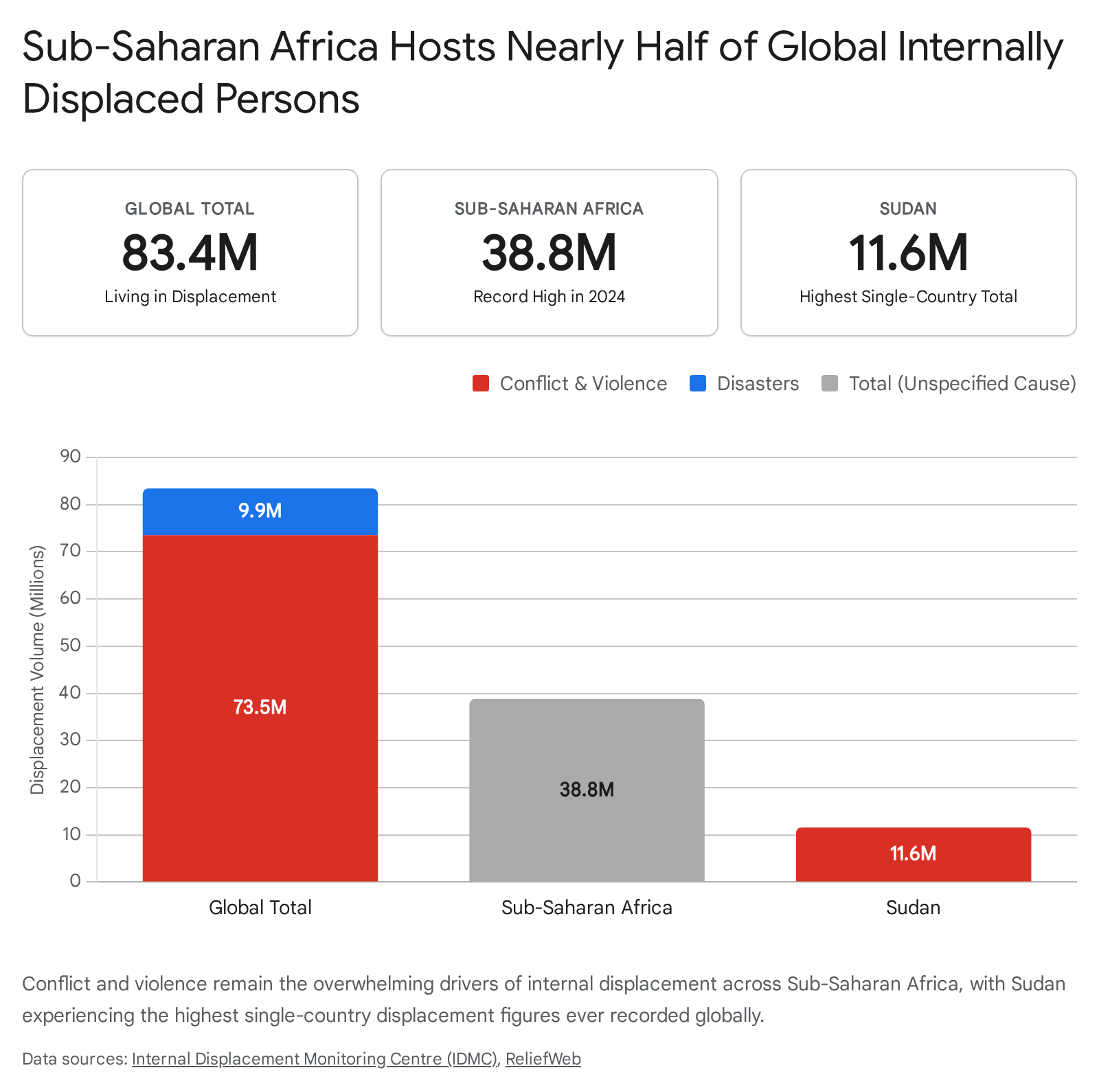
The sheer scale of forced mobility has reached grim, unprecedented historic milestones. By mid-2024, the United Nations High Commissioner for Refugees (UNHCR) reported that global displacement had hit an estimated 122.6 million individuals 25. Further underscoring the severity of the crisis, the Internal Displacement Monitoring Centre (IDMC) recorded that 83.4 million people were living strictly as Internally Displaced Persons (IDPs) at the end of 2024 - more than double the figure from just six years prior 32.
Crucially, the data reveals that nearly 90% of these IDPs (73.5 million) were displaced directly by conflict and violence, far outpacing those displaced by natural disasters 32. The undisputed epicenter of this crisis is the Global South. Sudan alone hosted a record-breaking 11.6 million IDPs, representing the largest internal displacement crisis ever recorded within a single nation's borders, driven by escalating hostilities that have decimated local infrastructure 32.
In the Middle East, virtually the entire civilian population of the Gaza Strip remained trapped in a state of repeated, cyclical displacement amid catastrophic violence, with over 90% of children living in conditions of severe food poverty 5332. Furthermore, regions like the Democratic Republic of the Congo continue to hemorrhage populations due to entrenched, protracted violence in provinces like North and South Kivu, where 97% of IDPs face acute food insecurity 53.
The economic cost of this internal displacement is crippling. In Sub-Saharan Africa, the total economic impact of internal displacement is estimated at $4 billion annually, representing a massive drain - up to 11% of pre-crisis GDP in certain nations - on economies already struggling to maintain basic solvency 33. These conflict-induced spikes are not isolated, spontaneous events; they operate within a framework of compounding, systemic vulnerabilities. More than three-quarters of people internally displaced by conflict reside in nations classified as highly or very highly vulnerable to climate change 32. This creates a devastating, self-perpetuating cycle where environmental degradation ruins livelihoods, fueling fierce resource competition, which in turn ignites armed conflict, forcing mass displacement and the subsequent collapse of national economies 2332.
What Are the Practical Takeaways for Everyday Realities Like Healthcare and the Global Food Supply?
The abstract, macroeconomic policies debated in national capitals regarding border walls, digital visas, and refugee quotas ultimately manifest in the most fundamental aspects of everyday civilian life: the ability to access reliable medical care and the affordability of basic sustenance at the local grocery store.
The Fragility of the Global Food Supply
The relationship between migration, labor availability, and global food security is absolute. In highly developed agricultural sectors, such as the United States, migrant labor serves as the irreplaceable backbone of the entire food supply chain. Currently, approximately 70% of U.S. farmworkers are immigrants, with an estimated 40% operating under undocumented status 3457. Similar dependencies exist in European agri-food supply chains, where seasonal migrant workers endure precarious conditions to maintain baseline agricultural outputs 5859.
Mass deportation policies, intensive workplace raids, and stringent border enforcement pose an existential threat to this finely balanced system. The U.S. Department of Labor has explicitly warned that sudden, large-scale crackdowns on migrant labor risk severe, immediate disruptions to domestic food production 35. The tangible economic realities of a rapidly reduced agricultural workforce include unharvested crops with narrow harvest windows, acute shortages of fresh fruits and vegetables, and corresponding, immediate price spikes for everyday consumers 5735. Economic models predict that an enforcement-only approach to immigration could lead to a 1.5% to 9.1% overall price increase for consumers, driving up baseline inflation by 3 percentage points and costing U.S. growers $3.1 billion annually in lost produce sales 34.
Globally, the intersection of displacement and food security is catastrophic. The Global Report on Food Crises 2025 indicates that over 295 million people experienced acute levels of hunger across 53 countries, an increase of 13.7 million from the previous year 5336. Conflict and the resulting mass displacement are the primary drivers of this starvation, violently uprooting farmers, obliterating local trade networks, and preventing the delivery of critical humanitarian aid 5337. When rural populations are forced to flee violence in breadbasket regions of Sudan, Myanmar, or the Sahel, the resulting precipitous drop in crop yields triggers localized hyperinflation, pushing entire displaced communities into IPC Phase 5 (Catastrophe/Famine) conditions where starvation is imminent 5338.
The Healthcare Reality
The intersection of the aging labor vacuum and restrictive immigration policies presents a direct, escalating threat to everyday healthcare access. As outlined previously, the projected shortfall of 11 to 15 million healthcare workers by 2030 means that both origin and destination countries face acute service delivery crises 212338.
In the Global North, failing to create streamlined, ethical visa corridors for foreign-trained nurses, physicians, and long-term care workers will inevitably lead to unmanageable patient-to-staff ratios, dangerously prolonged wait times for critical procedures, and the accelerated burnout of the existing domestic medical workforce 64. The chronic under-investment in domestic medical education guarantees that these nations cannot train their way out of the deficit quickly enough to meet the demands of their aging populations 23.
Conversely, the aggressive poaching of medical talent by wealthy nations hollows out the fragile healthcare systems of developing nations, resulting in a devastating "brain drain" 20. This leaves millions in the Global South without access to basic preventative medicine, skilled maternal care, or emergency response capabilities, effectively penalizing developing nations for producing highly skilled professionals 2023. To secure the everyday reality of global public health, nations must move beyond unilateral recruitment toward bilateral labor agreements that invest in the medical training infrastructure of origin countries, ensuring a sustainable, equitable pipeline of healthcare talent 2138.
Comparing the 5 Scenarios of Future Global Migration
The following table synthesizes the five primary scenarios, outlining their primary drivers, impacted geographic zones, and broad socio-economic consequences for the global system.
| Migration Scenario | Primary Drivers | Key Geographic Hubs | Macroeconomic & Social Impacts |
|---|---|---|---|
| 1. Climate-Driven Retreat | Sea-level rise, extended droughts, extreme weather events, soil salinization. | Pacific Islands (Fiji, Solomon Islands), Sahel, West Africa. | Substantial GDP losses (up to 5% annually in Africa); absolute necessity of state-funded "planned relocations" and resilient infrastructure investments. |
| 2. The Aging North's Labor Vacuum | Collapsing domestic birth rates, rapidly aging demographic pyramids. | South Korea, Germany, Japan, Canada, broader EU. | Shrinking tax bases and potential structural GDP decline; critical deficits in global healthcare personnel (15M shortage by 2030) driving "brain drain". |
| 3. 'Fortress' Border Policies | Nationalist political mandates, state security posturing, protectionism. | US-Mexico Border, European Union (Mediterranean/Balkans). | Disruption of historical circular migration; high financial implementation costs with minimal domestic wage gains; deep reliance on transit-country "externalization." |
| 4. Tech-Driven Skill Mobility | Digital transformation, rise of remote work, specialized global skill gaps. | ASEAN (Indonesia, Vietnam, Thailand), Global Tech Hubs. | Accelerated regional integration (e.g., DEFA); rapid wage inflation in specialized tech sectors; proliferation of digital nomad visas and formalized "tech passes." |
| 5. Conflict-Induced Spikes | State fragility, civil war, geopolitical fragmentation, resource scarcity. | Sudan, Gaza Strip, Democratic Republic of the Congo, Ukraine. | Record-breaking Internal Displacement (83.4M total IDPs); catastrophic regional food insecurity and famine; total collapse of local agricultural economies. |
Conclusion
The comprehensive analysis of global demographic shifts, environmental degradation, and labor market realignments leading into 2030 and beyond reveals that the traditional paradigms of migration management are increasingly obsolete. The persistent binary framing of migration as either a localized security threat to be repelled or a temporary humanitarian anomaly to be contained fails entirely to account for the deep, structural necessities of the 21st-century global economy.
The empirical data unequivocally demonstrates that the future of human mobility is characterized by complex, inescapable interdependencies. The industrialized nations of the Global North cannot sustain their economic output, maintain their tax bases, or staff their over-burdened healthcare systems without systematically absorbing labor from the Global South. Conversely, the Global South requires robust, formalized mobility frameworks - such as the African Union's Free Movement Protocol and the ASEAN Digital Economy Framework Agreement - to translate its youth bulges into powerful demographic dividends rather than sources of regional instability and crippling youth unemployment.
Furthermore, the escalating, undeniable realities of climate-driven retreat and conflict-induced internal displacement demand an immediate transition from reactive, ad-hoc emergency containment to proactive, heavily funded structural adaptation. Policies that rely on externalizing borders, erecting multi-billion dollar physical barriers, or criminalizing the movement of essential agricultural labor only serve to drive migration underground. This enriches transnational smuggling networks while directly jeopardizing the foundational stability of global food supply chains and domestic inflation rates. Policymakers, urban planners, and international institutions must accept that fluid human mobility is an enduring, necessary feature of the future global landscape. Attempting to halt it through fortress policies will ultimately prove drastically less effective, and far more economically damaging, than designing intelligent, humane systems to harness its immense economic and social potential.