
UN and IDMC data on climate change and migration patterns
Introduction to Climate Mobility
The intersection of environmental degradation, extreme weather events, and human mobility has emerged as one of the most profound demographic, socioeconomic, and geopolitical challenges of the twenty-first century. As global temperatures continue to rise, the escalating frequency and intensity of meteorological, hydrological, and climatological hazards are radically reshaping where and how populations are able to live. However, the dynamics of climate-induced migration are rarely linear. Rather than functioning as a singular, isolated driver of mass cross-border exodus, climate change primarily acts as a threat multiplier, exacerbating pre-existing socioeconomic vulnerabilities, political instability, and resource scarcity 123.
Recent data compiled by leading international monitoring bodies, notably the Internal Displacement Monitoring Centre (IDMC) and the International Organization for Migration (IOM), reveals a stark, unprecedented escalation in forced human movements. By the end of 2024, the world witnessed a record 83.4 million people living in internal displacement - a figure that has more than doubled over the past six years 456. While conflict and violence remain the dominant historical causes of total protracted displacement stocks, natural disasters triggered a staggering 45.8 million new internal displacements during the 2024 calendar year alone 57. This surge, driven almost entirely by weather-related events intensified by a changing climate, underscores the urgency of understanding how environmental factors compel human movement, the methodologies used to track these shifts, and the long-term projections that must inform global adaptation and mitigation strategies.
The impacts of these intersecting crises extend far beyond the immediate shock of displacement. The United Nations High Commissioner for Refugees (UNHCR) notes that the climate crisis and human displacement are increasingly interconnected, with nearly 60 percent of refugees and internally displaced people now living in countries that are among the most vulnerable to climate change 8. This convergence threatens to reverse decades of sustainable development, severely strain urban infrastructure, and trap millions in cycles of repeated displacement and chronic immobility 91011.
Legal Classifications and Definitional Debates
A significant analytical and operational challenge in addressing climate-induced human mobility lies in the absence of a universally accepted, legally binding definition for those displaced by environmental factors. The terminological landscape is fraught with political and legal implications, heavily influencing how populations are protected under international law, how financial adaptation aid is distributed, and how statistical data is categorized by global monitoring agencies.
The Misnomer of the Climate Refugee
In popular discourse, mass media narratives, and certain advocacy campaigns, the term "climate refugee" or "environmental refugee" is frequently deployed to describe individuals fleeing environmental devastation. However, there is a strong, unified consensus among legal scholars, the UNHCR, and the IOM that these terms have no basis in international law and should be explicitly avoided in formal policy and academic settings 8121314.
The 1951 Refugee Convention defines a refugee strictly as an individual who has crossed an international border owing to a "well-founded fear of being persecuted for reasons of race, religion, nationality, membership of a particular social group or political opinion" 81314. Environmental degradation, structural loss of livability, and sudden climate hazards do not meet this rigorous legal threshold for state-sponsored or tolerated persecution 1314. Consequently, individuals crossing borders solely due to environmental factors cannot legally claim asylum under the 1951 Convention 13.
Expanding the 1951 Convention to include climate drivers is widely viewed by institutional stakeholders as both politically unfeasible and practically detrimental. Legal experts and humanitarian agencies warn that formally reopening the Convention risks undermining the existing, fragile protection regime for those fleeing political persecution and war, potentially providing hostile states with an opportunity to narrow asylum definitions across the board 121314. While regional legal frameworks, such as the Organization of African Unity (OAU) Convention and Latin America's Cartagena Declaration, offer broader definitions encompassing events "seriously disturbing public order" - which could theoretically be applied to severe climate events - environmental triggers are still not formally codified globally as distinct, standalone grounds for cross-border asylum 8.
Internally Displaced Persons and Environmental Migrants
Because empirical demographic data consistently demonstrates that the vast majority of people displaced by climate hazards do not cross international borders, they are legally classified as Internally Displaced Persons (IDPs) 81516. IDPs are defined by the United Nations as persons or groups of persons who have been forced to flee their homes to avoid the effects of armed conflict, generalized violence, human rights violations, or natural and human-made disasters, but who have not crossed an internationally recognized state border 15.
To capture the specific nuance of environmental drivers without misapplying international refugee law, the IOM introduced a broad working definition for "environmental migrants" in 2007. The agency defines them as "persons or groups of persons who, predominantly for reasons of sudden or progressive change in the environment that adversely affects their lives or living conditions, are obliged to leave their habitual homes, or choose to do so, either temporarily or permanently, and who move either within their country or abroad" 1214. This highly flexible definition accounts for the full spectrum of climate mobility - from forced rapid evacuation to voluntary strategic relocation, and from internal movements to cross-border migration - while deliberately capturing the complexity of environmental drivers 12.
Sudden-Onset Versus Slow-Onset Environmental Events
When tracking displacement statistics and formulating targeted policy responses, monitoring agencies and climate scientists strictly differentiate between sudden-onset and slow-onset environmental hazards, as they produce highly distinct human migration outcomes.
Sudden-onset hazards encompass immediate meteorological, hydrological, and geophysical events such as hurricanes, tropical cyclones, flash floods, wildfires, earthquakes, and tsunamis 31718. Sudden-onset disasters typically force immediate, large-scale emergency evacuations designed to preserve human life, leading to acute, measurable spikes in internal displacement figures 318. These movements are generally reactive, highly localized, and frequently temporary, provided the affected geographic areas remain safe for subsequent habitation and structural recovery resources are available to the host governments and affected populations 218.
Conversely, slow-onset processes, officially recognized by the United Nations Framework Convention on Climate Change (UNFCCC), include phenomena such as sea-level rise, increasing average global temperatures, ocean acidification, glacial retreat, soil salinization, land and forest degradation, loss of biodiversity, and prolonged desertification 1719. These processes progressively erode natural capital and local livelihoods, particularly in rural, agriculture-dependent communities, contributing over time to severe structural food and water insecurity 31720. Migration driven by slow-onset events tends to be highly incremental, often taking the form of gradual rural-to-urban movement. Furthermore, this type of migration is much more likely to result in permanent relocation, as the originating environments gradually lose their fundamental ecological capacity to sustain human habitation 2321.
Global Internal Displacement Data and Trends
The Internal Displacement Monitoring Centre (IDMC) serves as the world's most authoritative data source for quantifying global forced mobility. The IDMC's annual Global Report on Internal Displacement (GRID) distinguishes carefully between two distinct, vital metrics: "new displacements" and the "IDP stock" 1722. New displacements refer to the total number of forced movements recorded within a single calendar year. Crucially, because the same individual may be displaced multiple times in one year due to shifting conflict lines or repeated severe weather events, each movement is counted independently 617. The IDP stock represents the total absolute number of people actively living in a state of internal displacement at the specific end-point of the year, providing a snapshot of unresolved, protracted displacement crises 1722.
An analysis comparing the 2024 and 2025 GRID reports (covering data for the calendar years 2023 and 2024, respectively) reveals a dramatic, compound escalation in human mobility driven by intersecting global crises of climate extremes and intractable conflict.
| Global Displacement Metric | End of 2023 Data | End of 2024 Data | Year-over-Year Change |
|---|---|---|---|
| Total Global IDP Stock | 75.9 million | 83.4 million | + 7.5 million (+9.8%) |
| IDP Stock (Conflict & Violence) | 68.3 million | 73.5 million | + 5.2 million (+7.6%) |
| IDP Stock (Disasters) | 7.7 million | 9.8 million | + 2.1 million (+27.2%) |
| New Internal Displacements (Conflict) | 20.5 million | 20.1 million | - 0.4 million (-1.9%) |
| New Internal Displacements (Disasters) | 26.4 million | 45.8 million | + 19.4 million (+73.4%) |
Table 1: Global Internal Displacement Figures comparing 2023 and 2024 IDMC GRID data. 451723
The 2024 Escalation in Disaster Displacement
In 2024, the global community recorded an unprecedented 45.8 million new internal displacements triggered explicitly by disasters 56. This marked the highest annual figure since the IDMC formally began monitoring disaster displacements in 2008, nearly doubling the annual average of the preceding decade 45. Weather-related events, heavily intensified by anthropogenic climate change, were responsible for 99.5 percent of these disaster-induced movements, leaving a minuscule fraction attributed to purely geophysical events like tectonic earthquakes or volcanic eruptions 524.
While a substantial portion of these 45.8 million individual movements represented temporary, pre-emptive government-mandated evacuations - which successfully saved lives but temporarily disrupted regional economies and household livelihoods - a highly concerning 9.8 million people remained physically displaced by disasters at the end of 2024 4524. This "stock" of 9.8 million disaster-displaced individuals represents a severe 27.2 percent increase over the previous year, indicating that state return, rebuilding, and recovery mechanisms are structurally failing to keep pace with the sheer frequency of extreme weather events 522. Furthermore, a total of 29 countries and territories recorded their highest historical figures for disaster displacement in 2024, driven largely by intense cyclone seasons, severe riverine flooding, and devastating, expansive wildfires 4524.
Regional Disaster Displacement Profiles
The devastating impacts of climate change and disaster events in 2024 were not distributed evenly across the globe.
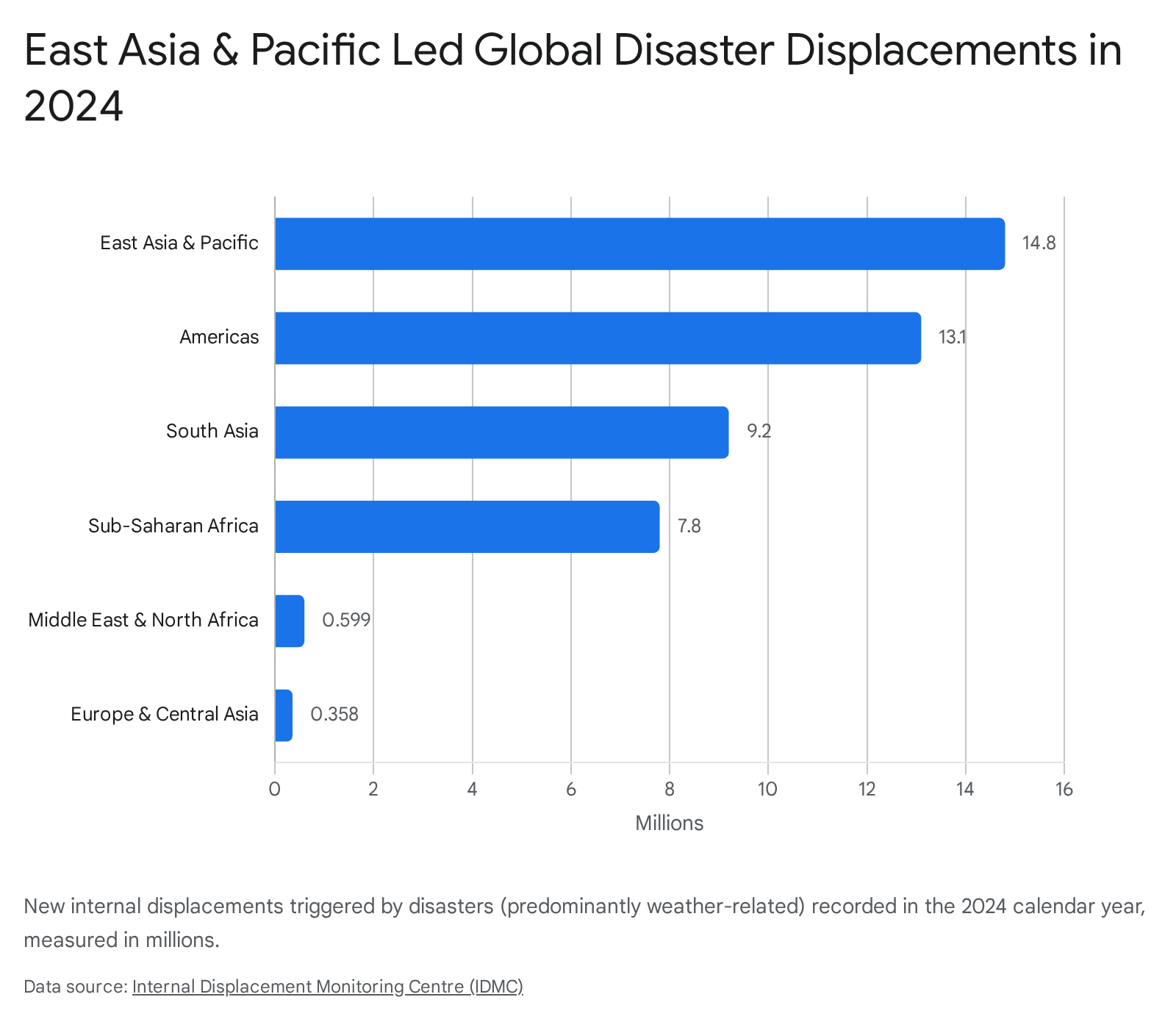
Specific regions bore the brunt of hydrological and meteorological extremes due to a complex combination of geographic vulnerability, highly exposed infrastructure, and varying socioeconomic adaptive capacities.
East Asia and the Pacific
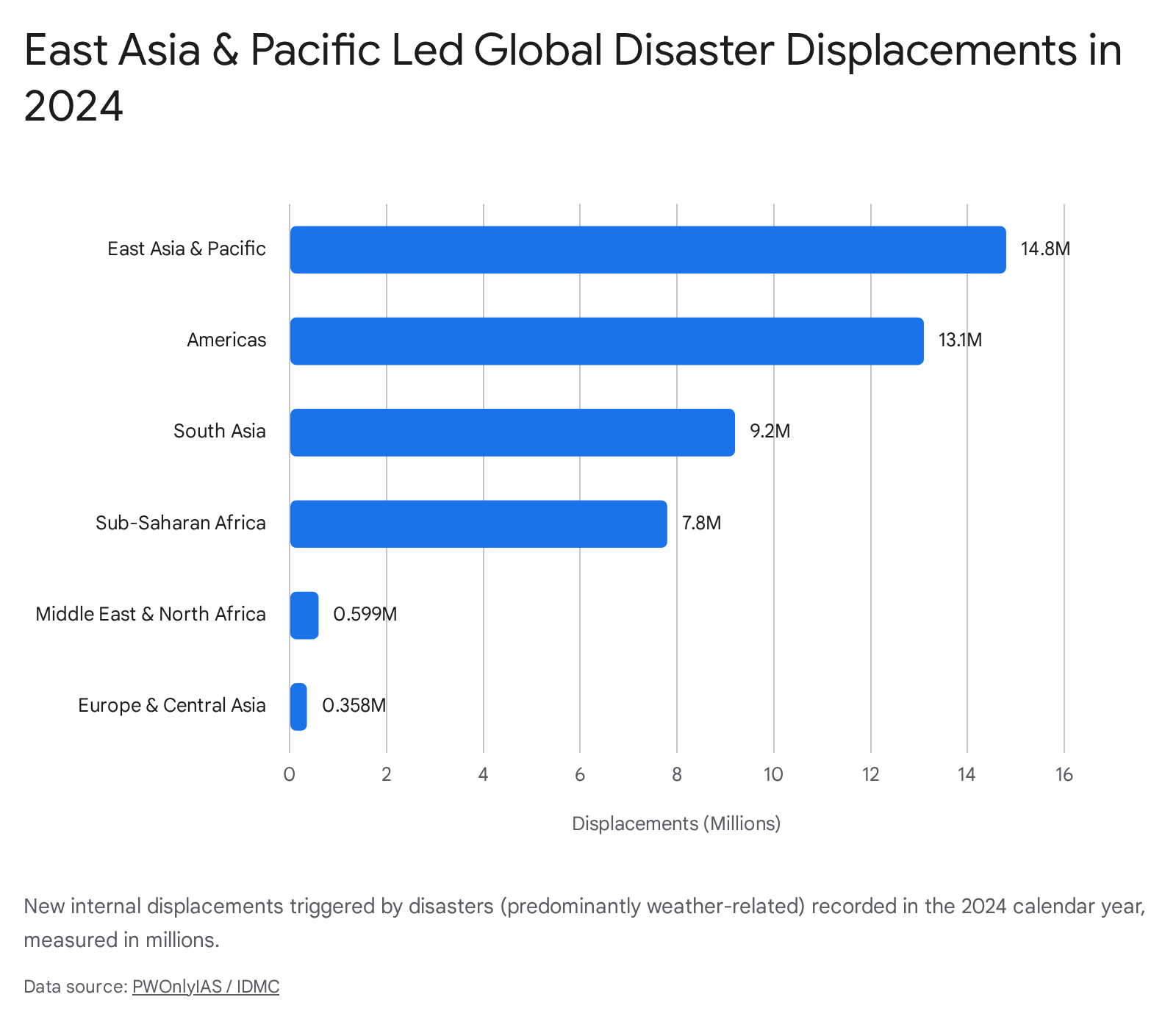
East Asia and the Pacific recorded the highest sheer volume of disaster displacements globally, with 14.8 million newly recorded movements in 2024 - the highest figure for the region since 2016 2425. After two years of relative relief provided by drier regional conditions associated with the El Niño climate pattern, the return of severe weather resulted in massive infrastructural destruction and population movement 2526. Powerful, rapidly intensifying typhoons, most notably Typhoon Yagi and Typhoon Gaemi, tore through heavily populated coastal and riverine areas in the Philippines, China, and Vietnam, triggering massive, state-led pre-emptive evacuations 2527. In the Philippines alone, a highly disaster-prone archipelago, an astonishing nine million disaster displacements were recorded throughout the year 25. Overall, the East Asia and Pacific region accounted for roughly one-third of the global total for disaster displacements during 2024 27.
The Americas
The Americas experienced an unprecedented, historic spike in mobility, reaching a record 14.5 million total internal displacements in 2024 - a volume greater than the previous five years combined for the hemisphere 626. This surge was almost entirely disaster-related (13.1 million movements) and was predominantly driven by events in the United States 24. The US recorded 11 million disaster-related movements, accounting for nearly a quarter of the global total and representing the highest displacement figure ever recorded for a single country in the IDMC database's history 526. These movements were heavily influenced by consecutive severe hurricane landfalls in the Atlantic basin, such as Hurricanes Helene and Milton, and devastating, fast-moving wildfires, such as the Park Fire in California and the protracted, ongoing displacement crisis resulting from the 2023 Maui fires in Hawaii 524.
South Asia
Following the termination of drier conditions associated with the El Niño phase in 2023, the return of heavy, erratic monsoon rains and highly destructive cyclones caused disaster displacements in South Asia to nearly triple year-over-year, reaching 9.2 million in 2024 62426. India alone recorded 5.4 million displacements - its highest volume in 12 years - driven primarily by severe riverine flooding in the states of Assam and Tripura 6. Cyclones Dana and Remal were responsible for triggering 1.6 million rapid displacements across the Indian subcontinent, demonstrating the region's acute vulnerability to storm surges and coastal inundation 6.
Sub-Saharan Africa
Sub-Saharan Africa remains the epicenter of complex, overlapping demographic and environmental crises. By the end of 2024, the region hosted 38.8 million IDPs (accounting for roughly 46 percent of the global total IDP stock), the vast majority of whom were originally uprooted by entrenched, protracted conflicts 626. During the year, the region recorded 7.8 million new displacements directly due to disasters, heavily influenced by extreme, unprecedented flooding in Chad and ongoing severe drought conditions in the Horn of Africa 6924. The situation in Sub-Saharan Africa exemplifies the compounding nature of systemic systemic risk: all 23 countries in the region that reported conflict displacements in 2024 also registered concurrent, overlapping movements triggered by natural disasters, severely complicating humanitarian access and stretching response capabilities to the breaking point 2426.
Middle East, North Africa, Europe, and Central Asia
While quantitatively less dominant in global disaster statistics, the Middle East and North Africa (MENA) still recorded 599,000 disaster-related movements in 2024 amidst massive, devastating conflict-driven displacement in Gaza and Sudan 524. Europe and Central Asia recorded 358,000 disaster displacements; however, this relatively low absolute volume masks the localized intensity of the environmental impacts, as 10 countries in the region reported their highest disaster displacement figures since continuous data collection became available 2426. Conflict displacement in this region remained predominantly associated with the ongoing war in Ukraine 2426.
| Region | Total New Internal Displacements (2024) | Displacements Strictly from Disasters (2024) | Key Drivers and Contextual Factors |
|---|---|---|---|
| East Asia & Pacific | 16.2 million | 14.8 million | Typhoons (Yagi, Gaemi), massive pre-emptive evacuations in the Philippines and China. 2425 |
| The Americas | 14.5 million | 13.1 million | US hurricanes (Helene, Milton) and wildfires (California). The US accounted for 11 million alone. 524 |
| South Asia | 9.2 million | 9.2 million | Severe monsoon floods and Cyclones (Remal, Dana), ending of El Niño dry spells. 624 |
| Sub-Saharan Africa | 19.3 million | 7.8 million | Floods (Chad), drought. Complete overlap of conflict and disaster in 23 specific nations. 24 |
| Middle East & North Africa | 5.7 million | 599,000 | Region completely dominated by conflict (Gaza, Sudan), overlapping with severe structural water stress. 24 |
| Europe & Central Asia | 846,000 | 358,000 | Record disaster highs in 10 countries; overall displacement heavily dominated by the Ukraine war. 2426 |
Table 2: Regional distribution of new internal displacements globally in 2024, highlighting the balance between total movements and those strictly triggered by disasters. 562426
Long-Term Projections and Modeling Methodologies
While historical and real-time data from the IDMC precisely tracks the immediate impacts of rapid-onset disasters, forward-looking predictive models attempt to quantify how the slower, more insidious impacts of climate change will reshape population distribution in the coming decades. The preeminent, most widely cited analysis in this specific demographic field is the World Bank's Groundswell report series 2829.
The World Bank Groundswell Projections to 2050
The updated World Bank Groundswell report projects that, in the absence of robust, immediate climate mitigation and structural development action, up to 216 million people across six major world regions could be forced to move within their own countries by the year 2050 2830. Rather than focusing on unpredictable sudden storms, the World Bank model heavily weights structural, long-term changes to regional habitability, tracking variables such as declining fresh water availability, reduced agricultural crop productivity, persistent sea-level rise, and escalating coastal storm surges 29.
The projections indicate that internal climate migration "hotspots" - areas from which people are desperate to leave due to environmental stress, and more resilient areas to which they are flocking - will emerge clearly as early as 2030 and rapidly intensify in geographic scope by 2050 3031. The projected breakdown of the 216 million potential internal climate migrants by 2050 is heavily skewed toward vulnerabilities in the Global South:
| Region | Projected Internal Climate Migrants by 2050 (Pessimistic Scenario) |
|---|---|
| Sub-Saharan Africa | Up to 86 million |
| East Asia and the Pacific | Up to 49 million |
| South Asia | Up to 40 million |
| North Africa | Up to 19 million |
| Latin America | Up to 17 million |
| Eastern Europe and Central Asia | Up to 5 million |
Table 3: Maximum projected internal climate migration figures by 2050 across six regions modeled in the World Bank Groundswell report. 2830
Importantly, the World Bank emphasizes that these grim trajectories are not set in stone. The models indicate that immediate, concerted global action to significantly reduce greenhouse gas emissions and invest in green, inclusive development could theoretically reduce the projected scale of internal climate migration by as much as 80 percent 2830.
Methodological Critiques and Data Limitations
Despite the widespread citation and utility of the Groundswell projections in policy formulation, forecasting future climate migration remains fraught with severe methodological challenges. The Intergovernmental Panel on Climate Change (IPCC) Sixth Assessment Report (AR6) explicitly notes that "the contribution of long-term changes in climate-related systems to observed human displacement or migration patterns has not been quantified so far," pointing out that very few peer-reviewed studies have successfully executed rigorous, systematic global projections without high margins of error 32.
Scholars analyzing these demographic models point out several critical limitations in the current data infrastructure. Forecasts frequently underrepresent the powerful influence of non-climate migration drivers - such as the pull of existing familial social networks, wage differentials, and shifting economic markets 32. Furthermore, macroscopic models struggle to accurately integrate the immediate shocks of fast-onset events with the slow, creeping degradation of slow-onset climate changes 32. They also frequently fail to account for future societal and technological tipping points, and overwhelmingly neglect the complex phenomenon of immobility 32. Consequently, predictive models represent plausible, mathematically sound scenarios based on environmental stress inputs, but they cannot perfectly account for the dynamic complexities of human agency, government policy intervention, and economic adaptation 29.
The Multi-Causality of Migration
Understanding the true nature of climate migration requires moving beyond deterministic frameworks that assume a simplistic, one-to-one causal relationship between an environmental hazard and a household's decision to move. Academic literature and global security institutions increasingly rely on a multi-causal framework, conceptualizing climate change primarily as a threat multiplier 12.
The Threat Multiplier Framework
Human mobility is determined by a highly complex interplay of macro-drivers (economic markets, political governance, demographic trends, social systems, and baseline environmental health) and micro-drivers (personal characteristics, household wealth, age, and gender) 11933. The academic consensus emphasizes that migration decisions are rarely mono-causal; rather, climate change acts as a threat multiplier by fundamentally exacerbating the baseline pressures of the other macro-drivers. Environmental hazards interact directly with existing economic, political, and social vulnerabilities, ultimately filtering through household constraints to result in varied outcomes ranging from adaptive migration to trapped immobility 121934.
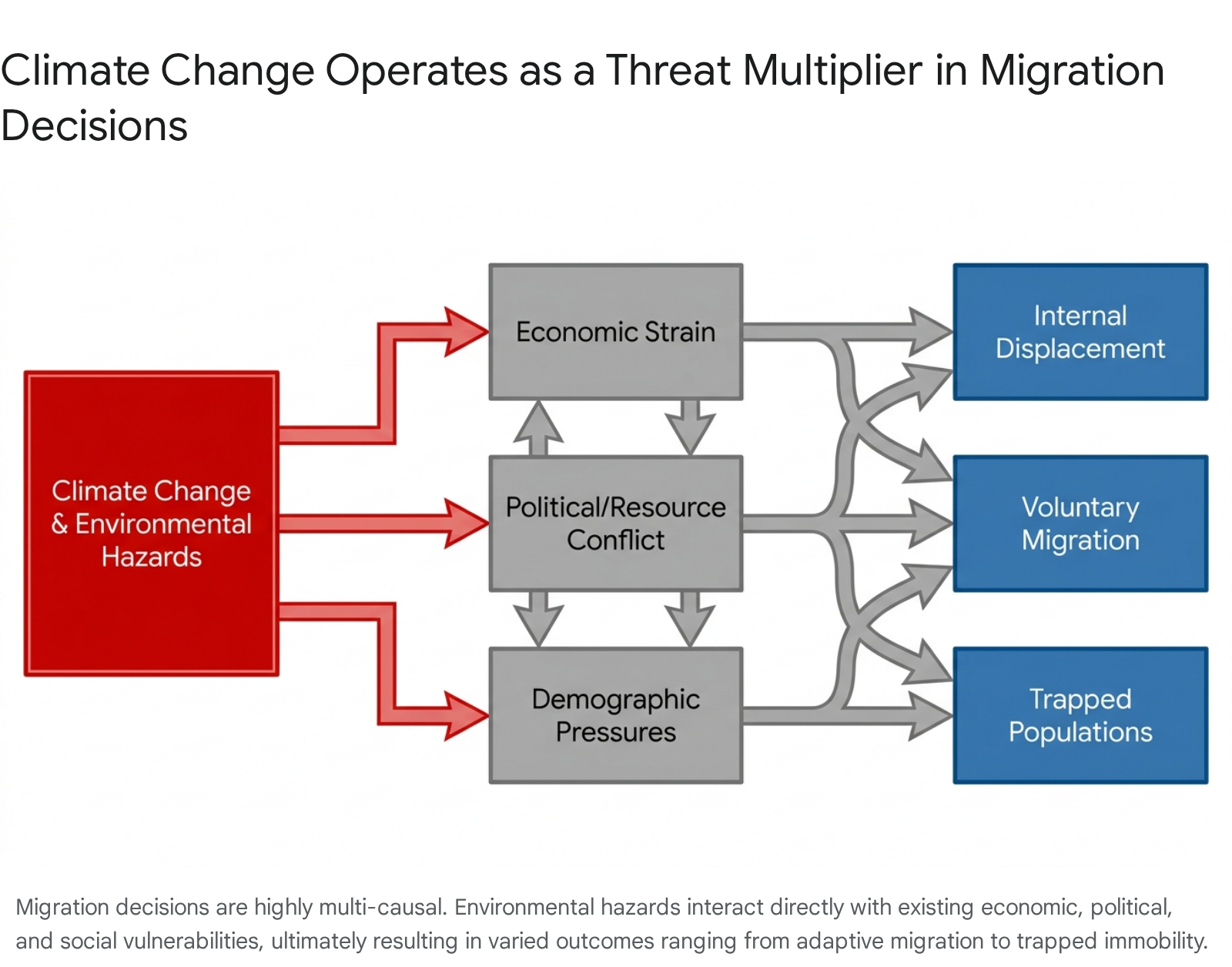
For example, a prolonged period of drought (an environmental driver) leads directly to widespread crop failure. This impacts local food supplies and decimates rural agricultural wages (an economic driver). The resulting resource scarcity can easily escalate pre-existing communal tensions over access to fresh water and shrinking arable land (a political and security driver) 134. A household's ultimate decision to migrate is rarely attributed solely to the temperature anomaly or the lack of rain; it is typically a desperate response to the ensuing economic collapse or the outbreak of localized violence 3435.
The convergence of conflict and climate is particularly lethal to regional stability. According to data monitoring by the IOM, 75 percent of all conflict-displaced people currently live in countries deemed highly or very highly vulnerable to climate change 2436. In these fragile settings, the compounding and cascading repercussions of climate stressors strain weakened public health infrastructures, overwhelm local governance capabilities, and destroy traditional socio-economic coping mechanisms, severely amplifying overall humanitarian needs 33437.
Debunking the Northward Mass Migration Myth
A pervasive and highly influential narrative within political and media discourse in the Global North characterizes climate change as a looming catalyst that will inevitably send overwhelming "floods" of climate refugees across international borders into Europe and North America 1635. Scholarly consensus, however, strongly rejects this narrative, labeling it as factually inaccurate, methodologically flawed, and politically harmful 1635.
Current empirical evidence and forecasting models consistently demonstrate that the overwhelming majority of people displaced by climate hazards remain within the borders of their own countries, attempting to stay as close to their places of origin as possible 835. Even when international borders are crossed due to extreme disaster, roughly 70 percent of refugees remain in immediately neighboring states in the Global South 8. For the most vulnerable populations, long-distance international migration - particularly to high-income, highly securitized nations in the Global North - is prohibitively expensive, legally difficult, and logistically inaccessible 3335.
Researchers argue that the "mass migration" security narrative is frequently weaponized in domestic politics to justify the harsh securitization of borders and the upgrading of military infrastructure, rather than fostering genuine climate adaptation efforts or addressing the economic inequalities in the regions where displacement actually occurs 163839.
Trapped Populations and Acquiescent Immobility
Contrary to the simplistic assumption that worsening climate impacts automatically lead to increased human migration, severe environmental degradation can actually decrease a population's capacity to move 3135. As climate change erodes agricultural yields, destroys livestock, and collapses local economies, affected households rapidly lose the financial capital required to finance a move, whether internal or international 235.
This phenomenon results in "trapped populations" - communities that remain highly exposed to severe climate hazards but entirely lack the material resources or legal pathways to leave 1035. Furthermore, academic literature identifies the parallel concept of "acquiescent immobility," wherein individuals possess the resources to migrate but actively choose to remain in highly vulnerable, deteriorating areas due to deep cultural ties, ancestral connections to the land, or strict reliance on established social networks 35. Failure to rigorously account for both trapped populations and voluntary immobility represents a significant blind spot in global policy planning and demographic forecasting models 3132.
Scholarly Perspectives from the Global South
The systemic burden of climate-induced migration falls disproportionately on the Global South - regions broadly characterized by a high economic reliance on climate-sensitive sectors (such as rain-fed agriculture), lower baseline adaptive capacities, and deep historical and institutional vulnerabilities 19. Paradoxically, the low-income populations currently facing the highest displacement risks have contributed the absolute least to the historical greenhouse gas emissions driving the global crisis 10.
The Demand for Climate Justice
Recent comprehensive bibliometric analyses of global climate migration research reveal a maturing academic field that is increasingly adopting a framework of "climate justice" 103941. Scholars emerging from institutions in the Global South argue that viewing climate migration purely through the lens of a sudden humanitarian emergency or a Western security threat strips the issue of its vital ethical and historical context. From a justice perspective, climate migration is a fundamental human rights issue intrinsically tied to historical inequalities, carbon emissions, and systemic global resource extraction 1039.
This perspective directly challenges the epistemic hierarchies that have long dominated global policy design. Dominant research framings originating from Global North institutions frequently reproduce narratives of Southern victimization or border security threats, completely overlooking the agency of local populations and side-lining necessary decolonial critiques 1039. Southern scholars are demanding a structural paradigm shift in migration studies that centers equity, localized representation, and a nuanced understanding of the differentiated impacts of climate stress across gender, age, and socioeconomic status 1039.
Rethinking Migration as Adaptation
In regions facing protracted, slow-onset environmental stress, such as extended drought in the Sahel or rising sea levels in Small Island Developing States (SIDS), researchers urge global policymakers to stop viewing migration strictly as a catastrophic failure of adaptation 10. Instead, voluntary, well-planned migration must be recognized, supported, and facilitated as a legitimate, proactive adaptation strategy 1040.
Extensive fieldwork and ethnographic research indicate that families rarely make a single, spontaneous decision to permanently abandon their ancestral homes due to a slowly shifting climate 40. Migration is typically a highly calculated, sequential process - often beginning with temporary or seasonal moves by individual family members to supplement household income through financial remittances, and only culminating in permanent displacement when all in-situ survival strategies have been exhausted 3740. Remittances play a massive role in this adaptive strategy; the IOM notes that global remittances reached $831 billion in 2022, providing a vital lifeline for communities facing environmental shocks 41. Supporting "adaptive migrants" requires the creation of safe, regular, and legal labor migration pathways, whereas responding to sudden "distress migrants" necessitates urgent, life-saving humanitarian relief 40. Both typologies must be acknowledged and managed differently.
Policy Frameworks and Data Governance
The immense scale and structural complexity of climate-induced mobility demand comprehensive, cross-sectoral policy responses that effectively bridge emergency humanitarian aid, long-term economic development planning, and aggressive climate change mitigation.
To move from a posture of reactive emergency response to one of proactive risk management, governments and international aid agencies require highly granular, localized data. Innovations combining traditional household surveys with advanced tracking tools - such as the IOM's Displacement Tracking Matrix (DTM), which currently accounts for 52 percent of the internal displacement figures provided in the IDMC's annual GRID report - are significantly improving the visibility of slow-onset displacement and the tracking of complex internal movements 4224243. Multilateral development banks and disaster risk agencies are increasingly using sophisticated predictive models to forecast displacement risks, allowing for pre-emptive financial and logistical resource allocation before a crisis peaks 944. For example, sophisticated early warning systems and aggressive pre-emptive evacuation protocols successfully saved thousands of lives during the 2024 Asian typhoon season, although they simultaneously - and necessarily - resulted in massive temporary displacement figures that severely strained local municipal infrastructure 2425.
There is also a pressing global need for targeted adaptation strategies that build economic and infrastructural resilience in the specific communities most at risk, allowing people the realistic choice to stay. In regions where areas will undeniably become entirely uninhabitable due to coastal sea-level rise or severe, irreversible desertification, formal frameworks for "planned relocation" must be implemented 124546. To be successful and equitable, planned relocation initiatives require extensive, transparent community participation to preserve cultural integrity, established social networks, and economic livelihoods, drawing on the leadership of affected Indigenous populations 3945.
At the international level, the implementation of the 2018 Global Compact for Safe, Orderly and Regular Migration (GCM) represents a critical step forward, as it formally recognizes disasters, climate change, and environmental degradation as legitimate drivers of migration and commits signatory states to developing collaborative, rights-based solutions 12. However, translating these international frameworks into tangible action on the ground requires substantial financial backing. Researchers and Global South advocates emphasize the absolute necessity of financial transfers from the Global North, including dedicated compensation funds for loss and damage, to support countries currently hosting massive IDP populations 374748. Without such structural financial support, developing nations will continue to struggle to manage the compounded, intersecting pressures of climate hazards, economic fragility, and mass human displacement 1136.