
5 Scenarios for AI in Education over the Next Decade
Artificial intelligence is fundamentally restructuring global education by accelerating the shift toward mastery-based assessments and transitioning teachers from administrative managers into orchestrators of critical thinking. Over the next decade, institutions will scale hyper-personalized Socratic tutoring, replace rigid degree structures with agile micro-credentials, and enable the Global South to leapfrog legacy educational infrastructure.
The Paradigm Shift: From Disruption to Structural Integration
The integration of artificial intelligence into global education systems has moved rapidly from a phase of panic and prohibition in early 2023 to one of profound structural and pedagogical transformation by 2026 12. When generative large language models first reached mass consumer availability, early institutional reactions involved blunt bans and a heavy reliance on AI detection software 23. However, as the technology proved deeply embedded into the modern economy, educational leaders recognized that banning the technology was neither feasible nor beneficial for student workforce preparation 456.
Surveys of higher education executives reflect this stark reality. Data reveals that 89% of students regularly use generative AI for coursework, compared to only 62% of faculty members utilizing it in their professional roles 5. Concurrently, 59% of institutional leaders report an increase in cheating since the wide availability of these tools, prompting widespread concerns regarding academic integrity, digital inequity, and shrinking student attention spans 5. Rather than attempting to hold back the tide, organizations like the Organization for Economic Cooperation and Development (OECD) and the United Nations Educational, Scientific and Cultural Organization (UNESCO) have argued that education must adapt to an AI-influenced world 6710.
This adaptation requires determining which skills to prioritize, which to phase out, and how to redesign the basic architecture of learning 611. According to the OECD's Future of Education and Skills 2030 framework, as AI automates routine cognitive tasks, "transformative competencies" such as creating new value, reconciling tensions, taking responsibility, and complex problem-solving will become the paramount goals of education 8. The resulting landscape over the next ten years points toward five distinct scenarios that will define the future of human learning.
Scenario 1: The End of the Take-Home Essay and the Rise of Mastery-Based Assessment
The most immediate disruption caused by generative AI has been the invalidation of traditional, unsupervised assessment methods. For decades, the take-home essay, the book report, and the unsupervised problem set have served as standard proxies for measuring a student's comprehension 12. Today, generative AI models can execute these tasks quickly and convincingly, effectively severing the reliable link between a finished academic product and the cognitive effort required to produce it 9.
The Flawed Calculator Analogy versus The Ghostwriter Reality
Early proponents of allowing unmitigated AI access in the classroom frequently compared generative models to the introduction of the electronic calculator in the 1970s. The argument posited that just as mathematics education adapted to a computational tool, humanities and sciences would seamlessly adapt to a textual one 1015. However, researchers, historians, and linguists have forcefully rejected this analogy as a dangerous false equivalence that misunderstands both the nature of the technology and the mechanics of human cognition 1112.
A calculator computes deterministic functions from clearly defined inputs; it does not hallucinate false information, infer context, guess at intentions, or attempt to persuade 12. More importantly, a calculator amplifies human mathematical reasoning but strictly requires the user to possess prerequisite knowledge of mathematical operations, order of operations, and logic to be useful 11. If a student does not understand the underlying mathematics, the calculator provides no advantage.
Generative AI, conversely, operates essentially as a ubiquitous ghostwriter 1314. A conceptual illustration often used by educators to clarify this distinction contrasts a student actively engaging with a notebook while using a simple calculator to solve an equation, against a student staring passively at a screen while an ethereal "ghost" figure types a complex essay for them. This metaphor highlights that generative AI does not merely fill a computational gap; it fills a cognitive gap 11. An AI model can organize a paragraph, evaluate evidence, and structure a thesis - allowing students to bypass the fundamental building blocks of language and communication 1120. When AI performs the intellectual heavy lifting, the student engages in "cognitive offloading," sacrificing the productive struggle necessary for neurological development and deep learning 121516.
Redesigning the Architecture of Assessment
Recognizing that AI detection tools are highly fallible, prone to false positives, and disproportionately penalize non-native speakers and neurodivergent students, institutions are abandoning detection in favor of fundamental assessment redesign 317. The focus has shifted from policing software usage to ensuring that human learning is authentic and verifiable.
To combat the ghostwriter effect, educators are implementing several structural changes that prioritize the learning process over the polished final product. The "flipped" assessment model has gained massive traction. In this paradigm, students consume lectures, conduct research, and read materials at home, while the application of knowledge - writing essays, solving complex equations, and taking exams - occurs entirely inside the classroom under direct supervision, often utilizing locked-down devices without internet access 19. University professors who previously relied on take-home problem sets report that out-of-sight grading conveys no actionable information regarding student proficiency, necessitating a return to synchronous, in-person evaluation 9.
Furthermore, graded work increasingly requires students to explain their thought processes. Educators are incorporating oral defenses, short interviews, and peer-teaching components into their rubrics. If a student cannot verbally defend the logic behind a submitted project or articulate how they arrived at a conclusion without looking at a screen, the work is not considered mastered, regardless of its grammatical or structural perfection 324.
This movement is accelerating a broader transition toward mastery-based progression. Innovative networks like Alpha School and Khan Lab School are abandoning seat-time requirements and traditional letter grades. Instead, students progress through mixed-age levels only when they demonstrate profound understanding of a concept. In these environments, AI serves as an adaptive diagnostic tool that recalibrates lessons when students veer off track, but advancement requires rigorous, in-person validation of competency 18. Some institutions, such as Acton Academy, have even instituted an "AI Driver's License" protocol, requiring students to grapple with the moral dimensions of technology and prove their ethical literacy before being permitted to use generative models for academic work 26.
| Traditional Assessment Paradigm | AI-Era Assessment Paradigm |
|---|---|
| Location of Work | Take-home assignments and unsupervised essays |
| Metric of Success | Polish and final product quality |
| Grading Model | Standardized letter grades based on cumulative points |
| Verification Method | Plagiarism checkers and text similarity matching |
| Pedagogical Focus | Information retrieval and synthesis |
Table 1: The shift from traditional to AI-era assessment methodologies 392418.
Scenario 2: The Evolution of the Teacher from Lecturer to Orchestrator
A pervasive and persistent myth surrounding the advent of educational artificial intelligence is that it will eventually render human teachers obsolete 192820. However, extensive research and early implementation data forcefully contradict this assumption. AI systems inherently lack emotional intelligence, the capacity for genuine human connection, and the contextual intuition required to manage a classroom of diverse, developing minds 1921. Instead of replacing educators, AI is precipitating a historic shift in the nature of the teaching profession: moving the role away from repetitive administrative labor and toward empathetic, interactive orchestration.
The Eradication of the Invisible Workload
In modern education, the demands on an educator's time extend far beyond instructional hours. Lesson planning, rubric alignment, parent communication, attendance tracking, and the development of individualized education programs (IEPs) consume evenings and weekends, contributing heavily to historic rates of teacher burnout 3132. AI tools are specifically targeting this invisible workload.
Platforms such as MagicSchool, Brisk Teaching, Eduaide, and Extramarks have seen massive global adoption 52223. These platforms allow teachers to automate first-pass assessments, generate multimedia presentations, and draft routine communications in seconds. By offloading these repetitive administrative burdens, educators report saving between 10 and 15 hours per week 24. This reclaimed time allows teachers to reinvest their energy into direct student mentorship, behavioral support, and the cultivation of classroom culture - elements of the profession that machines cannot replicate 2131.
Differentiated Instruction at Scale
The modern classroom is highly heterogeneous, requiring teachers to support students operating at wildly different reading, cognitive, and linguistic levels simultaneously. Historically, creating differentiated materials for a single lesson plan - modifying a text for an advanced reader, a struggling learner, and a non-native speaker - was prohibitively time-consuming 3132.
AI solves the bottleneck of differentiation. Utilizing tools like Diffit, a teacher can input a single core text or conceptual standard and prompt the AI to instantly generate variations scaled across multiple Lexile levels, complete with localized vocabulary support and custom comprehension questions 3223. This capability ensures that classrooms become more inclusive without multiplying the educator's preparation time. Consequently, the teacher's role elevates to that of a clinical diagnostician. By reviewing AI-generated analytics on student engagement and comprehension, the teacher can identify specific learning gaps and deploy targeted, human-led interventions 2831.
The Ethical Imperative of Human-in-the-Loop Grading
While the automation of administrative tasks is highly beneficial, the delegation of grading to AI models remains ethically contested. Universities and K-12 systems experimenting with automated assessment tools (AATs) and LLM-assisted grading have documented significant limitations. While AI can rapidly process multiple-choice questions or structured coding assignments via static and dynamic analysis, evaluating nuanced essays poses a greater challenge 3625.
Studies of AI-assisted grading indicate that while models can provide rapid, formative narrative feedback, they frequently suffer from algorithmic bias. Research has shown that AI often grades low-performing essays too leniently while grading high-performing, highly creative essays too harshly 2526. Furthermore, models can perpetuate biases present in their training data, potentially penalizing unique linguistic nuances or non-standard rhetorical structures 326.
In co-design pilot studies, teachers have demonstrated a clear preference for using AI to generate rapid formative feedback while deeply distrusting the software for automated summative scoring 36. The consensus framework for ethical implementation dictates that AI should be treated as an assistant that flags structural issues, while the human educator must remain the final arbiter of student success, ensuring that privacy compliance and educational equity are rigorously maintained 3626.
Scenario 3: Hyper-Personalized "Socratic" Tutoring at Scale
While AI significantly augments the teacher behind the scenes, its direct interaction with students is fundamentally reshaping the learning process. Educational researcher Benjamin Bloom famously identified the "2 Sigma Problem," demonstrating that students who receive 1:1 tutoring perform two standard deviations better than students in conventional classrooms. For decades, providing a dedicated tutor for every student was economically and logistically impossible. With the advent of generative AI, hyper-personalized tutoring at scale is becoming a reality 27.
The Rise of the Cognitive Partner
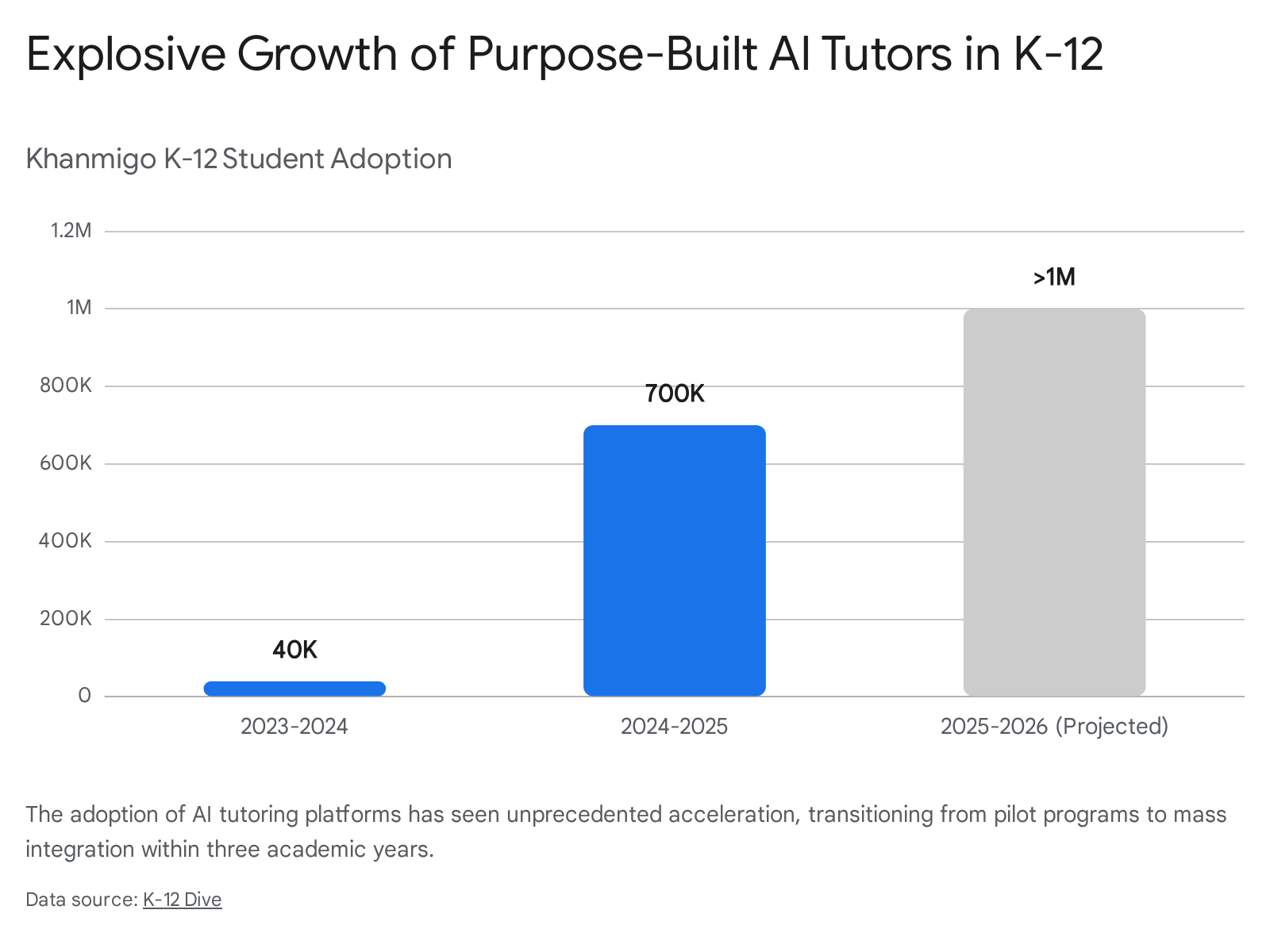
The most prominent institutional example of this shift is Khan Academy's deployment of Khanmigo, an AI tutor built on OpenAI's GPT-4 architecture. Between the 2023-2024 and 2024-2025 school years, Khanmigo's user base in the United States surged from 40,000 to 700,000 students, representing one of the fastest adoptions of educational technology in history, with projections anticipating well over one million users in the subsequent academic cycle 15.
Crucially, purpose-built educational AI tools do not function as search engines or answer generators. Guided by pedagogical frameworks such as the ICAP (Interactive, Constructive, Active, Passive) model of cognitive engagement, these tools are explicitly designed to move students away from passive information reception and toward interactive knowledge construction 28.
When a student asks a Socratic AI tutor for the solution to a complex algebraic equation, the AI is prompted to withhold the final answer. Instead, it responds with probing questions: "What do you think the next step would be?" or "Can you explain the mathematical reasoning behind that choice?" 2942. This interaction forces the student to reflect, reason, and articulate their understanding, replicating the high-impact interventions of an expert human tutor who guides a learner through the zone of proximal development 2829.
Navigating the Risks: Hallucinations and Automation Bias
Despite the immense promise of conversational AI tutoring, the technology carries inherent risks that education systems will spend the next decade attempting to mitigate. Generative AI models predict linguistic patterns based on training data; they do not inherently possess factual comprehension. This results in periodic "hallucinations," wherein the system generates highly articulate but entirely fabricated information 1012. In subjects requiring absolute precision, such as higher mathematics, early iterations of large language models struggled with multi-step calculations. To correct this, educational platforms have had to engineer complex architectures, such as "chain of thought" prompting and autonomous math agents that double-check the LLM's output against a standard calculator before presenting it to the student 27.
Furthermore, psychologists and researchers warn of "automation bias," a phenomenon where users place undue trust in the infallibility of the machine 30. A 2025 study from the Massachusetts Institute of Technology highlighted that students relying heavily on generative AI tools may unintentionally bypass deep cognitive processing, leading to poor long-term retention of written material 15. To counteract this erosion of critical thinking, future educational environments will increasingly emphasize source verification. Students will be taught to cross-reference AI-generated claims with human-verified primary sources, transforming the AI from an unquestionable oracle into a conversational sparring partner that must be continuously fact-checked 31.
Scenario 4: The Micro-Credential Economy Replaces Traditional Degree Pathways
The rapid evolution of the labor market, driven by the integration of AI across all sectors of the economy, is rendering traditional, multi-year curriculum cycles increasingly obsolete. The World Economic Forum notes that digitalization and automation are simultaneously eliminating legacy jobs while creating entirely new categories of technical and strategic roles 45. Consequently, 74% of employers in 2025 reported a clear preference for candidates holding verified, skills-based credentials for AI-related roles over those relying solely on traditional degree structures 46.
In response to this macroeconomic pressure, higher education is undergoing a structural unbundling. The impending demographic cliff - a projected drop in traditional college-aged students - coupled with shifting public perceptions regarding the return on investment of a four-year degree, has forced institutions to cater to non-traditional and working adult students 45. Universities are transitioning from exclusive purveyors of prolonged academic degrees to flexible platforms offering stackable, industry-aligned micro-credentials 4632.
Institutional Pivots to AI Fluency
Higher education institutions are launching scalable micro-credential programs to ensure their entire student populations achieve AI fluency, regardless of their primary major. These programs focus less on advanced computer science and more on applied literacy. * The University of Louisiana System: Led by the University of New Orleans, the system developed a free, 16-hour self-paced "Empowering AI Literacy" micro-credential accessible to its 82,000 students. The curriculum bypasses coding to teach the history of AI, ethical prompting, data privacy, and the societal impacts of automation. Upon completion, students earn a verifiable digital badge to display on professional networking platforms 3334. * The University of Florida: Recognizing the need for continuous adult upskilling, UF deployed an AI micro-credential targeting working professionals. Funded in partnership with NVIDIA, the non-credit courses focus on applied AI within specific industry verticals, such as "AI in Agriculture" and "AI in Business," catering directly to the immediate needs of the regional economy 35. * UMass Lowell & Arizona State University: To drive adoption from the top down, institutions are incentivizing faculty. UMass Lowell deployed mini-grants to faculty members to experiment with AI integration in their syllabi, lowering the barrier to entry. Meanwhile, ASU invited students and staff to propose pilot projects utilizing enterprise ChatGPT licenses, spurring grassroots innovation across the campus 34.
National Scale: India's FutureSkills Initiative
Nowhere is the pivot to micro-credentials more pronounced or urgent than in India. To sustain its rapid economic trajectory and position itself as a global technology powerhouse, India requires an estimated 1.25 million AI professionals by 2027 36.
To meet this monumental demand, the Indian government, via the Ministry of Skill Development and Entrepreneurship, launched the SOAR (Skilling for AI Readiness) program under the broader IndiaAI Mission 3738. Delivered entirely online through the Skill India Digital Hub to ensure geographical accessibility, the program quickly expanded from basic literacy awareness to offering 35 distinct, National Skills Qualifications Framework (NSQF)-aligned micro-credentials 38.
These bite-sized modules - covering topics from "AI for Manufacturing" to "Applied Machine Learning" - are co-designed with industry leaders like Microsoft and NASSCOM, effectively fusing vocational training with enterprise requirements 3854. By deploying these credentials across 570 tier-2 and tier-3 city data labs, India is democratizing access to technical education, establishing a robust pipeline of AI-skilled professionals outside of elite urban university systems and proving that modular education can drive national economic strategy 37.
| Initiative / Institution | Target Audience | Focus Area | Delivery Mechanism |
|---|---|---|---|
| Univ. of Louisiana (UNO) | Undergraduates (System-wide) | General AI Literacy & Ethics | 16-hour online self-paced module yielding a digital badge 3334 |
| Univ. of Florida | Working Professionals | Sector-specific Applied AI | Non-credit hybrid courses (e.g., AI in Agriculture) 35 |
| India SOAR Program | National Population / Vocational | NSQF-aligned Job Skills | 35 micro-credentials via Skill India Digital Hub 38 |
| UMass Lowell | University Faculty | Pedagogical Integration | Micro-grants for faculty to experiment with AI in syllabi 34 |
Table 2: A comparative overview of institutional and national shifts toward AI micro-credentialing 33343538.
Scenario 5: The Global South Leapfrogs Legacy Education Infrastructure
Historically, emerging economies across the Global South have faced immense logistical and financial barriers in building the physical and institutional infrastructure required for 20th-century education models. However, the dynamics of "disruptive innovation" operate differently in these regions, where high barriers to entry can occasionally be bypassed entirely 39.
Just as East Africa revolutionized regional finance by leapfrogging the need for physical landline banking infrastructure to build world-leading mobile money networks, the Global South is currently positioned to leapfrog outdated legacy educational systems using artificial intelligence 3940. The demographic imperative is severe: the Global South houses 85% of the world's population, with over 55% of its citizens under the age of 25 . High smartphone adoption rates in countries like India, Brazil, and Kenya provide the exact distribution network necessary to deploy mobile-first AI educational tools directly to millions of underserved learners 3958.
Localized AI versus Western Chatbots
A significant danger in global AI deployment is the underlying assumption that Western, English-dominant chatbots can simply be exported to emerging economies to solve educational deficits. AI models trained predominantly on Western datasets risk imposing foreign cultural biases, failing to support indigenous languages, and ignoring the specific infrastructural realities of rural classrooms 125841.
To counter this, universities, policymakers, and tech ecosystems across the Global South are prioritizing a "Local First" approach to AI development 3941. In South Africa, initiatives like Maski provide an AI teacher assistant deployed entirely via the WhatsApp messaging platform 58. This approach recognizes that while rural schools may lack reliable broadband or laptop computers, almost all educators possess smartphones. By utilizing a lightweight, ubiquitous interface, the tool is perfectly suited for regions with resource constraints 58. Similarly, in Brazil, the "AIED Unplugged" program reaches hundreds of thousands of students using advanced AI tools tailored to smartphones, empowering teachers in remote Amazonian villages to evaluate student writing efficiently without requiring expensive desktop hardware 39.
The African Union Continental AI Strategy
Recognizing artificial intelligence as a strategic sovereign asset, the African Union Executive Council officially endorsed the Continental AI Strategy in July 2024 4243. The strategy explicitly rejects the passive consumption of imported AI products that could lead to a new form of digital colonization 44.
Instead, the framework mandates the creation of localized, high-quality datasets, the preservation of African languages within natural language processing models, and the development of a distinctly Africa-centric AI ecosystem 4143. By integrating AI purposefully into critical sectors like agriculture, health, and education, the African Union aims to utilize the technology for socio-economic transformation and cultural renaissance, ensuring that AI serves as a tool for continental equity and integration rather than widening the existing global digital divide 4143.
Governance, Literacy, and the Parental Ecosystem
As AI embeds itself irreversibly into the classroom, the defining challenge of the next decade will be establishing ethical governance and ensuring digital equity. Currently, a severe digital divide exists based on socioeconomic status. Research tracking usage between 2024 and 2025 revealed that teenagers from high-income families are significantly more likely to be exposed to and utilize AI for educational purposes than their lower-income peers, a gap that doubled within a single year 45. If left unaddressed, this disparity will create a highly polarized workforce, where affluent students arrive at the labor market equipped with advanced AI fluency, while marginalized students are left technologically illiterate 45.
The Global Literacy Frameworks
To standardize AI education and prevent ad-hoc, fragmented policy rollouts, major international bodies have released comprehensive competency frameworks. The OECD and the European Commission jointly developed the "Empowering Learners for the Age of AI" framework, which outlines 22 specific competencies structured around engaging, creating, managing, and designing with AI 10. Notably, this framework will form the foundation for the upcoming PISA 2029 Media & AI Literacy assessment, effectively making AI fluency a globally tracked, standardized metric of national educational health 10.
Similarly, the UNESCO AI Competency Framework for Students, published in late 2024, mandates 12 competencies organized across a progression of Understanding, Applying, and Creating 464748. UNESCO's guidance explicitly warns against the dangers of "hyper-personalization" - the risk that an overreliance on 1:1 AI tutoring could reduce learning to an isolated, antisocial experience 6768. The framework insists that AI must be integrated in a way that strengthens education as a fundamentally social, human-centered process, heavily emphasizing ethical awareness and sustainable system design 686949.
| Framework Aspect | UNESCO AI Competency Framework for Students (2024) | OECD/EC AI Literacy Framework (Draft/2025) |
|---|---|---|
| Core Structure | 12 Competencies across 3 progression levels (Understand, Apply, Create) | 22 Competencies across 4 domains (Engage, Create, Manage, Design) |
| Key Dimensions | Human-centered mindset, AI Ethics, AI Applications, AI System Design | Technical concepts, critical thinking, ethics, human-centered perspectives |
| Global Application | Baseline curriculum guidance for global policymakers to ensure equitable access | Foundation for the PISA 2029 Media & AI Literacy international assessment |
| Philosophical Focus | Preventing hyper-personalization; maintaining human agency and social learning | Preparing students for workforce transitions and establishing assessment benchmarks |
Table 3: Comparison of major international AI literacy frameworks driving future curriculum reform 10464748.
The Home-School Disconnect
Despite the rapid development of these high-level frameworks by policy experts, a massive communication gap remains at the community level. In early 2026, surveys indicated that while 80% of parents expressed a strong desire for clear guardrails regarding AI use in schools, 81% remained unsure if AI was even part of their child's curriculum 5051. An overwhelming 96% of elementary school parents reported that their district had not communicated any clear AI policy to them 45.
In the absence of institutional guidance, students are forging their own paths, frequently utilizing AI for homework, creative writing, and increasingly for emotional support. This has led to concerns regarding children forming parasocial relationships with AI chatbots integrated into social media platforms like Snapchat, where the AI is positioned as a companion rather than an educational utility 673.
Educational experts advocate that the solution is not prohibition, but rather a "co-learning" approach in the home. Parents are encouraged to sit with their children to write prompts, test outputs, and critically evaluate the machine's inevitable errors, thereby demystifying the technology 673. By aligning home habits with evolving school policies, adults can establish a foundational rule for the next generation of learners: if you cannot verbally explain a concept without looking at the screen, the tool did the work, and genuine learning did not occur 2452.
Bottom line
The integration of artificial intelligence in education over the next decade will fundamentally dismantle industrial-era models of seat-time and unsupervised testing, replacing them with in-class competency validation and continuous, skills-based micro-credentialing. While AI offers unprecedented capabilities to reduce educator burnout and provide scalable Socratic tutoring, its success depends entirely on vigilant human oversight to prevent cognitive offloading, algorithmic bias, and digital inequity. Ultimately, the most successful education systems will be those that treat AI not as a replacement for human thought, but as a cognitive catalyst that forces students to think more deeply, verify claims rigorously, and cultivate the interpersonal skills that machines cannot replicate.