
Will Skills Replace the College Diploma
Over the next decade, the labor market will undergo a profound bifurcation: elite university degrees will retain their premium value for networking and wealth generation, while the broader economy shifts toward a hybrid model of verifiable micro-credentials and continuous upskilling. Despite overwhelming corporate rhetoric championing "skills-based hiring," actual hiring practices have barely changed due to rigid algorithmic resume filters and deeply ingrained cultural habits. Ultimately, emerging technologies like artificial intelligence and blockchain skills passports will be required to break the current reliance on traditional academic credentials.
The Clashing Realities of the Modern Labor Market
For generations, the standard narrative across the developed world dictated that a four-year university degree was the primary - if not the only - reliable engine for upward economic mobility. This belief constructed what labor economists now call the "paper ceiling," an invisible barrier locking out workers skilled through alternative routes.
Today, this paradigm is under intense pressure. The rapid evolution of artificial intelligence, soaring university tuition costs, and a global talent shortage have forced employers to reconsider what makes a candidate valuable. Yet, the transition away from degrees is proving incredibly difficult. While the media frequently highlights the "death of college," the reality of the labor market is far more nuanced. We are not witnessing the end of the degree, but rather a polarization of its value.
In an age of AI disruption and economic volatility, attending a top-tier, elite university remains one of the most significant educational advantages a student can secure. Data from labor economists reveals that students graduating from elite institutions earn a lifetime return on investment of up to $1.4 million more than their peers from non-selective universities 1. While Ivy League alumni make up less than 1% of U.S. college graduates, they constitute over 20% of the nation's top 1% of earners 1. Elite universities offer compounding advantages - tighter alumni networks, faster access to venture capital, and higher job placement rates at top-tier firms like Google and Goldman Sachs - that protect graduates from the automated displacements threatening middle-tier white-collar work 1.
However, for the vast majority of students attending non-selective or regional universities, the return on investment is becoming increasingly questionable. The modern economy is demanding agility, practical competencies, and the ability to orchestrate AI - skills that traditional, slow-moving academic curricula struggle to provide 2. This divide is forcing governments, corporations, and job seekers worldwide to explore entirely new scenarios for the future of education credentials.
The Zenith of Academic Credentialism
To understand the push for skills-based hiring, one must first examine the extremes of the system it is trying to replace. Nowhere is the crisis of credentialism more acute - and the social backlash more severe - than in East Asia.
Hyper-Credentialism in South Korea and China
The roots of academic credentialism in East Asia can be traced back to historical Confucian values, which placed a massive societal emphasis on education as the sole path to bureaucratic power and social prestige 24. As nations like South Korea and China transitioned rapidly from underdeveloped agrarian societies to technology-driven global powers over the past seven decades, this cultural reverence for education morphed into a hyper-competitive race for university admission 23.
By 2025, South Korea's college enrollment rate reached an astonishing 76.3% of the school-age population, while 69.7% of young adults (aged 25 - 34) held a college degree - the highest percentage among all Organisation for Economic Co-operation and Development (OECD) countries 36. This intense focus has fostered a highly stratified society where elite university alumni effectively monopolize top-tier jobs 4. The pressure begins alarmingly early; South Korea is currently witnessing a phenomenon colloquially termed Chilse Gosi, translating to the "7-year-old high-stakes exam," where young children face fierce competition just to enter prestigious private English-language academies 3.
The psychological and economic tolls of this system are profound. Research indicates that the overwhelming pressure to secure elite credentials raises the risk of severe depression among students by approximately 20% 2. Furthermore, because millions of young adults are pushed into academic pathways regardless of their actual career interests, graduation often leads to profound disillusionment and underemployment 2. In China, millions of highly educated graduates are struggling to find work that matches their qualifications in a deeply crowded labor market, a phenomenon exacerbated by "first-degree discrimination," where employers rigidly filter out candidates who did not attend elite undergraduate institutions 85.
Recognizing that this system is unsustainable, regional governments are attempting to intervene. In early 2026, the head of South Korea's National Education Commission, Cha Jung-in, publicly stated that "academic credentialism and the competitive system attached to the university hierarchy turns everyone into losers" 4. The South Korean government has proposed revisions to the fair hiring procedure act to strictly prohibit the inclusion of applicants' educational backgrounds in job-related documents, aiming to evaluate candidates purely on present job-related competencies rather than past academic prestige 4. However, unwinding decades of cultural conditioning remains a monumental task.
The Vocational Counter-Model: The DACH System
In stark contrast to the academic credentialism dominating East Asia and the United States, the "DACH" region - comprising Germany, Austria, and Switzerland - has long championed a highly successful alternative: the "Dual System" of vocational education and training (VET) 67.
In Austria, approximately 70% of all students choose vocational education and training at the end of their compulsory schooling 12. The dual system operates exactly as the name implies: students spend roughly 80% of their time working as paid apprentices in real companies to acquire hands-on, practical skills, while spending the remaining 20% in vocational schools to gain theoretical knowledge 12.
Crucially, this system does not carry the social stigma often associated with vocational training in other parts of the world. In Austria, achieving "Master" (Meister) status in a trade is officially equated to a Bachelor's degree under modern qualifications frameworks 12. Graduates face no dead-ends; they can take specialized exams to transition smoothly into Universities of Applied Sciences if they choose to pursue higher academic learning later in life 12. This model is widely credited with giving Austria, Germany, and Switzerland some of the lowest youth unemployment rates in the developed world, alongside highly competitive, innovation-driven economies 612.
Many nations attempting to combat credential inflation look to the DACH model as a blueprint. However, international labor experts caution that exporting the dual system is incredibly difficult. The model's success is not just educational; it relies on deep, historic, and financial partnerships between the government and the private business sector 8. In Switzerland, for instance, the entire system is designed primarily to meet the exact needs of industry, and local employers invest heavily in training youth because they trust the standardized outcomes 6. Without this pre-existing cultural and economic infrastructure, simply copying the curriculum yields disappointing results 8.
The "Skills-Based Hiring" Revolution and Its Stagnation
Recognizing the failures of pure credentialism and the difficulty of importing European vocational models, the corporate world initiated its own movement. Between 2022 and 2025, "skills-based hiring" - the practice of evaluating candidates based on practical abilities and competencies rather than solely on traditional markers like academic degrees - became the dominant recruitment trend globally 14.
The business case for this shift is robust. According to global talent analyses, companies that successfully implement skills-based hiring experience transformative outcomes. Firms report a 91% increase in employee retention, a 78% reduction in cost-to-hire, and significantly improved workplace diversity 1516. Data from McKinsey reveals that hiring for proven skills is five times more predictive of on-the-job performance than hiring based on educational background alone, and 2.5 times more predictive than relying merely on past job titles 1617. Furthermore, workers who are "Skilled Through Alternative Routes" (STARs) - meaning they lack a four-year degree - tend to stay with their employers 34% longer than their degree-holding peers 1618.
By 2025, an overwhelming 85% of global employers claimed they were using some form of skills-based hiring, up from 56% just three years prior 19. Major corporate giants, including Google, Apple, IBM, Accenture, and Walmart, publicly announced the elimination of degree requirements for vast swaths of their open positions 9211023.
The Public Sector Push
The public sector also aggressively embraced this philosophy to combat critical staffing shortages. Over half of all U.S. state governments adopted policies encouraging skills-based hiring 11. * Maryland: In 2022, Maryland became the first state to drop bachelor's degree requirements from the majority of public sector job descriptions. Within two years, the share of state government job postings not requiring a degree increased from 32% to 47%, and former Governor Larry Hogan reported a 41% increase in overall hires in the initiative's first year 111213. * Pennsylvania: The state removed four-year degree requirements from roughly 92% of positions in the state government, opening up approximately 65,000 jobs to a broader talent pool. Consequently, almost 60% of their new hires were individuals without a college degree 1112. * Colorado: Following a 2022 executive order prioritizing skills over degrees, Colorado modernized its state-sponsored labor exchange to analyze applicants based on skills extracted from resumes rather than traditional credentials 1112.
The "Say-Do" Gap and the Hiring Backslide
Despite the enthusiastic public announcements and localized public sector victories, comprehensive economic data reveals a startling disconnect between corporate rhetoric and actual hiring reality. This phenomenon has been dubbed the "Say-Do Gap."
A landmark 2024 study conducted by Harvard Business School and The Burning Glass Institute tracked the hiring practices of 11,300 large firms over nearly a decade. The researchers found that while nearly 40% of firms technically removed degree requirements from their job postings, the actual change in hiring behavior was negligible 27. The shift to skills-based hiring produced an incremental change of just 0.14% in the hiring of candidates without degrees. In practical terms, out of millions of job transitions, less than 1 in 700 actual hires resulted from these highly publicized policy changes 16272814.
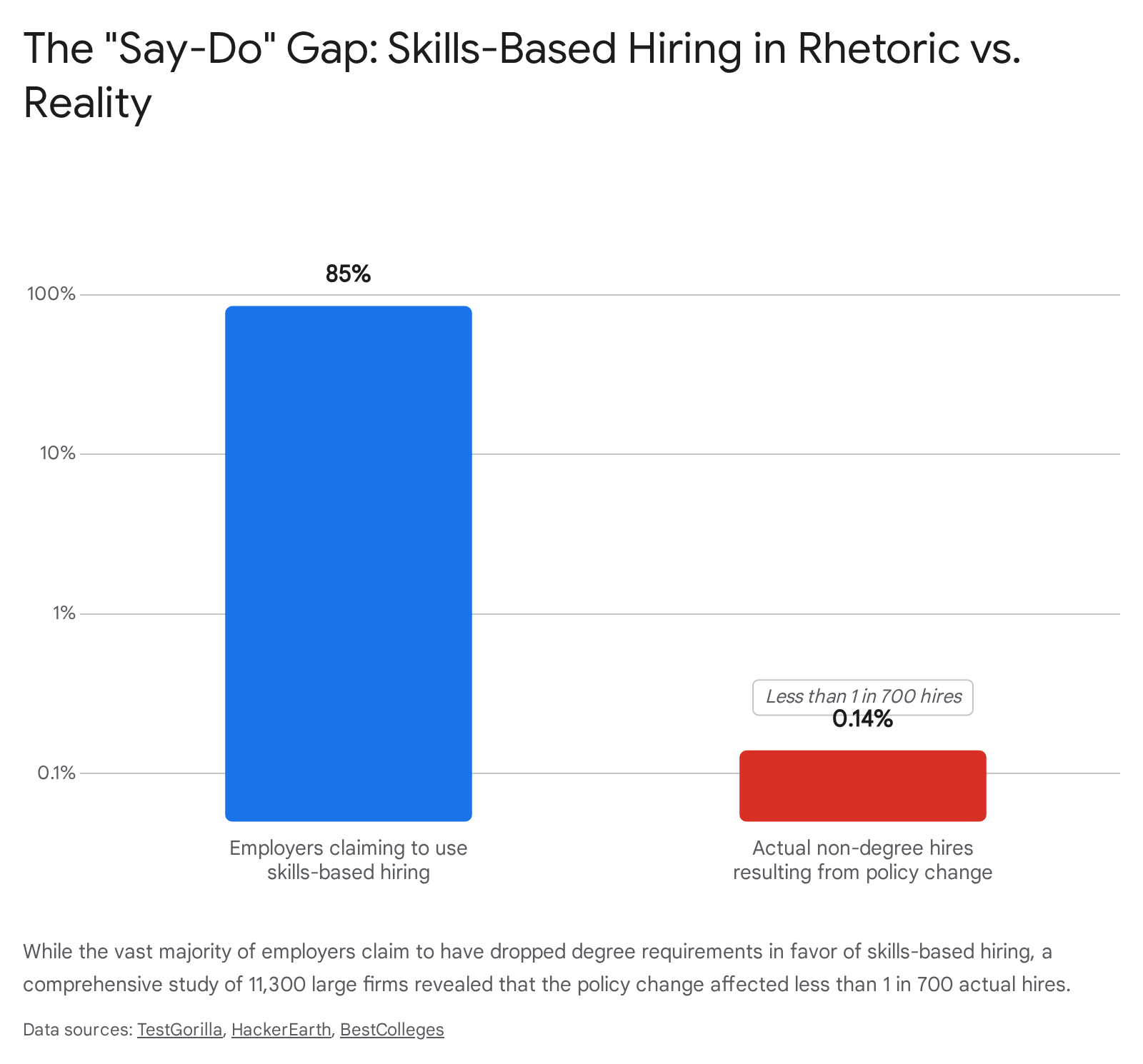
Even more concerning is that as the post-pandemic labor market cooled in late 2024 and 2025, a noticeable "backslide" occurred. Employers who had previously removed degree requirements began quietly re-inserting them into job descriptions 1228. According to Cengage Group, 71% of employers required degrees for entry-level roles in 2025, up from 55% the previous year, while the share of employers officially dropping degree requirements plummeted from 48% to 22% 28.
The voluntary approach to skills-based hiring - simply removing the requirement from a job description and hoping hiring managers change their behavior - has largely failed 28.
The Algorithmic Wall: Why Applicant Tracking Systems Fail Skills
If corporate executives genuinely desire to hire for skills, why is the success rate a mere 0.14%? The answer lies not in human intent, but in mechanical failure. The transition to skills-based hiring is fundamentally incompatible with the existing digital infrastructure of modern recruitment.
Nearly every corporate job application today passes through an Applicant Tracking System (ATS), such as Workday, iCIMS, or Greenhouse 3031. These software platforms are designed to collect thousands of applications, parse the resumes into structured data, and then mathematically score and filter candidates based on criteria established by the recruiter 3115.
When a candidate submits a resume, the ATS algorithm executes several rigid steps: 1. Parsing: The system extracts text to map job titles, company names, dates, skills, and educational background into specific database fields 3115. 2. Scoring: Algorithms compare the extracted content against the job description. In platforms like Workday, the proprietary scoring algorithm heavily weights exact keyword matches, previous job titles, tenure, and, crucially, educational degrees 30. 3. Hard Filters: Many systems apply automatic disqualification triggers. If a candidate does not meet a specific educational threshold or lacks the exact keyword phrasing demanded by the algorithm, their relevance score tanks 3031.
The consequence is a digital graveyard for skilled but unconventional candidates. A self-taught programmer might possess world-class Python skills, but if their resume features a creative layout, two-column formatting, or embedded graphics, the ATS parser often fails to read the document entirely, scrambling the data and resulting in an automatic rejection 31. Furthermore, if a job listing asks for "stakeholder management" and the candidate writes "client relationship coordination," basic ATS systems fail to connect the synonyms 31.
Because skills are inherently difficult to quantify and machine-read compared to the binary presence of a university degree, the algorithms inevitably default to filtering out non-degreed candidates. The 85% of companies claiming to practice skills-based hiring are largely doing so "in name only," updating the public job description but failing to update the underlying ATS algorithms and assessment tools used by actual hiring managers 281617.
The Rise of Micro-Credentials and Alternative Pathways
To bypass the ATS algorithmic wall and provide hiring managers with verifiable proof of competency, a new educational economy has emerged: the micro-credential. Rather than dismantling the concept of credentials entirely, the technology sector is attempting to replace the slow, expensive four-year degree with rapid, targeted, industry-recognized certificates.
Leading this charge are technology behemoths like Google and IBM, which have established massive, globally accessible training ecosystems.
Comparing Educational Pathways for the Modern Workforce
| Feature | Traditional 4-Year Degree | Google Career Certificates | IBM SkillsBuild |
|---|---|---|---|
| Financial Cost | Tens of thousands of dollars | $49/month via Coursera (approx. $300 total) 35 | Available at no cost to adult learners 1819 |
| Time to Completion | 4 Years | 3 to 6 months (part-time) 35 | Varies widely (10 to 90 hours per specific track) 1819 |
| Curriculum Focus | Academic, holistic, historically stable | Self-paced, targeted at entry-level IT and Data roles 38 | Modular, heavy emphasis on emerging AI and Cloud skills 19 |
| Labor Market Signal | General prestige, cultural fit, strong ATS filtering success | Demonstrates direct technical competency; backed by a 150+ employer consortium 35 | Specialized upskilling for enterprise tech; validates specific software proficiencies 20 |
Google Career Certificates have enrolled millions of learners by offering targeted tracks in fields such as IT Support, Data Analytics, Cybersecurity, and UX Design 3540. The appeal is obvious: for $49 a month, a learner can complete a program in under six months with no prior experience required 3540. Crucially, Google established an employer consortium of over 150 companies - including Deloitte, Walmart, and T-Mobile - that explicitly recognize these certificates during the hiring process, giving them the vital "hiring signal" that independent bootcamps often lack 35.
However, market analysts caution that not all micro-credentials are created equal. While tracks like Cybersecurity and Advanced Data Analytics offer a clear return on investment (with median post-certificate salaries ranging from $62,000 to $92,000), other tracks, such as generalized Digital Marketing, face severe market saturation and struggle to compete against traditional degrees 35.
IBM, meanwhile, has focused heavily on the looming artificial intelligence revolution. Through its SkillsBuild platform, IBM is committed to training 2 million learners globally in AI by 2026 20. Their credentials focus on immediate, practical proficiencies: prompt engineering, machine learning basics, AI ethics, and quantum computing concepts 1920. The goal is to provide a "skills passport" that proves a worker can integrate new technologies into existing business workflows, a capability that 47% of executives currently say their workforces lack 20.
Artificial Intelligence and the Disruption of Cognitive Labor
While the debate between degrees and micro-credentials dominates current hiring logistics, artificial intelligence is poised to fundamentally rewrite the value of human skills altogether.
By 2030, the global economy will look vastly different. According to projections by the World Economic Forum, automation could displace up to 800 million jobs globally, while simultaneously creating entirely new categories of work in the green economy and AI management 41.
Historically, higher education adapted to technological shifts by teaching students specific, advanced technical skills. However, the generative AI revolution is different. Jad Tarifi, a pioneer in Google's GenAI team, argues that traditional degrees are currently optimizing for obsolescence 2. AI systems are rapidly mastering the exact cognitive skills that previously justified expensive degrees 2. * Legal Research: AI can analyze case law, identify precedents, and draft contracts faster and more comprehensively than junior lawyers straight out of law school 2. * Medical Diagnosis: AI diagnostic tools are increasingly outperforming doctors in radiological pattern recognition and symptom analysis 2. * Technical Expertise: Routine software engineering, complex data analysis, and academic literature reviews are becoming automated processes 2.
The uncomfortable truth for higher education is that the value proposition of a traditional, specialized curriculum is collapsing faster than institutions can adapt 2. If a machine can pass a bar exam or write production-level code, the pure retention of technical knowledge is no longer a viable career moat.
The Future-Proof Curriculum: The Hybrid Thinker
If rote technical skills are being automated, what will employers actually hire for in 2030? The consensus among labor economists and technology pioneers is that the future belongs not to specialized technicians, but to "hybrid thinkers" who possess strong emotional intelligence, ethical judgment, and complex problem-solving abilities 241.
The most future-proof graduates will be those who blend distinct disciplines to orchestrate AI, rather than compete against it. Exciting future roles will emerge at the intersections of domains 41: * AI + Law: Experts who navigate the complex frontiers of tech regulation, digital copyright, and algorithmic ethics. * Psychology + Data Science: Behavioral data scientists who look beyond the math to understand consumer motivations, mental health trends, and user-centric product design. * Sustainability + Business: Green entrepreneurs capable of balancing profitability with the demands of a zero-carbon economy, a sector projected to create 24 million jobs worldwide by 2030 41.
Instead of accumulating credentials that AI can easily replicate, successful professionals will treat continuous, lifelong learning as the new normal, utilizing platforms like IBM SkillsBuild to constantly update their toolkit while relying on their uniquely human traits to drive value 220.
Blockchain and the Trustless Skills Passport
Even if individuals successfully acquire the right mix of micro-credentials, human soft skills, and AI orchestration abilities, the mechanical problem of the ATS algorithm remains. How does a worker seamlessly prove their diverse, non-traditional skill set to an employer?
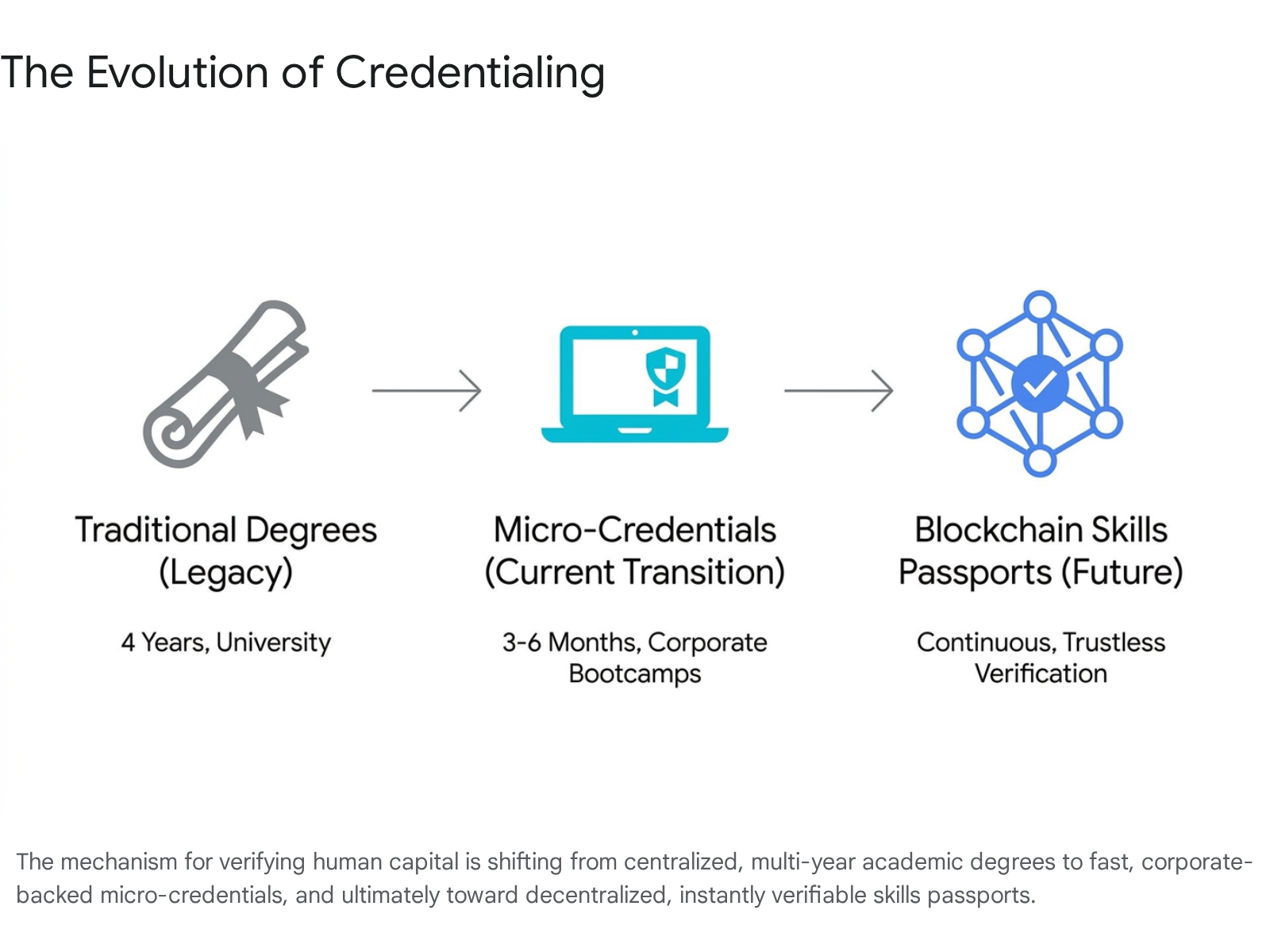
The technological fix on the horizon is the integration of blockchain technology to create verifiable, decentralized "Skills Passports" 4243.
Currently, credential verification is a massive, expensive operational bottleneck. In the healthcare sector, for instance, the average provider credentialing process takes between 60 to 120 days 44. Administrators must manually process paperwork, call primary sources (like universities and medical boards), and wait for committee reviews 44. This siloed, redundant system costs the healthcare industry billions of dollars annually and dangerously delays patient care 44. Across all industries, organizations are projected to spend $2.8 billion by 2028 simply verifying traditional credentials 45.
Blockchain technology offers a radically different, "trustless" approach. In this context, "trustless" does not mean unreliable; it means that trust is mathematically embedded into the system's cryptography, removing the need for a centralized authority or human intermediary 43.
When a student completes a university degree, passes an independent coding bootcamp, or earns a Google Career Certificate, the issuing institution can record that achievement as an immutable, tamper-proof digital credential on a blockchain 4346. The individual then owns their data in a digital wallet. When applying for a job, they can instantly share their granular, verified skills with an employer. The employer's software can authenticate the data in seconds, completely bypassing the need to chase down academic transcripts or rely on flawed ATS keyword matching 4344.
As interoperability frameworks (like Hyperledger and Polkadot) mature, this concept could evolve into a universally recognized global skills passport 4243. Workers will no longer be tied to outdated job titles or the prestige of a single university. Instead, their career mobility will be driven by a continuously updated ledger of lifelong learning, seamlessly integrating academic education, corporate training, and real-world project experience 43.
Bottom line
The narrative that the four-year college degree is entirely obsolete is premature; elite institutions will continue to offer unparalleled lifetime economic premiums and networking advantages. However, for the broader labor market, the sheer inefficiency of traditional credentialing has triggered a permanent structural shift. While corporate attempts at "skills-based hiring" are currently failing to scale due to rigid algorithmic resume filters and ingrained biases, the rise of corporate micro-credentials, AI-driven automation, and blockchain verification tools are actively dismantling the university monopoly. Moving into the 2030s, career security will not stem from a static piece of paper, but from a worker's ability to seamlessly verify their continuous learning and uniquely human capacity to orchestrate artificial intelligence.